What's inside
- Key Takeaways
- Quick Picks
- How Did We Organise a Range That Mixes Headsets and Headphones?
- What Makes the M-Series a Studio Fixture Rather Than a Fashion?
- When Does a True Headset Beat a Monitor Plus a Separate Microphone?
- How Does Each Member of the Family Earn Its Place?
- How Do the Six Family Members Compare at a Glance?
- How Do You Set Up the StreamSet or BPHS1 for a Clean Voice?
- What Mistakes Do Buyers Make With This Maker’s Range?
- Final Recommendation
- Why Does This Family Stay Closed-Back While Others Went Open?
- How Do Cables and Pads Decide the Real Cost of Ownership?
- What Should a Small Studio or a Streaming Room Buy First?
- How Does the StreamSet Fit a Real Streaming Week?
- How Should You Test a Monitor From This Family Before Committing?
- How Do You Care for These Headphones Across Years of Sessions?
- Which Buyer Should Look at the Rival House Instead?
- What Does the Second Pair in a Room Usually Turn Out to Be?
- How Do You Choose Between the Two True Headsets Without Guessing?
- What Should You Listen for When a Whole Family Shares One Design Language?
- Frequently Asked Questions
- Related Guides
As an Amazon Associate I earn from qualifying purchases. This post may contain affiliate links at no extra cost to you.
[widgetverdict.com] is reader-supported. When you buy through links on our site, we may earn an affiliate commission.
Where to buy: Each of the six picks below links to its verified Amazon listing at the product name. Looking for the best audio technica headsets means first understanding what this maker’s range actually is, because Audio-Technica sells two different products under one famous letter. The M-series — M20x, M30x, M40x, M50x — are studio monitor headphones: no microphone, no boom, just closed-back listening tools that recording studios adopted so completely that the M50x silhouette is practically the uniform of the modern session musician. The true headsets in the family are the broadcast and streaming models, the BPHS1 with its dynamic boom microphone and the M50xSTS-USB StreamSet with a cardioid condenser mic and a proper USB converter. This guide covers both halves honestly, labels which is which in every section, and helps you choose by what your voice needs to do, not by which letter is biggest.
Key Takeaways
- Only two of the six picks are true headsets with microphones: the ATH-M50xSTS-USB StreamSet for streaming and the BPHS1 for broadcast work.
- The ATH-M50x is the studio monitor benchmark — critically acclaimed, detachable cables, and the default recommendation when listening is the whole job.
- The ATH-M40x is the flatter, more neutral sibling, with 90-degree swivelling earcups and detachable cables for listeners who find the M50x too eager.
- The ATH-M20x and ATH-M30x form the honest entry ramp: fixed or simpler cabling, tracking-and-mixing intent, and prices that suit first studios and spare pairs.
- All four M-series models are closed-back, which isolates the wearer and keeps sound from leaking into live microphones — the reason studios chose them.
- If your day includes your own voice — streaming, podcasting, commentary, calls — start at the two headset picks and treat the monitors as listening-only tools.
Quick Picks
| Pick | Badge | Why it made the list |
|---|---|---|
| Audio-Technica ATH-M50xSTS-USB StreamSet Streaming Headset | Best true headset for streamers | The M50x platform plus a cardioid condenser microphone, 24-bit/96 kHz USB conversion, and sidetone. |
| Audio-Technica BPHS1 Broadcast Stereo Headset | Best for broadcast | A dynamic cardioid boom microphone on a closed-back broadcast headset built for commentary and production. |
| Audio-Technica ATH-M50X Professional Studio Monitor Headphones | Best monitor overall | The critically acclaimed studio standard with detachable cables and a sound generations of engineers trust. |
| Audio-Technica ATH-M40x Professional Studio Monitor Headphone | Best neutral monitor | Flatter tuning, 90-degree swivelling cups, and detachable cables for critical listeners on a budget. |
| Audio-Technica ATH-M20x Professional Studio Monitor Headphones | Best entry monitor | 96 dB sensitivity and a 15–20 kHz response in the most affordable seat in the M-series, adapter included. |
| Audio-Technica ATH-M30x Professional Studio Monitor Headphones | Best portable monitor | Closed-back tracking and field-recording intent with a screw-on adapter and carrying pouch in the box. |
How Did We Organise a Range That Mixes Headsets and Headphones?
We organised it by voice. The first question in this family is never which model sounds best; it is whether a microphone must hang from the product itself. If yes, your shortlist is exactly two deep — the StreamSet and the BPHS1 — and the interesting work is choosing between a USB streaming design and an analogue broadcast design. If no, your shortlist is the four monitors, and the work is choosing a tuning and a feature set along a ladder Audio-Technica has kept remarkably legible for a decade. Every section that follows honours that organisation, so a reader in a hurry can read only their half of the family and still leave with a complete answer.
We kept all six in one guide because buyers constantly cross-shop the halves, seduced by the M50x’s fame when their actual job needs a boom. Presenting the split plainly, in the introduction and in every pick’s spec box, is this guide’s main service. The comparison culture around this maker extends further, too: the German rival whose studio line competes model-for-model with the M-series is mapped in our guide to best beyerdynamic headsets, and readers torn between the two houses should read both before spending.
Finally, we weighted the unglamorous ownership facts this maker is known for: detachable cables on the upper monitors, a deep ecosystem of replacement pads, and designs that have stayed in production long enough for parts and knowledge to accumulate. In a working studio, those facts outrank a season’s tuning fashion.
What Makes the M-Series a Studio Fixture Rather Than a Fashion?
Closed-back isolation, first of all. A singer tracking a vocal cannot wear a headphone that leaks the backing track into the microphone, and an engineer checking a take in a room with the artist cannot wear one that leaks the studio into their judgement. The M-series seals, and that seal — not any single tuning decision — is why the silhouette appears in session photographs across every genre. The same seal serves podcasters recording in untreated rooms and commuters who simply want the world turned down. It also serves the mix engineer working at midnight in a flat with thin walls, whose neighbours become involuntary stakeholders in every open-back alternative.
Durability is the second pillar. These are tools bought by institutions as well as individuals, folded, dropped, cabled and re-cabled, and the upper models’ detachable cables acknowledge the statistical truth that cables die before drivers do. The third pillar is tuning legibility: the line steps from the eager, bass-forward M50x through the flatter M40x down to the honest entry models, so a buyer can choose a position on the excitement-versus-accuracy axis without leaving the family.
None of this makes the M-series the only studio answer — the beyerdynamic rivalry is real — but it explains why a guide to this maker reads less like a product launch and more like a tour of installed infrastructure.
When Does a True Headset Beat a Monitor Plus a Separate Microphone?
When your voice must move with your head. A boom microphone holds a fixed distance from your mouth through every turn, laugh, and lean, and that consistency is what broadcast commentary, live streaming, and long calls actually require. A desk microphone sounds wonderful until you turn to a second monitor; a boom does not care. The StreamSet and the BPHS1 exist for people whose head movement is part of the performance. Commentators gesturing at a replay, streamers reacting to a game, teachers demonstrating at a whiteboard — all of them are moving targets that a fixed microphone photographs badly and a boom follows faithfully.
The integrated route also simplifies the chain. The StreamSet’s USB connection carries a 24-bit/96 kHz converter and sidetone circuitry — sidetone being the feed of your own voice into your ears that keeps you from shouting into a sealed headset — so a streamer plugs in one cable and is working. The BPHS1 speaks the older broadcast language of analogue connectors, expecting the mixers and interfaces that production environments already own.
Choose the separate-microphone route instead when listening quality dominates and voice is occasional, or when you already own a good microphone and need only ears. The monitors below will happily serve that life. The error is buying a monitor for a boom’s job and discovering the gap live, on air, in front of an audience.
How Does Each Member of the Family Earn Its Place?

Audio-Technica ATH-M50xSTS-USB StreamSet Streaming Headset — Best true headset for streamers
The StreamSet takes the most famous silhouette in this guide and gives it a voice. Its listing title lays out the engineering: a cardioid condenser microphone, a 24-bit/96 kHz converter, and sidetone circuitry, aimed at podcasting and gaming. Each element answers a known streaming pain. The cardioid condenser captures a rich, present voice while favouring the mouth over the room; the USB converter removes the interface from a beginner’s shopping list and the quality lottery from their first year; and sidetone solves the sealed-headset shout, letting you hear yourself at a natural level so your delivery stays conversational.
The foundation matters as much as the additions. Underneath the microphone sits the M50x platform — the closed-back isolation that keeps game audio and monitor mixes out of the microphone, the tuning that streamers’ audiences have unknowingly heard for years, and a build that tolerates being worn for the absurd durations live content demands. A streamer is a broadcaster with a bedroom’s budget and a network’s schedule, and this product is one of the few designed with that exact person in the room.
Its boundaries are clear. USB ties it to computers and compatible devices rather than to analogue broadcast chains, where the BPHS1 below remains the native. Listeners who never speak should buy the plain M50x and save the difference. But for the voice-first buyer, this is the most complete single purchase in the entire guide — the headset the category title promises, delivered by the monitor the category is famous for.
- Microphone: Cardioid condenser microphone, per the listing title
- Converter: 24-bit/96 kHz, per the listing title
- Monitoring: Sidetone circuitry, per the listing title
- Stated uses: Podcasting and gaming, per the listing title
- Connection: USB, per the product name in the listing title
Strengths
- A genuine broadcast-quality voice path in a single USB plug.
- Sidetone keeps long streaming sessions naturally voiced.
- Built on the proven M50x closed-back platform.
Trade-offs
- USB focus limits analogue broadcast-chain use.
- Listeners who never use a microphone pay for one anyway.
- One more electronic chain to manage than a passive monitor.
Best for: Streamers, podcasters, and gaming creators who want one headset that hears and speaks professionally.
Not suited for: Pure listeners, who should take the M50x and spend the saving on music.

Audio-Technica BPHS1 Broadcast Stereo Headset — Best for broadcast
The BPHS1 is the professional’s plain answer. Its listing title says broadcast stereo headset with a dynamic cardioid boom mic, and every word is a design decision. Dynamic, because a dynamic microphone shrugs off loud voices, rough handling, and electrically noisy environments that trouble condensers. Cardioid, because a commentary position at a sports desk or a production table is surrounded by noise that must be rejected. Boom, because the microphone must follow the commentator’s head through every glance at a monitor, a stat sheet, and the field.
The headset half is built to the same brief: closed-back isolation so the wearer hears the production feed rather than the venue, and construction that assumes the product will be packed, shipped, and worn by strangers at events for years. This is not a product that courts the home listener, and its honesty about that is refreshing — it is the tool you see on the heads of people whose voices are being broadcast, chosen by engineers who maintain fleets of them.
Home users should understand the connection culture before buying: the BPHS1 belongs to the analogue world of mixers and interfaces, and it expects that company. Podcasters building a small studio around an interface will find it entirely at home; streamers wanting a single USB plug should look one pick up. Judged in its own world, it has no substitute in this guide.
- Microphone: Dynamic cardioid boom mic, per the listing title
- Class: Broadcast stereo headset, per the listing title
- Fit role: Closed-back isolation for production environments
- Connection culture: Analogue broadcast chain; confirm connectors in the maker’s documentation
- Intended users: Commentary, production, and broadcast work
Strengths
- Dynamic boom microphone built for loud, noisy voice work.
- Professional construction aimed at event and studio fleets.
- Isolation that lets the wearer trust the production feed.
Trade-offs
- Expects an analogue chain; not a plug-and-play USB product.
- Utilitarian comfort tuned for shifts, not for audiophile lounging.
- Over-specified for casual calls and occasional streaming.
Best for: Commentators, producers, and podcast studios running analogue interfaces and mixers.
Not suited for: Beginners wanting a single-cable USB setup for a laptop.

Audio-Technica ATH-M50X Professional Studio Monitor Headphones — Best monitor overall
The M50x is the headphone other headphones are compared against, and its listing title carries the confidence plainly: professional studio monitor headphones, professional grade, critically acclaimed, with detachable cable. The acclaim is not marketing archaeology; it is the accumulated verdict of studios that bought it for tracking and kept it for everything. Its tuning is the lively end of professional — bass with genuine weight, present treble, a midrange that keeps voices forward — which is why it crossed over from studios to listeners who simply wanted their music with some conviction in it.
The detachable cable system is the ownership headline. Multiple cable styles serve the desk, the commute, and the studio floor, and a cable failure becomes a small purchase rather than a service event. The closed-back design that made it a tracking tool makes it a travel and office tool too, isolating in both directions in a way no open-back rival in this batch of guides attempts.
Its cautions are matters of taste and fit. The tuning’s enthusiasm is not neutrality, and listeners building a critical mixing chain may prefer the M40x’s flatter testimony. The clamp and pad depth suit most heads for most sessions, with long-session comfort varying by wearer in the way of all closed designs. Neither caution dents the central fact: if one monitor headphone must be recommended to the widest range of buyers, this remains it.
- Class: Professional studio monitor headphones, per the listing title
- Cable: Detachable cable, per the listing title
- Colour: Black, per the listing title
- Design: Closed-back over-ear
- Microphone: None — this is a listening monitor
Strengths
- The category’s benchmark blend of tuning, isolation, and build.
- Detachable cables extend working life and adapt to settings.
- Equally at home tracking, mixing casually, or just listening.
Trade-offs
- Enthusiastic tuning is not the flattest in its own family.
- Closed-back heat builds over very long sessions.
- No microphone, despite the fame that makes buyers assume one.
Best for: Producers, musicians, and listeners who want the studio standard as their everyday headphone.
Not suited for: Streamers needing an integrated voice, who should start at the StreamSet.

Audio-Technica ATH-M40x Professional Studio Monitor Headphone — Best neutral monitor
The M40x is the sibling for listeners who heard the M50x and wished it would calm down. Its listing title emphasises engineering — cutting-edge engineering, 90-degree swivelling earcups, pro-grade earpads and headband, detachable cables included — and the product’s reputation completes the picture: a flatter, more even tuning that engineers reach for when the M50x’s bass enthusiasm would flatter a mix into dishonesty. If the M50x is the studio’s favourite storyteller, the M40x is its stenographer.
The swivelling cups earn their mention in practice. One-ear monitoring for a DJ or a tracking musician, flat packing for a bag, a better fit against an uneven head — the hinge quietly serves all three, and it is the kind of working detail that separates tools from ornaments. Detachable cables match the M50x’s ownership logic at a lower step on the ladder, which makes the M40x the value engineer’s classic answer: most of the platform, the tuning a professional would choose, less of the price.
Listeners should buy it for the right reason. It will not excite a bass-hungry listener the way its sibling does, and it is not trying to. It is trying to tell the truth at a price, and for mixing on a budget, for critical listening, and for anyone whose library rewards honesty, the truth is the exciting part.
- Class: Professional studio monitor headphone, per the listing title
- Earcups: 90-degree swivelling, per the listing title
- Cables: Detachable cables included, per the listing title
- Materials: Pro-grade earpads and headband, per the listing title
- Microphone: None — listening monitor only
Strengths
- Flatter tuning serves mixing and critical listening honestly.
- Swivelling cups add real working and packing flexibility.
- Detachable cables at a friendlier step in the range.
Trade-offs
- Less low-end theatre than the M50x offers.
- Shares the closed-back warmth over long sessions.
- Looks and feels utilitarian beside lifestyle rivals.
Best for: Budget-conscious engineers and critical listeners who want the family’s most honest tuning.
Not suited for: Listeners shopping for bass excitement as the headline experience.

Audio-Technica ATH-M20x Professional Studio Monitor Headphones — Best entry monitor
The M20x is where the family begins, and its listing title is the most specification-forward of the four monitors: 96 dB sensitivity, a 15–20 kHz frequency response, a suspension headband, a 6.3mm adapter, and an intended span of monitoring, tracking, and mixing. Read it as a promise kept modestly. This is a closed-back tracking headphone for first studios, school labs, podcast spare pairs, and any situation where several competent headphones matter more than one magnificent one.
The sensitivity figure is the practical headline: the M20x plays willingly from modest sources, which is what entry-level buyers actually own. The included quarter-inch adapter acknowledges the interface world it will visit. What the entry price removes is mostly refinement — the cable is fixed rather than detachable, the tuning is capable rather than authoritative, and the materials are working-grade. In a tracking room, where headphones are handed to musicians who treat them as furniture, those removals are nearly virtues.
Buy the M20x as infrastructure and it will never disappoint you. Buy it as a flagship and it will, which is a distinction this guide exists to draw. For the listener stepping up from bundled earbuds into the monitor world, it is also a legitimate first taste of what the family is about — sealed, honest, and built to be used rather than admired.
- Sensitivity: 96 dB, per the listing title
- Frequency response: 15–20 kHz, per the listing title
- Headband: Suspension headband, per the listing title
- Accessory: 6.3mm adapter, per the listing title
- Stated uses: Monitoring, tracking, and mixing, per the listing title
Strengths
- The family’s most affordable route into closed-back monitoring.
- Easy to drive from the modest sources beginners own.
- Adapter included for interface and console connections.
Trade-offs
- Fixed cable removes the family’s signature longevity trick.
- Tuning is competent rather than authoritative.
- Materials are working-grade throughout.
Best for: First studios, classrooms, and anyone buying competent tracking pairs in quantity.
Not suited for: A listener seeking one long-term flagship for critical work.
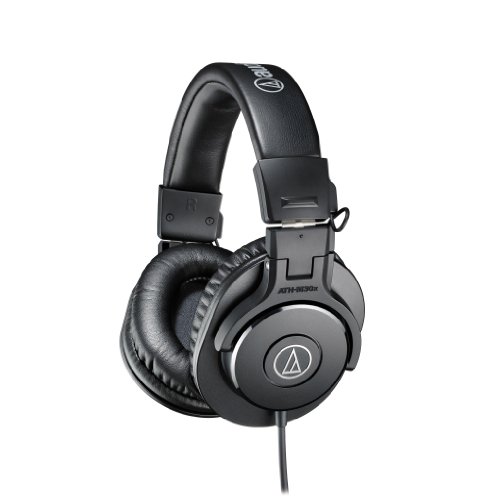
Audio-Technica ATH-M30x Professional Studio Monitor Headphones — Best portable monitor
The M30x occupies the family’s most underrated step: the point where the entry model’s compromises start being handed back. Its listing title names closed-back over-ear earcups, a screw-on adapter, a carrying pouch, and a remit of studio tracking, mixing, and field recording. The pouch and the field-recording phrase are the tells — this is the monitor Audio-Technica imagines leaving the building, riding in a kit bag to a location session, a rehearsal, a classroom across town.
The screw-on adapter deserves its sentence. Adapters that merely push on work loose in bags and vanish; a screw-on adapter stays married to the cable, which is exactly the behaviour a travelling recordist needs and a small parable of this maker’s working-design mind. The tuning steps up in refinement from the M20x while keeping the family’s sealed, tracking-first character, and the whole product feels aimed at the buyer who priced the M40x, hesitated, and still wanted a tool rather than a toy.
Position it honestly: below the M40x in tuning authority and cable flexibility, above the M20x in finish and travel-readiness. For field kits, student producers who carry their studio in a backpack, and second pairs that must survive commuting, that middle step is frequently the correct one — the M-series ladder working exactly as its maker designed it to work.
- Design: Closed-back over-ear earcups, per the listing title
- Adapter: Screw-on adapter, per the listing title
- Accessory: Carrying pouch, per the listing title
- Stated uses: Studio tracking, mixing, field recording, per the listing title
- Microphone: None — listening monitor only
Strengths
- Travel-ready package with pouch and secure screw-on adapter.
- A refinement step above the entry model in tuning and finish.
- Sealed design suits location and field recording work.
Trade-offs
- Still a step below the M40x in neutrality and cabling.
- Fixed-cable design shares the entry model’s main limitation.
- Easy to overlook between its siblings, though not easy to fault.
Best for: Field recordists and mobile producers who need a sealed monitor that travels well.
Not suited for: Desk-bound critical listeners, who should climb one step to the M40x.
How Do the Six Family Members Compare at a Glance?
| Pick | Type | Microphone | Defining trait |
|---|---|---|---|
| ATH-M50xSTS-USB StreamSet | Streaming headset | Cardioid condenser, USB | Sidetone and 24-bit/96 kHz conversion |
| BPHS1 | Broadcast headset | Dynamic cardioid boom | Analogue production pedigree |
| ATH-M50X | Monitor headphone | None | The studio benchmark tuning |
| ATH-M40x | Monitor headphone | None | Flattest tuning, swivelling cups |
| ATH-M20x | Monitor headphone | None | Entry price, 96 dB sensitivity |
| ATH-M30x | Monitor headphone | None | Pouch and field-recording remit |
The microphone column is the guide in miniature. Two rows say yes, four rows say no, and choosing your row honestly is worth more than any comparison of the rows’ other columns. Read the defining-trait column second: it is where the family’s ladder shows its logic, each step trading a specific capability rather than vague quality, so that a buyer who can name the trait they need can name their model in the same breath.
How Do You Set Up the StreamSet or BPHS1 for a Clean Voice?
Position the boom so the microphone sits just off the corner of your mouth, close enough to favour your voice over the room, and then leave it there — consistency of distance is consistency of level, and consistency is what lets an audience relax. On the StreamSet, enable the sidetone and set it until your own voice sounds present but not loud; that level is the one that keeps your delivery natural through a long session. Record a local test before every important session, listen back on the headset itself, and fix problems in the quiet of preparation rather than in front of an audience. Keep the same chair, the same boom position, and the same gain staging from session to session once the sound is right, because a voice chain that is re-invented weekly never accumulates the small refinements that separate a competent recording from a signature one.
On the BPHS1, the equivalent discipline lives in the chain: set gain at the interface or mixer so your loudest commentary peaks with headroom to spare, because a dynamic microphone forgives level but a clipped converter forgives nothing. In both cases, treat the closed-back seal as part of the voice setup — a good seal keeps the monitor feed out of the microphone and your voice the loudest thing in its world. Mark the settings that work — a photograph of the mixer, a note in the session file — so the next session starts from your best sound rather than from a fresh negotiation with the same knobs.
What Mistakes Do Buyers Make With This Maker’s Range?
The signature mistake is buying the famous monitor for a speaking job. The M50x has no microphone; every week someone discovers this during a live session. The second mistake is the reverse snobbery — assuming the true headsets must sound worse and cobbling together a monitor plus a distant desk microphone for a job that is all head movement. The third is climbing the monitor ladder by price alone, when the M40x’s flatter tuning, not the M50x’s fame, is what a mixing buyer actually needs.
Fourth, buyers ignore the cable question until a fixed cable fails on an entry model they planned to keep for a decade; the ladder’s detachable steps exist precisely for them. Fifth, they forget that closed-back isolation is a two-way promise — it keeps your music in and the room out, which is why these monitors, unlike open-back designs, can share a room with a live microphone or a sleeping household. Pilots reading across this batch of guides will recognise the same seal logic from our shortlist of best aviation anr headsets, where what a cushion keeps out decides what the electronics can achieve.
Sixth, glasses wearers forget to test any closed-back clamp over their frames before a long session; the fit interaction is gentler than in aviation but identical in kind, and our glasses-focused aviation guide’s fit-testing method, in best aviation headsets for glasses, transfers to studio chairs almost unchanged.
Final Recommendation
Decide by voice, then by tuning. If your voice works for a living — streaming, podcasting, gaming on camera — the StreamSet is the most complete answer this maker offers a home creator, and the BPHS1 is the answer when your chain is analogue and your venue is professional. If your ears work alone, the M50x is the benchmark for good reason, the M40x is the honest professional’s value, and the M30x and M20x are the travelling and entry steps of a ladder that has never needed gimmicks to justify itself. Buy the row of the table that matches your actual day, keep the cables and pads fresh, and the silhouette will do what it has done in studios for years — disappear into the work, leaving only your voice, exactly as clear as you meant it to be, arriving in rooms you will never see.
Why Does This Family Stay Closed-Back While Others Went Open?
Because its workplace demands it. The rooms where these headphones earn their living contain live microphones, loud monitors, and other people, and an open-back design fails all three constituencies at once — bleeding into the microphone, admitting the room, and sharing the music. Audio-Technica does build open-back references elsewhere in its catalogue, but the M-series’ identity is the sealed working tool, and the family’s consistency on that point is a feature: any M model can be handed to any musician in any session without a leakage conversation.
The sealed design shapes the sound in ways buyers should expect. Bass arrives with pressure and containment; the stage is intimate rather than architectural; long sessions run warmer than open-back equivalents. Listeners whose reference point is an open-back flagship may initially hear the M-series as close — because it is, deliberately, the sound of a tool designed for a room with a job happening in it. Judged on its own terms — isolation, consistency, durability — the design is not a compromise but a specification.
That specification is also why the family travels so well outside the studio. Offices, trains, and shared flats are all rooms with other people in them, and the seal that protects a vocal take protects a commute with equal indifference to genre.
How Do Cables and Pads Decide the Real Cost of Ownership?
Ask a studio manager what kills headphones and the answer is never drivers. Cables fray at connectors, get rolled over by chair casters, and vanish into other people’s bags; pads compress, crack, and absorb a season of sessions. The M-series’ upper models answer the first failure with detachable cables in several lengths and styles, and the whole family answers the second with a pad ecosystem deep enough that a five-year-old pair can be made to feel new for the price of a modest dinner.
This is where the ladder’s steps acquire their real meaning. The M20x’s fixed cable is not a scandal; it is a priced decision, appropriate for pairs bought as consumable infrastructure. The M50x’s detachable system is not a luxury; it is the mechanism by which a flagship stays a flagship across a decade of accidents. Buyers should choose their step by asking which failure they can afford: replacing a cable, or replacing the headphone.
Pads deserve the same forward thinking. Keep a spare set for the pair you depend on, replace them when the seal softens rather than when the covering splits, and remember that a pad change subtly refreshes the sound as well as the comfort — the cheapest restoration in the whole catalogue, hiding in the accessories list.
What Should a Small Studio or a Streaming Room Buy First?
Sequence the purchases by session reality. The engineer’s chair gets the judgement tool first — an M40x for flat testimony or an M50x for the benchmark’s all-round authority — because every other decision in the room is made through it. Tracking pairs come second, in the quantity the room’s largest session demands, and that is M20x and M30x territory, where sealed competence in multiples beats one more flagship standing idle. The voice position comes third and gets the headset: a StreamSet for a USB room, a BPHS1 where an interface and a mixer already run the show.
That order surprises buyers who shop by fame, because the famous model is the engineer’s chair rather than the room’s fleet. But studios are systems, and the system’s weakest hour is a session with too few tracking pairs or a voice chain improvised from the wrong product. Buy the system, and let each model do the job its row in this guide’s table describes.
Leave a little of the budget unspent for the consumables that arrive in year two — pads, a spare cable, a second pouch — because a room that plans its maintenance never cancels a session over a headphone, and that reliability, more than any tuning, is what clients remember.
How Does the StreamSet Fit a Real Streaming Week?
Picture the actual schedule: a weekday evening stream, a podcast recording on Wednesday, a video call with a sponsor on Friday, and a long gaming session on Sunday that is content and recreation at once. The StreamSet’s proposition is that one product covers the week without a cable swap or a chain rebuild — USB into the computer, sidetone keeping your voice level through the fourth hour, the condenser keeping the room’s radiator clicks out of the recording, and the closed back keeping the game’s loudest moment out of your own microphone.
The separate-components alternative — a monitor plus a desk microphone plus an interface — can out-perform it at each single task and under-perform it across the week, because every task change becomes a small production. Creators whose content is their consistency tend to choose the integrated tool for the desk and add separates later for a dedicated recording corner, if the audience ever justifies one. That is the honest upgrade path, and it starts, rather than ends, with the headset this guide leads with.
How Should You Test a Monitor From This Family Before Committing?
Bring the test to the tuning, because that is what you are buying. Play a mix you know intimately and listen to the low end first: the M50x will present it with weight and confidence, the M40x with restraint, and your preference between those presentations — not a reviewer’s — is the decision. Then play a vocal recording and judge the midrange’s honesty, then something bright and badly recorded, because a monitor that only flatters good recordings will lie to you about your own work eventually.
Test the seal with the room you have. In a studio, stand near a live microphone and check for bleed at your real listening level; at home, have someone speak at conversational level across the room and note how much arrives. Test the fit across a full session’s length, since closed-back comfort questions are all slow questions, and check the cable’s length against your actual desk geometry — the detachable models let you correct a mistake cheaply, which is itself a reason to favour them.
Finally, test the family’s premise: hand the headphone a job. Track something, mix something, record your voice if voice is the job. Tools reveal themselves in work faster than in auditioning, and this family, more than most, was built to be judged mid-task.
How Do You Care for These Headphones Across Years of Sessions?
Coil cables loosely and store the headphone where the pads rest uncompressed; a hook or a stand preserves the seal that the whole design depends on. Wipe pads after long sessions, especially in warm rooms, and treat the first softening of the seal as a scheduling note rather than a surprise. On the detachable models, exercise the connectors occasionally — a cable that has not been unplugged in three years can seize its welcome — and keep the unused cables in the pouch the travelling models provide.
For the headsets, add the microphone to the ritual: check the boom’s tension, keep the windscreen clean and replace it when it thins, and store the StreamSet’s USB cable strain-free at the connector. None of this is elaborate, and all of it is the difference between a tool that serves a decade and a purchase that quietly becomes a drawer resident. Studios that log their headphone maintenance — a line in the session notes, a date on the pad box — are not being precious; they are protecting the one piece of equipment every session touches.
Which Buyer Should Look at the Rival House Instead?
Loyalty is not a specification, and this guide gains nothing by pretending every reader belongs in this family. Listeners who want open-back staging for home listening should not be in the M-series at all — the sealed design that defines it answers a workplace question they are not asking. Listeners who prefer velour pads, a different clamp philosophy, and the German studio tuning tradition will find their natural home in the rival range this guide linked at the outset, and the honest comparison between the two houses is a matter of which set of working habits fits the room.
Voice-first buyers have a parallel honesty to observe. If your streaming life is really a gaming life, with short sessions and a chat channel rather than an audience, a dedicated gaming headset’s conveniences may serve you better than a broadcast tool’s discipline. The StreamSet rewards creators who treat their voice as a product; casual voice use does not need its converter, its sidetone, or its price of admission.
Everyone else — the tracking musician, the mixing engineer, the podcaster, the field recordist, the listener who wants the studio standard on the train — is standing in the right family’s doorway. The ladder is legible, the headsets are honest, and the only remaining task is the pleasant one of choosing your step.
What Does the Second Pair in a Room Usually Turn Out to Be?
Studios and streaming rooms accumulate second pairs along predictable lines, and knowing the pattern helps a first purchase land correctly. The engineer’s flagship acquires an entry-model sibling for guests and tracking, because no one hands the critical pair to a drummer. The streamer’s StreamSet acquires a plain M50x for the days when a co-host visits and needs ears without a second voice chain. The field recordist’s M30x acquires an M20x that lives permanently in the backup bag, because the session that matters is always the one where something fails.
The pattern underneath is that this family rewards standardisation. Pads, cables, and habits transfer between models; a room that commits to the ladder maintains one ecosystem instead of five. That is a large part of why institutions buy this maker, and it is available to a home buyer at exactly the same logic — choose the first pair as the founding member of a small system, and the second purchase, whenever it comes, will already have been half-decided by the first.
How Do You Choose Between the Two True Headsets Without Guessing?
Let your existing chain decide, because the two headsets speak different electrical languages. If your voice today runs through a computer and nothing else — no interface, no mixer, no plans for either — the StreamSet was designed as your complete answer, and its USB converter and sidetone are not features so much as the absence of three other purchases. If your voice already runs through an interface, or your work happens where a production engineer hands you a feed, the BPHS1’s analogue discipline is the native fit, and its dynamic microphone will forgive the loud, the close, and the careless in ways a condenser politely will not.
Then let your venue confirm it. The StreamSet’s natural venue is a room you control; the BPHS1’s is a venue that controls you — a commentary desk, a sideline, a production truck. Creators whose venue is a bedroom with ambitions should buy the StreamSet and grow; commentators whose venue is other people’s infrastructure should buy the BPHS1 and belong. The wrong choice is rarely catastrophic, but the right one disappears into the work immediately, and disappearance, in a tool worn on the head for hours, is the highest available praise.
What Should You Listen for When a Whole Family Shares One Design Language?
Consistency is this catalogue’s quiet promise: the M20x in a classroom and the M50x in a mastering room are dialects of one language, so skills and expectations transfer. An engineer who learned to mix on the M40x can track on an M20x without recalibrating their ears from zero, and a musician handed any pair in the family hears roughly the balance they heard on the last pair. That transferability is an economic feature disguised as an aesthetic one, and it is the deepest reason the family dominates working rooms rather than merely selling well in them.
It also disciplines the buyer’s upgrade path. Climbing the ladder buys refinement within a known character rather than a new character to learn, so the step from an M30x to an M50x feels like the same room with better light. Buyers who value that continuity should stay in the family without anxiety; buyers who crave contrast should know that contrast lives in the rival house, and that owning one of each is the time-honoured way this argument gets settled in real studios.
A closing observation for buyers hesitating at the ladder’s foot: the entry models in this family are not auditions for the real thing, they are the real thing at working scale, and thousands of released recordings were tracked on pairs no grander. Buy the step your work requires today, keep its pads and cable honest, and let the family’s consistency carry your ears upward when the work itself asks for more — that is how the professionals in this catalogue’s photographs actually got there, one necessary step at a time.
One more discipline separates rooms that love their headphones from rooms that tolerate them: audition any new pair against the room’s existing pair on the same recording, at matched loudness, before it joins the fleet. Loudness flatters whichever headphone plays louder, so match levels first and judge second, and a five-minute honesty ritual will tell you more about where the newcomer belongs — engineer’s chair, tracking wall, or back in its box — than a week of casual impressions scattered across different days and different songs.
Frequently Asked Questions
Does the ATH-M50x have a microphone?
No. The M50x is a monitor headphone for listening and studio work. The family member with the M50x platform plus a microphone is the ATH-M50xSTS-USB StreamSet, which adds a cardioid condenser microphone, USB conversion, and sidetone for streamers and podcasters. The confusion is understandable — the two products share a silhouette and most of a name — but it is exactly the confusion this guide’s table exists to prevent, so check the microphone column before any purchase in this family, however familiar the shape in the photograph looks.
Which is better for mixing, the M50x or the M40x?
For strict mixing honesty, most engineers reach for the M40x’s flatter tuning. The M50x’s livelier bass and treble make it the more enjoyable listener and a fine tracking tool, but enjoyment and testimony are different jobs, and this family conveniently sells both. The wisest small studios own the argument rather than settling it: the M40x in the engineer’s chair for decisions, the M50x on the artist’s head for confidence, because a singer who loves what they hear in the headphones sings like it, and a mix judged on the flatter pair travels to other systems with fewer surprises waiting in it.
Can I use the BPHS1 with a laptop?
It belongs to the analogue world, so expect to run it through an audio interface or mixer rather than plugging it straight into a laptop. Creators wanting a single USB connection should choose the StreamSet, which was designed for exactly that setup. The interface route is not a punishment — a small interface gives the BPHS1 proper gain, lets a second voice join through another input, and grows with a podcast from a hobby into a production — but it is a chain of purchases, and a buyer counting a single cable should count honestly before choosing the broadcast classic over its USB sibling.
Are the M-series good for everyday listening outside the studio?
Yes — the closed-back isolation that serves tracking also serves offices, commutes, and shared homes, and the M50x in particular built a second career as an everyday listener’s headphone. Just remember the whole monitor line is wired and microphone-free. Everyday use does change the maintenance rhythm: pads meet more skin, cables meet more bags and chair casters, and the headphone that lives a double life should have its pads inspected twice as often as a studio-only pair. Budget the small consumables accordingly and the double life costs nothing in longevity — one more reason the detachable-cable models earn their step on the ladder for listeners who plan to carry them everywhere.
What does sidetone do on the StreamSet?
Sidetone feeds a controlled amount of your own voice back into your ears while you speak. In a sealed headset your voice otherwise sounds muffled and distant to yourself, which tempts you to shout; sidetone restores a natural sense of your own level and keeps long sessions relaxed. Streamers notice the benefit most in the third hour of a session, when fatigue usually pushes voices louder and flatter; with sidetone set well, the voice you hear is the voice the audience hears, and the performance stays conversational long after an unmonitored broadcaster would have started projecting at a room that is not there.
Which model should a small studio buy several of?
For tracking pairs, the M20x and M30x are the quantity buys — sealed, durable, and priced for multiples. For the engineer’s own chair, one M40x or M50x covers the critical work the tracking pairs should not be asked to judge. Label the pairs when they arrive, because identical headphones in a shared room drift between owners and bags, and a labelled pair with its own pouch survives the room’s social life far better than an anonymous one. Studios that number their tracking pairs also learn their failure patterns — which pair’s cable is ageing, which pair’s pads are due — and that small administrative habit is worth real money across a year of sessions.
Related Guides
The two-household rivalry that frames this whole family — Tokyo’s monitor ladder against the German studio tradition — is best understood by reading this guide beside the beyerdynamic shortlist linked near the top, where the same questions of tuning, cabling, and broadcast booms receive a different maker’s answers. Whichever house you settle in, settle deliberately: the working rooms that get the most from their headphones are the ones that chose a family, learned its ladder, and then stopped shopping and started recording.


