What's inside
- Key Takeaways
- Quick Picks
- How We Chose These Picks
- Which of the Three Kinds Do You Actually Need?
- What Makes a Trainer Desk Stable Enough to Trust With a Laptop?
- How Do You Fit a Screen Into a Training Session, Practically?
- What About the Desk You Already Own?
- Where Does All This Live When Nobody Is Riding?
- The Six Bike Desk Picks, Reviewed One by One
- How Do the Six Divide When You Compare Them Directly?
- What Mistakes Do Bike Desk Buyers Keep Making?
- Final Recommendation
- Frequently Asked Questions
- Related Guides
As an Amazon Associate I earn from qualifying purchases. This post may contain affiliate links at no extra cost to you.
widgetverdict.com is reader-supported. When you buy through links on our site, we may earn an affiliate commission.
Where to buy: Amazon stocks the whole shelf below, and you can reach any listing by following the product’s name in the Quick Picks table or in its full review further down. Read the headings carefully, though — this shelf holds three different kinds of product, and only four of them are desks in the ordinary sense.
The best bike desks answer a question that sounds like a joke until you have lived it: how do you keep working while the bike is underneath you? Indoor training puts a rider in one position for an hour or more, staring at a wall, and the obvious modern fix is to put the work — the laptop, the tablet, the phone, the notebook — on a surface that straddles the front wheel. That is the trainer desk, and four of the six picks here are exactly that: height-adjustable tables on wheels, built to roll up to a bike on a trainer and hold a screen at riding eye level.
The other two picks solve the mirror-image problem, and honesty requires separating them from the start. The HARISON is not a desk at all: it is an under-desk pedal unit that slides beneath a desk you already own, so the pedalling happens at a normal workstation. The HitGo is a bike built into a chair with a work surface in the equation — a seated pedal workstation, bought as one piece of furniture. Three sub-classes, one shelf, one shared idea: the work surface and the pedals stop being enemies. This guide treats the three classes separately throughout, because buying a trainer desk when you needed a pedal unit is an expensive category error.
A note on what this guide does not do: it makes no claims about health, fitness or medical benefit. Whether pedalling while you work is good for you is a question for other pages and other professionals. What we judge here is furniture and workflow — stability, adjustability, surface size, how the thing rolls, stores and coexists with a laptop — because that is what decides whether any of these products is still in use a month after delivery.
Key Takeaways
- Four picks are trainer desks that straddle a bike’s front wheel: RAD Cycle, Wahoo, VEVOR and Alpcour.
- The HARISON is an under-desk pedal unit, not a desk — it pairs with the workstation you already have.
- The HitGo is a bike-and-chair workstation with foldable pedals and a title-stated 330 lb capacity.
- The Wahoo KICKR DESK V2 states the most precise figures here: height from 35 to 47 inches and a 28 x 14 inch desktop.
- Wheels decide daily life in this class: lockable casters on the VEVOR and Alpcour, a caster-and-fixed mix on the Wahoo.
- Buy by sub-class first — trainer desk, pedal unit or bike chair — and only then compare within it.
Quick Picks
| Pick | Badge | Why it earns its place |
|---|---|---|
| RAD Cycle Products Adjustable Bike Trainer Fitness Desk | Best established trainer desk | The long-running portable workstation desk for trainer setups, adjustable and built to roll to the bike. |
| Wahoo KICKR DESK V2 Indoor Cycling Desk | Best specified trainer desk | Height from 35 to 47 inches, a 28 x 14 inch desktop, five cable holders and a mixed wheel set. |
| VEVOR Cycling Desk, Foldable Bike Trainer and Treadmill Workstation | Best folding option | A foldable trainer desk with lockable wheels, non-slip slots and handlebar support that also serves a treadmill. |
| HARISON Under Desk Bike Pedal Exerciser | Best pedal unit for an existing desk | Not a desk — a quiet under-desk pedaller with adjustable resistance and an LCD display for the desk you own. |
| HitGo Office Exercise Bike Desk Chair | Best all-in-one pedal chair | A seated pedal workstation with a 9-level adjustable seat, foldable pedals and a stated 330 lb capacity. |
| Alpcour Bike Trainer Fitness Desk | Best gadget-minded trainer desk | A portable workstation table with a non-slip surface, gadget slots and lockable wheels. |
How We Chose These Picks
Sub-class honesty came first, for the reason given above: this shelf mixes three kinds of product, and a guide that blurs them misleads everyone. Every pick is labelled by what it actually is — trainer desk, pedal unit, bike chair — in its heading, its table row and its review. The two non-desk picks are here because buyers searching this term very often want exactly them; excluding the HARISON and the HitGo would make the guide tidier and less useful.
Within the trainer desks, we judged the things that decide a training session’s first five minutes. Height range matters because the surface must clear the front wheel and meet the rider’s eye line from the saddle; the Wahoo’s stated 35-to-47-inch span is the benchmark the others are read against. Wheel arrangement matters because the desk is rolled to the bike and away again every session — lockable wheels on the VEVOR and Alpcour, a two-caster-two-fixed arrangement on the Wahoo that trades free rolling for directional stability. Surface behaviour matters because a laptop on a vibrating, sloping tray is a laptop at risk: non-slip surfaces and gadget slots are functional features here, not decoration.
For the pedal unit and the bike chair, the judging shifts to coexistence with work. The HARISON’s questions are whether it fits beneath a real desk, whether its resistance adjusts across a useful span, and whether its display tells you anything you will actually glance at. The HitGo’s questions are whether the seat adjusts widely enough — nine levels, per its title — for different riders to share it, whether the pedals fold away so the chair can be a chair, and whether the stated 330 lb capacity covers the household member it will actually serve.
Finally, storage. Trainer desks live in rooms that also do other things — garages, spare bedrooms, living rooms — and a desk that folds, like the VEVOR, or rolls flat against a wall earns its place in those rooms differently from one that stands assembled all year. We weighted foldability and footprint accordingly, and we have noted in each review where the product expects to live when it is not in use.
Which of the Three Kinds Do You Actually Need?
Start from the bike, not the desk. If you own a bike on an indoor trainer and your problem is the empty hour — the laptop on the floor, the tablet propped on a box, the phone balanced on the handlebars — you need a trainer desk: the RAD, the Wahoo, the VEVOR or the Alpcour. These are tables engineered around a front wheel, with the height to clear it and the stance to straddle it. Nothing else in this guide solves that problem, and no trainer desk solves any other problem in this guide.
If you own no trainer and no intention of buying one, but your workday is spent at an ordinary desk and you want pedals under it, the HARISON is your category of one. It asks nothing of your furniture except knee room, it leaves your existing desk, chair and monitors exactly as they are, and it stores in a fraction of the space any bike-shaped alternative needs. Its limitation is equally clear: it provides no surface of its own, so it is only ever an addition to a workstation, never the workstation itself.
If you want one piece of furniture that is seat, pedals and work perch in a single footprint — for a small flat, a spare corner, a household member who will not assemble a system from parts — the HitGo is the answer on this shelf. The compromise is built in: an all-in-one is a fixed marriage of seat and pedals, so your favourite office chair stays out of the arrangement, and the work surface question becomes whatever you pair with it. Buy the sub-class that matches the room and the routine; the comparisons within each class are the easy part.
Households with more than one pattern in play should notice that the sub-classes combine without friction. A trainer desk in the garage and a pedal unit under the office desk is a common pairing, because the two products serve different hours of the same day and neither duplicates the other. The mistake is not owning two kinds; it is expecting one kind to cover both jobs. Buyers torn between classes are usually describing two different routines — the training hour and the working day — and the honest answer is that those are two purchases, sequenced by which routine is already happening and which is still aspirational.
What Makes a Trainer Desk Stable Enough to Trust With a Laptop?
A trainer desk stands in the worst neighbourhood in the room: inches from a spinning wheel, beside a rider who rocks side to side on every hard effort, on a floor that may be carpet, mat or concrete. Stability here is not a luxury specification. It comes from three places — the width of the base’s stance, the quality of the wheels or feet at its corners, and the height at which the surface is asked to work, since every design is steadier low than high. When you read the four trainer desks below, read their wheel arrangements as stability decisions: lockable casters that can be pinned before a session, the Wahoo’s fixed rear wheels that resist sideways drift, and bases wide enough to straddle a wheel without the legs living in the rider’s knee space.
The surface itself is the second half of trust. A laptop slides before it falls, so the non-slip finishes and gadget slots on the VEVOR and Alpcour are safety features wearing casual clothes: they keep a tablet in its slot and a laptop’s feet planted when the rider stands on the pedals and the whole arrangement trembles. Raised lips and slots also decide where the phone, the remote and the water bottle live, and a desk that gives each object a place keeps them off the floor and out of the drivetrain’s reach.
The third factor is you. The desk should be set before the session, at a height that puts the screen at eye level from the saddle, and then left alone; a desk adjusted mid-ride, one-handed, while clipped in, is an accident rehearsing. All four trainer desks adjust easily enough on the ground, before you clip in. Treat the setup as part of the ritual — desk rolled in, wheels locked or settled, surface loaded, then ride — and the format’s considerable convenience arrives without its avoidable dramas.
Vibration deserves its own sentence, because it is the stability issue riders notice last and laptops notice first. A trainer transmits a low tremor through the floor, and a desk standing on the same floor receives it. On hard floors the tremor arrives nearly undiminished; a training mat under both bike and desk softens it considerably and protects the floor into the bargain. If your laptop’s screen shimmers during hard efforts, the fix is usually the mat and the wheel locks together, not a different desk.
How Do You Fit a Screen Into a Training Session, Practically?
The screen is the point of the whole arrangement, and it has three jobs: it carries the training app or the video call or the document, it sits at a distance your neck tolerates from the saddle, and it survives the environment — warm, occasionally sweaty, full of moving limbs. A laptop is the common answer and the trainer desks are sized for one, the Wahoo’s 28 x 14 inch desktop being the stated example: enough for a laptop with a phone beside it, not enough for a laptop plus a second monitor plus a notebook spread. Buyers who work from the bike in earnest should measure their full kit against that class of surface before ordering, because trainer desks are deliberately compact — they straddle a wheel, not a room.
Tablets are the second answer and in some ways the better one: lighter, cooler-running, content with a slot or a stand, and indifferent to the vibration that hard drives and fans dislike. The gadget slots on the Alpcour and the non-slip slots on the VEVOR exist for exactly this pairing. A phone joins either setup as the controller — music, messages, the training app’s companion — and the cable holders on the Wahoo, five of them per its title, keep the charging leads for all of this out of the wheel’s neighbourhood, which is where loose cables in a training space eventually migrate.
Power deserves a plan of its own. A laptop working through a long session will want its charger, and a charger means a cable crossing the room to the desk. Route it behind the trainer, along the wall, anywhere except across the floor space where feet unclip. The desks’ cable management features help at the desk end; the room end is your responsibility, and five minutes spent on it before the first session saves the mid-ride discovery that your front wheel and your power lead have become acquainted.
What About the Desk You Already Own?
Half the buyers reading a guide like this one do not need a new surface at all — they need their existing workstation to accommodate movement. That is the HARISON’s entire case, and it is worth stating the general principle behind it: the best workstation is usually the one already adjusted to you. Your desk height, your chair, your monitor position represent accumulated small decisions, and a pedal unit preserves all of them. The checks are dimensional, not conceptual: knee room under the desk, the depth to slide the unit in and out, and a chair whose base does not fight the pedaller for the same floor.
The bike chair inverts the same principle. The HitGo replaces your chair rather than joining it, which suits a room being set up fresh — a corner in a bedroom, a place by a window — better than a workstation with years of tuning in it. Its foldable pedals let it stand down into an ordinary seat when the pedalling is done, and the adjustable seat is what makes it shareable between household members of different heights. Read its review as furniture first and exercise equipment second, because that is the order in which it will succeed or fail in your home.
There is a third pattern worth naming, because households discover it by accident: the trainer desk moonlighting as an ordinary standing desk. Rolled away from the bike, a height-adjustable table on wheels is a laptop perch for the sofa, a side table for a video call, a temporary surface anywhere in the home. The RAD and the Wahoo both live this double life in many homes. It does not change which one you should buy, but it softens the storage question — a piece of furniture with two jobs earns its floor space twice.
Where Does All This Live When Nobody Is Riding?
Training furniture has a second shift: the twenty-three hours when it is not in use, in rooms that mostly have other purposes. The trainer itself usually stays set up in a corner — folding trainers exist, but most owners leave the bike mounted — and the desk’s storage story decides whether the corner reads as a training station or as a room with an obstacle in it. The VEVOR folds flat and effectively leaves. The RAD and Alpcour roll against a wall and read as what they also are: small tables. The Wahoo parks the same way, its fixed wheels making it happiest pushed straight back against a wall rather than angled into a corner.
The pedal-side picks store on a different scale entirely. The HARISON is cupboard furniture — it can live under the desk permanently, since that is its working position anyway, and its storage question answers itself. The HitGo occupies a chair’s footprint full-time, which in a small home is a real commitment: it is always present, always a seat, and its foldable pedals are what keep that presence from feeling like gym equipment left out. Households choosing between the sub-classes should weigh these idle hours as heavily as the working one; furniture is mostly looked at, not used, and the pick that stores gracefully is the pick still welcome in the room by spring.
One more placement rule applies to everything on wheels in this guide: keep the desk’s parking spot out of the path between the bike and the door. A rider finishing a session, warm and slightly wobbly, carrying a bottle and a towel, should not have to negotiate the desk they just rolled away. Park it to the side the rider does not dismount toward — usually the left — and the room’s traffic pattern settles within a week into something nobody has to think about.
The Six Bike Desk Picks, Reviewed One by One
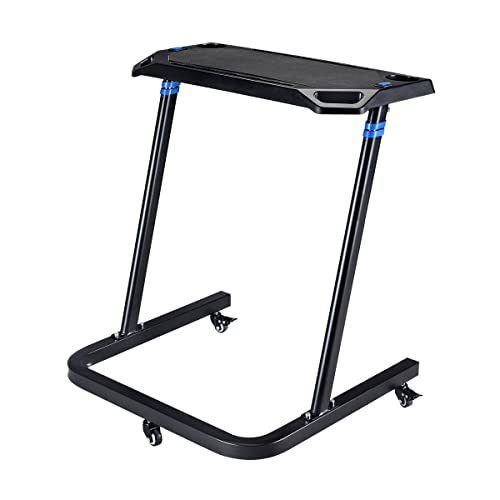
RAD Cycle Products Adjustable Bike Trainer Fitness Desk — Best established trainer desk
The RAD desk is the name this category grew up around: a portable workstation table for a bike on a trainer, height-adjustable, made by a company whose catalogue is bicycle accessories rather than furniture. That origin shows in the priorities. The desk exists to be rolled to the bike, loaded with a laptop or tablet, and rolled away again, and everything about the format — the portable brief in its own title — serves that daily in-and-out rather than a permanent installation.
For the rider whose training space is also a living space, that portability is the whole argument. The desk does its hour beside the trainer and then becomes a laptop table wherever else the day needs one, which is how most of these desks actually live: training furniture in the morning, general household surface by afternoon. RAD’s long presence in the category also means the design has been revised against years of owner feedback — the unglamorous virtue in a product class where a wobble or a slipping height clamp is discovered at the worst possible moment.
What the listing’s title does not give you is a set of precise dimensions, so buyers with a specific laptop-and-tablet layout, or an unusually wide trainer stance, should read the listing’s own dimension details before ordering rather than assuming the class standard. Judged on its record and its brief, though, the RAD is the default trainer desk: the one to buy when you want the category’s proven answer and no particular feature — folding, slots, a stated desktop size — is pulling you toward a rival.
There is a community effect worth mentioning, because it quietly de-risks the purchase. A desk sold in this category for this long has been fitted to every mainstream trainer, cursed at in every forum thread, and measured by owners in public. If your trainer is an unusual one, the odds are good that someone has already paired it with this desk and reported the result. Newer designs may be cleverer on paper; the RAD’s compatibility with the real world of trainers is documented in a way no specification sheet can match.
- Type: trainer desk — a table for a bike mounted on a trainer
- Height: adjustable
- Mobility: portable, rolls to and from the trainer
- Maker’s field: bicycle accessories
- Desktop dimensions: not stated in the listing title
- Suits: laptop or tablet at the trainer
Strengths
- The category’s established design, refined over years of sales.
- Portable brief suits rooms that are not dedicated training spaces.
- Doubles naturally as a household laptop table off the bike.
Trade-offs
- No precise desktop dimensions in the title to plan a layout against.
- No folding claim — it stores at its working size.
- A table only: the trainer and bike are separate purchases.
Best for: a rider who wants the proven trainer-desk format without a specialist requirement. Not suited for: a buyer who needs a folding desk or a stated desktop size before ordering.

Wahoo KICKR DESK V2 Indoor Cycling Desk — Best specified trainer desk
Wahoo sells the ecosystem this desk belongs to — the KICKR trainers — and the V2 desk reads like a product specified by people who watched riders use the first version. The title states its figures plainly: height adjusting from 35 to 47 inches, a desktop of 28 by 14 inches, two caster wheels and two fixed wheels, and five cable holders. In a category short on stated numbers, that precision is itself a feature: you can plan a room, a laptop layout and a cable route against it before the box arrives.
The wheel arrangement is the detail worth understanding. Full casters at all four corners roll in any direction and can also drift in any direction; the Wahoo’s split — casters to steer with, fixed wheels to track straight — makes the desk easy to position and then inclined to stay oriented as placed, rolling fore and aft rather than wandering sideways beside the wheel. Beside a spinning trainer, that directional discipline is worth more than omnidirectional freedom. The five cable holders continue the theme: Wahoo assumes a laptop, a tablet, a phone and a trainer’s own lead, and gives the cables a managed path instead of a dangle.
The 28 x 14 inch desktop is honest compactness. A laptop fits with a phone beside it; a laptop and a sprawling notebook setup do not. Riders whose session is a training app and a video will never notice the limit; riders planning to run a full second workstation from the saddle should measure their kit and may land on a larger-surfaced rival. Within its stated envelope, though, this is the most completely thought-out trainer desk here — the pick for buyers who plan in inches and cables rather than in hopes.
- Type: trainer desk for indoor cycling setups
- Height: adjusts from 35 to 47 inches, as stated in the listing title
- Desktop: 28 x 14 inches, as stated in the listing title
- Wheels: 2 casters and 2 fixed wheels
- Cable care: 5 cable holders
- Also serves: standing desk duty away from the bike
Strengths
- Stated height range and desktop size — plan before you buy.
- Mixed wheel set positions easily and tracks straight.
- Five cable holders tame a full device set’s leads.
Trade-offs
- The 28 x 14 inch top is a laptop-and-phone surface, not a workstation.
- Fixed wheels limit sideways shuffling in tight rooms.
- Ecosystem pricing sits above the category’s basic options.
Best for: a KICKR-ecosystem rider who plans layouts and cable routes precisely. Not suited for: a rider who wants to spread a laptop, monitor and paperwork across the surface.

VEVOR Cycling Desk, Foldable Bike Trainer and Treadmill Workstation — Best folding option
The VEVOR’s headline is the fold. A trainer desk that folds flat answers the question the other three leave open: where does this thing live in a home that trains twice a week? Against a wall, behind a door, under a bed — the folded desk leaves the room to its other lives, and unfolds when the trainer comes out. For flats and shared rooms, that single property can outweigh every other distinction in this guide.
The rest of the specification works the same practical seam. Lockable wheels let the desk roll to the bike and then be pinned in place for the session. Non-slip slots hold devices at a working angle without a separate stand, and the handlebar support named in the title gives the bike’s front end a steadier relationship with the desk than a free-standing table manages. The listing also claims treadmill duty — the same surface serving a walking workstation — which makes the desk a two-appliance purchase for households that own both machines.
VEVOR’s catalogue spans workshop and home equipment at aggressive prices, and the honest expectation to set is functional rather than luxurious: this is the desk bought for what it does — folds, locks, holds — in rooms where space is the scarcest resource. Riders with a dedicated training room and no storage problem will get more from the Wahoo’s precision or the RAD’s record. Riders negotiating with a small flat should start here and argue themselves out of it only if the fold proves unnecessary.
The treadmill claim deserves a fair reading rather than a dismissive one. A walking workstation and a cycling workstation want the same thing — a surface at standing eye height that tolerates a moving human beside it — and a desk specified for one usually serves the other adequately. Households with a treadmill under the stairs and a trainer in the garage are precisely the households that cannot justify two specialist tables. For them the VEVOR’s double duty is not a gimmick but the deciding line in its specification, provided the desk’s height and stance suit both machines, which is a measuring exercise worth doing once, carefully, before the order.
- Type: foldable workstation table for trainers and treadmills
- Storage: folds flat
- Wheels: lockable
- Surface: non-slip slots for devices
- Extra: handlebar support; also pitched for treadmill use
- Height: adjustable
Strengths
- Folds away — the only pick here that solves storage outright.
- Lockable wheels pin the desk in place for the session.
- Non-slip slots hold a tablet or phone without extra stands.
Trade-offs
- Folding hardware adds setup steps to every session.
- Functional finish rather than furniture-grade presentation.
- Jack of two appliances; a treadmill household should check fit carefully.
Best for: a small home where the training corner must disappear between sessions. Not suited for: a dedicated pain-cave setup that never needs to fold anything away.

HARISON Under Desk Bike Pedal Exerciser — Best pedal unit for an existing desk
Repeat the heading’s warning in full: this is not a desk. The HARISON is a pedal unit that lives under a desk — your desk, the one already holding your monitors at the right height — and its entire case is that the workstation you have is better than any workstation this guide could sell you. It slides into the knee space, offers adjustable resistance and an LCD display, and is pitched in its title as quiet, which in a shared home or an open-plan office is the feature that decides whether it gets used or exiled.
The workflow it enables is specific: seated pedalling during the parts of the day that are screen-bound anyway — reading, calls, email, the long document review. The display tracks the session’s basic numbers for those who like a record; the resistance adjustment lets the same unit serve a gentle spin during a call and a firmer effort during solitary work. Because it is small, it also travels between rooms and households in a way no bike-shaped furniture can: under the desk this year, under a table at a relative’s house during a long stay, stored in a cupboard between both.
The limits are the mirror of the virtues. It brings no surface, no seat and no structure — everything else in your setup stays your problem — and under-desk geometry is unforgiving: a low desk apron, a modesty panel, a chair with a wide five-star base can each veto the arrangement. Measure the knee space, check the chair’s footprint, and confirm your knees will clear the desk’s underside through a pedal stroke. Buyers who do that measuring get the cheapest, least disruptive entry in this guide; buyers who skip it get a return.
One behavioural note from owners of this whole product type: the pedal unit succeeds when it is left in place, ready, rather than fetched for each session. A unit stored in a cupboard and retrieved for virtuous afternoons has a short career; a unit living permanently under the desk, needing nothing but your feet, becomes part of the furniture’s background and gets used in the unplanned minutes — the long download, the hold music, the meeting that could have been an email. The HARISON’s small size is what makes that permanent residence possible under most desks, and it is the strongest argument for the format.
- Type: under-desk pedal unit — not a desk, no surface included
- Resistance: adjustable
- Display: LCD
- Pitch: quiet operation for home office use
- Pairs with: the desk and chair you already own
- Storage: small footprint, cupboard-sized
Strengths
- Keeps your existing desk, chair and monitor setup untouched.
- Smallest footprint and easiest storage in this guide.
- Adjustable resistance and a display for session tracking.
Trade-offs
- No work surface — it is an accessory, not a workstation.
- Needs knee room and a compatible chair base to work at all.
- Quiet is a claim to verify in your own room’s acoustics.
Best for: a settled home office that wants pedals added without changing anything else. Not suited for: a buyer who needs a surface, a seat or a complete workstation in the box.

HitGo Office Exercise Bike Desk Chair — Best all-in-one pedal chair
The HitGo takes the opposite approach to the HARISON: instead of adding pedals to your furniture, it is the furniture — a heavy-duty bike chair with a title-stated capacity of 330 lbs, a seat adjustable across nine levels, foldable pedals, and a recumbent seated pedalling position. It is bought as one object that occupies one footprint, which makes it the pick for a room being furnished rather than a workstation being modified.
The nine-level seat is the specification that matters most, because an all-in-one lives or dies on fit. A pedal chair whose seat suits only one body becomes one person’s appliance; nine levels of adjustment give different household members a realistic chance of each finding a workable position, and give a single owner room to fine-tune the relationship between seat height, pedal stroke and the desk or table they pair it with. The listing notes it fits under a standing desk, which is the natural pairing — the chair provides seat and pedals, the desk provides the surface, and the two meet in the middle.
The foldable pedals complete the furniture argument: pedals folded, the HitGo stands down into a seat that does not announce its other job, which matters in a bedroom or living corner where a permanent exercise silhouette is not the décor anyone chose. Judge the capacity figure as the title states it — 330 lbs is the maker’s number for the chair’s structure — and judge the whole product as a chair that pedals rather than a bike that chairs, and its priorities fall into place.
The recumbent position deserves a practical note for buyers pairing it with work. A recumbent seat sits you lower and further back than an upright chair, which changes the desk relationship: the surface needs to come to you, or the chair needs to sit close under it, and a standing desk at its lower settings — the pairing the listing itself suggests — is the arrangement that closes the gap. Buyers planning to use the HitGo at a fixed-height desk should check that pairing with a tape measure and a borrowed chair of similar seat height before committing, because the geometry, not the pedalling, is what will decide their afternoons.
- Type: bike desk chair — seat and pedals in one unit
- Capacity: 330 lbs, as stated in the listing title
- Seat: adjustable across 9 levels
- Pedals: foldable, for standing the unit down into a chair
- Position: recumbent seated pedalling
- Pairing: fits under a standing desk, per the listing title
Strengths
- One footprint provides seat and pedals — nothing to integrate.
- Nine seat levels make it shareable between different riders.
- Foldable pedals let it pass as an ordinary chair between sessions.
Trade-offs
- Replaces your chair rather than joining your current setup.
- The work surface still comes from a separate desk or table.
- All-in-one fit is a compromise for riders at size extremes.
Best for: a fresh corner setup that wants seat and pedals as a single piece of furniture. Not suited for: an owner attached to a carefully chosen office chair.

Alpcour Bike Trainer Fitness Desk — Best gadget-minded trainer desk
The Alpcour is the trainer desk designed by someone who counted the objects a rider carries to the bike: laptop, tablet, phone, bottle, remote. Its title names the answers — a non-slip surface, gadget slots, lockable wheels, adjustable height — and the desk’s character is that inventory made physical. Devices sit in slots at a readable angle instead of lying flat or leaning on improvised stands, and the non-slip top keeps the unslooted remainder where it was put when the rider’s effort shakes the room’s lighter furniture.
Lockable wheels place it between the Wahoo’s directional discipline and full-caster freedom: roll it anywhere, then lock it there. For riders who train in a doorway’s worth of space, repositioning the desk between sessions to clear a path, the lock-and-roll cycle is the daily reality, and the Alpcour is built for it. The portable multi-tasking brief in its title is honest — this is a desk that expects to be moved, loaded with several devices, and used for work and training interchangeably.
Against the RAD, its longer-established rival, the Alpcour’s case is features over record: the slots and surface treatment are things the RAD’s plainer top does not offer, at the cost of a shorter track record in the category. Against the VEVOR, it stays assembled — no fold — which suits a room with a permanent training corner. Gadget-heavy riders, the ones whose trainer sessions involve three screens and a fan remote, are the audience this desk was drawn for, and they will recognise themselves in its specification.
- Type: portable multi-tasking trainer table
- Surface: non-slip, with gadget slots
- Wheels: lockable
- Height: adjustable
- Brief: portable multi-tasking workstation table
- Suits: multi-device training setups
Strengths
- Gadget slots hold tablet and phone at a readable angle.
- Non-slip surface keeps devices planted during hard efforts.
- Lockable wheels roll freely, then pin for the session.
Trade-offs
- Shorter category track record than the RAD desk.
- No fold — it stores at working size like most rivals.
- Slots fit mainstream devices; oversized cases may not sit in them.
Best for: a rider whose sessions involve a laptop, a tablet and a phone all at once. Not suited for: a minimalist who trains with a single screen and values a plain top.
How Do the Six Divide When You Compare Them Directly?
| Pick | Type | Surface | Mobility | Defining extra |
|---|---|---|---|---|
| RAD Cycle Trainer Desk | Trainer desk | Workstation top, size not stated in title | Portable | The category’s established design |
| Wahoo KICKR DESK V2 | Trainer desk | 28 x 14 in | 2 casters, 2 fixed wheels | 5 cable holders; 35–47 in height |
| VEVOR Cycling Desk | Trainer desk | Non-slip slots | Lockable wheels, folds flat | Handlebar support; treadmill duty |
| HARISON Pedal Exerciser | Pedal unit | None — under your desk | Slides under furniture | Adjustable resistance, LCD display |
| HitGo Bike Desk Chair | Bike chair | None — pairs with a desk | One furniture footprint | 9-level seat; 330 lb stated capacity |
| Alpcour Trainer Desk | Trainer desk | Non-slip with gadget slots | Lockable wheels | Slots for multiple devices |
The table’s real message is the Type column. Four rows are surfaces in search of a bike; two rows are pedalling in search of a surface. Choose the row type that matches your missing half, and the choice within the type follows the extras column: folding for the VEVOR, specification for the Wahoo, record for the RAD, slots for the Alpcour. Crossing the types — buying a trainer desk to pedal at, or a pedal unit to hold a laptop — is the one error no feature list can rescue.
What Mistakes Do Bike Desk Buyers Keep Making?
The first is buying across the sub-classes: ordering a trainer desk for an office with no trainer in it, or an under-desk pedaller and then wondering where the laptop goes. The names on this shelf genuinely blur together, which is why this guide labels every pick by type at every appearance. Before ordering anything, say out loud which half you own — bike, desk, both, neither — and buy the half you lack.
The second is forgetting the wheel. A trainer desk must clear the bike’s front wheel and sit close enough for the rider to read and reach, and that geometry depends on the trainer’s stance and the desk’s base width together. Desks that straddle most mainstream trainers still deserve a tape-measure check against your own setup, particularly with wide-stance trainers and small wheels. The third mistake is surface optimism: piling a laptop, a monitor and paperwork onto a top sized for a laptop and a phone. Trainer desks are compact on purpose; respect the envelope and the devices stay safe.
The fourth is ignoring the floor. Wheels on carpet behave differently from wheels on a training mat or hard floor, and a desk that rolls sweetly in the showroom sense may creep on pile or skate on laminate. Lockable wheels exist for this reason; use the locks, and put the trainer and desk on the same surface where you can. The fifth mistake is treating the pedal unit’s fit as a detail: knee clearance is a measurement, not a hope, and the HARISON rewards the buyer who measured the desk’s underside before the box arrived.
Finally, a word about the second-hand temptation in this category. Trainer desks and pedal units appear on resale listings constantly, often barely used, and the savings can be real. What does not transfer is certainty about the height mechanism and the wheels — the two parts that wear. A used desk that sinks slowly under a laptop, or rolls when locked, is not a bargain at any price; test both functions before money changes hands, in the seller’s hallway if necessary.
Final Recommendation
Match the half you are missing. Trainer riders: the Wahoo if you plan in stated inches and cables, the RAD if you want the category’s proven answer, the VEVOR if the room must reclaim its floor between sessions, the Alpcour if your sessions run three devices at once. Desk owners: the HARISON, after measuring your knee space twice. Furnishers of fresh corners: the HitGo, paired with a desk whose underside welcomes it.
Whichever you choose, spend the first week tuning the arrangement rather than judging it: an inch of desk height, a different parking spot, a cable rerouted, a mat under the whole station. These products reward the owners who treat setup as a short project with an end, and punish — with slow disuse, the only real failure mode in this category — the owners who expect the first arrangement to be the final one.
Set the arrangement up as a ritual rather than an improvisation — desk rolled in and locked, screen at saddle eye level, cables routed behind the trainer, water within reach — and the hour on the bike stops being the hour your work waits for you. The corner of the garage where the trainer lives has heard every excuse the workday can make; a good desk, honestly chosen for the setup you actually own, is how that corner finally answers back.
Frequently Asked Questions
Will a trainer desk fit my bike and trainer combination?
Most mainstream combinations work, because the format is standardised around a front wheel straddled by the desk’s base. The variables are the trainer’s stance width, the wheel’s diameter and your handlebar height. The Wahoo’s stated 35-to-47-inch height range covers the saddle eye lines of most riders; for anything unusual — a very wide trainer, a recumbent — compare the listing’s dimension details against your setup’s measurements before ordering.
Can I really work productively from a trainer desk?
Reading, video calls, email, training apps and document review all work well from the saddle, and those are the tasks this furniture is designed around. Extended precise typing and mouse work are harder at any desk while pedalling, which is a workflow fact rather than a product flaw — most owners sort their day so the bike hour carries the screen-bound tasks and the desk hours carry the keyboard-bound ones. The HARISON at a normal desk inverts the same logic for gentler pedalling under ordinary work.
What is the difference between the HARISON and the HitGo?
The HARISON is pedals only: a compact unit that slides under your existing desk and works with your existing chair. The HitGo is a chair with pedals built in: it replaces your chair, adjusts across nine seat levels, and folds its pedals away when it is standing down. Choose the HARISON to change nothing else in your setup; choose the HitGo when you are furnishing a corner from scratch or want seat and pedals as one object.
Do trainer desks work as ordinary standing desks?
Yes, within their size. Away from the bike, a trainer desk is a height-adjustable laptop table on wheels, and the Wahoo’s title says so outright. The limit is the surface: these tops are sized for a laptop and a phone, not for a monitor arm, a keyboard tray and paperwork. As a secondary or roaming standing surface they serve well; as a primary workstation for a multi-monitor setup, a purpose-built standing desk is the right tool.
How do I stop cables reaching the bike’s moving parts?
Route every cable as if the wheel were looking for it. Keep leads behind the trainer or along the wall, use the desk’s cable holders where fitted — the Wahoo provides five — and never let a charging cable cross the floor space where feet unclip. A cable that must reach the desk should arrive from behind the rider, bundled, with its slack managed at the desk end rather than pooled on the floor beside the front wheel.
Can an under-desk pedal unit work with a standing desk?
Yes, in the seated position — which is the arrangement the HitGo’s listing gestures at from the other direction. A pedal unit under a height-adjustable desk works while you sit at it in the ordinary way; the desk’s adjustability simply gives you more control over the knee clearance the pedals need. What a pedal unit does not do is turn a standing desk into a walking or riding station while you stand — the pedals are a seated device, and the standing hours remain standing hours.
Are folding trainer desks as stable as fixed ones?
A folding frame carries an extra set of joints, and joints are where movement lives — that is the honest physics behind the VEVOR’s trade-off. In practice, a well-locked folding desk serves a laptop session perfectly well, and its lockable wheels do as much for stability as the frame does. The buyers who should choose fixed are those with a permanent training space and a heavy multi-device load; everyone negotiating with a small room gets more from the fold than they lose to the joints.
Related Guides
A bike desk rarely stands alone in a room for long; the workstation it joins usually grows into a corner arrangement, and our guide to the best l shaped desks with drawers covers the corner desks whose storage is built in. If the corner needs to store upward as well as outward, the best l shaped desks with hutch guide turns to L-shaped desks carrying shelving and cabinets above the surface. And for the desk itself — when the bike is away and the room becomes an office again — the best desktop standing desks guide covers the converters that turn a fixed desk into a sit-stand one.
Related guide: Best Streaming Desks


