What's inside
- Key Takeaways
- Quick Picks
- How We Chose These Picks
- Why Does One Maker Dominate This Shelf?
- What Should a Hutch Actually Hold?
- How Do You Live With a Wall of Storage Above Your Desk?
- Which Base Goes With a Hutch — Drawers, Files or Open Storage?
- How Should You Arrange the Two Wings Under a Hutch?
- Which Rooms Gain Most From a Hutch Desk?
- The Six Hutch Desks, Reviewed One by One
- How Do the Six Configurations Compare Side by Side?
- What Mistakes Do Hutch Desk Buyers Keep Making?
- Final Recommendation
- Frequently Asked Questions
- Related Guides
As an Amazon Associate I earn from qualifying purchases. This post may contain affiliate links at no extra cost to you.
widgetverdict.com is reader-supported. When you buy through links on our site, we may earn an affiliate commission.
Where to buy: all six desks can be ordered through Amazon — follow any pick’s name, in the table below or in its review, to land on the listing itself. One fact shapes this whole shelf, so it is stated up front in the intro rather than discovered later: most of these desks come from a single maker, and this guide treats that as information, not as an embarrassment to be disguised.
The best l shaped desks with hutch solve the corner desk’s vertical problem. An L desk spreads storage across the floor; a hutch stacks it against the wall — shelves, cabinets and display space rising above the surface, where the wall was otherwise holding nothing but a poster. For a home office that has run out of floor, the hutch is the only direction left to grow, and a desk designed with its hutch — rather than a shelf unit balanced on top afterwards — keeps the whole structure coherent, finished and safe.
Now the honest disclosure this category requires. Four of the six picks below are made by SEDETA. That is not this guide’s preference; it is the Amazon shelf’s reality for this exact class — L-shaped desks with integrated hutches are a niche that one maker has built out more completely than anyone else, in more sizes and configurations, while rivals mostly sell the L without the hutch or the hutch without the L. Pretending otherwise — by padding the list with desks whose hutches are afterthoughts, or by presenting the same desk in two finishes as two products — would make the guide look more diverse and be less true. Instead, the four SEDETA picks are differentiated the way a buyer in their own catalogue must differentiate them: by size, by configuration, by what the hutch contains. The two non-SEDETA picks, from Coleshome and an unbranded reversible design, earn their places on configuration, not on quota.
What varies across the six is genuinely worth choosing between. Sizes run from the Coleshome’s 53 inches to a SEDETA configuration that stretches to 94.5 inches when converted. Hutches carry open shelves, glass display cabinets, pegboards and enclosed storage in different mixtures. Below the surface the desks divide into file drawers, drawer banks and gaming-oriented open storage. LED lighting appears on most, power outlets on all. Read the six as a configuration exercise — which size, which hutch, which base — and the maker’s dominance stops mattering, because the configurations themselves are the choice.
Key Takeaways
- Four of the six picks are SEDETA desks — this class on Amazon is dominated by one maker, stated plainly rather than disguised.
- Sizes run from 53 inches (Coleshome) to a convertible SEDETA layout that reaches 94.5 inches.
- Hutch contents differ by pick: glass display cabinets, open shelves, pegboard, enclosed cabinets.
- Three SEDETA picks include a file drawer; the gaming-leaning picks trade drawers for CPU stands, bags and hooks.
- All six bring power outlets to the desk; LED lighting appears on five of the six.
- Choose by configuration — footprint, hutch contents, base storage — not by brand, because brand barely varies here.
Quick Picks
| Pick | Badge | Why it earns its place |
|---|---|---|
| SEDETA 67 x 65 L Shaped Desk with Hutch | Best display hutch | A 67 x 65 inch desk whose hutch adds glass display cabinets, with a file drawer and RGB LED light. |
| SEDETA 67″ Farmhouse Executive L Shaped Desk with Hutch & Storage | Best executive storage | Four drawers, a storage cabinet with doors and a file drawer under a farmhouse hutch, in black and brown. |
| SEDETA L Shaped Computer Desk with Hutch, 3 Drawers, Shelves | Best convertible layout | A hutch desk with pegboard that converts to a 94.5-inch straight arrangement, with a file drawer and LED light. |
| Coleshome L Shaped Gaming Desk with Hutch & LED Light | Best compact hutch desk | A reversible 53-inch black desk with an adjustable shelf, CPU stand, storage bag and steel hook. |
| Reversible L Shaped Desk with Drawers, Hutch and Storage Shelves | Best display cabinet value layout | A reversible desk with drawers, a display cabinet and LED light, in brown and black. |
| SEDETA L Shaped Gaming Corner Desk with Drawers and Hutch | Best gaming configuration | A reversible gaming L with drawers, a pegboard hutch, LED light and outlets, in rustic brown. |
How We Chose These Picks
We started by accepting the shelf as it is. The search for this exact class — L-shaped, hutch integrated, sold as one desk — returns one maker again and again, and a guide that filtered for brand variety would have filled its six slots with weaker desks that happen to wear different badges. So the filter was configuration. Each pick had to differ from the others in a way a buyer can act on: a different footprint class, a different hutch composition, a different storage base, or a different room it suits. Finish variants of the same desk were treated as one desk, always.
Hutch composition was judged as storage design, not decoration. A glass display cabinet serves collectibles, models and the objects a gaming or hobby desk accumulates; a pegboard serves tools, headphones and cables that want to hang; open shelves serve books and boxes; enclosed cabinets serve everything that should not be seen. The six picks spread across those four answers, and the reviews below say plainly which hutch suits which owner, because a display cabinet bought by a paperwork worker is wasted money in a handsome frame.
The base mattered as much as the top. Three picks carry file drawers — the SEDETA 67 x 65, the farmhouse executive and the convertible — which makes them candidates for real offices; the gaming-leaning picks carry CPU stands, storage bags and hooks instead, which suits their rooms. Power at the surface is universal here and was treated as a baseline rather than a distinction. LED lighting, present on most, was scored as ambience: pleasant, sometimes useful for evening work, never a reason to choose one desk over another on its own.
Size honesty closed the judging. A hutch desk is a large object twice over — the L’s footprint plus a wall of storage above it — and listings photograph them in rooms with no other furniture. We read each pick against the room it will actually enter, and the reviews note where a desk’s scale is its virtue and where it is its demand. The 94.5-inch convertible figure, in particular, is a maximum configuration, and it is described that way below rather than as the desk’s everyday size.
Why Does One Maker Dominate This Shelf?
Because the hutch desk is a difficult product to ship, and difficulty thins a field. An L desk with an integrated hutch is a large flat-pack with many panels, glass in some configurations, and a structure that must stay rigid across a corner and up a wall. Makers who attempt it casually produce wobbling towers and returns; the field narrows to those who have engineered the format properly and built a catalogue around it. SEDETA is that maker in this class at the moment — the name recurs across sizes and configurations because the company has made this specific furniture type its specialism.
For the buyer, dominance cuts both ways, and both ways are worth knowing. The advantage is depth: within one maker’s catalogue you can compare a 53-inch gaming hutch desk against a 67-inch executive one with shared design language, shared fittings and consistent descriptions, which makes the configuration differences — the things that actually matter — easier to read. Parts, instructions and design details tend to be consistent across the range. The disadvantage is the mirror image: if the maker’s house style does not suit your room, the class offers few alternatives, and the two non-SEDETA picks here exist partly to mark where the alternatives begin.
The practical advice follows. Shop this category by configuration first and maker second — decide the footprint, the hutch contents and the base storage you need, then find which desks, of any badge, match. If the match is a SEDETA, as it often will be, that is the shelf telling the truth about itself, not a failure of your search. And compare the maker’s own models against each other as rigorously as you would compare brands: the differences between the four SEDETA picks below are larger, in daily consequence, than many brand differences in wider categories.
What Should a Hutch Actually Hold?
Things you reach for weekly, not daily, and things you look at daily but touch rarely — that is the hutch’s natural inventory, and loading it otherwise is where hutch desks go wrong. The daily tools belong on the surface or in the top drawer, within the seated reach envelope. The hutch stands above and behind that envelope, so its shelves suit the reference books, the storage boxes, the printer paper, the collection, the spare peripherals: everything that should be present and visible but not under your elbows.
Weight discipline is the hutch’s physics. Every shelf above a desk holds its load over the surface and, ultimately, over you, so the heavy archive — the lever-arch files, the full document boxes — belongs in the base’s file drawer or cabinet, not on the top shelf. The glass display cabinets on the SEDETA 67 x 65 and the reversible display-cabinet pick are designed for the opposite load: light objects with visual value, models and collectibles and the hardware you are quietly proud of. A hutch loaded light-above and heavy-below is stable, calm and useful; loaded the other way it is a worry with shelves.
The pegboard hutches — on the convertible SEDETA and the gaming SEDETA — hold a third category: the hanging things. Headphones, cables, tools, controllers, the scissors that vanish from every desk — pegboard gives them a wall of hooks at eye level, visible and grabbable. For gaming and making desks, whose small equipment multiplies, a pegboard hutch often outperforms shelves entirely. Judge the hutch by your own inventory: list what will actually live above your desk, and the right composition — glass, shelf, board or cabinet — usually names itself.
How Do You Live With a Wall of Storage Above Your Desk?
By respecting sightlines. A hutch fills the wall your eyes rest on when they leave the screen, and its contents become the room’s backdrop to your work — which is why the display configurations exist, and why a hutch stuffed with chaotic boxes taxes its owner daily in a way a cupboard never would. Keep the eye-level shelf deliberate: the objects you are glad to see, arranged with air around them. Storage that must be ugly goes behind the cabinet doors that the farmhouse executive and the display models provide, or into boxes that match.
Lighting is the second daily fact. A hutch shades its own desk: the structure that holds your shelves also stands between the room’s light and your surface, and in a north-facing corner the work plane can sit in the hutch’s shadow all day. The LED lighting built into most of these picks answers exactly that, washing the surface and the hutch’s own shelves. Plan a desk lamp as well if your work is paper-heavy, and if the corner has a window, orient the L so the hutch does not stand between the window and your screen — the reversible picks give you that choice at assembly.
Assembly and settling are the third. A hutch desk is the largest build in this batch of guides: two structures, in effect, that must be square to each other and to the corner. Build the base first, level it, load it lightly, then add the hutch and check the whole against the wall before the final tightening. Walls are rarely flat and corners rarely square; a tall desk announces both facts. Felt pads and a patient second hour with the fixings are the difference between a hutch that feels built-in and one that ticks against the wall every time the desk is bumped.
Which Base Goes With a Hutch — Drawers, Files or Open Storage?
The hutch handles the visible storage; the base handles the heavy and the private, and the six picks offer three philosophies. The file-drawer bases — the two big SEDETAs and the convertible — suit the office pattern: documents below, reference above, the surface between them kept clear. This is the traditional executive arrangement, and the farmhouse SEDETA, with four drawers and a doored cabinet joining its file drawer, is its fullest expression here.
The gaming bases — the Coleshome and the gaming SEDETA — store differently: a CPU stand to keep the tower off the floor and breathing, a storage bag for the soft clutter, a steel hook for the headset. Nothing is filed because nothing in that room needs filing; the storage serves equipment rather than records. The reversible display-cabinet pick sits between the philosophies, with drawers for the small things and its hutch’s cabinet for the shown things — a hybrid for the room that is office by day and hobby space by night.
Choose by what your current desk’s surface is buried under. Paper points to the file bases. Hardware points to the gaming bases. A mixture — and most home offices are a mixture — points to the hybrid or to the executive, whose drawers and cabinet can absorb hardware as happily as paper. What you should not do is buy the base for the room you wish you had: a file drawer in a gaming room becomes an expensive shelf, and a storage bag in a paperwork office becomes a confession.
How Should You Arrange the Two Wings Under a Hutch?
The hutch usually stands over one wing — the desk’s design decides which — and that fact should organise the whole layout. The wing under the hutch becomes the storage wing: the screen often lives there too, backed by the shelves, with the reference and display layer rising behind it. The open wing, free of structure above it, becomes the flexible surface — the paperwork spread, the second laptop, the project in progress — and it is the wing that should face the room’s light, because nothing above it will shade the work.
Chair position follows. You sit at the inside angle, but your primary orientation — the direction your knees and your attention point for most of the day — should face the wing that holds the screen, with the other wing’s surface in easy swivel reach. On the reversible picks, that orientation is a choice made at assembly; on the fixed desks, walk the layout in the room before building, tape measure and chair both, because a hutch desk’s orientation is the hardest in this guide to change afterwards. The structure is tall, the build is long, and the desk will sit where it was built for years.
Cable planning has a hutch-specific wrinkle: the wall behind the hutch is the least reachable wall in the house once the desk is loaded. Route the desk’s own power and any wall-socket runs before the hutch is loaded — ideally before it is attached — and leave the surface outlets to handle everything that changes. The picks here all bring power to the surface for exactly this reason; the fixed runs behind the structure are yours to plan, and the day of assembly is the only day they will ever be easy.
Which Rooms Gain Most From a Hutch Desk?
The room with no floor left. A hutch desk’s whole premise is that the wall above a desk is storage space going to waste, so the rooms that gain most are the ones where every other direction is closed: the box-room office, the corner of the open-plan living space, the bedroom that must hold a wardrobe, a bed and a job. In those rooms the hutch is not an upgrade to the desk; it is the difference between storage existing and storage not existing, and the desk’s footprint — no larger than a plain L’s — is the entire spatial cost.
The collector’s room gains differently. A collection stored in boxes is a collection in storage; a collection behind glass at eye level, lit, is part of the room’s life and part of the workday’s background pleasure. The display configurations exist because that difference is real and large, and because no other furniture type puts the display directly above the place its owner spends the day. Hobbyists who work at the same desk they collect at are this format’s most satisfied owners, and their satisfaction is visible in how rarely display hutch desks appear on the second-hand market compared with plain desks.
The shared room gains a third way: boundaries. A hutch gives a workstation a vertical presence that reads as a place — the office’s architecture within a room that is also a dining room or a guest room — and that presence helps a household treat the corner as occupied territory even when the worker is absent. The farmhouse executive’s doors complete the effect, closing the office away at the end of the day. In homes where work and life share every wall, that small architectural claim is worth more than any single shelf.
The Six Hutch Desks, Reviewed One by One

SEDETA 67 x 65 L Shaped Desk with Hutch — Best display hutch
The dimensions come first because they define the desk: 67 by 65 inches, a near-square L that treats both wings as full working surfaces rather than a main desk with a token return. Above it, the hutch carries the configuration that distinguishes this pick from its own siblings — glass display cabinets, fluted detailing and storage, over a base with a file drawer. The fluted finish and the black colour give the whole structure a deliberate, furniture-first look: this is the hutch desk for a room where the desk is meant to be seen.
The display cabinets deserve a buyer’s honesty about their contents. Glass fronts are for objects that repay looking at — models, collectibles, cameras, the handsome hardware — kept dust-free behind the doors and lit by the desk’s RGB LED lighting, which in a display context stops being a gaming garnish and becomes cabinet lighting. Owners whose above-desk inventory is boxes and paper will find the cabinets a beautiful answer to a question they never asked; the farmhouse executive below exists for them. Owners with a collection currently exiled to a wardrobe have found its home.
The file drawer in the base keeps the desk honest as a workstation — the records live low and heavy, as they should, beneath the display above. Power outlets at the surface serve the working wing. At 67 by 65 inches, the corner required is a real one, and the build is the largest kind in this guide; measure the room for the desk’s presence, not just its fit, because a near-square L with a display hutch is a piece of architecture. For the right room — a dedicated office, a hobby room with a collection — it is the most striking desk here.
- Overall size: 67 x 65 inches
- Hutch: glass display cabinets with fluted detailing and storage
- Base storage: file drawer
- Lighting: RGB LED
- Power: built-in outlets
- Finish: black
Strengths
- Glass display cabinets give a collection a lit, dust-free home.
- Near-square L makes both wings genuine working surfaces.
- File drawer keeps the desk a real workstation underneath.
Trade-offs
- Display cabinets are wasted on boxes and paperwork.
- The largest presence here — it will define its room.
- Black fluted styling is a committed, formal look.
Best for: a dedicated office or hobby room with a collection worth displaying. Not suited for: a paperwork-first worker or a corner that must stay visually quiet.

SEDETA 67″ Farmhouse Executive L Shaped Desk with Hutch & Storage — Best executive storage
If the display model is the hutch as showcase, this farmhouse executive is the hutch as cupboard: storage with doors, in black and brown, over the guide’s most complete base — four drawers, a storage cabinet with cabinet doors, and a file drawer. The philosophy is concealment. Everything the office accumulates goes behind a door or into a drawer, and the room sees furniture rather than inventory. For a home office that shares its room with the household — the dining room corner, the spare room that hosts guests — that concealment is the feature the whole purchase turns on.
Sixty-seven inches of L gives the executive layout its room: a working wing for the screen and keyboard, a return for the paperwork in progress, and the hutch above holding the reference layer. The farmhouse styling in black and brown is warmer than the display model’s black formality, and it sits more easily with domestic furniture. The power outlet at the surface keeps the charging inside the system. This is the desk for the practice — the bookkeeper, the administrator, the household’s chief paperwork officer — whose corner must process paper daily and look like a room afterwards.
Against its sibling above, the choice is philosophical and simple: display or conceal, glass or doors, the collection or the archive. Against the convertible SEDETA below, the farmhouse trades flexibility for finish — this desk is an L, in a corner, permanently, and its storage assumes that settlement. Buyers whose rooms rearrange should read on; buyers whose office corner is established for years have found the most settled desk in the guide.
Four drawers deserve their own allocation logic, because a bank that size fails if it is treated as four identical holes. The working pattern for an executive base: the top drawer for the day’s tools, the second for active project paper, the deeper drawers for the supplies and the finished files awaiting the cabinet, and the file drawer itself for the standing archive. Arranged that way, the farmhouse’s base mirrors the hutch above it — daily at hand, weekly above, archival below — and the whole structure becomes a single system sorted by frequency, which is the quiet design intelligence this desk rewards.
- Overall size: 67 inches
- Style: farmhouse executive
- Hutch: storage with cabinet doors
- Base storage: 4 drawers, a storage cabinet and a file drawer
- Power: built-in outlet
- Finish: black and brown
Strengths
- The most complete concealed storage here — drawers, cabinet, file drawer.
- Doors hide the office from a shared room completely.
- Farmhouse warmth suits domestic offices better than black formality.
Trade-offs
- A fixed, settled L — no convertible tricks for changing rooms.
- Concealment cuts both ways: nothing is on display, including the nice things.
- A large build that assumes a permanent corner.
Best for: a paperwork practice in a shared room that must look like a room. Not suited for: a collector who wants the hutch to show anything off.
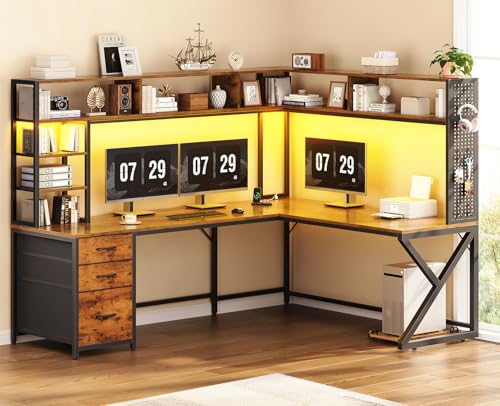
SEDETA L Shaped Computer Desk with Hutch, 3 Drawers, Shelves — Best convertible layout
The convertible is the range’s restless member: an L-shaped desk with a hutch whose layout converts into a straight arrangement stretching to 94.5 inches. Read that figure correctly — it is the desk unfolded, both wings in a line, a configuration for the room where the corner gave way to a wall, or for the household that works side by side along one long surface. As an L it is a full corner desk with three drawers, shelves and a file drawer; converted, it is the longest desk in this guide by a wide margin. Few desks survive a change of room shape; this one was designed for it.
The hutch carries the pegboard, which changes the storage’s character from shelving to hanging: tools, headphones, cables and controllers on hooks at eye level, rearranged in seconds as the work changes. Pegboard is the maker’s answer for the making-and-gaming desk, and paired with the LED lights and the brown finish it gives this pick a workshop warmth the display and farmhouse models do not attempt. The file drawer in the base keeps one foot in the office world — records below, tools above, a combination that suits the home worker whose job has a physical side: the repairer, the crafter, the engineer with a bench’s worth of small equipment.
The convertibility is not free. A desk designed to reconfigure carries joints and fixings a fixed desk does not, and the honest expectation is a structure that rewards being left in one configuration for long stretches rather than folded weekly. Buy it for the move you can foresee — the house move, the room swap, the growing household — not as a weekly transformer. Judged that way, it is the most future-proof desk here, and the only one whose second room is already planned for.
- Layout: L shape, convertible to a straight desk up to 94.5 inches
- Hutch: shelves with a pegboard
- Base storage: 3 drawers and a file drawer
- Finish: brown
- Power: built-in outlet at the surface
- Lighting: LED lights in the hutch
Strengths
- Converts from corner L to a 94.5-inch straight desk.
- Pegboard hutch suits tools, headphones and making gear.
- File drawer keeps records capacity in a flexible desk.
Trade-offs
- Reconfiguration is an event, not a weekly habit.
- The 94.5-inch figure needs a long wall to mean anything.
- Pegboard storage is open — nothing is concealed.
Best for: a worker whose room will change shape — movers, growing households, side-by-side workers. Not suited for: a settled corner that wants the most rigid, finished structure.
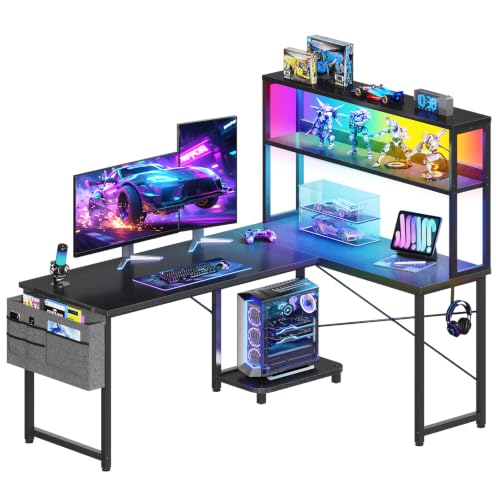
Coleshome L Shaped Gaming Desk with Hutch & LED Light — Best compact hutch desk
The Coleshome is the guide’s relief from scale: 53 inches, black, reversible, a gaming desk whose hutch brings the format down to a size a bedroom corner can hold. It is also one of the two picks not made by the category’s dominant maker, and its configuration shows a different mind at work — an adjustable shelf in the hutch rather than fixed cabinetry, a CPU stand below, a storage bag and a steel hook handling the clutter that gaming generates. Where the big SEDETAs organise like offices, the Coleshome organises like a gaming station, because that is its room.
The adjustable shelf is the detail to appreciate. Hutch shelves are usually fixed at heights chosen by the maker; an adjustable one adapts to the actual objects — the tall model, the console stood upright, the stack of game cases — and readapts when the objects change. In a teen’s or young gamer’s room, where the inventory turns over yearly, that adaptability outlasts any fixed configuration. The CPU stand keeps the tower off the carpet and breathing; the steel hook gives the headset its permanent address; the bag swallows the soft remainder. The LED light does the evening work of making the corner feel like a station rather than a desk.
The limits are the compact format’s own: 53 inches is a single-screen station with a return, not a sprawling setup, and there is no file drawer or paperwork capacity anywhere in the design — nor should there be. Buyers cross-shopping this against the SEDETA gaming model below are choosing between compact adaptability and a larger, drawer-carrying build. For the bedroom gaming corner that is this desk’s named territory, the Coleshome’s size is not its compromise; it is its qualification.
There is also a household negotiation embedded in this desk’s design. A gaming corner in a shared bedroom or a family room survives on its ability to look intentional, and the Coleshome’s hutch — gear shelved, headset hooked, tower standing in its place — reads as a station rather than a spill. Parents choosing a desk for a teenager’s room, and partners sharing a room with a gaming corner, are really buying that intentionality: everything has a place, so the place stays kept. It is the same argument the farmhouse executive makes for paperwork, translated into the dialect of headsets and controllers.
- Overall size: 53 inches
- Layout: reversible L
- Hutch: adjustable shelf, with LED light
- Base storage: CPU stand, storage bag, steel hook
- Finish: black
- Aimed at: gaming and home office corners
Strengths
- The hutch format at a bedroom-friendly 53 inches.
- Adjustable hutch shelf adapts to changing gear.
- CPU stand, bag and hook answer gaming clutter specifically.
Trade-offs
- No drawers or file storage for paperwork of any kind.
- A single-screen scale; multi-monitor setups will crowd it.
- Black gaming styling is one committed look.
Best for: a bedroom gaming corner that wants a hutch without executive scale. Not suited for: an office worker with documents to store.

Reversible L Shaped Desk with Drawers, Hutch and Storage Shelves — Best display cabinet value layout
The second non-SEDETA pick is the unbranded all-rounder: a reversible L with drawers, a hutch with storage shelves and a display cabinet, LED lights and a power outlet, in brown and black. Its configuration is the hybrid this guide’s earlier sections described — drawers below for the small and the private, a display cabinet above for the shown, shelves between — and it is the desk for the room that is office and hobby space in the same day, which is most rooms that have hutches at all.
Reversibility is worth more here than on a plain desk, because a hutch desk is harder to place: the hutch’s relationship to the window, the door and the room’s light decides the desk’s comfort, and a reversible build lets the whole structure mirror itself to suit the corner it actually meets. The display cabinet borrows the flagship idea from the big SEDETA — a lit, glazed home for the objects worth seeing — at a less architectural scale, and the drawers give this pick the paperwork foothold the gaming desks lack: not a file drawer’s archive, but a working set of drawers for the documents a hybrid room produces.
The unbranded nature cuts the way unbranded usually cuts: the configuration is complete and the value proposition plain, while the long-term certainties — spare parts, a maker’s catalogue to match a second piece against — are thinner than the dominant maker’s. Buyers furnishing a room as a one-off, who want the display-cabinet idea without the 67-inch commitment, are this desk’s audience. It is the guide’s middle path, and it walks it competently.
One more virtue belongs to the hybrid layout and deserves naming: it ages across uses better than the specialist desks. The room that is a gaming corner at eighteen becomes a study at twenty-two and an office at twenty-six, and a desk with drawers, shelves and a display cabinet can be re-read at each stage — games out, books in; models out, files in — without the structure itself becoming wrong. The specialist picks serve their stage better; this one serves the sequence of stages, which for a first proper desk is often the wiser purchase.
- Layout: reversible L
- Hutch: storage shelves with a display cabinet
- Base storage: drawers
- Finish: brown and black
- Power: an outlet built into the desk
- Lighting: LED lights
Strengths
- Hybrid storage: drawers below, display cabinet above.
- Reversible build suits awkward corners and changing light.
- The display-cabinet idea at a moderate scale.
Trade-offs
- No file drawer — drawers only, for paperwork.
- Unbranded: thinner long-term parts and matching-furniture prospects.
- Neither full gaming nor full executive — a deliberate middle.
Best for: a hybrid office-and-hobby room that wants display and drawers in one moderate desk. Not suited for: a records-heavy practice or a buyer building a matched furniture set.

SEDETA L Shaped Gaming Corner Desk with Drawers and Hutch — Best gaming configuration
The fourth SEDETA is the gaming configuration of the maker’s own range: a reversible corner desk with drawers, a hutch with storage shelves and a pegboard, LED lights and a power outlet, in rustic brown. Set it against the Coleshome, its natural rival, and the maker’s approach shows: where the Coleshome stores gaming gear in bags and on hooks, this desk gives it drawers and a pegboard — closed storage and hanging storage, the two systems a gaming room with paperwork ambitions actually uses. The rustic brown finish also widens its rooms: it can sit in a living room or a study without the black gaming silhouette announcing itself.
The pegboard is the hutch’s working element, and in a gaming context it earns its place daily — headset, controllers, cables, the tools of the hobby, hung at eye level and rearranged as the setup evolves. The drawers below take the rest: the games, the spare parts, the documents a gaming household still somehow produces. Reversibility lets the return and its storage sit on the side the room dictates. As a system, it is the most complete gaming hutch desk here, trading the Coleshome’s compactness for capacity.
Size is the question the listing leaves to its own dimension details, so buyers should confirm the footprint against their corner before ordering rather than assuming the Coleshome’s 53 inches or the big models’ 67. What can be said from the configuration is the intent: a corner gaming station meant to stay, with storage for the hobby’s whole inventory, in a finish that survives the room’s other uses. Gamers whose corner is permanent and whose gear has outgrown a bag-and-hook system are this desk’s exact audience.
The drawers change the gaming room’s daily texture in a way worth spelling out. Gaming clutter is mostly small, valuable and losable — dongles, drives, cables, spare parts, the second controller — and a drawer bank gives it a closed, dust-free, findable home that open shelving never quite manages. Paired with the pegboard for the grabbable and the shelves for the bulky, the desk covers the hobby’s three storage classes in one structure. That completeness is the maker’s range experience showing: this is a configuration refined against how gaming corners actually accumulate, not a desk with a hutch added as an afterthought.
- Layout: reversible L corner desk
- Hutch: storage shelves with a pegboard
- Base storage: drawers
- Finish: rustic brown
- Lighting: LED lights
- Power: outlet at the surface
Strengths
- Drawers plus pegboard cover gaming storage completely.
- Rustic brown sits comfortably in living rooms and studies.
- Reversible build places the storage where the room wants it.
Trade-offs
- Footprint must be confirmed from the listing before ordering.
- No file drawer for a true document load.
- Open pegboard storage shows everything it holds.
Best for: a permanent gaming corner with a growing inventory of gear. Not suited for: a compact bedroom where the Coleshome’s 53 inches is the ceiling.
How Do the Six Configurations Compare Side by Side?
| Pick | Size | Hutch | Base storage | Character |
|---|---|---|---|---|
| SEDETA 67 x 65 | 67 x 65 in | Glass display cabinets | File drawer | Display flagship |
| SEDETA Farmhouse Executive | 67 in | Doored storage | 4 drawers, cabinet, file drawer | Concealed executive |
| SEDETA Convertible | L, or 94.5 in straight | Shelves, pegboard | 3 drawers, file drawer | Flexible layout |
| Coleshome Gaming | 53 in | Adjustable shelf | CPU stand, bag, hook | Compact gaming |
| Reversible Display Desk | Reversible L | Shelves, display cabinet | Drawers | Hybrid all-rounder |
| SEDETA Gaming Corner | Reversible L | Shelves, pegboard | Drawers | Full gaming system |
Read the Character column as the shortlist. Display, concealment, flexibility, compactness, hybrid, gaming system — six answers to the question of what a wall of storage is for. The maker column would bore you: four of the six rows share a badge, as the intro promised. Configuration is the comparison that matters in this class, and it is the one the table makes.
What Mistakes Do Hutch Desk Buyers Keep Making?
The first is shopping for brand diversity that this shelf does not contain, and ending with a worse desk bought for its badge. The class is dominated by one maker; the correct response is to compare configurations rigorously, including the dominant maker’s own models against each other, rather than to import a weaker desk for variety’s sake. The second mistake is the reverse error — treating two finishes of one desk as two desks, in a shortlist or in a comparison, and double-counting a single option. A finish is a choice within a pick, not a pick.
The third is loading the hutch like a bookcase and the base like a shelf — heavy above, light below — when stability and sense both demand the opposite. Files and document boxes belong in the base’s drawers and cabinets; the hutch takes the light, the visible and the weekly. The fourth is forgetting the hutch’s shadow: buyers plan the storage and forget the surface beneath it needs light, then wonder why the desk feels gloomy at noon. The built-in LED lighting on most picks mitigates it; a desk lamp completes the answer, and both should be planned before the first week, not discovered during it.
The fifth is measuring the floor and forgetting the wall. A hutch desk needs its wall — flat enough, free of the picture rail, the radiator pipe, the awkward socket at hutch height — and it needs the ceiling’s clearance at the tightest point of the delivery path if it is ever to be moved between rooms. Walk the whole route and the whole wall with a tape before ordering; a hutch desk is the least returnable object in this entire batch of guides, and the buyers who measure twice are the ones who never learn that personally.
Final Recommendation
Choose the configuration, and let the badge fall where it falls. A collection to display: the SEDETA 67 x 65. An office to conceal: the farmhouse executive. A room that will change: the convertible. A bedroom gaming corner: the Coleshome at 53 inches, or the SEDETA gaming desk if the corner and the inventory are bigger. A hybrid room that does everything: the reversible display desk. Four of those answers wear the same maker’s name, and after the reading above, that should read as a fact about the shelf rather than a flaw in the shortlist.
Before ordering any of them, do the two unfashionable things: photograph your corner and your above-desk inventory as they are today, and measure the wall as carefully as the floor. The photograph tells you which hutch — glass, doors, board or shelf — your actual belongings are asking for; the wall measurement tells you whether the desk that answers can stand there. Buyers who skip the photograph buy the hutch for an imagined inventory, and spend the first year storing real things in a structure designed for imaginary ones.
Whichever configuration you choose, build it in its corner, level the base before the hutch goes on, and load the storage heavy-low and light-high from the first day. A hutch desk bought and built that way stops being furniture you store things in and becomes the wall your work has always wanted — the corner of the room that finally holds everything, at eye level, in its place, behind glass or doors or on its hooks, exactly where you left it.
Frequently Asked Questions
Is it a problem that most of these desks come from one maker?
It is a fact to shop with, not a problem to solve. One maker, SEDETA, has built out this exact class — L-shaped desks with integrated hutches — more completely than its rivals, so its models dominate any honest shortlist. The practical consequences are mild: design language and fittings are consistent across the range, and the real comparison becomes configuration against configuration. The two non-SEDETA picks here show where alternatives exist; neither was included to fill a quota.
Can a hutch be added to a plain L desk later instead?
A separate shelf unit placed on a desk is not a hutch in the structural sense: it is unattached weight on a surface never designed for it, with a tipping risk and a visual mismatch. Wall-mounted shelves above a plain L desk are the safer retrofit and give much of the storage honestly. But the integrated hutch — braced to the desk, finished as one object, with its cabinets and lighting built in — is a different and better thing, and buyers who know they want one should buy the desk that has it.
How tall is the storage above these desks, practically?
Tall enough that the top shelf belongs to the rarely reached and the lightly loaded — which is why this guide insists on heavy-low, light-high loading. The eye-level and just-above shelves are the hutch’s working territory: reference books, display pieces, the pegboard’s hanging gear. If your inventory needs frequent access to everything, a hutch is the wrong shape and a low, wide storage desk or a bookcase beside the desk will serve you better than any pick here.
Does the 94.5-inch convertible really work as one long desk?
That is its designed party trick: the L’s two wings reconfigure into a straight run of up to 94.5 inches, suiting a long wall or two people working side by side. Treat the conversion as an occasional rearrangement — a move, a room change — rather than a weekly transformation, since the joints that allow it are worked each time. Buyers whose rooms are settled should prefer a fixed desk’s rigidity; buyers facing a foreseeable change of room shape get genuine insurance from this pick.
Are LED lights on a desk useful or just decoration?
Mostly ambience, with one practical exception this guide has noted: a hutch shades its own desk, and lighting built into the hutch’s underside returns light to the surface the structure shadows. As display lighting inside glass cabinets — the big SEDETA’s arrangement — it also does real work. What it should never be is the deciding feature between two desks; choose on size, hutch contents and base storage, and let the lighting be the pleasant remainder.
Does a hutch desk make a small room feel smaller?
It makes the corner feel fuller and the floor feel freer, and most owners count that a fair trade. The hutch concentrates the room’s storage into one vertical claim instead of letting it spread across shelves, boxes and surfaces elsewhere. The risk is a dark or low-ceilinged corner, where a tall dark structure can loom — the lighter finishes and the glass-fronted configurations exist partly to answer that, and a buyer with a gloomy corner should weigh finish as a light decision, not just a style one.
Will a hutch desk fit through my doors and up my stairs?
As a flat pack, almost certainly — panels travel where assembled furniture cannot. The questions are the longest panel against your tightest turn, and the assembled desk’s final position, because a built hutch desk does not move between rooms without partial disassembly. Measure the route for the panels and the corner for the desk, and plan to build it where it will live. That planning, done once, is the whole of the delivery risk in this class.
Related Guides
A hutch desk stores upward from a fixed base; the next guide takes the opposite approach to the same desk, with our roundup of the best desktop standing desks covering the converters that raise a workstation from its surface. For sit-stand at full scale, the best large standing desks guide examines the largest electric desks and what their extra width is actually for. And for readers who liked the hutch’s freedom from anything electrical, the best crank adjustable standing desks guide gathers the hand-crank desks and frames that rise on muscle alone.


