What's inside
- Key Takeaways
- Quick Picks
- How Were These Six Chosen for DJ Work?
- What Does Cueing Actually Demand From a Headphone?
- Why Do DJs Care About Two Jack Sizes?
- How Loud Is Too Loud in the Booth?
- How Do You Practise Cueing at Home Without a Booth?
- On-Ear or Over-Ear: Which Serves a DJ Better?
- What Belongs in a Working DJ’s Bag Besides the Headphone?
- How Does Recording Your Sets Change What You Need?
- Why Do Cables Deserve Their Own Conversation?
- How Should a Beginner Practise the Half-On Position?
- What Should You Listen for During a Soundcheck?
- Mobile DJ or Resident: Does the Job Change the Answer?
- When Should Ear Pads and Cables Be Replaced?
- Where Do These Six Sit Against Each Other?
- What Do First-Time DJ Headphone Buyers Get Wrong?
- Final Recommendation
- Frequently Asked Questions
- Related Guides
As an Amazon Associate I earn from qualifying purchases. This post may contain affiliate links at no extra cost to you.
widgetverdict.com is reader-supported. When you buy through links on our site, we may earn an affiliate commission.
Where to buy: Amazon stocks all six models gathered here, from Pioneer’s booth-bred pair through OneOdio’s jack-of-all-trades designs to a TASCAM monitor headphone that moonlights for DJs at a fraction of booth-brand money.
A DJ headphone has a stranger job than any other headphone in this series. It must shout over a room that is already shouting, isolate one ear against a PA while the other ear listens to the floor, fold into a bag that gets thrown into booths nightly, and survive being worn half-on for hours. The best dj headsets, and the industry calls them headphones far more often than headsets since most carry no microphone, are judged on cueing clarity, isolation, swivel geometry, and plain toughness rather than on hi-fi refinement. This guide’s six picks divide along those lines: two from Pioneer DJ, the booth’s house brand; three from OneOdio, covering wired, folding, and Bluetooth variations of a flexible idea; and one from TASCAM, a studio monitor headphone whose honesty suits DJs who also record.
Terminology deserves one sentence before the picks. A working DJ almost never needs a microphone in the headphone itself; the mic lives on the mixer or the booth. So this roundup follows the products rather than the keyword’s wording, and every pick below is a monitoring headphone built for cueing, mixing, or the studio-desk work around a DJ set. If you need a broadcast headset with a boom mic, that is a different guide on this site, linked at the foot of this page.
Key Takeaways
- Swivel and fold geometry matters as much as sound: the HDJ-CUE1’s swivel earcups and foldable frame are built for one-ear cueing and bag life.
- Pioneer’s HDJ-X5 is the professional step in this group, aimed at working DJs who need a booth tool rather than a starter pair.
- OneOdio’s wired models carry both 3.5mm and 6.35mm jacks, ending the adapter hunt between controllers, mixers, and laptops.
- The OneOdio A70 adds Bluetooth with a stated 72-hour playtime to wired DJ connections, a hybrid for travel and practice.
- The TASCAM TH-02 is a studio monitor headphone first, suited to DJs who produce and record as much as they play out.
- None of these six is a headset with a boom microphone; DJ monitoring and broadcast headsets are different tools.
Quick Picks
| Pick | Badge | Why it earns its place |
|---|---|---|
| Pioneer DJ HDJ-CUE1 | The starter booth pick | On-ear, foldable, with swivel earcups for one-ear cueing, designed by the brand that equips most booths. |
| Pioneer DJ HDJ-X5 | The working DJ’s Pioneer | A professional model from Pioneer’s DJ line for players whose headphones are tools of the trade. |
| OneOdio Wired DJ Hi-Res | The dual-jack all-rounder | 50mm drivers and both 3.5mm and 6.35mm connections for controllers, mixers, keyboards, and guitars. |
| OneOdio A71 | The folding studio-DJ crossover | Hi-Res wired over-ears that fold, with both jack sizes, for recording, monitoring, and mixing. |
| OneOdio A70 | The Bluetooth hybrid | Wireless listening with a stated 72 hours of playtime, plus wired jacks when the booth demands a cable. |
| TASCAM TH-02 | The honest monitor bargain | A wired studio monitor headphone with a quarter-inch adapter, for production desks and practice rigs. |
How Were These Six Chosen for DJ Work?
The first filter was intended use as stated by the makers themselves. Every pick’s title names DJ work, monitoring, or mixing, because a general listening headphone rarely survives the booth’s combination of volume, folding, and one-ear wearing. The second filter was geometry: swivel cups, folding frames, or at minimum a robust over-ear or on-ear build that tolerates being worn askew for a whole set. The third was connection reality. DJ equipment speaks two jack sizes, the small 3.5mm of controllers and laptops and the quarter-inch 6.35mm of mixers and instruments, and models that natively cover both earned their places partly on that flexibility.
One deliberate inclusion deserves explaining: the TASCAM TH-02 calls itself a studio monitor headphone, not a DJ model. It stays because a large share of modern DJs produce tracks, record mixes, and practise on production desks, and a monitor’s flatter voice serves those hours better than a bass-lifted booth tuning. As throughout this series, specifications come only from the listing titles; where a title is terse, as Pioneer’s HDJ-X5 listing is, the spec box reports the terseness rather than decorating it with figures borrowed from reviews.
What Does Cueing Actually Demand From a Headphone?
Cueing is the DJ’s private channel: the next track, heard in one ear, beat-matched against the track the room is hearing through the other. It demands three things ordinary listening does not. First, clarity at volume, because the cue ear competes with a PA system a few metres away; a headphone that distorts or turns harsh when pushed will be pushed anyway and will fatigue its wearer by midnight. Second, isolation in the cup that stays on, so the cued track is not drowned by the room leaking in. Third, a midrange that keeps kick drums and hi-hats distinct, because beat-matching is done on transients and rhythm, not on bass weight. A headphone can be a glorious listening device and a poor cueing tool if its low end swamps those cues.
The wearing geometry follows from the job. One cup on, one cup off, repeated hundreds of times a night, is why swivel earcups appear in the HDJ-CUE1’s title and why folding frames run through the OneOdio designs. A rigid hi-fi headphone resents that treatment; a DJ headphone is engineered around it. When you read the pick sections, weigh every sound comment against this workload. The question is never simply how a model sounds on a quiet afternoon. It is how it sounds at one in the morning, half-worn, at volume, for the two hundredth cue of the night.
Why Do DJs Care About Two Jack Sizes?
Because the booth is a museum of connectors. A DJ controller or laptop offers the small 3.5mm socket. A club mixer, an audio interface, a keyboard, or a guitar amp expects the quarter-inch 6.35mm plug. Adapters bridge the gap and are famous for two behaviours: getting lost, and adding a wobbly joint exactly where a cable gets yanked. OneOdio’s answer, repeated across its three models here, is to build both connections into the headphone’s world, with dual jacks or cables for each size, so the same headphone walks from a bedroom controller to a club mixer without a pouch of brass adapters. The TASCAM takes the older studio route, a quarter-inch adapter supplied for its wired plug.
Pioneer’s models assume the professional ecosystem instead, where the mixer is a known quantity and the cable is chosen for it. Neither philosophy is wrong; they serve different gigs. A mobile DJ who plays weddings on a controller, birthdays on a laptop, and the occasional bar with a house mixer should weight the dual-jack flexibility heavily. A resident DJ who plays one room on one mixer can ignore the whole question and choose on sound and fit alone. Know your venues before you weight this section, because the right answer is written in your diary, not in a spec sheet.
How Loud Is Too Loud in the Booth?
Loud enough to hear the cue clearly over the room, and not one notch further, is the only safe rule, and it is harder to follow than it sounds because booths are noisy and adrenaline is a volume control of its own. Isolation is the health feature here: a cup that seals well, like the CUE1’s swivelling on-ear design worn properly, lets you cue at a lower level than a leaky one, and that difference, repeated over years of weekends, is the difference between a long career and a short one. Take the headphone off entirely between mixes when the set allows; your ears reset faster than you expect, and the next cue will sound clearer for the rest.
Monitor speakers in the booth, where fitted, change the equation helpfully: a good booth monitor lets the headphone rest more and cue at lower levels, so if your regular room offers one, position yourself to use it and treat the headphone as the precision tool rather than the only tool. Where no monitor exists, the headphone carries the whole load, and isolation quality becomes the health specification you should shop by first.
Volume discipline also protects the music. A DJ cueing at punishing levels loses fine judgement about how the room itself sounds, and the set’s balance suffers in ways the crowd feels without naming. Treat the cue level as a tool you set during soundcheck, in a calm room, and then defend against the night’s excitement. Your future hearing is part of your equipment list, and unlike everything else in the bag, it has no replacement model.

Pioneer DJ HDJ-CUE1 — The starter booth pick
The CUE1 is Pioneer’s invitation model, and its title reads like a checklist of what a first DJ headphone must do: on-ear wearing, wired connection, a foldable frame, swivel earcups, and clear cueing. The swivel cups are the heart of it. They rotate so one cup can sit against your ear while the other rests aside, and they fold so the headphone travels in a bag without occupying the space a rigid pair demands. Pioneer describes the model as built for new and everyday DJs, which is honest positioning; this is the headphone for the bedroom-to-first-gigs years, tuned to make cueing legible rather than to flatter a mastered album.
On-ear wearing is a deliberate DJ tradition worth understanding. A smaller cup that sits on the ear seals quickly, comes off quickly, and lets the free ear hear the room without a gap, which suits the constant on-off rhythm of cueing. The trade is pressure: an on-ear cup holds on by pressing, and some heads find an hour of that pressure more tiring than an over-ear’s embrace. The listing names the colour as dark silver and keeps its other figures close; driver dimensions and cable details are not in the title, so a buyer comparing raw specifications should read Pioneer’s own documentation alongside the listing. What the title does promise, foldable, swivelling, cueing-focused design from the company whose mixers fill most booths, is the substance of the recommendation.
- Design: on-ear, wired, foldable, with swivel earcups
- Purpose stated: DJ monitoring with clear cueing
- Audience stated: new and everyday DJs
- Colour: dark silver
- Driver size: absent from the listing title; Pioneer DJ documentation carries the specification for buyers comparing figures
- Cable arrangement: not detailed in the title, so check the listing contents for length and connector before a gig depends on it
Strengths
- Swivel earcups serve the one-ear cueing position that defines booth work.
- Folding frame travels in a gig bag without the bulk of rigid headphones.
- Pioneer DJ’s booth heritage means its tuning priorities match the job’s real demands.
Trade-offs
- On-ear pressure tires some wearers across a long night of constant cueing.
- The title publishes few technical figures, so spec-led comparison shopping needs the maker’s documentation.
- Its starter positioning means heavy touring use will eventually argue for the professional tier above it.
Best for: a new DJ building a first rig who wants booth-correct geometry from the start. Not suited for: a wearer who knows on-ear pressure bothers them within the first hour, since a whole set multiplies that discomfort.
Look at the CUE1 listing on Amazon for its cable and accessory contents, which decide how booth-ready it is out of the box.
Pioneer DJ HDJ-X5 — The working DJ’s Pioneer
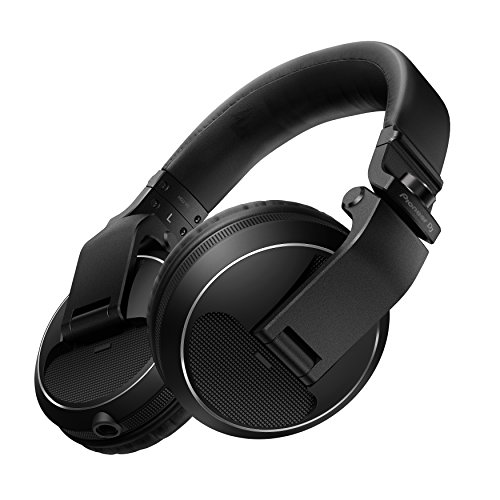
The HDJ-X5’s listing title is the shortest in this guide: professional DJ headphones, black, and little else. That terseness cuts two ways. It tells you the model’s intent without ambiguity, a professional tool in Pioneer’s DJ line, positioned above the CUE1’s starter brief for DJs whose headphones earn money and absorb punishment nightly. It also withholds every figure a comparison shopper wants, driver size, weight, cable type, folding behaviour, and this guide will not fill those gaps from outside knowledge, because the listing a buyer receives is the contract that matters. Pioneer DJ’s documentation is the correct source for the X5’s engineering detail, and a professional buyer should read it before ordering, the way you would read any tool’s manual before a season of work.
What can be said from positioning alone is still useful. The X line exists for working DJs, and its design priorities in Pioneer’s range are durability under booth conditions and sound that stays legible at booth volumes. A resident or touring DJ choosing between the two Pioneers here is really choosing a duty cycle: the CUE1 for learning and lighter schedules, the X5 for the calendar where the headphone is opened five nights a week and expected to shrug off being dropped, sat on, and rained with the general weather of nightlife. If that is your calendar, the professional model’s premium is not a luxury; it is the cost of not replacing a starter pair mid-season. Verify the folding and cable arrangements in documentation, since your bag and your mixer will have opinions about both.
- Designation: professional DJ headphones, per the listing title
- Colour: black
- Brand line: Pioneer DJ
- Technical figures: the listing title publishes none, so Pioneer DJ documentation is the required verification route for driver, weight, and cable specifications
- Wearing style: not specified in the title; confirm in documentation if on-ear versus over-ear is a fixed preference
- Accessories: the title lists none, so read the box contents on the listing page before assuming cables or adapters travel with it
Strengths
- Professional positioning in the booth’s house brand, aimed at working duty cycles.
- A step up in intended durability from the starter CUE1 for DJs playing constantly.
- Pioneer’s DJ tuning priorities favour cue legibility at real booth volumes.
Trade-offs
- The listing title is nearly bare, so every specification requires a documentation detour before purchase.
- Its professional tier will be wasted money on a hobbyist who plays monthly at home.
- Buyers who need published figures to justify a purchase will find the OneOdio listings more forthcoming.
Best for: a working DJ whose headphones are opened nightly and must be treated as professional tools. Not suited for: a first-time buyer who wants every specification printed on the listing before spending.
Pair the HDJ-X5 listing on Amazon with Pioneer DJ’s documentation page, and judge the two together as one specification.

OneOdio Wired DJ Hi-Res — The dual-jack all-rounder
OneOdio’s wired DJ model makes the most pragmatic pitch in this guide: 50mm drivers, a Hi-Res designation, and both 3.5mm and 6.35mm jacks, so the same headphone serves a PC, a keyboard, and a guitar as readily as a DJ controller or mixer. That instrument list in its title, PC, keyboard, guitar, reveals the model’s real identity. It is a generalist for people whose music-making crosses devices all week: producing at a desk on Monday, practising keys on Wednesday, playing a party set on Saturday. The dual-jack arrangement is the enabling feature, because each of those devices traditionally demands its own adapter, and adapters are where sessions go to die.
The 50mm driver figure is the largest stated in this roundup, and in a DJ context a big driver brings headroom: the ability to play a cue loudly without the sound tightening into distortion. Headroom is not the same as quality, and OneOdio’s tuning across its range favours an energetic low end that flatters dance music while asking critical listeners to accept some generosity in the bass. For cueing, that energy is rarely a problem, since the kick drum is the metronome of beat-matching and a headphone that presents it boldly makes the job easier. The title does not describe folding or swivel behaviour for this model, so a DJ for whom one-ear geometry is non-negotiable should confirm the cup movement in the listing details or look at the A71 below, whose foldable design is stated outright.
- Drivers: 50mm, stated in the listing title
- Designation: Hi-Res, wired, over-ear
- Connections: dual 3.5mm and 6.35mm jacks
- Uses named: studio monitoring, recording, podcasting, mixing, DJ work, PC, keyboard, guitar
- Colour: black
- Cup movement: swivel or folding behaviour is not described in the title, so the listing detail section is where to verify it
Strengths
- Both jack sizes built in ends the lost-adapter problem across controllers, mixers, and instruments.
- Stated 50mm drivers offer volume headroom for cueing over a loud room.
- Its cross-device brief suits musicians whose week mixes production, practice, and DJ sets.
Trade-offs
- Cup geometry is unstated in the title, a real gap for DJs who cue one-eared all night.
- Energetic bass tuning flatters dance music more than it serves critical mixing decisions.
- A generalist’s breadth means a booth specialist like the X5 may still outlast it under nightly abuse.
Best for: a musician-DJ who moves between controller, keyboard, and desk and hates adapters. Not suited for: a purist who needs a confirmed swivel cup and will not buy until the geometry is proven.
The wired OneOdio listing on Amazon details its cable arrangement, which is the feature to study if the dual-jack life appeals to you.

OneOdio A71 — The folding studio-DJ crossover
The A71 narrows its sibling’s brief toward the studio end of DJ life. Its title names recording, monitoring, and mixing first, adds a foldable design the wired model above does not claim, and keeps the dual 3.5mm and 6.35mm jack pairing that makes OneOdio easy to live with. Foldability changes a headphone’s biography: it goes in the bag, on the train, to the studio across town, and that travel is where most headphones die. A model designed to fold is a model designed to be carried, and for a DJ who records mixes at a friend’s studio or produces in shared spaces, that is a working feature rather than a convenience.
Hi-Res wired over-ears with a studio brief tend toward a more even-handed tuning than booth-first models, and the A71’s positioning suggests the same: a headphone for hearing a mix as it is, then still cueing with it at night. The title does not state a driver diameter for the A71, an omission worth noticing after its sibling published 50mm so proudly; assume nothing, and check OneOdio’s documentation if the figure matters to you. What is stated, the fold, the jacks, the studio-to-DJ spread, describes a headphone for the producer-DJ whose hours split between making tracks and playing them, and whose bag space is as contested as their calendar.
- Design: wired over-ear, foldable, stated in the listing title
- Designation: Hi-Res studio headphones for DJ and mixing use
- Connections: 3.5mm and 6.35mm jacks for PC, computer, and DJ equipment
- Colour: black
- Driver diameter: not given in the listing title; OneOdio documentation holds the figure for verification
- Microphone: none described; this is a monitoring headphone, not a communications headset
Strengths
- Foldable design is built for the bag, where DJ headphones actually spend their lives.
- Dual jack sizes keep it compatible from laptop to mixer without adapter chains.
- Studio-leaning brief serves production and mix-recording hours as well as sets.
Trade-offs
- Driver size goes unstated, frustrating direct comparison with its 50mm sibling.
- A crossover tuning may feel less booth-aggressive than Pioneer’s purpose-built cueing models.
- Folding hinges are moving parts, and moving parts are where heavy-handed owners eventually find wear.
Best for: a producer-DJ who travels between studios and sets with one bag and one headphone. Not suited for: a resident club DJ who never folds a headphone and would rather spend on booth durability alone.
Open the A71 listing on Amazon to inspect the hinge design in its photographs, since the fold is this model’s whole argument.

OneOdio A70 — The Bluetooth hybrid
The A70 asks a heretical question: what if the DJ headphone also handled the journey home? Its title pairs Bluetooth wireless with a stated 72 hours of playtime, then keeps the wired 3.5mm and 6.35mm jacks for studio monitoring, mixing, guitar, amp, and PC. That combination respects a professional truth and a human one. The professional truth is that booths run on cables, and no sensible DJ cues over Bluetooth with its latency and its battery risk. The human truth is that the same person wears the headphone on the train, in the airport, and while preparing a set at a kitchen table, and wireless freedom serves all of those hours. The A70 is wired where it must be and wireless where it can be.
Seventy-two hours of stated playtime changes the charging psychology entirely; this is a headphone you charge when you remember, not when you must, and a forgotten charge still leaves the wired jacks as a complete fallback rather than a dead product. For practice sessions, wireless is genuinely useful, letting a DJ move around a home setup while preparing. For the set itself, plug in. The title does not state driver size or folding behaviour for the A70, so, as with the A71, documentation carries those answers. Judge this model as a travel-and-practice headphone with full booth credentials in reserve, and its priorities make complete sense.
- Connection: Bluetooth wireless plus wired 3.5mm and 6.35mm jacks
- Playtime: 72 hours as stated in the listing title
- Designation: Hi-Res, over-ear, DJ studio brief
- Uses named: studio monitoring, mixing, guitar, amp, PC
- Colour: black
- Driver and folding details: not published in the listing title; OneOdio’s documentation is the place to confirm both
Strengths
- Wireless freedom with a long stated playtime covers travel, practice, and everyday listening.
- Full wired jacks remain available, so the booth never depends on a battery or a radio link.
- One headphone replaces the separate travel pair many DJs otherwise carry.
Trade-offs
- Bluetooth latency rules wireless out for live cueing; the cable remains mandatory in the booth.
- Electronics add weight and a battery that will age, unlike the purely wired picks here.
- Its hybrid breadth means a dedicated booth tool may still beat it on pure cueing toughness.
Best for: a travelling DJ who wants one headphone for the flight, the practice session, and the set. Not suited for: a traditionalist who wants no battery, no radio, and no electronics between the mixer and their ears.
Read the A70 listing on Amazon for its wired cable contents, since the hybrid promise depends on those cables being in the box.
TASCAM TH-02 — The honest monitor bargain
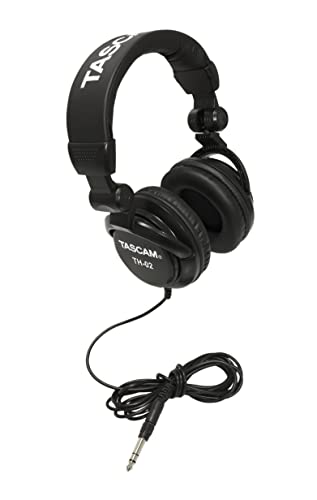
The TH-02 arrives from a different building entirely: TASCAM makes recording equipment, and this is a professional studio monitor headphone that its title aims at recording, podcasting, DJ work, music, and guitar, with a quarter-inch jack adapter in the package. A monitor headphone’s virtue is honesty. Where booth models may lift the bass to survive a loud room, a monitor tries to tell the truth about a mix, and that truth is what a DJ needs when recording a set for release, checking a production, or practising at home where no PA competes. Many working DJs quietly own a pair like this for the desk and a tougher pair for the bag, and the TH-02’s accessible tier makes that two-headphone strategy realistic.
Its limits are the mirror of its honesty. A studio monitor is not built around one-ear cueing geometry, and its title claims no swivel or folding design, so as a primary booth headphone it asks the wearer to adapt rather than adapting itself. Its over-ear wired design and the supplied quarter-inch adapter cover mixers and interfaces comfortably, while smaller devices will use its standard plug. The title publishes no driver figure, and monitor buyers are often figure-driven, so TASCAM’s documentation is the verification route. Buy the TH-02 for the hours when truth matters more than theatre, and it will earn its keep every week you produce, record, or practise seriously.
- Design: wired, over-ear studio monitor headphones
- Adapter: quarter-inch (1/4 inch) jack adapter included, per the listing title
- Uses named: recording, podcast, DJ, music, guitar
- Brand: TASCAM, a recording-equipment maker
- Driver figure: not stated in the listing title; TASCAM documentation provides it for buyers comparing specifications
- Cueing geometry: no swivel or fold is claimed in the title, so treat it as a fixed-frame desk headphone
Strengths
- Monitor honesty serves recording, production checks, and home practice better than booth-flattered tuning.
- The included quarter-inch adapter connects it to mixers and interfaces without a shopping trip.
- Its tier makes the two-headphone strategy, desk pair plus booth pair, affordable to working DJs.
Trade-offs
- No stated swivel or folding design limits its one-ear cueing comfort in a loud booth.
- Studio tuning may sound less exciting than DJ models when the goal is pure listening pleasure.
- Technical figures are absent from the title and require a documentation check.
Best for: a DJ who records mixes and produces tracks at a desk as seriously as they play out. Not suited for: a club resident needing a folding, swivelling booth tool as their only headphone.
The TH-02 listing on Amazon is short and plain, much like the headphone; check its contents line for the adapter before ordering.
How Do You Practise Cueing at Home Without a Booth?
Recreate the booth’s essential problem at a safe scale: one ear on the cue, one ear on the room. Play your main output through a small speaker at conversation level, wear the headphone half-on as you would in a club, and practise bringing tracks in until the blend is seamless at that modest volume. The skill being trained is not loudness tolerance; it is the timing of the mix and the discipline of listening to two streams at once, and both transfer directly to the real booth. Record every practice mix and listen back the next day on a different device, because yesterday’s triumphant blend often reveals a drifting beat or a clashing key that the moment concealed.
Rotate your practice across your actual gig hardware. If you play on a controller at home and a house mixer on Fridays, cue on both during the week so neither feels foreign under pressure. Note which headphone jack each setup needs and keep the right cable in the bag permanently; the dual-jack OneOdio models forgive forgetfulness here, while the Pioneer and TASCAM picks reward a small, deliberate cable kit. Practice is where a DJ’s professionalism is built, and the headphone is the practice instrument, so its comfort across hundreds of quiet repetitions matters as much as its behaviour on the loudest night of the year.
On-Ear or Over-Ear: Which Serves a DJ Better?
The booth has voted with its habits for decades, and both answers survive because they serve different bodies and different sets. On-ear designs like the CUE1 sit on the ear itself. They go on and off in a flick, they seal fast, and they leave the wearer’s sense of the room intact, which suits DJs who cue in short, constant bursts. Their cost is pressure concentrated on a small area, and across a six-hour wedding set that pressure writes its memoir on your ears. Over-ear designs, the OneOdio trio and the TASCAM here, surround the ear and spread their hold across the skull. They isolate more, they suit long continuous wearing, and they ask a little more time to position for the half-on cueing stance.
Glasses, hair, and head size quietly rig this vote. A wearer with thick glasses frames may find an over-ear cushion seals around the arms where an on-ear cup presses them into the ear. A DJ with a smaller head may find a big over-ear sliding at the exact moment both hands are busy. The only reliable test is a full practice session in the exact configuration you perform in, hat, glasses, and all. Treat any headphone bought without that rehearsal as provisional, whichever badge it wears, because geometry is the one specification no listing can settle for you.
What Belongs in a Working DJ’s Bag Besides the Headphone?
The headphone is the star of the bag, but the supporting cast decides whether a bad night becomes a cancelled night. A spare cable, where the model permits swapping, is the single highest-value extra in DJ life, because cables fail more than drivers ever will. A quarter-inch adapter, even for dual-jack owners, rescues the evening a house mixer presents an unfamiliar face. A small torch, a roll of tape for marking your gear, and a USB stick with your library backed up complete the professional minimum. DJs who record their sets add the desk discipline of the TH-02’s world: a way to hear the recording honestly before it reaches an audience.
The bag itself deserves one rule: the headphone goes in folded or cased, never loose under a laptop. The A71’s folding design and the CUE1’s fold exist for this moment. A headphone that survives the journey arrives ready; a headphone that travels badly is a countdown. Build the habit when the gigs are small and forgiving, because the night it matters will not warn you.
How Does Recording Your Sets Change What You Need?
A recorded set is judged in quiet rooms on honest equipment, which reverses the booth’s priorities. The bass lift that helped you cue over a PA now reads as bloat on a listener’s headphones, and the blend that felt smooth at volume reveals its seams at a desk. This is why the production side of DJ life keeps pulling DJs toward monitor-style headphones like the TH-02 and the studio-leaning A71: decisions made while hearing the truth survive the journey to the audience. Record a short test mix after any change of headphone and compare it against a reference track you trust, on the new pair and on a familiar speaker, before trusting the new pair with a full set.
Recording also exposes your cueing habits. Listening back, you will hear whether you favour one side, whether your levels jump between tracks, and whether your transitions lean on the same trick. None of that is visible from inside the booth. The DJs who improve fastest treat the recording as a coach, and the headphone they check it on is the coach’s voice, which is a strong argument for owning one honest pair alongside the booth tool.
Why Do Cables Deserve Their Own Conversation?
Because the cable is where DJ headphones go to die. It gets yanked when a dancer leans into the booth, trapped under mixer cases, coiled too tightly by tired hands at three in the morning, and flexed at the same two points, the cup joint and the plug, until a conductor gives up. A coiled cable forgives the yank by stretching; a straight cable transmits it to the connector. When you evaluate any model here, look at how the cable meets the cup and whether the design gives that joint any strain relief, and decide in advance how you will coil it after every set, loosely, in the same direction, every time. Habits formed deliberately outlast hardware bought hopefully.
Cable length is a booth-ergonomics question too. Too short pins you to the mixer and punishes the reach for a record box or a drink of water; too long pools at your feet and finds every caster wheel in the building. Mobile DJs who move between a controller on a table and a mixer across a booth should measure their longest working distance before choosing, and dual-jack owners should confirm which cable lengths the box actually contains. The glamorous specifications get the attention, but the humble cable decides how the headphone feels at hour four, and hour four is when sets are won.
How Should a Beginner Practise the Half-On Position?
Start with the headphone worn normally and both tracks playing, then slide one cup back to rest above or behind the ear while keeping the other sealed. Practise until the movement is one-handed and thoughtless, because in a real set your other hand is always employed. Alternate which ear cues, even if one feels natural and the other clumsy; a DJ who can only cue on one side is hostage to booth layouts that put the monitor speaker on the wrong side. Short daily sessions beat weekend marathons for building this fluency, and quiet volumes protect the ears that the fluency depends on. Within a few weeks the half-on stance stops feeling like a technique and starts feeling like the way headphones are simply worn, which is exactly where you want it before your first paying crowd arrives.
What Should You Listen for During a Soundcheck?
Arrive with three reference tracks you know to the bone: one with a sparse, exposed kick pattern, one vocal-led, and one dense production that falls apart on weak equipment. Run each through the house system and through your cue channel, and note where your headphone’s account differs from the room’s. That difference is your personal translation table for the night; every decision you make in the cue will be filtered through it. Set your cue level against the room at its expected peak, not its soundcheck emptiness, by asking whoever runs the system to push the mains briefly to show level. A cue set in a quiet room will be buried by a full one, and raising it mid-set in a panic is how ears get hurt.
Walk the room if the venue allows it, headphone in hand, and listen to how the space itself treats bass in the corners and the centre. Your headphone cannot fix the room, but knowing the room stops you blaming the headphone for the building’s resonances and overcorrecting the mix. Finish by checking the unglamorous things: the right jack is connected, the spare cable is where you think it is, and the headphone’s fold or swivel moves freely. Soundcheck is the last calm moment of the night, and the professionals spend it on exactly this inventory.
Mobile DJ or Resident: Does the Job Change the Answer?
Considerably. A resident plays one room, learns its mixer and its monitor, and can optimise ruthlessly for that single environment; the professional Pioneer tier makes its strongest case here, where the headphone and the room grow old together. A mobile DJ plays weddings in barns, birthdays in restaurants, and corporate sets in glass atriums, carrying every cable and adapter the venue forgot. For that life, flexibility is survival: the OneOdio dual-jack models forgive unfamiliar equipment, the A70’s wireless covers the long load-in playlist and the background-music hours, and a folding frame earns its hinges weekly. Mobile work also multiplies the audience’s requests and the announcements, which is a reminder that the DJ’s own headphone still needs no microphone; the mic belongs to the mixer, and the headphone’s job stays monitoring.
Travel wear separates the two lives further. A resident’s headphone hangs on the same hook nightly, while a mobile pair is packed, driven, unpacked, and repacked hundreds of times a year, which is why this guide keeps returning to folds, hinges, and cable joints. If your diary is mobile, weight those mechanics above the last degree of tuning refinement. A headphone that arrives intact and connects to everything will outperform a finer one left at home because its adapter was missing.
When Should Ear Pads and Cables Be Replaced?
Ear pads announce their retirement honestly: the surface cracks, the foam stops springing back, and the seal you relied on for isolation turns approximate. In booth terms, worn pads cost you cue clarity and push you toward higher volumes, so they are a hearing issue disguised as a cosmetic one. Replace them when the spring leaves the foam, and keep the old pair in the bag as emergency spares. Cables announce themselves with crackle on movement, sound that drops from one side when the plug turns, or visible damage at a joint. Any of those signs before a season of gigs means replace now, at home, calmly, rather than during a first dance.
Build both replacements into the cost of ownership from the start. A working DJ who budgets pads and a cable into the year treats the headphone as the professional tool it is, and the headphone repays the respect by never choosing the worst possible moment to retire. The models in this guide sit at tiers where such maintenance is plainly worthwhile; a headphone cheap enough to discard whole is a different philosophy, and none of these six was chosen on it.
Where Do These Six Sit Against Each Other?
| Model | Form | Connection | Defining trait |
|---|---|---|---|
| Pioneer DJ HDJ-CUE1 | On-ear | Wired | Swivel cups, foldable, starter booth brief |
| Pioneer DJ HDJ-X5 | Professional DJ | Wired | Working-DJ tier in Pioneer’s line |
| OneOdio Wired DJ Hi-Res | Over-ear | Wired, dual jacks | 50mm drivers, instruments welcome |
| OneOdio A71 | Over-ear | Wired, dual jacks | Foldable studio-DJ crossover |
| OneOdio A70 | Over-ear | Bluetooth plus wired jacks | 72-hour stated playtime hybrid |
| TASCAM TH-02 | Over-ear monitor | Wired, quarter-inch adapter | Studio honesty for desk work |
Two philosophies organise that table. Pioneer sells geometry and duty cycle, headphones shaped by the booth’s physical routine. OneOdio and TASCAM sell flexibility and honesty, headphones that move between the booth, the desk, and the instrument stand. A DJ’s calendar decides which philosophy fits: nights out argue Pioneer, hours at home argue the crossovers, and many real calendars argue for one of each.
What Do First-Time DJ Headphone Buyers Get Wrong?
The commonest error is buying a listening headphone for a working job. A beautiful hi-fi model with a fixed frame and a delicate cable will sound wonderful at home and miserable in a booth, where it cannot swivel, cannot fold, and cannot take volume. Buy for the job’s geometry first and its sound second. The second error is the opposite excess: assuming a DJ headphone must be all bass. Beat-matching lives in the kick and the hats, and a headphone that buries its midrange under low end makes the central skill of DJing harder, not easier.
Third, buyers forget the cable until it fails mid-set, and cables fail at connectors, so inspect yours monthly and treat any intermittent crackle as a retirement notice rather than a quirk. Fourth, new DJs practise only at full volume, training their ears to need a level that a long career cannot sustain; practise quietly and save loudness for the room. Fifth, they buy one headphone for two incompatible jobs, booth and studio, then blame it for both. The TH-02’s presence in this guide is the standing reminder that a modest second pair, bought for the desk, often improves both jobs more than one expensive compromise improves either.
A closing word on taste, because DJs argue about headphones the way guitarists argue about strings. Your preference for a forward, energetic cue sound or a flatter, honest one is not a defect to be corrected by any guide; it is information about how you hear rhythm. Use the picks above to narrow the field by geometry, connections, and duty cycle, then let a week of practice sets arbitrate the sound. The headphone you reach for without thinking, three Fridays from now, is the right one, and every specification in this article exists to help you reach that unthinking moment sooner.
Final Recommendation
New DJs should start with the HDJ-CUE1, whose swivel cups and folding frame teach correct booth habits from the first practice session. Working DJs playing several nights a week should step to the HDJ-X5 and verify its engineering detail in Pioneer’s documentation, because at that duty cycle durability is the specification that pays. The OneOdio wired model suits the musician whose headphone must serve instruments as faithfully as decks, the A71 suits the producer who travels, and the A70 suits the DJ whose life happens on trains as much as in booths, with its cable kept ready for the set itself. The TH-02 completes the picture as the desk pair for recording and honest listening. Match the headphone to the hours you actually spend, and let the booth, the bag, and the desk each get the tool they ask for.
Frequently Asked Questions
Why do DJ headphones swivel?
So one cup can press to the ear for cueing while the other sits aside, letting the free ear hear the room. That half-on position is held for much of a set, and a cup that rotates to meet the ear keeps the seal and the comfort that a rigid cup cannot.
What if my venue’s mixer sounds different from my home setup?
Expect it to. Mixers and controllers voice their headphone outputs differently, so build your practice routine on the least flattering output you own and treat a better booth output as a bonus. A short soundcheck routine with reference tracks, described earlier in this guide, closes most of the gap.
Can I use a DJ headphone for everyday listening?
Certainly. DJ models are ordinary headphones with tougher geometry and a tuning that favours rhythm and clarity. The OneOdio A70 is the natural everyday choice here thanks to its Bluetooth mode, while the wired models serve any device with the right jack.
Do I need the quarter-inch jack?
If your mixer, interface, keyboard, or amp offers only the larger socket, yes. OneOdio’s dual-jack models and the TASCAM’s included adapter solve it natively; with other models, confirm the cable or adapter situation before the gig rather than during it.
Is Bluetooth ever acceptable for DJing?
For practice, preparation, and listening, yes. For live cueing during a set, no: wireless latency delays the cue relative to the room, and beat-matching depends on those two streams aligning. The A70’s wired jacks exist precisely so its wireless convenience never has to enter the booth.
Can I DJ with the headphones I already own for listening?
For learning at home, absolutely; any comfortable headphone teaches you beat-matching. The upgrade becomes necessary when the job’s physical demands arrive: swivelling for one-ear cueing, folding for the bag, isolation for a loud room, and connections that match booth equipment. Let the gigs, not the marketing, tell you when your listening pair has reached its limit.
How do I make a DJ headphone last?
Fold or coil it as designed, store it in the bag rather than loose, inspect the cable and connectors monthly, and keep a spare cable if your model allows swapping. Most DJ headphones die at the cable or the hinge, and both deaths announce themselves early to anyone who looks.
Should a beginner buy the professional model straight away?
Only if the calendar justifies it. A beginner playing at home gains more from the CUE1’s approachable design and spending the difference on music and practice time. The professional tier pays when the headphone works several nights a week; before that, it is capacity you have not yet grown into.
Why does my cue sound different from the room?
Because your headphone and the PA are different systems in different positions, and the room itself reshapes the PA’s sound. Learn the gap during soundcheck with reference tracks, then trust the translation you measured rather than chasing the room’s exact sound inside your cue.
What is the difference between a DJ headphone and a studio monitor?
Priorities. A DJ headphone optimises for isolation, volume headroom, and one-ear geometry in a loud room. A studio monitor optimises for an honest, even response at a quiet desk. The TH-02 represents the second philosophy, the Pioneers the first, and many DJs own one of each.
Related Guides
- Best Headsets With Great Mic Quality
- Best Xbox Series X Headsets
- Best Motorcycle Communication Headsets


