What's inside
- Key Takeaways
- Quick Picks
- How Did We Shortlist These Six Tactical Headsets?
- What Does Hearing Protection Actually Have to Do on a Range or a Field?
- Which Radio and Mounting Questions Decide Compatibility?
- The Six Tactical Headsets in Detail
- How Does Electronic Pass-Through Change What You Can Do?
- Which Headset Shape Suits Airsoft, the Range, Hunting, and Work?
- What Keeps an Electronic Headset Alive Season After Season?
- Protection Figures and Fit, Pick Against Pick
- How Do You Build Hearing Safety Into a Shooting or Field Routine?
- Which Buying Errors Put Tactical Headset Users at Risk?
- Final Recommendation
- Frequently Asked Questions
- Related Guides
As an Amazon Associate I earn from qualifying purchases. This post may contain affiliate links at no extra cost to you.
widgetverdict.com is reader-supported. When you buy through links on our site, we may earn an affiliate commission.
Where to buy: You will find all six headsets below on Amazon, spanning helmet-mounted electronic ear protection with boom microphones and slimmer in-helmet sets built purely around a two-way radio.
A tactical headset has to solve two problems that pull against each other. It must keep harmful noise — gunfire at a range, an impact tool, a roaring engine bay — away from your ears, and at the same time it must keep the useful sounds close: a range officer’s command, a teammate’s call, the radio traffic that coordinates the whole exercise. The best tactical headsets resolve that tension with electronic ears that pass quiet sound through, clamp down on loud sound, and carry a microphone that puts your voice on the radio net without you touching the handset. The six picks below were chosen for exactly that balance, and this guide is strict about the numbers: a noise reduction rating appears here only where the product’s own listing title states one.
That discipline matters because hearing protection is a safety purchase, not a convenience purchase. Two of the EARMOR models and the FMATAL GEAR headset publish an NRR figure in their titles; the Retevis and Hdlsina listings do not, and this guide will not assign them one. Where a listing is silent, the pick sections say so and tell you where to verify the figure, because an invented decibel number on a safety product is worse than no number at all. What every pick here does share is a complete headset — ear cups or in-helmet speakers, a microphone, and a radio connection — rather than a loose accessory; the only push-to-talk unit in the pool arrives bundled with its headset, the Hdlsina with its U94 PTT, and it is treated as one product throughout.
Key Takeaways
- Only three listings here publish an NRR in their titles: both EARMOR models at 22dB and the FMATAL GEAR at 26dB — the rest must be verified with the manufacturer before you rely on a figure.
- Mounting splits the field: the EARMOR M32X carries ARC rail mounts for a helmet, while the Retevis walkie-talkie headset is designed to be worn inside a helmet.
- Radio compatibility is the hidden gate — Kenwood and Baofeng compatibility is stated for the M32X, and Baofeng models are named for both Retevis picks.
- Electronic sound pickup is the feature that separates a tactical headset from plain ear muffs: it lets speech and ambient cues through while protection handles the loud events.
- The Hdlsina is the only pick whose listing bundles a push-to-talk unit (U94 PTT, 2-pin) with the headset itself.
- Fit under a helmet, sealing around glasses, and microphone discipline decide real-world performance as much as any rating.
Quick Picks
| Pick | Badge | Why it earns its place |
|---|---|---|
| EARMOR M32X Tactical Helmet Headset | The rail-mounted helmet pick | ARC rail ear muffs with mic, a stated NRR 22dB, IPX-5 waterproofing and Kenwood/Baofeng compatibility. |
| EARMOR M32 Plus Tactical Headset | The headband electronic pick | Electronic ear protection with a stated NRR 22dB and noise cancelling, in a military-helmet-ready frame with mic. |
| Retevis EHK007 Tactical Headset | The radio-first ear-pro pick | ENC, an adjustable headband and named compatibility with Baofeng UV-5R, BF-F8HP PRO and AR-5RM radios. |
| FMATAL GEAR 2026 AMP Tactical Headset | The highest stated rating | A stated NRR 26dB with digital noise reduction — the largest protection figure any listing here publishes. |
| Retevis Walkie Talkie Tactical Headset | The in-helmet radio pick | Built to be worn inside a helmet, with named compatibility across Retevis RT-series radios, Baofeng and Samcom. |
| Hdlsina Tactical Shooting Headset with U94 PTT | The bundled-PTT pick | Headset and U94 PTT 2-pin in one purchase, with an ARC rail adapter and noise reduction with sound pickup. |
How Did We Shortlist These Six Tactical Headsets?
We required a complete communication headset: ear protection and a microphone and a radio interface in one product, because a tactical headset that cannot put you on the net is just ear muffs with ambitions. We then read the listings the way a safety officer would — protection claims first, and only the claims actually printed. A stated NRR in the title counted as published data; marketing words like “noise reduction” without a figure counted as a description of intent, not a measurement, and the pick sections keep that distinction visible rather than laundering adjectives into numbers.
Compatibility was the second filter. A headset’s connector and wiring standard decide which radios it can serve, and the listings here name their radios: Kenwood and Baofeng for the M32X, specific Baofeng models for the Retevis EHK007, a spread of Retevis, Baofeng and Samcom models for the in-helmet Retevis. Picks that state their radio partners plainly save the buyer the classic tactical-gear disappointment of a headset that arrives speaking the wrong plug. Mounting came third — rail-mounted, headband, and in-helmet designs serve different helmets and different days — and the roundup deliberately includes all three approaches so the comparison is about your kit, not about one brand’s idea of a head.
What Does Hearing Protection Actually Have to Do on a Range or a Field?
Start with the physics your ears cannot negotiate with. A gunshot is an impulse: extremely loud, extremely brief, and quite capable of damaging hearing in a single unprotected exposure. Foam plugs and passive muffs answer impulse noise by blocking everything, which works for protection and fails for awareness — the wearer cannot hear a ceasefire call, a warning shout, or the radio. Electronic tactical headsets exist to split the difference. Microphones on the cups pick up the surrounding sound, electronics pass the quiet parts through to speakers inside the cups at a safe level, and the loud events are cut down before they reach the ear. You hear the conversation and the command; the shot arrives as a managed thump rather than a crack.
That is why the honest spec in this category is twofold: a protection figure for the loud events, and the quality of the pass-through for everything else. The listings here give us the first figure only three times — NRR 22dB on the two EARMOR models, NRR 26dB on the FMATAL GEAR — and describe the second in words: noise cancelling, sound pickup, digital noise reduction. Treat those words as a promise to test, not a measurement to file. And hold the line on the unstated figures: for the Retevis and Hdlsina picks, this guide reports no NRR because their titles publish none, and anyone whose range, employer, or event requires a documented rating should obtain it from the manufacturer’s documentation for that exact model before relying on it.
Double protection deserves a plain explanation, because it confuses buyers into thinking ratings add like coins. Wearing plugs under muffs does not add the two figures together; the combined protection is higher than either device alone, but by a modest margin rather than a sum, and it is governed by the weaker seal and by bone conduction, which no cup can block. The practical takeaway is simpler than the maths: in the loudest settings — indoor ranges, magnum calibres, working beside unsuppressed rifles — plugs under an electronic headset like the ones here give you the electronic awareness and a deeper cushion of protection, and the pass-through volume can be raised to compensate for the plugs. It is the arrangement professionals reach for, and it costs almost nothing to adopt.
One more protection truth that listings never mention: the seal is the spec. Ear cups protect at their published level only when the cushion seals against the head, and shooting glasses, helmet straps, and hat brims all break seals. A headset worn over thick glasses arms can leak enough to cost real protection. Part of choosing among these six is choosing the mounting and cup shape that seals against your head, with your eyewear, under your helmet — a fitting exercise no decibel figure can do for you.
Which Radio and Mounting Questions Decide Compatibility?
Work through three questions in order. First: what radio do you carry? The connector at the end of the headset’s cable — and the wiring behind it — must match that radio’s accessory port. The M32X states Kenwood/Baofeng compatibility, which covers a large share of the handhelds used in airsoft, events, and volunteer work; the EHK007 names Baofeng’s UV-5R, BF-F8HP PRO and AR-5RM; the in-helmet Retevis names its own RT21, RT22, RT68 and H777 plus Baofeng and Samcom FPCN30A. If your radio is not in a pick’s list, that pick is not for you, whatever its other virtues.
Second: where does the headset live — on a helmet rail, on a headband under a helmet, or inside the helmet’s own space? The M32X mounts to ARC rails, which means it becomes part of the helmet: donned together, stored together, adjusted once. The Hdlsina also ships an ARC rail adapter. Headband designs like the M32 Plus and the EHK007 stay independent of the helmet, which suits users who move between helmeted and unhelmeted work in the same day. The in-helmet Retevis takes the third path, sitting slim inside the helmet’s ear space for radios users who never take the helmet off during play or work.
There is a fourth, quieter question: what happens when something breaks at the event? Headsets fail at connectors, booms, and cushions, in that order, and the fix is almost never available trackside. A team that standardises on one or two models from this list can carry a single spare headset and a shared pool of cushions and cables that fit everything; a team running six different headsets carries six different failure modes and no spares that fit any of them. Standardisation is unfashionable advice in a hobby that loves variety, but for clubs, companies, and organised groups it is the difference between a broken headset being a two-minute swap and a member sitting out the day. Individual buyers can safely ignore this paragraph; organisers should underline it.
Third: how do you transmit? A boom microphone near the mouth plus a push-to-talk discipline is the standard pattern; the Hdlsina’s bundled U94 PTT puts that button in the purchase, worn on the chest or belt where a gloved hand can find it. The other picks rely on the radio’s own controls or a PTT you supply — the listings here do not bundle separate PTT units, so budget and plan for how your hand reaches the transmit button with gloves on, under time pressure, before the first event rather than during it.
The Six Tactical Headsets in Detail

EARMOR M32X Tactical Helmet Headset — The rail-mounted helmet pick
The M32X is built around the helmet rather than around the head. Its ear muffs mount on ARC rails, the accessory rails that run along modern tactical and airsoft helmets, which means the headset and helmet come off and go on as one unit and the ear cups park exactly where you adjusted them, every time. For a user who wears the helmet for hours — an airsoft player through a full milsim day, a marshal, an instructor — that repeatability is the product. The listing states an NRR of 22dB, noise cancelling ear protection, a microphone, and IPX-5 waterproofing, a rating that speaks to rain and sweat rather than submersion: this headset expects weather.
The stated Kenwood/Baofeng compatibility places it on the most common handheld-radio ecosystem in this hobby and volunteer world, so the odds are good it plugs into the radio already on your vest. Think through the rail commitment before buying, though: rail mounting is a marriage. If your work alternates between two helmets, or between helmet and cap, a rail-mounted set serves only the helmeted hours, and moving it between rails is a between-events job rather than a mid-day swap. Users whose helmet is a constant will not feel that constraint at all; users whose headwear changes with the task will feel it daily.
- Protection: NRR 22dB as stated in the listing
- Mounting: ARC rail ear muffs for helmet use
- Water resistance: IPX-5 as stated in the listing
- Radio fit: Kenwood/Baofeng compatible per the listing
- Stated roles: airsoft, military, hunting
Strengths
- Rail mounting makes the headset and helmet one repeatable unit with a consistent cup position.
- A published NRR figure and an IPX-5 rating give the buyer two checkable numbers instead of adjectives.
- Kenwood/Baofeng compatibility covers the handhelds most commonly carried in this scene.
Trade-offs
- Rail mounting ties the headset to a railed helmet; it is not the pick for cap-and-headband days.
- NRR 22dB is the lower of the two published figures in this roundup — heavy indoor-range users should weigh the FMATAL’s stated 26dB.
- The listing does not describe a headband option, so unhelmeted use is outside its design.
Best for: a helmeted airsoft player, marshal, or instructor whose radio is a Kenwood or Baofeng handheld and whose helmet carries ARC rails.
Not suited for: a shooter who works unhelmeted at a bench all day, because the rail mount has nothing to attach to without the helmet it was designed around.
EARMOR M32 Plus Tactical Headset — The headband electronic pick
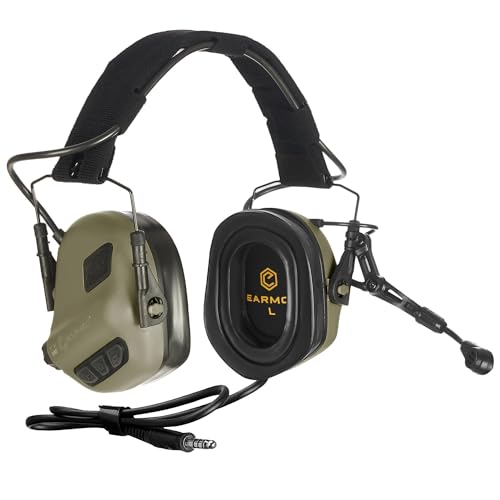
The M32 Plus takes the same electronic-protection idea as its rail-mounted sibling and puts it in a conventional headset frame: ear muffs on a headband, a microphone, electronic pass-through with noise cancelling, and the same stated NRR 22dB. Its listing calls it military helmet ready, which describes the frame’s ability to coexist with a helmet rather than attach to it — the distinction matters. A headband headset can be worn to the range in the morning, under a bump helmet at midday, and on its own again for the drive home, and that flexibility is the M32 Plus’s argument against the M32X.
There is a team dimension to the headband choice as well. Headsets that live on the person rather than on a helmet can be pooled — handed to the next shooter, the guest, the new club member — without transferring helmet fittings or re-adjusting rails. Clubs, training companies, and families that share gear across heads will find the M32 Plus’s independence administratively simpler: one headset, any head, any hat. The counterpoint is personal fit; a shared headband gets adjusted constantly, and constant adjustment is how booms end up mispositioned. If the headset will be yours alone, that objection evaporates.
For range use specifically, this is the shape most shooters already know: cups that fold or sit flat in a range bag, a boom that swings to the mouth, controls reachable by feel. The electronic pass-through is the working feature — hearing the range officer, the timer, and the shooter beside you while the cups handle the reports. Buyers cross-shopping the two EARMOR models should decide on mounting first and features second, because the protection figure and the brand’s approach are shared; what differs is whether the headset belongs to the helmet or to you.
- Protection: NRR 22dB as stated in the listing
- Type: electronic ear protection with noise cancelling
- Frame: headband headset, described as military helmet ready
- Microphone: included per the listing
- Radio compatibility: the listing title does not name specific radio brands for this model — confirm the connector against your radio in EARMOR’s documentation
Strengths
- Headband independence lets one headset serve helmeted and unhelmeted work in the same day.
- Electronic pass-through keeps commands and conversation audible between shots.
- The published 22dB figure lets a safety officer file a real number rather than a description.
Trade-offs
- A headband under a helmet can create pressure points on long days that rail mounting avoids.
- The title does not name radio compatibility, so the connector homework falls on the buyer.
- Same stated 22dB as the M32X — buyers wanting the highest published figure should look at the FMATAL listing.
Best for: a range shooter or hunter who wants electronic protection and a mic in a familiar headband frame that also fits under a helmet when needed.
Skip it if your radio pairing must be confirmed before ordering, because the title names a microphone and helmet fit but never a compatible radio family.

Retevis EHK007 Tactical Headset — The radio-first ear-pro pick
Retevis comes at this category from the radio side, and the EHK007 shows it: the listing leads with the radios — Baofeng UV-5R, BF-F8HP PRO and AR-5RM — and describes the headset as ear protection for hunting and shooting with ENC, an adjustable headband, and a well-fitting design it also pitches at racing. That breadth of named uses is honest about what this product is: a communications headset with protective cups, bought by people whose first question is whether it works with the radio already in their hand.
ENC — environmental or electronic noise cancelling, depending on the maker’s usage — addresses the microphone and pass-through clarity rather than publishing a protection measurement, and here the discipline of this guide applies in full: the EHK007’s title states no NRR, so none is claimed for it. If your range, club, or employer documents a required rating, verify this model’s figure with Retevis before purchase. If your use is airsoft, racing support, or event work where the headset’s job is communication with protective cups as a supporting feature, the EHK007’s precise radio list and adjustable fit make a straightforward case — it is the pick for the buyer who starts from the radio and works outward.
- Radio fit: Baofeng UV-5R, BF-F8HP PRO, AR-5RM named in the listing
- Noise feature: ENC as stated in the listing
- Fit: adjustable headband, described as well-fitting
- Stated roles: hunting, shooting, airsoft, racing
- Protection rating: no NRR figure appears in the listing title — request the documented rating from Retevis if your venue requires one
Strengths
- Named compatibility with three popular Baofeng models removes the connector guessing game.
- An adjustable headband suits shared use across a team whose members have different heads.
- Retevis’s radio heritage shows in a listing written around the net, not just the cups.
Trade-offs
- No published NRR in the title means the protection figure must be sourced before safety-critical use.
- Compatibility is Baofeng-centred; Kenwood or Motorola users are outside the stated list.
- The listing’s racing pitch signals a comms-first design rather than a range-protection-first one.
Best for: a Baofeng owner in airsoft, hunting, or race support who wants ear coverage and a mic matched to the UV-5R family without adapters.
Not suited for: a shooter whose range mandates a documented NRR on file, unless Retevis supplies that figure for this model in writing first.

FMATAL GEAR 2026 AMP Tactical Headset — The highest stated rating
The FMATAL GEAR headset makes the boldest protection claim in this roundup: NRR 26dB, stated plainly in its title, with digital noise reduction handling the electronic side. Four decibels over the EARMOR figure is a meaningful margin on paper — decibels are logarithmic, so a few points represent a real difference in energy reaching the ear — and for a shooter whose days are spent on an indoor range, where reflections stack the noise, the highest published figure in the group is a rational place to start. The listing frames it as hearing protection with communication, aimed at the range rather than the field.
Think about who else benefits from that margin. Instructors and range safety officers absorb more exposures in a week than most shooters do in a season, because they stand beside other people’s gunfire all day; for them, the largest published figure is not a luxury but occupational arithmetic. The same logic extends to anyone supervising new shooters, whose muzzle discipline is still forming and whose shots arrive from less predictable angles. A headset bought for the supervising role should be shopped protection-first even if the same person, shooting alone, might prioritise fit or radio features — the FMATAL’s listing speaks directly to that supervising buyer.
Two cautions keep this pick honest. First, a higher NRR is earned at the seal, not at the checkout: cups that leak around glasses or sit over a hat deliver a fraction of their laboratory figure, so fit-testing this headset with your own eyewear matters more than the gap between 22 and 26. Second, the listing is comparatively terse about the communications side — it does not name radio brands or a mounting system in its title the way the EARMOR and Retevis listings do. A buyer whose primary need is protection for range work, with comms as a secondary channel, is well served by starting here; a buyer building a helmet-and-radio system should confirm the FMATAL’s connector and mounting details with the manufacturer before treating it as interchangeable with the rail-mounted picks.
- Protection: NRR 26dB as stated in the listing — the highest figure published in this roundup
- Electronics: digital noise reduction per the listing
- Form: earmuff-style tactical headset with communication
- Radio compatibility: not named in the listing title — verify connector and wiring with FMATAL GEAR for your radio
- Model year: listed as the 2026 AMP model
Strengths
- The stated 26dB rating leads this group on the one number protection buyers compare first.
- Digital noise reduction addresses the pass-through side, not just the blocking side.
- A range-focused earmuff form suits bench and indoor-range days without helmet complications.
Trade-offs
- The title names no radio partners, so comms integration needs homework the other picks pre-answer.
- No mounting system is described in the title — helmet users cannot assume rail compatibility.
- The published figure still depends on seal; thick glasses arms can hand back the advantage.
Best for: an indoor-range or high-volume shooter who shops protection-first and wants the largest stated NRR in this group.
Not suited for: a helmet-and-radio system builder who needs named rail mounting and radio compatibility confirmed in the listing itself.
Retevis Walkie Talkie Tactical Headset — The in-helmet radio pick
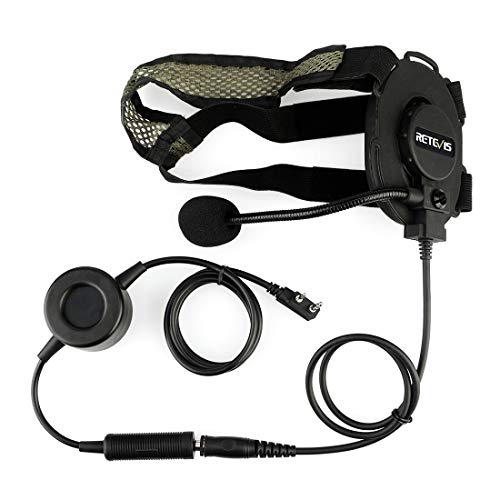
The second Retevis takes the opposite physical approach from its EHK007 sibling: instead of cups on a headband, this headset is designed to be worn inside a helmet, keeping the profile slim where a helmet’s own shell provides the structure. Its listing names the widest radio family in the roundup — Retevis’s own RT21, RT22, RT68 and H777, Baofeng’s UV-5R and BF-F8HP PRO, and the Samcom FPCN30A — which makes it the natural pick for mixed fleets: an airsoft team, an event crew, or a site team whose radios were bought across several years and brands.
In-helmet designs trade on a specific bargain. The helmet’s closeness keeps speakers positioned and the microphone near the mouth without a bulky external frame, and the whole arrangement disappears under the shell — valuable in airsoft, where snag points and bulk are gameplay problems, and in work settings where the helmet is mandatory anyway. The honest limitation is the mirror of the EHK007’s: the title presents this as airsoft ear protection within a communications headset and publishes no NRR, so the protection story must be verified with Retevis before anyone treats the in-helmet set as their documented hearing protection for live-fire environments. As a radio headset for helmeted play and work, though, its compatibility list is the most welcoming in this group.
- Fit: designed to be worn inside a helmet, with microphone
- Radio fit: Retevis RT21/RT22/RT68/H777, Baofeng UV-5R and BF-F8HP PRO, Samcom FPCN30A per the listing
- Stated role: two-way radio airsoft ear protection
- Protection rating: the listing title publishes no NRR for this model — obtain Retevis’s documented figure before live-fire reliance
- Form factor: slim in-helmet profile rather than external cups
Strengths
- The broadest stated radio compatibility here, spanning three brands of handhelds.
- An in-helmet profile removes external bulk and snag points for airsoft and helmeted work.
- Keeps speakers and mic positioned by the helmet itself, donned as one unit.
Trade-offs
- Useless without the helmet it is designed to live inside — there is no headband fallback.
- No NRR in the title, so documented-protection roles need manufacturer confirmation first.
- Slim in-helmet speakers cannot match full cups for passive isolation in loud environments.
Best for: an airsoft player or helmeted crew member whose team runs a mix of Retevis, Baofeng and Samcom handhelds.
Not suited for: a live-fire shooter who needs a published protection rating from the listing, because this model’s title offers compatibility detail instead of a rating.

Hdlsina Tactical Shooting Headset with U94 PTT — The bundled-PTT pick
The Hdlsina is the only pick in this roundup that arrives as a transmitting system rather than a headset awaiting its other half: the listing bundles the headset with a U94 push-to-talk unit on a 2-pin connection, plus an ARC rail adapter, in a tan finish. That bundle composition is a genuine practical difference. A PTT worn on the chest strap or belt is how tactical headsets are actually used — the radio stays clipped away, the button sits where a supporting hand falls, and transmissions happen without fishing for the handset. Buyers of the other five picks should note that their listings do not include a separate PTT; the Hdlsina’s box closes that gap on day one.
The tan finish deserves a sentence of its own, because colour in this category is camouflage logic, not fashion: tan blends with the arid, dusty environments and kit colours common in airsoft and desert shooting, and it shows dust and wear less accusingly than black. Buyers whose kit is uniformly black or ranger green should simply register that this bundle, as listed, dresses differently from the rest of their rig — a trivial point for most, a real one for teams that standardise appearance for marshals and staff.
Its stated audio features are noise reduction and sound pickup — the protective clamping and ambient pass-through pairing this category runs on — and the ARC rail adapter gives it the helmet route as an option rather than a commitment, since an adapter can be fitted or left in the bag. As with the Retevis picks, the discipline of this guide applies to its protection figure: the title publishes no NRR, so none is reported here, and a buyer whose use demands a documented rating should get Hdlsina’s figure in writing. Judged as a shooting-and-airsoft communications bundle with the transmit button included, though, it is the most complete single purchase in the six.
- Bundle: headset plus U94 PTT (2-pin) included per the listing
- Mounting: ARC rail adapter included
- Audio features: noise reduction and sound pickup as stated in the listing
- Finish: tan
- Protection rating: no NRR figure is printed in the listing title — ask Hdlsina for the documented rating if your range requires one
Strengths
- The bundled U94 PTT completes the transmit path in one purchase — no separate accessory hunt.
- An included ARC rail adapter leaves the helmet option open without forcing it.
- Sound pickup preserves ambient awareness alongside the noise reduction side.
Trade-offs
- The 2-pin PTT fixes the radio interface; radios outside that wiring need a different solution.
- No published NRR in the title, so protection documentation is a pre-purchase errand.
- Tan is the listed finish — buyers needing black kit should confirm colour options before ordering.
Best for: an airsoft or shooting user who wants the headset and the push-to-talk button in a single box, with a rail adapter for helmet days.
Radios wired for anything other than the bundled U94’s 2-pin connection leave this kit incomplete, so check the accessory port before the rail adapter tempts you.
How Does Electronic Pass-Through Change What You Can Do?
Passive protection has a hidden cost that only shows up in use: isolation. A shooter sealed inside foam and plastic cannot hear the timer’s beep clearly, the instructor’s correction, or the teammate moving behind them, and in field settings that isolation becomes a safety problem of its own — the vehicle reversing, the warning called from the next bay, the dog handler’s whistle. Electronic pass-through exists to return that awareness without surrendering protection. External microphones feed the environment to speakers inside the cups, the electronics cap the level at a safe ceiling, and impulse sounds are compressed or cut in the instant they occur. The wearer lives in a soundscape that feels natural at conversational level and refuses to become dangerous at gunshot level.
The quality differences live in the details the listings only gesture at. Directionality matters: cups with a microphone per side preserve your sense of where a sound came from, so a voice on your left sounds like a voice on your left — genuinely important when a team is moving and calls are positional. Compression behaviour matters too: well-mannered electronics duck the loud event and recover quickly, so the word spoken half a second after a shot is not lost; clumsier systems clamp down and stay down, turning every string of shots into a string of silences. The listings here describe this layer in their own vocabularies — noise cancelling on the EARMOR models, digital noise reduction on the FMATAL, sound pickup on the Hdlsina, ENC on the EHK007 — and those phrases are starting points for a listening test, not verdicts. When you first fit any of these, have a partner walk around you speaking at normal volume, then judge whether you can place them blind. That thirty-second test tells you more about working awareness than any figure in a title.
Pass-through also changes team behaviour, for the better. People who can hear each other stop shouting; people who stop shouting stop lifting a cup to talk; people who keep both cups sealed stay protected for the whole session instead of the parts between conversations. Range officers and team leaders consistently prefer electronic headsets on their lines for this reason alone — the net and the ear stay connected, and instructions land the first time.
Which Headset Shape Suits Airsoft, the Range, Hunting, and Work?
Airsoft rewards the helmet-integrated answers. Play involves helmets or head protection for hours, radios are universal, and the noise being managed is more about communication clarity and impact protection than about genuine hearing damage — though gas and pyro devices argue for real cups. The M32X’s rail mounting and the Retevis in-helmet set are the natural citizens here, and the Hdlsina’s bundled PTT matches how airsoft nets actually run, with the button on the rig and the radio buried in a pouch. The compatibility lists matter most in this world, because team radios are a patchwork of Baofeng and Retevis handhelds bought over years.
The live-fire range reverses the priorities: protection documentation first, communication second. The FMATAL’s stated 26dB and the EARMOR models’ stated 22dB are the figures a range-focused buyer can plan around, with the headband M32 Plus the most conventional range-bag shape of the three. Hunting sits between the two worlds — pass-through awareness is prized, because the sounds a hunter listens for are quiet ones, and shots are few but unannounced; an electronic headband set that seals well and keeps wind noise manageable serves the field better than a rail system married to a helmet nobody wears in a blind. Work settings — grounds crews, event riggers, volunteer teams on radios — should start from the radio fleet and the shift length: named compatibility and a fit that survives eight hours beat a decibel contest nobody’s safety file requires, though any workplace with a documented hearing-conservation programme moves the documented rating back to the top of the list.
Across all four, one question cuts through the marketing: what will be on your head, and for how long? The best tactical headset is the one whose mounting matches your helmet or your bare head, whose plug matches your radio, whose seal matches your glasses, and whose protection figure — where your activity demands one — exists in writing. Everything else is preference, and preference is a legitimate thing to optimise once the safety and compatibility gates are passed.
What Keeps an Electronic Headset Alive Season After Season?
Electronic protection adds a failure mode passive muffs never had: it can be switched off, run flat, or corrode quietly in a kit bag. The listings here do not publish battery figures in their titles, so this guide will not invent runtimes — instead, build the habits that make whatever endurance your headset has sufficient. Carry spare batteries in the range bag as a fixed item, like the headset itself; a pass-through that dies mid-session leaves you with passive cups at best and a lifted cup at worst, and both outcomes trace back to a two-minute packing omission. After wet or sweaty use — the M32X’s IPX-5 rating anticipates weather, it does not repeal it — dry the cushions and the battery compartment before storage, because trapped moisture is what kills contacts over a winter in the cupboard.
Cables and connectors deserve the same respect as the electronics. The joint where a cable meets a cup or a plug is where tactical headsets actually break, flexed thousands of times by donning, doffing, and snagging on kit. Route cables so they are not the first thing a sling, a seatbelt, or a door catches; coil them loosely rather than winding them tight around the cups; and inspect the radio connector’s pins when traffic turns intermittent, because a bent pin impersonates a dead radio convincingly. Microphone booms should be moved by their base, not levered by the tip, and a boom that no longer holds position is a repair, not an annoyance — a wandering mic silently downgrades every transmission you make. None of this is glamorous, and all of it is the difference between a headset that serves five seasons and one that becomes a cautionary story by the second.
Protection Figures and Fit, Pick Against Pick
| Headset | Stated NRR | Mounting | Radios named in listing | Notable extra |
|---|---|---|---|---|
| EARMOR M32X | 22dB | ARC rail | Kenwood, Baofeng | IPX-5 waterproof |
| EARMOR M32 Plus | 22dB | Headband, helmet ready | Not named in title | Electronic pass-through |
| Retevis EHK007 | Not stated in title | Adjustable headband | Baofeng UV-5R, BF-F8HP PRO, AR-5RM | ENC |
| FMATAL GEAR 2026 AMP | 26dB | Earmuff form | Not named in title | Digital noise reduction |
| Retevis in-helmet headset | Not stated in title | Worn inside helmet | Retevis RT series, Baofeng, Samcom FPCN30A | Slim profile |
| Hdlsina with U94 PTT | Not stated in title | ARC rail adapter included | 2-pin PTT interface | PTT bundled |
How Do You Build Hearing Safety Into a Shooting or Field Routine?
Treat the headset as one layer in a routine, not as the routine itself. The routine starts before the first shot: check the seal with your actual eyewear on, because glasses arms are the commonest leak, and consider thin-armed or strap-mounted eye protection if the cups will not close over your frames. Run a pass-through check at conversational distance — a partner speaking at normal volume should sound present and located, not muffled or disembodied — and a radio check on the net you will actually use, with the microphone positioned a finger’s width from the corner of your mouth. A boom set too far away makes you the person everyone asks to repeat; too close, and every breath becomes traffic.
During the session, protection discipline is mostly about not defeating your own equipment. Electronic cups tempt users to lift one side to hear a conversation — the moment a cup is off, that ear is unprotected in exactly the environment the headset exists for; use the pass-through instead, and turn its volume up rather than breaking the seal. Agree the hand signals and the radio words for ceasefire before starting, because the net is only as good as its discipline: short transmissions, call signs first, and no stepping on an emergency call. Afterwards, the routine closes with care — wipe the cushions, let them dry before the case closes, check cables at the connector where flexing concentrates, and store the headset where the cups are not crushed, because a deformed cushion is a leaking seal next time out.
Fit checks should be scheduled, not improvised. Cushions compress and harden over a season, headbands lose tension, and a seal that was honest in spring can be leaking by autumn without any visible drama. Once a month in heavy use — and always before a competition, a course, or a deployment-style event — run the full sequence deliberately: don the headset with your eyewear, have a partner speak from each side at conversational level, transmit a test message and ask for a readability report, and fire nothing until the checks pass. If the seal feels thin or the cushions look glazed and flat, replace the cushions before replacing the headset; on most cup designs they are the wear item, and fresh cushions restore both comfort and the published protection the cups were rated with.
Know the signs that protection has failed or hearing has been stressed: ringing that persists after the session, muffled hearing that takes hours to clear, or needing to shout at a distance that was conversational in the morning. Those are signals to stop, to double up protection — plugs under electronic muffs is a legitimate and common arrangement for the loudest environments — and to take persistent symptoms to a professional. No headset in this guide, at any stated rating, licenses ignoring what your own ears report.
Which Buying Errors Put Tactical Headset Users at Risk?
The gravest error is assuming a rating that was never published. A headset described with words like noise reduction may be an excellent communications product and an unmeasured protection product at the same time; if your use is live fire, the figure has to exist on paper from the manufacturer for the exact model. The second error is buying the headset before the radio: connector and wiring compatibility are binary, and the most protective cups in this roundup are furniture if their plug does not match your handset. Check the named radio lists above against the radio in your hand, not the radio you plan to buy someday.
Fit errors follow. Cups bought without a glasses check leak; rail mounts bought for a helmet without ARC rails cannot mount; in-helmet sets bought for a helmet with thick internal padding may not sit as designed. The fourth error is skipping the PTT plan — discovering at the first event that transmitting means grabbing the radio body, which means a hand off the task, a microphone far from the mouth, and traffic nobody can read. The Hdlsina bundle exists precisely because that discovery is common. Finally, beware the doubled-up mistake in reverse: assuming electronic headsets make earplugs unnecessary in every environment. Indoor ranges and large calibres can exceed what a single device handles, and plugs under muffs remain the professional answer there.
Final Recommendation
Choose by your day, not by the spec sheet’s loudest number. Helmeted players and instructors on Kenwood or Baofeng radios should start with the EARMOR M32X and its rail-mounted repeatability; shooters who split helmeted and unhelmeted work will live happier with the M32 Plus. If the largest published protection figure is your priority, the FMATAL GEAR’s stated 26dB leads this group, provided its fit seals over your eyewear. Baofeng owners should read the two Retevis picks closely — headband versatility in the EHK007, in-helmet slimness and the widest radio list in its sibling — and anyone who wants to transmit properly from the first day should weigh the Hdlsina’s bundled PTT heavily. Whatever you choose, fit it, seal it, and verify any rating your safety depends on: the range will still be loud next weekend, and your hearing has to last longer than your gear does.
Frequently Asked Questions
Why do only some of these headsets list an NRR?
Because NRR is a tested rating, and not every maker publishes it in the listing title. In this roundup the two EARMOR models state 22dB and the FMATAL GEAR states 26dB; the Retevis and Hdlsina titles describe noise features without printing a figure. Absence from a title is not proof a rating does not exist — it means you must obtain it from the manufacturer’s documentation for that model before relying on it.
Can I wear a tactical headset over shooting glasses?
You can, but the glasses arms can break the ear-cup seal and reduce real protection below the published figure. Test the combination you will actually wear: put the glasses on, fit the headset, and check for gaps and pressure. Thin-armed eyewear, or cups that seal well around your frames, preserve the rating you paid for.
What is the difference between rail-mounted and in-helmet headsets?
A rail-mounted headset like the M32X attaches to the helmet’s ARC rails as external ear cups, positioned by the rail. An in-helmet headset like the Retevis sits inside the helmet’s ear space with a slim profile and no external cups. Rails give consistent cup placement and fuller ear coverage; in-helmet designs minimise bulk and snag points. Your helmet and your activity decide which bargain suits you.
Do I need a separate push-to-talk unit?
It depends on the pick and your radio. The Hdlsina bundle includes a U94 PTT on a 2-pin connection. The other listings here do not bundle a separate PTT, so you would transmit using the radio’s own button or a PTT you supply. Plan the transmit path before an event: a button reachable by a gloved hand, with the mic near your mouth, is the standard that keeps traffic readable.
Are electronic headsets enough on an indoor range?
For many shooters, yes; for the loudest indoor environments and large calibres, earplugs worn under electronic muffs are a common professional arrangement that adds protection while the pass-through still delivers commands and conversation. Let the environment decide, respect any range rules on protection, and treat persistent ringing or muffling after a session as a sign to add protection, not to push through.
What should a team standardise before buying several headsets?
Standardise the radio first, the connector second, and the headset third — in that order, because each layer constrains the next. Then buy one spare headset beyond the headcount and a small stock of cushions and cables, and write the team’s channel plan and call signs into the same document as the purchase list. A team that does this once can absorb a new member or a broken boom in minutes; a team that lets every member buy privately will spend its first hour of every event solving connector mismatches instead of training.
Can one headset serve both airsoft and live-fire days?
It can, provided the protection side is documented for the live-fire role. A headset with a published NRR that suits your range use — the EARMOR models or the FMATAL here — can cross over to airsoft without apology, and its radio compatibility will usually carry across too, since both worlds lean on the same handhelds. The reverse journey needs care: a comms-first headset whose title publishes no rating should not be promoted to live-fire duty on the strength of its airsoft service. Check the figure first, then enjoy the crossover.
How do I know a headset will fit my radio?
Start from the listing’s own compatibility statement: the M32X names Kenwood and Baofeng, the EHK007 names three Baofeng models, the in-helmet Retevis names Retevis, Baofeng and Samcom models, and the Hdlsina’s bundled PTT is a 2-pin unit. If your radio appears in the list, the match is stated; if it does not — or the listing names no radios, as with the M32 Plus and the FMATAL — confirm the connector and wiring with the manufacturer before ordering.


