What's inside
- Key Takeaways
- Quick Picks
- How We Chose These Picks
- Comparison
- How to Choose Among These Six
- Does Ultra Short Throw Really Replace a Television?
- What Does a Golf Simulator Actually Need From a Projector?
- How Much Brightness Does a Short Throw Room Need?
- Where Does the Sound Come From in a Short Throw Room?
- Common Mistakes
- Final Recommendation
- Frequently Asked Questions
- Related Guides
As an Amazon Associate I earn from qualifying purchases. This post may contain affiliate links at no extra cost to you.
widgetverdict.com is reader-supported. When you buy through links on our site, we may earn an affiliate commission.
Short throw changes what a room can do, and the best short throw 4k projectors in this guide split into two families that buyers routinely confuse. Three of the six machines are ultra short throw designs — the AWOL Vision Aetherion Pro, the AWOL Vision LTV-3000 Pro and the Hisense PT1 — built to sit on a low cabinet a short distance from the wall and throw a screen measured in feet rather than inches. The other three — the Optoma GT3900UHD, the Optoma UHD35STX and a generic AI-focus model — are conventional short throw projectors that live on a table or a ceiling mount a few feet back. Both families earn the short throw label honestly, but they furnish a room differently, cost differently in furniture terms, and punish sloppy alignment in different ways.
Resolution deserves the same sorting. Five titles here claim 4K in some form: the Optoma GT3900UHD says True 4K UHD outright, the AWOL pair and the Hisense say 4K or 4K UHD, and the generic model says 4K in its name while describing focus and apps in far more detail than imaging. Where a title prints a contrast ratio, a brightness figure or a gaming lag number, this guide quotes it. Where a title stays quiet — the UHD35STX is strikingly terse for an Optoma gaming model — the spec box records the quiet instead of borrowing numbers from a sibling product. Short throw buyers pay for geometry as much as for pixels, and geometry claims deserve the same discipline.
Brightness spans a wide band across the six titles: 2,500 lumens on the Hisense PT1, 2,600 ISO lumens on the Aetherion Pro and 4,000 lumens on the GT3900UHD, with the remaining three titles giving no figure at all. That spread maps onto rooms. A dedicated media room with controlled light can live happily at the lower end, where contrast does the heavy lifting. A living room that hosts films at dusk and football in the afternoon asks more of a projector, and the picks below are judged against the rooms their own titles describe — laser TV replacements, golf simulator bays, gaming dens and portable setups that move between a bedroom ceiling and a garden wall.
Key Takeaways
- Three picks are ultra short throw laser TV designs (both AWOL models and the Hisense PT1); three are conventional short throw machines for a table or ceiling mount.
- The Optoma GT3900UHD states the highest brightness here at 4,000 lumens and calls itself True 4K UHD; the Aetherion Pro states 2,600 ISO lumens with a 6,000:1 contrast figure plus IRIS.
- Gaming figures appear in two titles: the Aetherion Pro claims 1080p 240Hz gaming with 1ms lag, and the Hisense PT1 claims a 240 high refresh rate.
- Dolby Vision appears on both AWOL models and the Hisense; the LTV-3000 Pro adds Dolby Atmos and HDR10+ in its title.
- The generic pick’s title says 4K without explaining the imaging behind the label, so this guide treats its resolution claim as a label to verify rather than a specification to repeat.
Quick Picks
| Pick | Badge | Why it earns its place |
|---|---|---|
| AWOL VISION Aetherion Pro 4K UST Projector | Flagship UST gaming pick | An RGB triple laser ultra short throw machine with Dolby Vision, a stated 6,000:1 contrast with IRIS and a 1080p 240Hz gaming mode claiming 1ms lag. |
| Optoma GT3900UHD 4K Short Throw Laser Projector | Brightest conventional short throw pick | True 4K UHD wording, a stated 4,000 lumens and a 30,000-hour DuraCore laser, aimed at gaming rooms and golf simulator bays. |
| AWOL Vision LTV-3000 Pro | UST cinema pick with Atmos | A triple laser ultra short throw model stating Dolby Vision and Atmos, HDR10+ and a picture up to 150 inches from a cabinet. |
| Hisense PT1 UST Triple Laser Projector | UST pick with IMAX Enhanced | Triple laser 4K UHD with Google TV, 80 to 150 inch sizing, IMAX Enhanced branding and a stated 240 high refresh rate. |
| Optoma UHD35STX 4K Short Throw Gaming Projector | Short throw gaming nameplate pick | Optoma’s 4K UHD short throw gaming and home entertainment model, with a title so brief that several specifications need checking in the manufacturer documentation. |
| Generic 4K Short Throw Projector with AI Auto Focus | Portable AI-setup pick | A short throw model built around AI auto focus, built-in apps and Dolby Audio, pitched at bedrooms, ceilings and outdoor use rather than a fixed laser TV wall. |
How We Chose These Picks
Short throw is a geometry promise before it is anything else: a large picture from a distance short enough that people can walk between the projector and the wall without crossing the beam, or, in the ultra short throw case, no meaningful gap at all. The six picks were chosen to cover the ways households actually buy that promise. At one end sit the laser TV replacements, projectors designed to retire a big television and inherit its cabinet, its soundbar shelf and its evening audience. In the middle sit the gaming and simulator machines, where throw distance decides whether a swing, a steering wheel rig or a sofa fits into the same room. At the far end sits a portable model whose short throw serves a bedroom ceiling one night and a garden wall the next.
Within that spread, titles were read strictly. A brightness figure counts when the title prints one, in the unit the title chooses — note that the Aetherion Pro states ISO lumens while the GT3900UHD states plain lumens, and those two scales are not interchangeable, so this guide never converts or ranks them as if they were. A gaming claim counts at the resolution the title attaches to it: the Aetherion Pro’s 240Hz and 1ms figures are tied to 1080p in its own wording, and the review below keeps them tied. A 4K claim counts as written, from the GT3900UHD’s True 4K UHD phrasing down to the generic model’s unexplained label, with the distance between those phrasings discussed openly rather than averaged away.
Sound and smarts were treated as secondary but real. Dolby Vision, Dolby Atmos, HDR10+ and IMAX Enhanced all appear in these titles, and each is a content pipeline as much as a badge: the source, the app and the projector must all agree before the badge lights up. Google TV appears on both UST flagships’ rivals — the Hisense and the Aetherion Pro — which matters because a laser TV replacement lives or dies by whether the household can drive it with one remote. The reviews weigh those ecosystems alongside the optics, since a projector that wins on contrast and loses on Tuesday-evening usability has only half won.
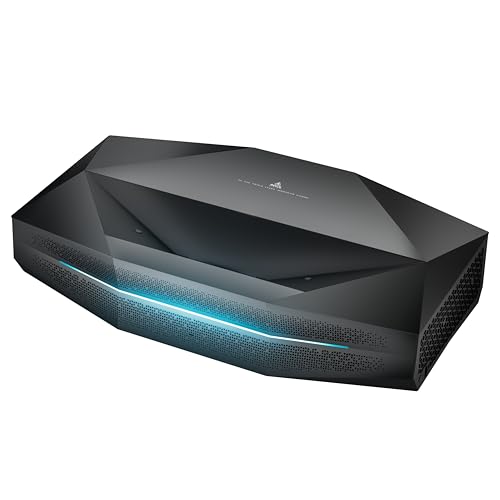
AWOL VISION Aetherion Pro 4K UST Projector — Flagship UST gaming pick
The Aetherion Pro’s title is the most densely specified in this guide, and it reads like AWOL Vision answering three buyers at once. For the film household there is an RGB triple laser light source, Dolby Vision and a contrast claim of 6,000:1 assisted by IRIS, which points to dynamic iris work deepening dark scenes rather than a static panel figure. For the streaming household there is Google TV built in, so the projector behaves like the television it replaces, apps and voice remote included. For the gaming household there is the pairing that headlines this review: 1080p gaming at 240Hz with a stated 1ms lag, a specification that belongs on gaming monitors, transplanted onto a machine that throws its picture from a cabinet inches below the screen.
Hold that gaming claim up to the light, because its wording does honest work. The 240Hz and 1ms figures attach to 1080p, not to the 4K resolution that leads the product name. That is the standard bargain of fast projectors — resolution steps down so frame rate can step up — and AWOL states the trade in the title instead of letting buyers assume 4K and 240Hz arrive together. At 1080p and 240 frames per second, a frame lasts a shade over four milliseconds, so a 1ms lag claim describes a pipeline adding a fraction of a frame. Whether a given console or PC can feed 240Hz at all is a separate question your source hardware answers, but the projector’s side of the bargain is printed plainly.
PixelLock is the remaining named feature, and it belongs to the ultra short throw ownership experience rather than to any single evening’s viewing. UST projectors magnify tiny misalignments: a cabinet nudged by a centimetre becomes a visibly crooked corner at 120 inches. Alignment assistance that locks the picture’s geometry down — and keeps it locked — addresses the quiet frustration that makes some UST owners drift back to televisions. Brightness is stated at 2,600 ISO lumens, a figure measured on the stricter ISO scale, which suits the controlled-light media rooms these flagship UST machines usually serve. In a bright open-plan space the number asks for help from curtains; in a dimmed room, paired with that contrast claim, it describes a picture built on depth rather than raw punch.
- Light source stated: RGB triple laser
- Resolution stated: 4K ultra short throw
- Brightness stated: 2,600 ISO lumens
- Contrast stated: 6,000:1 plus IRIS
- HDR stated: Dolby Vision
- Platform stated: Google TV
- Gaming stated: 1080p 240Hz, 1ms lag
- Alignment stated: PixelLock
Strengths
- The stated 1080p 240Hz gaming mode with 1ms lag is the strongest gaming specification among the six titles.
- Dolby Vision plus a 6,000:1 contrast claim with IRIS targets dark-scene depth, where UST flagships earn their keep.
- Google TV makes it a genuine television replacement rather than a display waiting for a source box.
Trade-offs
- The headline gaming figures apply at 1080p, so 4K gaming runs at the panel’s standard rates instead.
- At 2,600 ISO lumens it wants a light-controlled room more than the 4,000-lumen Optoma below does.
- Ultra short throw placement demands a flat, stable cabinet and a wall or screen that rewards the precision.
Best for: a media room household replacing a large television, where one cabinet-top machine must cover films with Dolby Vision and fast 1080p gaming. Not suited for: a golf simulator bay with light spilling in from a garage door, where its stated 2,600 ISO lumens will fight the room instead of filling it.
Open the Aetherion Pro listing on Amazon to study its current specification in full: check price on Amazon.
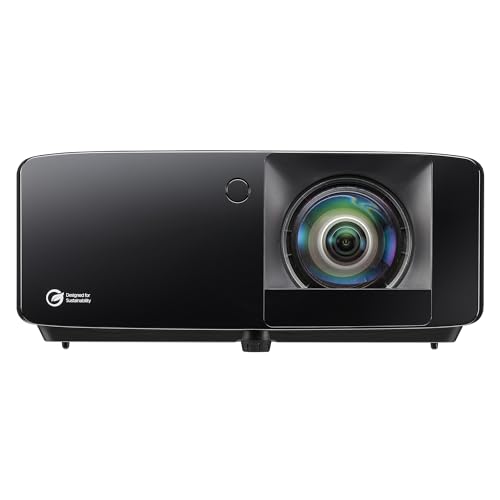
Optoma GT3900UHD 4K Short Throw Laser Projector — Brightest conventional short throw pick
Optoma’s GT line has always been the gaming branch of its projector family, and the GT3900UHD carries that brief into 4K short throw territory with the most emphatic resolution wording in this guide: True 4K UHD. Those two adjectives are doing deliberate work in a market where 4K can mean several different imaging arrangements, and Optoma plants its flag on the literal reading. Around that claim sit a stated 4,000 lumens — the highest brightness figure among the six titles — and a DuraCore laser rated at 30,000 hours, which at four hours of use a day describes a light source measured in decades rather than lamp cycles.
The title names golf simulator duty directly, and that single phrase explains the specification’s shape. A simulator bay needs a projector bright enough to survive the light a hitting area requires, mounted close enough that the player and the club never enter the beam, and sharp enough that a ball flight rendered against a virtual fairway stays readable at impact. Short throw geometry plus 4,000 stated lumens answers the first two needs together. HDR compatibility is stated as well, which serves film nights in the same room once the mat is rolled away, though buyers should note the title says compatible rather than naming a specific HDR format such as Dolby Vision — the pipeline tops out where the wording stops.
Low input lag gaming is claimed without a millisecond figure, and this guide leaves that space blank rather than filling it from Optoma’s wider catalogue, because GT models vary and a figure borrowed from a sibling would be a small fiction. The practical consequence sorts buyers cleanly. Simulator players, sports gamers and racers will find the combination of brightness, throw and 4K detail persuasive on its own terms. Players who shop by published lag numbers — fighting game and rhythm players especially — should pull the figure from the manufacturer documentation before committing, since the title’s silence is the only honest data point available here. What is not in doubt is the machine’s intended habitat: a room with a job to do, where the projector is equipment first and furniture never.
- Resolution stated: True 4K UHD
- Brightness stated: 4,000 lumens
- Light source stated: DuraCore laser, 30,000-hour rating
- Throw stated: Short throw
- HDR stated: HDR compatible
- Use stated: Golf simulator ready, low input lag gaming (no figure given)
- Platform: Not stated in the listing title — verify with the manufacturer documentation
- Audio: Not stated in the listing title — verify with the manufacturer documentation
Strengths
- The stated 4,000 lumens leads this guide, suiting simulator bays and living rooms that never fully darken.
- True 4K UHD wording is the most explicit resolution claim among the six titles.
- A 30,000-hour laser rating removes lamp replacement from the ownership picture entirely.
Trade-offs
- Low input lag is claimed without a figure, so millisecond-led buyers must verify it in the documentation.
- No streaming platform is named in the title, so a separate source device belongs in the plan.
- Conventional short throw placement still needs a table or mount set back from the wall, unlike the cabinet-top UST picks.
Best for: a golf simulator build or a bright gaming room that needs 4K detail thrown from a few feet away. Not suited for: a cabinet-top laser TV setup, since this machine’s short throw still expects distance between lens and wall that a media console cannot give it.
Look at the GT3900UHD listing on Amazon to confirm the simulator accessories it pairs with: check price on Amazon.
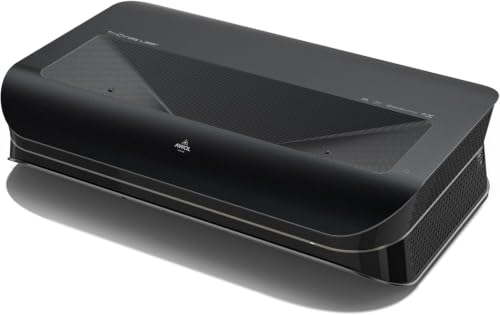
AWOL Vision LTV-3000 Pro — UST cinema pick with Atmos
The LTV-3000 Pro is AWOL Vision’s cinema-leaning ultra short throw machine, and its title spends its words on the picture-and-sound pipeline rather than on gaming. Triple laser is the light source, stated without the RGB prefix its Aetherion sibling carries. Dolby Vision and Dolby Atmos appear together — a pairing that matters, because Vision governs the picture’s dynamic range scene by scene while Atmos governs object-based sound, and a projector claiming both is claiming the full premium streaming pipeline in one box. HDR10+ is stated alongside, which covers the other major dynamic HDR format, so households whose libraries straddle both ecosystems are not forced to choose a side.
Screen size is the one physical figure the title gives: 150 inches, the ceiling of the ultra short throw proposition, where the projector sits below a picture taller than most adults. At that scale the UST bargain shows its best and its demands in equal measure. The best is immersion no television at a sane budget approaches, from a cabinet that also holds the soundbar. The demands are wall quality — every ripple in a painted wall becomes topography at 150 inches — and light control, because a picture spread that large divides the projector’s output across a wide canvas. The title gives no brightness figure for this model, and this guide will not import one from the Aetherion line; buyers planning the full 150 inches should take the lumen figure from the manufacturer documentation and size their room’s darkness to it.
Three-dimensional support is stated in the title — 4K 3D — which makes the LTV-3000 Pro one of a shrinking class of machines still serving the 3D Blu-ray collections that enthusiasts refuse to abandon. If your shelf holds those discs, this pick and the Hisense below are your shortlist within the shortlist. What the title does not discuss is gaming: no refresh rate, no lag figure, no game mode. That silence, set against the Aetherion Pro’s explicit 240Hz claim from the same brand, reads as positioning rather than oversight. This is the projector AWOL built for the evening film, with the brand’s gaming ambitions living in the model above it in this guide.
- Light source stated: Triple laser
- Resolution stated: 4K, with 3D support
- Screen size stated: Up to 150 inches
- HDR stated: Dolby Vision, HDR10+
- Audio format stated: Dolby Atmos
- Brightness and gaming figures: Not stated in the listing title — verify with the manufacturer documentation
- Streaming platform: Not stated in the listing title — verify with the manufacturer documentation
Strengths
- Dolby Vision and HDR10+ together cover both dynamic HDR ecosystems in one machine.
- Dolby Atmos support completes a premium streaming pipeline without format gaps.
- Stated 3D support keeps legacy 3D Blu-ray collections playable on a 150-inch picture.
Trade-offs
- No brightness figure appears in the title, which matters acutely at the stated 150-inch maximum size.
- No gaming specification is stated, so players should look to the Aetherion Pro instead.
- A picture this large exposes every flaw in an uneven wall, pushing most buyers toward a dedicated screen.
Best for: a film-first household building a laser TV wall around Dolby Vision, Atmos audio and the occasional 3D disc. Not suited for: a fast-twitch gaming den, since the title publishes no refresh or lag figures to judge it by.
See the LTV-3000 Pro listing on Amazon for the screen sizes and bundles currently offered: check price on Amazon.

Hisense PT1 UST Triple Laser Projector — UST pick with IMAX Enhanced
Hisense built its laser TV category before most rivals took ultra short throw seriously, and the PT1 carries that lineage with a title organised around range and certification. The range first: 80 to 150 inches from one machine, which means the same projector can serve a modest media wall in a flat and a full cinema wall in a house, adjusting its picture size to the furniture rather than the other way round. Triple laser is the light source, 4K UHD the resolution, and Google TV the platform, so the PT1 matches the Aetherion Pro feature for feature on the streaming household’s checklist while adding one badge neither AWOL model claims: IMAX Enhanced.
That badge deserves a plain explanation. IMAX Enhanced is a certification programme covering picture and sound processing for IMAX Enhanced content, promising expanded aspect ratio sequences and a DTS-based immersive audio mix on supported titles. Its value depends entirely on how much of your library carries the label — Disney’s Marvel catalogue is the famous example — and for households deep in that catalogue the PT1 is the only pick here speaking its language. Dolby Vision and Dolby Atmos are both stated as well, plus 3D support, so the PT1’s format coverage is the broadest in this guide: two premium picture pipelines and a legacy format in a single title.
The numbers Hisense chooses to print are 2,500 lumens and a 3,000:1 contrast ratio, and the pairing is instructive. The brightness sits at the lower end of this guide’s stated figures, while the contrast claim is half the Aetherion Pro’s headline ratio — though contrast figures from different brands are measured under different conditions and should never be ranked like-for-like, a caution this guide applies to its own comparison table. A 240 high refresh rate is stated without a resolution attached, so this review records it exactly that way: the rate is claimed, the resolution it applies at is not specified in the title, and gamers should confirm the pairing in the documentation. Judged on what is printed, the PT1 is the format completist’s UST — the machine for a household whose streaming subscriptions span every badge on the box.
- Light source stated: Triple laser
- Resolution stated: 4K UHD
- Screen size stated: 80 to 150 inches
- Brightness stated: 2,500 lumens
- Contrast stated: 3,000:1
- Certification stated: IMAX Enhanced
- HDR and audio stated: Dolby Vision and Atmos, 3D support
- Platform stated: Google TV; refresh stated as 240 high refresh rate
Strengths
- IMAX Enhanced certification is unique among the six picks and suits Disney-heavy libraries.
- The stated 80 to 150 inch range lets one machine follow a household from flat to house.
- Dolby Vision, Atmos and 3D together give it the broadest format coverage in the guide.
Trade-offs
- The stated 2,500 lumens is the lowest printed brightness here, asking for a properly dimmed room.
- The 240 refresh claim arrives without a stated resolution, so gamers cannot judge the pairing from the title.
- Contrast is claimed at 3,000:1, below the Aetherion Pro’s figure, though cross-brand ratios are not directly comparable.
Best for: a streaming household with IMAX Enhanced and Dolby Vision libraries that wants one UST machine across a wide size range. Not suited for: a bright family room used for afternoon sport, where 2,500 stated lumens will look thin against daylight.
Check the PT1 listing on Amazon to see which screen bundle Hisense currently pairs it with: check price on Amazon.

Optoma UHD35STX 4K Short Throw Gaming Projector — Short throw gaming nameplate pick
Some titles are specifications; this one is a nameplate. The UHD35STX’s entire listing title is a single line — 4K UHD short throw gaming and home entertainment projector — and everything this review can honestly say grows from those few words plus the weight of the model line behind them. What the words do establish is real: a 4K UHD resolution claim, a short throw lens, and a dual brief covering gaming and general home entertainment. Optoma’s UHD35 family built its reputation on exactly that combination for living rooms that game, and the STX suffix marks the short throw variant of the line.
Everything else a buyer would normally compare is absent from the title, and the spec box below prints that absence in the standard wording rather than papering over it. No brightness figure. No lag figure, despite gaming leading the description. No light source named, no HDR format specified, no platform, no audio details. This matters beyond pedantry: two households could buy this machine expecting different things, one picturing the laser longevity of its GT3900UHD sibling, the other picturing lamp-based economics, and the title alone cannot settle which picture is right. The manufacturer documentation can, in about ninety seconds, and this guide’s advice is to spend those ninety seconds before the purchase rather than after it.
Positioned fairly, the UHD35STX is the conventional short throw option for a buyer who trusts the Optoma gaming lineage and wants 4K detail without the ultra short throw cabinet arrangement or the simulator-grade brightness of the GT3900UHD. A table or ceiling mount a few feet from the wall, a console beneath, a soundbar doing audio duty — the familiar arrangement this class of projector has served for a decade. Its review is shorter on numbers than its rivals’ because its title is shorter on numbers, and in a guide that quotes only what titles print, that proportionality is the honesty policy working as designed. Buyers who enjoy the research will find the full specification one search away; buyers who want the figures curated for them have five chattier titles above and below this one.
- Resolution stated: 4K UHD
- Throw stated: Short throw
- Use stated: Gaming and home entertainment
- Brightness, input lag and light source: Not stated in the listing title — verify with the manufacturer documentation
- HDR format, platform and audio: Not stated in the listing title — verify with the manufacturer documentation
Strengths
- It combines the three claims living-room gamers ask for first: 4K UHD, short throw and a gaming brief.
- It comes from Optoma’s established UHD gaming line rather than an unbranded listing.
- Conventional short throw mounting suits rooms where a UST cabinet arrangement does not fit the furniture.
Trade-offs
- The title publishes no brightness figure, so room suitability cannot be judged from the listing headline.
- No lag figure is stated despite the gaming positioning, leaving competitive buyers to verify it themselves.
- Light source goes unnamed in the title, which affects long-term running cost expectations.
Best for: a living room gamer who wants Optoma’s 4K short throw gaming line on a table or ceiling mount and is willing to confirm the detailed figures in the documentation. Not suited for: a buyer choosing strictly on published specifications, since this title publishes fewer of them than any rival here.
Read the UHD35STX listing on Amazon alongside its documentation before deciding: check price on Amazon.

Generic 4K Short Throw Projector with AI Auto Focus — Portable AI-setup pick
The last pick arrives without a brand name, and its title spends its length on convenience instead of optics: AI auto focus, built-in apps, Dolby Audio, WiFi and Bluetooth, and a string of habitats — home theater, portable, outdoor, ceiling, bedroom. Start with the resolution wording, because it is the point this guide most wants a buyer to see clearly. The title says Short Throw Projector 4K and nothing more about imaging: no native resolution, no chip description, no distinction between a 4K picture the projector forms itself and a 4K signal it accepts and downscales. Those are very different machines wearing the same two characters, and unbranded listings use the label for both. This review therefore records the claim as a label, full stop, and advises treating any purchase as a verification exercise.
What the title does describe in earnest is setup automation. AI auto focus addresses the portable projector’s recurring chore: every new wall, every moved table, every ceiling mount angle begins with a focus hunt, and a machine that performs that hunt itself converts setup from a ritual into a button press. Built-in apps remove the streaming stick from the packing list. Dolby Audio names the sound processing, though no speaker wattage is given. High brightness is claimed as an adjective rather than a number, which in this guide’s accounting is worth exactly what an adjective is worth — the projector may well be bright for its class, but no figure exists here to compare against the GT3900UHD’s stated 4,000 lumens, and none will be invented.
None of that makes the pick a booby prize; it makes it a different product. The five machines above it are installations — measured, mounted, aligned once and left alone. This one is an appliance for households whose projection happens in different places: a bedroom ceiling on Friday, a garden wall on Saturday, a child’s room for a holiday film. Short throw geometry serves that life well, keeping the projector close to whatever surface is available and out of the middle of whatever room it lands in. Buy it for the automation and the mobility, verify the resolution behaviour from the documentation and early owner reports, and it fills a niche the branded flagships genuinely do not attempt.
- Resolution stated: 4K (label only; imaging method not described in the title)
- Throw stated: Short throw
- Setup stated: AI auto focus
- Platform stated: Built-in apps
- Audio stated: Dolby Audio
- Connectivity stated: WiFi and Bluetooth
- Brightness: Claimed as high brightness in the title, with no figure given
- Use stated: Home theater, portable, outdoor, ceiling and bedroom
Strengths
- AI auto focus removes the repeated setup chore that defines portable projector ownership.
- Built-in apps and WiFi/Bluetooth make it a self-contained movie system without a stick or console.
- Its stated habitats span ceiling, bedroom and outdoors, a range none of the installation picks attempt.
Trade-offs
- The 4K wording does not say whether the projector forms a native 4K image or accepts a 4K signal.
- Brightness is an adjective in the title rather than a figure, so bright-room performance is unproven on paper.
- An unbranded listing offers no model line or track record to lean on when judging longevity.
Best for: a household wanting one movable short throw projector for bedrooms, ceilings and garden evenings, with setup handled automatically. Not suited for: a permanent cinema wall where verified native 4K detail is the whole reason for buying.
Browse the generic 4K short throw listing on Amazon and read its imaging description closely: check price on Amazon.
Comparison
| Projector | Throw type | Resolution as titled | Stated brightness | Headline extra |
|---|---|---|---|---|
| AWOL Aetherion Pro | Ultra short throw | 4K | 2,600 ISO lumens | 1080p 240Hz gaming, 1ms lag stated |
| Optoma GT3900UHD | Short throw | True 4K UHD | 4,000 lumens | Golf simulator ready, 30,000-hour laser |
| AWOL LTV-3000 Pro | Ultra short throw | 4K with 3D | No figure in title | Dolby Vision, Atmos and HDR10+ |
| Hisense PT1 | Ultra short throw | 4K UHD | 2,500 lumens | IMAX Enhanced, 80–150 inch range |
| Optoma UHD35STX | Short throw | 4K UHD | No figure in title | Gaming and home entertainment brief |
| Generic AI Focus model | Short throw | 4K (label only) | Claimed as high, no figure | AI auto focus, built-in apps |
Read the throw column first, because it divides the six into two furniture decisions before any specification competes. The three UST machines want a cabinet and a wall; the three conventional machines want a table or a mount and a few feet of air. Read the brightness column second and notice how much of it is silence — two titles give no figure and a third gives an adjective — which is why the reviews keep sending brightness questions to the manufacturer documentation. The resolution column, finally, is a wording ladder from True 4K UHD down to a bare label, and a buyer who learns to hear those differences will shop this whole category better than any single recommendation can shop it for them.
How to Choose Among These Six
Begin with the wall and the furniture, not the specification sheet. Measure the distance your room naturally offers between the projector’s resting place and the screen surface. If that resting place is a low cabinet directly beneath the picture, you are in ultra short throw territory and the shortlist is the two AWOL models and the Hisense. If it is a coffee table, a rear shelf or a ceiling mount several feet back, the two Optomas and the generic model are your field. Choosing the wrong family and then fighting the geometry with keystone correction is the most expensive mistake in this category, and it is made in the first five minutes of shopping.
Next, name the room’s light honestly. The GT3900UHD’s stated 4,000 lumens exists for rooms that stay lit — simulator bays, family rooms, afternoon sport. The UST flagships, at 2,500 to 2,600 stated lumens on their respective scales, are built for rooms that dim, where their contrast and HDR pipelines can show. Then name the content. Dolby Vision libraries point to the AWOL pair or the Hisense; IMAX Enhanced viewing points only to the PT1; 3D collections narrow the field to the LTV-3000 Pro and the PT1; fast gaming at a stated 240Hz points to the Aetherion Pro and nowhere else in this guide. A household that games, streams and watches films in one room should rank those content claims above any single brightness number.
Throw distance deserves one more pass, because manufacturers describe it loosely and rooms forgive nothing. A short throw projector still needs its specified distance held fairly precisely: too close and the picture shrinks below the screen’s borders, too far and it spills past them, with zoom ranges absorbing only part of the error. Tape the position on the cabinet or mark the mount point before drilling anything, project a test grid at the intended screen size, and live with the geometry for an evening before making it permanent. Ultra short throw placement is even less forgiving in the vertical plane — a cabinet a centimetre too low tilts the whole picture — so the UST picks reward buyers who level the furniture first and align the projector second, in that order, with the alignment tools each title names doing the final correction rather than the first.
Finish with the verification list the terse titles make necessary. For the UHD35STX: brightness, lag and light source from the documentation. For the generic model: what its 4K label means in imaging terms, and a lumen figure if one exists. For the LTV-3000 Pro: the brightness figure its title omits. None of these checks takes long, and each converts a guess into a specification before money moves. The projectors that printed their numbers up front have earned a head start in trust; the ones that did not can still earn the purchase, but they should earn it in the documentation rather than on the strength of a badge.
Does Ultra Short Throw Really Replace a Television?
For the evening viewing that dominates most households, the three UST picks make a credible claim. They switch on like televisions, run Google TV like televisions, sit on the same furniture a television occupied, and throw a picture far larger than the television they replaced. The Aetherion Pro adds a gaming mode with monitor-class figures; the PT1 adds IMAX Enhanced; the LTV-3000 Pro adds the full Dolby pipeline and 3D. A household whose viewing is streaming, sport and film after dusk will feel the replacement is complete within a week.
The seams show at the edges of the day and the room. Daylight viewing favours a panel’s raw brightness over any projector in this guide, and a UST picture on a plain painted wall in a sunlit room looks washed in a way a television never does. Ambient light rejecting screens exist for exactly this pairing, but they are an additional purchase the television never asked for. Sound is the second seam: a projector’s built-in audio, however certified, fires from below the picture and rarely matches a soundbar, so most UST households end up adding one — at which point the cabinet holds a small cinema system rather than a television substitute, which is either the dream or the scope creep, depending on the household.
What Does a Golf Simulator Actually Need From a Projector?
The GT3900UHD names the job in its title, and the job’s requirements explain its specification. A simulator projector mounts where the swing is not: short throw geometry lets it sit close to the screen, ahead of or above the hitting zone, so a driver backswing never crosses the beam and a follow-through never finds the lens. Brightness matters more than in cinema use because a hitting bay is lit for ball visibility and camera tracking, and the projected fairway must hold its contrast under that light — the practical case for the guide’s highest stated lumen figure. Resolution matters in a specific way: the ball’s flight line and the green’s contours must stay legible at the moment of the strike, which is where a True 4K UHD claim earns its wording.
What the simulator does not need is equally clarifying. Dynamic HDR badges, streaming platforms and 3D support contribute nothing to a launch monitor session. Lag, interestingly, matters less than gamers assume: the delay between impact and the rendered ball flight is a whole-system figure dominated by the launch monitor and the simulation software, and the projector’s share — claimed as low here without a number — is rarely the bottleneck a player feels. Buyers speccing a bay should therefore weight throw distance, brightness and mounting flexibility in that order, and treat the GT3900UHD’s gaming claims as a welcome second job for film nights rather than the reason for the purchase.
How Much Brightness Does a Short Throw Room Need?
Brightness needs scale with two things buyers underestimate: screen size and ambient light. The same projector lighting a 100-inch picture concentrates its output; stretched to 150 inches, that output spreads across more than twice the area and the picture dims accordingly, which is why the LTV-3000 Pro’s missing lumen figure matters most to buyers planning its maximum size. Ambient light works as a tax on contrast rather than on brightness alone — the projector cannot project black, so every lumen of room light landing on the screen lifts the darkest parts of the picture toward grey.
Against that physics, the stated figures sort themselves. Four thousand lumens, as the GT3900UHD claims, buys headroom for lit rooms and large screens. The 2,500 to 2,600 lumen UST pair buys a rich picture in a dimmed room at moderate sizes, with contrast figures doing the expressive work. And the titles that print no figure leave the buyer unable to run this calculation at all, which is itself information: a manufacturer confident in a brightness number usually prints it. When a title substitutes the words high brightness for a number, the prudent reading is that the number, whatever it is, was not the listing’s best argument.
Where Does the Sound Come From in a Short Throw Room?
Projection separates the picture from the loudspeakers in a way television never does, and short throw geometry rearranges the problem rather than solving it. A conventional short throw machine sits near the audience, sometimes behind it on a ceiling mount, so its built-in speakers — where a title even mentions them, which most of these do not — fire from the wrong end of the room, and dialogue arrives from behind the listeners while the mouths move on the far wall. The standard cure is to decouple sound from the projector entirely: a soundbar under the screen fed by the source or by an audio return channel, with the projector treated as a silent display. Plan that routing before the mount goes up, because the cable path between a ceiling projector and a screen-side soundbar is the least convenient run in the whole installation.
Ultra short throw machines invert the geometry helpfully. The projector already sits where a television’s speakers would be, directly beneath the picture, so built-in audio at least originates from the right place, and the format claims in these titles — Dolby Atmos on the LTV-3000 Pro and the PT1 — describe processing pipelines that a soundbar or the projector’s own drivers can render with varying ambition. A buyer should read an Atmos badge on a projector as compatibility with the format’s stream, not as a promise of ceiling-bounced immersion from a cabinet-top box. The honest hierarchy runs: projector speakers for convenience, a soundbar for dialogue clarity and bass, and a separate receiver system for households building a true cinema. Short throw buyers who budget the picture and forget the sound discover the gap on the first film night, when the wall is magnificent and the voices are coming from a box behind the sofa.
There is also a synchronisation wrinkle that gaming households meet first. Every device in an audio chain adds a whisper of delay, and a soundbar fed through a television-style return path can drift speech a frame or two away from lips, or a button press away from its sound effect. The projectors in this guide that publish gaming figures — the Aetherion Pro above all — assume the player cares about milliseconds; the audio route deserves the same care, favouring direct connections from console to soundbar where the setup allows, and the projector’s game mode left to govern the picture alone.
Common Mistakes
Assuming every 4K label describes the same imaging. This guide alone contains True 4K UHD wording, plain 4K UHD, 4K with 3D, and a bare 4K label with no imaging description at all. The words are the specification you are given; read them at the resolution they are written.
Comparing lumen figures across scales. The Aetherion Pro states ISO lumens and the GT3900UHD states lumens without a scale named, and those numbers cannot be ranked as if they shared a ruler. Treat cross-scale comparisons as approximations, never as verdicts.
Buying an ultra short throw projector for a wavy wall. UST geometry grazes the wall at a shallow angle and turns small surface flaws into long shadows. A screen, or at minimum a genuinely flat wall, is part of the purchase whether the listing mentions it or not.
Reading a 240Hz gaming claim as a 4K gaming claim. On the Aetherion Pro the title ties 240Hz and 1ms to 1080p explicitly. Resolution and refresh trade against each other in every projector here; the title tells you which side of the trade each mode sits on.
Skipping the documentation check on terse titles. The UHD35STX prints almost nothing beyond its nameplate claims. Ninety seconds with the manufacturer documentation converts its unknowns into specifications; buying without those ninety seconds converts them into surprises.
Final Recommendation
The Aetherion Pro is the most complete machine in this guide: the only pick stating a full gaming specification, a Dolby Vision pipeline and a contrast figure with iris assistance, all in a cabinet-top design that asks nothing of the room except darkness and a flat wall. The GT3900UHD is the pick for rooms with a job — simulator bays and bright gaming spaces — where its stated brightness and True 4K UHD wording do work the UST flagships are not aimed at. The PT1 suits the format completist, the LTV-3000 Pro the film devotee with a 3D shelf, the UHD35STX the Optoma loyalist willing to verify the details, and the generic model the household whose projector travels. Match the family to the furniture first and the specification to the content second, and any of the six will feel chosen rather than merely bought.
A short throw projector is, in the end, a promise that the room you already have is big enough for the picture you want. Keep that promise in view while the badges compete for your attention, measure your cabinet and your wall before you measure anything else, and the right machine usually identifies itself.
Frequently Asked Questions
What is the difference between short throw and ultra short throw?
Distance. A conventional short throw projector like the GT3900UHD sits a few feet from the wall on a table or mount. An ultra short throw model like the Aetherion Pro sits on a cabinet almost directly beneath the screen. Both fill a large picture from close range; UST simply takes the idea to its limit, at the cost of demanding a flatter wall and a steadier cabinet.
Is the generic pick really a 4K projector?
Its title says 4K and describes nothing about how the image is formed, which is exactly why this guide records the claim as a label. Some projectors in this class form a native 4K image; others accept a 4K signal and display it at a lower resolution. The manufacturer documentation for this specific model is the only place that question gets an honest answer.
Can these projectors game at 240Hz in 4K?
Not on the evidence of these titles. The Aetherion Pro states its 240Hz and 1ms figures at 1080p, and the Hisense PT1 states a 240 refresh rate without attaching a resolution. High refresh and full 4K detail trade against each other in this generation of projectors, and the titles here respect that trade even when the marketing leads with both numbers.
Which pick suits a golf simulator best?
The GT3900UHD, which names golf simulator readiness in its title and backs it with the guide’s highest stated brightness at 4,000 lumens and True 4K UHD wording. Simulator bays are lit spaces, and brightness plus short throw geometry matter there more than HDR badges or streaming platforms.
How long do the laser light sources in these picks last?
A figure is printed by just one title in this guide: the GT3900UHD’s DuraCore laser is rated at 30,000 hours, which at four hours of daily use stretches past two decades. The other laser models here publish no hour figure in their titles, and while laser sources as a class are long-lived compared with lamps, this guide will not assign them the Optoma’s number. If service life will decide your purchase, take each model’s rated hours from its manufacturer documentation and compare those documents directly.
Do I need a special screen for an ultra short throw projector?
A perfectly flat wall can work, but UST projectors graze the surface at a shallow angle that exaggerates every ripple, so most owners end up with a fixed screen, and ambient light rejecting screens exist specifically for UST pairings in brighter rooms. Budget the surface as part of the system rather than as an afterthought.
Related Guides
If the cabinet-top arrangement is your direction, our dedicated guide to ultra short throw projectors as television replacements goes deeper on screens and soundbars. Simulator builders should continue to our roundup of short throw projectors chosen specifically for golf simulation, where mounting geometry gets its own treatment. And for evenings that move outside, our guide to projectors for outdoor backyard movie nights covers the portable end of the category.


