What's inside
- Key Takeaways
- Quick Picks
- How We Chose These Picks
- What Makes a 2.1 System the Default Desk Upgrade?
- What Is the Difference Between Bass and Boom?
- Why Do the Satellites Matter More Than Their Size Suggests?
- How Do Film and Music Ask for Different Things?
- How Do the Six Systems Compare on Value?
- How Do You Choose Between the Two Certified Veterans?
- What Does a Decade of Ownership Actually Look Like?
- What Should You Spend, and Where Does the Money Stop Helping?
- Which Rooms Does the Format Serve Best?
- How Do You Set Up a 2.1 System for Film and Music?
- How Much Does the Source Matter to a 2.1 System?
- How Should Neighbours and Thin Walls Enter the Decision?
- What Mistakes Do Buyers Make With 2.1 Systems?
- How Does a 2.1 System Fit the Working Day, Not Just the Evening?
- When Should You Skip 2.1 Entirely?
- What About Second-Hand, Refurbished and Hand-Me-Down Systems?
- What Is the One-Week Test for a System You Have Just Bought?
- Final Recommendation
- What Do You Check When a 2.1 System Disappoints on Day One?
- How Does the Format Handle Classical, Jazz and Other Demanding Shelves?
- Frequently Asked Questions
- Related Guides
As an Amazon Associate I earn from qualifying purchases. This post may contain affiliate links at no extra cost to you.
widgetverdict.com is reader-supported. When you buy through links on our site, we may earn an affiliate commission.
Where to buy: three systems below are linked to listings we verified while researching this guide; three more are covered in prose because their listings did not meet the same verification standard, and for those the manufacturers’ own shops are the dependable source. Prices in this category move with seasons and sales, so judge any system by the tier it sits in rather than by the figure on a given Tuesday.
The best 2 1 pc speakers occupy the sweet spot of computer audio, and they have occupied it for twenty years. The formula — two small satellites for the desk, one subwoofer for the floor — exists because it answers the two failures of built-in sound at once: the satellites restore the voices, detail and stereo picture that laptop and monitor speakers smear, while the subwoofer restores the low foundation that no small cabinet can produce alone. Nearly every other format in this field is a negotiation with that formula: stereo pairs surrender the bass, soundbars surrender the width, surround systems surrender the simplicity. A 2.1 set surrenders the least, which is why it remains the default upgrade.
This guide judges the format on overall value for the two jobs a home desk actually performs: film and music. Not gaming features, not wireless tricks — those have their own guides on this site — but the plain question of which system, bought once and kept for years, makes a streamed film feel like an event and a record collection feel alive, without demanding a hobbyist’s patience in return. The six below include two THX-certified veterans, one modern all-rounder with a wireless streak, and three prose-only systems that complete the honest picture of what the market offers.
Key Takeaways
- A 2.1 system is the default desk upgrade because it fixes both failures of built-in sound: thin satellites and missing bass.
- For film and music, subwoofer quality — depth with control — matters more than any feature list; boom is easy, tuneful bass is the craft.
- The Klipsch ProMedia 2.1 and Logitech Z623 have defined this class for over a decade, and both remain benchmarks because their fundamentals were right.
- The Logitech Z407 is the modern answer for desks whose sources rotate between computer, phone and tablet.
- Value in this category is measured in years: a system kept for a decade at a fair price beats a cheaper one replaced twice.
- Three picks are prose-only for verification reasons; they include the most beautiful and the most hi-fi systems in the guide.
Quick Picks
| Pick | Badge | Why it earns its place |
|---|---|---|
| Klipsch ProMedia 2.1 | Best overall for film and music | Horn-loaded satellites and a commanding subwoofer, certified and proven. |
| Logitech Z623 | Best power and longevity | THX-certified output, multiple inputs and a production run measured in decades. |
| Logitech Z407 | Best modern all-rounder | Balanced sound, three input types and a wireless control dial for room-wide ease. |
| Edifier S350DB | Best hi-fi build (prose-only) | Wooden bookshelf satellites, an eight-inch subwoofer and an amplifier’s input panel. |
| Harman Kardon SoundSticks 4 | Best design object (prose-only) | Museum-grade looks with warm, room-filling sound and Bluetooth streaming. |
| Bose Companion 50 | Best compact premium (prose-only) | Small satellites, a floor module and a control pod, tuned for easy listening. |
How We Chose These Picks
Value was the filter, and we defined it before looking at a single product: the total experience of owning the system — how it sounds with film and music, how it behaves daily, how long it lasts — divided by what it asks of you in money, space and patience. That definition promotes veterans. A system that has been manufactured for a decade has survived the only review that cannot be gamed, which is the market’s, and its spare parts, documentation and second-hand knowledge base are all part of what a buyer receives.
Within that frame we listened for the two disciplines. Film asks for dialogue that survives a score, effects with headroom, and bass that can be cinematic at eight in the evening and civilised at midnight. Music asks for a midrange with texture, a stereo image that holds a singer steady, and bass that plays notes rather than weather. Systems that do both without constant adjustment earned the linked places. The prose-only three were chosen to mark the format’s borders: the hi-fi build for buyers who want real speaker cabinets, the design object for rooms where appearance is a specification, and the compact premium set from the industry’s most famous name in small speakers — each unverifiable as a listing at our standard, each too relevant to omit.
We excluded two kinds of product deliberately. Soundbar-based 2.1 sets answer a different geometry and are covered in their own guides. And the very cheapest no-name systems, whose subwoofers produce a single enthusiastic note regardless of the music, fail the value definition at any price, because a purchase repeated is the most expensive kind.
What Makes a 2.1 System the Default Desk Upgrade?
Anatomy. The satellite’s job is everything directional — the frequencies your ears use to place a voice, a guitar, a closing door — and a small two-way cabinet at ear height performs it better than any television or laptop array firing from a bezel. The subwoofer’s job is everything foundational, the frequencies you feel as much as hear, and it performs that job from the floor where placement is free and cabinet size is no longer rationed by a desk. Dividing the work this way lets each part be good at its half, and the crossover between them, when it is engineered with care, disappears entirely from the listener’s awareness.
The format’s second virtue is forgiveness. It asks for no receiver, no speaker wire runs around a room, no calibration microphone ritual; it connects to a computer in minutes and improves everything the computer plays. Its third virtue is scale: the same formula serves a student’s first desk and a film lover’s study, differing only in how much cabinet and amplifier the budget buys. Formats come and go in consumer audio, but a solution that is simple, forgiving and scalable tends to stay the default — and twenty years into its reign, the 2.1 system’s challengers are still explaining why they are not it.

Klipsch ProMedia 2.1 — Best overall for film and music
If this guide had to end after one recommendation, it would end here. The ProMedia 2.1 pairs horn-loaded satellites — a technology Klipsch has refined in full-sized loudspeakers for generations — with a subwoofer that supplies genuine low-end authority, and the combination has a character neither rival quite duplicates: sound that projects. Dialogue in a film does not sit inside the satellites; it arrives in the room, clear at modest volume, which is the single quality that decides whether a streamed film feels like cinema or like television with better intentions.
Music receives the same treatment. The horns give acoustic instruments and voices a presence that flatters everything from a string quartet to a podcast, while the subwoofer, set with a little restraint, plays basslines as notes with pitch and decay rather than as a generalised warmth. THX certification underwrites the package — the system was measured against real standards — and the current generation adds Bluetooth for the phone without disturbing the wired-first design. Its controls are traditional, its styling is purposeful rather than pretty, and its satellites ask for a clear line to your ears. Grant those small requests and it delivers the most complete film-and-music performance this format offers at a sane tier.
- Layout: horn-loaded two-way satellites plus side-firing ported subwoofer
- Certification: THX-certified for film and game sound
- Inputs: wired analogue plus Bluetooth in the current generation
- Character: projecting, present, dialogue-first
Strengths
- Film dialogue clarity that defines the class.
- Subwoofer authority with genuine musical pitch and control.
- A design proven across two decades of production.
Trade-offs
- Satellites reward careful placement and punish being hidden.
- No remote or wireless control accessory.
- Styling is functional; design-led rooms should see the prose picks.
Best for: the buyer who wants one system for film nights and record collections alike. Not suited for: desks that need room-wide remote control or invisible hardware.
One more ProMedia quality deserves naming, because it decides long-term satisfaction quietly: it is honest at low volume. Many systems need level before their balance assembles — the bass wakes up late, the detail earlier — so late-night listening becomes a negotiation. The Klipsch’s horn efficiency means its character is present at the volumes a shared house actually permits after dark, dialogue intact and bass in proportion. A system that only sounds like itself when loud is a system half-owned; this one is whole at a murmur, and film lovers in flats should weight that heavily.
Logitech Z623 — Best power and longevity
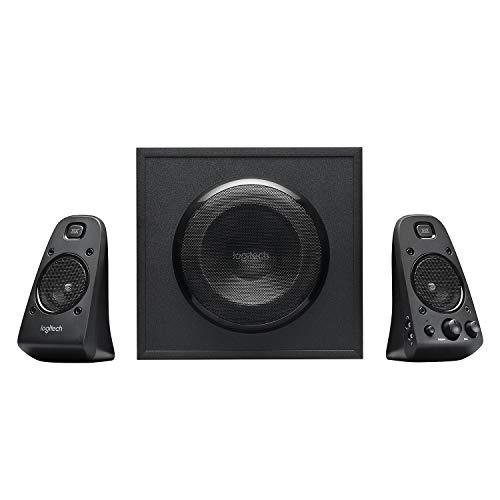
The Z623 is the value argument made physical. Its proposition is not subtlety of features but depth of fundamentals: a large subwoofer with a seven-inch driver, two honest satellites, THX-certified output that fills a room without strain, and multiple wired inputs so a computer and a console can share the system without a cable swap. It has been manufactured, essentially unchanged, since the beginning of the last decade — a production run that in consumer electronics reads less like a product cycle and more like a public utility.
For film, that output buys headroom, and headroom is what separates a system that survives a blockbuster from one that merely accompanies it: effects land without distortion, scores swell without the satellites thinning, and the whole presentation stays composed at the volumes a living-room desk actually uses. For music it is a warmer, weightier listen than the Klipsch — less projected, more enveloping — and many listeners will prefer exactly that. What it will not do is stream from a phone or accept a remote’s instructions; its controls sit on the subwoofer, in the analogue world where it was designed.
Judge it as the format’s workhorse and it has no serious rival here: the most output, the longest track record and the simplest ownership story, at a tier that has historically undercut systems with half its capability. Buyers who keep equipment until it dies tend to find this system, and then they stop shopping.
- Layout: two-way satellites plus large subwoofer, controls on the subwoofer face
- Certification: THX-certified output
- Inputs: multiple wired inputs for shared PC and console duty
- Character: warm, weighty, room-filling
Strengths
- The most clean output in this guide, with headroom to spare.
- Multiple inputs end the console-versus-PC cable argument.
- A decade-plus production run is the strongest reliability evidence available.
Trade-offs
- No Bluetooth and no remote — a deliberately wired, manual system.
- The subwoofer is large and wants a planned floor position.
- Bass control requires a trip to the subwoofer itself.
Best for: film-first desks, shared systems and buy-it-for-a-decade owners. Not suited for: phone streamers, or anyone who adjusts volume from the sofa nightly.
The Z623’s multiple inputs deserve a second look from value hunters, because they quietly delete a future purchase. The household that adds a console, a small television or a second computer does not need a switcher, a second system or a cable ritual; the Logitech simply accepts the new citizen. Spread across a decade of evolving desks, that tolerance is worth real money, and it is the kind of value that never appears in a launch-day comparison because it accrues in year three rather than week one. This guide counts it, which is why a wired-only veteran stands so high in a modern ranking.
Logitech Z407 — Best modern all-rounder
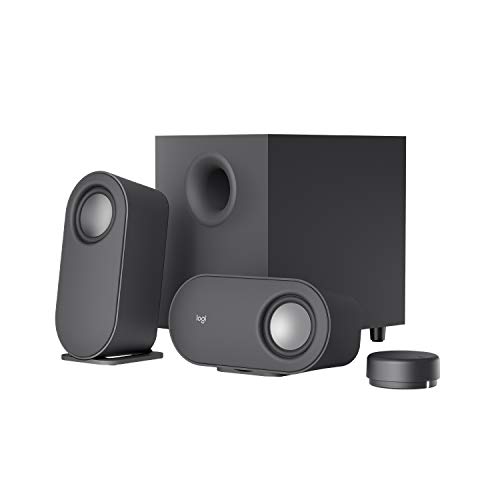
The Z407 is what the 2.1 formula looks like when it is redesigned for the decade of the rotating source. Its sound is the balanced, friendly kind that flatters the actual diet of a home desk — streamed series, playlists, calls, the occasional film — with satellites that keep voices forward and a subwoofer tuned for body rather than bravado. Around that sound it wraps the most complete convenience package in this guide: Bluetooth for the phone, USB audio for the computer, analogue for the rest, and a wireless control dial that lets the volume live wherever the listener does.
On the value axis of this guide it scores differently from the veterans. It will not out-play the ProMedia on a film’s hardest scenes or out-shout the Z623 in a big room, and its subwoofer is the most modest of the three linked systems. What it returns is daily ease across a household’s whole device population, and for many desks that ease is worth more than headroom used twice a month. It is also the most presentable of the three — a system a shared living space can absorb without negotiation.
Consider it the default for the modern mixed desk, and the veterans the defaults for the dedicated one. That is not a ranking so much as a map, and this guide’s badges are drawn so that both kinds of reader reach their answer quickly.
- Layout: compact satellites plus ported subwoofer
- Inputs: Bluetooth, USB audio and analogue
- Control: wireless dial for volume and playback
- Character: balanced, voice-forward, household-friendly
Strengths
- Every modern source connects without adapters or rituals.
- The wireless dial is a genuine daily convenience, not a gimmick.
- Presentable design suits shared living spaces.
Trade-offs
- Less output and sub-bass than the two certified veterans.
- The dial is a small object a household can misplace.
- Film effects at high volume reach its limits sooner.
Best for: mixed-device households and living-room desks. Not suited for: dedicated film rooms chasing maximum scale.
There is a fairness point to record for the Z407 as well: its balanced tuning is the least fatiguing in this guide for the mixed diet of a working desk. The certified pair are more thrilling; the Z407 is more livable across a nine-hour day of calls, playlists and video, and livability is a species of value that hi-fi vocabulary underrates. Households choosing it are not settling — they are optimising for the hours they actually spend, which is the most rational optimisation in this entire guide.
Edifier S350DB — Best hi-fi build (prose-only)
The S350DB is the system for the reader who looked at the linked picks and thought: but I want actual speakers. Its satellites are wooden bookshelf cabinets with real tweeters; its subwoofer is an eight-inch unit with genuine depth; and its input panel — Bluetooth, optical, coaxial, analogue — belongs to a small amplifier rather than a computer accessory. In a desk-and-television corner it becomes the room’s audio hub, and its remote keeps the arrangement civilised from the chair.
Sonically it is the most composed system in this guide: a midrange with the texture hi-fi buyers mean by the word, bass with weight that stops when the note stops, and an overall balance that flatters long music sessions more than any rival here. The compromises are size, in every dimension, and a source-switching manner that suits a settled setup rather than a rotating cast. We cover it in prose because its listing did not pass our verification; through the maker’s channels it is the connoisseur’s route into this format, and the one most likely to end a hi-fi buyer’s search rather than start it.
- Layout: wooden bookshelf satellites plus 8-inch subwoofer
- Inputs: Bluetooth, optical, coaxial and analogue
- Controls: remote plus independent subwoofer level
- Character: composed, textured, amplifier-minded
Strengths
- The most speaker-like sound in the guide, especially for music.
- Optical input makes it a true desk-and-TV hub.
- Subwoofer level adjusts independently of the master volume.
Trade-offs
- The largest footprint here by a clear margin.
- Source switching suits settled setups, not device rotation.
- Unverified listing — purchase through the maker or a trusted seller.
Best for: music-first corners where the desk meets the television. Not suited for: laptop desks or small rooms.
Harman Kardon SoundSticks 4 — Best design object (prose-only)
Every category has one product that people buy with their eyes and defend with their ears, and in this format it is the SoundSticks. Transparent satellites, a domed subwoofer like a piece of laboratory glassware, a design with a permanent place in museum collections — and, beneath the sculpture, a warm and spacious sound that behaves more like a small living-room system than a desk accessory. Bluetooth streaming keeps the sculpture free of the cable that would spoil it.
The ownership terms are the design’s terms: minimal touch controls, cables that must be dressed because everything is visible, and a subwoofer dome that shows dust the way a black piano shows fingerprints. Buyers who accept those terms get the only system in this guide that guests ask about. We list it in prose for the by-now familiar verification reason; it stands here as the proof that in a format this mature, beauty is a legitimate axis of value and not a distraction from it.
- Layout: transparent satellites plus domed subwoofer
- Inputs: Bluetooth streaming plus wired connection
- Controls: minimal touch surfaces
- Character: warm, spacious, room-oriented
Strengths
- The most beautiful object in this guide, by acclamation.
- Room-filling warmth that suits living spaces.
- Bluetooth keeps the design free of trailing cables.
Trade-offs
- Controls are minimal to a fault for frequent adjusters.
- Transparency displays dust and cabling alike.
- Nearfield precision trails the hi-fi and certified picks.
Best for: design-led living spaces that stream more than they sit. Not suited for: precision listeners or low-maintenance households.
Bose Companion 50 — Best compact premium (prose-only)
Bose built its name on making small speakers sound larger than physics prefers, and the Companion 50 is that philosophy in 2.1 form: two compact satellites, an Acoustimass module for the floor, and a control pod that puts volume and a headphone socket within a hand’s reach of the keyboard. The tuning is the house style — smooth, forgiving, engineered so that nothing in a film or a playlist ever sounds harsh, thin or effortful at the volumes a desk sustains.
Critical listeners sometimes call that smoothness a veil; the system’s many devoted owners call it the reason they can listen all day. Both descriptions are true, and the choice between this and the ProMedia is really a choice of temperament: projection and edge, or polish and ease. The Companion 50’s compromises are its analogue-era input set and a premium price for compact hardware. We include it in prose, its listing unverified at our standard, because a value guide that omitted the most famous name in small speakers would leave readers to wonder whether we had noticed it at all. We noticed. It is the comfort choice, and comfort is a value.
- Layout: compact satellites plus floor bass module
- Control: desktop pod with volume and headphone socket
- Inputs: analogue-era set, wired-first
- Character: smooth, forgiving, all-day easy
Strengths
- Effortless, fatigue-free sound for long listening days.
- Control pod is the most convenient wired control here.
- Compact satellites suit desks the bookshelf picks cannot enter.
Trade-offs
- Polish comes at the cost of the last degree of detail.
- No modern wireless input in this generation.
- Premium pricing for its physical scale.
Best for: all-day listeners who value ease over edge. Not suited for: detail hunters or wireless-first households.
The three prose-only systems also share a lesson about where value hides. None of them competes on the certified veterans’ ground of verified output, and none on the Z407’s ground of convenience. They compete on the axes the specification era forgets — cabinet craft, industrial design, and a house tuning refined over decades — and the fact that all three sustain premium positions in a mature market tells you those axes are worth money to real buyers. A value guide that recognised only decibels per coin would miss the market it claims to describe.
What Is the Difference Between Bass and Boom?
Every 2.1 system can make a low noise; the craft is in making a low note. Bass, properly speaking, has pitch, attack and decay — you can follow a bassline’s melody, hear where a kick drum ends and the room begins, and feel a film score’s foundation change chord. Boom is what remains when a subwoofer is tuned to one enthusiastic frequency and plays it regardless of the input: impressive for eleven seconds in a shop, exhausting for two hours at home, and fatal to dialogue, because that single note sits exactly where male voices live and smears them into the furniture.
The systems in this guide earn their places partly on this distinction. The ProMedia and S350DB play notes; the Z623 plays them with more weight; even the modest Z407 subwoofer is tuned for body rather than bravado. The test is available to any buyer in any shop: play a walking bassline or a solo double bass and ask whether you could hum the tune afterward. If you could, the subwoofer is an instrument. If all you remember is weather, walk away — no discount redeems a one-note subwoofer, because you will hear that note under everything you ever play.
Why Do the Satellites Matter More Than Their Size Suggests?
Buyers fixate on the subwoofer because it is the visible novelty of the format, but the satellites carry the overwhelming majority of what you hear: every word, every melody, every cue that tells you where the world is. A 2.1 system with excellent satellites and a modest subwoofer sounds like a good system having a quiet day in the bass; the reverse arrangement sounds like a bass appliance with voices attached. This is why the ProMedia’s horn-loaded satellites and the S350DB’s real bookshelf cabinets anchor their systems’ reputations, and why the cheapest systems — which invert the budget, spending on the box that thumps — disappoint within a week.
It is also why placement effort should be spent on the satellites first. Their height, angle and symmetry decide the stereo image, which is the format’s claim to cinema at a desk; the subwoofer, by contrast, is acoustically forgiving about everything except corners and excess level. New owners instinctively fuss over the big box and ignore the small ones. Reverse the instinct and the system rewards you in the first minute.
How Do Film and Music Ask for Different Things?
Film is a dynamic art: whispers and detonations share a soundtrack, and a system must be quiet enough for the first and composed enough for the second, often within the same minute. That is why headroom — the Z623’s great gift — matters so much for cinema, and why dialogue clarity, the ProMedia’s, is the other half of the equation. Music is a tonal art: it asks less for range and more for truth — a piano’s hammer, a voice’s grain, a bassline’s pitch — sustained over hours rather than moments. The S350DB and Companion 50 are tuned by that second standard, one toward texture and the other toward ease.
The practical consequence is a listening test with two exhibits. Judge a candidate system first by a conversation at low volume, then by a loud orchestral or electronic passage, and refuse to buy on either alone. Systems that pass both — as the linked three here do, each in its own accent — are the ones that disappear into a household’s life. Systems that pass only the loud test are shop systems, and the shop is where they belong.
How Do the Six Systems Compare on Value?
| System | Film strength | Music strength | Daily ease | Listing |
|---|---|---|---|---|
| Klipsch ProMedia 2.1 | Dialogue and authority | Presence and detail | Traditional controls | Linked |
| Logitech Z623 | Scale and headroom | Warmth and weight | Manual, wired | Linked |
| Logitech Z407 | Balanced streaming | Friendly all-round | Wireless dial | Linked |
| Edifier S350DB | Composed, via optical | Most hi-fi here | Remote control | Prose-only |
| Harman Kardon SoundSticks 4 | Ambience | Warmth | Minimal controls | Prose-only |
| Bose Companion 50 | Smoothness | All-day ease | Control pod | Prose-only |
Read the table as temperaments rather than rankings. The certified pair win on verified fundamentals; the Z407 wins the modern household; the prose three each win a reader the linked systems cannot serve. Value, in a format this mature, is mostly the art of matching temperament to desk.
How Do You Choose Between the Two Certified Veterans?
The ProMedia and the Z623 have shared this category’s summit for so long that the choice between them deserves its own map. Choose the Klipsch if dialogue is your first love — if your films are talk-rich, your podcasts constant, and your room small enough that projection beats power. Its sound arrives at the listener; choose the Logitech if scale is your first love — bigger rooms, louder habits, a console sharing the system, and a preference for warmth over edge. Its sound surrounds the listener. Both are wired-first, both are certified, both will outlast the computer they are bought for; the difference is temperament, and temperament is a legitimate thing to spend money on.
And if the choice still will not resolve, the tiebreaker is control. The household that adjusts from the sofa should take neither veteran as first choice — the Z407’s dial or the S350DB’s remote answers that life better — while the household that sets a volume and leaves it can ignore the entire convenience axis and buy purely on sound. Guides exist to narrow choices; this one narrows yours to temperament and habit, which is as far as honest narrowing goes.
What Does a Decade of Ownership Actually Look Like?
The veterans in this guide have something no new product can counterfeit: a known old age. Owners of the ProMedia and Z623 report the same biography — years of daily use, a control knob that still turns cleanly, a subwoofer that has survived house moves — because both were designed before the industry’s centre of gravity shifted to annual replacement. That biography is part of the value calculation this guide is built on. A system bought once and used for ten years costs its owner a tenth of its price annually; a system replaced three times in the same span costs three purchases, three setups and three rounds of electronic waste, whatever the stickers said.
Ownership also has a texture the specification lists omit. The Z623 asks you to walk to its subwoofer to change the bass; the Z407 asks you to keep track of a small dial; the S350DB asks you to house real furniture. None of these is a defect, but each is a daily relationship, and the right system is the one whose demands match your habits. The best value in this guide is therefore not a product but a fit — the certified fundamentals, the modern convenience or the hi-fi build, chosen against the desk and the decade you actually have in mind.
What Should You Spend, and Where Does the Money Stop Helping?
This format has a well-defined value curve, and knowing its shape saves more money than any sale. The first step — from built-in sound to any competent system in this guide — is enormous, the largest improvement-per-cost in all of computer audio. The second step, from a basic system to the certified veterans, is substantial and audible in every film: better drivers, better crossovers, bass with pitch. The third step, into the premium and design tiers, buys refinement, materials and beauty rather than transformation — real goods, honestly sold by the S350DB, SoundSticks and Companion 50, but goods a buyer should choose knowingly.
Below the guide’s floor sits the territory we excluded: systems whose price is their only specification. Their failure is not cheapness but dishonesty — subwoofers that produce one note, satellites that hiss, controls that fail in the second year — and their true cost is the second purchase they oblige. The value sweet spot, where this guide’s linked picks live, is the tier where engineering is real and branding is still a minority of the price. Buy there, buy once, and the format’s twenty-year reputation will make sense from your own chair.
Which Rooms Does the Format Serve Best?
The 2.1 system’s kingdom is the small-to-medium room with a primary seat: the study, the bedroom, the living-room corner where one chair or one sofa end does most of the listening. In that kingdom its geometry is ideal — a defined sweet spot, a subwoofer with a short list of sensible addresses, and output requirements every pick here meets with room to spare. Open-plan spaces stretch it; the satellites still serve the desk faithfully, but the subwoofer’s work multiplies with the volume of air, and the Z623’s headroom becomes the minimum rather than the luxury.
Room character matters as much as room size. Hard, bare rooms flatter the smoother systems — the Companion 50 and Z407 — and punish the ProMedia’s projection with reflections, though a rug and a bookshelf civilise any of them. Soft, furnished rooms forgive everything and reward detail, which is where the Klipsch and the S350DB give their finest performances. None of this requires treatment or expertise; it requires only the admission that the room is the largest component in the system, and the one already paid for.
How Do You Set Up a 2.1 System for Film and Music?
Satellites first: equal distance from your seat, angled toward it, tweeters near ear height, with a little air behind any rear-ported cabinet. Then the subwoofer, which wants a more careful conversation. Start it under the desk, slightly off-centre, away from the corner. Play a film scene with a deep score and a quiet conversation in the same minute — most modern dramas provide one — and set the subwoofer’s level, where the model provides one, at the point where the score has weight and the conversation has none of the subwoofer in it. That single calibration serves music too, because a bass that respects a voice respects a vocalist.
Then check the crossover illusion with a piano recording: the low notes should sound like the same instrument as the high ones, arriving from the desk rather than the floor. If the piano seems to have a relative under the desk, reduce the subwoofer a notch. Finally, set your computer’s output high and clean, the system’s volume to your loudest sane level, and make daily adjustments from the control you reach most easily. A 2.1 system calibrated this way disappears — and a disappeared system is the goal, because what remains is the film.
How Much Does the Source Matter to a 2.1 System?
More than the brochures admit and less than the cable industry hopes. A 2.1 system of this quality will faithfully reproduce whatever it is fed, including the flaws: a laptop’s noisy headphone output arrives with its hiss intact, and a heavily compressed stream arrives with its flatness intact. The remedies are mostly free. Feed the system the best output your computer offers — the Z407’s USB path bypasses the analogue stage entirely — and prefer the higher-quality stream settings in your music service, because the difference between a starved stream and a healthy one is larger, through these speakers, than the difference between several of the systems themselves.
What will not help is jewellery: exotic cables, risers and conditioners address problems a desk system does not have, at prices that would move you a full tier up this guide’s table. The value discipline of this article applies to accessories with interest — every coin spent polishing a signal is a coin not spent on the drivers that must reproduce it. Spend on the speakers, feed them decently, and stop.
How Should Neighbours and Thin Walls Enter the Decision?
Because the subwoofer is the neighbour-facing component, and a value calculation that ignores the building is incomplete. In a detached house the Z623’s full voice is a pleasure; in a flat with party walls it is a pleasure rationed by the clock, and the rationing should be priced in. Systems with easily reached subwoofer control — the S350DB’s independent level, the Z407’s dial governing the whole — adapt to a building’s moods fastest. The down-to-earth advice is to audition your own habits honestly: if most listening happens after nine in the evening in a flat, weight low-volume honesty (the ProMedia) and easy control (the Z407) above headline output, because output you cannot use is not value, however certified.
What Mistakes Do Buyers Make With 2.1 Systems?
The eternal mistake is subwoofer placement by furniture rather than by ear: the corner it fits becomes the corner it booms from, and the buyer concludes the system is crude when the address was. The second is judging by a trailer in a shop — effects at demo volume flatter exactly the systems that will fatigue you at home. Third, buyers compare wattage figures across brands as though they shared a unit; they do not, and the certified systems in this guide are the ones whose output claims were independently examined. Fourth, shoppers forget the second source: the console, the phone, the television that will all want the speakers within a year. Count your sources before you count your watts.
How Does a 2.1 System Fit the Working Day, Not Just the Evening?
The value case quietly includes the hours nobody markets to. A home desk’s speakers spend most of their lives on calls, tutorials, podcasts and background playlists, and a 2.1 system’s virtues translate directly: voices with body are less fatiguing across a day of meetings than voices through a laptop’s slot, and music at low volume keeps its foundation when a subwoofer is carrying the bottom, so the working day sounds composed rather than thin. The Z407’s livability and the ProMedia’s low-volume honesty both earn their keep here, in the unglamorous majority of the system’s life.
There is an ergonomic dividend too. Sound that fills a room evenly lets a listener move — to the printer, the kitchen, the window — without the experience collapsing, which is the daily reality of home working and the thing a headset or a laptop speaker cannot offer. Count those hours in the value ledger and the format’s case strengthens again: the best 2.1 pc speakers are not an evening luxury bolted onto a desk, but the desk’s own voice, improved for everything it says.
When Should You Skip 2.1 Entirely?
Honesty about a format’s borders is part of recommending it. Skip 2.1 if your listening is overwhelmingly spoken word at a small desk — a good stereo pair serves it with less furniture. Skip it if the room is a true cinema room with seats in rows, where a 5.1 system or a receiver-based build is the honest tool and this site’s surround guides take over. Skip it if the household’s centre of gravity is portable — a speaker that travels beats a system that anchors. And skip the format’s cheap end entirely, for the reason given at the start: a 2.1 system that must be bought twice was never the value option, whatever the first receipt claimed.
What About Second-Hand, Refurbished and Hand-Me-Down Systems?
A format this long-lived has a thriving second life, and value hunters should know its rules. The veterans are the safest second-hand buys in computer audio precisely because their designs are known: a ProMedia or Z623 that powers on, plays cleanly at low volume without hiss and shows no knob crackle is very likely to serve for years, since speakers have few wear parts beyond their surrounds and controls. Test with a voice at low volume — the examination that reveals most faults — and inspect the subwoofer’s driver surround for cracking before money changes hands.
The cautions are equally specific. Wireless features age fastest, so a second-hand convenience-led system should be priced as the wired system it may become. Proprietary cables and pods are the parts most often missing from a used box, and a Companion 50 without its pod or a Z407 without its dial is a diminished object whose replacement cost belongs in the negotiation. Buy the veterans used with confidence, the gadget-led systems used with arithmetic, and every system used with a listening test — the format rewards the patient at every tier.
What Is the One-Week Test for a System You Have Just Bought?
Live with it deliberately before the return window closes. Day one belongs to setup — geometry, subwoofer by voice, sources connected. The days after belong to range: one dialogue-heavy film, one loud one, one record you have known for years, one working day of calls and playlists at honest volumes. Note, literally if necessary, the moments the system disappears and the moments it intrudes — a hiss, a boom, a control in the wrong place. A system from this guide should disappear almost always by the week’s end, its intrusions reduced to taste rather than faults. If instead the intrusions gather, the test has done its job cheaply: exchange within the guide’s table by temperament, because the fundamentals you need are here — the fit was wrong, not the format.
Final Recommendation
Buy the Klipsch ProMedia 2.1 if one system must do everything well: it is the most complete film-and-music performer in the format, and its two decades at the top of this category were earned one living room at a time. Buy the Logitech Z623 when output, simplicity and a decade of service outrank every other consideration, and the Z407 when the household’s devices rotate and daily ease is the value that matters. The prose-only three serve the hi-fi builder, the design lover and the comfort seeker respectively. In every case the advice is the same: buy at the tier where the engineering is real, set the subwoofer by a voice rather than by an explosion, and then keep the system for the decade it was built to serve.
What Do You Check When a 2.1 System Disappoints on Day One?
Almost every day-one disappointment in this format is a setup fault wearing the system’s clothes, and a short order of checks resolves most of them. First, satellite identity: confirm the left satellite is on the left — swapped channels are astonishingly common and make every stereo image feel wrong in a way owners struggle to name. Second, subwoofer level and placement, using the voice test from the setup section; a system judged before this calibration has not been judged at all. Third, the source: try a second device and a known-good recording before concluding anything about the hardware, because a starved stream through a revealing system sounds like the system’s fault and is not.
Fourth, the computer’s own enhancements — loudness equalisation, spatial processing and per-app volume all ship enabled on many machines and all rewrite the signal before the speakers hear it. Switch them off for a week and let the system speak in its own voice. Owners who run these four checks almost never return a system from this guide; owners who skip them sometimes return two, and buy the third with the same fault waiting at home.
How Does the Format Handle Classical, Jazz and Other Demanding Shelves?
A buyer’s record shelf is the final examiner, and the demanding genres sort this guide cleanly. Classical music asks for dynamic honesty — a string quartet’s intimacy and an orchestra’s full weight in the same library — and rewards the S350DB’s composure and the ProMedia’s projection in roughly that order. Jazz asks for texture and timing: a brushed snare, a walking bass with pitch, a horn with breath in it; the Klipsch was practically designed by that examination. Electronic music asks the subwoofer the hardest questions in the catalogue, and the Z623’s headroom and the S350DB’s eight-inch depth answer them best, provided the level discipline from the setup section is obeyed.
Spoken word, the shelf nobody brags about and everybody uses, is the ProMedia’s home fixture and the Z407’s daily bread. The point of the exercise is not to crown a genre champion but to notice that your shelf already voted. The system that wins your most-played genre wins your money’s worth, because value is paid out in hours listened — and hours gather where the music you actually own sounds most like itself.
Frequently Asked Questions
What is the single best first upgrade if I already own a basic 2.1 set?
Placement, which is free: satellites to ear height and symmetrically placed, subwoofer out of the corner and calibrated by a voice. Owners routinely report a bigger improvement from an evening of geometry than from the purchase that preceded it. If a purchase must follow, let it be the satellites’ tier — that is where the format keeps its quality — rather than a larger subwoofer for a system whose voices are already its limit.
Is 2.1 enough for films, or do I need surround sound?
For a desk or a small room, a good 2.1 system delivers the dialogue, score and effects that carry a film; surround adds envelopment, which is a genuine pleasure and a larger project involving more speakers and more room. Our 5.1 guides cover that step when a room is ready for it.
Why do two picks here have THX certification, and does it matter?
It means their output, distortion and response were measured against published standards and passed. In a category where wattage claims are unregulated, certification is one of the few numbers a buyer can actually lean on — a floor of competence, independently verified.
Can a 2.1 system replace a soundbar for a desk-and-TV corner?
Often, yes — especially the S350DB with its optical input, or any system fed from the television’s headphone or analogue output. A soundbar wins on tidiness; a 2.1 system wins on stereo width and bass quality. The room’s geometry should decide.
How long should a good 2.1 system last?
A decade is a reasonable expectation for the certified veterans here, whose production runs already approach that span. Speakers age slowly; what dates a system is its inputs, which is why the Z407’s modern set is its own form of longevity.
Do I need a special cable or sound card to get the best from these systems?
No. Every system here connects with the cables in its box, and the one meaningful upgrade — using a USB input where offered, to bypass a noisy laptop output — is a setting rather than a purchase. Spend nothing on accessories until the speakers have lived with you for a month; the format’s value story depends on that discipline.
Why are half the picks prose-only?
Because we attach purchase links only to listings we can verify to our standard, and three worthy systems did not meet it at the time of writing. They are included so the guide describes the real market; buy them through the makers’ own stores.
A closing word on confidence: this is the most mature category in computer audio, which makes it the safest place in this entire field to spend money. The designs are settled, the failure modes are known, the veterans have track records a buyer can inspect, and the format’s promise — real stereo, real bass, one simple connection — has been kept by the systems above for years. Few technology purchases offer that combination at any price; that it is available at a desk-speaker price is the whole argument of this guide.
Related Guides
Readers weighing the neighbouring formats will find our guides to Bluetooth 2.1 systems for rotating devices, gaming speakers with spatial audio and lighting, stereo pairs that skip the subwoofer and full 5.1 systems for the PC helpful.


