What's inside
- Where to Buy These Cameras
- Key Takeaways
- Quick Picks
- How We Chose These Picks
- Comparison
- How to Choose a Low Light Action Camera
- Why do action cameras struggle after dark in the first place?
- Does a bigger sensor always beat clever processing at night?
- When is adding your own light better than buying a night camera?
- How should you expose a night ride without ruining it?
- Common Mistakes
- Final Recommendation
- Frequently Asked Questions
- Related Guides
As an Amazon Associate I earn from qualifying purchases. This post may contain affiliate links at no extra cost to you.
widgetverdict.com is reader-supported. When you buy through links on our site, we may earn an affiliate commission.
Dusk is when action footage goes to die, and the best low light action cameras are the ones designed to refuse. The failure is mechanical: as light falls, a small sensor must either raise its sensitivity and fill the frame with noise, or slow its shutter and smear every movement into a watercolour. The six cameras in this guide fight that failure with the only weapons that genuinely work — larger sensors that gather more light per frame, apertures that open wider, processing built for night scenes, and in one case a light built into the camera itself. Their titles state sensors of 1/1.3 and 1/1.1 inches, a variable aperture reaching f/2.0, explicit low-light imaging claims from three different makers, and frame rates that stay high enough to freeze motion after sunset.
The shortlist reads as a tour of strategies. DJI’s Osmo Action 4 pairs its 1/1.3-inch sensor with a title that names stunning low-light imaging and 10-bit D-Log M colour. The Osmo Action 6 Essential Combo enlarges the sensor to a 1/1.1-inch square design and adds the category’s rarest tool, a variable aperture from f/2.0 to f/4.0, alongside a stated four hours of battery and 50GB of storage. Insta360’s Ace Pro 2 answers with dual AI chips, a Leica SUMMARIT lens and an explicit low-light claim in an 8K body. Ourlife’s 6K camera claims low-light imaging in a dual-screen, vertical-friendly design at the accessible end. GoPro’s LIT Hero takes the most literal route available: a built-in light. AKASO’s Brave 7 LE closes the guide as the control case — a capable 4K30 camera whose title makes no low-light claim at all, included so readers can see exactly what the specialists are adding.
A discipline runs through every review below, and it is worth naming once: a low-light claim in a title is a direction, not a measurement. No title here publishes a sensitivity ceiling or a noise figure, so this guide compares the mechanisms — sensor dimensions, aperture values, processing claims, an actual lamp — and refuses to crown a night champion from prose alone. Buyers whose sport happens after dark should read the mechanisms, shortlist two, and let sample footage shot in their own kind of darkness settle it.
The reviews are ordered by the strength of the low-light case each title can make, from the large-sensor flagships down to the honest control. Specification boxes record silences as carefully as claims, because in this category the unstated sensor size or the missing aperture figure is often the most informative line in the box.
Where to Buy These Cameras
Linked picks carry their Amazon links in the Quick Picks table and inside their own reviews, where the current listing and its exact combo contents can be verified before ordering. Night performance cannot be judged from a product page’s bright sample thumbnails, so treat the listing as a source of facts — sensor, aperture, battery, storage — and seek unedited owner footage for the judgement itself.
Key Takeaways
- The Osmo Action 6 Essential Combo states the largest sensor here, 1/1.1-inch square, and the widest aperture, opening to f/2.0.
- Three titles claim low-light capability outright: the Osmo Action 4, the Ace Pro 2 and the Ourlife 6K camera.
- The GoPro LIT Hero is the only pick with a built-in light, attacking darkness by adding illumination instead of sensitivity.
- The Action 4’s 10-bit D-Log M colour gives night footage grading room that standard profiles cannot match.
- The Action 6 Essential Combo states four hours of battery and 50GB of storage — endurance for long nights out.
- The AKASO Brave 7 LE makes no low-light claim in its title and is included as the guide’s honest baseline.
Quick Picks
| Pick | Badge | Why it earns its place |
|---|---|---|
| DJI Osmo Action 4 Standard Combo | Gradable night footage | A 1/1.3-inch sensor with an explicit low-light claim, 4K/120fps and 10-bit D-Log M colour for editors who finish night clips properly. |
| DJI Osmo Action 6 Essential Combo | Widest aperture, biggest sensor | A 1/1.1-inch square sensor, variable aperture opening to f/2.0, Rocksteady 3.0, cold resistance, four hours of battery and 50GB built in. |
| Insta360 Ace Pro 2 Dual Battery Bundle | AI-assisted night processing | A 1/1.3-inch sensor, Leica SUMMARIT lens, dual AI chips and an explicit low-light claim, with Active HDR and a flip touchscreen. |
| Ourlife 6K Action Camera | Vertical-ready night claim | A 6K/30fps specification with a stated low-light imaging claim, dual touch screens, native 9:16 vertical framing, 170-degree field of view and a 30M waterproof rating. |
| GoPro LIT Hero Action Camera | Built-in light pick | The only camera here carrying its own illumination, with 4K60 video, 12MP photos, a touch screen and HyperSmooth stabilisation in a lightweight waterproof body. |
| AKASO Brave 7 LE Action Camera | Honest daylight baseline | A complete 4K30 kit — touchscreen, EIS 2.0, remote, two batteries, 131-foot rating, microphone support — whose title promises nothing about darkness. |
How We Chose These Picks
Selection for a low-light guide cannot start from resolution or price; it starts from the physics each title discloses. Sensor size was the first filter, because it is the one specification that predicts night behaviour before a single frame is shot, and it admitted the DJI and Insta360 models built around 1/1.3-inch sensors, and the 1/1.1-inch Action 6 immediately. Aperture was the second filter, and only one title in the entire search stated one — the Action 6’s variable f/2.0 to f/4.0 — which says something sobering about how this category usually prefers adjectives to numbers.
Explicit night claims were the third filter, credited but not trusted. When a title says low-light imaging, the claim earned the camera a review; the review then examines what hardware stands behind the words. That is why the Ourlife camera, whose title claims stunning low-light imaging alongside its 6K specification, is examined for its supporting evidence with the same rigour as the flagships — and why the Brave 7 LE, claiming nothing, is reviewed for everything else it states and treated as the measure of what a night premium actually buys.
One unconventional pick was admitted on mechanism alone. The LIT Hero’s built-in light does not improve its sensor; it changes the scene, which for close-range night subjects — a campsite, a cave wall, a face at arm’s length — can matter more than any sensor. A guide about filming in darkness that ignored the only camera carrying its own illumination would be a guide about specifications rather than about darkness.
Frame rate was checked last and mattered more than expected. Slow shutter speeds are the cheap route to bright night footage and the ruin of action footage, so titles stating high frame rates alongside their night claims — 4K at 120 frames per second on the Action 4 — were credited for keeping the action in action camera after dark.

DJI Osmo Action 4 Standard Combo — Gradable night footage
The Action 4’s night case rests on three stated pillars, and each one addresses a different stage of the problem. The 1/1.3-inch sensor addresses capture: more area per frame means more photons per frame, which is the only honest beginning a night image can have. The title’s low-light imaging claim addresses processing: the maker’s assertion that its pipeline is tuned for exactly these scenes. And 10-bit D-Log M addresses the morning after: night footage is dominated by near-black tones that band and block in 8-bit files, and a 10-bit flat profile preserves the gradations that let an editor lift a dusk ride into watchability without the sky tearing into steps.
The 4K at 120 frames per second specification matters at night for a reason daylight shooters miss. Slow motion at dusk is usually impossible because high frame rates demand short exposures, and short exposures demand light. A camera whose sensor and processing are built for low light is precisely the camera that can keep 120fps usable longest into the evening, turning floodlit skate parks, night ski runs and city descents into genuine slow-motion subjects rather than daylight-only tricks. The title does not promise a frame rate at a stated light level — no title honestly could — but the combination of claims points one way.
Endurance completes the night argument. The stated 160 minutes of runtime covers a full evening session — the ride out at golden hour, the session under lights, the ride home — without a battery change performed with cold fingers in the dark. Waterproofing is claimed without a depth figure, as in the rest of DJI’s line here, so night divers should take the depth question to the documentation; night riders, paddlers in the shallows and travellers shooting rainy neon streets are covered by the claim as written.
Against the Action 6 below, the Action 4 concedes sensor size and aperture control, and against the Ace Pro 2 it concedes the flip screen and AI assistance. What it keeps is the editor’s toolchain: the flattest, deepest colour pipeline in this guide, attached to a sensor large enough to feed it after dark. For footage that will be graded, that is the night specification that survives contact with a timeline.
Picture the exact evening this camera is for: a harbour town at blue hour, scooters crossing a wet promenade, the sky holding its last colour over black water. A small-sensor camera renders that scene as noise with lights in it. The Action 4’s stated combination — the large sensor gathering the promenade’s reflections, the flat profile holding the sky’s gradient, the frame rate still high enough to slow a passing rider — is built to render it as a place. That difference, between documenting that you were somewhere dark and showing what the darkness looked like, is the entire premium this camera asks, and for travellers who shoot their trips’ evenings as seriously as their days, it is fairly asked.
- Sensor stated: 1/1.3-inch
- Video stated: 4K at 120fps
- Low-light claim stated: Stunning low-light imaging
- Colour stated: 10-bit and D-Log M colour performance
- Runtime stated: Long-lasting 160 minutes
- Aperture figure / waterproof depth figure: Not stated in the listing title — verify with the manufacturer documentation
Strengths
- 10-bit D-Log M preserves night-sky and shadow gradation for grading.
- A large stated sensor backs the low-light claim with hardware.
- 4K/120fps keeps slow motion plausible later into the evening.
Trade-offs
- Ungraded D-Log M night footage looks flat and dull straight from the camera.
- No aperture value is stated for judging its lens speed directly.
- Its sensor is a size step below the Action 6 in this guide.
Best for: editors who grade footage and shoot evening sessions that run past sunset into full dark. Not suited for: buyers who upload unedited clips, since the flat profile advantages never reach the screen without a grade.
Verify the Standard Combo’s contents on the Action 4 listing: check price on Amazon.

DJI Osmo Action 6 Essential Combo — Widest aperture, biggest sensor
On paper assembled from titles alone, the Action 6 Essential Combo makes the strongest night case in this guide, and it makes it with numbers. The sensor grows to 1/1.1 inches and turns square, gathering the most light per frame of any pick here while preserving the reframing freedom the shape allows. The aperture is stated outright — variable, from f/2.0 to f/4.0 — and f/2.0 is a genuinely wide opening for this category, admitting roughly the light that night scenes are made of. A variable iris also lets the camera stop down at noon instead of reaching for filters, but after dark it is the wide end that earns the review’s attention: aperture is the one specification that multiplies light before the sensor ever sees it.
Rocksteady 3.0, named in the title, matters disproportionately at night. Electronic stabilisation steadies a frame by cropping and warping it, and its raw material is shutter speed: the slower the shutter, the more each frame smears and the less the algorithm has to work with. A big sensor behind a wide aperture keeps shutter speeds higher for longer into the evening, which means the Action 6’s stabilisation is fed better frames at dusk than a smaller-sensor rival’s identical-sounding system. The title’s cold-resistant claim extends the same logic to winter nights, when batteries sag and lesser cameras quit early.
The supporting figures read like a night expedition checklist. Four hours of stated battery is the longest endurance claim in this guide, sized for aurora waits, night markets and full evening events. Fifty gigabytes of built-in storage means the night’s footage has somewhere to live even when the card wallet is in the other jacket. The 8K headline, almost an afterthought in a low-light guide, contributes reframing room for the vertical cut of a night ride.
Its silences are the usual DJI ones in this guide: waterproof is claimed in the name of the line — the title calls it an 8K waterproof action camera — without a depth figure, and no explicit low-light imaging phrase appears, because the hardware figures are left to speak instead. On stated evidence, they speak clearly. Buyers choosing one camera for after-dark work should start their shortlist here and make the others argue their way past it.
Winter deserves a separate mention in this review, because the title makes a claim most rivals avoid: cold resistance. Night and cold arrive together for aurora hunters, ski tourers and anyone filming a January street, and cold attacks a camera twice — batteries deliver less, and fingers operating small controls deliver less too. A stated four-hour battery is the buffer against the first attack, and it changes behaviour in the field: the camera can wait, powered and ready, through the long dark intervals that northern nights are mostly made of, instead of being rationed for the predicted peak that so often arrives late or not at all.
- Sensor stated: 1/1.1-inch square sensor
- Video stated: 8K
- Aperture stated: Variable, f/2.0 to f/4.0
- Stabilisation stated: Rocksteady 3.0
- Battery stated: 4 hours; cold-resistant
- Internal storage stated: 50GB
- Waterproof depth figure: Not stated in the listing title — verify with the manufacturer documentation
Strengths
- The widest stated aperture and largest sensor form the strongest hardware night case here.
- Four hours of battery and cold resistance suit winter and all-evening shoots.
- 50GB of internal storage keeps recording when cards are forgotten.
Trade-offs
- The title makes no explicit low-light imaging claim to set expectations by.
- Square-sensor footage asks for deliberate reframing in the edit.
- No depth figure is stated for its waterproofing.
Best for: night riders, winter shooters and travellers whose sessions run for hours after dark. Not suited for: divers needing a stated depth rating from the title before purchase.
Inspect the Essential Combo’s inventory on the Action 6 listing: check price on Amazon.
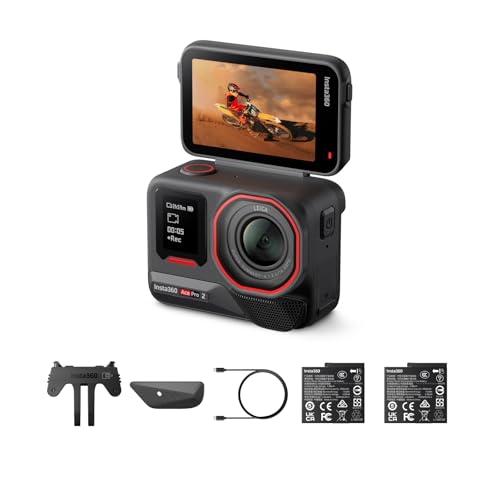
Insta360 Ace Pro 2 Dual Battery Bundle — AI-assisted night processing
The Ace Pro 2 approaches darkness as a computation problem. Its hardware foundation matches the Action 4’s — a sensor measuring 1/1.3 inches — and its title then adds the processing stack: dual AI chips, an explicit low-light claim, Active HDR and a Leica SUMMARIT lens. Computational night modes earn their keep by stacking and analysing multiple frames, trading a whisper of immediacy for visibly cleaner shadows, and a dedicated AI pipeline is the machinery such modes run on. For the vlogger walking a night market or the rider crossing a lit city, that trade is usually the right one: the footage’s audience sees the result, not the shutter speed.
Active HDR belongs in the night conversation because the hardest after-dark scenes are rarely uniformly dark. They are mixed: black sky over sodium-lit streets, headlights in a tunnel of shadow, a campfire face against a dark treeline. HDR processing exists for exactly that spread, holding the bright source from blowing out while the shadows are lifted. The Leica-branded lens contributes the optical half of the bargain — coatings and contrast that keep flare from streetlights from fogging the whole frame, though the title states no aperture figure and this review will not supply one.
The 2.5-inch flip touchscreen is a night feature in disguise. Framing a piece to camera in the dark, checking that a face is lit rather than silhouetted, reviewing whether the last run survived the light — all of it happens on the screen, and a tilting main screen is simply the best review tool in this guide. The bundle’s two batteries answer the endurance question that the title otherwise leaves open, since no runtime in minutes or hours is stated.
What the title withholds should temper the recommendation precisely. No aperture, no runtime figure, no waterproof depth and no internal storage are stated, so a buyer planning a specific night discipline — a dive, an all-night time-lapse, a winter expedition — must confirm those numbers in the documentation. For the commonest night work, though — cities, events, evening rides and faces around fires — the stated combination of sensor, lens, AI processing and HDR is aimed squarely and credibly.
Night markets, food streets and festival lanes are this camera’s home turf, and they explain its feature order. Such places mix tungsten, neon, LED and open flame inside a single pan, which is the exact chaos Active HDR and scene-aware processing exist to tame. The flip screen lets the presenter taste, react and narrate without a second operator, and the Leica lens branding promises the flare discipline that mixed point lights demand. A buyer whose channel is built on evenings in busy, bright-dark places will find the Ace Pro 2’s title reads like a specification written from their own shooting diary — the strongest compliment a listing can earn.
- Sensor stated: 1/1.3-inch
- Video stated: 8K, AI-powered
- Lens stated: Leica SUMMARIT lens
- Processing stated: Dual AI chip, AI editing, Active HDR
- Low-light claim stated: Low Light (in title)
- Screen stated: 2.5-inch flip touchscreen
- Aperture / runtime / depth figures: Not stated in the listing title — verify with the manufacturer documentation
Strengths
- Dual AI processing and an explicit low-light claim target night scenes directly.
- Active HDR suits mixed lighting — streetlights, headlights, fires — better than plain exposure.
- The flip screen makes reviewing and framing night shots practical.
Trade-offs
- No aperture figure is stated to judge the lens speed on paper.
- No runtime figure appears in the title despite the two-battery bundle.
- Computational night processing can smooth fine detail that purists prefer noisy and real.
Best for: city-night vloggers and travellers shooting mixed lighting who want processing to share the work. Not suited for: expedition shooters who need stated runtime and depth figures before committing.
Confirm the two-battery bundle’s contents on the Ace Pro 2 listing: check price on Amazon.

Ourlife 6K Action Camera — Vertical-ready night claim
The Ourlife camera is the guide’s test of how far a claim can travel without a sensor figure behind it. Its title claims stunning low-light imaging in the same breath as a 6K at 30 frames per second specification, yet states no sensor size and no aperture — the two numbers this guide has used to judge every other night case. That does not make the claim false. It makes it unverifiable from the listing, and the honest review says exactly that: this camera may shoot pleasing dusk footage through processing and a fast lens the title declines to describe, but a buyer cannot confirm the mechanism before purchase and should weight owner footage more heavily here than for any other pick.
What the title does state is a coherent creator package. Dual screens with touch control cover framing from both sides. A native 9:16 vertical mode acknowledges where much action footage is now published, sparing the crop that vertical delivery usually imposes. A 170-degree field of view is the widest stated angle in this guide, swallowing handlebar-to-horizon scenes whole. The waterproof figure is printed plainly — 30M — a depth that covers snorkelling, which the title names as its intended water sport, and the bundled 32GB and remote control round out a box that asks little of the buyer’s wallet afterward.
EIS is stated without a generation or system name, so stabilisation expectations should be set at competent rather than flagship. The 6K ceiling at 30fps will not produce high-resolution slow motion. And the low-light claim, repeated here as the maker states it, should be read as an invitation to check samples shot after sunset — ideally unedited, ideally in the blue-hour and streetlight conditions the buyer actually faces — rather than as a settled fact.
Judged with that candour, the Ourlife earns its place as the accessible night claimant: the only camera in this guide pairing any low-light claim with a vertical-native, dual-screen, snorkelling-rated package at the value end. Buyers who publish vertically and shoot their water sports at the surface will find its stated list surprisingly complete. Buyers whose darkness is deep — night diving, unlit trails — should climb to the big-sensor picks above, where the claims come with dimensions attached.
The vertical mode deserves more credit in a night context than it usually gets. Vertical video is disproportionately evening video — stories from gigs, dinners, rides home and night walks — and a camera that frames 9:16 natively lets its owner compose for that shape at dusk instead of cropping a horizontal frame in the dark afterwards. Combined with the dual screens, the Ourlife becomes a plausible one-device answer for a creator whose entire output is vertical and whose budget is singular. The claim discipline of this review stands — test the night claim on real footage — but the package logic around the claim is sounder than its price class usually manages.
- Video stated: 6K at 30fps
- Low-light claim stated: Stunning low-light imaging
- Screens stated: Dual screen touch
- Framing stated: 9:16 vertical mode; 170-degree wide FOV
- Waterproof stated: 30M, for snorkelling
- Extras stated: EIS, remote control, 32GB included
- Sensor size / aperture: Not stated in the listing title — verify with the manufacturer documentation
Strengths
- Native 9:16 vertical recording serves phone-first publishing without cropping.
- A stated 30M rating and snorkelling purpose give its water use a clear boundary.
- Dual touch screens and an included remote and card complete the kit in one box.
Trade-offs
- The low-light claim stands without a stated sensor size or aperture to support it on paper.
- 6K recording is limited to 30fps, ruling out high-resolution slow motion.
- EIS is stated without a system name or generation.
Best for: vertical-first creators and snorkellers who want a stated night claim in an affordable, complete package. Not suited for: night divers and unlit-trail riders, whose darkness demands a stated large sensor.
Look at the Ourlife camera’s listing for its full box contents: check price on Amazon.

GoPro LIT Hero Action Camera — Built-in light pick
The other five cameras in this guide cope with darkness. The LIT Hero declines to. Its title leads with a built-in light, and that single feature reframes the low-light problem for the subjects action cameras most often film at night: faces at arm’s length, campsite scenes, a tent interior, a cave or wreck’s near wall, the friend group around a fire pit just beyond the firelight. For those subjects, adding light beats gathering it — a modest lamp at one metre outperforms any sensor’s sensitivity, restores colour that noise reduction would smear, and lets the camera keep the fast shutter speeds that action footage needs.
The rest of the title describes a sensibly mainstream camera: 4K at 60 frames per second in Ultra HD, 12-megapixel photos, a touch screen, HyperSmooth stabilisation — GoPro’s named system, stated here in full — in a lightweight, compact, waterproof body. Sixty frames at 4K is double the AKASO and Ourlife ceilings, giving evening footage a half-speed option under artificial light. The Hero name places it in GoPro’s simpler line, and the title’s economy reflects that: no sensor size, no aperture and no depth figure are stated.
The light’s limits deserve the same clarity as its virtues. A reach of a built-in lamp is short; it will not illuminate a ski slope, a trail ahead of a bike at speed, or a concert stage. It will also flatten the subjects it does reach if used carelessly, since frontal light erases the modelling that makes faces readable — a reason to treat it as one tool among exposure settings rather than as a switch marked night. And a lamp spends battery, a cost the title does not quantify, so runtime expectations for lit shooting belong to the documentation.
Within those boundaries, the LIT Hero is the guide’s most original answer and, for a defined set of buyers, its most practical one. Social shooters, campers, cavers, anglers after dark and parents filming garden nights will get more usable footage from a camera that brings light than from a camera that merely tolerates darkness. It is included in a low-light guide not as a curiosity but as a reminder that the oldest photographic solution to darkness is still, at close range, the best one.
Parents should read this review with particular attention, because the LIT Hero solves a filming problem that has nothing to do with sport. Garden evenings, birthday sparklers, tent stories and the walk back from the fireworks are close-range, face-first, low-light subjects that defeat small sensors and bore large ones’ owners with settings. A camera that simply brings its own light, in a body a family can operate with cold hands, will capture more of those evenings than a technically superior camera left in a drawer for being complicated. Not every low-light problem is an expedition; some are just bedtime, outdoors.
- Light stated: Built-in light
- Video stated: 4K60 Ultra HD
- Photos stated: 12MP
- Stabilisation stated: HyperSmooth stabilization
- Screen stated: Touch screen
- Body stated: Lightweight, compact, waterproof
- Sensor size / depth figure / light output figure: Not stated in the listing title — verify with the manufacturer documentation
Strengths
- A built-in light restores colour and shutter speed for close night subjects.
- 4K60 doubles the frame rate of the value picks in this guide.
- HyperSmooth is named in full, the clearest stabilisation statement here.
Trade-offs
- A small lamp cannot light trails, slopes or stages at distance.
- No sensor size is stated for judging unlit performance.
- Lit runtime is not stated, and lamps spend battery quickly.
Best for: campers, social shooters and close-range night filming where subjects sit within a few metres. Not suited for: night riders at speed, whose subject is a trail far beyond any reach of a built-in lamp.
See the LIT Hero’s listing for its full specification: check price on Amazon.

AKASO Brave 7 LE Action Camera — Honest daylight baseline
The Brave 7 LE earns the closing review by saying nothing. Its long title enumerates a touchscreen, EIS 2.0 stabilisation, a remote control, two 1350mAh batteries, external microphone support, WiFi, zoom and a 131-foot underwater rating — and contains no low-light claim, no sensor size and no night language of any kind. In a guide devoted to darkness, that silence is data. It marks the boundary between cameras engineered and marketed for the night and a competent generalist that will do its honest best at dusk and should not be bought on the expectation of more.
What should a buyer expect from it after sunset? The title supports a careful answer. Electronic stabilisation of a named generation will steady a walking shot under streetlights. The touchscreen will make exposure adjustments reachable. Two batteries will outlast an evening event. Underwater, its stated 131 feet of rating exceeds the Ourlife’s 30M for the diver whose reef visits happen in daylight. None of that converts into night performance; it converts into a camera that degrades gracefully as light falls, in the company of most of the market.
There are buyers for whom that is the correct purchase, and a low-light guide serves them by saying so. A family whose filming ends at the beach barbecue’s edge, lit by house lights and phone torches, does not need a 1/1.1-inch sensor. A dive club buying three units for daytime reefs should not pay a night premium per unit. The Brave 7 LE’s kit completeness — remote, spare battery, microphone path — may serve those buyers better across a year than a specialist sensor serves them across a handful of dark evenings.
The review’s obligation is the boundary line, and here it is in plain terms: if the footage that matters to you happens after dark — night rides, dusk surf, evening events without house lighting — buy one of the five cameras above this one, whose titles stake claims and dimensions on that work. If your darkness is occasional and somebody else’s lights are usually on, the Brave 7 LE remains the sensible, fully equipped generalist it is in every other guide where it appears.
One more honest scenario belongs to this baseline. Rental and loaner fleets — dive shops, resorts, school media departments — choose cameras like the Brave 7 LE precisely because their titles promise verifiable, mechanical things: a depth in feet, a battery count, a remote in the box. Night performance cannot be rented against a specification that does not exist, and fleet buyers know it. The camera’s presence at the foot of a low-light guide is therefore not a booby prize; it is a reminder that most of the world’s action footage is shot in somebody’s daylight, and that buying for the footage you actually shoot is the first rule this entire guide is built on.
- Video stated: 4K at 30fps
- Photos stated: 20MP
- Stabilisation stated: EIS 2.0
- Underwater stated: 131 feet
- Batteries stated: 2 x 1350mAh
- Extras stated: Touch screen, remote control, WiFi, external microphone support
- Low-light claim / sensor size: Not stated in the listing title — verify with the manufacturer documentation
Strengths
- A complete two-battery kit with remote and microphone support in one box.
- The stated 131-foot rating leads the guide for daytime diving.
- Its title makes no night promises it cannot cash, simplifying the buying decision.
Trade-offs
- No low-light claim or sensor figure supports after-dark work.
- 4K recording stops at 30fps, limiting evening slow motion.
- Dusk footage will rely on house lights and luck rather than design.
Best for: daylight-first buyers with occasional lit evenings, and dive groups equipping several units. Not suited for: anyone whose important footage happens after dark without ambient lighting.
Check the Brave 7 LE’s kit list on its Amazon listing: check price on Amazon.
Comparison
| Product | Night mechanism stated | Sensor / aperture stated | Top video stated |
|---|---|---|---|
| DJI Osmo Action 4 | Low-light imaging claim, D-Log M colour | Sensor of 1/1.3 inches | 4K/120fps |
| DJI Osmo Action 6 Essential | Largest sensor, f/2.0 aperture end | 1/1.1-inch square; f/2.0–f/4.0 | 8K |
| Insta360 Ace Pro 2 | Low-light claim, dual AI chip, Active HDR | Sensor of 1/1.3 inches | 8K |
| Ourlife 6K Camera | Low-light imaging claim | Not stated in the listing title | 6K/30fps |
| GoPro LIT Hero | Built-in light | Not stated in the listing title | 4K60 |
| AKASO Brave 7 LE | No night mechanism stated | Not stated in the listing title | 4K/30fps |
Read the second column as the guide in miniature. Four cameras gather light better — by sensor, aperture or processing — one camera adds light of its own, and one declines the contest. Which column wins depends entirely on the distance between your lens and your subject after dark: beyond a few metres, gathering wins; within a few metres, the lamp is embarrassingly effective; and where somebody else is paying for the lighting, the baseline camera spends your money on batteries and remotes instead.
How to Choose a Low Light Action Camera
Begin by describing your darkness precisely, because the word covers incompatible problems. City darkness is bright in patches and black between them, and it rewards dynamic range and HDR processing. Trail darkness is uniform and total, and it rewards sensor size and aperture. Water darkness is blue, deep and close, and it rewards a light and a depth rating. A buyer who cannot say which darkness they film in is not ready to rank these cameras, and a seller who promises one camera for all three should be read with suspicion.
Next, rank the stated mechanisms over the stated adjectives. A sensor dimension can be compared across brands; an aperture can be compared across the whole of photography; a claim of stunning imaging can be compared with nothing. This guide has therefore weighted the Action 6’s figures most heavily, the Action 4’s and Ace Pro 2’s sensor-plus-claim combinations next, and bare claims last. That weighting is not a verdict on footage — processing can still embarrass a larger sensor on a given night — but it is the only weighting a buyer can perform from listings alone.
Then check the frame rate your night needs. Slow motion after dark is the first casualty of low light across the whole category, because high frame rates shorten every exposure. If evening slow motion is the point of the purchase, the Action 4’s 4K/120fps and the LIT Hero’s 4K60 under its own light are the relevant ceilings; if the night work is walking, talking and travelling, 30fps ceilings stop mattering and sensor or lamp should decide.
Finally, budget for the night around the camera. A spare battery for long evenings, a small external light where the camera allows one, and a faster memory card for high-bitrate night modes all belong in the same order. Darkness is unforgiving of improvisation, and the cheapest night upgrade is usually the accessory bought before the trip rather than the camera replaced after it.
Keep the receipt of your reasoning, too: when the next model year arrives with louder claims, a written note of which mechanism you bought and why will tell you whether the new camera solves your problem or merely re-describes it.
Why do action cameras struggle after dark in the first place?
Three constraints collide. The sensors are small because the cameras must be light enough to wear. The lenses are wide because the framing must forgive rough mounting, and wide lenses on small bodies gather modest light per pixel. And the shutter must stay fast because the subject, by definition, is action — a combination that starves every frame. Daylight hides all three sins under an abundance of photons. Darkness invoices them simultaneously, which is why night performance separates action cameras more brutally than any daylight test can.
Electronic stabilisation deepens the bind. It needs sharp frames to crop and align, and sharp frames need shutter speed, and shutter speed needs light. A camera can therefore appear stabilised and clean at noon and turn to smeared, wobbling noise at eight in the evening without anything being broken. The models in this guide with large sensors and wide apertures are, in effect, buying their stabilisation systems better raw material to work with after dark.
Heat finishes the list of night enemies. Sealed waterproof bodies trap warmth, high sensitivity amplifies it into noise, and long evening recordings at high frame rates push small cameras toward their thermal limits precisely when the light is worst. Cold resistance, stated by the Action 6, is the mirror virtue — winter nights drain batteries that summer evenings would not — and both belong in a serious night buyer’s thinking.
Does a bigger sensor always beat clever processing at night?
Not always, and the Ace Pro 2 exists to argue the point. Multi-frame processing can average away noise that a single large-sensor frame must keep, and AI-driven scene recognition can expose a face correctly inside a scene that defeats a dumb metering system. For the static and slow-moving night subjects most vloggers film, a computational camera can produce the more pleasing picture on the night, whatever the sensor chart says.
The large sensor’s counter-argument is motion and honesty. Processing needs several similar frames to combine, and fast action gives it dissimilar ones; artefacts appear exactly where the sport is quickest. A big sensor’s cleaner single frames also grade more predictably and match better with other cameras in a multi-camera edit. Riders and athletes should lean optical; talkers and travellers can lean computational; and buyers who do both should read the Action 4’s combination — large sensor, deep colour, no AI claims — as the middle road.
There is a longevity angle too. Processing fashions change with every model year, while a large sensor’s advantage is physics and ages slowly. A camera bought for a five-year night career is safer founded on glass and silicon area than on this season’s algorithm, however brilliant the algorithm’s launch footage looks.
When is adding your own light better than buying a night camera?
Whenever the subject is close and the setting allows it. A small video light on a short grip transforms faces, food, campsites, workshops and cave mouths, and it does so for any camera — including the baseline Brave 7 LE — at a fraction of a flagship upgrade’s cost. The LIT Hero builds that insight into the body, trading the separate light’s power and aiming freedom for the certainty of never having left it at home.
Distance is the boundary. Light falls off brutally with range, so trails, slopes, stages and streetscapes stay the big sensors’ territory no matter how bright a pocket lamp claims to be. Water complicates the rule in the diver’s favour: underwater, subjects are close and ambient light dies quickly, which is why dive torches exist and why a camera’s own light, modest on land, can be genuinely useful on a night reef — subject always to the depth rating, which for the LIT Hero must be confirmed in the documentation since its title states none.
Etiquette is the final consideration. A lamp is a social act: it announces filming, flattens the mood of a firelit circle and can dazzle fellow riders. The discreet sensitivity of a large-sensor camera preserves scenes that a light would change by arriving. Night buyers should ask not only what their footage needs, but what their evenings can tolerate.
How should you expose a night ride without ruining it?
Resist the urge to make night look like day. A frame exposed until the sky turns grey has lost the very thing the ride felt like, and no audience mistakes it for noon. Expose for the lit subject — the rider under the streetlight, the face by the fire, the dashboard of the trail lit by a headtorch — and let the surroundings fall toward black, where they honestly belong. Every camera in this guide will produce more watchable footage with that discipline than with sensitivity pushed to its ceiling.
Lock what the camera wants to wander. Auto exposure at night hunts constantly, brightening for a dark stretch and dimming for a lit sign until the footage breathes like a lung. Where a model allows exposure to be fixed or compensated — a setting to confirm in the documentation for the specific pick — a rider crossing mixed lighting will get steadier, more professional results from a locked, slightly dark frame than from a clever, restless one. The same applies to white balance under sodium and LED street lighting, whose colour shifts are otherwise corrected frame by frame into a flickering argument.
Shoot more than you need and expect to discard boldly. Night footage has a lower keeper rate than daylight on every camera ever made, including the flagships above, because focus, exposure and noise all conspire at once. The professional habit is volume plus ruthlessness: record the whole session, keep the lit seconds, and let the rest go without mourning. Storage figures like the Action 6’s stated 50GB and the doubled batteries in two of these bundles exist, in the end, to make that habit affordable.
Common Mistakes
Believing a low-light adjective without a mechanism. Two titles in this guide claim stunning low-light imaging; only one of them states the sensor behind the claim. Adjectives are free. Dimensions cost money to build, which is why they are the claims worth paying for.
Testing a night camera under shop lighting. Retail brightness flatters every sensor ever made. A camera intended for trails and dusk should be judged on footage shot in comparable darkness, ideally unedited, and a seller’s noon sample reel answers a question nobody asked.
Chasing slow motion into the dark. High frame rates divide the available light into thinner slices. Expecting 120fps night footage to match its daylight self leads buyers to blame cameras for arithmetic. Drop the frame rate as the light drops, or add light.
Forgetting that stabilisation eats light too. Electronic systems crop and demand sharp frames. A night shot that looks wobblier than the daylight one is usually a shutter-speed problem wearing a stabilisation costume, and the cure is light or sensor, not a settings menu.
Ignoring the battery cost of darkness. High sensitivity, lamps and long evening sessions all spend power faster than a noon ride. The stated four hours of the Action 6 and the doubled batteries in two bundles here exist because night work is thirsty work.
Final Recommendation
For a single recommendation, the DJI Osmo Action 6 Essential Combo states the most complete night case in figures a buyer can verify: the largest sensor, the widest aperture, four hours of battery, cold resistance and storage in reserve. Editors should take the Action 4 for its 10-bit colour, city vloggers the Ace Pro 2 for its processing and flip screen, and close-range social shooters the LIT Hero, whose little lamp will outshoot every sensor here across a camp table. The Ourlife serves vertical creators on a budget with its claim taken as a claim, and the Brave 7 LE serves everyone whose evenings are lit by somebody else. Darkness, in the end, is not one condition but three — and the right camera is the one whose stated mechanism matches the dark you actually film in, which is a more useful closing test than any ranking this page could impose.
Before ordering any of them, try the discipline this guide used: write down your three darkest recurring scenes, note which mechanism each camera states for each scene, and let the shortest honest list win. It takes ten minutes, it survives every future model launch, and it will still be the right method when this shortlist is two generations old.
Frequently Asked Questions
Which sensor size should I look for in a low light action camera?
On the evidence of these titles, 1/1.3-inch is the working standard for serious night claims and 1/1.1-inch, stated by the Action 6, is the step above it. Titles that state no sensor size are asking to be judged on footage instead, which is a reasonable request at lower prices and a weak one at flagship prices.
What does a variable aperture do on the Osmo Action 6?
It lets the lens open to f/2.0 for dark scenes and stop down to f/4.0 in bright ones, controlling both light intake and depth of field. In this guide it is the only stated aperture, and its wide end is a principal reason the Action 6 leads the night shortlist on paper.
Is the GoPro LIT Hero’s built-in light enough for night riding?
For the rider’s own face and immediate surroundings, it can help; for the trail ahead at speed, no built-in lamp of this class reaches far enough. Night riding at pace belongs to the large-sensor picks, ideally supplemented by a bar or helmet light doing the trail illumination.
Can the Ourlife camera really shoot in low light?
Its title claims stunning low-light imaging, and this guide reports the claim as stated. The title gives no sensor size or aperture to corroborate it, so the claim should be tested against unedited owner footage from dusk conditions before the camera is trusted with an important night event.
Why is a daylight camera included in a low light guide?
The Brave 7 LE marks the baseline honestly. Many buyers wonder whether a cheaper generalist will cope after dark, and the answer is best given by reviewing the generalist in the open — complete kit, no night mechanism stated — rather than by leaving the question to a sales page.
Does 10-bit colour matter at night?
Yes, disproportionately. Night frames are mostly shadow and gradient, exactly where 8-bit files band into visible steps. The Action 4’s 10-bit D-Log M preserves those gradients for grading, which is why editors rank it above technically brighter cameras for finished night work.
Related Guides
Cameras chosen for small hands and shallow water are rounded up in our guide to best kids action cameras For scenes where the night surrounds the camera entirely, our comparison of best consumer 360 cameras And for spherical shooting on a tighter budget, our shortlist of best inexpensive 360 cameras
Related guides
- Best Thermal Imaging Cameras Hunting: Six Handheld Thermal Monoculars for Night Observation
- Best Mirrorless Cameras for Bird Photography: Crop Reach, Fast Bursts and the Lens Question Answered First
- Best 4K Cameras Travel Shooters Actually Carry
- Best 1080 Webcams: Six Full HD Cameras Judged on Light, Focus and Voice


