What's inside
- Where to Buy
- Key Takeaways
- Quick Picks
- How We Chose These Picks
- Side-by-Side: What the Titles Actually Promise
- How to Choose a Laptop for Fortnite
- Does Fortnite Need a Gaming Laptop at All, or Will Integrated Graphics Do?
- Should You Play at Native Resolution or Drop It for Frame Stability?
- What Settings Habits Matter More Than Hardware in Fortnite?
- How Does Fortnite’s Seasonal Nature Change What You Should Buy?
- Which Buying Errors Haunt Fortnite Laptop Shoppers?
- Final Recommendation
- Frequently Asked Questions
- Related Guides
As an Amazon Associate I earn from qualifying purchases. This post may contain affiliate links at no extra cost to you.
widgetverdict.com is reader-supported. When you buy through links on our site, we may earn an affiliate commission.
Where to Buy
Six linked listings carry this guide, and each one is worth opening on its own page before money moves. The ASUS ROG Strix G16 listing is where its current figure sits, so check price on Amazon there and read the 165Hz line in its title while you are on the page. Shoppers leaning toward the Alienware 16 Aurora should confirm the WQXGA panel wording on its product page, where the delivered cost is also shown. The older HP Victus 15 keeps its pricing on its own listing, and its 2022 model code deserves a second glance before ordering. Acer’s page for the Nitro V displays what that 16-inch build costs today. The MECHREVO Aurora 16X and the MSI Cyborg 15 likewise publish their figures only on their respective Amazon pages, so open both before deciding which RTX 5060 machine earns the click.
Searching for the best fortnite laptops usually starts with a graphics card name and ends, a few browser tabs later, with a question nobody answered: will this machine stay smooth when a final circle collapses into a box fight and twenty builds appear at once? Fortnite rewards a particular blend of hardware. The game leans on quick single-core processor work when edits and builds stack up, it answers beautifully to a fast-refresh screen because tracking a swinging opponent is a visual task before it is an aiming one, and its competitive community plays at reduced settings where the graphics card’s job is consistency rather than spectacle. A laptop chosen for this game is therefore not simply a gaming laptop with a famous badge. It is a system balanced around frame stability, panel speed and cooling that holds its clocks through a full evening of matches.
One honesty rule governs everything below. No listing title in this guide mentions Fortnite, and no title prints a frame rate for any game, so this guide assigns no frames-per-second figure to any machine. What the titles do print — graphics cards, processors, memory, storage, panel resolutions and refresh rates — is enough to reason carefully about fit, and that reasoning is what follows. Where a title stays silent about something a Fortnite player might want, such as graphics memory capacity or chassis weight, the spec box records the silence rather than filling it with a guess.
The six machines divide into three tempers. Two are RTX 5060 flagships of the mainstream, the Strix G16 and the MECHREVO Aurora 16X, built around the same Intel HX processor and fast panels. Two are RTX 5050 machines, the Alienware 16 Aurora and the Acer Nitro V, trading a step of graphics muscle for their own charms — resolution in one case, a 165Hz screen in the other. One is MSI’s Cyborg 15, an RTX 5060 laptop with Windows 11 Pro and the slimmest ambitions of the group. And one, the HP Victus 15, is an older RTX 3050 design from 2022, included deliberately and labelled honestly: it is the budget door into this guide, not a peer of the newer silicon, and its review says exactly what that means for a Fortnite player in practice.
Key Takeaways
- Panel speed is a genuine Fortnite feature: four of the six titles print refresh rates of 144Hz or higher, topped by the Aurora 16X at 180Hz.
- Three machines carry the RTX 5060, two carry the RTX 5050, and the 2022 Victus carries the older RTX 3050 — the graphics gap between those tiers matters more than any other line here.
- Memory splits the field sharply: four picks hold 16GB, while the Victus and the Nitro V hold 8GB, which Fortnite players who stream or keep Discord and a browser open will feel.
- The Strix G16 pairs its RTX 5060 with the joint-strongest processor in the guide, the Core i7-14650HX, and the only 1TB drive among the top tier.
- Storage divides at 512GB versus 1TB; Fortnite itself is modest, but a shared games library is not.
- No title here names the game or quotes a frame rate, so every performance statement in this guide is framed as hardware reasoning, never as a measured result.
Quick Picks
| Pick | Badge | Why it is here |
|---|---|---|
| ASUS ROG Strix G16 | Top Choice | RTX 5060, an HX-class i7 and a 165Hz screen — the most complete Fortnite specification in the guide. |
| Alienware 16 Aurora | Sharpest Screen | A WQXGA 120Hz panel for players who split time between matches and everything else a laptop does. |
| HP Victus 15 | Budget Door | A 2022 RTX 3050 design that lowers the entry cost, with clear limits stated in its review. |
| Acer Nitro V | Fast Panel, Lean Memory | 165Hz and an RTX 5050, held back by 8GB of RAM that buyers should plan around. |
| MECHREVO Aurora 16X | Refresh Maximalist | 180Hz at 2.5K with RTX 5060 power, from a smaller brand with a thinner support footprint. |
| MSI Cyborg 15 | Pro Software Pick | RTX 5060 graphics and Windows 11 Pro in the most portable full-size chassis here. |
How We Chose These Picks
Fortnite’s demands were translated into title evidence before any machine was admitted. The game is built on rapid building and editing, which keeps the processor busy feeding geometry, and on close-quarters tracking fights, which is where panel refresh earns its keep. So the admission test asked three questions of each listing title. Does it name a discrete GeForce RTX graphics card, rather than integrated graphics alone? Does it name a processor with genuine multi-core strength? And does it state enough about memory and storage to judge whether the machine can hold the game, its launcher ecosystem and a player’s wider library without daily friction? Six titles answered all three clearly enough to link.
Refresh rate was treated as a first-class fact, not a garnish. Four titles print one: 165Hz twice, 180Hz once, 144Hz once, plus the Alienware’s 120Hz. The Victus title, written in 2022, describes its display only as Full HD, and this guide refuses to upgrade that silence into a number — its review discusses the panel strictly as an FHD screen of unstated speed. That restraint matters because competitive Fortnite is precisely the genre where a panel figure changes what a buyer should pay, and a guide that invents the figure has failed at its only job.
Memory was weighed the way players actually load a machine. Fortnite alone is not a heavy memory consumer, but nobody plays Fortnite alone on the software level: the Epic launcher, voice chat, a browser with a stream or a wiki, and recording tools all share the same pool. Sixteen gigabytes, fitted to four of these machines, is the comfortable figure. Eight gigabytes, fitted to the Victus and the Nitro V, is workable for the game itself and tight for everything around it, and both reviews say so without softening it.
One more admission principle deserves stating, because it excluded machines readers might expect to see. Several well-known gaming laptops were left out not for weak hardware but for titles that refused to commit to the facts this guide needed — panels described with adjectives instead of refresh figures, memory printed without its generation, graphics named by family rather than model. In a category where two configurations of the same laptop can differ by an entire graphics tier, a vague title is not a neutral thing; it transfers the risk of the purchase from the seller to the buyer. The six linked machines are the ones whose titles accepted that risk themselves. A reader who finds a tempting seventh option elsewhere now owns the tool this guide used: read the title like a contract, and let any line it will not print count as a line answered in the negative.
Brand reality formed the final filter, applied unevenly on purpose. ASUS, Alienware, HP, Acer and MSI run large service networks; MECHREVO is a smaller gaming brand whose Aurora 16X earns its place on specification while carrying a support caveat that its review states openly. A guide that pretended those ownership experiences were identical would be lying by symmetry, so they are not presented as identical below.

ASUS ROG Strix G16 — Top Choice
The Strix G16 leads because its title reads like a Fortnite shopping list written by someone who plays the game. An RTX 5060 does the rendering. An Intel Core i7-14650HX — an HX chip, the class Intel builds for sustained gaming loads rather than thin-and-light efficiency — feeds it. Sixteen gigabytes of DDR5 and a 1TB fourth-generation SSD hold the software, and the screen is a 16-inch FHD+ panel in 16:10 aspect refreshing at 165Hz with a stated 3ms response. Competitive players ask for exactly this stack: graphics headroom, processor headroom, and a panel fast enough to display what the other two produce.
The 16:10 aspect deserves its sentence. Fortnite’s interface carries a hotbar, material counters and a minimap competing for the same pixels, and the extra vertical room of FHD+ over plain FHD gives that interface breathing space without shrinking the playfield. Wi-Fi 7, the newest wireless standard named anywhere in this guide, suits households with current routers and crowded airwaves, though competitive players will still reach for a cable when one is available. ASUS’s ROG line also brings the deepest owner community in this guide, which matters in year two when a fan needs replacing or a setting needs explaining.
Who it suits is the player treating Fortnite as their main competitive title and this laptop as a multi-year commitment. The honest limits are the ones the title leaves open: graphics memory capacity is not stated, chassis weight is not stated, and neither is battery capacity, so a buyer planning to carry it daily should verify those figures in the manufacturer documentation before ordering. Nothing in the printed specification suggests a weakness for this game; the silences are about portability, not performance.
Consider how a Fortnite evening actually unfolds on a machine like this, because the specification maps onto it unusually well. The first hour is battle royale with a squad, where the HX processor’s fast cores handle the constant geometry churn of building while the RTX 5060 keeps the rendering side unhurried. The second hour drifts into creative maps and aim training, where frame stability matters more than peak numbers and where the 165Hz panel makes every flick and edit feel directly connected to the hand. The third hour is clips: reviewing the evening’s fights, trimming highlights, maybe uploading them. A 1TB drive and 16GB of memory mean none of those transitions involves closing one life to start another. That continuity — game, practice, creation, communication, all open at once — is what a complete specification buys, and it is the quality players describe months later when they say a laptop feels fast, long after benchmark numbers are forgotten.
Longevity deserves a careful word for this pairing, because the claim is about trajectory rather than promise. Fortnite evolves in seasons, its engine features grow, and its social layer keeps adding weight around the game itself. A machine bought with headroom in processor, graphics and storage absorbs those increments quietly; a machine bought at the minimum meets each new season as a small negotiation. The Strix’s specification is the guide’s clearest example of buying the absorption rather than the negotiation.
- Display: 16-inch FHD+ 16:10 panel, 165Hz, 3ms response as stated
- Processor: Intel Core i7-14650HX
- Graphics: NVIDIA GeForce RTX 5060
- Graphics memory: Not stated in the listing title — verify with the manufacturer documentation
- Memory: 16GB DDR5
- Storage: 1TB Gen 4 SSD
- Wireless: Wi-Fi 7
- Operating system: Windows 11 Home
Strengths
- HX-class processor matches Fortnite’s appetite for fast core performance during build fights
- 165Hz 16:10 panel gives both motion clarity and interface room
- 1TB drive is double the storage of most rivals here
Trade-offs
- Weight and battery figures are absent from the title, so portability is unverified
- Windows 11 Home rather than the Pro edition one rival ships
- RTX 5060 sits a tier below the halo cards, so cinematic modes in other games will ask for settings discipline
Best for: a committed Fortnite player who wants the guide’s most complete specification in one purchase.
Not suited for: a daily commuter choosing by weight, because the title prints no weight figure to choose by.

Alienware 16 Aurora — Sharpest Screen
Alienware’s Aurora makes a different bet from the Strix. Its title specifies a WQXGA display — a resolution tier well above FHD — refreshing at 120Hz, driven by an RTX 5050 and an Intel Core 7 240H, with 16GB of DDR5 and a 1TB SSD behind them. For Fortnite specifically, 120Hz remains comfortably inside the high-refresh band where tracking fights feel transformed compared with 60Hz, and the sharper panel pays its dividend everywhere else a laptop earns its living: text, video, creative work and the general crispness of a desktop you stare at for years.
The reasoning a Fortnite player must do here is about resolution discipline. A WQXGA panel contains far more pixels than FHD, and rendering the game at native resolution asks more of the RTX 5050 than rendering at FHD would. Competitive players routinely lower in-game resolution or use performance-oriented settings, and on this machine that habit is not a compromise but the intended way to play: let the panel be gorgeous for everything else, and let the game run at the resolution that keeps frames stable. The 1TB drive and full 16GB of memory mean no other part of the specification asks for similar management.
The blue finish named in the title is a small thing that signals the machine’s intent — Alienware builds design objects as much as computers, and support, parts and resale all benefit from the brand’s scale. Wi-Fi 7 matches the Strix on wireless modernity. The Aurora suits the player whose Fortnite hours share the machine with study, work or content creation, and who would rather have one excellent screen for all of it than a panel optimised for a single game at the expense of the rest of the day.
The Aurora also invites a thought about what a gaming laptop is for in a household where it is the only premium screen. On this machine, the same panel that tracks a swinging pickaxe at 120Hz in the evening displays documents, films and photographs at a sharpness FHD panels cannot approach during the day. Buyers cross-shopping the Strix should ask themselves honestly which hours dominate. If the laptop is a Fortnite instrument first and everything else second, the Strix’s faster panel and stronger processor argue well. If it is a life instrument that also plays Fortnite seriously, the Aurora’s screen argues back, and its argument improves every single day rather than only on match nights.
Dell’s ownership infrastructure under the Alienware badge deserves its mention too. Firmware updates, replacement parts and resale demand all run deeper for this brand than for most of the guide, which compounds across a long ownership. The Aurora is not the best Fortnite machine here by the game’s own narrow metrics — it is the best argument that a Fortnite machine can also be the nicest object a household owns.
- Display: WQXGA panel, 120Hz refresh as stated
- Processor: Intel Core 7 240H
- Graphics: NVIDIA GeForce RTX 5050
- Memory: 16GB DDR5
- Storage: 1TB SSD
- Wireless: Wi-Fi 7
- Finish: Blue
- Operating system: Windows 11 Home
Strengths
- WQXGA resolution is the sharpest screen in this guide by a wide margin
- Full 16GB memory and 1TB storage ask for no management habits
- 120Hz keeps it firmly in high-refresh territory for tracking fights
Trade-offs
- RTX 5050 is a tier below the RTX 5060 machines
- Native-resolution play in demanding modes will strain that graphics card
- Panel response time is not stated in the listing title — verify with the manufacturer documentation
Best for: a player who wants one sharp, premium screen for matches, study and media alike.
Not suited for: a settings-maximalist who insists on native resolution everywhere, because the WQXGA pixel count outruns the RTX 5050 at the top end.
HP Victus 15 — Budget Door
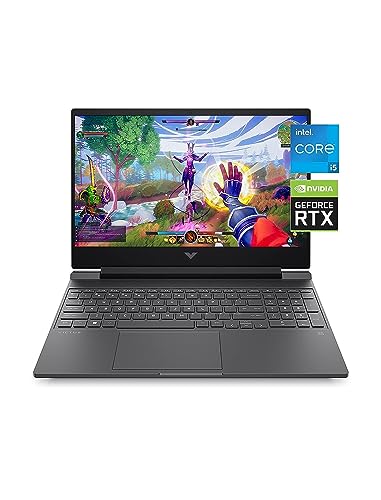
Every guide needs its honest floor, and the Victus is this one’s. The listing is a 2022 model — the title carries the year and the model code 15-fa0025nr — built around an RTX 3050, a 12th-generation Intel Core i5-12500H, 8GB of RAM and a 512GB SSD behind a Full HD display. Beside RTX 5060 machines it is outclassed on paper in every row, and its review will not pretend otherwise. What it offers is a reputable brand, a discrete graphics card from a known generation, and an entry point for a player whose budget is a fact rather than a preference.
Frame the expectations correctly and the machine has a real case. Fortnite’s competitive scene plays at reduced settings precisely because clarity and stability matter more than shadows, and an RTX 3050 was a mainstream card of its era that handled the game’s performance-oriented modes in its day. The i5-12500H remains a capable processor with strong cores. The constraints are the 8GB of memory — tight once chat, launcher and browser join the game — and a panel whose refresh rate the title never states, described only as Full HD. A buyer here should assume a standard-refresh screen until the manufacturer documentation proves otherwise, because in this genre the panel is half the purchase.
HP lists Enhanced Thermals and a backlit keyboard in the title, small mercies that matter across long sessions. The Victus suits a younger player’s first gaming laptop, a spare machine for a second room, or a stopgap bought knowingly. It does not suit anyone expecting it to trade blows with the 5060 pair above; the honest reason to buy it is that it costs less — check its listing for the current figure — and the honest reason to skip it is everything its review just said.
One more consideration belongs in this review because budget machines live or die by it: the upgrade question. A laptop bought cheaply and upgraded once — memory being the classic candidate — can outgrow its specification, while one bought cheaply and sealed stays exactly what it was. HP’s title says nothing about slots or serviceability, so this guide claims nothing; the buyer who cares should check the model’s documentation before ordering, and should price the machine as the 8GB configuration printed, treating any upgrade path as a bonus discovered rather than a promise made. Bought that way, with the panel’s speed verified from documentation and the price confirmed on the listing, the Victus is a rational floor. Bought on badge and hope, it is how disappointment happens.
- Display: Full HD; refresh rate not stated in the listing title — verify with the manufacturer documentation
- Processor: Intel Core i5-12500H, 12th generation
- Graphics: NVIDIA GeForce RTX 3050
- Memory: 8GB RAM
- Storage: 512GB SSD
- Cooling note in title: Enhanced Thermals
- Keyboard: Backlit
- Operating system: Windows 11 Home
- Model year stated: 2022 (15-fa0025nr)
Strengths
- Established HP line with broad parts and support availability
- Discrete RTX graphics rather than integrated graphics alone
- i5-12500H processor remains respectable for the game’s CPU demands
Trade-offs
- RTX 3050 is two graphics generations behind the leaders here
- 8GB of RAM is the joint-lowest figure in the guide
- Panel refresh rate is unstated, a serious unknown for a competitive title
Best for: a first gaming laptop bought on a firm budget, with expectations set by this review.
Not suited for: a ranked grinder who needs a verified high-refresh panel, because this title never prints one.

Acer Nitro V — Fast Panel, Lean Memory
The Nitro V is the guide’s most lopsided specification, and its review is a study in which lopsidedness a Fortnite player can live with. The strong side is genuinely strong: an RTX 5050, an Intel Core 5 210H, and a 16-inch WUXGA IPS panel refreshing at 165Hz — the joint-fastest screen here, on the joint-largest display, with IPS viewing stability for shared screens and off-angle glances. Acer’s Nitro line has served the value end of gaming for years, and this configuration’s panel generosity is very much in that tradition.
The lean side is memory: 8GB of DDR5, half the figure of the Strix, the Aurora and the Cyborg. For Fortnite in isolation that pool is workable; for the way people actually play — voice chat open, a stream running, clips being captured — it is the specification most likely to announce itself. Storage is 512GB on a fourth-generation SSD, adequate for a focused library. Wi-Fi 6, rather than 7, is a minor step behind the leaders and irrelevant beside a cable. The practical verdict writes itself: this is the pick for a player who values panel speed above multitasking sprawl, plays with a tidy set of background apps, and would rather have 165Hz today than memory headroom they may never use.
Buyers should also weigh upgradeability as a question for Acer’s documentation on this exact model, since the title is silent on slots; many Nitro machines have historically welcomed memory upgrades, but this guide claims nothing the title does not print. Treat the 8GB as the machine you are buying, let any upgrade path be a pleasant discovery, and the Nitro V’s bargain — newest-generation graphics and a fast, big panel at the cost of memory discipline — can be judged fairly.
Picture the player this specification fits, because it is a recognisable one. They play in the evening, squad voice chat open and nothing else — no stream, no capture software, no forty browser tabs of homework and highlights. Their desktop is tidy because their habits are. For that player, the Nitro V’s 8GB ceiling may never announce itself at all, while its 165Hz panel announces itself in the first minute of the first match. Specifications are only shortages relative to a life; Acer has built a machine whose shortage is real but narrowly aimed, and whose strength — that big, fast IPS screen — is the thing Fortnite players in this guide are shopping for in the first place.
- Display: 16-inch WUXGA IPS, 165Hz as stated
- Processor: Intel Core 5 210H
- Graphics: NVIDIA GeForce RTX 5050
- Memory: 8GB DDR5
- Storage: 512GB Gen 4 SSD
- Wireless: Wi-Fi 6
- Keyboard: Backlit
- Operating system: Not stated in the listing title — verify with the manufacturer documentation
Strengths
- 165Hz IPS panel is the joint-fastest and joint-largest in the guide
- RTX 5050 brings current-generation graphics features
- Acer’s Nitro line has a long value-track record and wide owner base
Trade-offs
- 8GB of RAM constrains multitasking around the game
- 512GB storage is the smaller tier offered here
- Wi-Fi 6 trails the Wi-Fi 7 machines by one generation
Best for: a player who plays lean — game, chat, nothing else — and prizes panel speed above all.
Not suited for: a streamer running capture, chat, browser and game together, because 8GB of memory is the ceiling that setup will hit first.

MECHREVO Aurora 16X — Refresh Maximalist
On printed specification alone, the Aurora 16X would lead this guide. Its title pairs the same Core i7-14650HX and RTX 5060 combination as the Strix with a 16-inch 2.5K IPS panel refreshing at 180Hz — the fastest screen here — in 16:10 aspect with full sRGB coverage stated. Sixteen gigabytes of RAM, a 512GB SSD, an RGB keyboard and a named cooling system, Ice Shark, complete a sheet that reads like a flagship’s. For a Fortnite player, 180Hz at high resolution is headroom in both directions: drop the game’s resolution for maximum frame stability, or enjoy the sharper panel for everything else.
The caveat is not in the specification but around it. MECHREVO is a smaller gaming brand than the household names in this guide, with a thinner retail and service footprint in many markets, and its title even carries a small typographical stumble in the memory line — the sort of detail that tells you the listing operation is less polished than ASUS’s or Dell’s. None of that makes the machine bad; owners of the brand’s laptops often praise exactly this pattern of generous specification for the money. It does mean the buyer should purchase with eyes open: confirm warranty terms for your region on the listing, keep documentation, and value the panel and processor for what they are.
Judged purely as Fortnite hardware, the Aurora 16X is formidable — the strongest processor tier, the joint-strongest graphics tier, and a panel faster than the game genre can easily saturate at reduced settings. Judged as an ownership proposition, it asks for a buyer comfortable being their own first line of support. That is a legitimate trade many enthusiasts make gladly, and this guide’s role is to make sure it is made knowingly rather than discovered later.
The panel deserves one more paragraph of its own, because 180Hz at 2.5K is a combination the big brands in this guide do not offer at all. High resolution and high refresh usually arrive as alternatives — the Alienware chose sharpness at 120Hz, the Strix chose speed at FHD+ — while MECHREVO’s title claims both in one panel. For Fortnite, the practical play is to run the game at a reduced rendering resolution and let the 180Hz refresh carry the competitive experience, then enjoy the full 2.5K for desktop work, video and slower games. A panel that can be two panels is a genuine feature, and it is the strongest single reason a specification-led buyer ends up circling this listing.
- Display: 16-inch 2.5K IPS, 180Hz, 16:10, 100% sRGB as stated
- Processor: Intel Core i7-14650HX
- Graphics: NVIDIA GeForce RTX 5060
- Memory: 16GB DDR5 (printed as DRR5 in the title)
- Storage: 512GB SSD
- Keyboard: RGB backlit
- Cooling named in title: Ice Shark Cooling
- Operating system: Windows 11 Home
Strengths
- 180Hz panel is the fastest display in this guide
- Flagship pairing of HX processor and RTX 5060
- 2.5K resolution serves productivity and media between matches
Trade-offs
- Smaller brand with a thinner service network than the big names here
- 512GB storage is half the Strix’s capacity
- Graphics memory capacity is not stated in the listing title — verify with the manufacturer documentation
Best for: a specification-led enthusiast who wants the fastest panel and is comfortable with a smaller brand’s support model.
Not suited for: households expecting walk-in service centres and a vast local parts network, because MECHREVO’s footprint is smaller than HP’s or Dell’s.

MSI Cyborg 15 — Pro Software Pick
MSI’s Cyborg closes the linked six with a blend nobody else here offers: RTX 5060 graphics — the guide’s top graphics tier — in a 15.6-inch machine running Windows 11 Pro. The title specifies an FHD IPS panel at 144Hz, an eight-core Intel Core 5 210H, 16GB of DDR5, a 512GB SSD, and the RTX 5060 with 8GB of GDDR7 memory stated outright, a figure several rivals leave unprinted. Wi-Fi 6E and an RGB backlit keyboard round out a specification aimed at players who also work on the machine they game on.
For Fortnite, the Cyborg’s balance is sound rather than spectacular. The 144Hz panel sits in the heart of the high-refresh band. The RTX 5060 with stated 8GB of graphics memory gives the rendering side genuine headroom for the game’s busier modes and for higher settings than competitive play demands. The Core 5 210H is a step below the HX chips in the Strix and Aurora 16X for sustained multi-core work, and Fortnite’s build-heavy endgame is processor-sensitive — but it remains a modern eight-core part, and the gap is one of degree, not kind. The listing also mentions an included accessory bundle, which buyers should confirm on the page itself.
The Pro operating system is the differentiator that will decide this pick for a specific reader: the player whose laptop doubles as a work machine needing Pro’s management, encryption and remote features. For that reader, the Cyborg delivers top-tier graphics without giving up the professional software layer, in the most carry-friendly full-size format in the guide. For the pure gamer, the Strix’s stronger processor and larger drive argue louder. Both readings are correct; they are answers for different owners.
The Cyborg’s styling lineage is worth a sentence for buyers who will carry it into mixed company. MSI’s Cyborg line has traditionally worn its gaming identity more visibly than the Victus or the LOQ-class machines of the wider market, with angular lines and lighting that announce themselves. The title here confirms the RGB keyboard and little else about the shell, so treat appearance as a listing-page check rather than a printed fact. What is printed — Pro software, 6E wireless, stated graphics memory — describes a machine specified by someone thinking about the second and third years of ownership, when operating system features and memory ceilings matter more than launch-week benchmarks.
- Display: 15.6-inch FHD IPS, 144Hz as stated
- Processor: Intel Core 5 210H, eight cores
- Graphics: NVIDIA GeForce RTX 5060, 8GB GDDR7 as stated
- Memory: 16GB DDR5
- Storage: 512GB SSD
- Wireless: Wi-Fi 6E
- Keyboard: RGB backlit
- Operating system: Windows 11 Pro
Strengths
- RTX 5060 with its 8GB graphics memory printed plainly in the title
- Windows 11 Pro suits work-and-play double duty
- Wi-Fi 6E and a full 16GB of memory keep the supporting spec modern
Trade-offs
- Core 5 processor trails the HX chips for sustained heavy loads
- 512GB storage is the smaller tier in this guide
- 144Hz, while ample, is the slowest stated refresh among the new-generation picks
Best for: a player whose gaming laptop must also satisfy a workplace’s Pro software requirements.
Not suited for: a buyer chasing the highest stated refresh rate, because the Aurora 16X’s 180Hz and the 165Hz pair both sit above its 144Hz panel.
Side-by-Side: What the Titles Actually Promise
| Pick | Panel | Graphics | Processor | Memory | Storage |
|---|---|---|---|---|---|
| ASUS ROG Strix G16 | 16″ FHD+ 165Hz | RTX 5060 | Core i7-14650HX | 16GB DDR5 | 1TB Gen 4 SSD |
| Alienware 16 Aurora | WQXGA 120Hz | RTX 5050 | Core 7 240H | 16GB DDR5 | 1TB SSD |
| HP Victus 15 | FHD, refresh not stated | RTX 3050 | Core i5-12500H | 8GB | 512GB SSD |
| Acer Nitro V | 16″ WUXGA IPS 165Hz | RTX 5050 | Core 5 210H | 8GB DDR5 | 512GB Gen 4 SSD |
| MECHREVO Aurora 16X | 16″ 2.5K IPS 180Hz | RTX 5060 | Core i7-14650HX | 16GB | 512GB SSD |
| MSI Cyborg 15 | 15.6″ FHD IPS 144Hz | RTX 5060 8GB | Core 5 210H | 16GB DDR5 | 512GB SSD |
The table’s pattern is a fork. Down one path sit the balanced machines — Strix, Aurora, Cyborg — where no row embarrasses the others. Down the other sit the specialists: the Nitro V spending its budget on panel and graphics while starving memory, the Victus spending nothing anywhere because its design dates from 2022, and the Aurora 16X spending on everything except brand infrastructure. Fortnite players should choose their fork by deciding which shortage they would rather manage, because at these tiers every machine is managing one.
How to Choose a Laptop for Fortnite
Start with the panel, because in this game the screen is a competitive instrument. A stated refresh of 120Hz or higher transforms tracking and camera work; below that, or unstated as on the Victus, you are buying blind on the feature that matters most. Resolution is the counterweight: FHD and FHD+ panels are easy for modern graphics cards to feed at high frame rates, while WQXGA and 2.5K panels ask you to lower the game’s rendering resolution when stability matters. Neither answer is wrong, but know which you are buying.
Next, weigh the processor more heavily than raw graphics tier. Fortnite’s building system generates geometry constantly, and its busiest moments — stacked endgame lobbies, creative maps with dense logic — tax the CPU’s fast cores. The HX chips in the Strix and Aurora 16X are the strongest statements in this guide for exactly that reason. Graphics still matters: the RTX 5060 machines hold headroom for the game’s prettier modes and for future updates, the RTX 5050 pair are the sensible present, and the RTX 3050 is a purchase about price, full stop.
Cooling is the invisible member of this checklist, because no title here prints temperatures and few print anything beyond a marketing name for the thermal system. What a buyer can reason about is class: HX processors and top-tier graphics in full-size chassis give cooling systems room to work, and established gaming lines have generations of refinement behind their fan curves. The practical habits matter as much as the hardware — play on a hard surface, keep intakes clear, use a stand if the desk setup allows — because a throttled flagship performs like a lesser machine while costing like a greater one. Judge the picks above partly by how much thermal headroom their class implies, and then protect that headroom with the way you set the machine up.
Then audit the unglamorous rows. Sixteen gigabytes of memory is the comfortable figure for game-plus-ecosystem; eight is a discipline. A 1TB drive ends storage management for most libraries; 512GB begins it. Finally, decide your brand posture. Established makers sell you a support network along with the hardware; MECHREVO sells you specification. Fortnite will not care which you chose. Your third year of ownership might.
Does Fortnite Need a Gaming Laptop at All, or Will Integrated Graphics Do?
Fortnite is famously scalable, and its performance-oriented rendering modes can run on surprisingly modest hardware, including recent integrated graphics at low settings and reduced resolution. So the game, in truth, starts on far less than anything in this guide. What integrated graphics cannot give you is the combination competitive players actually buy: high and stable frame rates at respectable resolution, on a high-refresh panel, with the ecosystem of chat and capture running alongside. Every pick here exists because a discrete RTX card is what turns Fortnite from running into running the way its serious players experience it. Buy integrated only if casual modes at modest settings are the whole ambition — and if they are, this entire guide is more laptop than you need.
Should You Play at Native Resolution or Drop It for Frame Stability?
On the FHD-class machines — the Strix, the Cyborg and the Victus — native resolution is the natural setting, and the hardware was chosen to feed it. On the two high-resolution panels, the Aurora’s WQXGA and the Aurora 16X’s 2.5K, competitive wisdom says to render the game lower and let the panel’s refresh do the competitive work, reserving native resolution for desktop use and less frantic games. Fortnite’s own performance mode exists for precisely this trade, prioritising frame stability and input clarity over visual density. Treat resolution as a dial you control per game, not a vow you make to the panel, and a high-resolution laptop stops being a dilemma and becomes two machines in one.
What Settings Habits Matter More Than Hardware in Fortnite?
Ask experienced players and a pattern emerges: the laptop is half the setup, and the settings file is the other half. Competitive players favour performance rendering modes, restrained shadow and effects settings, and view distances chosen deliberately rather than maxed by default. They cap or uncap frame rates according to their panel, keep drivers current, and play plugged in, because laptops ration power on battery in ways that quietly undo expensive hardware. They also warm up in creative aim maps, which is not a hardware point at all — merely the reminder that a 180Hz panel displays your habits, good and bad, with equal fidelity. Buy the machine that removes excuses, then remove the rest yourself.
How Does Fortnite’s Seasonal Nature Change What You Should Buy?
Fortnite is not a finished artefact; it is a service that reinvents itself in seasons, adds modes, retires others and periodically rebuilds its map and its engine features. A laptop bought for it is therefore bought for a moving target, and that changes the arithmetic of value. Hardware headroom — the stronger processor, the newer graphics generation, the larger drive — is not vanity in this context; it is insurance against the game’s own growth. The RTX 5060 machines and the 1TB pair are priced, in effect, partly in that insurance. Conversely, the game’s scalability is the budget buyer’s friend: because Epic keeps performance modes alive for modest hardware, an older machine like the Victus remains playable far longer than a fixed, demanding single-player title would allow. Both truths point the same way — buy for the version of Fortnite you will be playing in two years, not the one in this week’s trailer.
The social layer grows too. Voice, parties, creative hubs and user-built experiences all add processes around the core game, which is another quiet argument for the 16GB machines. A laptop that runs the island beautifully but stumbles when the party fills up has optimised for the screenshot rather than the evening. When in doubt between two picks in this guide, choose the one whose specification leaves room for the game Fortnite is becoming, and for the crowd you will be playing it with.
Peripherals complete the picture, and they deserve a budget line of their own. A high-refresh panel paired with a worn membrane keyboard and a heavy, sensor-poor mouse is a chain with two weak links, and Fortnite’s editing mechanics punish input hardware more honestly than most genres punish anything. None of the titles here bundle a mouse worth planning around, so reserve a little of the budget for one, and for a headset that lets footsteps and reload cues arrive as information rather than ambience. The laptop is the engine of the setup; the peripherals are its steering, and competitive players feel the steering every second of every match.
Which Buying Errors Haunt Fortnite Laptop Shoppers?
Chasing a graphics badge while ignoring the panel is the most expensive habit in this category. An RTX card behind a slow or unstated-refresh screen produces frames nobody sees, and Fortnite, of all games, is where those unseen frames were the point. Read the refresh figure in the title before the GPU name, every time.
Underbuying memory is the quieter error. Eight gigabytes runs the game; it does not run the player’s evening, and the stutter that arrives when chat, browser and capture compete for a small pool gets blamed on the graphics card that did not cause it. If your play involves an audience, a squad’s worth of apps or a second monitor of browser tabs, the 16GB machines are not a luxury tier — they are the correct tier.
A third error is buying a 2022 machine at a 2025 expectation. The Victus in this guide is a fair purchase precisely because its age is printed and priced into the decision; the same hardware bought unknowingly, under the assumption that RTX means current, curdles into resentment. Check the model year in the title the way you check the graphics name. And a fourth: forgetting the cable. Players on congested Wi-Fi blame panels and processors for latency their network caused; several picks here support the newest wireless standards, and none of them repeal physics. Plug in for ranked play when you can.
Final Recommendation
The Strix G16 is the recommendation for the player who wants the decision finished: the strongest processor tier, top-tier graphics, a 165Hz 16:10 panel and a 1TB drive, from the brand with the deepest gaming support bench. The Aurora 16X is its mirror for specification hunters comfortable with a smaller brand, and the Cyborg serves the player who also needs Windows 11 Pro. The Alienware Aurora is the lifestyle pick, sharpest screen and gentlest compromises. The Nitro V is the panel-lover’s bargain with a memory asterisk, and the Victus is the budget door, honest about being one.
Fortnite rewards the player who removes friction between intention and screen, and each of these six machines removes a different amount of it for a different amount of money. Pick the friction you can least tolerate — a slow panel, a small memory pool, an old graphics card, a thin support network — and buy the machine that eliminates exactly that.
A closing word about timing, since Fortnite’s audience skews young and its purchases are often gifts. A laptop bought for this game will outlast several of the game’s seasons and probably the player’s current rank, settings taste and squad. That argues for the balanced machines over the narrow specialists when the buyer is choosing for someone else: the Strix and the Cyborg forgive changing habits, the Alienware forgives a drift toward schoolwork and creation, and even the Victus forgives a tight year, provided its limits were understood at the till. The only unforgivable purchase in this guide would be one made from a badge alone, without the five minutes of title-reading each review modelled. Do the reading, and the machine will do the rest — season after season, circle after circle, build fight after build fight.
Whichever route you take, run the same five-line audit on arrival that this guide ran on paper: refresh figure, graphics name, processor model, memory figure, storage figure. The audit takes minutes, sits inside every return window, and converts a purchase made on trust into one made on knowledge. Fortnite will supply the test environment for free — one busy match will tell you more about a machine than an afternoon of benchmarks — provided the paperwork already told you what the match is supposed to feel like.
Frequently Asked Questions
Do any of these listings promise a specific Fortnite frame rate?
No. None of the six titles mentions the game or quotes any frame rate, and this guide assigns none. The recommendations rest on the printed hardware — graphics tier, processor class, memory and panel refresh — reasoned against how Fortnite is known to load a system.
Is 120Hz enough, or should I insist on 144Hz and above?
The transformative step is from 60Hz into the 120Hz-and-above band, which the Alienware reaches. Steps within the band — 144Hz, 165Hz, 180Hz — are refinements that fast players appreciate and most players would rank below memory and graphics tier when budgets force a choice.
Can the HP Victus still play Fortnite acceptably?
Its RTX 3050 and i5-12500H were a mainstream pairing in 2022, and Fortnite’s performance-oriented modes are designed to scale down gracefully. Expect to play at reduced settings, manage the 8GB memory pool carefully, and accept that its panel’s refresh rate is unstated in the title rather than verified fast.
How much storage does a Fortnite player actually need?
Fortnite itself is a modest install beside modern cinematic games, so 512GB serves a focused library comfortably. The 1TB machines earn their keep when the laptop also holds several large titles, captured clips and everything else a household machine accumulates.
Does Wi-Fi 7 matter for online play?
It helps in congested homes with a matching router, and the Strix and Alienware both state it. But a wired connection remains the competitive player’s first choice wherever a cable can reach, regardless of wireless generation.
Should a Fortnite player care about the processor as much as the graphics card?
Yes, and this guide weighted it accordingly. Building and editing generate constant work for the processor’s fastest cores, and crowded endgames multiply that load, so the HX chips in the Strix and the Aurora 16X earned their prominence here. Graphics tier decides how pretty the game can look; processor strength decides how composed it stays when the lobby gets busy. A balanced machine needs both, which is why no pick in this guide pairs a strong card with a bottom-tier chip.
What should I verify in the first ten minutes after a laptop from this guide arrives?
Open the display settings and confirm the refresh rate matches the figure in the title you ordered from, because machines occasionally ship set lower. Check system information for the processor, memory and storage against the same title. Then launch the game plugged in, set a performance-oriented rendering mode, and play one full match while watching whether the experience matches the hardware’s promise. Any mismatch found inside the return window is an errand; found later, it is an argument.
Why is a smaller brand like MECHREVO included beside ASUS and Alienware?
Because its printed specification — HX processor, RTX 5060, 180Hz 2.5K panel — is among the strongest here, and excluding it would hide a real option. Its review states the trade plainly: specification in exchange for a thinner service network.
Related Guides
Players whose next obsession is a heavier open world should continue to our guide to the best laptops for Elden Ring, where the graphics and memory demands climb sharply. Those whose Fortnite squad also lives in blocky sandbox worlds will find the best laptops for heavily modded Minecraft roundup useful, since modpacks tax RAM and storage in ways Fortnite never does. And for the unmodded classic itself, our best laptops to run Minecraft Java guide explains why that edition rewards processor speed and memory over raw graphics power.


