What's inside
- Key Takeaways
- Quick Picks
- How We Chose These Picks
- What Separates a Portable, a Desktop External and an Internal Drive in Practice?
- What Do Warranty and Rescue Terms Actually Tell You?
- How Long Should a Hard Drive Last, and What Shortens Its Life?
- The Six Seagate Drives in Detail
- How Does a Hard Drive Fit Into a Storage Plan Built Around Speed?
- How Do the Six Seagate Drives Divide the Work?
- How Do You Set Up a Backup Rhythm These Drives Can Actually Keep?
- What Do Seagate Buyers Most Often Get Wrong?
- Which Seagate Drive Belongs in a Student Bag, a Family Home and a Small Office?
- Final Recommendation
- Frequently Asked Questions
- Related Guides
As an Amazon Associate I earn from qualifying purchases. This post may contain affiliate links at no extra cost to you.
widgetverdict.com is reader-supported. When you buy through links on our site, we may earn an affiliate commission.
Where to buy: Seagate recycles family names across very different drives, so each pick below links to the exact model-coded listing — STGX, STKP, ST8000DM004, ST8000VNZ04, ST2000DM008 — whose title supplied every figure quoted in its section.
Shopping for the best seagate hard drives means resisting the idea that a hard drive is a hard drive. The six in this guide share a logo and a spinning-platter ancestry, and almost nothing else: two are portable drives that live in laptop bags, one is a desktop brick that lives beside a monitor, two are internal drives for a PC case, and one is a NAS drive engineered to spin all day, every day, in a vibrating multi-bay enclosure, with data-recovery cover woven into its warranty. Capacity is the least interesting difference between them. The interesting difference is the job each was built to survive.
So this guide is organised by workload, not by terabytes. Read it by asking where the drive will live and what failure would mean there. A portable that dies loses a backup — annoying, recoverable. A NAS drive that dies inside a redundant array is an inconvenience; the same drive as a sole copy of a photo library is a catastrophe. Seagate’s own range encodes that thinking in its families — Portable, Expansion, BarraCuda, IronWolf — and in the Rescue recovery services attached to several of them, whose terms differ by model and are quoted here exactly as the listings state them.
Key Takeaways
- Match the family to the job: Portable for bags, Expansion for desks, BarraCuda for inside a PC, IronWolf for a NAS that never sleeps.
- The Seagate Portable pair — 2TB (STGX2000400) and 5TB (STGX5000400) — are USB 3.0 plug-and-play drives for Windows and macOS, with the 5TB also named for PS4 and Xbox use.
- The Expansion 8TB desktop drive pairs its capacity with a one-year warranty and one year of Rescue cover, as its listing states.
- The BarraCuda 8TB internal (ST8000DM004) is the high-capacity desktop option, with two-year warranty and two-year Rescue terms in its title.
- The IronWolf 8TB (ST8000VNZ04) is the NAS specialist: all-CMR recording, AgileArray, RV sensors for multi-bay use, a 180TB-per-year workload rating and three-year warranty plus three-year Rescue.
- The BarraCuda 2TB internal is the only pick whose title publishes its speed figures: 7200 RPM with a 256MB cache.
Quick Picks
| Pick | Badge | Why it earns its place |
|---|---|---|
| Seagate Portable 2TB | The everyday backup | USB 3.0 plug-and-play portable storage for Windows and macOS, with an Adobe Creative Cloud trial and one-year warranty. |
| Seagate Portable 5TB | The big bag drive | Five terabytes of portable USB 3.0 storage for PC, Mac, PS4 and Xbox, with one year of Rescue service. |
| Seagate Expansion 8TB Desktop | The desk archive | Eight terabytes of desktop USB 3.0 storage with drag-and-drop simplicity, one-year warranty and one-year Rescue. |
| Seagate BarraCuda 8TB Internal | The capacious desktop drive | An 8TB SATA internal drive for everyday PC storage and gaming libraries, with two-year warranty and Rescue terms. |
| Seagate IronWolf 8TB NAS | The always-on specialist | A NAS-optimised 8TB drive with all-CMR recording, RV sensors, a 180TB/year rating and three-year warranty plus Rescue. |
| Seagate BarraCuda 2TB Internal | The responsive classic | A 3.5-inch SATA drive whose title states 7200 RPM and a 256MB cache — the speed-quoted pick of the six. |
How We Chose These Picks
We required verified listings with model codes, then sampled Seagate’s four working families so the guide compares jobs rather than near-identical capacities: two portables at different sizes, one desktop external, two internal desktop drives at opposite ends of the capacity and speed conversation, and the IronWolf as the NAS representative. Every figure quoted — capacities, interfaces, the one published RPM and cache pair, warranty and Rescue terms — comes from the listing title of that exact model, because Seagate’s families reuse names across generations and a borrowed figure is a wrong figure.
The natural comparison lives in the Best Western Digital Hard Drives guide, where the rival maker’s families divide the same jobs along similar lines; reading both is the fastest way to see which distinctions are Seagate’s own — the Rescue services and the IronWolf’s published workload rating — and which are simply how hard drives are. Owners planning a full storage refresh alongside a new build may also want the case guides linked later in this article, since internal drives still need a case with bays and airflow to live in.
One principle governed the judgements: a hard drive purchase is a bet on behaviour over years, not a benchmark on day one. Warranty length, recovery cover, workload ratings and recording technology — the unglamorous lines in these listings — therefore weighed more heavily in this guide than any transfer figure, and the picks are ordered by the clarity of their job rather than by capacity.
What Separates a Portable, a Desktop External and an Internal Drive in Practice?
Form and power, mostly — and those two facts cascade into everything else. The Portable drives draw their power from the USB cable itself, which is why they can live in a bag and work from any laptop; the trade is that they are built for intermittent duty, carried, plugged in for a backup or a media session, then put away. The Expansion desktop drive is a larger unit that stays in one place, trading portability for capacity per purchase and the simplicity of a permanent desk archive. Internal drives assume a host — a PC case with a SATA connection and a power supply — and in exchange become part of the machine, always present, always mounted, with no cable to find.
Duty cycle is the deeper divide, and it is where the IronWolf leaves the others behind. A desktop BarraCuda is engineered for a machine that is switched on for the working day; a NAS drive is engineered for a machine that is never switched off, in an enclosure where neighbouring drives vibrate against it around the clock. Seagate states the IronWolf’s terms openly in its title — 24/7 NAS optimisation, rotational vibration sensors for multi-bay use, a 180TB-per-year workload figure — and those lines, not its capacity, are its price justification. Putting a desktop drive in a NAS is the classic false economy of home storage; putting a NAS drive in a desktop is merely an unnecessary expense. The families exist so that neither mistake is necessary.
What Do Warranty and Rescue Terms Actually Tell You?
Read them as the manufacturer’s own confidence, expressed in years. In this guide the stated terms climb with the seriousness of the job: one year of warranty on the Portable 2TB, one year of Rescue service on the Portable 5TB, one year of each on the Expansion desktop drive, two years of warranty and Rescue on the BarraCuda 8TB, and three years of both on the IronWolf. That ladder is not an accident of marketing; it tracks how each drive is built and what its maker expects of its working life, and it gives buyers a rare honest signal in a category full of unverifiable longevity claims.
Rescue deserves a plain explanation. It is Seagate’s data-recovery service: if a covered drive fails, the service attempts to recover the data from it. That changes the failure conversation for the drives that carry it — a dead portable holding the only copy of a trip’s photographs is a different event with recovery cover than without it. It does not replace a backup, and this guide will say so again in the mistakes section, because a recovery service is a salvage operation, not a strategy. But as a differentiator between otherwise similar drives, the presence and length of Rescue cover is one of the few that can matter enormously on exactly one bad day.
How Long Should a Hard Drive Last, and What Shortens Its Life?
Honest answer first: nobody can promise a number for an individual drive, which is why this guide keeps returning to warranties, workload ratings and recovery terms — they are the only longevity language a maker can be held to. What ownership experience does teach is the shape of the risks. Drives dislike heat, vibration they were not built for, power interruptions mid-write and, in the portable formats, physical travel. They are largely indifferent to the things owners worry about, like being read from often. Managing the real risks is mostly environmental: airflow around internal drives, a padded case for portables, a NAS drive — rather than a desktop drive — where multi-bay vibration is the daily condition.
The workload rating on the IronWolf, 180TB per year, is the one published attempt in this guide to quantify a working life, and it deserves respect as a planning tool: a household NAS that mostly streams its own media will live far inside that figure, while a small business hammering an array with surveillance or shared project writes should do the arithmetic honestly. Desktop and portable drives publish no such figure in their titles here, which is itself information — their makers expect lighter, less measurable duty, and buyers planning heavier duty should migrate up the range rather than hope.
Replacement, finally, should be a plan rather than an event. Drives that hold archives earn a review every few years: is the capacity still honest, is the warranty long expired, does the backup of the backup still exist? The owners who lose data are rarely the ones whose drives failed; they are the ones whose single drive failed while also being the plan. Every section of this guide has been quietly arguing the same sentence — keep two copies, in two places, on drives chosen for their actual jobs — and it is worth saying once, outright.
The Six Seagate Drives in Detail

Seagate Portable 2TB — The everyday backup
The Seagate Portable 2TB — model STGX2000400 — is the simplest object in this guide: a USB 3.0 portable hard drive for everyday storage and plug-and-play backup across Windows and macOS, with an Adobe Creative Cloud trial included and a one-year warranty stated in its title. It asks nothing of its owner: no power brick, no software commitment, no setup ritual. Plug it in, copy the things that matter, put it back in the bag.
That simplicity is a considered design, not a missing feature list. The market for a drive like this is everyone whose backup plan is currently a hope — students, photographers with a laptop, families with one computer holding a decade of pictures. Two terabytes swallows a realistic personal archive whole, and the drive’s portability means the backup can live somewhere other than beside the computer, which is the detail that turns a copy into protection against theft, spills and the other accidents that take machine and backup together.
The honest way to use a drive like this is as one leg of a simple system: the computer holds the working files, the Portable holds the backup, and the backup happens on a rhythm — weekly, or after every significant shoot, project or trip. Owners who adopt that rhythm describe portable drives as boring, which is the highest praise storage can earn. Owners who buy one and fill it with the only copies of things have not bought a backup drive at all; they have bought a smaller, more losable computer.
Keep its cable with it. A portable drive separated from its cable in a drawer is a backup that fails at the moment of need, and the fix costs nothing but the habit.
For students and field workers alike, this is the drive that makes ‘I have a backup’ a true sentence at the lowest commitment in the guide — and a true sentence is the entire point.
Its ceiling should be named plainly: when the archive becomes a library — video projects, a decade of RAW files, a household’s combined history — two terabytes stops being a backup and becomes a selection exercise. That is the moment the 5TB portable or the Expansion earns its place, and owners who make the jump early describe it as the cheapest storage decision they ever made.
Start here, start today: the best backup drive is the one whose first copy happens this week, and this is the lowest-friction way in the guide to make it happen.
- Model: STGX2000400
- Capacity: 2TB portable
- Interface: USB 3.0
- Compatibility: Windows and macOS, plug-and-play
- Extras: Adobe Creative Cloud trial included; one-year warranty
Strengths
- Genuinely plug-and-play across Windows and macOS — no setup barrier to a first backup
- Bus-powered portability lets the backup live away from the computer it protects
- Adobe trial suits the photographers and creators most likely to need it
Trade-offs
- One-year warranty is the shortest stated term in this guide
- Portable scale caps capacity at the personal-archive level
- A carried drive faces knocks a desk drive never does — it needs a case and a habit
Best for: a laptop owner making their first real backup, or carrying a personal archive between home and work
Not suited for: a media library or game collection that already exceeds its capacity — the 5TB portable is the answer there
If a first backup is the goal, check the Seagate Portable 2TB listing on Amazon and make the first copy the day it arrives.
Seagate Portable 5TB — The big bag drive
The Portable 5TB — STGX5000400, in black — is the same idea at library scale: a USB 3.0 external drive for PC, Mac, PS4 and Xbox, with one year of Rescue service included in its title. Five terabytes in a portable format holds what two-terabyte drives make you choose between: the full photo archive and the video projects and the console library, in one bag-sized object.
The console naming in its title is a real clue to its life. This is the drive that carries a game library between machines and houses, stores the captures, and still has room to be the household backup when it is home. The Rescue year matters proportionally more here than on its smaller sibling, precisely because a drive this capacious concentrates more of a life’s files in one place — a concentration this guide keeps warning about, and which the recovery cover at least partially answers. Bought with a backup rhythm in mind, it is the most versatile object in the Seagate half of this comparison.
Five terabytes in a bag also changes media habits: an entire game library can travel between a PC and the consoles the listing names, and a video project’s rushes can move from desk to location without a cloud upload in between. That travelling life is exactly what the one year of Rescue service in the title is insuring — a drive that moves is a drive exposed to the knocks and losses that desk drives never meet.
Label it with its purchase date and its role. Five-terabyte drives accumulate contents across years and machines, and the owner who labelled theirs is the owner who can still say what would be lost if it vanished.
Between the two portables, the choice is purely arithmetic: count the library, the projects and the console installs honestly, then buy the capacity that leaves a third of the drive empty.
One habit protects a drive like this disproportionately: eject it properly, every time, and let it spin down before the bag moves. Portable drives die socially — yanked cables, bags dropped mid-write — far more often than they die mechanically, and the Rescue term in the title is not a licence to skip the courtesy.
Choose the 5TB when the honest count of your library already embarrasses the 2TB — future you, mid-project, will be grateful for the headroom.
- Model: STGX5000400
- Capacity: 5TB portable
- Interface: USB 3.0
- Compatibility: PC, Mac, PS4 and Xbox as stated in the title
- Cover: one-year Rescue service; colour: black
Strengths
- Five terabytes in a portable, bus-powered format — library scale that travels
- Console compatibility named in the title suits game-library duty
- One-year Rescue service partially answers the risk of concentrating files
Trade-offs
- Concentrating 5TB in one carried drive raises the stakes of loss or damage
- Rescue cover runs one year, shorter than the internal drives’ terms below
- Portable drives are intermittent-duty devices; it is not an always-on archive
Best for: a large portable library — games, media and projects — that genuinely travels between machines
Not suited for: an always-on home archive role, which belongs to the desktop Expansion or a NAS
Travelling libraries can check the Seagate Portable 5TB listing on Amazon to confirm the model code before ordering.
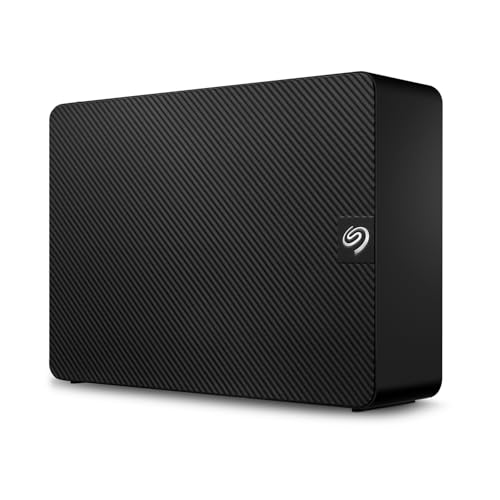
Seagate Expansion 8TB Desktop — The desk archive
The Expansion 8TB desktop drive — STKP8000400 — is the stay-at-home counterpart to the portables: a USB 3.0 desktop hard drive for easy backup, sold on plug-and-play, drag-and-drop simplicity, automatic detection by Windows and Mac, and a stated package of one-year warranty plus one year of Rescue. Eight terabytes at a desk is an archive in the true sense — the place a household’s or a studio’s accumulated files go to be kept, not carried.
Its virtue is the absence of friction at exactly the point where backups usually die. There is no enclosure to assemble, no interface to configure, no decision to make after the purchase; the drive presents itself to either major operating system and accepts folders. For the family archivist, the small studio or the creator whose projects have outgrown portable drives, that frictionlessness is worth more than any specification. The one-year terms are the honest caveat: this is the archive you also keep a second copy of the crown jewels from, elsewhere — a discipline the mistakes section below returns to.
The Expansion’s natural partner is a schedule. Desktop archives fail socially, not mechanically: the drive sits ready, the owner means to copy the folders, and the copying slips by a month, then a season. Pairing this drive with the backup software already inside the operating system — set once, checked occasionally — converts good intentions into a system, and converts the Expansion from a large place to put things into what it was sold as: an archive.
Give it a permanent home with airflow around it rather than a drawer; a desktop drive that lives connected and visible is a drive whose backups actually happen.
The Expansion is also the natural gift to a family archivist — the person holding everyone’s photographs — because its drag-and-drop simplicity asks nothing of its owner’s technical confidence.
The Expansion also reframes an old question: whether a household needs a NAS. For a single archive consulted by one machine at a time, a big USB desktop drive answers most of the need at a fraction of the commitment — and this guide’s IronWolf section exists for the households whose sharing and always-on needs have genuinely outgrown that answer.
Choose the Expansion when the archive has stopped travelling and started accumulating; desks, not bags, are its native country.
- Model: STKP8000400
- Capacity: 8TB desktop external
- Interface: USB 3.0
- Behaviour: plug-and-play, drag-and-drop, auto-detects Windows and Mac
- Terms: one-year warranty plus one-year Rescue, as stated in the title
Strengths
- Eight terabytes of desk archive with zero assembly or configuration
- Drag-and-drop simplicity suits non-technical owners and family archives
- Rescue cover included for the first year
Trade-offs
- One-year warranty and Rescue are the joint-shortest terms in this guide
- A desktop unit stays in one place — no portability at all
- An archive this size still needs its own backup for irreplaceable files
Best for: a household or studio archive that has outgrown portable drives and values simplicity over all
Not suited for: a travelling library, or an always-on server role that belongs to NAS hardware
Archivists can check the Seagate Expansion 8TB listing on Amazon to confirm the stated warranty and Rescue terms.

Seagate BarraCuda 8TB Internal — The capacious desktop drive
The BarraCuda 8TB internal — ST8000DM004 — moves inside the PC: a SATA 6 Gb/s internal hard drive for everyday PC storage, gaming and computing, with a two-year warranty and two years of Rescue stated in its title. Its proposition is capacity per bay. One 3.5-inch bay becomes eight terabytes of library — the games, the media, the archives and the projects — inside the machine, always mounted, with no external box or cable in the story.
That proposition fits the modern desktop’s real division of labour. Fast solid-state storage holds the system and the current work; a drive like this holds everything else, in bulk, at a cost per terabyte spinning platters still win easily. The two-year Rescue term is a thoughtful inclusion on a drive that will hold so much of a machine’s life, and it doubles the Portable 2TB’s warranty at the same time. Owners should simply be clear about the role: this is a library drive of enormous generosity, and asking it to also be the responsiveness star of the build misunderstands both it and the build.
An 8TB internal also changes how a PC is organised. With room this generous, the sensible layout is generous too: the operating system and current projects on fast storage, and the BarraCuda holding the long tail — game libraries, media collections, archives, virtual machines — where its capacity is the feature and its platter nature is no hardship. Owners who force it to be the system drive of a snappiness-obsessed build are asking the wrong drive the wrong question.
Mount it with airflow in mind inside the case — an internal drive buried against cables in a dead-air corner ages faster than the same drive in the bay the case designer intended.
Gamers with growing libraries should note the listing’s own framing: everyday PC storage and gaming are the stated jobs, and an 8TB library drive ends the uninstall-to-install ritual entirely.
There is a silence worth noting in its title: no rotational speed is published, unlike the 2TB model’s. Buyers for whom that figure is decisive should consult the manufacturer documentation for ST8000DM004 specifically — this guide’s discipline of quoting only titles is precisely what makes its other figures trustworthy.
Choose the big BarraCuda when one bay must hold the whole library and the machine’s fast storage is reserved for work in progress.
- Model: ST8000DM004
- Capacity: 8TB internal, 3.5-inch class desktop drive
- Interface: SATA 6 Gb/s
- Stated role: everyday PC storage, gaming and computing
- Terms: two-year warranty plus two-year Rescue, as stated in the title
Strengths
- Eight terabytes from a single internal bay transforms a PC’s library room
- Two-year warranty and Rescue terms double the portable drive’s cover
- SATA internal format means no external box, cable or power brick
Trade-offs
- Its title publishes no RPM or cache figure, so speed shoppers should look at the 2TB BarraCuda’s stated figures
- Internal fitting requires a bay, SATA connection and basic building confidence
- A single internal drive is not a backup for the machine it lives in
Best for: a desktop needing a vast internal library for games, media and archives beside fast system storage
Not suited for: a NAS enclosure — that duty belongs to the IronWolf — or a laptop, which cannot take a 3.5-inch drive
Library builders can check the BarraCuda 8TB listing on Amazon and match the ST8000DM004 model code.

Seagate IronWolf 8TB NAS — The always-on specialist
The IronWolf 8TB — ST8000VNZ04 — is the specialist of this guide and the pick whose title reads like an engineering brief: a SATA 6 Gb/s internal NAS drive, optimised for 24/7 operation, with AgileArray, all-CMR recording, rotational-vibration sensors for multi-bay enclosures, a 180TB-per-year workload rating, and three-year warranty plus three-year Rescue terms. Every one of those phrases answers a specific way NAS drives die, and together they are the reason NAS drives exist as a category.
Judge it against its actual workplace. Inside a NAS, a drive spins continuously, vibrates against its neighbours, rebuilds arrays under load and holds data that several people or an entire household depend on. The IronWolf’s RV sensors exist for the vibration; the CMR recording for the rebuilds; the workload rating for the duty; the three-year terms for the owner’s peace of mind. In a desktop it would be an overqualified, perfectly pleasant drive. In a NAS it is simply the correct tool, and using a desktop drive in its place is the one economy this guide actively argues against.
The IronWolf’s all-CMR point deserves emphasis because it is the line NAS buyers most often miss. Conventional magnetic recording writes data in the orderly way multi-bay arrays and their controllers expect, particularly during rebuilds, when a drive works hardest and errors cost most. Seagate prints ‘All-CMR’ in this drive’s title precisely so the NAS buyer does not have to guess — and in a category where recording technology is sometimes discovered only after purchase, that printing is a genuine service.
Buy NAS drives for an array in matching batches where possible; identical models age, vibrate and behave alike, which is what multi-bay enclosures and their controllers are happiest managing.
If your NAS holds anything irreplaceable, the IronWolf’s three-year Rescue term is not a luxury line in the title; it is the drive’s second job, running quietly behind the first.
Array planning rewards one more discipline: keep a cold spare. An IronWolf array with a shelf spare rebuilds on the day of a failure rather than after a delivery, and in NAS life the rebuild window is when the remaining drives earn their workload ratings. The spare is the cheapest member of the array and the one that most changes its risk.
Choose the IronWolf whenever the enclosure has more than one bay and a power button that is never used; in that sentence is the whole NAS argument.
- Model: ST8000VNZ04
- Capacity: 8TB internal NAS drive
- Interface: SATA 6 Gb/s
- Engineering: AgileArray, all-CMR, RV sensors for multi-bay use
- Ratings and terms: 180TB/year workload; three-year warranty plus three-year Rescue; 24/7 optimised
Strengths
- Purpose-built for 24/7 multi-bay NAS duty, with RV sensors for that environment
- All-CMR recording, stated in the title — the technology NAS rebuilds want
- Three-year warranty and Rescue are the longest terms in this guide
Trade-offs
- Its specialisation is wasted as a single desktop drive
- NAS ownership itself — enclosure, array planning — is a commitment beyond the drive
- Workload rating assumes NAS patterns; it is not a general speed claim
Best for: a multi-bay NAS holding a household’s or a small team’s shared data, running around the clock
Not suited for: a single-drive desktop build, where the BarraCuda models deliver the same capacity without the NAS premium
NAS builders can check the IronWolf 8TB listing on Amazon and verify the ST8000VNZ04 code against their enclosure’s bay plan.

Seagate BarraCuda 2TB Internal — The responsive classic
The BarraCuda 2TB internal — ST2000DM008/ST2000DMZ08 — is the classic desktop hard drive, and the only pick here whose title publishes its performance figures: a 3.5-inch SATA 6 Gb/s drive at 7200 RPM with a 256MB cache, in frustration-free packaging. In a guide where several titles keep their rotational speed to themselves, that candour defines this drive’s character: it is the responsive, general-purpose internal, specced for a machine that asks its hard drive questions all day.
Two terabytes at 7200 RPM is the traditional second-drive specification, and it remains a deeply sensible one. Paired with a modest solid-state system drive it gives a budget or family PC a fast-feeling bulk store; installed as the main drive in a simple machine, it keeps that machine honest and quick by hard-drive standards. It will not hold the libraries the 8TB models swallow, and it does not pretend to. What it offers is the oldest bargain in storage: enough room, proper speed, no drama — the drive a million ordinary desktops are quietly built around.
There is a budget-system elegance to this drive: in a build where the fast solid-state drive is small, a responsive 7200 RPM BarraCuda as the second drive keeps the whole machine feeling intentional rather than compromised — games and files load from a drive that was designed to be asked questions all day. It is also the natural upgrade for an older desktop whose original hard drive is the last slow thing in it.
The frustration-free packaging in the title is a small honesty: this is a bare internal drive for a builder with a bay, a SATA cable and a screwdriver, and it is packaged like one.
In five years this drive’s specifications will look modest and its role will not have changed at all: the dependable, quick-spinning second drive is a permanent category, and this is its current Seagate expression.
For upgraders of older machines, this drive pairs naturally with a memory and solid-state refresh to produce the classic second life: a desktop that felt finished becomes responsive and roomy for a few more years, with the BarraCuda holding everything the smaller fast drive cannot.
Choose the 2TB BarraCuda when responsiveness per purchase matters more than raw room — the classic build, correctly specced.
- Model: ST2000DM008/ST2000DMZ08
- Capacity: 2TB internal, 3.5-inch
- Interface: SATA 6 Gb/s
- Published speed figures: 7200 RPM, 256MB cache
- Packaging: frustration-free, as stated in the title
Strengths
- 7200 RPM and a 256MB cache, printed in the title — the responsive end of this guide
- Classic second-drive specification that pairs naturally with a small SSD
- Simple, builder-friendly bare-drive format and packaging
Trade-offs
- Two terabytes fills quickly against modern game and media libraries
- No Rescue term is stated in this listing’s title, unlike its siblings
- A desktop internal drive cannot serve portable or NAS roles
Best for: a budget or family desktop wanting a responsive bulk drive, or an older PC’s hard-drive refresh
Not suited for: a large library build — the 8TB BarraCuda owns that role — or any portable use
Classic-build shoppers can check the BarraCuda 2TB listing on Amazon and confirm the 7200 RPM figure in the title.
How Does a Hard Drive Fit Into a Storage Plan Built Around Speed?
Modern machines are two-tier by default, and this guide’s internal drives are the second tier by design. The fast tier — solid-state, expensive per terabyte — holds the operating system, the applications and whatever is being worked on this month. The spinning tier holds everything else: the completed projects, the libraries, the archives, the installs not in this season’s rotation. Judged as a system drive, a hard drive in this decade is a compromise; judged as the second tier, it is the reason the first tier can stay small and affordable. The BarraCuda pair divide that tier by temperament — the 2TB for responsiveness, the 8TB for room — and the IronWolf exports the same tier to the network, where every machine in the house can share it.
The external drives extend the plan outward. The portable is the tier that travels and the tier that leaves the building; the Expansion is the tier that accumulates. A complete household storage plan usually contains one drive from each paragraph of this guide, which is less a sales pitch than a description of how the families were designed: Seagate did not make six rivals, it made six posts, and the buyer’s task is staffing them. Read the six sections above as job descriptions and the plan writes itself.
How Do the Six Seagate Drives Divide the Work?
| Drive | Lives | Capacity | Interface | Stated warranty / Rescue |
|---|---|---|---|---|
| Portable 2TB | In a bag | 2TB | USB 3.0 | One-year warranty |
| Portable 5TB | In a bag | 5TB | USB 3.0 | One-year Rescue |
| Expansion 8TB | On a desk | 8TB | USB 3.0 | One year / one year |
| BarraCuda 8TB | Inside a PC | 8TB | SATA 6 Gb/s | Two years / two years |
| IronWolf 8TB | Inside a NAS | 8TB | SATA 6 Gb/s | Three years / three years |
| BarraCuda 2TB | Inside a PC | 2TB | SATA 6 Gb/s | 7200 RPM, 256MB cache (terms not stated in title) |
The three 8TB drives are the table’s lesson: identical capacity, three different lives, three different term ladders. Capacity is the number buyers compare first and the one that decides least. Readers speccing a whole machine around one of the internal drives will find the bay and airflow side of the story in the Best NZXT PC Cases and Best Cooler Master PC Cases guides, where several cases still make honest room for 3.5-inch drives.
How Do You Set Up a Backup Rhythm These Drives Can Actually Keep?
The technology is the easy half; the rhythm is the product. Decide what each drive is for in one sentence — the portable is the travelling backup, the Expansion is the desk archive, the internal BarraCuda is the library, the IronWolf is the shared store — and write that sentence on the drive or its enclosure. Ambiguity is what turns storage into a pile of partial copies, and a labelled role ends it. Then automate the copying with the tools the operating system already includes, scheduled for an hour the machine is reliably on, and check the result monthly by opening a file from the backup rather than trusting a green icon.
Keep one copy somewhere else. The portable in a bag at a relative’s house, the archive’s crown jewels duplicated to a second drive — the geography matters more than the brand. Every drive in this guide will eventually fail, be lost or be replaced; that is not pessimism, it is the physics of spinning storage, and the entire Seagate range, with its Rescue terms and workload ratings, is designed by people who know it. A backup system that assumes failure survives it. A single drive, however excellent, is not a system.
What Do Seagate Buyers Most Often Get Wrong?
The expensive error is role confusion: a desktop drive installed in a NAS, a portable treated as an archive, an internal library drive mistaken for a backup of the machine it lives inside. The second error is capacity optimism — buying the drive that fits today’s library exactly, in a world where libraries only grow; the honest rule is to buy for the library of two years from now, which is why this guide’s 5TB and 8TB options exist. The third is ignoring the terms ladder printed in the titles, then being surprised that the cheapest drive carries the shortest cover.
The quiet error is subtler: treating Rescue as a backup. A recovery service is a salvage attempt after a failure, with no promise attached; a backup is a copy that exists before the failure. Drives with Rescue deserve their credit in this guide — and the owners who fare best are the ones who hope never to learn how good it is.
Which Seagate Drive Belongs in a Student Bag, a Family Home and a Small Office?
The student bag is the Portable 2TB’s native habitat: lectures, libraries and shared flats punish anything larger, more fragile or more complicated, and a backup that travels with the laptop is a backup that exists. When the degree involves film, photography or game development, the same bag simply upgrades to the 5TB — the role does not change, only the arithmetic. The family home is the Expansion’s: one big, simple archive at a desk, holding everyone’s photographs and documents, operable by the least technical person in the house, which is a design requirement and not a joke.
The small office is where the guide’s distinctions sharpen. A single professional’s overflow and archive can live happily on an Expansion or a big internal BarraCuda; the moment several people share the data, around the clock, the IronWolf in a NAS stops being an enthusiast’s toy and becomes the office’s memory, with the warranty and Rescue ladder to match. Misjudging that boundary — sharing a household’s or a business’s working data from a drive built for one desk — is the most expensive mistake in this entire category, and it is made by degrees, one shared folder at a time.
Final Recommendation
For most people the Portable 2TB is where Seagate ownership should start: a first, real, travelling backup. Step to the 5TB when the library — especially a console library — demands it, and to the Expansion 8TB when the archive has become a desk institution. Inside a PC, the BarraCuda 2TB is the responsive classic for ordinary builds and the BarraCuda 8TB the library for serious ones. And for a NAS there is no debate to have: the IronWolf’s engineering and terms make it the only pick in this guide designed for the job, and it should be bought without a runner-up.
Buy the drive whose failure you have already planned for, and no Seagate in this guide will ever give you a bad day that becomes a bad year.
Frequently Asked Questions
Can I use a BarraCuda desktop drive in a NAS?
You can, and this guide advises against it as a plan. A NAS runs drives continuously in a vibrating multi-bay environment; the IronWolf exists precisely for that duty, with RV sensors, all-CMR recording, a published 180TB-per-year workload rating and longer warranty and Rescue terms. The saving on a desktop drive is small against the data a NAS usually holds.
What is Rescue, and does it replace a backup?
Rescue is Seagate’s data-recovery service, included for the stated term on several drives here: it attempts to recover data from a failed drive. It does not replace a backup, because recovery is a salvage attempt after failure, while a backup is a copy made before it. Own both ideas in the right order: backup first, Rescue as the safety net.
Why does only the 2TB BarraCuda list its RPM?
Because that is what its listing title publishes. Several titles in this guide state capacity, interface and terms but not rotational speed or cache, and this guide quotes only what each title states. If a specific figure decides your purchase, the manufacturer’s documentation for the exact model code is the authority.
Is 8TB too much for a home user?
For a single laptop’s documents, yes; for a household archive, a media library or a game collection, it is the size that ends capacity anxiety for years. The three 8TB drives here differ by role — desk, desktop and NAS — so choose the role first and let the capacity follow.
What does all-CMR mean on the IronWolf?
Conventional magnetic recording: data written in the orderly, non-overlapping fashion that NAS controllers and array rebuilds handle best. Seagate states the IronWolf line here is all-CMR in its title, which removes a question NAS buyers otherwise have to research model by model.
Which drive suits a PS4 or Xbox library?
The Portable 5TB names PS4 and Xbox compatibility in its title and pairs that with five terabytes of travelling room, making it the console-library pick of the six. Its one year of Rescue service is a welcome extra on a drive that will be carried between rooms and houses.
Should I buy two smaller drives or one large one?
For backups, two drives in two places beat one drive of double capacity every time — the second copy’s location is the protection. For a working library inside one machine, one large drive is simpler and is what the 8TB BarraCuda exists for. Decide which problem you are solving: copies or room.
How do I know when to replace a hard drive?
Treat the end of the stated warranty as a review date rather than a death sentence: check the backup of the backup, confirm the capacity still fits the library’s growth, and replace on your schedule instead of the drive’s. Drives that begin clicking, vanishing from the system or corrupting files should be copied immediately and retired without debate.
A closing note on the Seagate range as a whole, because it explains the guide you have just read. This is a maker that still believes in the labelled family: a drive’s name tells you its workplace, its title tells you its terms, and its model code tells you exactly which object will arrive. In a storage market drifting toward anonymous capacity, that legibility is a consumer feature in its own right — it is what makes a six-drive guide sortable by job rather than by guesswork, and what makes the right purchase repeatable when the second drive, the bigger drive or the replacement drive is needed.
Keep the model codes when you buy. Storage is the one category where the second purchase is usually an expansion of the first — another portable for the other bag, a matching IronWolf for the empty bay, a bigger BarraCuda for the library that grew — and the owner who recorded STGX, STKP or the five-digit BarraCuda and IronWolf codes at the first purchase will make every later one in minutes, certain of compatibility, instead of starting the research again from a photograph.
And date your drives, physically, with a label. Capacity fills, warranties lapse and roles evolve; the labelled drive tells its own story at a glance in the drawer or the bay, years after the order email is buried. Storage rewards exactly one personality trait — mild, consistent organisation — and every drive in this guide, from the smallest portable to the NAS specialist, is designed to repay it.
One last practical ritual ties the whole guide together: the day a drive arrives is the day its role starts, not the day it happens to be needed. Format it if your system asks, label it, run the first full copy, and verify one file from the copy before the drive takes its place in the bag, on the desk or in the bay. Storage bought in calm and commissioned in calm behaves in a crisis; storage bought in a panic, mid-crisis, inherits the panic. Every drive above is at its best as part of a plan made early — which is, in the end, the only buying advice the hard-drive category has ever really had.
And spare a thought for the humble detail every one of these listings shares: a model code that fits on a label. STGX for the bag, STKP for the desk, the DM and VN codes for the bays — a small, learnable language that turns a drawer of anonymous black boxes into an inventory. Learn it once and Seagate’s range stops being six products and becomes a shelf you understand, which is the moment storage stops being a recurring anxiety and becomes what it should have been all along: furniture for your files, chosen once and trusted daily.
If this guide has a single sentence to be remembered by, it is the one the comparison table teaches: three drives can share a capacity and share nothing else. Keep that sentence in mind in every storage aisle and listing page, and the rest of the discipline — the roles, the rhythms, the second copies — tends to follow on its own.
Buy in that spirit and the terabytes take care of themselves — they always were the easy part. The hard part was never the hardware; it was deciding, in advance and in writing, what each drive is for. Do that, and whichever Seagate leaves this page with you will be the right one, because it will have been chosen as a member of a system rather than as a solitary hope.
The same thirty-second discipline closes this guide: before ordering, read the chosen listing’s title once more and say its job, its interface and its stated terms out loud against your plan. Seagate prints all three in the title — the family for the job, the connector for the machine, the warranty and Rescue ladder for the risk — and the returns this category suffers are almost never caused by the drives. They are caused by a near-identical name read too quickly, in a range where one suffix carries the whole meaning.
Related Guides
The rival range and the cases these internal drives live in are covered in the companion guides: Best Western Digital Hard Drives, Best NZXT PC Cases, and Best Cooler Master PC Cases.


