What's inside
- Key Takeaways
- Quick Picks
- How We Chose These Picks
- What Actually Separates One Corsair Headset From Another?
- Which Corsair Features Are Worth Paying Attention To?
- What Should You Know About Each of These Headsets Corsair Picks?
- How Do the Six Corsair Headsets Compare Side by Side?
- How Should You Set Up a Corsair Headset on Day One?
- How Does Corsair Ownership Feel After the First Month?
- Which Corsair Headset Suits Each Kind of Player Best?
- How Do the Corsair Picks Handle Music and Film Away From Games?
- What Should You Check in the First Week With a New Corsair Headset?
- How Do Corsair’s Tiers Map to Sensible Spending?
- How Should You Care for a Corsair Headset So It Lasts?
- A Final Word on Choosing Within One Brand
- What Else Is Worth Knowing Before You Decide?
- Which Corsair Buying Mistakes Cost Owners the Most?
- Final Recommendation
- Frequently Asked Questions
- Related Guides
As an Amazon Associate I earn from qualifying purchases. This post may contain affiliate links at no extra cost to you.
widgetverdict.com is reader-supported. When you buy through links on our site, we may earn an affiliate commission.
Where to buy: Corsair sells this range through Amazon storefront listings, and every model named here links straight to its checked product page, from the wireless VOID v2 at the accessible end to the open-back VIRTUOSO PRO at the specialist end.
Shopping inside one brand sounds limiting until you look at how wide Corsair casts its net, and anyone hunting the best headsets corsair makes quickly finds a catalogue that runs from a lightweight dual-wireless all-rounder to an open-back wired flagship with graphene drivers. That breadth is the real story of this guide. Corsair is not selling six versions of the same headset with different colours; it is selling genuinely different answers to different evenings, desks and consoles, and the differences live in connection type, microphone ambition, battery endurance and whether the earcups seal you in or let the room breathe.
Three threads run through the whole family. Dolby Atmos appears on four of the six picks, which tells you Corsair treats spatial audio as a house standard rather than a flagship garnish. SoundID personalisation shows up on three models, letting the headset reshape its tuning around your hearing instead of forcing you to accept a fixed curve. And memory foam earpads recur across the range, because Corsair learned early that a headset players remove after forty minutes has failed no matter how it measures on a test rig.
Read the six reviews below as a sorting exercise rather than a ladder. The HS65 SURROUND at the wired, affordable end will suit a shared family PC better than the VIRTUOSO MAX flagship would, while a streamer chasing broadcast-grade voice will find the HS80 MAX more relevant than anything else here. If you are also weighing rival ecosystems, our comparison of best gaming headsets razer shows how a competitor splits the same decisions, and the low-end behaviour gets its own treatment in the best gaming headsets for bass roundup. Readers shopping for an older relative rather than themselves should detour to best bluetooth headsets for hard of hearing before spending anything.
Key Takeaways
- Four of the six Corsair picks carry Dolby Atmos in the listing title, so spatial audio is a family trait here, not a flagship extra.
- SoundID personalisation appears on the HS80 MAX, VIRTUOSO MAX and HS65 SURROUND, each tuning output to the individual listener.
- Battery claims split the wireless models sharply: 70 hours for the VOID v2 against up to 65 hours for the HS80 MAX.
- The VIRTUOSO PRO is the odd one out in a good way: wired, open-back, and built around 50mm graphene drivers for listeners who sit at one desk.
- Microphone ambition peaks at the HS80 MAX, Virtuoso RGB Wireless XT and VIRTUOSO MAX, all three described with broadcast-quality wording.
- Only the HS65 SURROUND names Xbox support, so console coverage is the first filter to apply before comparing anything else.
Quick Picks
| Pick | Badge | Why it earns its place |
|---|---|---|
| CORSAIR VOID v2 Wireless Gaming Headset | The dual-wireless all-rounder | Dual wireless, Bluetooth and a 70-hour battery across PC, PlayStation, Switch and mobile make it the easiest Corsair to recommend broadly. |
| CORSAIR HS80 MAX Wireless Gaming Headset | The broadcast-voice pick | A broadcast-quality microphone, SoundID tuning and up to 65 hours over 2.4GHz put voice work at the centre of this headset. |
| CORSAIR Virtuoso RGB Wireless XT | The connection maximalist | Bluetooth, USB and 3.5mm wired paths sit beside the wireless link, with sub-1ms latency wording and a broadcast-quality mic. |
| CORSAIR VIRTUOSO MAX Wireless Gaming Headset | The flagship with ANC | Active noise cancellation, simultaneous connectivity and SoundID headline Corsair’s most complete wireless specification here. |
| CORSAIR VIRTUOSO PRO Wired Gaming Headset | The open-back purist | A wired open-back design with 50mm graphene drivers and a 20Hz to 40kHz response, built for one desk and critical listening. |
| CORSAIR HS65 SURROUND Gaming Headset | The wired value anchor | A 3.5mm wired connection with a USB adapter, Dolby 7.1 surround and SoundID, and the only Xbox mention in this guide. |
How We Chose These Picks
We built this shortlist from Corsair’s current Amazon listings and read each title the way a careful buyer should: as a contract. A feature only counts in these reviews when the listing headline states it, which is why the VIRTUOSO PRO gets no wireless credit despite sitting in a family full of radios, and why the HS65 SURROUND is the sole pick we describe as an Xbox option. Where a headline stays quiet, the spec boxes say so plainly instead of borrowing a sibling model’s credentials.
Balance mattered as much as peak specification. A Corsair-only guide that recommended six wireless flagships would fail the teenager on a wired family PC, the podcaster who never leaves one desk, and the Switch player who needs Bluetooth on a train. So the six span dual-wireless freedom, a wired open-back purist piece, and a 3.5mm workhorse with a USB adapter in the box. Price never appears in these pages, deliberately: tiers shift, and the honest comparison is between connection sets, driver designs and microphone quality, which stay fixed once you own the headset.
What Actually Separates One Corsair Headset From Another?
Start with the cable question, because it quietly decides everything downstream. The VOID v2, HS80 MAX, Virtuoso RGB Wireless XT and VIRTUOSO MAX all cut the cord, but they cut it differently: the VOID v2 leans on dual wireless with Bluetooth alongside its primary link, the HS80 MAX names 2.4GHz explicitly, and the Virtuoso XT hedges every bet by keeping USB and 3.5mm wired fallbacks beside its radio.
Then look at the microphone ladder, because Corsair grades its own range honestly if you read closely. Plain microphone wording appears on the HS65 SURROUND, while the HS80 MAX, Virtuoso XT and VIRTUOSO MAX all carry broadcast-quality phrasing in their titles. That gap matters the moment your voice becomes content: a Discord call forgives almost anything, but a recorded commentary or a work presentation exposes a thin capsule immediately.
Comfort engineering is the third separator, and it is more varied than the shared memory foam suggests. The VOID v2 stakes its claim on light weight and fast charging, accepting that a headset worn across a whole evening of mixed gaming and video calls lives or dies by how forgettable it feels at hour three. The Virtuoso line answers with denser, more premium earpad construction.
Which Corsair Features Are Worth Paying Attention To?
Dolby Atmos earns its keep in games built with height and distance cues, where footsteps on a floor above you stop being a guess. Four picks here carry it, so the sharper question is which Atmos model fits your platform mix: the VOID v2 spreads across PC, PlayStation and Switch with mobile in tow, while the VIRTUOSO MAX narrows to a PC and PlayStation pairing but adds active noise cancellation for open-plan rooms.
SoundID deserves a slower look than it usually gets. Instead of offering fixed presets labelled with genre names, SoundID builds a profile around your responses and applies that shape consistently, which helps listeners whose hearing is uneven between ears or who find stock tuning either dull or harsh. It appears on the HS80 MAX, VIRTUOSO MAX and, notably, the HS65 SURROUND, where it arrives as SoundID Audio Profile Technology on a wired model.
Battery figures need translating into habits. Seventy hours on the VOID v2 means a week of heavy evening play between charges for most owners, and its fast charging softens the one night you forget. The HS80 MAX quotes up to 65 hours, close enough that the difference should never decide between them; decide instead on microphone quality and fit.
What Should You Know About Each of These Headsets Corsair Picks?

CORSAIR VOID v2 Wireless Gaming Headset — The dual-wireless all-rounder
The VOID v2 is where most Corsair shoppers should start, because it makes the fewest demands in exchange for its flexibility. Dual wireless means the low-latency link handles the game while Bluetooth keeps a phone connected for calls or a podcast during loading screens, and the platform list in its title reads like a household inventory: PC, PS5, Switch, PS4 and mobile all named outright. Dolby Atmos handles spatial duties, so this is not a stripped starter model trading features for its battery figure.
That battery figure deserves respect rather than a shrug. Seventy hours with fast charging changes ownership from a nightly ritual into an occasional top-up, and the lightweight build suits the long, mixed sessions this headset is clearly designed for: an evening that drifts from a co-op campaign to a film to a call without a hardware swap. Listeners who prioritise voice quality above all should still look up the range, since the title makes no broadcast-grade microphone claim here, but as a single headset for a multi-device life, the VOID v2 assembles the strongest overall case in the Corsair catalogue.
- Connection: dual wireless with Bluetooth
- Platforms named: PC, PS5, Switch, PS4, mobile
- Spatial audio: Dolby Atmos
- Battery: 70 hours, fast charging
- Build note: lightweight design
Strengths
- Genuine dual wireless, so a phone stays paired while the game link runs
- Seventy-hour battery with fast charging shrinks charging to an afterthought
- Platform list covers consoles, PC and mobile without adapter guesswork
Trade-offs
- Microphone wording in the title is plain, with no broadcast-quality claim
- No active noise cancellation for noisy shared rooms
- No wired fallback is named in the title if the battery does run flat
Best for: a household player splitting time between PS5, Switch and PC who charges things rarely and hates cables across the desk
Not suited for: streamers requiring broadcast-grade voice capture as the first priority, since the title reserves that wording for the HS80 MAX and Virtuoso models
If the VOID v2 matches your platform mix, check the CORSAIR VOID v2 listing on Amazon to confirm the current bundle before ordering.

CORSAIR HS80 MAX Wireless Gaming Headset — The broadcast-voice pick
The HS80 MAX exists for people whose voice leaves the room. Its title leads with a broadcast-quality microphone claim, and that single phrase rearranges the priorities of the whole headset: capsule clarity, consistent placement and clean transmission matter more here than squeezing out extra battery or shaving weight. Add SoundID Technology shaping the output around your own hearing and Dolby Atmos underneath, and the HS80 MAX reads as a creator’s tool that also happens to be an excellent gaming headset.
The supporting details hold up under scrutiny. Up to 65 hours of battery removes endurance anxiety from long recording or streaming days, the 2.4GHz link keeps game audio tight while Bluetooth covers the phone, and memory foam earcups suit the stationary, seated hours this model expects from you. Mac appears in the platform list alongside PC, PlayStation, Switch and mobile, widening its desk appeal. Buyers who never speak online are paying for a microphone they will not use, and they should admit that honestly and look at the VOID v2 instead; buyers who do speak will feel the difference in every call.
- Connection: 2.4GHz wireless plus Bluetooth
- Platforms named: PC, PS5, Switch, PS4, Mac, mobile
- Microphone: broadcast quality, per the listing title
- Spatial audio: Dolby Atmos with SoundID Technology
- Battery: up to 65 hours; memory foam earcups
Strengths
- Broadcast-quality microphone claim leads the title for good reason
- SoundID personalises tuning instead of offering fixed presets
- Sixty-five-hour battery and memory foam suit long seated sessions
Trade-offs
- No active noise cancellation despite the premium positioning
- Xbox is absent from the platform list in the title
- Voice-first design is wasted money for silent single-player listeners
Best for: streamers, podcasters and remote presenters whose recorded voice carries their work and who play on PC or PlayStation
Not suited for: Xbox owners needing native console support, because the title names PC, PlayStation, Switch, Mac and mobile only
Voice-led buyers can check the HS80 MAX on Amazon to verify the microphone details against their recording setup.
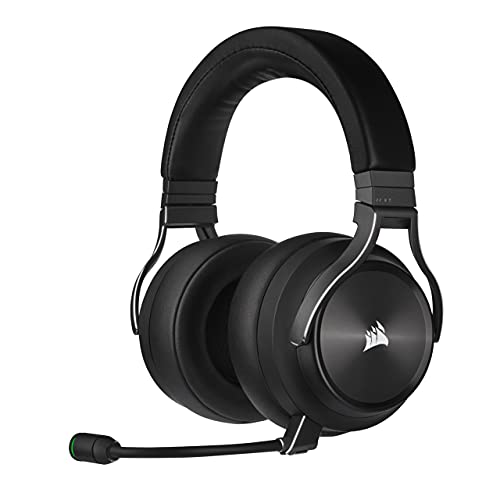
CORSAIR Virtuoso RGB Wireless XT — The connection maximalist
The Virtuoso RGB Wireless XT is the headset for people who have been stranded by a connection type before and refuse to repeat the experience. Its title stacks Bluetooth beside USB and a 3.5mm jack, so the same headset plugs into a PC properly, pairs to a phone casually, and still works with a controller or an older device through a plain cable. Sub-1ms latency wording covers the wireless link, and the broadcast-quality microphone claim puts it in the same voice tier as the HS80 MAX.
That flexibility carries a philosophy worth understanding: the XT treats wireless as the default rather than the only option, which makes it the safest travel and multi-desk pick in this guide. Memory foam earpads and Dolby Atmos round out a specification that reads like Corsair emptying the parts bin in a good way. The honest cost is complexity and a feature list you must actually use to justify the tier; a single-platform player will leave half of this headset’s talent idle. But for the listener whose week genuinely spans consoles, two computers and a phone, nothing else in the Corsair range covers the map this completely.
- Connection: wireless plus Bluetooth, USB and 3.5mm
- Platforms named: PC, PS5, Switch, PS4, Mac, mobile
- Microphone: broadcast quality, per the listing title
- Spatial audio: Dolby Atmos
- Latency wording: sub 1-ms in the title; memory foam earpads
Strengths
- Wired USB and 3.5mm fallbacks beside wireless and Bluetooth
- Broadcast-quality microphone claim matches the HS80 MAX tier
- Broadest platform list here, including Mac and mobile
Trade-offs
- No battery-hours figure is stated in the listing title
- Feature depth is wasted on a single-device setup
- No active noise cancellation is claimed in the title
Best for: multi-desk professionals and travellers who rotate between PC, PlayStation, Switch and phone within a single week
Not suited for: single-platform players wanting the simplest possible setup, because the XT’s connection menu solves problems they do not have
Shoppers who need every fallback path can check the Virtuoso RGB Wireless XT on Amazon for the full connection list.

CORSAIR VIRTUOSO MAX Wireless Gaming Headset — The flagship with ANC
The VIRTUOSO MAX is Corsair aiming at the ceiling. Active noise cancellation is the headline addition, and it changes the headset’s habitat: open-plan offices, shared living rooms and households where someone else’s television competes with your game all become workable listening environments. Simultaneous connectivity means the 2.4GHz game link and a Bluetooth device stay live together rather than forcing a swap, and SoundID plus Dolby Atmos handle the personalised spatial layer on top.
Notice what the title does not promise. Switch and mobile fall off the platform list that the cheaper VOID v2 manages to include, and no battery-hours figure is stated, so endurance claims would be invention; the spec box records that silence honestly. What remains is a deliberate flagship trade: maximum control over your sound environment and your mix, aimed at PC and PlayStation players who listen in imperfect rooms. If your gaming space is already quiet and private, the MAX solves a problem you do not have, and its price tier will feel like a tax. If your space is loud, it may be the only pick here that truly fits your life.
- Connection: 2.4GHz wireless plus Bluetooth, simultaneous connectivity
- Platforms named: PC, PS5, PS4, Mac
- Microphone: broadcast quality, per the listing title
- Spatial audio: Dolby Atmos with SoundID
- Noise control: active noise cancellation
Strengths
- Active noise cancellation for shared and open-plan rooms
- Simultaneous connectivity keeps game audio and Bluetooth live together
- Broadcast-quality microphone and SoundID complete the flagship brief
Trade-offs
- Platform list narrows to PC, PlayStation and Mac in the title
- Battery endurance is not stated in the listing headline
- ANC premium is poor value in an already quiet room
Best for: PC and PlayStation players in noisy households who take calls and game from the same chair all day
Not suited for: Switch and mobile listeners needing those platforms named, since the MAX title omits both despite its flagship tier
If room noise is your main enemy, check the VIRTUOSO MAX listing on Amazon to confirm the cancellation details.

CORSAIR VIRTUOSO PRO Wired Gaming Headset — The open-back purist
The VIRTUOSO PRO rejects almost everything the rest of this guide celebrates, and it is more interesting for it. No battery, no Bluetooth, no noise cancellation: instead, an open-back wired design around 50mm graphene drivers with a stated 20Hz to 40kHz frequency response. Open-back cups trade isolation for a wider, more natural sense of space, the quality competitive players describe as hearing the room inside the game rather than a pair of speakers strapped to the skull. The detachable uni-directional microphone keeps voice chat available without forcing a boom into music listening.
Ownership here is a commitment to a single, quiet desk. Sound leaks both ways through an open back, so a partner in the same room will hear your game and your game will hear the television; the PRO assumes a door that closes. It also assumes you value driver quality over convenience in a way the wireless picks cannot match at any tier, because none of them publish a comparable driver story in their titles. Listeners building one serious listening station, rather than covering every device they own, will find this the most honest headset in the Corsair range: it does one thing with unusual focus.
- Connection: wired
- Design: open back
- Drivers: 50mm graphene
- Frequency response: 20Hz-40 kHz, per the listing title
- Microphone: detachable uni-directional
Strengths
- Open-back staging gives positional audio a natural sense of space
- Graphene drivers and a wide stated response anchor the sound claim
- Detachable microphone converts cleanly between gaming and listening
Trade-offs
- Sound leaks in and out, so shared rooms are a genuine problem
- Wired only, with no wireless or Bluetooth path at all
- No Dolby Atmos or SoundID is claimed in the listing title
Best for: desk-bound listeners in a private room who rank driver quality and natural staging above every convenience feature
Not suited for: commuters and shared-room players requiring isolation, because an open-back wired design leaks sound in both directions
Purists can check the VIRTUOSO PRO on Amazon to confirm the driver specification before committing a desk to it.

CORSAIR HS65 SURROUND Gaming Headset — The wired value anchor
The HS65 SURROUND closes the guide at the practical end, and its title is quietly the most democratic of the six: PC, PS5, Xbox, Switch and Mac all named, reached through a humble 3.5mm plug with a USB adapter for the surround processing on PC. Dolby 7.1 surround does the positional work, SoundID Audio Profile Technology personalises the tuning, and memory foam earpads carry the comfort brief. It is also, notably, the only headset here whose title claims Xbox, which settles the question instantly for a large group of buyers.
Wired ownership has a texture worth stating plainly: no charging, no pairing menus, no battery ageing, and a headset that works the moment it is plugged in, years from now, on whatever device still offers the jack or the adapter path. The compromises are equally plain: a cable across the desk, a microphone the title calls clear rather than broadcast-grade, and surround that depends on the USB adapter route rather than living in every connection. For a family PC, a spare-room console setup, or a first serious headset bought with clear eyes, the HS65 SURROUND is the Corsair that asks the least and delivers the essentials.
- Connection: wired 3.5mm with USB adapter
- Platforms named: PC, PS5, Xbox, Switch, Mac
- Surround: Dolby 7.1 Surround Sound
- Personalisation: SoundID Audio Profile Technology
- Earpads: memory foam; microphone described as clear in the title
Strengths
- Only pick here whose title names Xbox support
- USB adapter brings Dolby 7.1 and SoundID to a wired headset
- No battery or pairing to manage, ever
Trade-offs
- Microphone is described as clear, not broadcast quality
- Cable management becomes part of the desk setup
- Surround processing depends on the USB adapter path
Best for: families and first-time buyers wanting one wired headset that covers Xbox, PlayStation, Switch and PC without charging routines
Not suited for: wireless listeners who move around while playing, since a 3.5mm cable tethers every session to the desk
Value-focused shoppers can check the HS65 SURROUND on Amazon to confirm adapter contents for their console setup.
How Do the Six Corsair Headsets Compare Side by Side?
Badges and headlines blur together after six reviews, so line the family up on the facts their titles actually state: connection, platforms, spatial audio and the one job each model does better than its siblings.
| Pick | Connection | Coverage / focus | Headline figure | Signature trait |
|---|---|---|---|---|
| CORSAIR VOID v2 Wireless Gaming Headset | Dual wireless + Bluetooth | PC, PS5, Switch, PS4, mobile | Dolby Atmos | 70 hours |
| CORSAIR HS80 MAX Wireless Gaming Headset | 2.4GHz + Bluetooth | PC, PS5, Switch, PS4, Mac, mobile | Dolby Atmos | Up to 65 hours |
| CORSAIR Virtuoso RGB Wireless XT | Wireless, BT, USB, 3.5mm | PC, PS5, Switch, PS4, Mac, mobile | Dolby Atmos | Not stated in title |
| CORSAIR VIRTUOSO MAX Wireless Gaming Headset | 2.4GHz + Bluetooth, simultaneous | PC, PS5, PS4, Mac | Dolby Atmos | Not stated in title |
| CORSAIR VIRTUOSO PRO Wired Gaming Headset | Wired, open back | Desk use; platform list not stated | Not stated in title | Wired, no battery |
| CORSAIR HS65 SURROUND Gaming Headset | Wired 3.5mm + USB adapter | PC, PS5, Xbox, Switch, Mac | Dolby 7.1 | Wired, no battery |
Read the platform column first, because it eliminates models faster than any other fact here. Xbox appears exactly once, beside the HS65 SURROUND, while Switch appears on the VOID v2, HS80 MAX and Virtuoso XT but not on the flagship MAX.
The microphone column that this table cannot show splits the range into talkers and listeners. Broadcast-quality wording clusters on the HS80 MAX, Virtuoso XT and VIRTUOSO MAX, while the VOID v2 and HS65 SURROUND make no such claim and the PRO answers with a detachable uni-directional design instead.
How Should You Set Up a Corsair Headset on Day One?
Begin with the connection your platform prefers, not the one that pairs fastest. On PC, use the 2.4GHz link or the wired path for gaming and keep Bluetooth for the phone, because Bluetooth profiles trade latency and microphone quality in ways that punish competitive play. Console players should follow the platform list in their model’s title rather than assuming a dongle negotiates with everything; the HS65 SURROUND’s USB adapter, for instance, exists precisely because surround processing needs a route a bare 3.
Next, do the personalisation while you are patient, not mid-match. Run the SoundID process on the HS80 MAX, VIRTUOSO MAX or HS65 SURROUND in a quiet room and save the profile before touching anything else, then enable Dolby Atmos on the models that carry it and play a familiar scene you know well.
Finish with the microphone, even if you rarely speak. Record thirty seconds of your own voice in the app or chat tool you actually use, at your normal playing distance, and listen back for plosives, room echo and level.
One under-discussed Corsair habit is how consistently memory foam appears across tiers, from the HS65 SURROUND up through the HS80 MAX and Virtuoso XT. That consistency matters for glasses wearers especially, since softer pads deform around frames instead of pressing them into the temple, and it means comfort is rarely the reason to climb this range.
It is also worth deciding your stance on software before choosing, because SoundID and Atmos both live partly in setup rather than in the hardware alone. Owners who enjoy a twenty-minute calibration and keep profiles per device will extract more from the HS80 MAX or VIRTUOSO MAX than owners who unbox, pair and never open an app again. Neither temperament is wrong, but the second one quietly argues for the VOID v2 or HS65 SURROUND, whose value sits in hardware behaviour that needs no tending after day one.
How Does Corsair Ownership Feel After the First Month?
The first month with a Corsair headset is mostly about routines settling into place. Wireless owners learn where their headset sleeps, whether that is a hook beside the monitor or a cable kept in the desk’s left drawer, and the models here reward that small organisation differently. The VOID v2’s fast charging forgives a forgotten night entirely, topping up during a morning coffee, while the HS80 MAX and Virtuoso models ask for a slightly steadier rhythm in exchange for their microphone and tuning ambitions. None of this is dramatic, and that is the point: a headset that integrates quietly into a room’s habits gets used for years, while one that demands ceremony gets replaced by earbuds within a season.
Comfort reveals its real verdict around week three, when novelty stops flattering every cushion. Memory foam across this range softens the adjustment, but head shapes differ enough that the honest test is a full film or a long raid night rather than a shop’s two minutes. Owners who wear glasses should pay particular attention during that window, since pad pressure on frames accumulates slowly and announces itself late. Corsair’s consistency on pad material across tiers means a buyer who finds the HS65 SURROUND comfortable has useful evidence about its expensive siblings, a rare case of a range teaching you about itself from the bottom up.
Software habits diverge in the same period. SoundID owners tend to run the personalisation once, live with it for a fortnight, then run it again with fresh ears and keep the second profile, a pattern worth copying deliberately rather than discovering by accident. Atmos owners go through a similar two-stage settling, first marvelling at height cues in a favourite game, then quietly recalibrating which games benefit and which sound better left alone. The headsets do not change across that month; the listener’s literacy does, and Corsair’s feature set is deep enough to reward the learning.
Durability impressions form last and matter most for the next purchase. Hinges, boom arms and earpad surfaces are where headsets confess their build budgets, and the detachable microphone on the VIRTUOSO PRO plus the replaceable-feeling solidity of the Virtuoso line generally inspire more confidence than featherweight designs costing less. None of the six here feels disposable, which is its own statement about the range: Corsair prices its floor high enough that even the HS65 SURROUND arrives with memory foam, a USB adapter and a personalisation feature, rather than as a stripped token at the bottom of a catalogue.
Which Corsair Headset Suits Each Kind of Player Best?
The competitive player should start from the microphone and latency columns rather than the flagship shelf. The Virtuoso RGB Wireless XT’s sub-1ms latency wording and broadcast-quality capsule serve ranked play directly, while the HS80 MAX offers the same voice tier with SoundID shaping what the player hears. Both keep the player’s own communication crisp under pressure, which matters more to a team’s results than any marginal difference in driver tuning, and both stay wireless so a heated moment never ends with a cable wrapped around a chair arm.
The cinematic single-player listener lives at the opposite pole, where the VIRTUOSO PRO’s open-back staging and graphene drivers turn quiet exploration games into places rather than levels, provided the room allows it. Where the room does not allow it, the VIRTUOSO MAX’s noise cancellation manufactures the quiet instead, and its simultaneous connectivity keeps a phone’s notifications from breaking immersion with a re-pairing dance. Two different technologies, one shared goal: keeping the game’s world intact for hours at a stretch.
The household generalist, the buyer shopping for a shared machine or a teenager’s first serious headset, should resist the flagship pull entirely. The HS65 SURROUND covers the widest console list in the guide including Xbox, never needs charging before a session, and survives being borrowed, dropped and left on the floor with a wired stoicism the flagships cannot match. The VOID v2 serves the same household one tier up, when the shared machine is joined by a Switch and a phone and the cable itself becomes the argument.
The creator, finally, is the buyer Corsair seems to have designed the middle of this range around. SoundID on the HS80 MAX, a broadcast-quality microphone, a battery that outlasts a streaming schedule and memory foam for the editing hours afterwards: the specification reads like a job description for someone who records, streams or presents from the same chair they game in. Buyers who recognise that chair should not let a generalist recommendation talk them into the VOID v2’s plainer microphone, however sensible it looks on a comparison table.
How Do the Corsair Picks Handle Music and Film Away From Games?
A gaming headset that embarrasses itself with music gets abandoned for films and playlists, so the question deserves direct treatment. The VIRTUOSO PRO is the range’s obvious musician, its open-back design and wide stated frequency response producing the kind of staging that acoustic recordings and orchestral scores reward, with the detachable microphone removed so nothing about the object announces its gaming day job. At a quiet desk with a good recording, it is the pick here most likely to make an owner sell a separate pair of listening headphones.
The wireless models answer differently, through tuning rather than architecture. SoundID’s personal profile, built for games, carries into music as a correction shaped around the listener’s own hearing, which many owners find flatters their playlists more than a fixed music preset would. Dolby Atmos film mixes on the VOID v2, HS80 MAX and Virtuoso models give action cinema genuine height and movement, and the VIRTUOSO MAX’s cancellation lets a late-night film keep its dynamic range without waking the house at every explosion.
The HS65 SURROUND is the honest trailer here: perfectly enjoyable for a film on the family PC through its adapter, unremarkable as a music instrument, and entirely unbothered by that verdict. Its job is to be the headset that is always plugged in and always adequate, and judged on uptime rather than artistry it may be the most-used object in this entire guide a year after purchase. Range reviews love flagships, but ownership statistics belong to the dependable.
What Should You Check in the First Week With a New Corsair Headset?
Day one belongs to fit and firmware. Wear the headset for a full session at your normal posture and note where pressure gathers by the second hour, because that map predicts month three more accurately than any first impression. Update the firmware before judging any feature, since wireless behaviour, SoundID handling and Atmos support all live partly in software that may have moved since the box was sealed. A headset judged on its shipping firmware is a draft of the product, not the product.
Days two and three belong to the microphone, tested in the applications you actually use rather than in a silent utility. Record in your chat app, your meeting software and your streaming tool if you use one, because each processes voice differently and a capsule that flatters one may thin out in another. The broadcast-quality models here forgive more environments, but boom position still decides more than brand does, and a centimetre of adjustment now prevents a season of teammates asking you to repeat callouts.
The middle of the week belongs to the platform tour. Connect the headset to every device its title names, in the order you will actually use them, and confirm that switching behaves the way your evenings require. The Virtuoso XT’s wired fallbacks, the VOID v2’s Bluetooth pairing and the HS65 SURROUND’s adapter route all reveal their manners only in motion, and the return window is the cheapest laboratory you will ever have for those manners.
By the weekend, run the honest comparison against the headset being replaced, on the same game, the same scene and the same volume. Memory flatters new purchases; a direct alternation does not. If the Corsair wins on the qualities you bought it for, keep it with confidence and stop reading reviews. If it wins on specifications but loses on the evening itself, the return window exists precisely for that discovery, and using it is good shopping rather than indecision.
How Do Corsair’s Tiers Map to Sensible Spending?
The HS65 SURROUND anchors the range’s logic: it spends its budget on compatibility, an adapter and personalisation rather than on radios, and for a wired life it is not a compromise but a correct answer. Buyers should read the tiers above it as purchases of specific freedoms, wireless movement, broadcast voice, cancellation, connection redundancy, each priced as the option it is. Framed that way, the range stops looking like a ladder of worth and starts looking like a menu of lives, which is how Corsair actually built it.
The VOID v2 is the tier where most of the menu’s value concentrates, because its freedoms, dual wireless, Bluetooth, Atmos and a 70-hour battery, are the ones ordinary evenings use daily. The HS80 MAX charges more attention for a voice most players underuse and creators cannot live without. Neither is the sensible default for the other’s owner, and the price difference between them is best understood as the price of a microphone, not the price of quality.
The Virtuoso tier buys insurance and occasion: insurance in the XT’s every-cable redundancy, occasion in the MAX’s cancellation and the PRO’s open-back ceremony. Insurance purchases should be justified by a remembered disaster, a trip stranded without the right cable, a room too loud to play in, rather than by a fear of missing out. Buyers who can name the disaster will never regret the tier; buyers who cannot are usually shopping for reassurance the VOID v2 already provides.
One spending rule survives every tier: allocate for the accessories the design implies. A stand or hook for a flagship, a spare cable for a wired daily driver, a case for anything that travels. Corsair’s headsets are built to be kept, and the small furniture of keeping is part of the purchase price whether a buyer budgets for it or discovers it later, one scuff at a time.
How Should You Care for a Corsair Headset So It Lasts?
Memory foam earpads age by compression and skin oil, and their lifespan stretches when they rest between sessions rather than staying clamped on a stand that mimics a head. Wipe pads with a barely damp cloth weekly if the headset is used daily, let them dry fully before the next session, and treat a flattened pad as a replaceable part rather than a failing headset. The seal those pads make is part of the sound, so their care is audio maintenance, not cosmetics.
Batteries reward moderation. The VOID v2 and HS80 MAX will serve longest when their owners avoid the twin habits of permanent full charge on a cable and total depletion in a drawer; ordinary use between those extremes is all the care modern cells ask for. Fast charging is a convenience for the forgotten night, not a daily routine, and owners who treat it that way will still be quoting respectable endurance in the headset’s third year.
Boom microphones and hinges ask for gentleness at their pivots, the two places headsets actually break. Swing booms by their arms rather than their capsules, fold nothing that was not designed to fold, and keep the detachable microphone of the VIRTUOSO PRO in a known place when it is off the headset, because a lost detachable mic converts a gaming headset into headphones at the worst possible moment. Small disciplines, compounded nightly, are the entire secret of the five-year headset.
A Final Word on Choosing Within One Brand
Brand-loyal shopping is often mocked as lazy, but inside a range this legible it becomes a method: learn one maker’s vocabulary once, and every future upgrade reads itself. A listener who starts on the HS65 SURROUND already understands what SoundID promises when they meet it again on the HS80 MAX, and what the Virtuoso name asks in return. That accumulated literacy has real value across a decade of purchases, and it is the strongest argument for Corsair’s consistency across these six designs.
The countervailing discipline is to keep reading titles rather than badges. Corsair’s own range contains an open-back wired purist and a noise-cancelling flagship that share almost nothing except a logo, and the buyer who shops the logo will mishandle both. The reviews in this guide were written model by model, claim by claim, precisely because the brand’s breadth punishes assumption and rewards attention in equal measure.
Choose, then, the model whose stated life matches your lived one, and let the brand be the frame rather than the picture. A household that does so will end with a headset that feels inevitable in hindsight, which is the sensation every good tool produces and the standard this catalogue, at its best, comfortably meets.
And when the next upgrade eventually calls, the same method will serve again: read the new titles as contracts, match them against the evenings you actually live, and let the range’s own honesty, which this guide has relied on throughout, do the persuading one more time.
What Else Is Worth Knowing Before You Decide?
One more pattern deserves a place in the record, because it decides returns more than any feature does: the difference between the headset a buyer imagined and the headset their room actually needed. Corsair’s range is unusually forgiving of that mistake, since its models overlap in comfort and tuning language, and an exchange within the family usually lands the buyer one shelf over rather than in a different universe. Even so, the cheapest version of that lesson is learned here, on paper, by matching the platform list and the microphone tier to the week you already live.
Keep the receipt, keep the box until the second week closes, and keep notes during the first if anything surprises you. A buyer who can name the surprise precisely, in the vocabulary these reviews use, can fix it with one exchange instead of three, and that precision is the final service a carefully read guide performs.
Which Corsair Buying Mistakes Cost Owners the Most?
Buying the flagship for a platform it does not name. The VIRTUOSO MAX omits Switch and mobile from its title while the cheaper VOID v2 includes both, so check the platform list before the feature list, every time.
Treating Bluetooth as the gaming connection. On the dual-wireless models, Bluetooth is the phone path; the low-latency link is the game path. Swapping them produces delay and a thinner microphone that owners then blame on the headset.
Skipping the SoundID setup. Three of these headsets personalise their tuning, but only if the owner runs the process. Leaving it undone and then judging the sound is judging a different product from the one purchased.
Putting an open-back headset in a shared room. The VIRTUOSO PRO leaks sound both ways by design. In a living room it will annoy everyone, including its owner, no matter how good its graphene drivers are.
Ignoring the adapter in the box. The HS65 SURROUND’s surround and SoundID features travel through its USB adapter on PC. Plugging straight into a 3.5mm jack and declaring the features missing is a setup error, not a product flaw.
Final Recommendation
If one recommendation has to stand for the whole Corsair catalogue, it is the VOID v2 for most households and the HS80 MAX for anyone whose voice is part of their play or their work. The VOID v2 covers the widest platform map with the longest stated battery and asks nothing in return except acceptance of a plain microphone description. The HS80 MAX accepts a slightly shorter battery claim and spends the difference on the broadcast-quality capsule and SoundID, a trade every streamer and presenter should take without hesitation.
The remaining four are specialists, and proud of it. Choose the Virtuoso XT when your week genuinely spans wired and wireless worlds, the VIRTUOSO MAX when your room is loud and your platforms are PC and PlayStation, the VIRTUOSO PRO when one quiet desk deserves the best driver story Corsair tells, and the HS65 SURROUND when Xbox support or a no-charging wired life decides the matter. Corsair’s range rewards buyers who name their actual evenings honestly; the right model here is the one that matches yours, and for this catalogue that match matters more than the badge on the box.
Frequently Asked Questions
Does every Corsair headset in this guide support Xbox?
No, and the titles make the answer unusually clear. Only the HS65 SURROUND names Xbox among its platforms, reaching it through its wired 3.5mm connection. The wireless models list PlayStation, Switch, PC, Mac and mobile in various combinations, but Xbox does not appear in their headlines, so Xbox owners should treat the HS65 SURROUND as the Corsair pick here or look at cross-platform ranges designed around that console.
What does SoundID actually change for a listener?
SoundID builds a personal tuning profile from your responses during setup and applies that shape to everything the headset plays, instead of forcing a fixed factory curve or a handful of genre presets. It appears on the HS80 MAX and VIRTUOSO MAX as SoundID Technology and on the HS65 SURROUND as SoundID Audio Profile Technology. Listeners who find stock headsets consistently dull, harsh or lopsided between ears usually benefit most, because the correction targets their hearing rather than an average.
Is Dolby Atmos on these headsets the same as 7.1 surround?
They solve related problems differently. Dolby Atmos, carried by the VOID v2, HS80 MAX, Virtuoso XT and VIRTUOSO MAX, works with object-based spatial information including height cues where the content provides it. The HS65 SURROUND instead lists Dolby 7.1 Surround Sound, a channel-based approach delivered through its USB adapter on PC. Both aim at positional clarity; Atmos is the more modern format, while the HS65 approach keeps a wired headset competitive at its tier.
How long will the wireless models really last between charges?
Only two titles state figures: 70 hours for the VOID v2 and up to 65 hours for the HS80 MAX, and real life trims both depending on volume, Bluetooth use and features running. The Virtuoso XT and VIRTUOSO MAX do not publish an hours figure in their headlines, so we record that plainly rather than guessing. In practice, any of the stated figures covers a week of evening play, and the VOID v2 adds fast charging for the night the routine slips.
Why would anyone choose the wired VIRTUOSO PRO over wireless flagships?
Because its priorities are acoustic rather than convenient. The open-back design produces a wider, more natural soundstage than sealed wireless cups, the 50mm graphene drivers carry a stated 20Hz to 40kHz response that no other title here matches, and a wire never needs charging or pairing. The costs are real: sound leaks both ways and the headset belongs to one desk. For a private listening room, those costs buy the most distinctive sound in the Corsair line.
Can these headsets handle phone calls as well as games?
The models with Bluetooth, which is most of the wireless four, can stay paired to a phone while their main link handles the game, so a call does not require re-pairing or removing the headset. Voice quality on calls follows the same ladder as gaming: the broadcast-quality microphones on the HS80 MAX, Virtuoso XT and VIRTUOSO MAX will sound clearest, while the VOID v2 and HS65 SURROUND handle calls perfectly serviceably for everyday conversation.
Related Guides
Keep comparing with best gaming headsets razer, best gaming headsets for bass and best bluetooth headsets for hard of hearing, each covering a neighbouring slice of the headset shelf in the same title-checked detail.


