What's inside
- Where Should a Smaller-Headed Player Start Shopping?
- Key Takeaways
- Quick Picks
- How Were These Six Chosen With Smaller Heads in Mind?
- Why Do Standard Headsets Slide Around on Smaller Heads?
- How Can You Make a Slightly Loose Headset Behave Better?
- Which Six Headsets Suit a Small Head Best?
- Does Earpad Size Matter as Much as Headband Size?
- How Do You Keep a Small-Fit Headset in Good Shape?
- When Is a Wireless Headset Worth It for a Smaller Head?
- Side-by-Side: What Separates the Small-Head Six?
- What Should Parents Check When Buying for a Smaller-Headed Player?
- What Mistakes Do Smaller-Headed Buyers Keep Making?
- Final Recommendation
- Frequently Asked Questions
- Related Guides
As an Amazon Associate I earn from qualifying purchases. This post may contain affiliate links at no extra cost to you.
**[widgetverdict.com] is reader-supported. When you buy through links on our site, we may earn an affiliate commission.**
Where Should a Smaller-Headed Player Start Shopping?
You can find all six headsets in this guide on Amazon, and the best gaming headsets for a small head share a pattern you can shop by: light frames, memory foam that seals without force, and bands whose smallest settings are genuinely small rather than nominal. No listing title here publishes a minimum head size, so this guide argues from weight class, padding, and design instead of invented measurements. If your taste runs to one brand’s whole catalogue, Best Logitech Headsets lays out that range by tier, while the picks below are organised purely around fit for smaller heads.
Start by forgiving your current headset a little: it was almost certainly designed around an average adult head, and its looseness on you is a sizing mismatch, not a defect. Your job is to find the frame whose geometry starts closer to your head, so that its adjustment range is spent fine-tuning rather than compensating.
Keep one standard in mind while you read: a headset for a smaller head should be judged at minute sixty, mid-conversation, after you have looked down at your phone twice. Anything can feel fine standing still in a shop or fresh from a box; the picks below were chosen for the hour after that.
Key Takeaways
- Lightness is the small head’s core feature: less weight needs less clamp to stay in place.
- Memory foam earpads seal by moulding, which suits smaller ears better than firm pads that bridge and leak.
- A detachable or flip-away microphone removes side weight that makes loose headsets rotate.
- No title in this group publishes a minimum head size, so a stability test at home is part of the purchase.
- Budget frames are accidentally good at this brief: simpler and lighter often beats premium and heavy.
- Judge fit by whether the cups stay centred while you talk and turn, not by how tight the band can go.
Quick Picks
| Headset | Badge | One-line case |
|---|---|---|
| JBL Quantum 100M2 Gaming Headset | Best All-Round Small Fit | Memory foam cushions and a restrained wired frame suit smaller heads without drowning them in hardware. |
| Logitech G335 Wired | Lightest Big-Brand Option | A featherweight wired design with memory foam earpads that asks very little of a small head or neck. |
| Logitech G432 Gaming Headset | Best Surround on a Budget Frame | DTS Headphone:X 2.0 and 50mm drivers bring spatial audio to smaller heads without a flagship frame. |
| SENZER SG500 | Best Folding Travel Pick | A foldable frame with memory foam padding that packs flat for players who game in more than one place. |
| BENGOO G9000 Stereo Gaming Headset | Bold Budget All-Platfomer | Soft memory earmuffs, LED styling, and a platform list that covers nearly everything, at the budget end. |
| Ozeino 7.1 Gaming Headset | Budget Pick in White | A white, LED-lit budget headset with noise cancelling mic claims and the widest device list of the value tier. |
How Were These Six Chosen With Smaller Heads in Mind?
Every candidate was screened against the failure modes smaller-headed players actually report: sliding forward during play, earcups resting below the ear, bands that reach their smallest setting and still feel loose, and weight that drags a marginal fit downward across an evening. Models survived if their listing titles named properties that answer those failures — memory foam cushions, lightweight construction, foldable or compact frames, detachable microphones — and were set aside if their only claims were audio superlatives attached to a full-size flagship frame.
Platform breadth was the second screen, because smaller heads are disproportionately found in shared and family setups where one headset serves several machines. Five of the six picks connect by a universal wired standard to most consoles and PCs, and the one PC-leaning model, the G432, is labelled as such in its own section rather than being quietly oversold. Brand depth counted last and least: it breaks ties between similar fits, as it does between the two Logitech models, but it never promoted a heavy headset over a light one.
As with every guide in this series, nothing was invented. There are no minimum-circumference figures in these sections because the listings publish none, and where a title is silent about a specification the spec list under the pick simply leaves it out. Competitive players should also read Best Headsets to Hear Footsteps in Games, since a headset that stays centred is the precondition for the imaging those picks are chosen for.
Why Do Standard Headsets Slide Around on Smaller Heads?
The mechanics are simple once stated. A headband is an arc sprung to rest at a designed width; at its smallest settings on a small head, the spring is barely engaged, so very little force holds the cups against the ears. Gravity then wins slowly: the cups creep downward, the band’s contact point rolls forward on the crown, and the player develops the reseating habit — a push back up every few minutes that becomes so automatic they stop noticing it until a guide names it. Each reseat also breaks the ear seal, which is why loose headsets sound thin and inconsistent as well as feeling unstable.
Weight accelerates everything. A heavy frame has more momentum when you turn your head and more downward pull when you look at a keyboard or a phone, so it migrates faster and needs more clamp to resist migration — clamp a small head cannot comfortably give. This is why the small-head strategy inverts the usual advice: instead of seeking a firmer grip, seek less mass and more friction. Memory foam supplies friction by conforming to the ear’s surroundings; light frames reduce the forces friction must resist. The picks above are ordered by how completely they embrace that inversion.
Face shape plays a quieter role. Boom microphones are positioned for an average jaw, and on a smaller face the capsule can sit low or wide of the mouth, which teammates hear as distance. Detachable and flip designs at least offer consistent placement, and keeping the boom’s weight off the headset during solo play removes one more source of slow rotation. Small details, but fit at this end of the range is a game of small details, because the margins the average head forgives are exactly the margins a small head does not have.
How Can You Make a Slightly Loose Headset Behave Better?
Before replacing anything, exhaust the adjustments your current headset hides. Many bands have more travel at their smallest end than owners realise, because the last clicks are stiff when new; work the sliders through their full range a few times. Seat the band slightly further back on the crown than feels natural, which rotates the cups’ pressure toward the ears and resists forward slide. If your headset has a detachable cable, route it so its weight hangs from your clothing with a clip rather than from the left cup, since a hanging cable is a constant downward tow on one side.
Hairstyle and headwear are legitimate variables, not vanity. A high ponytail changes the band’s contact entirely, and players who switch between loose hair and tied hair are effectively switching head sizes; a headset with foam that adapts will forgive the change better than a rigid one. If you routinely wear a cap under your headset, test fits that way too. And if you are buying for a growing child, resist sizing up for growth: a headset that fits next year fits badly all of this year, and the budget picks in this list exist precisely so that buying for now is affordable.
Know when adjustment ends and replacement begins. If the band is at its smallest setting, the cups still sit low, and the headset migrates during ordinary conversation, the geometry is wrong and no ritual will save it. That is the moment this list is for. Players who split time between shooters and the racing rig may also want Best Gaming Headsets for Racing Sims open in another tab, because endurance comfort and small-fit comfort overlap heavily in what they ask of a frame.
Which Six Headsets Suit a Small Head Best?

JBL Quantum 100M2 Gaming Headset — Best All-Round Small Fit
Smaller-headed players face the mirror image of the big-head problem: a headset sized for the average adult sits loose, slides forward when they look down, and parks its earcups below the ear instead of around it. The Quantum 100M2 answers with proportions rather than gimmicks — a compact wired frame and memory foam cushions that grip gently instead of relying on clamp alone. JBL’s Quantum line is tuned for game audio first, so the small-fit argument does not come at the cost of treating sound as an afterthought.
The detachable microphone matters more at this end of the size range than most buyers expect. A boom that removes cleanly lightens the left side, and on a small head any side-to-side weight imbalance encourages the whole headset to rotate slowly during play. With the mic off, the 100M2 becomes a plain pair of headphones for music or a handheld session, and its 3.5mm connection asks nothing of any device it meets. With the mic on, voice chat across PC and every major console is covered by that same single cable.
Judge this headset by stability rather than by squeeze. The right fit for a small head is one where the cups stay centred while you talk, laugh, and glance at a second screen, without the band being cinched to its tightest notch as a desperate measure. Memory foam helps here in a specific way: it fills the small gaps behind the ear that let a loose headset begin its slide, adding friction without adding force. If your current headset migrates south every twenty minutes, that foam-plus-light-frame combination is aimed precisely at your complaint.
There is an honesty to the 100M2’s positioning that suits this guide. It does not claim a petite size in its title, because almost no headset does; instead it stacks the properties that small heads actually need — modest weight, foam that fills gaps, a removable mic, universal wired connection — and lets the combination speak. For a first deliberate small-fit purchase, that stack is the safest place to start, and its platform list means it will still be useful if your gaming migrates from console to PC later.
One scenario worth picturing is the shared-desk household, where the 100M2’s universality quietly compounds. It can be the headset a smaller-headed player uses on their own PC in the morning, on the family PlayStation in the evening, and on a Switch in a car the next day, and the fit they have dialled in travels with it because nothing about the connection changes the frame. Players underestimate how much of fit satisfaction is familiarity: a headset your head knows is a headset your head stops monitoring. By being usable everywhere, the JBL gives a small head that familiarity faster than any single-platform rival in this list.
- Connection: wired, 3.5mm jack
- Microphone: detachable
- Cushions: memory foam ear cushions
- Platforms named in title: PC, PlayStation, Xbox, Nintendo Switch
Strengths
- Memory foam fills the gaps that let loose headsets start sliding
- Detachable mic removes left-side weight for solo play and media
- Single 3.5mm cable covers PC, PlayStation, Xbox, and Switch alike
Trade-offs
- Wired only, so couch play depends on cable length and controller jacks
- No wireless receiver means no untethered desk or living-room use
- Title gives no driver size, so audio judgements rest on the Quantum tuning brief
Best for: smaller-headed players whose current headset slides forward and needs constant reseating.
Not suited for: players set on wireless freedom who refuse any cable between headset and controller.
Start with the Quantum 100M2 listing and picture your longest session in it before choosing.
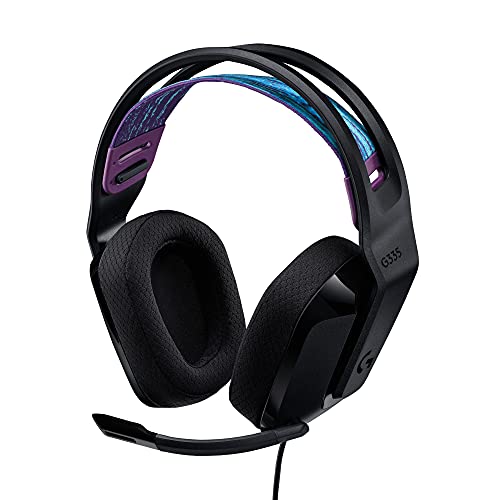
Logitech G335 Wired — Lightest Big-Brand Option
Logitech designed the G335 around lightness, and lightness is the small head’s best friend. Every gram a frame carries has to be held up by the wearer’s neck and resisted by the contact points on the skull; on a smaller head those contact points are fewer and the band’s leverage is worse, so a light headset stays put with far less clamp than a heavy one needs. The G335’s memory foam earpads then do the sealing work that brute force does in heavier designs, moulding to the ear instead of squeezing the head behind it.
The flip-to-mute microphone suits smaller faces in a way worth spelling out. Boom length is fixed at the factory, and on a small head a long fixed boom can end up beside your cheek rather than in front of your mouth; a flip design at least parks completely out of the way and returns to one consistent position. Logitech’s gaming line also brings the reassurance of a company that supports its headsets with parts and documentation for years, which matters when a well-fitting model is one you intend to keep rather than churn.
Consider who this headset quietly excludes: nobody, by platform. The title lists PC, PlayStation, Xbox, and Nintendo Switch behind one 3.5mm jack, so a small-headed player in a multi-console household is not forced into a different fit experiment per machine. That universality pairs well with the weight story, because the G335 can become the household’s default headset — the one that lives by the TV, travels to a friend’s place, and works everywhere it lands without a dongle hunt or a pairing ritual.
Where the G335 asks for compromise is in spectacle and extras. There is no lighting suite to show off and no wireless mode to brag about, and players who equate features with value may underrate it in the basket. Wear it for an evening, though, and the absence of weight becomes the feature. For a small head, the best headset is frequently the one you forget, and Logitech built this model to be forgotten in exactly that way.
There is a subtle dignity argument for the G335 as well. Smaller-headed adults are routinely handed the hand-me-down, the kids’ model, or the headset that happens to be left over, and the G335 is none of those: it is a current, deliberate design from a major gaming line that happens to suit them because lightness was its brief. Wearing equipment chosen for you, rather than inherited by accident, changes how a setup feels. If you have spent years making do with whatever almost fit, the G335 is the pick that most clearly says the making-do can stop.
- Connection: wired, 3.5mm audio jack
- Microphone: flip-to-mute
- Earpads: memory foam
- Platforms named in title: PC, PlayStation, Xbox, Nintendo Switch
- Colour in title: black
Strengths
- Lightweight build reduces the clamp a small head needs for stability
- Memory foam earpads seal by moulding rather than by squeezing
- Flip-to-mute mic parks fully away and returns to a fixed position
Trade-offs
- No wireless option for players who move around while they play
- Restraint in extras may disappoint feature-led buyers
- A very petite fit still depends on the band’s smallest setting suiting you
Best for: neck-sensitive players who want the lightest credible option from a major gaming brand.
Not suited for: players who play standing or roaming and need the headset to follow without a cable.
Weigh the G335 listing against the weight of your current headset; the difference is the argument.
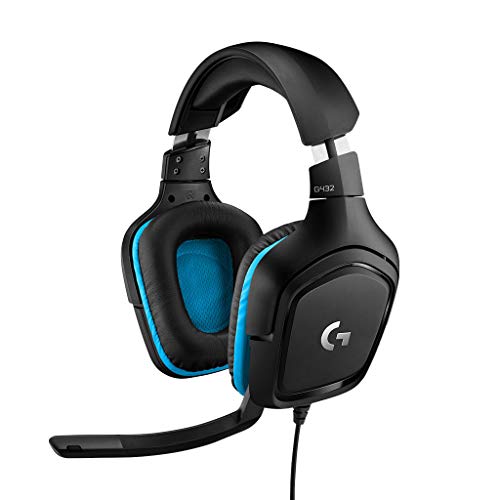
Logitech G432 Gaming Headset — Best Surround on a Budget Frame
The G432 is the pick for a smaller-headed PC player who cares about spatial audio and refuses to pay flagship prices for it. DTS Headphone:X 2.0 processes the game’s sound into a surround presentation over its 50mm drivers, which helps with placing footsteps and reloads around you, and it does this on a frame from Logitech’s more accessible tier. The fit relevance is indirect but real: surround processing only works when the earcups sit centred over your ears, so a headset that stays placed on a small head delivers the feature as designed, while a loose one smears it.
Two connection paths give the G432 a practical edge at a desk. USB unlocks the DTS processing on PC, while the 3.5mm jack keeps the headset useful with a controller or laptop that lacks the software side. That split personality suits a player whose gaming is PC-first but not PC-only. The flip-to-mute microphone follows the pattern of its G335 sibling, parking upward with a gesture that becomes automatic within a week of ownership.
Be clear-eyed about its stated home: the title says PC compatible, and the surround feature belongs to that USB-and-PC world. Console players can use the analogue connection where supported, but they should not buy this model expecting the DTS layer to follow them to a PlayStation or Xbox. Within its intended territory, though, the G432 makes a tidy argument — real spatial processing, full-size drivers, and a frame that a small head can wear without the band hovering at its tightest setting feeling like a compromise.
Longevity thinking also favours this model for younger players, a group in whom small heads are common. A headset that survives being borrowed, dropped into school bags for LAN afternoons, and used for homework calls as well as ranked matches earns its keep in ways a fragile flagship cannot. The G432’s wired simplicity is a feature in that life: nothing to charge before a session, nothing wireless to interfere in a crowded house, and a microphone that mutes with a flick when a parent walks in mid-call.
Desk players should also note how the G432 behaves across a working day, since many smaller-headed PC users wear one headset for calls, study, and play in rotation. The USB path serves the gaming hours with surround processing, the analogue path serves everything else without software, and the flip-to-mute gesture covers the doorbell moment in any context. A headset that crosses those contexts without a fit renegotiation is worth more than its specification list suggests, because the alternative — three headsets for three jobs — guarantees that at least two of them fit badly.
- Connection: wired, USB and 3.5mm jack
- Drivers: 50mm audio drivers
- Surround: DTS Headphone:X 2.0
- Microphone: flip-to-mute
- Platform stated in title: PC
Strengths
- DTS Headphone:X 2.0 gives PC players genuine spatial processing
- USB and 3.5mm connections split desk duty and fallback duty cleanly
- 50mm drivers match the size class of far pricier gaming headsets
Trade-offs
- Surround processing lives on the PC USB path, not on consoles
- Wired design ties you to the desk or controller
- Padding and frame are workmanlike beside Logitech’s premium tiers
Best for: PC players with smaller heads who want surround sound without flagship pricing.
Not suited for: console-first players expecting the DTS surround layer to work on PlayStation or Xbox.
Choose the G432 from its listing if your gaming chair sits in front of a PC most nights.

SENZER SG500 — Best Folding Travel Pick
The SG500’s defining trick is that it folds, and folding changes who a headset can serve. A smaller-headed player who games at a desk, on a sibling’s console, and at a friend’s house needs a headset that survives a backpack; a rigid flagship frame travels badly and gets left behind, which means the good fit stays home. The SG500 folds into a flatter package, arrives with memory foam padding for the ears, and connects by wire to the long platform list its title names, so the same fit is available wherever the session happens.
Its noise cancelling microphone addresses a household reality: smaller heads often belong to younger players or to adults gaming in shared rooms, and both groups get talked over by televisions, siblings, and kitchen noise. A mic that works to reject some of that background keeps callouts usable without raising your voice. Set expectations by class — this is a value-tier headset, and its microphone and surround presentation are honest attempts rather than class leaders — but the combination of fold, foam, and mic is coherent for its intended life.
Fit-wise, the SG500 follows the same logic as the other small-head picks: modest structure, foam doing the sealing, nothing oversized. Foldable hinges are also adjustment points of a kind, letting the cups settle at a natural angle against a smaller jawline instead of forcing one fixed geometry. The risk that comes with hinges is long-term play in the joints, so treat the folding mechanism with the respect you would give any hinge: open and close it with two hands, and do not use the folded headset as a bookend.
Buy the SG500 for the life you actually lead rather than the desk you imagine. If your gaming is spread across rooms and houses, portability is not a bonus feature; it is the difference between using your fitted headset and using whatever is plugged in where you land. The SG500 understands that, and its price class means a loss or a breakage is an annoyance rather than a disaster — a consideration parents buying for younger, smaller-headed players will weigh correctly.
The SG500’s folding design carries one more benefit that only appears over time: storage. A headset that folds flat lives in a drawer or a bag slot instead of occupying a desk stand, and smaller rooms and shared bedrooms reward that. It also gets put away properly, which protects the foam and the hinges from the slow damage of being knocked off desks and sat on by visitors. Owners of rigid headsets in small spaces know the choreography of moving the headset to use the desk; the SG500 simply opts out of that choreography, and for its mobile audience that is a daily mercy.
- Connection: wired
- Microphone: noise cancelling (per listing title)
- Padding: memory foam
- Design: portable, foldable
- Platforms named in title: PC, PS4, PS5, Xbox One, Switch
Strengths
- Foldable frame travels in a bag instead of staying home
- Memory foam padding supports the gentle-seal approach small heads need
- Noise cancelling microphone helps in busy shared rooms
Trade-offs
- Hinges are wear points that rough handling will loosen over time
- Value-tier audio and mic sit below the big-brand picks here
- Wired connection only, with no wireless upgrade path
Best for: players who game across several rooms or houses and need one headset that travels.
Not suited for: single-desk players who never move their setup and can prioritise pure audio hardware instead.
Look at the SG500 listing if your headset spends as much time in a bag as on your head.

BENGOO G9000 Stereo Gaming Headset — Bold Budget All-Platfomer
The G9000 is the extrovert of this list: LED lighting, a long platform list, soft memory earmuffs, and a price class that makes it the easiest headset here to buy on a whim. For smaller heads, its relevant virtue is the earmuff material. Soft memory foam around the ear forgives a loose-ish band by sealing gently and adding the friction that keeps cups placed, which is the same trick the premium picks use, executed at a fraction of the commitment. As a first headset for a younger player, that combination of forgiving fit and low stakes is genuinely sensible.
Honesty about class is required, and this guide will not skip it. The 7.1 surround in the title is software processing rather than discrete channels, the microphone and build sit at the level its price implies, and the LED glow is powered decoration that some households will love and others will switch off mentally on day one. None of that makes the G9000 a bad purchase; it makes it a correctly understood one. Bought as an affordable, comfortable, widely compatible headset, it delivers. Bought as a flagship in disguise, it would disappoint, and the fault would be the expectation rather than the product.
Its platform reach deserves emphasis because it is unusually complete for the tier. The title names PlayStation generations, PC, Xbox One and Series X|S, and Nintendo, which means a small-headed player can carry one fit across an entire household’s hardware collection. For families, that universality can outweigh refinements a child will never configure. The G9000 also tolerates the realities of younger ownership — being shared, being lent, being replaced without grief if the worst happens — better than any delicate premium frame.
Fit checks still apply. Run the same stability test you would run on any pick here: talk, turn, look down, and see whether the cups hold their place without the band at its tightest. The G9000’s foam gives it a fair chance of passing, and its lightness for its size helps. If it passes, you have solved a small-head fit at the lowest commitment in this article, and the money saved can wait for the day a growing player wants to step up to the Logitech tier with a clearer idea of what their head actually needs.
A word about the G9000’s lighting, since dismissing it entirely would miss why it sells. For younger players, the LED glow is part of the ritual of gaming — the setup feeling like a setup — and a headset that a child is proud to wear is a headset that stays on properly instead of being pushed up onto the forehead. Fit guidance for children that ignores motivation fails in practice. The G9000 pairs that motivation with foam that forgives and a price that forgives the parents, and that is a coherent product, however easy it is for adult reviewers to sneer at the lights.
- Connection: wired
- Sound: 7.1 surround (processing, per listing title)
- Earmuffs: soft memory foam
- Extras: LED light
- Platforms named in title: PS4, PC, Xbox One, PS5 controller, Nintendo, Xbox Series X|S
Strengths
- Soft memory earmuffs seal gently on smaller heads
- Platform list covers PlayStation, Xbox, PC, and Nintendo hardware
- Low commitment makes it a sensible first headset for younger players
Trade-offs
- 7.1 surround is processing, not discrete channels, and sounds like it
- Microphone and build quality match the budget tier honestly
- LED styling will not suit players who prefer an understated look
Best for: younger or first-time players needing one affordable headset for every console at home.
Not suited for: players chasing refined microphone quality for streaming or recorded content.
Pick the G9000 from its listing as a first headset, with expectations set exactly where its tier sits.
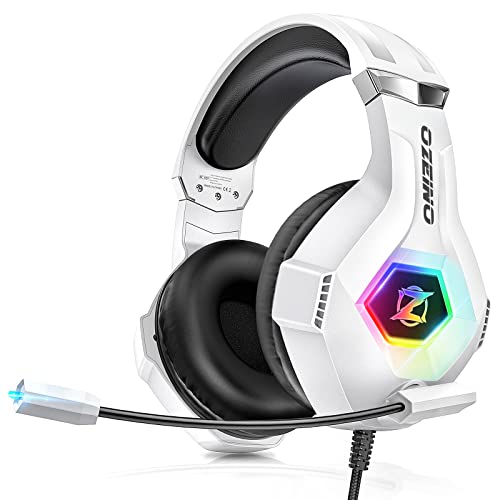
Ozeino 7.1 Gaming Headset — Budget Pick in White
Ozeino’s headset competes with the BENGOO for the same buyer and differentiates itself with a white finish and an even longer device list that reaches laptops and mobile phones. For a smaller-headed player, the underlying proposition is familiar: an over-ear frame, processing-based 7.1 surround, a noise cancelling microphone claim, and LED lighting, assembled at a price that invites experimentation. If your fit needs are modest — a headset that does not swim on your head and does not demand a tight band to stay aboard — this class can be enough, and the white colourway suits setups that reject the standard black-and-red gaming uniform.
The same class honesty applied to the BENGOO applies here with equal force. Surround is processing, the microphone’s noise cancelling is a claim to be tested in your actual room rather than a studio result, and materials are chosen to meet the price. Where the Ozeino earns its place in a small-head guide is that none of those compromises is a fit compromise aimed at you: the frame class is light, the cups are full-size without being cavernous, and the wired connection means it works with the controller and handhelds a younger or casual player actually uses.
Choosing between this and the G9000 is mostly about taste and tiny practicalities. The white finish shows its life more honestly, which some owners prefer and others will regret by month three. The device list’s inclusion of mobile matters if the headset will serve phone calls and handheld sessions between console nights. Either way, run the stability test, keep the packaging through the first week, and judge the microphone with your own teammates rather than with the listing’s adjectives.
There is a broader point this pair of budget picks makes about small-head shopping. The premium industry largely ignores petite sizing, while the value tier, almost by accident, builds lighter and simpler frames that smaller heads often prefer. It is entirely possible for the cheapest headset in this article to be the one a particular small-headed player wears most happily, and that outcome is not a failure of the guide but a reminder that fit is personal geometry, not a price ladder. Start where the geometry works; upgrade later only if a specific shortcoming names itself.
The Ozeino also makes an interesting spare-headset argument for households that already own a premium model. A second headset that fits the smaller-headed member of the house, works with every device including phones, and costs little enough to live in a drawer solves the nightly negotiation over the good headset. Many homes would be calmer with one excellent headset and one well-chosen Ozeino than with two mid-tier models that fit nobody perfectly. Think of it as fit insurance for the household’s smallest head, bought at the tier where insurance is cheap.
- Connection: wired
- Sound: 7.1 surround (processing, per listing title)
- Microphone: noise canceling (per listing title)
- Extras: LED light
- Platforms named in title: PC, PS4, PS5, Xbox, Switch, Xbox Series X/S, laptop, mobile
- Colour in title: white
Strengths
- White finish offers an alternative to the standard gaming look
- Device list stretches from consoles to laptops and phones
- Light value-tier frame suits smaller heads that dislike heavy hardware
Trade-offs
- Surround and mic noise cancelling are processing claims to verify at home
- Materials and longevity expectations belong to the budget class
- White surfaces show scuffs and discolouration sooner than black
Best for: casual and younger players wanting a light, colourful headset for mixed devices.
Not suited for: players who need a microphone proven for streaming, podcasts, or work calls.
Compare the Ozeino listing’s white finish and device list against your own hardware shelf.
Does Earpad Size Matter as Much as Headband Size?
It matters differently. The headband decides where the cups are allowed to sit; the pads decide what happens once they get there. On a smaller ear, an oversized pad can swallow the ear entirely and seal against the jaw and skull in ways that feel muffling and hot, while a pad proportioned to the ear seals on the intended ring of contact and stays cooler. None of the titles in this group publishes pad dimensions, so treat pad size as a home-trial judgement: your ear should sit inside the opening without the pad’s inner wall folding it, and the seal should survive a smile, which moves your jaw under the pad’s lower edge.
Heat deserves its sentence too. Smaller heads often belong to players with longer hair worn down, and hair trapped inside an earcup raises temperature and breaks seals at once. Foam pads handle a modest amount of hair better than firm leatherette rings, because the foam finds gaps instead of bridging across them. If you play with hair down, run your trial that way, and expect the memory foam picks to forgive you more than the firmer budget pads will.
How Do You Keep a Small-Fit Headset in Good Shape?
Light frames reward gentle storage. Hang a headset by its band on a wide hook or rest it on a stand; never store it by one earcup, which twists the band’s set over weeks and can make a good fit lopsided. Foldable models like the SG500 should be folded along their hinges rather than compressed into a bag under books, and detachable microphones should live in the same drawer every time, because a lost boom is the most common way a good headset becomes a bad one. Wipe foam pads after long sessions and let them dry before the next, since foam that stays damp softens unevenly and changes the seal you tuned.
Cables are the other lifespan lever in an all-wired list. Route the cable so it is never the thing that catches when you stand up; a single hard yank can damage the entry point and start the crackle that ends headsets. Coil loosely for travel rather than wrapping tightly around the frame, which stresses both the cable and the band. These habits cost nothing, and on headsets bought for fit, they protect the exact quality — a known, settled geometry — that made the purchase worthwhile.
When Is a Wireless Headset Worth It for a Smaller Head?
Wireless earns its weight when the player’s life genuinely involves distance from the screen: living-room consoles, standing play, or a desk shared with a standing-height workspace. In those cases the cable is not a minor tether but a constant mechanical argument with a light frame, and removing it can stabilise a fit that a cable kept disturbing. The condition is that the wireless model itself must be light for its class, because a heavy wireless headset hands back every advantage its missing cable bought. None of the six picks here is wireless, which reflects the current market at these tiers rather than a rule; if you shop beyond this list, weigh any wireless candidate in your hand before you weigh its feature list.
Side-by-Side: What Separates the Small-Head Six?
| Model | Fit strategy | Connection | Notable extra |
|---|---|---|---|
| JBL Quantum 100M2 Gaming Headset | Foam seal, compact wired frame | 3.5mm wired | Detachable microphone |
| Logitech G335 Wired | Lightweight frame, foam pads | 3.5mm wired | Flip-to-mute microphone |
| Logitech G432 Gaming Headset | Mid-size frame, PC tuning | USB and 3.5mm | DTS Headphone:X 2.0 on PC |
| SENZER SG500 | Foldable frame, foam padding | Wired | Folds flat for travel |
| BENGOO G9000 Stereo Gaming Headset | Soft memory earmuffs | Wired | LED lighting, widest console list |
| Ozeino 7.1 Gaming Headset | Light value frame | Wired | White finish, phone and laptop listed |
The table separates the six into three philosophies. The JBL and the G335 pursue fit through refinement — foam, lightness, and restraint — and suit players who know their problem is migration and pressure. The G432 and SG500 add a capability each, surround processing and folding, for players whose small-head problem travels with a PC habit or a multi-household life. The BENGOO and Ozeino trade refinement for reach and price, and for younger players that trade is frequently the correct one. Choose your philosophy first; the model inside it will be obvious.
What Should Parents Check When Buying for a Smaller-Headed Player?
Parents are the hidden audience of every small-head guide, because children and teenagers make up so much of this size range and rarely get to choose their own equipment. Three checks matter more than any feature list. First, weight: a child will not complain about neck strain in words, they will simply stop wearing the headset, so choose light and watch whether it stays on during a whole session. Second, the microphone’s mute: a flip-to-mute design gives a child a physical, unmissable way to go private, which is a household courtesy worth more than audio polish. Third, replaceability: at this age, headsets are consumables in a way adult equipment is not, and the budget tier exists so that a growth spurt or an accident is a shrug rather than a crisis.
Fit checks with children need translating too. Ask whether the headset feels like it is hugging or hanging; ask after the session, not during the excitement of unboxing, because novelty masks discomfort for about twenty minutes. Watch for the tells instead of relying on answers: the headset pushed up onto the forehead between rounds, one cup worn behind the ear, the volume climbing to fight a broken seal. Each tell maps to a section of this guide, and each has a pick that answers it. Buying for a smaller head is not about finding a children’s product; it is about respecting geometry that adult product plans ignored, on behalf of someone who cannot yet articulate it.
What Mistakes Do Smaller-Headed Buyers Keep Making?
Cinching the band tighter to cure sliding
Tightness treats the symptom by force and creates a new problem at the crown, while the cups still sit where geometry puts them. A headset that needs its tightest setting to survive a session is telling you its arc is too big. Listen to it, and shop for a frame whose middle settings are your settings, leaving adjustment in reserve in both directions.
Buying a flagship because the audio reviews glow
Flagship frames are built around average-to-large heads and flagship weights. A smaller-headed buyer can end up paying the most money in the category for the worst personal fit, then blaming their own head. Read fit evidence before audio evidence at this end of the range; the mid-tier and even budget models here exist because their geometry, not their marketing, suits you.
Sizing up for a growing child
A headset bought for next year’s head delivers a year of sliding, broken seals, and a child who concludes that headsets are uncomfortable. Buy for the head that exists today, favour the affordable picks while growth is fast, and step up when growth slows. The money saved across two correctly sized budget headsets is usually less than one flagship bought too big and replaced anyway.
Skipping the talk test
Most buyers test a headset by listening to a game for two minutes, sitting still. Small-head fit fails in motion and in conversation, when jaw movement and head turns work the cups loose. Talk to someone for five minutes, laugh, look down at your phone, and only then judge. A headset that survives conversation will survive a match; the reverse is not reliably true.
Before ordering, write down which failure you are solving — the slide, the low cups, the band at its final click, or the weight — and check that your chosen pick’s first paragraph names that failure back to you. If it does not, you have been shopping by brand or by bargain, and the right model is the one whose section reads like a description of your own evenings. Small-head fit is personal geometry, and the purchase should be just as personal.
Final Recommendation
For most smaller-headed players, the JBL Quantum 100M2 is the balanced starting point: foam that seals gently, a mic that comes off, and a cable that works everywhere. The G335 is the better buy if neck fatigue is your main complaint, the G432 if PC surround matters, and the SG500 if your gaming life is mobile. The BENGOO and Ozeino are the honest budget doors into the category, particularly for younger players whose heads and tastes are both still changing.
The right headset for a small head is the one still sitting exactly where you put it when the session ends — and once you have felt that difference, you will wonder why the industry made you wait this long to experience it.
Buy once, but buy by geometry. Note which of your current headset’s failures you recognised in these pages — the slide, the low cups, the band at its last click — and let that diagnosis, not a brand or a bargain, choose among the six. A smaller head is not a niche the market forgot; it is simply a size the average product plan skipped, and the models above prove that the right properties, honestly matched, close the gap completely.
Frequently Asked Questions
Are there headsets actually sized for small heads?
Very few gaming headsets are marketed in sizes, and none of the six listing titles here publishes a minimum head measurement. The practical market answer is to shop by properties — light weight, memory foam, compact or foldable frames — which is how this list was built. Treat any seller who promises a precise fit range without published measurements as decorating rather than informing.
Will memory foam really stop a headset sliding?
It helps through friction and gap-filling rather than force. Foam that moulds around the ear increases the contact area and resists the small movements that start a slide, which is often enough when the frame’s weight is modest. Foam cannot rescue a band whose smallest setting is still far too large, which is why foam picks here are paired with light frames rather than heavy ones.
Is a wired headset better for small heads than wireless?
Wired models dominate this list because they are lighter — no battery, no radios — and lightness is the small head’s first need. Wireless can work if the model is light, but a cable also provides a subtle anchor some players like. Judge individual models by weight class and fit evidence, not by connection ideology.
How should a headset for a small head actually feel?
Centred and uneventful. The cups should cover your ears fully without the band hovering at its tightest click, the crown should feel contact rather than pressure, and after ten minutes of talking and turning your head, nothing should have migrated. If you are aware of the headset as an object, something is still wrong; the goal is to forget it entirely.
What about children who game with adults’ headsets?
Children are the largest group of small-headed players, and adult headsets fit them worst of all. The budget picks here — BENGOO, Ozeino, and the foldable SG500 — are the pragmatic answer while heads are growing: light, forgiving, widely compatible, and painless to replace. Keep session lengths sensible, keep volumes moderate, and let the fit be comfortable rather than merely tolerated.
Can I add a headband cushion to fix a loose fit?
A thicker cushion takes up some slack at the crown and can rescue a borderline fit, and it is a cheap experiment before replacing a headset you otherwise like. It does nothing for cups that sit too low, because it raises the band rather than moving the cups. Try it when the only symptom is crown looseness; replace the headset when the cups themselves are misplaced.
My headset fits at the start and loosens by the end of a session. Why?
Two things are usually happening. Foam warms and softens as you wear it, which slightly changes the seal, and a band set near its smallest click can creep a notch under repeated movement. Check whether your model is creeping by marking the slider position before a session and comparing afterwards. If it creeps, a frame with a firmer detent or a self-settling design will serve you better than another evening of readjustment.
Do smaller heads need different volume habits?
The headset does not change what safe listening is, but a loose fit tempts players to raise the volume to overcome a broken seal and room noise leaking in. Fixing the seal first usually lets the volume come back down, which is one more reason fit is the first purchase and everything else follows it. If you find yourself turning a well-sealed headset up session after session, treat that as a signal to check your hearing habits rather than your hardware.
Which pick works best across a whole family’s consoles?
The BENGOO G9000 names the widest console spread in its title, and the JBL and Logitech G335 match it closely through the universal 3.5mm standard. Any of the three can live in a family room and serve whoever sits down. The G432 is the exception to keep at a PC desk, where its surround processing belongs.
Related Guides
Smaller-headed shoppers comparing brands should continue to Best Logitech Headsets for a tier-by-tier view of one major catalogue, competitive players will find the imaging-focused selection in Best Headsets to Hear Footsteps in Games, and endurance comfort for long sim sessions is covered by Best Gaming Headsets for Racing Sims.
Related guide: Best Gaming Headsets Atmos
Related guide: Best Gaming Headsets For First Person Shooters
Related guide: Best Competitive Gaming Headsets


