What's inside
- Where to Buy
- Key Takeaways
- Quick Picks
- How We Chose These Picks
- Comparison Table
- How to Choose a Projector for Events
- What Makes an Event Projector Different From a Meeting Room One?
- How Bright Does an Event Projector Need to Be?
- When Does Short Throw Matter More Than Brightness?
- Common Mistakes When Buying for Events
- Final Recommendation
- Frequently Asked Questions
- Related Guides
As an Amazon Associate I earn from qualifying purchases. This post may contain affiliate links at no extra cost to you.
[SITE_DOMAIN] is reader-supported. When you buy through links on our site, we may earn an affiliate commission.
Where to Buy
Event projectors live hard lives in transit cases, so read each listing for the version actually being sold before comparing anything else. ViewSonic’s PA503W page is where to confirm the WXGA model with its VGA input, since that legacy port is exactly what older event laptops still need. The PA503HD listing should be checked for the auto keystone wording, which matters when a projector gets aimed by whoever arrives first. BenQ’s MW560C deserves a look at its stated three-year warranty terms on the page, because warranty length is a working feature for a machine that travels. Epson’s EX3280 listing is the place to verify the built-in speaker arrangement for rooms where no PA system exists. ViewSonic’s LSD400HD-ST page should be read for its 0.5 short throw figure against the distance your venue actually allows. Casio’s XJ-M251 listing rewards a check of what the USB connection covers in the seller’s current description.
Weddings, conferences, school assemblies, pop-up cinemas and community celebrations all ask the same rude question of a projector: can you be bright, quick and forgiving in a room you have never seen, operated by somebody who met you an hour ago? The best projectors for events are the ones that answer yes without drama. Six machines are compared here, and they cluster tightly around one specification — roughly 4,000 lumens — because that figure has become the event trade’s working answer to rooms that dim imperfectly and screens that appear wherever a wall allows.
Notice what this category values once brightness is granted. Keystone correction appears in title after title, because event projectors are aimed from chair stacks, side tables and whatever furniture the venue owns. Optical zoom appears because the projector lands where the power socket is, not where geometry wishes. Inputs lean generous and slightly old-fashioned — VGA survives here — because the laptop that arrives at an event is not always the laptop the organiser expected. Every title below is a small essay in forgiveness, written by manufacturers who understand that events are where preparation goes to be tested.
Resolution splits the group into two honest camps. WXGA and XGA machines serve presentations, slideshows and lyric screens where text size is generous and content is built for legibility. Full HD machines serve the growing share of events that are really about video: wedding films, product launches, sports screenings, conference keynotes with cinematic ambitions. Neither camp is wrong; each is priced and specified for the programme it expects, and the reviews below keep asking which programme you are actually running.
One pick breaks the pattern in an instructive way: a short throw laser that projects a large image from half a metre’s worth of throw ratio, built for rooms where the projector must sit close to the wall. Its presence is a reminder that event projection is sometimes a geometry problem wearing a brightness costume, and that the right answer to a cramped venue is a different lens, not a bigger lumen count.
Portability threads through everything here even though no title leads with it. Event machines are carried, and carried machines get knocked, and knocked machines need alignment tools that work fast and menus that forgive tired operators at midnight. When two picks state similar brightness, the one whose correction tools and connection panel suit a stranger’s hands is the one that will still be friends with its owner after the fiftieth event.
Key Takeaways
- Four of the six titles state 4,000 lumens, marking the brightness tier the event market has settled on for dimmable rooms.
- ViewSonic’s PA503HD adds auto keystone and 1080p to the 4,000-lumen formula, suiting video-led events.
- BenQ’s MW560C pairs its 4,000 lumens with a stated 20,000:1 contrast and a three-year warranty.
- Epson’s EX3280 is the XGA outlier at a stated 3,600 lumens, with a built-in speaker for rooms without a PA.
- The LSD400HD-ST is the geometry specialist: 1080p laser light at a stated 0.5 short throw.
- Casio’s XJ-M251 is the modest veteran at a stated 3,000 lumens, sized for smaller gatherings.
Quick Picks
| Pick | Badge | Why it is here |
|---|---|---|
| ViewSonic PA503W | The All-Rounder | 4,000 lumens of WXGA DLP with VGA, optical zoom and a 120Hz, low-latency claim. |
| ViewSonic PA503HD | The Video Step-Up | The same 4,000-lumen formula in Full HD, with auto keystone for fast setups. |
| BenQ MW560C | The Meeting Professional | WXGA at 4,000 lumens with a stated 20,000:1 contrast, SmartEco and a three-year warranty. |
| Epson EX3280 | The Speaker-Equipped Portable | 3LCD XGA at a stated 3,600 lumens with a built-in speaker and a portable brief. |
| ViewSonic LSD400HD-ST | The Short Throw Laser | 1080p laser light at 4,000 lumens with a stated 0.5 throw and 360-degree projection. |
| Casio XJ-M251 | The Small-Room Veteran | WXGA at a stated 3,000 lumens with USB, for gatherings that do not need the full event tier. |
How We Chose These Picks
Event duty was defined by three tests drawn from how these evenings actually unfold. A candidate had to be bright enough for a room that dims imperfectly, which set the centre of the shortlist near the stated 4,000-lumen tier. It had to forgive hurried placement, which is why keystone correction, optical zoom and short throw geometry recur through the titles. And it had to connect to whatever arrived, which is why panels mixing HDMI with VGA, USB and even Ethernet were credited rather than treated as clutter.
Resolution was judged against programme, not against fashion. A wedding slideshow and a keynote deck do not need the pixel count a product film needs, and a guide that ranked XGA last on principle would mislead the many organisers whose content is text at generous sizes. Each review therefore names the content its pick flatters and the content that exposes it, so a buyer can match machine to programme instead of buying the largest number in the row.
Light source was recorded only where a title states it. One pick here is explicitly a laser model; the others leave the matter unstated in their titles, and their reviews say so rather than assuming. For a machine that travels, the practical questions — how it handles being switched on and off repeatedly across a day, and what its service story looks like — belong in the manufacturer’s documentation, and the how-to-choose section returns to them.
Finally, event-specific extras were weighed as working tools: a stated warranty term on the BenQ, a built-in speaker on the Epson, Ethernet on the short throw ViewSonic, a 120Hz and low-latency claim on the PA503W. Each answers a failure organisers actually remember — the room with no sound system, the networked venue, the games night bolted onto a conference — and each is credited in its own review rather than averaged away.
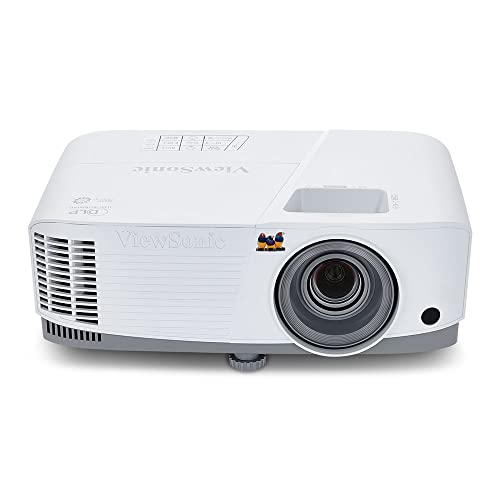
ViewSonic PA503W — The All-Rounder
Conference organisers, school event coordinators and anyone who has ever been handed a hall and a deadline will read the PA503W’s title as a checklist written by a colleague. Four thousand lumens of WXGA DLP brightness. HDMI for modern sources and VGA for the laptop from 2014 that the keynote speaker refuses to replace. Optical zoom so the image can be sized from wherever the table ended up. Vertical keystone for the tilt that stacking chairs introduces. Ceiling mount support for the venues where it lives permanently. Classroom, business, presentation and large screen all named outright.
WXGA deserves a defence in an age of resolution marketing. At event distances, on screens filled with slides, agendas, photographs and video at social sizes, the 1280-wide widescreen frame this class of panel provides is rarely the limiting factor; room light and screen surface limit first. What WXGA buys instead is brightness per unit of budget and a panel shape that matches the widescreen laptops feeding it. An organiser choosing between a dimmer high-resolution machine and this brighter WXGA one for a lit hall should usually take the light.
The 120Hz and low-latency wording in the title widens the brief in a way event buyers increasingly exploit. The same machine that shows keynotes by day can host a games tournament, a sports screening or an interactive exhibit by night, and motion handling stops being an afterthought. Community venues and schools, whose projectors must justify themselves across the whole calendar rather than a single event type, are exactly the buyers who benefit from that breadth.
Setup forgiveness is the deeper story. Vertical keystone corrects one axis of hurried placement; optical zoom forgives distance; the input panel forgives the source. What the title does not claim — horizontal keystone, lens shift, automatic anything — marks the boundary of that forgiveness, and an organiser whose venues force severe side angles should note it and read the PA503HD’s auto keystone claim with interest.
Consider also the machine’s afterlife between events. A projector this shape lives in a cupboard, a flight case or a ceiling, and gets borrowed by departments and committees who will not read its manual. A mainstream model from a major maker, with a conventional menu and widely available lamps or service through normal channels, is a safer communal asset than an exotic specification nobody local understands.
- Brightness: 4,000 lumens, as printed in the title
- Resolution: WXGA
- Technology: DLP
- Inputs: HDMI, VGA and USB stated
- Placement tools: vertical keystone and optical zoom stated
- Motion: 120Hz and low latency stated
- Mounting: ceiling mount stated
Strengths
- A stated 4,000 lumens covers the dimmable halls most events actually happen in.
- VGA survives on the panel, rescuing events built around older laptops.
- Optical zoom sizes the image from wherever the projector had to sit.
Trade-offs
- WXGA resolution softens fine text and detailed spreadsheets at large sizes.
- Only vertical keystone is stated, so side-angled placement stays uncorrected.
- No light source is named in the title, so service questions go to the documentation.
Best for: conferences, classrooms and community events mixing slides, photographs and video in dimmable rooms.
Not suited for: a screening-led event built around films, where the WXGA panel rather than the brightness becomes the limit.
Every event kit needs one machine nobody has to think about, and the PA503W’s title reads like the specification of that machine: bright enough, connected enough, forgiving enough, and honest about the rest.
Weather deserves a mention in any event discussion, because outdoor and marquee events rewrite the rules hourly. A machine that will serve garden screenings and festival tents should be judged at dusk rather than at noon, and its brightness spent on the hours when the audience actually gathers. The PA503W’s tier of output, aimed at a modest screen after the light drops, covers the realistic version of outdoor cinema far better than a specification bought for a midday fantasy nobody schedules.

ViewSonic PA503HD — The Video Step-Up
Sibling to the pick above and separated from it by one decisive letter group, the PA503HD takes the same 4,000-lumen event formula and renders it in 1080p Full HD. That step changes the machine’s centre of gravity from presentation toward video. Wedding films stop looking like enlargements and start looking like films. Product launches gain the crispness their budgets assumed. A keynote built around photography holds its detail from the middle rows backward. Organisers whose programmes have quietly become video programmes — which is most of them, lately — are this model’s natural constituency.
Auto keystone is the second headline, and event people will value it correctly. Manual keystone correction costs minutes and patience at the exact moment an event has neither; automatic correction lets the person setting up — often a volunteer, often holding three other jobs — place the machine, let it square itself, and move on to the chairs. Combined with optical zoom, the PA503HD describes a setup measured in minutes, which is the currency events actually trade in.
The title’s closing words, promising smooth action, pair with the same 120Hz family claim as its sibling and point the machine at sports screenings and games nights as well as ceremonies. A community hall that screens the match on Saturday and hosts the AGM on Tuesday needs one projector that respects both programmes, and this ViewSonic’s specification reads as though it were written by somebody who runs exactly that hall.
What the HD step does not change deserves equal clarity. Brightness stays at the stated 4,000 lumens, so room matching is identical to the WXGA model: dimmable halls, moderate screens, no miracles in daylight. The input list in the title is shorter — HDMI and USB are named, VGA is not — so an event built around legacy laptops should confirm the panel on the listing before assuming the older port survived the step up.
There is a rental angle here too. Hire companies favour machines whose setup explains itself, because every minute of telephone support during somebody else’s event is margin evaporating. A bright Full HD unit with automatic correction is close to the ideal hire-fleet citizen, and private buyers benefit from the same trait every time a friend borrows it for a garden screening.
- Stated brightness: 4,000 lumens
- Panel resolution: 1080p Full HD
- Technology: DLP
- Inputs: HDMI and USB stated
- Placement tools: optical zoom and auto keystone stated
- Motion: 120Hz stated
- Mounting: ceiling mount stated
Strengths
- Full HD resolution serves the video-led programmes most events now run.
- Auto keystone collapses setup time when volunteers are doing the aiming.
- A stated 4,000 lumens matches its sibling’s room coverage exactly.
Trade-offs
- VGA is not named in the title, so legacy-laptop events must verify the panel first.
- Brightness is unchanged from the WXGA model, so bright rooms gain nothing from the step up.
- The title states no light source, leaving service planning to the documentation.
Best for: weddings, launches, screenings and mixed community programmes where video carries the evening.
Not suited for: an event dependent on a VGA-only source, since that port is absent from this title’s input list.
Choose between the two ViewSonics by programme rather than by price instinct: slides and legacy laptops point one way, films and fast setup point here.
There is a social dimension to auto keystone that setup crews understand instinctively: the projector stops being the expert’s job. When squaring the image no longer requires the one volunteer who knows the menu, any member of the team can set up, and the expert can be somewhere else solving a harder problem. Machines that democratise their own setup quietly multiply the competence of every organisation that owns them.

BenQ MW560C — The Meeting Professional
BenQ’s MW560C introduces itself as a meeting room machine and then, unusually, puts a warranty in its title: three years, printed alongside 4,000 lumens, a 20,000:1 contrast ratio, HDMI and VGA, auto keystone and SmartEco technology. Event buyers should read that warranty as a specification in its own right. A projector that travels between venues, or serves a hall whose calendar never empties, is a machine whose failure date matters; a maker willing to print a term that long in the headline is making a claim about the whole ownership experience, not just the picture.
The contrast figure is the other number worth pausing over, because it is the highest stated in this guide. Contrast in a lit room is partly a fiction — ambient light sets the real black level — yet in the dimmed conditions of an evening event, a presentation with charts, photographs and the occasional video clip benefits from the deeper end of the range. BenQ’s meeting-room heritage shows in the pairing: brightness for the lights-up hours, contrast for the lights-down ones, in one specification.
SmartEco, the maker’s power-management branding, matters to event economics in a quiet way. Machines that modulate output to content draw less power and, in lamp-era designs, stretch consumable life; whatever its mechanism in this model, its presence in the title signals a maker thinking about running costs across a heavy calendar. Organisations that run a projector thirty hours a week should ask the documentation what SmartEco does here and price the answer into the comparison.
WXGA resolution places this BenQ in the presentation camp alongside the PA503W, with the same defence and the same boundary: generous text and slides are its home, fine detail and film are not. Auto keystone covers hurried placement on one axis automatically, and the HDMI-plus-VGA panel covers both generations of presenter laptop, which between them describe the overwhelming majority of real meeting and event mornings.
The meeting-room framing should not scare off event buyers; it should reassure them. Meeting rooms are where projectors go to be used daily by people who never read manuals, and a machine specified for that abuse — bright, contrast-aware, warranted in print — brings exactly the temperament a community hall, a training provider or a wedding venue needs from its house projector.
- Output figure given in the title: 4,000 lumens
- Panel: WXGA
- Contrast: 20,000:1, per title
- Inputs: HDMI and VGA stated
- Placement tools: auto keystone stated
- Power feature: SmartEco technology stated
- Warranty: three years stated in the title
Strengths
- A three-year warranty printed in the title underwrites heavy event calendars.
- The stated 20,000:1 contrast is the strongest such figure in this guide.
- Auto keystone plus VGA covers hurried setups and older presenter laptops.
Trade-offs
- WXGA resolution limits fine detail and film-led programmes.
- Optical zoom is not claimed in the title, so placement distance matters more.
- The title states no light source, so consumable planning needs the documentation.
Best for: training providers, meeting venues and halls running presentations most days of the week.
Not suited for: a film-society programme, where WXGA resolution rather than brightness or contrast sets the ceiling.
Of the six titles here, this is the one that talks most like a facilities manager, and facilities managers are the people whose projectors are still working in year four.
Procurement officers should note how the warranty changes the conversation with finance departments. A three-year printed term converts an unknown future cost into a bounded one, and bounded costs are what budgets are made of. Compare that against a cheaper machine with a shorter promise and the BenQ’s case stops being about lumens at all; it becomes an argument about how an organisation prefers its risks, stated in the one language every committee shares.

Epson EX3280 — The Speaker-Equipped Portable
Epson’s EX3280 is the contrarian of the group: 3LCD rather than DLP, XGA rather than widescreen, a stated 3,600 lumens rather than 4,000, and a built-in speaker that the event world should not underestimate. Its title calls it a portable business projector, and portable is the operative word — this is the machine for the organiser whose events happen in borrowed rooms: the village hall with no PA, the classroom after hours, the community meeting above a pub, the training session in a client’s spare office.
The speaker is the feature that rescues those rooms. Event veterans know the scenario by heart: a video clip central to the presentation, a hall with no sound system, a laptop speaker addressing forty people. A projector carrying its own speaker of any substance turns that small humiliation into a non-event. It will not fill a ballroom and nobody should ask it to; it fills a classroom, a meeting room, a scout hut, and it travels in the same bag as the machine itself.
3LCD technology brings the colour argument with it: colour brightness quoted alongside white brightness, at a stated 3,600 lumens for both, which suits the saturated slides and photographs of school and community programmes. The stated 15,000:1 contrast sits respectably in the middle of this guide’s figures. XGA’s 4:3 frame is the honest limitation, matching legacy content and document work while letterboxing modern widescreen video — an organiser screening films should step to a widescreen pick instead.
Portability also implies a different ownership pattern: this Epson will be set up and struck hundreds of times, aimed by eye, focused by hand, and carried by whoever drew the short straw. A mainstream business model from a maker with deep service coverage suits that life, and the title’s plain business framing is a promise that parts, lamps or service will be findable through ordinary channels years from now.
Schools should read this pick with particular attention. A stated 3,600 lumens is ample for classroom-sized screens in dimmable rooms, the speaker covers the video-heavy lessons and assemblies that define school use, and the XGA panel matches the document cameras and older content libraries schools still run. It is the least glamorous specification in the guide and quite possibly the most bought-for-a-reason one.
- Colour and white brightness, per title: 3,600 lumens
- Resolution: XGA
- Technology: 3-chip 3LCD
- Contrast: 15,000:1, per title
- Input: HDMI stated
- Sound: built-in speaker stated
- Form: portable business projector, per title
Strengths
- A built-in speaker rescues borrowed rooms that have no sound system at all.
- 3LCD colour brightness suits saturated school and community content.
- Portable business framing promises mainstream service and parts availability.
Trade-offs
- XGA’s 4:3 frame letterboxes widescreen video and softens fine detail.
- A stated 3,600 lumens is the second-lowest figure here, limiting screen size in lit rooms.
- Only HDMI is named in the title, so legacy sources need checking on the listing.
Best for: schools, community groups and trainers working in borrowed rooms with no installed sound.
Not suited for: a widescreen film programme or a large lit hall, where the 4:3 panel and 3,600 lumens both run out.
Judge the EX3280 by the rooms it was built for rather than the rooms in the brochure photographs, and it stops looking modest and starts looking correctly sized.
The speaker also changes who can run the event. A presenter travelling alone — the trainer, the celebrant, the peripatetic teacher — cannot also be a sound engineer, and a self-contained machine collapses two jobs into one bag. Organisations that send people out solo should weigh that consolidation heavily, because the alternative is a second case, a second setup, and a second thing to forget in a car park at the end of a long day.

ViewSonic LSD400HD-ST — The Short Throw Laser
Every event organiser knows a room where projection should work and geometry says no: the narrow function suite, the exhibition stand, the golf simulator bay, the classroom where the only mount point would put the projector inside the audience. ViewSonic’s LSD400HD-ST is the answer engineered for those rooms. Its title states a 0.5 short throw, which in plain terms means a large image from roughly half the distance a conventional lens would need, in 1080p, at a stated 4,000 lumens, from a laser light source.
Short throw changes more than distance. A projector sitting close to the screen wall stops casting the presenter’s shadow across the slides, stops blinding speakers who turn to face the room, and stops inviting guests to walk through the beam. For interactive and presentational events — training, teaching, trade-show demonstration — those are not conveniences but the difference between a screen that belongs to the room and one that fights it. The title’s golf simulator mention recognises the other classic short throw home: a bay a few metres deep that still wants a fairway ten feet wide.
Laser light compounds the venue logic. Event and simulator machines are switched on and off relentlessly, struck and re-aimed, run for a two-hour booking and then again an hour later. A light source indifferent to that rhythm, reaching full brightness immediately, suits the booking calendar far better than one that prefers long, gentle sessions. The title’s 360-degree projection claim extends the flexibility further, allowing orientations that exhibition and simulator builds exploit.
The connection panel is the most complete in this guide: HDMI, Ethernet and USB are all named. Ethernet in particular speaks to managed venues — a projector that joins the network can be monitored, scheduled and controlled from the same system running the rest of the building, which matters in schools, leisure centres and simulator businesses running several bays. Horizontal and vertical keystone are both stated, completing a placement toolkit matched to the awkward rooms the lens was built for.
The discipline short throw demands is precision at close range. Small placement errors magnify, a screen that is not flat will announce itself, and the projector’s proximity to the wall makes cable and power planning part of the geometry. None of that should deter the rooms this machine exists for; it should simply be budgeted as care rather than discovered as surprise.
- Brightness: 4,000 lumens, as printed in the title
- Resolution: 1080p
- Light source: laser
- Throw: 0.5 short throw stated
- Placement tools: horizontal and vertical keystone, 360-degree projection stated
- Inputs: HDMI, Ethernet and USB stated
- Named uses: business, classroom and golf simulator, per title
Strengths
- A stated 0.5 throw fills a screen in rooms too shallow for conventional lenses.
- Laser light suits the stop-start rhythm of bookings and simulator bays.
- Ethernet joins managed venue networks for monitoring and control.
Trade-offs
- Close placement magnifies alignment errors and exposes uneven screen surfaces.
- Short throw geometry is wasted in a deep hall where a standard lens would serve.
- The projector sits near the audience, so fan and heat land closer to the front row.
Best for: simulator bays, exhibition stands, classrooms and shallow rooms where the mount must sit near the screen.
Not suited for: a deep auditorium, where its 0.5 throw cannot reach the screen from the back wall at all.
When a venue’s problem is distance rather than darkness, this is the only pick in the guide actually solving it, and no amount of extra lumens elsewhere substitutes for the right lens.
Exhibition builders add one more demand that this ViewSonic’s title quietly answers: unattended running. A stand projector may run for ten hours a day, days in a row, restarted by whoever opens the booth. Laser light’s indifference to cycling, Ethernet’s remote oversight and a lens that keeps hands off the screen area combine into a machine that can be left alone with the public, which is a rarer and more valuable trait than any single figure in its specification.

Casio XJ-M251 — The Small-Room Veteran
Casio’s XJ-M251 closes the guide at the modest end: WXGA resolution, a stated 3,000 lumens and USB named in a title so short it feels like a shrug. Read it instead as a machine for the events the other five would be wasted on. A book club’s illustrated talk. A small wedding’s slideshow in a dim restaurant room. A classroom celebration, a team briefing in a borrowed office, a village quiz night with a picture round. At those scales, 3,000 lumens on a modest screen in a room that can pull its curtains is not a compromise; it is the correct amount of projector.
Scale honesty matters in event buying because overspending on brightness starves the rest of the kit. The organiser who buys a 4,000-lumen flagship for a forty-person room has spent money that could have bought the screen, the stand, the cables and the spare everything that actually determine whether an evening runs smoothly. The Casio’s restraint is a budgeting argument: match the machine to the largest room it will genuinely serve, and let the savings equip the events properly.
USB in the title hints at the machine’s era and its working pattern — presentations delivered from simple sources, in rooms where the setup is one person and a laptop bag. WXGA keeps it widescreen-compatible with modern slides, and the absence of further claims in the title should be read plainly: no keystone boasts, no zoom boasts, no network, no speaker claim. A buyer whose events need any of those should take the hint and step up this guide rather than discovering the gap during a rehearsal.
What the Casio offers instead is simplicity as a feature. Fewer systems mean fewer surprises, and a veteran model from an established maker means the second-hand and service knowledge around it is deep. For a small organisation buying one projector to be operated by whoever volunteers, that plainness has genuine value that a specification table struggles to price.
Its limits should be stated as plainly as its virtues. Three thousand lumens in a bright, undimmable room will wash out; a large screen will stretch it thin; video-led programmes will want the Full HD picks above. The XJ-M251 is not the guide’s recommendation for ambitious events. It is the recommendation for honest ones, where the room is small, the light is kind and the programme is people talking over pictures.
- Title-stated output: 3,000 lumens
- Resolution: WXGA
- Input: USB stated
- Light source: Not stated in the listing title — verify with the manufacturer documentation
- Keystone and zoom claims: Not stated in the listing title — verify with the manufacturer documentation
Strengths
- A stated 3,000 lumens is correctly sized for small rooms with curtains.
- WXGA matches modern widescreen slides without paying for unused resolution.
- A simple, veteran specification leaves little to surprise a volunteer operator.
Trade-offs
- Brightness runs out quickly in large or undimmable rooms.
- The title claims no keystone, zoom or speaker, so placement must be straightforward.
- Video-led programmes will want the Full HD models instead.
Best for: small gatherings, classrooms and community talks in rooms that can be darkened.
Not suited for: a large hall or a bright venue, where 3,000 lumens cannot hold the image.
There is dignity in a machine that knows its room. The Casio will not headline a conference, and for the hundreds of smaller evenings happening every week, that was never the job.
Reliability folklore follows veteran models like this one for a reason. A design that has been sold for years has had its weaknesses found by other people’s events, and the unit a buyer receives today is the survivor of that long public testing. Newer specifications promise more on paper; older ones promise fewer surprises, and a small organisation with no backup machine should think carefully about which promise it needs.
Comparison Table
| Pick | Headline facts from its listing title | Event it suits first |
|---|---|---|
| ViewSonic PA503W | 4,000 lumens, WXGA DLP, VGA, optical zoom, 120Hz | Conferences and classrooms with mixed-age laptops |
| ViewSonic PA503HD | 4,000 lumens, 1080p DLP, auto keystone, optical zoom | Weddings and video-led programmes |
| BenQ MW560C | 4,000 lumens, WXGA, 20,000:1 contrast, three-year warranty | Daily meeting and training calendars |
| Epson EX3280 | 3,600 lumens, XGA 3LCD, built-in speaker, portable | Borrowed rooms with no sound system |
| ViewSonic LSD400HD-ST | 4,000 lumens, 1080p laser, 0.5 short throw, Ethernet | Simulator bays and shallow rooms |
| Casio XJ-M251 | 3,000 lumens, WXGA, USB | Small gatherings in darkenable rooms |
Six titles, one shared lesson: the event market buys forgiveness — of placement, of sources, of light — before it buys refinement. A buyer who reads the table through that lens will notice that each row forgives a different sin, and the right pick is the one forgiving the sin their own events commit most often.
How to Choose a Projector for Events
Begin with the worst room on your calendar, not the best. The hall that cannot dim, the suite that is too shallow, the borrowed space with no sound — the projector that survives that room will stroll through every other. Buyers who spec for their flagship venue and improvise at the difficult one end up renting at the difficult one forever, which is the most expensive way to own a projector.
Match resolution to programme with equal honesty. Count what your events actually show: if the honest answer is slides, lyrics and photographs, WXGA or even XGA will serve and the savings belong in brightness and kit. If the answer is films, launches and screenings, Full HD is the floor and the PA503HD or the short throw ViewSonic lead the conversation.
Inventory your sources before admiring any specification. The laptops, media players and document cameras your events genuinely use decide whether VGA is a lifeline or a museum piece, whether Ethernet matters, whether a speaker is essential. Event history is a better buying guide than event aspiration, because the projector must serve the evenings that happen, not the ones in the brochure.
Transport deserves a line in the decision too. Measure the case, not just the projector: a machine that travels weekly should fit a standard flight case or a padded bag its owner will actually use, with room for cables and the remote. Weight that seems trivial in a showroom becomes a personality trait by the fiftieth staircase, and more than one capable projector has been retired early because carrying it was nobody’s favourite job.
Finally, rehearse the setup in your head, minute by minute. Who carries it, where it sits, how it gets squared, what happens when the first cable is wrong. The pick whose title answers those minutes — auto keystone, optical zoom, a speaker, a short throw — is the pick that will still be earning its keep when the novelty of brightness has long worn off.
What Makes an Event Projector Different From a Meeting Room One?
Movement and strangers. A meeting room projector is installed once and operated by regulars; an event projector is transported, aimed by whoever arrives first, fed by unfamiliar laptops and judged by an audience that came for something else. That is why the titles in this guide emphasise correction tools, legacy inputs and warranty terms over the contrast and colour refinements a fixed room can exploit.
The distinction is a spectrum rather than a wall — the BenQ here is meeting-room branded yet event-ready, and the ViewSonics name classrooms alongside presentations. Buyers should locate their own usage on that spectrum honestly: a projector that travels twice a year can borrow a fixed room’s priorities, while one that travels twice a week should buy forgiveness first and refinement with whatever budget remains.
How Bright Does an Event Projector Need to Be?
The cluster of stated 4,000-lumen titles in this guide is the market answering from experience: that tier holds a respectable image on a mid-size screen in the partial darkness most halls can achieve. Drop to the Casio’s stated 3,000 and the room must be smaller or darker; the Epson’s 3,600 sits between, sized for classrooms and borrowed rooms rather than ballrooms.
Audience distance completes the triangle. Brightness is judged from the back row, and back rows at events are farther than back rows at home, because event screens serve crowds. A figure that feels cinematic at twelve feet can feel merely adequate at forty, not because the machine changed but because the eye did. Organisers should walk to the worst seat during setup and judge the image from there; it is the only seat whose opinion is honest.
Screen size and surface move the answer as much as the room does. A modest screen concentrates any of these figures into a punchy image, while an oversized screen in a lit hall will defeat all of them equally. Organisers routinely gain more by shrinking the image slightly and pulling two curtains than by climbing a brightness tier, and the wisest event budgets spend on blackout and screens before they spend on lumens.
When Does Short Throw Matter More Than Brightness?
Whenever the room’s depth, not its light, is the binding constraint. A shallow suite, a simulator bay or an exhibition stand cannot give a conventional lens the metres it needs, and no brightness figure compensates for an image that physically cannot reach the required size. The LSD400HD-ST’s stated 0.5 throw exists for those rooms, with the bonus that presenters stop shadowing their own slides.
Short throw also changes audience geometry: the projector leaves the middle of the room, cables stop crossing walkways, and the front row stops sitting inside the beam’s heat and fan noise. Events built around a speaker standing at the screen — teaching, training, demonstrating — feel different in kind, not just in convenience, once the lens moves close to the wall.
Power planning is the invisible half of event projection. A hall’s sockets are never where the screen is, extension reels introduce their own hazards, and a projector sharing a circuit with catering equipment lives dangerously. The organiser who walks the room with the socket map in mind — and who carries one long, rated extension lead as a matter of policy — will find that several picks in this guide become easier to place than their throw figures suggested, simply because the machine can stand where the power is.
Backup thinking separates professional kits from hopeful ones. A spare cable for each connection type, a second way to play the film, a laptop that has already been introduced to the projector: none of these cost much, and each converts a potential cancellation into an anecdote. The projector at the centre of the kit matters enormously, but events are saved at the edges, by the unglamorous duplicates nobody photographed.
Common Mistakes When Buying for Events
Buying for the flagship venue and improvising everywhere else leads the regrets. The projector that is perfect in the main hall and hopeless in the breakout rooms, the marquee and the borrowed classroom will spend its life being apologised for. Event equipment should be specced against the full calendar, weighted toward the difficult rooms.
Forgetting sound is the quiet classic. Half the titles here make no audio claim at all, which means the room’s sound is the buyer’s problem, and discovering that during a video-led ceremony is a special kind of silence. The Epson’s built-in speaker covers small rooms; everything else assumes a PA, a speaker in the kit bag, or a programme that never plays audio.
Assuming the source laptop is modern ruins one event in every season. VGA survives in these titles because organisers kept meeting the presenter whose machine predates HDMI-only design. A kit that cannot accept the laptop that actually arrived is not a kit; check the panel against your real presenters, not your hoped-for ones.
Neglecting the strike is the mistake nobody photographs. Events end late, volunteers are tired, and a projector that is fiddly to pack, slow to cool or awkward to carry gets damaged in the last ten minutes of the night. Setup speed gets all the attention; a machine’s manners at midnight matter just as much across a year of events.
Final Recommendation
Most event buyers should start with the PA503HD: a stated 4,000 lumens in Full HD with auto keystone is the closest thing this category has to a universal answer, and it will carry weddings, screenings and conferences without complaint. Presentation-led calendars with legacy laptops point to the PA503W or the warranty-backed BenQ MW560C instead. Borrowed-room organisers should take the Epson’s speaker and portability seriously, shallow rooms belong to the short throw laser, and small honest gatherings are the Casio’s home.
Whichever machine an organiser chooses, the purchase completes itself in the kit around it: a screen the room can use, cables for both input generations, a speaker plan, and a case that survives the boot of a car. A projector bought as a system succeeds at events; a projector bought as a specification merely attends them, and the difference shows by the third song, the second speaker and the first video clip of the night.
Committees buying by consensus should run one demonstration before any vote: the two finalists, the same film clip, the same hall at the same hour, judged from the back row by the people who will operate them. Committees discover in twenty minutes what a month of specification emails cannot settle — which machine the volunteers find friendly, which image the room flatters, and which setup the organisation can actually repeat at midnight in December.
Frequently Asked Questions
Is 4,000 lumens enough for a wedding venue?
For a mid-size screen in a hall that can dim its lights for the film and speeches, the stated 4,000-lumen tier in this guide is the market’s settled answer. A vast screen or a glass-walled venue at midday asks for more light control before it asks for more lumens.
Which of these suits a golf simulator?
The ViewSonic LSD400HD-ST names golf simulation in its title and backs it with a stated 0.5 short throw and 1080p laser light, which is the geometry a simulator bay needs. The PA503W also names simulator-adjacent uses in its sibling guide coverage, but the short throw machine is the purpose-built answer here.
Do I still need VGA on an event projector?
If your events host guest presenters, keep it on the shortlist. Two titles here retain VGA precisely because older laptops keep arriving at real events, and an adapter hunt during a keynote is a failure no brightness figure can redeem.
Can one projector handle both presentations and film nights?
Yes, with the programme deciding the resolution. The PA503HD’s Full HD panel and 4,000 stated lumens cover both duties in dimmable rooms, while WXGA picks like the BenQ favour presentations and treat film as a secondary use.
How long should setup take at a well-run event?
With a forgiving machine — auto keystone, optical zoom, a panel that matches the source — a practised organiser should reach a squared, focused image within minutes of the case opening. If a projector regularly needs half an hour of coaxing, the cost is not the half hour; it is the rehearsal, the soundcheck and the calm that the half hour was stolen from.
What should travel in the case besides the projector?
Both generations of video cable, a remote with spare batteries, a compact speaker for rooms without a PA, gaffer tape for cable runs, and a lens cloth. The projector is the centre of the kit, not the whole of it.
A last thought for organisers building a permanent event kit around any of these machines: label everything. The remote, the cables, the case and the projector itself should carry the organisation’s name and a phone number, because event equipment migrates — between halls, between committees, between the boot of one car and another — and the kit that comes home is the kit that was labelled. The finest specification in this guide is worth nothing in a hall it never arrived at, and the humble label maker has saved more events than any lumen figure ever printed.
Rehearsal is the other unglamorous multiplier. Ten minutes spent the day before — projector on the actual table, actual laptop connected, actual film cued — converts the unknowns of an event into a checklist already ticked. Every pick in this guide rewards that habit equally, because none of them can rehearse on the organiser’s behalf.
Related Guides
Event projection borders two larger questions covered nearby: our large venue projector guide, for the permanent installations that events grow into, and our guide to projectors that can serve as a television, where daily brightness and streaming take over the judging.


