What's inside
- Key Takeaways
- Quick Picks
- How did we choose these six DeWalt chargers?
- What do the amp ratings on a DeWalt charger actually tell you?
- Which battery platforms does each charger need to cover?
- How many charging ports does your rotation really need?
- How do pack size and battery age change the charging picture?
- What should a two-charger strategy look like for a growing fleet?
- The six DeWalt chargers, reviewed in detail
- How do the six DeWalt chargers stack up side by side?
- What mistakes do buyers make when choosing a tool battery charger?
- How should you set up a charging corner that stays safe and sane?
- How do you rotate packs so the whole fleet ages evenly?
- Final Recommendation
- Frequently Asked Questions
- Related Guides
As an Amazon Associate I earn from qualifying purchases. This post may contain affiliate links at no extra cost to you.
widgetverdict.com is reader-supported. When you buy through links on our site, we may earn an affiliate commission.
Where to buy: Amazon carries the full DeWalt charging range, from the compact single-bay units up to the ToughSystem station, so every charger below can be ordered from the same basket as the batteries it will feed. Read the pick sections before ordering, because the differences between a 4-amp standard charger and a fan-cooled rapid unit matter more than the badge on the box.
Choosing among the best dewalt 20volt chargers sounds simple until you count how many distinct jobs the word charger covers in this range. One charger lives in a kitchen drawer and tops up a drill battery on weekends. Another sits on a framing site where four batteries rotate through two saws all day and a slow bay is a genuine bottleneck. A third rides inside a rolling tool storage system and has to survive transport. DeWalt sells hardware for all three situations, and the model numbers, DCB1104, DCB118, DCB102 and their relatives, tell you almost nothing until you decode what each one actually does.
This guide decodes them. The six chargers below were chosen to cover the real spread of the range: a 4-amp everyday charger, a fan-cooled rapid charger, a dual station with USB ports, a 6-amp unit, a four-port simultaneous charging station, and a dual-port charger built into the ToughSystem 2.0 storage format. Where the listing title states a figure, such as charge current in amps or the battery platforms supported, we use it. Where the title stays silent, for example on exact charge times, we say so rather than guessing, because charge time depends on the capacity of the pack you slide in and no honest guide can quote one number for every battery.
Key Takeaways
- Charge current is the headline difference: the range here runs from 4-amp standard charging to a 6-amp unit and a fan-cooled rapid charger, and higher current matters most with large-capacity packs.
- Platform coverage differs by model. Some chargers handle the compact and mainstream packs only, while others also accept FLEXVOLT 20V/60V MAX batteries, so check your fleet before choosing.
- Port count is a workflow decision, not a luxury: single-bay, dual-bay and four-port simultaneous stations suit very different battery rotations.
- The DCB102 adds two USB ports, which makes it the natural bench charger for crews who also charge phones and lights at the same spot.
- The ToughSystem 2.0 charger is a storage-system component first; it earns its place if your tools already live in that ecosystem.
- No charger in this guide has a quoted charge time in its listing title, so judge speed by rated amps and cooling, not by invented minutes.
Quick Picks
| Pick | Badge | Why it earns its place |
|---|---|---|
| DEWALT DCB1104 4 Amp Charger | Everyday single-fleet standard | The straightforward 4-amp charger for 12V MAX and 20V MAX packs, sized for home workshops and light site use. |
| DEWALT DCB118 Fan-Cooled Rapid Charger | Rapid charging with active cooling | A fan-cooled rapid charger covering 20V MAX and FLEXVOLT packs, aimed at users who burn through batteries faster than a standard bay refills them. |
| DEWALT DCB102 Dual Charging Station | Two bays plus USB | A corded dual charging station for 12/20V MAX batteries with two USB ports included, built for a fixed bench or site box. |
| DEWALT DCB1106 6 Amp Charger | Higher-current all-platform pick | A 6-amp charger spanning FLEXVOLT plus the compact and mainstream lines, the strongest rated current in this line-up for big packs. |
| DEWALT DCB1404 Multiport Charging Station | Four ports, simultaneous | A multiport simultaneous charging station at 4 amps covering 12V MAX, 20V MAX and FLEXVOLT 20V/60V MAX batteries. |
| DEWALT ToughSystem 2.0 Dual Port Charger | Storage-integrated dual port | A dual-port 20V charger in the ToughSystem 2.0 format, made to live inside a rolling storage stack rather than on a shelf. |
How did we choose these six DeWalt chargers?
We started from the questions owners actually ask after buying their second or third battery. Is one bay enough? Does FLEXVOLT compatibility matter for a fleet that is still all 20V MAX? Is a fan inside a charger a gimmick or a real advantage on a hot site? The six picks answer those questions with hardware rather than marketing: each one is the strongest representative of a distinct charging pattern, standard, rapid, dual, high-current, multiport and storage-integrated.
One more filter shaped the order. We weighted the problems owners report after six months, not the excitement of unboxing day: the charger that was too slow once the fleet grew, the station that could not take the new FLEXVOLT pack, the single bay that became a queue. Every pick below is the answer to one of those six-month problems, which is why the line-up contains no novelty items and no duplicate roles. If two chargers did the same job, we kept the one whose title made the stronger, clearer claim and dropped the other, so each of the six earns its slot by being the best representative of a distinct pattern rather than by being merely adequate at several.
We also held every pick to the listing title. Amperage figures, platform lists and port counts in the spec boxes come straight from those titles. Features the titles do not mention, such as wall mounting, charge-time minutes or indicator behaviour, are flagged as unstated instead of being filled in from memory of similar models, because DeWalt revises these units and a spec copied from a sibling model is exactly how buyers end up with the wrong charger. If your shortlist later expands beyond tool batteries, our companion guides on Best Marine Deep-Cycle Battery Chargers and Best Inverter Chargers for Van Life cover the charging hardware that lives on boats and in vans rather than on benches.
What do the amp ratings on a DeWalt charger actually tell you?
The amp figure in a charger name is its rated charge current, and it is the closest thing to a speed rating you can trust. A 4-amp charger pushes charge into a compatible pack at up to four amps; a 6-amp unit raises that ceiling by half. In practice the gap shows up most with high-capacity batteries. A compact 2.0Ah pack fills quickly on almost anything, while a large FLEXVOLT pack on a 4-amp bay occupies that bay for a long stretch of the working day. Crews notice this as a queue: batteries waiting for the charger instead of waiting in tools.
Amps are a ceiling, not a constant. Chargers taper current as a pack approaches full, and they manage heat as they go, which is why the fan inside the DCB118 matters. Active cooling lets a rapid charger sustain aggressive charging without the pack or the charger electronics cooking, and on summer sites, in direct sun or inside a closed van, that thermal headroom is the difference between rated speed and throttled speed. If your work is indoors and unhurried, cooling is a nice extra. If your charger lives in a hot truck bed, it is close to a requirement.
What amps do not tell you is a finish time, and you should distrust any listing summary that converts them into one without naming the battery. The same 4-amp charger that briskly refills a slim pack will take far longer over a high-capacity one, and temperature, pack age and how deeply the battery was drained all move the number. Judge these six by current, cooling and port count, and treat any precise minute count you meet elsewhere as an estimate tied to one specific pack.
Which battery platforms does each charger need to cover?
DeWalt’s naming hides a compatibility question that decides purchases. The 20V MAX line is the mainstream platform. The 12V MAX line is the compact sub-family, and FLEXVOLT packs are the dual-voltage batteries that run 20V MAX tools and combine for 60V MAX equipment. A charger that lists only 12V MAX and 20V MAX, like the DCB1104, is complete for a household fleet built on those two lines. The moment a FLEXVOLT pack enters the kit, for a mitre saw, a table saw or a large blower, that charger stops being complete, and you need one of the models whose title names FLEXVOLT, the DCB118, DCB1106 or DCB1404.
Read the platform list in each spec box as a hard boundary, not a suggestion. A pack that does not appear in the charger’s stated platforms should not be forced onto its rails. This sounds obvious, yet mixed fleets grow casually: a FLEXVOLT battery arrives bundled with one tool, the old charger stays on the bench, and the mismatch is discovered at the worst moment. The multiport DCB1404 exists partly for this reality, covering 12V MAX, 20V MAX and FLEXVOLT 20V/60V MAX in one station so a mixed fleet charges in one place.
Households charging batteries for equipment beyond the tool wall face the same matching discipline in other categories. The voltage and connector matching we stress in Best Scooter Battery Chargers is the two-wheeled version of the platform check here: the charger must be built for the battery in front of it, full stop.
How many charging ports does your rotation really need?
Count batteries in play during your busiest hour, not batteries owned. A homeowner with three packs and one drill rarely has two empty at once, and a single-bay charger keeps up easily. A two-person crew running a saw, an impact driver and a light can empty three packs before lunch, and at that point a dual station stops being a convenience and becomes the thing that keeps the afternoon moving. Four ports, as on the DCB1404, suit a gang box serving several trades or a workshop where batteries return in waves at the end of the day.
Simultaneous is the word to verify. The DCB1404’s title states multiport simultaneous charging, which means the ports work together rather than taking turns. Stations that charge sequentially can look identical on a shelf yet behave very differently at 4 p.m. when four flat packs land at once. Where a title does not use the word simultaneous, as with the dual models here, the honest reading is that both bays charge their packs as a station, and the practical test is simply whether your rotation empties faster than the station refills it.
There is also a bench-space economy to ports. One four-port station with one power cord is tidier and easier to move than four separate chargers on a power strip, and it presents one obvious home for every battery, which is how packs stop getting lost in truck cabs. The trade is single-point failure: one dead station idles the fleet, while scattered single chargers degrade gracefully. Busy crews often split the difference, a multiport station at base plus one standard charger that travels.
How do pack size and battery age change the charging picture?
A charger never works alone; it works on a specific battery, and two variables dominate that pairing. The first is capacity. Slim compact packs ask little of any charger and refill quickly even at 4 amps, which is why casual users rarely feel charger envy. High-capacity packs invert the experience: the same charger that felt instant with a compact battery becomes an appointment. When owners say a charger is slow, they usually mean their packs grew. The fix is either more current, the DCB1106’s route, or more ports, the DCB1404’s route, and choosing between them means deciding whether your problem is one big battery or several medium ones.
The second variable is age. Lithium packs lose capacity gradually and gain internal resistance as they cycle, and a charger responds to the battery it is given: an elderly pack may accept charge differently, finish sooner because there is less to fill, and deliver less work per charge. None of that is the charger’s fault, and no charger in this guide can restore a tired pack. What a good charging setup does give you is visibility. When packs rotate through one known station, the pack that suddenly behaves differently stands out; when batteries charge wherever a socket is free, decline hides until a tool dies mid-task.
There is a buying implication hiding in that. If your fleet’s runtime is shrinking, price a replacement pack before pricing a faster charger. Owners regularly upgrade charging hardware to fix what is actually battery wear, and the disappointment is predictable. Chargers divide time; batteries store work. Diagnose which side of that line your problem sits on, then spend on the correct one.
What should a two-charger strategy look like for a growing fleet?
Most mature setups in this category end up as a pair, and the pairings below are deliberate rather than accidental. A station plus a traveller is the classic pattern: the DCB102 or DCB1404 lives on the bench where batteries return, while a DCB1104 rides in the van for the days the bench is a postcode away. The pair costs less than two stations and covers both geographies a working fleet actually inhabits.
A second pattern pairs breadth with speed. The DCB1106 handles everything, including the FLEXVOLT packs, at the strongest stated current, while the DCB118 waits for the days when heat and urgency coincide. That looks redundant until a summer deadline arrives, at which point the fan-cooled unit stops being a luxury and becomes the reason the big packs keep cycling. Fleets that never work hot or hurried can skip this pattern honestly.
The third pattern is the storage pairing: a ToughSystem DWST08050 in the stack for everything mobile, backed by any bench unit for overflow and for the platforms the ToughSystem charger does not claim, 12V MAX and FLEXVOLT. Notice that each pattern starts from a gap in the first charger’s title, a missing platform, a missing port, a missing fan, rather than from a vague wish for more. That is the discipline this whole guide runs on: the listing titles tell you what each unit is, and a sensible second purchase fills a named gap instead of duplicating a strength.
The six DeWalt chargers, reviewed in detail

DEWALT DCB1104 4 Amp Charger — The sensible default for a 12V and 20V fleet
Every range needs an unglamorous centre, and in this line-up the DCB1104 is it. Its title describes a lithium-ion battery charger rated at 4 amps for the 12V MAX and 20V MAX platforms, which is precisely the combination most DeWalt owners actually run: compact 12V tools in the kitchen-drawer kit, 20V drills and drivers doing the real work. If that sentence describes your shelves, this charger covers your fleet completely, with no unused capability paid for and no missing platform discovered later.
Four amps is a well-judged rating for that role. It is brisk enough that a homeowner or a light-duty tradesperson is not planning their day around the charger, yet it is not the aggressive end of the range, which suits packs that spend their lives in moderate rotation. The DCB1104 makes most sense as the always-plugged-in home base: one charger on the bench, packs rotating through it in the evening, everything full by morning. It is also the natural second charger for a crew whose main station is a rapid or multiport unit, because a cheap, correct spare beats a borrowed, wrong one.
There is a quieter virtue worth naming: predictability. A standard 4-amp charger behaves the same in January and July, in a cool workshop or a warm kitchen, and for packs charged overnight or over a lunch break that consistency is all the performance most owners will ever sample. Enthusiasm for rapid hardware tends to arrive exactly when a fleet’s demands spike, and it fades just as fast when the work turns domestic again. The DCB1104 is the charger for the other ninety percent of a battery’s life, the routine top-ups and evening refills that keep a modest fleet permanently ready without drama, heat or decisions.
Its limits are written in the same title. FLEXVOLT does not appear, so owners of 60V-capable tools should not shortlist it as their only charger. There is no fan claim and no multiport claim, so sustained back-to-back charging of large packs in hot conditions belongs to the DCB118 or DCB1106 instead. Judged on its own brief, though, the DCB1104 is the charger most buyers in this category actually need, and the one against which the fancier units must justify themselves.
- Platforms (from title): 12V MAX and 20V MAX lithium-ion batteries
- Rated charge current: 4 amps
- Model code: DCB1104
- Port count: the listing title does not state a port count, so confirm the bay layout in the manufacturer documentation before ordering for a multi-battery rotation
- Charge time: no figure appears in the listing title, and times vary by pack capacity, so treat any minute count as pack-specific
Strengths
- Covers the two platforms most home and light-trade fleets are built on, the compact line and the mainstream line, in one unit.
- The 4-amp rating keeps everyday packs turning over at a pace that suits bench charging between jobs.
- Simple role with nothing to configure, which makes it a dependable spare charger for a van or site box.
Trade-offs
- FLEXVOLT packs are outside its stated platforms, so a growing fleet outgrows it.
- One charging role at a time means a queue forms when several flat packs arrive together.
- No fan cooling is claimed, so hot environments and rapid turnaround are better served elsewhere in this list.
Best for: owners whose batteries all sit on the compact or mainstream platforms and who want one correct, everyday charger on the bench.
Not suited for: FLEXVOLT owners, or crews emptying several large packs daily who need rapid or multiport throughput.
When the fleet is purely 12V and 20V, the DCB1104 is the charger to beat, so look up the DCB1104 on Amazon before paying more for capability your batteries cannot use.

DEWALT DCB118 Fan-Cooled Rapid Charger — Speed with thermal headroom
The DCB118 exists for the moment a standard charger becomes the slowest tool you own. DeWalt labels it a fan-cooled rapid battery charger for 20V MAX and FLEXVOLT lithium-ion packs, and both halves of that description matter. Rapid sets the expectation of aggressive charge current; fan-cooled explains how the unit sustains it. Heat is the tax on fast charging, for the pack and for the charger itself, and an internal fan is the straightforward way to keep paying it down while the current stays high.
FLEXVOLT support widens its fleet coverage beyond the DCB1104’s. Owners running 60V-capable outdoor gear or big saws alongside their 20V MAX drills can keep one rapid charger for the packs that hurt most to wait on, the large ones. Note what the title does not claim: 12V MAX is absent from its platform list, so a household with compact 12V packs still needs a charger that names them. Rapid chargers are specialists, and the DCB118’s specialism is the top end of the range.
Ownership details deserve a sentence. A fan is a moving part in a dusty world, so the DCB118 rewards owners who keep its intake clear and give it a blast of air when the workshop gets cleaned; neglected vents quietly tax the very cooling the buyer paid for. It will also be the most audible charger here when working hard, a fair trade on a site and a minor consideration in a quiet studio or office workshop. Neither point dents its purpose, but both belong in an honest account of a machine whose whole identity is moving heat away from expensive batteries.
Who feels the difference? Anyone whose work pattern drains a pack faster than a standard bay refills it: decking crews, fencers, landscapers cycling blower and trimmer batteries, roofers in summer heat. For a drill that empties one slim pack a week, the fan will rarely matter. Judge this pick by your worst hot day, not your average one, because that is the day rapid charging with cooling earns its premium over the standard units in this guide.
- Platforms (from title): 20V MAX and FLEXVOLT lithium-ion batteries
- Cooling: fan-cooled, stated in the title
- Charging class: rapid charger
- Model code: DCB118
- Rated amps: the listing title does not print an amp figure for this model, so verify the current rating in the manufacturer documentation rather than assuming it matches the 6-amp DCB1106
Strengths
- Active fan cooling supports sustained rapid charging in hot vans, sheds and summer site conditions.
- FLEXVOLT coverage means the largest packs in the fleet can use the fastest bay you own.
- A single focused bay keeps the unit compact enough to travel with the tools it serves.
Trade-offs
- 12V MAX packs are not in its stated platforms, so compact-tool owners need a second charger.
- One bay at rapid speed still queues when three or four packs come back flat together.
- Fan-cooled hardware is wasted money for slow, indoor, overnight charging routines.
Best for: heavy users of 20V MAX and FLEXVOLT packs whose work outruns a standard charger, especially in hot conditions.
Not suited for: households built on 12V MAX compact tools, or gentle overnight charging where rapid speed adds nothing.
If waiting on batteries is costing you working time, the fan-cooled DCB118 is the direct answer, and its Amazon listing is worth comparing against the hours your crew currently loses to a slow bay.

DEWALT DCB102 Dual Charging Station — Two bays and a pair of USB ports
The DCB102 is a station in the literal sense: a corded dual charging station for 12/20V MAX batteries with two USB ports included. That combination sketches its intended home precisely. It belongs somewhere fixed, a workshop bench, a gang box, the charging corner of a site cabin, where two tool batteries cycle through the bays while a phone, a headlamp or a speaker tops up from the USB ports beside them. It is the only pick here that charges anything beyond DeWalt packs, and on a real bench that turns out to be a daily convenience rather than a novelty.
Dual bays change the rhythm of a two-battery rotation. Instead of a queue with one pack always waiting, the pair that runs a drill and an impact driver can both sit on charge over lunch, and the afternoon starts full. For a solo tradesperson that is usually the point of diminishing returns, which is why the DCB102, rather than the four-port station, is the sweet spot for one- and two-person operations whose fleets are 12V and 20V only.
Think about placement before purchase, because a station earns its keep in one spot for years. The DCB102 wants a shelf or bench end with a socket behind it, enough clearance to slide packs on and off without knocking the unit, and sightlines that let a glance confirm which bays are occupied. Crews who mount it inside a gang box gain protection and lose that glance, which is why many add a simple rule: packs live on the station or in a tool, never on the box floor. Small disciplines like that are what separate a charging station from a charging pile.
The boundaries are the familiar ones. FLEXVOLT is not named in the title, so this station does not solve the big-pack problem, and as a corded station it is furniture rather than a grab-and-go charger. It also predates the current range’s naming tidy-up, so check the spec box figures against the title rather than assuming parity with newer models. Within its brief, though, it remains a thoughtfully aimed product: two bays, two USB ports, one plug, one obvious place where batteries live.
- Platforms (from title): 12/20V MAX batteries
- Bays: dual charging station, corded
- Extra outputs: 2 USB ports included
- Model code: DCB102
- Rated amps per bay: the listing title does not state a charge current, so confirm per-bay output in the manufacturer documentation if turnaround speed is critical
Strengths
- Two bays keep a working pair of batteries cycling without a queue at the charger.
- The included USB ports absorb phones and lights that otherwise fight for bench sockets.
- A fixed corded station gives batteries one permanent home, which reduces lost packs.
Trade-offs
- FLEXVOLT packs are outside the stated platforms, limiting it as fleets grow upward.
- Station format suits a bench, not a tool bag, so it will not be your travelling charger.
- Two bays still fall behind a four-port station when a whole crew returns packs at once.
Best for: one- and two-person operations running 12V and 20V fleets from a fixed bench or site box.
Not suited for: FLEXVOLT owners needing big-pack charging, or anyone wanting a charger that travels inside a tool bag.
For a bench that charges batteries and everything else, the DCB102 covers the corner neatly; find the DCB102 dual station on Amazon before splitting the job across separate chargers and power strips.
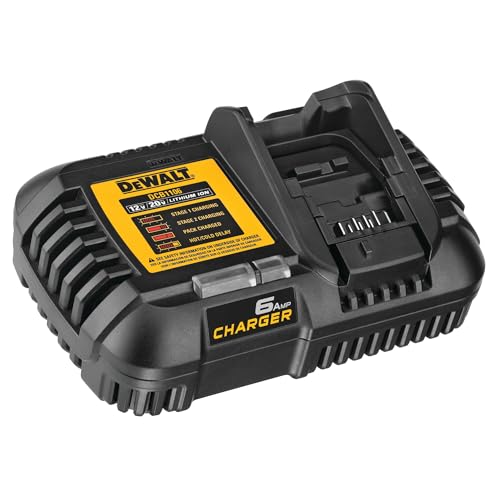
DEWALT DCB1106 6 Amp Charger — The highest stated current in this line-up
If the DCB1104 is the range’s centre, the DCB1106 is its strong arm. The title gives it the clearest speed credential of the six: a 6-amp charger spanning 12V MAX, 20V MAX and FLEXVOLT. That platform list is the broadest here alongside the multiport station, and the current rating is the highest number printed on any of these listings. For an owner with a mixed fleet and big packs, this is the single charger that asks the fewest compromises.
Six amps changes which batteries feel slow. Large-capacity 20V MAX packs and FLEXVOLT batteries are the ones that colonise a 4-amp bay for long stretches; raising the ceiling to six amps shortens that occupation meaningfully, and because the DCB1106 also accepts the little 12V packs, the same unit serves the whole shelf. It is the pick we would hand to a growing fleet: the one bought today still being correct after the first FLEXVOLT tool arrives.
Consider also what six amps does for battery temperament over a fleet’s life. Packs that return to service promptly get cycled evenly and predictably, while packs marooned for hours on a slow bay tempt owners into running them deeper and hotter in the tool to finish a task. A stronger charger quietly discourages that abuse by making the charged pack the easy choice. No listing title can promise longer battery life, and we will not invent that claim here, but workflow shapes treatment, and treatment is what batteries actually experience day after day.
It is not the rapid charger, though. The DCB118’s fan gives it a thermal argument the DCB1106’s title does not make, and in genuinely hot, back-to-back conditions the fan-cooled unit may hold its pace better. Nor is the DCB1106 a station: one pack at a time, however strong the current. Its case rests on breadth plus current, the highest stated amps across the widest platform list, in a conventional single charger format that drops onto any bench.
- Platforms (from title): FLEXVOLT batteries, plus the compact 12V line and the mainstream 20V line
- Rated charge current: 6 amps, the highest figure stated among these six listings
- Model code: DCB1106
- Cooling: the listing title makes no fan claim for this model, so do not assume active cooling when planning hot-environment use
- Port count: not stated in the listing title; check the manufacturer documentation for the bay layout
Strengths
- The broadest platform coverage here, 12V MAX through FLEXVOLT, in one charger.
- Six-amp current is the strongest stated rating in the group, aimed squarely at large packs.
- Future-proofing: it stays correct when a fleet adds its first 60V-capable tool.
Trade-offs
- No fan cooling is claimed, so sustained rapid work in heat favours the DCB118.
- A single charging position cannot match a multiport station for end-of-day waves.
- Owners with only small packs pay for current their batteries will never draw.
Best for: mixed fleets with large 20V MAX and FLEXVOLT packs that want one strong, general charger.
Not suited for: crews needing several packs charged at once, or hot-site rapid cycling where fan cooling is the priority.
The DCB1106 is the easiest single-charger recommendation for a growing fleet; weigh its Amazon price against the cost of buying a smaller charger now and replacing it when FLEXVOLT arrives.

DEWALT DCB1404 Multiport Charging Station — Four ports charging at the same time
The DCB1404 answers the end-of-day problem directly. Its title describes a fast charger and multiport simultaneous charging station, rated at 4 amps, covering 12V MAX, 20V MAX and FLEXVOLT 20V/60V MAX batteries. Simultaneous is the load-bearing word: four ports working together means the wave of flat packs that lands at knock-off time all start charging at once, instead of queueing through one or two bays while their owners wait or, worse, leave them flat overnight.
Four amps per the title is a sensible station rating. Multiport hardware trades peak single-pack speed for parallel throughput, and for a fleet that is the right trade: four packs each charging at a solid rate finish as a group sooner than a relay through a faster single bay. The platform spread matches the DCB1106’s breadth, so the station does not force a mixed fleet to keep a second charger for the FLEXVOLT packs or the little 12V batteries.
Stations change behaviour in a way single chargers never do. When every battery visibly belongs in one glowing row, people return packs without being chased, flat batteries stop hiding in tool bags, and the morning question of what is charged answers itself at a glance. Fleet managers call this accountability; home users just call it never starting a project with three flat packs again. That organisational value, more than any amp figure, is what the DCB1404 is really selling, and it is why stations anchor serious setups even when their per-pack pace is unremarkable.
Who needs it? Workshops with several staff, hire and maintenance departments, training centres, and serious home workshops where one person’s projects still rotate half a dozen packs. Who does not is equally clear: a solo DIYer will pay for ports that sit empty. Stations also concentrate risk, one fault idles four bays, so busy operations often pair this with a standard charger as backup, a pattern we recommend rather than apologise for.
- Platforms (from title): FLEXVOLT 20V/60V MAX batteries alongside the compact and mainstream lines
- Ports: multiport, simultaneous charging stated in the title
- Rated charge current: 4 amps
- Model code: DCB1404
- Exact port count: the title says multiport without printing a number, so confirm the physical port count in the manufacturer documentation before planning a fleet layout around it
Strengths
- Simultaneous multiport charging clears an end-of-day wave of flat packs in parallel.
- Full platform spread, 12V MAX to FLEXVOLT, means one station serves a mixed fleet.
- One cord and one home for every battery keeps gang boxes and benches orderly.
Trade-offs
- Per-pack pace is station-grade rather than rapid, so a single urgent pack is faster elsewhere.
- Capacity is wasted on small fleets whose packs rarely queue.
- A station fault idles several bays at once unless a spare charger is kept.
Best for: workshops, crews and departments returning several mixed-platform packs at the same time each day.
Not suited for: solo users with two or three packs, or anyone whose priority is one urgent battery refilled as fast as possible.
If your batteries arrive flat in groups, the DCB1404 is built for exactly that hour of the day; count your evening queue first, then price the DCB1404 multiport station on Amazon against the overtime that queue creates.

DEWALT ToughSystem 2.0 Dual Port Charger — Charging that lives inside the storage stack
The ToughSystem 2.0 dual port charger, model DWST08050, is the odd one out here, deliberately. Its title describes a 20V dual port charger in the ToughSystem 2.0 format, which means the product is as much a storage component as a charger. It is designed to sit within DeWalt’s modular rolling storage ecosystem, so the batteries charge inside the stack that already carries the tools, protected during transport and plugged in as one unit at the destination.
That integration solves a real annoyance: chargers are the items most often left behind, crushed in a van, or found with a cable wrapped around a saw. A charger that is part of the box system is simply always there, and dual ports mean the two packs a mobile worker cycles hardest can charge during the drive between jobs or over lunch from a site supply. For tradespeople already committed to ToughSystem cases, this is the only pick whose value compounds with kit they own.
There is a transport argument beyond convenience. Batteries riding loose in a van get their terminals knocked, their rails scuffed and their charge spent by accidental contact; batteries seated in a charger inside a latched case arrive as they left. For a mobile worker the DWST08050 therefore protects the packs while it fills them, a double duty none of the bench units here attempt. It also turns the stack itself into the charging station at a client’s property, one plug into their socket and the whole kit recovers while the work proceeds.
The corollary is that its value collapses outside that ecosystem. The title names 20V only, no 12V MAX and no FLEXVOLT, so fleet coverage is the narrowest of the six, and a buyer without ToughSystem storage is purchasing a format with nothing to dock into. Read this pick as a system decision: superb if your tools already roll in those cases, easy to skip if they live on shelves.
- Platforms (from title): 20V batteries
- Ports: dual port charging
- Format: ToughSystem 2.0 storage-integrated charger
- Model code: DWST08050
- Rated amps: the listing title does not print a charge current for this model, so verify output in the manufacturer documentation if turnaround speed drives the purchase
Strengths
- Lives inside the ToughSystem 2.0 stack, so the charger travels protected and is never left behind.
- Dual ports keep a mobile worker’s two hardest-working packs cycling between jobs.
- One plugged-in stack at the destination charges tools where they are stored.
Trade-offs
- Stated coverage is 20V only, the narrowest platform list of these six picks.
- The format’s value depends on owning ToughSystem 2.0 storage already.
- Bench users gain nothing from the storage integration they are paying for.
Best for: mobile tradespeople whose tools already live and travel in ToughSystem 2.0 cases.
Not suited for: bench-based workshops, or fleets needing 12V MAX and FLEXVOLT charging from the same unit.
Already rolling with ToughSystem cases? The DWST08050 turns dead transport time into charging time, and Amazon stocks it alongside the cases it docks with, so completing the stack takes one order.
How do the six DeWalt chargers stack up side by side?
| Charger | Platforms in title | Stated current | Ports / format | Defining trait |
|---|---|---|---|---|
| DCB1104 | 12V MAX, 20V MAX | 4 A | Standard charger | Everyday default |
| DCB118 | 20V MAX, FLEXVOLT | Not stated in title | Rapid, fan-cooled | Sustained fast charging |
| DCB102 | 12/20V MAX | Not stated in title | Dual station, 2 USB ports | Bench hub |
| DCB1106 | 12V MAX, 20V MAX, FLEXVOLT | 6 A | Standard charger | Highest stated current |
| DCB1404 | 12V MAX, 20V MAX, FLEXVOLT | 4 A | Multiport simultaneous station | Parallel throughput |
| DWST08050 | 20V | Not stated in title | Dual port, ToughSystem 2.0 | Storage integration |
What mistakes do buyers make when choosing a tool battery charger?
The most expensive mistake is buying for the fleet you had last year. A charger bought when every pack was 20V MAX becomes the bottleneck the day a FLEXVOLT tool joins the kit, and the replacement purchase erases the saving. Sketch where your fleet is heading, outdoor equipment and big saws usually pull FLEXVOLT in, and buy the platform coverage once.
Second, shoppers convert amps into minutes in their heads and then feel cheated. A 6-amp rating does not promise a fixed fill time, because pack capacity sets the workload. Compare chargers on current, cooling and ports, and compare your own routine against the queue you actually experience at the end of a day.
A related error is assuming the charger bundled with a kit is the charger the fleet deserves. Kit chargers are chosen to hit a bundle price, and they are frequently the slowest unit in the catalogue. Owners then judge the whole platform by that experience for years. If your tools arrived with a basic charger and charging feels like a chore, the platform is not slow; the bundle was. Upgrading the charger alone, to the DCB1106 or DCB118 here, is often the cheapest performance improvement available to an existing fleet, cheaper than one new battery and felt on every single charge.
Third, multiport buyers forget to check the word simultaneous. Ports that take turns are a different product from ports that work together, and the difference only appears when several flat packs land at once, which is precisely when it matters. Finally, batteries get stored on chargers in freezing garages and hot vans for months; chargers manage charge, not storage conditions, so bring packs into temperate space for long rests regardless of which of these six you buy.
How should you set up a charging corner that stays safe and sane?
Give the charger a fixed, ventilated spot off the floor, away from sawdust piles and solvent storage, with the cord run so nobody trips it out of the wall mid-charge. Fan-cooled units need their vents unobstructed, so do not bury the DCB118 under manuals or rags. Label packs with a marker as they age in pairs, rotate them evenly, and pull any pack that comes off a tool swollen, cracked or smelling sweet and chemical straight out of service. When a pack finishes, take it off the bay if it will sit for weeks; chargers are for charging, and temperate shelf storage is kinder to lithium cells than permanent residence on a live station.
How do you rotate packs so the whole fleet ages evenly?
Uneven ageing is the quiet fleet killer: two favourite packs do ninety percent of the work while the rest sit, and the favourites die young. Rotation fixes it with embarrassingly simple mechanics. Number every pack with a paint marker the day it arrives. Work them in numerical order, always taking the lowest-numbered charged pack and returning flat packs to the charger in the order they emptied. On a multiport station this becomes a left-to-right habit; on a single bay it becomes a queue on the bench, charged packs to the left, waiting packs to the right.
Pair discipline matters for the tools that draw two packs or punish one hard. Keep packs bought together working together, because a strong pack paired with a weak one in a demanding tool simply drags the weak one deeper. When a pack’s runtime falls noticeably behind its siblings, mark it clearly and retire it to light duties, lights and radios rather than saws, before it fails somewhere awkward. None of this needs an app or a spreadsheet; it needs a marker, a habit, and a charger setup with an obvious home, which loops back to why the station-format picks in this guide earn their bench space.
Finally, match rotation to seasons. Outdoor fleets surge in spring and idle in winter; before the idle months, run packs down to a comfortable middle charge rather than storing them brim-full or empty, keep them indoors, and give them a top-up cycle midway through the rest. The charger you chose will handle the electrical side faithfully, but the calendar side of battery care belongs to the owner, and five minutes of it twice a year is worth more than any single feature compared in the table above.
Final Recommendation
For most DeWalt owners the DCB1106 is the one-charger answer: the broadest platform list with the strongest stated current. Home fleets of 12V and 20V packs can save the difference with the DCB1104, benches gain a hub in the DCB102, hot and heavy work justifies the fan-cooled DCB118, group charging belongs to the DCB1404, and the ToughSystem charger rewards anyone already rolling that storage. A charger is a small purchase that decides whether your batteries feel abundant or scarce, and of these six, the right one is the one matched to the fleet you will own next year, not the one you owned last year. Buy the platform coverage first, the ports second and the speed third, and the charger you choose today will still be the correct one when the fleet around it has doubled.
Frequently Asked Questions
Is it worth replacing the charger that came in my tool kit?
Often, yes. Kit chargers are specified to complete a bundle at a price, and they are commonly the slowest chargers DeWalt sells, so owners blame the platform for a bundle decision. If charging regularly makes you plan around it, moving to the 6-amp DCB1106 or the fan-cooled DCB118 improves every charge you will ever make, and the kit charger retires usefully as a spare for the van or the garage.
Can a 20V MAX charger charge FLEXVOLT batteries?
Only when the charger’s stated platforms include FLEXVOLT. In this line-up the DCB118, DCB1106 and DCB1404 name FLEXVOLT in their titles, while the DCB1104, DCB102 and the ToughSystem charger do not, so treat those three as 12V/20V or 20V-only units and do not assume cross-coverage.
Does a higher amp rating always mean a faster full battery?
It raises the ceiling on charge current, which shortens charging most noticeably on large-capacity packs. Actual time still depends on the pack’s capacity, its temperature and how flat it started, which is why none of these listings can honestly promise one universal minute count.
Is fan cooling worth paying for?
If your charger works in hot vehicles, summer sites or back-to-back rapid cycles, yes: the DCB118’s fan helps it sustain rapid charging where a passive unit would slow itself down to manage heat. For cool indoor benches and overnight charging, the advantage rarely shows.
Should I buy a dual or multiport station for two batteries?
Two batteries that empty together suit a dual station like the DCB102 or the ToughSystem dual port unit. Multiport simultaneous charging, as on the DCB1404, pays off when three or more packs routinely come back flat at the same time; below that, ports sit idle.
Why does my charger feel slow with my biggest battery?
Because the workload grew, not because the charger weakened. A high-capacity pack simply holds more charge to replace, so the same current takes longer over it. If that wait disrupts work, the remedies in this guide are a higher-current charger such as the 6-amp DCB1106, a fan-cooled rapid unit, or more ports so the big pack stops blocking the queue.
Can I leave batteries on the charger all the time?
Modern chargers manage a full pack safely for ordinary intervals, but long-term storage is better off the bay, in a temperate room, partly rather than brim-full where the battery maker advises it. For seasonal tools, charge, use, and store the packs indoors instead of leaving them on a live station in an unheated garage.
Related Guides
Charging questions multiply once batteries leave the tool wall. Continue with Best Marine Deep-Cycle Battery Chargers for onboard boat systems, Best Scooter Battery Chargers for mobility and e-scooter packs, and Best Inverter Chargers for Van Life for combined inverter-chargers that refill a leisure battery from shore power.


