What's inside
- Key Takeaways
- Quick Picks
- How Did We Judge Storage That Has to Travel?
- What Are the Three Kinds of Desk Storage?
- How Much Storage Does a Working Desk Actually Need?
- How Do You Set Up a Storage Desk So the Storage Gets Used?
- Who Should Buy a Separate Pedestal Instead?
- Drawers, Cabinets and Shelves: Comparing the Storage Itself
- How Does Storage Change the Way a Desk Is Shared?
- What Mistakes Do People Make When Buying a Desk for Its Storage?
- How Long Does a Storage Desk Stay Organised?
- Final Recommendation
- Frequently Asked Questions
- Related Guides
As an Amazon Associate I earn from qualifying purchases. This post may contain affiliate links at no extra cost to you.
widgetverdict.com is reader-supported. When you buy through links on our site, we may earn an affiliate commission.
Where to buy: Amazon sells all six desks in this roundup, and each one answers the standing desk’s most persistent embarrassment: where the stuff goes. A height-adjustable desk with no storage is a slab that rises and falls over a floor of piles — the files in a crate, the stationery in a mug, the chargers in a nest beside the power strip. The best standing desks with storage build the answer into the furniture: drawers that rise with the top, a lockable file cabinet, open compartments, a keyboard tray, hooks and shelves, so the desk’s organisation survives the change of height that defines it. Check the listing for the current figure; what follows compares the storage itself as carefully as the lift.
That last phrase is the guide’s method. Storage on a moving desk is an engineering problem, not a furniture afterthought, because everything stored must travel: drawers add weight the motors must lift, cabinets must not foul the frame’s legs or the user’s knees, and a file drawer hung badly becomes a pendulum with paperwork in it. The six picks solve the problem at six different scales — from a compact 35-inch desk with dual drawers to a 71-inch L-shaped executive arrangement with a file cabinet — and the reviews judge each solution as a system: what it holds, where it hangs, what it costs the lift, and what it leaves for the buyer to solve separately.
One distinction runs through the whole roundup and is worth naming before the picks. Some of these desks integrate their storage into the desk itself — drawers built into the top’s structure, rising and falling as one object. Others arrive as a designed pairing: a desk plus a cabinet element that stands in its own footprint under or beside the top. Neither approach is automatically better. Integrated storage moves with you and never gets left at sitting height; cabinet storage holds more, locks better, and can outlive the desk. The reviews say which approach each pick takes, from its title, and judge it on that approach’s own terms.
Key Takeaways
- Storage here comes in three kinds: drawers integrated into the desk, cabinet elements paired with it, and open shelves, trays and hooks.
- The AODEMOKO is the security pick: a lockable file cabinet plus open compartments on a 71-inch executive desk.
- The SEDETA is the capacity pick: a 71-inch L-shape with drawers, a file cabinet and a CPU stand.
- Drawer counts run from the SHW’s single compartmented drawer to the YOLEZO’s dual drawers on a compact 35-inch desk.
- Extras divide the field further: built-in power outlets on three picks, a keyboard tray on the AODK, cable trays on two.
Quick Picks
| Pick | Badge | Why it earns its place |
|---|---|---|
| AODEMOKO 71in Standing Desk with Drawers | The lockable executive | A 71-inch electric desk with drawers, a lockable file cabinet, open compartments and a built-in power outlet. |
| HUANUO 48×24 Standing Desk with 2 Drawers | The compact two-drawer desk | A 48 x 24 electric desk with two drawers, four preset heights and two hooks, C-clamp mount compatible. |
| AODK 55in Standing Desk with Drawers | The fully accessorised desk | Drawers plus a keyboard tray, power outlet, LED lights, monitor stand and cable tray at 55 inches. |
| SHW 55×28 Standing Desk with Drawer | The compartmented drawer | A 55 x 28 desk whose single drawer has adjustable compartments, with memory presets, cable management and hooks. |
| SEDETA 71in L-Shaped Standing Desk with Drawers | The L-shaped command centre | A 71-inch L-shaped desk with drawers, a file cabinet, power outlets and a CPU stand. |
| YOLEZO 35×24 Standing Desk with Dual Drawers | The small-room storage desk | A compact 35 x 24 desk with dual drawers, a storage shelf and cable management, in light walnut. |
How Did We Judge Storage That Has to Travel?
By asking three questions of every pick, in order. What does it hold — not in the brochure’s poetry but in categories: files, devices, stationery, the charger’s colony, the personal clutter a working day generates? Where does it hang — integrated into the moving top, paired beneath it, or open to the room — and what does that position cost in knee room, lift load and access at standing height? And what does it leave unsolved — because every pick here leaves something, whether that is locking, depth for hanging files, or room for the printer, and a review that names the remainder is more useful than one that pretends the storage is total.
The titles were read as the specification of record, as throughout this batch of guides. Where a title states a feature — the AODEMOKO’s lockable cabinet, the AODK’s keyboard tray and cable tray, the SHW drawer’s adjustable compartments — the review builds on it. Where a title is silent — drawer dimensions, load capacities, height ranges on most of these desks — the spec boxes say so in this article’s own wording, because storage is the category where assumed dimensions go to die: a file drawer that does not take your file format is a deep tray with ambitions, and the only honest place for its measurements is the manufacturer’s documentation.
We also weighed the lift itself, because storage is bought with it. Every drawer and cabinet in this roundup rides on, or stands beside, an electric frame whose own specification the titles mostly leave unstated — memory presets are mentioned on three picks, which at least confirms the daily ritual is a button press rather than a hold-and-wait. Buyers for whom the desk is mostly a desk and the storage a bonus should keep that proportion in mind; buyers for whom storage is the point will find the extremes of this roundup — the lockable executive and the L-shaped command centre — are effectively office suites that also rise. Readers whose clutter problem is really a small-room problem should also meet the opposite philosophy in our Best Pneumatic Sit-Stand Desks guide, where the desks store nothing, weigh little and roll away entirely.
What Are the Three Kinds of Desk Storage?
Integrated drawers first: storage built into the desk’s own structure, travelling with the top through its whole range. Their virtue is access — the drawer you need at standing height is at standing height, and the sitting-to-standing transition never strands your notebook at ankle level the way a separate pedestal can. Their limits are depth and weight: a drawer hung under a moving top must be shallow enough to clear the user’s knees and light enough, loaded, for the motors to lift without complaint, so integrated drawers are stationery-and-device storage, not archives. Four picks here — HUANUO, AODK, SHW, YOLEZO — are built primarily on this kind.
Cabinet storage second: a file cabinet element designed with the desk, standing in its own footprint. The AODEMOKO’s lockable file cabinet and the SEDETA’s cabinet are the roundup’s examples. A cabinet holds what drawers cannot — hanging files, lever-arch folders, the lockable volume that paperwork with any sensitivity requires — and because it stands on the floor, its weight never taxes the lift at all. Its question is positional: it occupies the under-desk territory where knees and CPU towers also want to live, and the pairing only works when the desk’s width honestly budgets for all three tenants.
Open storage third: compartments, shelves, trays and hooks — the AODEMOKO’s open compartments, the YOLEZO’s storage shelf, the AODK’s monitor stand and cable tray, the hooks on the HUANUO and the SHW. Open storage is for the day’s active objects: the headphones on their hook, the current project in its compartment, the tablet on the shelf. It organises by visibility rather than by custody, and it is the kind that makes a desk feel equipped rather than merely furnished. Most real desks need two of the three kinds; the roundup’s best systems, judged below, are the ones whose titles show the maker knew which two.
How Much Storage Does a Working Desk Actually Need?
Audit the piles you already have, because they are the specification. The typical home-office accumulation divides into four honest piles: the daily handful (notebook, pens, phone, glasses — a single shallow drawer’s worth), the device colony (laptop docks, chargers, cables, the external drive — a drawer or a tray plus cable management), the paper archive (files, statements, the lever-arch generation — a cabinet’s worth, and only a cabinet’s), and the personal sediment (keys, wallet, the mug collection’s overflow — a hook and a compartment). A desk whose storage matches your two largest piles will feel miraculous; a desk that solves the smallest pile beautifully and ignores the archive will feel like a tease.
By that audit, the roundup sorts itself. The daily-handful worker is served by the SHW’s single compartmented drawer — adjustable compartments are exactly the daily handful, organised — or by the YOLEZO’s dual drawers in a small room. The device-colony worker belongs to the AODK, whose keyboard tray, cable tray and monitor stand attack the colony from three sides at once. The paper worker has only two honest addresses here: the AODEMOKO’s lockable cabinet for the executive archive, or the SEDETA’s L-shaped suite, where the cabinet, the drawers and the CPU stand divide the whole office between them.
And the honest remainder deserves its sentence: no desk in this roundup stores a printer’s paper habit, a library, or a family’s shared paperwork, and none claims to. Storage bought for the audit you ran will satisfy; storage bought for the office you imagine will be outgrown by February. Run the audit with the piles on the floor in front of you, not from memory — memory understates sediment by half, every time, and the sediment is what the drawers were for.
How Do You Set Up a Storage Desk So the Storage Gets Used?
Assign every compartment a tenant before the first working day, and write the assignment down if the desk is shared. Storage fails socially before it fails physically: the drawer that opens to miscellaneous becomes the drawer that is never opened, because nothing is ever findable in it. The working pattern is frequency zoning — the daily handful in the drawer nearest the dominant hand, the device colony in the tray and the second drawer, the archive in the cabinet, the sediment evicted to the hooks and the open compartment where it can be seen and periodically judged. The SHW’s adjustable compartments are a gift to this discipline: move the dividers to fit the tenants you actually have rather than the stationery of an imagined executive.
Mind the lift’s arithmetic as you load. Everything in an integrated drawer is cargo the motors raise dozens of times a week; keep the heavy tenants — the reference books, the full archive boxes — in the floor-standing cabinet or out of the desk entirely, and let the drawers carry the light, frequent things they were shaped for. Check the knee map too: sit and stand at the loaded desk and confirm the drawers clear your legs through the whole range, because a drawer that meets a knee at standing height will be emptied and abandoned within a month, and the desk will be blamed for a loading decision.
Cables are the setup’s final act, and two picks here bring their own answer — the AODK’s cable management tray and the YOLEZO’s cable management — while the power outlets built into the AODEMOKO, the AODK and the SEDETA shorten the colony’s supply lines to the length of the desk itself. Use them as designed: the strip lives in the tray, the desk’s own lead is the only one that travels to the wall, and the drawers stay drawers instead of becoming cable storage by default. A storage desk set up this way delivers the category’s actual promise — not merely a desk that rises, but a workstation whose organisation rises with it, intact, every time. Compact-room readers should note the pairing this suggests with our Best Small Treadmill Desks guide: a walking pad under a storage desk is a complete small office in two objects, provided the drawers clear the raised standing height the pad demands.
Who Should Buy a Separate Pedestal Instead?
Anyone whose archive is the point. A dedicated pedestal or filing cabinet, bought separately, out-stores every integrated solution in this roundup on depth, locking and file capacity, and it never taxes a motor or a knee. If your paper pile is the largest of the four in the audit, the honest architecture may be a plain standing desk plus serious separate storage — and our Best Industrial Desks guide covers the fixed slabs that pair with pedestals in the traditional way. The integrated desks here win when the storage must move with the worker, when the room cannot spare a pedestal’s footprint, or when the desk is shared between heights and users and its organisation must travel with its top.
Anyone furnishing a room that reconfigures should also pause. Drawers and cabinets anchor a desk to its spot in a way a bare slab never is; a training room or a multi-use space may be better served by mobile, storage-free furniture and a single lockable cabinet at the room’s edge. And anyone whose clutter is mostly digital — the paperless worker whose piles are cables and devices — should weight the trays, hooks and outlets of the AODK and the SHW over the cabinets of the AODEMOKO and the SEDETA, because buying file capacity for files you do not keep is the storage equivalent of a gym membership in January.
A word on the two finishes of thought a buyer brings to this category. Some shoppers arrive from the desk side: they know they want to stand, they have chosen their size and their lift, and storage is the tiebreaker among near-identical slabs. Others arrive from the storage side: their room has failed them — the piles, the custody problem, the archive in carrier bags — and the standing desk is simply the furniture the storage comes attached to. Both shoppers are served by this roundup, but they should read it in opposite directions. The desk-first shopper should start at the HUANUO and the SHW, where the lift’s daily manners lead and the storage is a well-judged bonus. The storage-first shopper should start at the AODEMOKO and the SEDETA, where the cabinets lead and the lift is the mechanism that keeps the archive at the worker’s height. Reading against your own direction is how a buyer ends up with a beautiful archive that stands badly, or a beautiful lift that stores nothing they own.

AODEMOKO 71in Standing Desk with Drawers — The lockable executive
The AODEMOKO is the roundup’s most complete office in one purchase: a 71-inch electric desk in black, with drawers, a lockable file cabinet, open storage compartments and a built-in power outlet. Read that specification as a system. The drawers take the daily handful; the open compartments take the active projects that need to be visible; the cabinet takes the archive — and locks it, which no other pick here claims to do; and the outlet means the whole arrangement plugs into the wall with a single lead while the devices charge from the desk itself. For an executive home office handling papers that matter, this is the only pick whose storage has a security policy.
The 71-inch span is what makes the system physically possible. A cabinet under a desk consumes the territory a knee or a tower might want, and at 71 inches there is territory enough for the cabinet, the seated worker and the frame to coexist without negotiation. The executive word in the title is, for once, descriptive: this is a desk for someone whose work includes documents with consequences — contracts, accounts, client files — and whose previous standing desk forced those documents into a separate, static cabinet across the room, at sitting height, while the worker stood.
The caveats are the system’s own weight and silence. The title does not state drawer dimensions, the frame’s capacity or the height range, so the file format question — whether your folders hang as the cabinet intends — and the lift’s figures belong to the manufacturer’s documentation before ordering. A desk this complete is also a commitment of floor: 71 inches of black executive furniture does not disappear into a small room’s corner, and it is not meant to. Buy it as the office’s headquarters and it is the roundup’s most finished object; buy it for a bedsit and it will be the room’s landlord.
- Top: 71 inches, black
- Storage: drawers, lockable file cabinet, open compartments
- Power: built-in power outlet
- Frame: electric height adjustable
- Drawer dimensions: the title omits them — the maker’s documentation is the authority
Strengths
- The only lockable storage here — an archive with a security policy.
- Three storage kinds in one system: drawers, cabinet, open compartments.
- Built-in outlet collapses the cable colony to a single wall lead.
Trade-offs
- Seventy-one inches of black furniture dominates smaller rooms.
- Drawer and cabinet dimensions are not stated in the title.
- Capacity and height range are likewise absent from it.
Best for: an executive home office whose paperwork needs to lock away at standing height.
Not suited for: a compact room where the desk must share its wall with the rest of life.
Check the AODEMOKO 71in desk on Amazon if your standing desk’s missing feature was a locked door for the files.

HUANUO 48×24 Standing Desk with 2 Drawers — The compact two-drawer desk
The HUANUO takes the opposite scale from the AODEMOKO and makes a tidy argument of it: 48 by 24 inches of electric desk in black, with two integrated drawers, four preset heights, two hooks, and compatibility with C-clamp mounts. Forty-eight inches is the classic one-person width — a monitor or a laptop with a notebook’s territory beside it — and the two drawers underneath are sized by that same philosophy: the daily handful and the device colony, organised, travelling with the top, in a desk that still fits the spare room’s honest dimensions.
Four preset heights is the roundup’s most generous stated count, and on a compact desk it earns its keep in shared use — two workers, two postures each, no hold-the-button negotiations at handover. The C-clamp compatibility is the detail that reveals the design’s thinking: monitor arms and accessories clamp to the top’s edge, which means the drawers and the frame were laid out to leave that edge usable, a small courtesy that desks with full-width drawer boxes often forget. The two hooks take the headphones and the bag — the sediment that otherwise colonises the top’s corners — off the surface entirely.
What the compact scale cannot do is archive. Two drawers of under-top depth are stationery-and-device volume; the paper worker’s files will still need their cabinet elsewhere, and the title’s silence on drawer dimensions means even the device colony should verify its largest tenant — a dock, a console controller — against the documentation. The title likewise leaves capacity and height range unstated. Within its scale, though, this is the roundup’s most completely considered small desk: storage, presets, mounts and hooks all present, none of them theatrical.
- Top: 48 x 24 inches, black
- Storage: two integrated drawers, two hooks
- Presets: four preset heights
- Mounts: C-clamp mount compatible, per the title
- Drawer dimensions: unpublished in the title; confirm them in the maker’s documentation
Strengths
- Two travelling drawers at the classic one-person width.
- Four presets suit a desk shared between two workers.
- C-clamp compatibility keeps the top’s edge free for arms.
Trade-offs
- No archive capacity — files need a home elsewhere.
- Drawer dimensions are not stated in the title.
- Forty-eight inches will not host a dual-monitor sprawl.
Best for: a single worker or a sharing pair in a spare room of honest size.
Not suited for: a paper-heavy practice whose archive is the storage problem itself.
See the HUANUO 48×24 desk on Amazon if two drawers and four presets describe your whole requirement list.

AODK 55in Standing Desk with Drawers — The fully accessorised desk
The AODK’s title is the longest shopping list in the roundup: 55 inches, drawers, a keyboard tray, a power outlet, LED lights, a monitor stand, a cable management tray, three memory heights, rustic brown. Read past the abundance to the system it describes and a coherent target emerges — the device-colony worker. The monitor stand raises the screen and reclaims the top beneath it; the keyboard tray gives the hands their own level and frees the surface; the cable tray swallows the colony’s wiring; the outlet powers it; the drawers hold its peripherals. Every accessory is aimed at the desk whose problem was never paper but equipment.
The keyboard tray deserves its own sentence, because it is the feature buyers either need or actively dislike, with little middle ground. For the typist whose wrists want the keyboard lower than the monitor’s shelf, the tray is the desk’s ergonomic centre; for everyone else it is a knee-space negotiation and a surface that collects the sediment the drawers were meant to hold. Decide which worker you are before ordering — the AODK’s whole architecture leans into the tray’s answer. The LED lights, meanwhile, are the one purely atmospheric item in the title: pleasant, harmless, and not a reason to buy or reject anything.
Rustic brown at 55 inches sits warmly in a home office, and three memory heights cover the sitting-standing-perch routine. The silences are the family’s: no drawer dimensions, no stated capacity, no height range in the title, all for the documentation. And an accessorised desk has an accessorised assembly — stands, trays and drawers are an afternoon of building, not an hour. For the equipment-heavy worker willing to build it once, this is the roundup’s most complete answer per inch of width.
- Top: 55 inches, rustic brown
- Storage: drawers, keyboard tray, monitor stand
- Cabling: cable management tray, power outlet
- Presets: three memory heights
- Extras: LED lights
Strengths
- The device colony is attacked from three sides: tray, stand, drawers.
- Cable tray plus built-in outlet ends the dangling-loom era.
- Three memory heights cover the full posture routine.
Trade-offs
- The keyboard tray is a love-it-or-hate-it commitment.
- The fullest assembly in the roundup — an afternoon’s build.
- Drawer dimensions and capacity go unstated in the title.
Best for: an equipment-heavy worker whose desk problem is devices, not documents.
Not suited for: a minimalist who wants a slab, two legs and silence from their furniture.
Look at the AODK 55in desk on Amazon if your drawers need a cable tray and a monitor stand for company.
SHW 55×28 Standing Desk with Drawer — The compartmented drawer
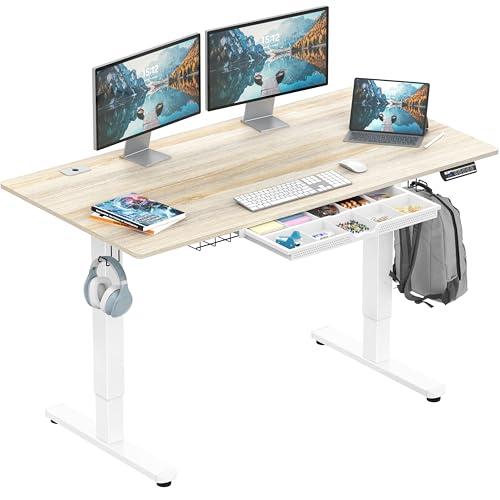
The SHW makes the roundup’s most restrained storage argument: one drawer, at 55 by 28 inches in maple, but a drawer with adjustable compartments — and restraint, properly aimed, beats abundance. The daily handful that most drawers swallow into a jumble is here given divided territory: pens in one compartment, cables in another, the glasses and the notebook each in theirs, the dividers movable as the tenants change. A single organised drawer that is opened fifty times a week serves a working day better than two cavernous ones opened in hope and closed in archaeology, and the SHW’s design understands the difference between storage volume and storage usefulness.
The rest of the desk supports the same philosophy of enough. Memory presets handle the height ritual; the cable management keeps the colony’s wiring out of the drawer’s jurisdiction; the hanging hooks take the headphones and the day’s bag. The 28-inch depth is the comfortable monitor distance, and the maple finish is the palette’s light, warm option — a desk that brightens a home office rather than fortifying it. At 55 inches it is the same width class as the AODK, aimed at a different worker: not the equipment colony but the tidy minimalist whose entire storage audit fits in one well-divided drawer.
The limits are the argument’s own edges. One drawer is one drawer: the archive, the device overflow and the second notebook all live elsewhere, and the buyer whose audit produced two large piles should not let this desk’s elegance talk them out of their own arithmetic. The title states neither the drawer’s dimensions nor the frame’s capacity and range. But for the worker whose piles are small and whose standards are high, the SHW is the roundup’s most civilised object — proof that the storage question can be answered with a single, well-made word.
- Top: 55 x 28 inches, maple
- Storage: one drawer with adjustable compartments, hanging hooks
- Controls: memory presets
- Cabling: cable management included, per the title
- Drawer dimensions: not a title figure — check the maker’s documentation before ordering
Strengths
- Adjustable compartments turn one drawer into an organised system.
- Hooks and cable management complete a tidy, restrained package.
- Maple finish brightens rather than fortifies a room.
Trade-offs
- One drawer’s volume is a hard limit the audit must respect.
- No file or archive capacity of any kind.
- Key dimensions and figures are absent from the title.
Best for: a tidy worker whose whole storage audit fits one divided drawer.
Not suited for: a two-pile household whose archive and overflow need volume, not elegance.
Check the SHW 55×28 desk on Amazon if your ideal drawer has compartments that move where your habits tell them.

SEDETA 71in L-Shaped Standing Desk with Drawers — The L-shaped command centre
The SEDETA is the roundup’s maximalist: a 71-inch L-shaped electric desk in black and brown, with drawers, a file cabinet, power outlets and a CPU stand. The L-shape is the system’s foundation. A straight desk gives its worker one front; an L gives two — the screen front, where the monitors and the keyboard live, and the side front, where the paperwork, the second laptop or the meeting with a visitor happens. For a worker whose day genuinely has two fronts, the L is not a luxury shape but the floor plan of the job, and 71 inches along its main run gives both fronts real territory.
The storage is distributed the way the shape suggests. The drawers serve the working front; the file cabinet takes the archive; and the CPU stand solves the tower problem by furniture rather than by floor — the machine lifted, aired and off the carpet, in its designed place instead of in the knee’s territory or on the top’s. The power outlets, plural in the title, shorten every supply line in the arrangement. Together the specification reads like a small office’s entire furniture order compressed into one product, which is exactly what it is for: the room that must contain a whole practice — screens, files, machine, paperwork, visitors — inside one footprint.
The commitments are proportional. An L-shaped desk chooses its corner and keeps it; the room must be measured in two directions, the delivery and assembly are the roundup’s largest undertaking, and the shape cannot be tried in a small room to see — it fits on paper or it does not fit at all. The title leaves drawer dimensions, capacity and height range to the documentation. Buyers with the corner, the two-front day and the archive to house will find nothing else here — or in most of the market — that answers all three at once; buyers without them are purchasing a monument to a job they do not have.
- Top: 71 inches, L-shaped, black and brown
- Storage: drawers and file cabinet
- Extras: power outlets, CPU stand
- Lift: electric height adjustment
- Drawer dimensions: absent from the title, so the maker’s documentation decides
Strengths
- Two working fronts — screens on one, paperwork and visitors on the other.
- Drawers, cabinet and CPU stand divide the whole office between them.
- Power outlets built in, plural, across a large arrangement.
Trade-offs
- An L-shape is a permanent corner commitment, measured in two directions.
- The largest assembly and delivery in the roundup.
- Key figures and dimensions live in the documentation instead.
Best for: a practitioner whose day has two fronts and a corner to hold them.
Not suited for: a small room that needs its desk to be rearrangeable furniture.
See the SEDETA L-shaped desk on Amazon if your office outgrew the straight desk some time ago.

YOLEZO 35×24 Standing Desk with Dual Drawers — The small-room storage desk
The YOLEZO is the roundup’s smallest desk and, inch for inch, its most storage-dense: 35 by 24 inches of electric desk in light walnut, with dual drawers, a storage shelf and cable management. Thirty-five inches is a laptop’s workstation and nothing more — and the design’s honesty is that it knows it, spending its ingenuity not on pretending to width but on giving the small desk the full storage system the big ones boast about. Two drawers for the handful and the colony, a shelf for the active layer, cable management for the wiring: the complete liturgy, at bedsit scale.
That scale has a real constituency. The box room, the flat’s corner, the spare bedroom that is also the guest room — these are the rooms standing desks are most often exiled from for want of a size that fits, and a 35-inch desk with real drawers is the difference between a workstation and a laptop on the ironing board. The light walnut finish helps the small room argument: pale furniture in a tight space reads as less mass, and a desk that must live in a bedroom should be fluent in not looming.
The limits are arithmetic, not quality. An external monitor crowds 35 inches into a negotiation; a second device evicts the notebook; and the dual drawers, at this footprint, are necessarily compact — their dimensions, like the frame’s capacity and range, are documentation figures, and the device colony’s largest tenants should be measured against them before ordering. Buy the YOLEZO for the room it fits and the system it completes at that size, and it is the roundup’s most efficient purchase; buy it hoping it will stretch, and no drawer count will save it.
- Top: 35 x 24 inches, light walnut
- Storage: dual drawers, storage shelf
- Cabling: cable management included, per the title
- Mechanism: electric, height adjustable
- Drawer dimensions: not spelled out in the listing title — check the manufacturer’s documentation for the confirmed figure
Strengths
- The full storage system — drawers, shelf, cable care — at 35 inches.
- Light walnut keeps a small room’s visual mass down.
- Dual drawers at a footprint most desks offer none.
Trade-offs
- Thirty-five inches is a laptop-only width in practice.
- Compact drawers need their dimensions checked against your devices.
- No archive capacity — the cabinet question remains open.
Best for: a box-room worker who refuses to choose between small and organised.
Not suited for: a dual-monitor setup whose width requirement is not negotiable.
View the YOLEZO 35×24 desk on Amazon if your room is small and your standards for drawers are not.
Drawers, Cabinets and Shelves: Comparing the Storage Itself
| Pick | Size | Storage system | Power and cable help | Defining trait |
|---|---|---|---|---|
| AODEMOKO 71in | 71 in | Drawers, lockable file cabinet, open compartments | Built-in outlet | The archive with a lock |
| HUANUO 48×24 | 48 x 24 in | Two drawers, two hooks | C-clamp mount compatible | Compact, four presets |
| AODK 55in | 55 in | Drawers, keyboard tray, monitor stand | Outlet and cable tray | The device-colony system |
| SHW 55×28 | 55 x 28 in | One drawer, adjustable compartments, hooks | Cable management | One drawer, perfectly divided |
| SEDETA 71in L | 71 in, L-shaped | Drawers, file cabinet, CPU stand | Power outlets | Two fronts, whole office |
| YOLEZO 35×24 | 35 x 24 in | Dual drawers, storage shelf | Cable management | The full system at bedsit scale |
The table’s lesson is that storage is not a quantity but a match. The two cabinet desks hold the archives; the two-drawer desks hold the working day; the SHW holds the handful, divided; the AODK holds the devices, wired. A buyer who reads the rows by their own audit’s largest pile will land on the right row in one pass — which is more than can be said for reading them by width, price or the length of the feature list.
One more comparison hides inside the table and deserves daylight: the outlets. Three of these desks build power into the furniture, and in a category sold on organisation that is not a garnish — the desk that powers its own colony from its own surface is the desk whose cables can actually be managed, because every lead’s journey shrinks to the top’s own geography. Buyers comparing two otherwise-equal picks should treat a built-in outlet as a storage feature wearing an electrical disguise, and weight it accordingly; the nest behind a desk without one is not a mystery, it is a measurement.
How Does Storage Change the Way a Desk Is Shared?
Profoundly, and mostly for the better. A bare standing desk shared between two workers is a neutral slab reset by each arrival; a storage desk holds a household’s worth of negotiated territories — whose drawer, whose hook, whose compartment — and the negotiation, done once, is what makes sharing work. The HUANUO’s four presets and two drawers read in this light as a two-person design whether or not it was intended as one: a height and a drawer each, the sediment separated by treaty, the top returned to neutral at every handover because everything has somewhere that is not the top to go.
The failure mode of shared storage is the commons drawer — the one unassigned volume into which both workers’ overflow drains, and from which nothing returns without a search. Households and small offices should assign every compartment on day one, label the archive’s sections if the cabinet is shared, and treat the hooks as named pegs rather than public land. It sounds like facilities management because it is, at household scale, and the desks in this roundup give a sharing pair more assignable territory than any bare desk can: the difference between a workstation two people timeshare and a workstation two people fight over is almost entirely drawers with names on them.
There is a privacy corollary the lockable pick makes explicit. Shared rooms leak paper: the contract on the desk is read by the room’s other life — the partner, the cleaner, the curious teenager — and a cabinet that locks converts the desk from a display of its owner’s work into a container for it. Even without a lock, drawers change the room’s information economy; a closed drawer is a boundary a bare top cannot draw. Workers whose home office is also a family room should count that boundary as a storage feature in its own right, because it is the one they will use every single evening.
What Mistakes Do People Make When Buying a Desk for Its Storage?
The first is counting drawers instead of auditing piles. Three drawers of the wrong depth lose to one drawer of the right compartments every working day of the year, and the audit in the buying section — four piles, honestly measured — takes ten minutes with the piles physically in front of you. Buyers who skip it buy storage for an imagined office and spend the year storing their real one on the floor beside the desk.
The second is forgetting that integrated storage is cargo. Every loaded drawer is weight the motors lift and knees must clear, at every height, forever. The failure mode arrives slowly: the drawer fills with books and archive boxes because it is there, the lift grows laboured, the knees meet the drawer box at standing height — and the desk gets blamed for a loading policy its owner wrote. Keep integrated drawers light and frequent; let cabinets and shelves take the weight.
The third is assuming dimensions. File formats, laptop docks and drawer depths are a geometry of millimetres, and the titles in this category mostly decline to state them. The buyer who needs a specific tenant housed — the hanging files, the full-size keyboard, the console — must take that tenant’s measurements to the manufacturer’s documentation before the order, because a drawer that almost fits is a tray with a front on it.
The fourth is buying the cabinet and forgetting the room. A file cabinet under a desk is a third tenant in the under-desk territory, alongside knees and legs and possibly a tower; at 71 inches the tenancy works, and at 48 it would not — which is why the cabinet picks here are the wide ones. Measure the under-desk map with all its tenants drawn in, at sitting and standing heights both, before falling for a specification.
How Long Does a Storage Desk Stay Organised?
As long as its zoning survives contact with deadlines, which is a question of design honesty rather than tidiness. Storage systems fail at their ambiguous volumes: the drawer with no assigned tenant becomes the drawer of last resort, and a drawer of last resort expands to fill every drawer it touches. The systems in this roundup that resist the entropy longest are the ones with the most specific shapes — the SHW’s movable compartments, the AODK’s tray that declares itself for keyboards, the cabinet that declares itself for files. Specificity is a fence. A buyer choosing between two desks should ask which one’s storage has more fences, because fences are what organisation is made of once the first month’s enthusiasm has been spent.
The monthly reset is the other half of the answer, and it is shorter than the guilt about it. Five minutes: every drawer opened, every tenant evicted that no longer matches the zone on the mental map, the sediment on the hooks judged and mostly discarded, the cable tray glanced at for the newcomer lead that someone plugged in “temporarily” in March. Storage desks reward this liturgy more than bare desks reward any equivalent, because their organisation is a stored asset — it depreciates visibly and restores completely, in minutes, on a schedule. The owners whose desks still look like the setup section of this guide in year two are not tidier people. They are people with a five-minute appointment and furniture whose fences made the appointment easy to keep.
And when the system finally does outgrow itself — the archive’s second cabinet, the device colony’s embassy on a side table — that is not the desk failing. It is the audit changing, as audits do when jobs change, and the desk’s integrated core remains what it was bought to be: the daily handful and the working layer, travelling with the top, while the growth lives in furniture that stands still. Buy the desk for the piles that move with your day, and let the rest of your storage be furniture. That division, kept honestly, is the whole secret this category has to tell.
Final Recommendation
Run your audit, then buy its answer. If the archive rules your piles and some of it must lock, the AODEMOKO is the roundup’s headquarters — drawers, compartments, a lockable cabinet and an outlet across 71 inches. If the whole office must fit one corner, the SEDETA’s L-shape is the maximal answer, with the cabinet, the drawers and the tower all housed. The device-heavy worker belongs to the AODK and its trays; the tidy minimalist to the SHW and its one divided drawer; the sharing pair in a spare room to the HUANUO’s two drawers and four presets; and the small room that refuses compromise to the YOLEZO, which packs the entire storage liturgy into 35 inches. What all six understand — and what a bare slab never will — is that a standing desk’s job is not finished when it rises: the work rises with it, the files, the devices and the day’s small sediment, and a desk that carries its organisation through the lift is a desk whose owner stops tidying and starts working, at whatever height the hour asks for. That is the whole purchase, stated once: not a desk with drawers, but a working day that stays organised while it moves.
Frequently Asked Questions
Do drawers on a standing desk rise with the top?
Integrated drawers do — they are built into the desk’s structure and travel through the whole height range, which is their chief virtue: nothing is stranded at sitting height. Cabinet elements that stand on the floor do not travel; they stay at floor level by design, which is why they can be deeper and lockable. Know which kind you are buying, because the two kinds serve different piles.
Can a desk drawer hold hanging files?
File drawers and cabinets can; ordinary under-top drawers generally cannot — they are stationery depth, not archive depth. In this roundup the file capacity lives in the AODEMOKO’s lockable file cabinet and the SEDETA’s file cabinet. Formats vary, so confirm the cabinet’s internal dimensions against your folders in the manufacturer’s documentation before ordering.
Does storage weight affect the lift?
Yes. Everything in an integrated drawer is cargo the motors raise, and heavy loading — books, archive boxes — makes the lift work harder and can crowd your knees at some heights. Keep integrated drawers for light, frequent items and put the weight in a floor-standing cabinet or outside the desk. The frames’ stated capacities, where titles give them, include the top and everything on and under it.
Is one deep drawer or two shallow ones better?
For the daily handful, organisation beats volume: a single drawer with adjustable compartments — the SHW’s design — keeps small things findable, which is what a drawer opened fifty times a week is for. Two drawers earn their keep when the piles genuinely separate, devices in one and paper in the other. Audit your own piles; the answer is in them, not in the drawer count.
What if I need more storage later?
Add a separate pedestal or cabinet beside the desk rather than overloading the integrated storage — floor-standing pieces do not tax the lift and can be deeper than any under-top drawer. Keep the desk’s own storage zoned for the daily work and let the separate piece take the archive’s growth. The desk and the pedestal do not need to match in anything but approximate colour to look intentional.
Are built-in power outlets worth having?
For device-heavy desks, yes: an outlet on the desk shortens every charging lead to the desk’s own length and leaves a single cable travelling to the wall, which is the difference between a managed colony and a nest. Three picks here build outlets in. They do not replace a proper cable plan — a tray for the strip and the loom — but they make the plan dramatically easier to keep.
Related Guides
Storage is one answer to the desk problem; the guides below cover the desks that answer it differently — by rolling away entirely, by carrying a walking worker through the day, and by being a fixed slab that a separate pedestal can serve. A complete room often mixes two of these philosophies, and knowing all three is how the mixture gets chosen rather than accumulated.
Keep reading: Best Pneumatic Sit-Stand Desks · Best Small Treadmill Desks · Best Industrial Desks


