What's inside
- Key Takeaways
- Quick Picks
- How Did We Choose These Six Power Banks?
- What Does 10,000mAh Actually Deliver on a Real Trip?
- Which Pack Fits the Way You Actually Travel?
- The Six Packs in Detail
- How Do These Six Power Banks Differ When the Trip Gets Long?
- What Mistakes Do Power Bank Buyers Keep Making?
- Final Recommendation
- How Do You Pack and Use a Power Bank Well on the Road?
- What Should You Check Before Trusting a Pack With a Long Day?
- How Long Will a Pack Like These Stay Useful?
- Which Charging Style Suits a Commuter, and Which Suits a Camper?
- How Do You Read a Power Bank Listing Without Being Fooled?
- What About Charging Two Phones From One Pack on a Family Day Out?
- Does a Power Bank Belong in a Work Bag Every Day?
- Frequently Asked Questions
- Related Guides
As an Amazon Associate I earn from qualifying purchases. This post may contain affiliate links at no extra cost to you.
widgetverdict.com is reader-supported. When you buy through links on our site, we may earn an affiliate commission.
Where to buy: each power bank below is sold through Amazon, and the product names in the Quick Picks table and in the detailed sections carry the purchase links, so you can move from a shortlist straight to the listing that matches your phone and your travel habits. Start with the table if you already know whether you want a cable-free magnetic pack or a plain wired brick, and read the full sections when the difference between two similar Anker models is not obvious from the names alone.
Finding the best portable chargers cell phone 10000 mah plus buyers can actually rely on means looking past the capacity printed on the box. Ten thousand milliamp-hours is the floor of this category, not the finish line, because two packs with identical ratings can behave very differently once a cable, a warm train carriage and a phone that throttles its own charging enter the picture. This guide works through six packs that all clear that capacity floor, then explains what separates a travel essential from a drawer ornament: output wattage, whether the cable you need is built in or left at home, how the pack itself refills, and whether it snaps magnetically to the back of your phone or simply sits in a bag doing quiet wired work.
The six picks divide into three families. The Anker entries cover the straightforward wired traveller, the magnetic Qi2 snap-on style and a three-in-one design that folds a wall plug into the body. The charmast leans hard into built-in cables, offering four of them plus a spread of outputs and inputs for households where nobody can ever find the right lead. Belkin brings an integrated USB-C cable and a second port for charging two devices together, while the Miady two-pack treats the problem as a numbers game, giving you a black pack and a white pack so one can live in a backpack and the other by the front door.
Key Takeaways
- Every pick here holds at least 10,000mAh, so the real decision is output style: wired speed, magnetic snap-on convenience, or built-in cables that cannot be forgotten.
- The Anker Nano 3-in-1 refills itself from a wall socket through its foldable plug, which removes the separate charger brick from your packing list entirely.
- Qi2 magnetic charging on the Anker MagGo runs at 15W according to its listing title, and it only makes sense if your phone supports magnetic alignment.
- The charmast carries four reinforced built-in cables with six outputs and three inputs, the widest connection spread in this group.
- Miady sells its slim pack as a two-pack rated 37Wh and described as flight-safe, which suits travellers who split gear between bags.
- A power bank’s own recharge method matters as much as its output; a pack that is empty on departure day helps nobody.
Quick Picks
| Pick | Badge | Why it earns its place |
|---|---|---|
| Anker Power Bank 10,000mAh 30W (USB-C) | Best straightforward wired pick | Thirty watts through USB-C input and output covers fast phone top-ups without magnetic hardware or folding tricks. |
| Anker MagGo Power Bank Qi2 10000mAh | Best magnetic snap-on | Qi2-certified 15W magnetic charging in a slim body shaped for iPhone users who hate carrying a cable. |
| Anker Nano 3-in-1 Portable Charger 10,000mAh | Best for light packing | A built-in USB-C cable plus a foldable wall plug means the pack, the lead and the charger are one object. |
| charmast Power Bank 10,000mAh (Built-In Cables) | Best for mixed-device households | Four reinforced built-in cables, six outputs and three inputs handle a table full of different phones at once. |
| Belkin 10000mAh 20W USB C Power Bank, Portable Charger for | Best two-device wired option | An integrated USB-C cable plus an extra USB-C port lets it feed a phone and a second device together at 20W class output. |
| Miady 2-Pack Portable Charger, Slim 10000mAh Power Bank Travel | Best value in pairs | Two slim 37Wh packs, one black and one white, each with three outputs and two inputs for backpack and camping duty. |
How Did We Choose These Six Power Banks?
The first filter was the capacity floor in the keyword itself: nothing under 10,000mAh was considered, because smaller packs turn into single-charge accessories that leave a modern phone short during a delayed flight or a long festival day. Beyond that floor, we looked for variety of approach rather than six near-identical bricks. A traveller crossing an airport with a USB-C phone, a partner carrying an older handset and a child with a tablet needs something different from a commuter who only ever rescues one iPhone on the train home, and the shortlist reflects that spread deliberately.
Output claims were taken only from the listing titles supplied for this guide, and where a title stays silent about a figure, the spec boxes below say so instead of borrowing numbers from a sibling model. That discipline matters in this category because brands sell several packs that look alike while differing in wattage, and a 30W pack and a 20W pack behave noticeably differently when a phone is at four percent before a boarding call. We also weighed how each pack refills itself, since input speed decides whether an overnight charge is a certainty or a gamble, and we favoured designs that reduce the number of separate objects a traveller must remember: built-in cables, folding plugs and magnetic attachment all scored well on that count.
Finally, we checked that every linked pick is a current, clean listing rather than a refurbished unit, and we kept the group to six so that each one could be discussed properly instead of name-checked. If your needs sit outside these six shapes entirely — say you want a laptop-class brick far above this capacity — the guides linked at the end of this article cover larger packs and solar options, including Best 40000mAh Portable Chargers for readers whose trips run longer than a weekend.
What Does 10,000mAh Actually Deliver on a Real Trip?
Capacity ratings describe the cells inside the pack, not the energy that lands in your phone. Conversion losses in the cable, heat in the pack’s circuitry and the phone’s own charging management all take a share, so a 10,000mAh pack should be thought of as roughly one generous full charge for a large modern phone, or a charge and a half for a smaller handset, rather than the two or three full charges the raw arithmetic suggests. Planning around that honest expectation is the difference between a pack that feels dependable and one that feels like it lied to you at the airport.
Wattage shapes the experience just as much. A 30W USB-C output can push a compatible phone through its fastest charging window, which is the early part of the charge where the battery accepts power most eagerly; that is why a twenty-minute top-up from a strong pack can add a genuinely useful chunk of battery before a flight. A 15W magnetic pad trades some of that pace for the pleasure of snapping the pack onto the phone and using both as one slab in a coat pocket. Neither approach is wrong, but they suit different temperaments: the wired sprinter and the magnetic minimalist rarely envy each other’s gear.
Heat is the quiet third factor. Packs warm up during fast output, phones warm up receiving it, and a pack sealed inside a sun-baked car or a stuffed backpack pocket will protect itself by slowing down. Leaving a little airflow around a charging phone, and avoiding charging under a pillow in a hotel bed, keeps speeds closer to the headline behaviour. None of the titles in this guide publish thermal figures, so treat any brand’s laboratory pace as a best case rather than a promise for a July layover.
Which Pack Fits the Way You Actually Travel?
Start with the cable question, because it decides more purchases than wattage does. If you already carry a good USB-C lead for a laptop or tablet, a plain pack like the first Anker costs you nothing extra in bag clutter. If your cables live in a kitchen drawer and vanish when needed, a built-in design from charmast, Belkin or the Nano removes the hunt entirely. Then ask how the pack refills: a folding wall plug turns any hotel socket into a refill station without a separate brick, while USB-C input packs depend on whatever charger you packed for the phone itself.
Household shape matters too. Solo travellers can optimise for thinness and speed, but families charging a rotation of phones, earbuds cases and a handheld console will value the charmast’s six outputs or the simple doubling of the Miady pair. Magnetic buyers should confirm their phone or case supports magnetic alignment before choosing the MagGo; a magnetic pack used with a non-magnetic phone becomes an awkward pad that slides around in a bag. Readers comparing wider categories may also want Best Portable Chargers And Power Banks For Phones, which steps back from this capacity class and surveys the broader field.
The Six Packs in Detail

Anker Power Bank 10,000mAh 30W (USB-C) — Best straightforward wired pick
This is the pack for someone who finds the whole category faintly overcomplicated and wants one honest brick that charges quickly and refills quickly. Its listing title states 30W with USB-C input and output, and that symmetry is the point: the same port family that feeds your phone also feeds the pack, so a single decent USB-C cable and the charger you already own complete the kit. Anker names iPhone 17 and 16 models and Galaxy handsets in the title, which reflects the USB-C-everywhere reality of current phones rather than any exclusivity.
In daily use the appeal is pace without ceremony. Thirty watts is enough to drive the fast early phase of a modern phone’s charge, the window where a short café stop can rescue an evening. Because there is no magnetic hardware, the body stays a simple slab that slides into a jacket pocket or the side sleeve of a laptop bag, and because there is no built-in cable, there is also no short tether dictating how the phone must rest while it charges; your own cable length sets the geometry. The trade is obvious: forget the cable and the pack is a paperweight until you find one, which is why this pick suits organised carriers rather than hopeful ones.
Refill behaviour deserves a word, because USB-C input at this class means the pack itself can recover quickly between outings instead of demanding an entire night as penance for one drained evening. Commuters who empty it on a Friday can plausibly restore it over breakfast on Saturday. Nothing in the title promises wireless output, pass-through tricks or a display, and that plainness is honestly the charm: every design dollar went into the single job of moving power through a port quickly, in both directions.
- Capacity: 10,000mAh, printed in the listing title
- Output: 30W via USB-C, per the title
- Input: USB-C, per the title
- Colour named in title: Black
- Wireless charging: the listing title does not mention it, so confirm on the product page if that matters to you
Strengths
- Thirty-watt USB-C output gives modern phones a properly brisk top-up from a pocketable body.
- USB-C input means the pack refills through the same cable ecosystem as the phone it serves.
- No fragile moving parts, folding prongs or tethered leads to fray, snag or snap.
Trade-offs
- Everything depends on a cable you supply yourself, every single time.
- Phone rests wherever the cable reaches rather than snapping into a fixed magnetic position.
- Travellers with several older devices may miss extra ports for simultaneous charging.
Best for: a commuter carrying a USB-C phone and an existing cable habit, wanting the fastest simple top-up in this group.
Not suited for: travellers who routinely lose cables and need the lead physically attached to the pack.

Anker MagGo Power Bank Qi2 10000mAh — Best magnetic snap-on
The MagGo answers a different frustration: the dangling cable. Its title calls it Qi2-certified at 15W and MagSafe-compatible, shaped slim with an ergonomic design for the iPhone 17, 16, 15 and 14 series. Snapped onto the back of a compatible phone, pack and handset become a single thicker phone that still fits a hand and most pockets, and you can keep scrolling, shooting photos or following a map while the battery climbs — behaviour a cabled pack makes clumsy.
Fifteen watts will not match the wired sprint of the 30W Anker above, and pretending otherwise would mislead. What it buys instead is frictionless habit: the pack lives on the phone during a museum day or a conference, topping up continuously in small sips rather than rescuing dramatically at the end. Qi2 certification in the title signals the magnetic alignment standard that keeps the coils centred, which is what separates a dependable snap-on pack from the older magnetic pads that drifted, warmed up and charged at a crawl.
The slim wording in the title matters for this style, because a magnetic pack is worn rather than carried; every extra millimetre is felt in the hand all day. The ergonomic shaping Anker mentions is aimed at that all-day grip. Buyers with Android handsets should read the title’s iPhone focus carefully: magnetic alignment depends on the phone or case providing the ring, and without it this becomes the wrong tool. For the Apple-centric traveller, though, this is the pack most likely to be used daily instead of saved for emergencies, and a pack that gets used beats a faster pack left at home.
- Capacity: 10,000mAh, printed in the listing title
- Magnetic output: Qi2-certified 15W, per the title
- Compatibility named in title: iPhone 17/16/15/14 series and more
- Colour named in title: Black
- Wired output figures: the listing title does not state them, so check the product page before relying on a port speed
Strengths
- Magnetic attachment removes the cable from the walking-around charging experience entirely.
- Qi2 certification in the title promises proper coil alignment rather than hopeful magnetism.
- Slim, ergonomically shaped body suits all-day carry on the back of the phone.
Trade-offs
- Fifteen-watt magnetic pace trails the wired 30W picks when minutes genuinely matter.
- Value collapses without a magnetic phone or magnetic case to align with.
- Thick non-magnetic cases between phone and pack will undermine the snap.
Best for: an iPhone owner with a magnetic case who charges in small sips throughout long days out.
Not suited for: Android users without magnetic alignment hardware, who would pay for a snap that never snaps.
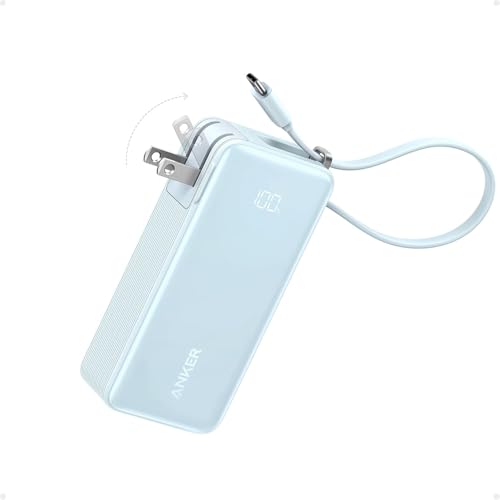
Anker Nano 3-in-1 Portable Charger 10,000mAh — Best for light packing
The Nano’s trick is subtraction. Its title lists three functions in one body: a 10,000mAh pack at 30W, a built-in USB-C cable, and a foldable wall plug. That combination deletes two separate objects from a travel kit — the loose cable and the wall charger for the pack itself — because the Nano plugs straight into a socket to refill, then unplugs and becomes the battery, with its own tethered lead ready for the phone. For a one-bag traveller counting grams and objects, that consolidation is the entire argument, and it is a strong one.
Thirty watts keeps it honest as a charger rather than a novelty: the title’s output figure matches the plain Anker brick in this guide, so choosing the Nano does not mean accepting a slower phone charge in exchange for the folding plug. The built-in cable also guarantees the lead is always the right one for the pack’s own port family, ending the particular misery of carrying a pack and a Lightning-era cable that fits nothing you own anymore. Anker names the iPhone 17, 16 and 15 series in the title, reflecting the USB-C tether.
Built-in cables do impose a fixed reach, so the phone will live close to the pack while charging; on a train table that is fine, while charging from a bag on the floor takes more thought. The folding prongs are also a part that will be flexed thousands of times, so treat them with the same respect you would give any hinge. The blue finish named in the title at least makes the little unit easy to spot in a dark bag. Judged as a system rather than a battery, the Nano is the most thoughtfully reduced object in this line-up.
- Capacity: 10,000mAh, printed in the listing title
- Output: 30W, per the title
- Built-in features named in title: USB-C cable and foldable wall plug
- Compatibility named in title: iPhone 17 / 16 / 15 series
- Colour named in title: Blue
Strengths
- Foldable wall plug lets the pack refill from any socket without a separate charger.
- Built-in USB-C cable removes the most commonly forgotten item in portable charging.
- Full 30W output means the consolidation costs nothing in charging pace.
Trade-offs
- The tethered cable’s fixed length dictates how phone and pack sit together.
- Folding prongs are a moving part that rewards gentle handling over years.
- One built-in lead means multi-device households still need other solutions.
Best for: a minimalist traveller who wants the pack, its cable and its wall charger to be a single blue object.
Not suited for: someone charging across a room from the socket, where a short built-in lead cannot reach.

charmast Power Bank 10,000mAh (Built-In Cables) — Best for mixed-device households
Where the Anker designs each perfect one connection, the charmast refuses to choose. Its title promises reinforced built-in cables — four of them — alongside six outputs and three inputs, with 3A fast charging and a carry-on-only travel framing for iPhone, Samsung and Pixel handsets. That spread is aimed squarely at the kitchen-table reality of mixed households, where a parent with a Pixel, a teenager with an iPhone and a grandparent with an older Samsung all descend on the same pack during a power cut or a long drive.
Reinforced is the load-bearing word in that title, because built-in cables live hard lives: they are pulled from their slots, bent around phone corners and stuffed back daily. Reinforcement at the strain points is what separates a cable that survives a school year from one that frays by half-term. Four cables also means the pack can serve several connector generations without adapters, and the three input options make refilling flexible when the only free charger in a holiday rental is an unfamiliar one.
Six outputs does not mean six phones at full speed simultaneously — the title gives a 3A fast-charging figure rather than per-port wattages, and honest expectations matter: this pack is a sharing hub, spreading its 10,000mAh across a family rather than sprinting one phone. The carry-on-only note in the title is worth respecting too; power banks belong in cabin baggage, never in a checked suitcase. For a home that currently owns one charger and four opinions, the charmast’s breadth is worth more than any single-port speed crown.
- Capacity: 10000mAh, given in the listing title
- Built-in cables: four, reinforced, per the title
- Connections: six outputs and three inputs, per the title
- Charging figure in title: 3A fast charging
- Travel note in title: carry-on only
Strengths
- Four reinforced built-in cables cover a household’s mixed connector generations without adapters.
- Six outputs let several devices sip from the pack during an outage or long drive.
- Three input choices make refilling easy with whatever charger a rental home offers.
Trade-offs
- Shared output means individual phones charge gently rather than at flagship pace.
- Four tethered cables make the body busier to pack than a clean slab.
- A damaged built-in cable cannot simply be swapped like a loose lead.
Best for: a family with iPhone, Samsung and Pixel handsets sharing one pack on trips and during outages.
Not suited for: a solo traveller chasing the fastest possible single-phone charge from a minimalist kit.

Belkin 10000mAh 20W USB C Power Bank, Portable Charger for — Best two-device wired option
Belkin’s entry splits the difference between the cable-free dream and the cable-required reality. The title describes a 10000mAh pack at 20W with an integrated USB-C cable and an extra USB-C port, built to charge two devices, naming iPhone and iPad in its framing alongside the iPhone 17 and Samsung Galaxy S26. The integrated lead handles the main phone without a packing decision, while the spare port accepts a second cable for a partner’s phone, a tablet or a friend’s handset at the gate.
Twenty watts sits a step below the 30W Anker models in this guide, and the honest reading is that Belkin spent its design budget on the integrated cable and dual-device layout rather than on the highest output figure. For the way most people actually use a travel pack — phone on the tether, earbuds or a second phone on the port, both recovering over a lunch stop — that balance is sensible. A tablet named in the title also hints at the second-device role: an iPad sipping alongside a phone is exactly the two-device picture this pack paints.
The integrated cable carries the usual built-in caveat about fixed reach, balanced here by the freedom of the second port, which takes any cable length you own. Belkin’s long history in phone accessories also shows in the framing of the listing, which reads like a product designed around airport behaviour rather than laboratory numbers. If your travel pattern is two devices and one bag, this is the most balanced wired option in the six, trading a slice of peak wattage for a layout that matches real journeys.
- Capacity: 10000mAh, given in the listing title
- Output: 20W, per the title
- Connections named in title: integrated USB-C cable plus an extra USB-C port
- Devices named in title: iPhone and iPad, including iPhone 17 and Samsung Galaxy S26
- Simultaneous charging: two devices, per the title
Strengths
- Integrated cable covers the primary phone with zero packing decisions.
- Extra USB-C port welcomes a second device on any cable you already own.
- Two-device layout matches couples and phone-plus-tablet travel patterns well.
Trade-offs
- Twenty-watt ceiling trails the 30W picks for a single urgent top-up.
- The tethered lead’s reach is fixed, as with every built-in design here.
- Output shared between two devices will slow both compared with solo charging.
Best for: a traveller routinely reviving a phone and a tablet together from one bag pocket.
Not suited for: a speed-focused user who charges one phone at a time and wants maximum wattage.

Miady 2-Pack Portable Charger, Slim 10000mAh Power Bank Travel — Best value in pairs
Miady’s answer to the capacity question is simply: have two. The listing sells a two-pack of slim 10000mAh packs, one black and one white, each with three outputs and two inputs, a 37Wh rating described as flight-safe, aimed at backpack travel and camping and compatible with iPhone and Android handsets. The colour split is a small, smart touch: in a household or a couple, whose pack is whose stops being an argument, and in a single traveller’s kit the white one can live in the day bag while the black one stays in the luggage.
The slim framing matters because a pack that is genuinely thin gets carried, and a carried pack is the only kind that helps. Three outputs per unit is generous for this style, letting a phone share with earbuds or a headlamp battery at a campsite, and dual inputs mean refilling is not hostage to one cable type when you are borrowing chargers on the road. The title’s flight-safe wording and the 37Wh figure speak directly to air travellers, who need packs that sit comfortably within cabin-baggage practice.
What the title does not publish is a headline wattage, so this guide will not invent one; expect honest, ordinary charging rather than a flagship sprint, and read the product page if pace is your deciding factor. Judged on its own terms — coverage, redundancy and price-conscious doubling — the Miady pair solves the most common power-bank failure of all, which is the pack being in the other bag, the other car or the other person’s pocket when the phone fades. Two adequate packs in the right places beat one excellent pack in the wrong place, and that is the whole case for this pick.
- Capacity: 10000mAh per pack, two packs included, per the title
- Energy figure in title: 37Wh, described as flight-safe
- Connections per pack: three outputs and two inputs, per the title
- Colours named in title: black and white
- Output wattage: the listing title does not publish a figure, so verify on the product page if pace decides your purchase
Strengths
- Two packs end the wrong-bag problem by covering two bags, cars or people.
- Slim bodies suit daily carry in a backpack or jacket without a brick-like bulge.
- Three outputs per pack handle phone plus small accessories at a campsite.
Trade-offs
- No wattage figure appears in the title, so fast-charge expectations need checking.
- Two packs mean two refilling routines to remember before a trip.
- Plain styling and feature set will not excite magnetic or folding-plug fans.
Best for: a couple or family splitting packs between bags, cars and people by colour.
Not suited for: a buyer wanting one premium pack with published fast-charge figures and magnetic snap.
How Do These Six Power Banks Differ When the Trip Gets Long?
| Pack | Connection style | Headline figure from title | Signature trait |
|---|---|---|---|
| Anker Power Bank 10,000mAh 30W (USB-C) | Wired, bring your own cable | 30W USB-C in and out | Simplest fast brick |
| Anker MagGo Power Bank Qi2 10000mAh | Magnetic snap-on | Qi2-certified 15W | Lives on the phone’s back |
| Anker Nano 3-in-1 Portable Charger 10,000mAh | Built-in cable | 30W | Foldable wall plug refills it |
| charmast Power Bank 10,000mAh (Built-In Cables) | Four built-in cables | Six outputs, three inputs, 3A | Household sharing hub |
| Belkin 10000mAh 20W USB C Power Bank | Integrated cable plus port | 20W, two devices | Phone-plus-tablet balance |
| Miady 2-Pack Portable Charger | Wired, three outputs each | 37Wh per pack | Two slim packs, two colours |
Read the table by failure mode rather than by brand. The pack that fails you through a forgotten cable is solved by charmast, Belkin or the Nano. The pack that fails you by being somewhere else is solved by Miady’s doubling. The pack that fails you by slowness is solved by the 30W wired Anker, while the pack that fails you by annoyance — the dangling lead on a walking tour — is solved by the MagGo’s magnetic patience. Long trips expose exactly one of these weaknesses per traveller, and naming yours honestly is the fastest route through this comparison. Outdoor travellers whose routes leave sockets behind entirely should also read Best Camping Solar Panel Phone Chargers, where the refill source is the sun rather than a wall.
What Mistakes Do Power Bank Buyers Keep Making?
The first mistake is reading 10,000mAh as two full phone charges. Conversion losses shrink the delivered energy, so plan on one generous charge and treat anything beyond that as a bonus; travellers who plan on the honest figure are never stranded by arithmetic. The second mistake is buying magnetic hardware for a non-magnetic phone or a thick, plain case, then blaming the pack for a weak snap that was never physically possible. The third is forgetting the refill half of the equation: a pack that takes all night to recover will eventually be caught empty, which is why input method and input speed deserve the same scrutiny as output.
Fourth, people pack power banks in checked luggage, against the carry-on practice the charmast title itself flags; keep every pack in the cabin, both for the rules and because a pack you cannot reach cannot help you. Fifth, buyers chase the largest output number while ignoring the cable they will actually use — an elderly, frayed lead can throttle a fine pack into mediocrity. Finally, households buy one premium pack when their real problem is distribution; the Miady pair exists because location, not quality, was the failure.
Final Recommendation
Choose by the object you want to carry. The plain 30W Anker is the confident default for organised USB-C travellers, the MagGo is the daily companion for magnetic iPhone owners, and the Nano is the one-bag traveller’s consolidation trick, folding cable and wall plug into the battery itself. The charmast serves the mixed-device household, the Belkin balances a phone and a tablet on one tether plus a port, and the Miady pair wins wherever being in the right bag matters more than any specification. Whichever shape you pick, refill it the night before, keep it in the cabin bag, and let the capacity floor do its quiet work. A dead phone at a departure gate is a small tragedy with a known cure, and every pack above administers it in its own dialect.
How Do You Pack and Use a Power Bank Well on the Road?
Start the night before departure with a boring ritual that saves trips: charge the pack to full, charge the phone to full, and put the pack in the bag you will actually carry onto the plane or train, not the bag you hope to carry. Then check the cable situation with fresh eyes. Wired-pack owners should coil one known-good USB-C lead beside the pack; built-in-cable owners should confirm each tether still seats cleanly in its slot, because a cable that will not stow properly gets crushed in transit and bent at exactly the strain point that matters.
During the journey, charge in the fast window first. Phones accept power most eagerly at low battery, so plugging in at twenty percent during a coffee stop extracts far more value than topping up from eighty percent out of anxiety. Keep the phone and pack out of direct sun on a café table, and avoid burying a charging phone inside a rucksack’s insulated pocket, where heat builds and both devices slow themselves down for protection. On a night train or in a hostel bunk, the magnetic MagGo style earns its keep because there is no lead to trail across a shared space and trip a stranger in the dark.
At the destination, give the pack a home: the same pocket, every night, beside the socket it refills from. The Nano’s folding plug makes that ritual trivial in a hotel room, while USB-C input packs should borrow the phone’s charger after the phone itself is full, a relay that keeps both devices ready by morning. Before the journey home, repeat the departure ritual rather than trusting memory — the number of power banks that arrive at an airport already empty, having served bravely on day one and never been refilled, is one of travel’s quiet constants.
What Should You Check Before Trusting a Pack With a Long Day?
Test the whole chain at home, once, under no pressure. Drain your phone to around a quarter, connect the pack the way you intend to use it in the field, and watch the first ten minutes: the phone should acknowledge fast charging where the pack claims it, the magnetic snap should hold through a gentle shake if that is your style, and built-in cables should reach comfortably in the orientation your hand prefers. A pack that annoys you on the sofa will infuriate you at a departure gate, and a home test converts that discovery from a crisis into a return.
Check the refill chain too. Time how long your chosen charger takes to bring the empty pack back to life, at least roughly, and note whether the pack can charge a phone while it itself is plugged in, if that overnight relay matters to your routine — the listing titles in this guide do not promise that behaviour, so treat it as a product-page question rather than an assumption. Travellers carrying a laptop charger should confirm the pack accepts it happily, since one shared high-power brick for laptop, phone and pack is the lightest refill system of all.
Finally, think about the second device you always forget in the planning stage: earbuds, a watch, a partner’s phone, a child’s handheld console. Count their likely demands against the honest delivered capacity discussed earlier, and decide in advance which device owns the pack’s last quarter. That small act of triage, done calmly at home, prevents the familiar holiday negotiation conducted at four percent battery beside a motorway services socket.
How Long Will a Pack Like These Stay Useful?
Rechargeable cells age with cycles and with time, losing a slice of capacity each year, so a pack bought for this summer’s trip will still serve in two summers’ time but with a slightly smaller tank. You can slow that decline with unglamorous habits: avoid leaving the pack baking in a car, avoid storing it completely empty for months, and refill it after big outings rather than letting it sit drained in a drawer. A pack kept between roughly half and full, in a cool drawer, ages far more gracefully than one abandoned flat after every festival.
Connector shifts age packs faster than cells do. The USB-C convergence visible across this whole shortlist — the iPhone series named in these titles now charges through the same port family as Galaxy and Pixel handsets — is genuinely good news for longevity, because a USB-C pack bought today is unlikely to be orphaned by next year’s phone. Magnetic standards are settling too, with Qi2 alignment replacing the guesswork of earlier pads. The designs most exposed to fashion are the built-in-cable models, whose tethered lead is fixed at purchase; that is the honest price of their convenience, and for most households the cable will outlast the phone it was bought for anyway.
When a pack finally fades, retire it through a battery recycling route rather than a household bin, and replace it by failure mode rather than by headline number: if the old pack died too small, step up a capacity class; if it died forgotten, buy the design — folding plug, built-in cable, magnetic snap — that removes the forgetting. The six packs above were chosen so that each of those replacement stories has a clear answer waiting.
Which Charging Style Suits a Commuter, and Which Suits a Camper?
The commuter’s day is a chain of short sockets and shorter tempers: a train seat, a café table, twenty minutes in a departure lounge. For that rhythm the wired 30W Anker and the MagGo divide the vote by temperament. The Anker rewards the commuter who plans, delivering the biggest possible battery gain inside a coffee stop, while the MagGo rewards the commuter who improvises, sipping power continuously in a coat pocket between platforms so the phone never reaches the anxious zone at all. Both fit a work bag; the Nano arguably fits the commuter best of all, because the morning ritual shrinks to grabbing one blue object that contains battery, lead and plug.
The camper’s problem is inverted: sockets vanish for days, and every gram and every cable is carried on a back. Here the Miady pair’s slim shapes and three outputs serve the tent economy, where a phone, a head torch battery and a partner’s handset queue politely for the same reservoir, and where having the second pack back at the car is a genuine reserve rather than a duplication. The charmast earns a campsite place too when the group is a family in one large tent, its four tethers ending the nightly hunt for the one lead that fits a child’s older handset. What camping punishes is fragility and fuss: folding plugs and magnetic alignment matter less under canvas than simple, sealed, forgiving hardware that works with cold fingers.
Festival-goers sit between the two worlds, with long days, scarce sockets and high loss rates. For them the honest advice is redundancy over refinement: a Miady in the day bag and the knowledge that its twin is charging in the tent beats a single premium pack whose loss or theft ends the weekend’s navigation, photography and ticket access in one blow. Match the style to the failure you fear, not to the specification you admire, and the choice among these six usually makes itself.
How Do You Read a Power Bank Listing Without Being Fooled?
Read the title the way this guide was forced to: as the only contract you actually have. Capacity in milliamp-hours tells you the size of the reservoir; wattage tells you the width of the pipe; and the connector list tells you whether the pipe fits your house. When a title publishes a wattage, as the Anker and Belkin listings do here, you can reason about pace. When a title stays silent, as Miady’s does on wattage, the correct response is not suspicion but a trip to the product page with that single question in hand, rather than assuming flagship speed from a slim photograph.
Watch for the quiet words that carry real information. Certified, in the MagGo’s Qi2-certified wording, signals a standardised magnetic alignment system rather than a marketing adjective. Reinforced, in the charmast title, points at the specific failure point of built-in cables. Flight-safe and the 37Wh figure in Miady’s title address the airline question directly, in the units cabin rules actually use. Carry-on only, also in the charmast title, is not a limitation but a reminder printed where buyers will see it. Titles that bother to include these operational details tend to belong to products designed around real journeys.
Equally, notice what a title does not claim, and let the spec boxes in this guide model that honesty: where a figure is absent, we wrote that it is absent instead of borrowing a number from a sibling model. Carry that habit into every listing you read after this one, in every category, and you will be fooled far less often than the average shopper scrolling at midnight.
What About Charging Two Phones From One Pack on a Family Day Out?
Shared charging is where expectations need the most managing, because a reservoir sized for one generous phone charge is being asked to rescue two handsets at once. The practical pattern that works is triage by need rather than equality: the phone navigating, holding the tickets or summoning the ride home gets priority and the fast early window, while the phone used for photographs and messages takes a slower sip whenever the first is resting. The Belkin’s tether-plus-port layout and the charmast’s forest of cables both support that pattern physically, but the discipline has to come from the family, not the hardware.
Set the rule before the day begins: nobody plugs in above sixty percent while somebody else sits below twenty. That single agreement prevents the common absurdity of one handset hoarding a top-up it does not need while the navigation phone dies at the exact roundabout where the route mattered. Rotate the pack at natural pauses — lunch, the train, the queue for tickets — and let each session run long enough to matter, since five scattered two-minute connections deliver mostly heat and optimism.
Households that do this often should treat the exercise as evidence. If two phones regularly drain the pack between them, the household’s real answer is distribution: the Miady pair, one pack per adult, or a step up into the larger capacity class linked earlier in this guide. A 10,000mAh pack stretched across a family is a bridge, not a destination, and recognising when you have outgrown the class is part of buying well within it.
Does a Power Bank Belong in a Work Bag Every Day?
For many readers the honest answer is yes, and the reason is not emergencies but texture: the day a phone survives without anxiety is simply a better day. A slim pack riding permanently in the work bag converts every low-battery warning from a small crisis into a non-event, and it rescues colleagues often enough to become minor office infrastructure. The Miady’s slim profile and the plain Anker’s clean slab both suit that permanent-residency role, while the MagGo suits the worker whose phone is already its home. The only discipline required is a weekly refill habit, ideally tied to an existing ritual — Friday evening, gym night, the Sunday reset — so the pack’s readiness never depends on remembering a special occasion. Treat it like a spare tyre you actually check, and it will be ready on the one wet evening when the train is cancelled, the phone is at three percent and the taxi app is the only way home.
Frequently Asked Questions
How many full phone charges does a 10,000mAh pack really give?
Expect roughly one full charge for a large modern phone, or somewhat more for a smaller handset, because conversion losses between the pack’s cells and the phone’s battery consume a share of the rated capacity. Anyone promising you three full charges from this class is doing arithmetic with the losses quietly removed.
Is magnetic charging slower than a cable?
Generally yes, and this guide’s own numbers show it: the MagGo’s title states 15W magnetic output while the wired Anker models state 30W. Magnetic charging repays that difference in convenience, since the pack rides on the phone and tops up continuously during use instead of demanding a tethered pause.
Can I take these packs on a plane?
Power banks travel in cabin baggage, not in checked suitcases, and the Miady listing’s flight-safe 37Wh wording reflects how comfortably this capacity class sits within ordinary airline practice. Keep the pack in your hand luggage where you can also actually use it during a delay.
Do built-in cables wear out faster than loose ones?
They face more bending at fixed points, which is why the charmast title’s word reinforced is worth paying attention to. A built-in cable that does fail cannot be swapped like a loose lead, so buyers who are rough on gear may prefer the plain Anker’s bring-your-own-cable honesty.
Why does one pack refill itself from the wall?
The Anker Nano’s foldable plug removes the separate charger from the refill process, so any socket restores the pack directly. That matters in hotel rooms and rental homes where the single available charger is already claimed by the phone itself every night.
Does the colour of a pack matter at all?
Only in the ways that decide whether it gets found and whose it is. The Nano’s blue body is easier to spot at the bottom of a dark bag than another black slab, and the Miady pair’s black-and-white split quietly assigns ownership inside a household. Beyond visibility and ownership, colour changes nothing about the electricity, so let it break ties rather than make decisions.
Should a household buy one strong pack or two ordinary ones?
If the failures you remember are about location — the pack was in the other car, the other bag, the other person’s coat — two ordinary packs like the Miady pair fix the real problem. If the failures were about speed during a single traveller’s layover, one strong wired pack is the better spend.
One habit separates owners who love their pack from owners who merely own one: the pack gets a post-trip debrief of exactly ten seconds. Was it fast enough at the moment that mattered, was it where the phone needed it, did the cable arrangement annoy anyone? Those three answers, noticed once, decide whether the next purchase repeats this one or corrects it — and they cost nothing but the noticing.
Related Guides
- Best 40000mAh Portable Chargers
- Best Camping Solar Panel Phone Chargers
- Best Portable Chargers And Power Banks For Phones
Related guides
- Best 17 Laptops: The Complete Tier-by-Tier Guide to Big-Screen Machines
- Best 4K Monitors for MacBook Pro: USB-C Panels With Real Power Delivery
- Best Routers for Remote Work: VPN Gateways, Travel Routers and Home Wi-Fi That Holds a Call
- Best Sim Racing Monitors: Ultrawide Cockpits From 34-Inch OLED Speed to the 49-Inch Wrap


