What's inside
- Key Takeaways
- Quick Picks
- How These Data Picks Were Chosen
- Comparison Table
- How to Choose a 4000-Lumen Data Projector Without Misreading the Number
- ANSI, Color and Vendor Lumens: Why Identical Numbers Are Not Identical
- WXGA or 1080p: How Much Grid Does Your Data Need?
- What Setup Ritual Keeps Data Readable Week After Week?
- How Do Data Projectors Serve Classrooms Differently From Boardrooms?
- What Role Does a Screen Play in Data Legibility?
- How Should IT Standardise Projectors Across an Estate?
- What Changes When the Data Is Live?
- How Do You Test a Data Projector Before the Estate Commits?
- What About the Sound of Data?
- How Long Should a Data Projector Serve Before Replacement?
- Common Mistakes
- Final Recommendation
- Frequently Asked Questions
- Related Guides
As an Amazon Associate I earn from qualifying purchases. This post may contain affiliate links at no extra cost to you.
[SITE_DOMAIN] is reader-supported. When you buy through links on our site, we may earn an affiliate commission.
Reading this guide: every model name in the headings below links to its Amazon listing, and every brightness figure quoted in this article comes from that pick’s own listing title. Data projection lives or dies on legibility, so the listing’s resolution and lumen lines deserve the same scrutiny you would give the projector’s first spreadsheet.
The best data projectors 4000 lumens class exists because of a specific failure: the meeting where the numbers would not read. Data projection — spreadsheets, dashboards, code, charts, documents — is the most demanding content a projector can show, because every pixel carries information and every viewer must receive all of it. A film forgives a soft corner; a balance sheet does not. This guide gathers six machines whose titles all state the same headline figure, 4000 lumens, and then separates them by everything that figure does not say.
That shared number needs immediate translation, because 4000 lumens is not one measurement wearing six badges. Epson quotes 4000 lumens of both color and white brightness for the EX3290. BenQ quotes 4000 ANSI lumens for the laser LH650, the standardised form of the claim. The ViewSonic and remaining BenQ titles quote a plain vendor figure. These numbers live in the same neighbourhood, but they were not measured in the same house, and the how-to section below explains how to compare them without being misled by the arithmetic.
Resolution splits the six into two honest camps. Four machines are Full HD 1080p — the ViewSonic PA503HD and LSD400HD-ST, the BenQ MH733 and LH650 — while two are WXGA, the ViewSonic PA503W and the Epson EX3290. For data work that split is not a footnote: a 1080p grid renders more spreadsheet rows, finer chart labels and crisper code than a WXGA grid at the same screen size, and data audiences sit close enough to notice.
Light sources draw the second map. Two picks are laser machines — the short-throw LSD400HD-ST and the BenQ LH650 — promising steady output without lamp changes. The rest follow the conventional lamp-based pattern their class implies, with BenQ’s SmartEco system appearing in two titles as the economy manager. Around those cores sit the data-room details that decide daily life: optical zoom, corner fit, 2D keystone, Ethernet, USB-C, wireless casting and, on the LH650, a stated 10W speaker.
Judge these six as instruments rather than entertainers. The right one disappears into the working day, rendering every figure faithfully at the back of a lit room; the wrong one makes a room full of professionals lean forward and squint at numbers they are being paid to read.
Key Takeaways
- All six titles state 4000 lumens, but the claims differ in kind: color-and-white on the Epson EX3290, ANSI on the BenQ LH650, plain vendor figures elsewhere.
- Four picks are Full HD 1080p; the ViewSonic PA503W and Epson EX3290 are WXGA, a real trade for dense spreadsheets and code.
- The ViewSonic LSD400HD-ST and BenQ LH650 are laser machines, removing lamp replacement from the data room’s calendar.
- The LSD400HD-ST adds a stated 0.5 short throw, H/V keystone, 360-degree projection and Ethernet for installed rooms.
- The BenQ LH650 pairs its laser with USB-C, a stated 10W speaker, wireless projection, 2D keystone and corner fit.
- The BenQ MH733 states wireless casting, a glass lens for image accuracy, and SmartEco energy savings in its title.
Quick Picks
| Pick | Badge | Why it earns its place |
|---|---|---|
| ViewSonic PA503W 4000lm Projector | Zoom-equipped WXGA workhorse | A 4000-lumen WXGA DLP with optical zoom, vertical keystone, 120Hz and low latency, plus VGA and USB for mixed fleets. |
| ViewSonic PA503HD 4000lm Projector | The Full HD step in the PA line | A 4000-lumen 1080p DLP with optical zoom, auto keystone, 120Hz, HDMI and USB for classrooms and boardrooms. |
| Epson EX3290 WXGA Projector | Color-and-white brightness, 3LCD | A widescreen WXGA model stating 4000 lumens for color and white alike, with a built-in speaker and two HDMI ports. |
| ViewSonic LSD400HD-ST Laser Projector | Short-throw laser installer | A 4000-lumen 1080p laser with a stated 0.5 short throw, H/V keystone, 360-degree projection, HDMI, Ethernet and USB. |
| BenQ MH733 1080P Business Projector | Casting-friendly Full HD | A 4000-lumen 1080p DLP with wireless casting, auto keystone, SmartEco energy saving and a glass lens for image accuracy. |
| BenQ LH650 Laser Business Projector | Laser precision with USB-C | A 1080p laser quoting 4000 ANSI lumens, Rec.709 colour, USB-C, a 10W speaker, wireless projection and corner fit. |
How These Data Picks Were Chosen
The entry ticket was the guide’s premise itself: a brightness figure of 4000 lumens stated in the candidate’s own title. Not approximately, not in a sibling model’s title, and not in a reviewer’s measurement — in the title, where a seller commits to it. Machines that could not produce that commitment were left to other guides, however bright they may be in practice.
Data legibility formed the second filter. Resolution was recorded exactly as titles state it, and the WXGA pair were kept in the guide deliberately, with their trade named, because many data rooms project at sizes where WXGA remains serviceable and their other virtues — zoom, price class, colour behaviour — are real. What this guide refuses to do is blur the distinction, because a buyer planning a 150-inch spreadsheet deserves the arithmetic in the open.
Installation and connection reality came third. Data projectors live in ceilings and on credenzas in rooms with fixed furniture, so titles naming optical zoom, corner fit, 2D keystone, short throw geometry or Ethernet control earned credit, as did the presenter’s routes in: dual HDMI, USB-C, VGA for the legacy estate, and wireless casting for the laptop that refuses cables.
Finally, the light-source ledger was opened for every pick. Laser machines were credited with removing lamp logistics; lamp machines were credited with the class’s conventional economics, with SmartEco’s stated energy management noted where a title claims it. A data room runs its projector like a utility, and utilities are judged on their whole-life behaviour, not their first morning.
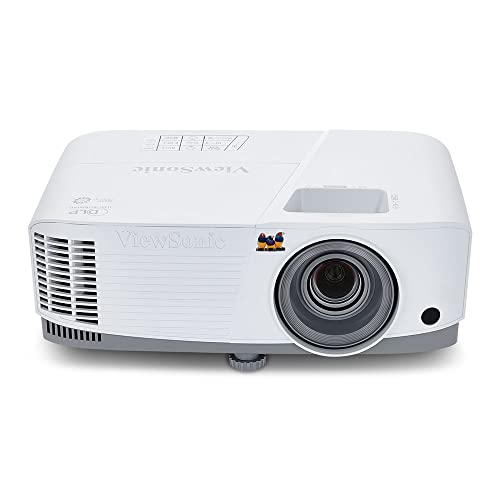
ViewSonic PA503W 4000lm Projector — The zoom-equipped WXGA workhorse
The PA503W is the data room’s dependable middle: a stated 4000 lumens behind a WXGA DLP picture, with the installer’s friends all present in the title — optical zoom for sizing from a fixed mount, vertical keystone for squaring, ceiling-mount intent, and a port list spanning HDMI, VGA and USB. A generation of offices has run on exactly this recipe, because it answers the questions shared rooms actually ask, in the order they ask them.
Two figures in the title deserve a second look from data buyers. The 120Hz and low-latency claims speak of motion smoothness that presentation machines rarely advertise; for scrolling dashboards, live data feeds and video-rich training material, that smoothness keeps moving content composed rather than smeared. It will not turn the PA503W into a gaming machine, nor does the title pretend otherwise, but data that moves is data too, and this ViewSonic acknowledges it.
The WXGA trade must be faced squarely, as this guide faces it everywhere. A WXGA grid shows fewer spreadsheet rows and softer small labels than the 1080p picks here, and on a large screen in a text-dense room the difference is not subtle. At moderate screen sizes, with documents designed at readable sizes, the PA503W’s brightness and zoom flexibility carry the day — which is why it remains the pick for standardising across ordinary rooms rather than showcasing in one demanding one.
No speaker or wireless claim appears in its title, so the room provides sound and the presenters provide cables, as traditional data rooms always have. Within that tradition the PA503W is a rational, fleet-friendly purchase, and its Amazon listing carries the current price for buyers outfitting more than one room at a time.
A last word on the PA503W’s ceiling-mount intent, because it signals the machine’s expected biography: installed once, aligned once, and then expected to vanish into the room’s routine for years. Projectors bought for that biography should be judged on the dull virtues — zoom range, port survival, a maker’s parts pipeline — and the PA503W’s title is practically a manifesto for them.
- Resolution: WXGA, per listing title
- Brightness: 4000 lumens, per listing title
- Display: DLP, per title
- Motion: 120Hz and low latency claimed in title
- Lens: optical zoom stated; vertical keystone stated
- Ports: HDMI, VGA and USB named
- Mounting: ceiling mount named in title
- Speaker and wireless features: Not stated in the listing title — verify with the manufacturer documentation
Strengths
- Optical zoom eases fixed installations
- VGA and USB suit mixed laptop fleets
- 120Hz claim suits moving data content
Trade-offs
- WXGA softens dense spreadsheets at size
- No speaker named in its title
- No casting feature named in its title
Best for: an organisation standardising ordinary meeting and classroom spaces on one model.
Not suited for: a large room projecting fine print to the back row.

ViewSonic PA503HD 4000lm Projector — The Full HD step in the same family
The PA503HD reads as its sibling’s answer to the resolution objection: the same stated 4000 lumens and the same installer-friendly shape, but with a 1080p Full HD DLP picture where the PA503W offers WXGA. For data work, that single line is the review. More pixels per spreadsheet, finer chart labels, code that stays crisp at sizes where a class or a board is actually reading it — the HD earns its suffix in exactly the currency data rooms trade in.
The supporting cast will be familiar by design: optical zoom for the fixed mount, auto keystone — an upgrade in convenience over the W’s vertical-only correction, since the machine squares itself — 120Hz for smooth motion, and HDMI with USB for sources. ViewSonic names classrooms, business and presentation among its habitats, plus large screens and smooth action, which is the title’s way of saying the resolution headroom is meant to be used.
What the title omits mirrors the sibling too: no speaker, no wireless, no VGA this time, so legacy laptops may need an adapter’s diplomacy and the room must still provide its own voice. Buyers should weigh that port change carefully if their estate includes veteran machines, because the HD’s sharper picture is wasted on a presenter who cannot connect to it.
Between the two ViewSonics, the choice is a clean one: the HD for rooms where text density rules, the W where legacy connections and standardisation rule. The PA503HD’s Amazon listing will confirm its price today, and data-heavy teams should start their comparison of this guide right here, with the sharpest-value combination of stated brightness and native resolution in the line.
One more data-room virtue hides in the PA503HD’s auto keystone, and it concerns the rooms nobody plans for: the borrowed classroom, the rearranged training space, the office whose furniture migrates with every reorganisation. A machine that squares itself tolerates that migration gracefully, while a manual-only design accumulates small misalignments until somebody schedules a correction afternoon. In estates where rooms change faster than installations do, self-squaring is not a convenience but a maintenance strategy.
- Resolution: 1080p Full HD, per listing title
- Brightness: 4000 lumens, per listing title
- Display: DLP, per title
- Motion: 120Hz claimed in title
- Lens: optical zoom stated; auto keystone stated
- Ports: HDMI and USB named in title
- Mounting: ceiling mount named in title
- Speaker, wireless features and VGA: Not stated in the listing title — verify with the manufacturer documentation
Strengths
- Full HD grid suits dense data
- Auto keystone simplifies setup
- Optical zoom fits fixed mounts
Trade-offs
- No VGA named for legacy laptops
- No speaker named in its title
- No casting feature named in its title
Best for: a boardroom or classroom projecting spreadsheets, dashboards and documents daily.
Not suited for: an estate of older laptops depending on a VGA connection.

Epson EX3290 WXGA Projector — Colour honesty from a 3LCD design
The EX3290 makes the Epson argument in its purest form: a 3-chip 3LCD design quoting 4000 lumens of color brightness and 4000 of white, in a widescreen WXGA frame, with a built-in speaker and two HDMI ports. That dual figure is the headline for data buyers, because data is coloured — charts, heat maps, dashboards, brand templates — and a projector whose colour output matches its white output renders all of it at full strength rather than in pastel.
Single-figure projectors can post the same 4000 beside a white slide while their coloured content runs dimmer, a gap that only appears when the quarterly deck’s charts arrive. Epson’s habit of stating both numbers removes the guesswork, and for rooms whose data is predominantly visual — marketing dashboards, design reviews, teaching material rich with diagrams — the EX3290’s honesty may matter more than the resolution step it concedes to the 1080p picks.
That concession is real and should be weighed without flinching: WXGA is WXGA, and a dense spreadsheet at a large size will read softer here than on the PA503HD or the BenQ pair. The built-in speaker and dual HDMI soften the machine’s daily manners considerably, covering voice-led meetings and two permanently connected sources, and the widescreen shape matches modern laptops without letterboxing.
Choose the EX3290 when your data wears colour and your room values a self-contained, speaker-equipped unit from a business line with a long memory. Its listing on Amazon carries the current price, and buyers torn between colour fidelity and pixel count should project their most colourful deck and their densest spreadsheet in imagination, then ask which one the room shows more often.
The EX3290’s dual HDMI deserves a practical footnote, because permanently connected sources change a room’s behaviour. A room PC on one input and a table cable on the other means the projector’s day involves switching, not plugging — and switching is faster, gentler on ports, and possible for the least technical presenter in the building. Port counts look like trivia in a specification table and behave like policy in a working room.
- Resolution: widescreen WXGA, per listing title
- Brightness: 4000 lumens of color and white brightness
- Display system: 3-chip 3LCD
- Audio: built-in speaker stated
- Ports: 2 HDMI ports named in title
- Light source type and wireless features: Not stated in the listing title — verify with the manufacturer documentation
Strengths
- Equal color and white brightness figures
- Built-in speaker covers voice-led rooms
- Two HDMI ports keep sources connected
Trade-offs
- WXGA trails 1080p for fine data
- No wireless feature named in its title
- Light source unstated in its title
Best for: a colour-heavy data room — dashboards, charts and teaching visuals — in a mid-sized space.
Not suited for: maximum-density spreadsheets on the largest screens.

ViewSonic LSD400HD-ST Laser Projector — Short-throw laser for installed rooms
The LSD400HD-ST is the installation specialist of this guide, and its title reads like a site surveyor’s checklist: a bright 4000-lumen 1080p picture, laser light, a stated 0.5 short throw, horizontal and vertical keystone, 360-degree projection, and a connection panel naming HDMI, Ethernet and USB. Every line answers a problem that appears when a projector stops being a gadget and becomes part of a room’s architecture.
The short throw rewrites the room’s geometry first. A big, sharp image from close to the wall means no presenter crosses the beam, no ceiling mount hangs over the table’s centre, and small or oddly shaped rooms gain a data display they could not otherwise fit. Pair that with H/V keystone — correction on both axes, for the off-centre placements real rooms impose — and 360-degree projection for mounts at unconventional angles, and the installer gains a machine that adapts to architecture instead of arguing with it.
Laser light supplies the ownership half of the proposition: full stated brightness from the first second, held steadily across years, with no lamp waiting to dim before the board’s visit or to expire during exam season. Ethernet joins the panel for networked control and monitoring, the language of managed estates, while the title’s mention of golf simulators alongside business and classroom use hints at the chassis’s second career in immersive installations.
No speaker or casting claim appears in the title, so the installed room provides audio and sources through its own infrastructure, as installed rooms do. For a permanent data space — the training room, the simulation suite, the classroom that must simply work every morning — this ViewSonic is the most architecturally literate pick here, and its Amazon listing will confirm the current price for the project plan.
The LSD400HD-ST’s 360-degree projection claim deserves a final architectural note, because it frees the mount from the ceiling’s tyranny. A projector that can be oriented freely can live on a side wall bracket, beneath a shelf, or at the angle a heritage building’s beams dictate, and still deliver a squared, upright picture. Rooms that defeated conventional mounts — the converted chapel, the glass pavilion, the training space under a staircase — are this feature’s natural constituency, and they are more common in real estates than catalogue photography admits.
- Resolution: 1080p, per listing title
- Brightness: 4000 lumens, per listing title
- Light source: laser
- Throw: 0.5 short throw stated
- Correction: H/V keystone stated
- Mounting: 360-degree projection stated
- Ports: HDMI, Ethernet and USB named
- Speaker and wireless features: Not stated in the listing title — verify with the manufacturer documentation
Strengths
- Short throw frees awkward room geometry
- Laser light ends lamp scheduling
- Ethernet suits managed installations
Trade-offs
- No speaker named in its title
- No casting feature named in its title
- Installation design exceeds portable needs
Best for: a permanent training room, classroom or simulation space with limited throw distance.
Not suited for: a presenter carrying one projector between several rooms.

BenQ MH733 1080P Business Projector — Casting-friendly Full HD with a glass lens
The MH733’s title contains a phrase data buyers should savour: a glass lens for image accuracy and clarity. In a category where optics are usually left unmentioned, BenQ names the material and its purpose, because data projection is an accuracy discipline — the edge of a character, the rule of a gridline, the hairline on a chart — and lens quality is where that accuracy is won or lost before a single pixel is consulted.
Around the lens, the specification assembles the modern presenter’s kit: a 4000-lumen Full HD DLP picture, wireless casting for the cable-free laptop, auto keystone correction for hurried placement, and SmartEco technology which the title credits with 70% less energy consumption. That energy figure deserves its plain reading — it is the maker’s claim for its power-saving system, and in a fleet of rooms running all day, the direction of the claim matters to running costs even before its precision is audited.
The MH733 thus occupies the guide’s convenience pole among the lamp-based 1080p models: sharper than the WXGA pair, more welcoming than the installation specialist, less infrastructural than the laser BenQ below. Its title stays silent on speakers and ports beyond the casting story, so a buyer should confirm the wired panel on the listing, especially if the room’s sources are permanent rather than carried in.
Presenters who cast by default and rooms that value optical quality will find this the most congenial machine in the guide. The MH733’s Amazon page carries today’s price, and a comparison against its laser sibling, the LH650, becomes a clean choice between lamp economics with casting charm and laser endurance with a fuller stated kit.
A closing thought on the MH733’s energy claim, because data rooms run long hours and small percentages compound. A power-saving system that trims consumption whenever content allows — dark slides, static documents, the pauses in a working day — saves its money invisibly, across every hour of every room in the fleet. Buyers comparing two otherwise equal lamp machines should let that arithmetic speak, since the electricity column is one of the few in the ledger that never takes a day off.
- Resolution: 1080p Full HD, per listing title
- Brightness: 4000 lumens, per listing title
- Display: DLP, per title
- Optics: glass lens for image accuracy and clarity, per title
- Wireless: wireless casting stated
- Correction: auto keystone correction stated
- Power: SmartEco technology, 70% less energy consumption claimed
- Speaker and port list: Not stated in the listing title — verify with the manufacturer documentation
Strengths
- Glass lens claim targets data accuracy
- Wireless casting suits modern presenters
- SmartEco energy saving stated plainly
Trade-offs
- Port list unstated in its title
- No speaker named in its title
- Lamp economics rather than laser endurance
Best for: a presenter-led meeting room where laptops cast and text must stay exact.
Not suited for: a fully installed room needing network control and short throw.

BenQ LH650 Laser Business Projector — Laser precision with a modern port list
The LH650 is the guide’s most completely stated machine, and it begins with the most carefully worded brightness claim: 4000 ANSI lumens from a laser 1080p engine. The ANSI qualifier signals the standardised measurement, which makes this figure the most conservatively framed in the guide — the number a sceptical buyer can lean on hardest. Around it, BenQ assembles the modern data room in miniature: Rec.709 wide colour gamut, USB-C, a 10W speaker, wireless projection, auto and 2D keystone, and corner fit.
Each item earns its sentence. Rec.709 colour keeps branded templates and charts faithful, a data-room virtue as much as a cinema one. USB-C admits the modern laptop through a single cable, ending the adapter ritual for a growing share of presenters. The stated 10W speaker covers voice and video without a separate system. Corner fit joins 2D keystone as the geometry toolkit for rooms whose projector cannot sit square to the wall, correcting each corner into line rather than merely tilting the whole frame.
Laser light and SmartEco power saving complete the ownership story: steady stated brightness across years, no lamp line in the budget, and power management trimming the running costs of a machine that may glow through every working hour. Against its MH733 sibling, the LH650 trades lamp economics for this endurance and a fuller stated kit; against the ViewSonic laser, it trades short throw for ANSI-worded brightness, colour discipline and the speaker.
For a single important data room — the boardroom, the analysis suite, the classroom whose screen never rests — the LH650 is the pick that leaves the fewest boxes unticked. Its Amazon listing will confirm the current price, and buyers comparing laser options should weigh its ANSI figure and corner-fit toolkit against the LSD400HD-ST’s throw geometry, because that is the real contest at this guide’s summit.
The LH650’s Rec.709 claim merits one more sentence of context for data buyers who associate colour gamuts with cinema. In a data room, a defined gamut means the chart your analyst built on a calibrated monitor arrives with its colours in the intended relationships — the red that means danger stays distinct from the amber that means caution. Colour discipline is information discipline, and a title that names its gamut is a title that understands the assignment.
- Resolution: 1080p, per listing title
- Brightness: 4000 ANSI lumens, per listing title
- Light source: laser
- Colour: Rec.709 wide colour gamut stated
- Ports: USB-C named in title
- Audio: 10W speaker stated
- Wireless: wireless projection stated
- Correction: auto keystone, 2D keystone and corner fit stated
- Power: SmartEco power saving named
Strengths
- ANSI-worded brightness claim inspires confidence
- USB-C ends the adapter ritual for modern laptops
- Corner fit and 2D keystone tame awkward rooms
Trade-offs
- Standard throw, unlike the ViewSonic laser
- Fullest kit asks flagship commitment here
- HDMI count unstated in its title
Best for: a primary boardroom or analysis room needing laser endurance and modern connections.
Not suited for: a tight room whose only mount point sits close to the screen.
Comparison Table
| Model | Resolution | Brightness claim | Light source | Standout trait |
|---|---|---|---|---|
| ViewSonic PA503W | WXGA | 4000 lumens | Unstated in title | Optical zoom, VGA, 120Hz |
| ViewSonic PA503HD | 1080p | 4000 lumens | Unstated in title | Optical zoom, auto keystone |
| Epson EX3290 | WXGA | 4000 lumens color and white | Unstated in title | 3LCD colour honesty, speaker |
| ViewSonic LSD400HD-ST | 1080p | 4000 lumens | Laser | 0.5 short throw, Ethernet |
| BenQ MH733 | 1080p | 4000 lumens | Unstated in title | Wireless casting, glass lens |
| BenQ LH650 | 1080p | 4000 ANSI lumens | Laser | USB-C, 10W speaker, corner fit |
How to Choose a 4000-Lumen Data Projector Without Misreading the Number
Begin by translating the brightness claim in front of you. An ANSI figure, like the LH650’s, comes from a standardised method and can be compared across brands with reasonable confidence. A color-and-white pair, like the EX3290’s, tells you coloured content receives the full output — vital information for chart-heavy rooms that a single figure conceals. A plain vendor figure is a claim made under the maker’s own conditions: useful as a statement of class, unwise as a laboratory verdict. All six here occupy the same working tier; treat small numerical pride as marketing weather, not climate.
Resolution is the second decision, and data content makes it starkly. Count the rows and columns your work actually shows: a dashboard designed for a Full HD monitor loses content or clarity on a WXGA grid, while a deck of bold charts loses nothing. The four 1080p picks protect dense work at large sizes; the WXGA pair serve rooms whose material is designed readably and whose screens are moderate. Buy for your densest regular document, not your prettiest one.
Geometry comes third, because a projector that cannot fit the room fits nothing else either. Standard throws with optical zoom — the two PA models — serve conventional rooms with fixed mounts. The LSD400HD-ST’s stated 0.5 throw serves rooms where the mount must hug the wall. Corner fit and 2D keystone, the LH650’s toolkit, serve rooms whose projector must sit off-square. Measure first, admire specifications second.
Close with the ownership ledger: laser steadiness against lamp economics, SmartEco’s stated savings against a plain power draw, and the connection panel your presenters will actually use — USB-C for the modern fleet, VGA for the veteran one, casting for the cable-free, Ethernet for the managed estate. The right projector is the one whose ledger, geometry and grid all match the same room.
ANSI, Color and Vendor Lumens: Why Identical Numbers Are Not Identical
The lumen is a unit of light output, but the path to printing it on a box varies. ANSI lumens follow a defined measurement procedure, averaging brightness across the screen under specified conditions, which disciplines the claim. Vendor figures may be measured at the light source’s most flattering setting, in the brightest picture mode, under conditions no data room would tolerate for text. Neither number is a lie; they are answers to different questions, and the wise buyer asks which question was posed.
Colour brightness adds the dimension that data rooms ignore at their cost. A projector can achieve its white figure while its colour output trails, and since nearly everything in a spreadsheet era is coloured — conditional formatting, chart series, dashboard status lights — the trailing is visible exactly where accuracy matters. Epson’s dual-figure habit exists to expose this, and the EX3290’s equal pair is its strongest argument in this entire guide.
The practical synthesis is simple. Compare ANSI to ANSI where you can; treat vendor figures as tier markers rather than measurements; weight colour brightness heavily when your content is colour; and remember that screen size dilutes every figure equally. A 4000-lumen claim lighting 100 inches is a different experience from the same claim stretched across 150, whatever method produced the number.
WXGA or 1080p: How Much Grid Does Your Data Need?
Think in rows. A spreadsheet’s usefulness scales with how many rows remain readable at once, and a 1080p grid simply holds more of them at legible size than a WXGA grid does. Code reviews, financial models and dense dashboards are row-hungry content; their audiences will feel the WXGA ceiling within minutes, as scrolling replaces seeing and context leaks away with every page-down.
WXGA’s defence is equally concrete. Decks designed for projection — large type, few elements, bold charts — use a fraction of either grid, and at moderate screen sizes the two resolutions are indistinguishable for such material. Teaching content, agendas, video-led training and status dashboards all live comfortably in WXGA’s house, which is why the PA503W and EX3290 remain rational purchases rather than cautionary tales.
Seating distance arbitrates the borderline cases. Viewers close to a large screen resolve the grid’s limits quickly; viewers across a long room may never perceive the difference they paid for in a 1080p upgrade. Measure your room’s geometry, name your densest weekly document, and the resolution question usually answers itself — with the tie, in data rooms, going to the sharper grid.
What Setup Ritual Keeps Data Readable Week After Week?
Legibility is maintained, not installed once. Focus drifts with temperature and knocks, so the data room’s ritual begins with a monthly focus check against a text document — not a photograph, whose softness hides sins that a spreadsheet exposes instantly. Adjust until character edges stop improving, then leave the ring alone until the next check.
Geometry deserves the same discipline. Keystone and corner corrections are set-and-forget only while the projector stays untouched; a bumped mount or a helpful cleaner’s nudge can tilt the grid enough to soften one corner’s figures. The machines with auto keystone forgive some of this, while corner-fit models like the LH650 let an installer restore a perfect rectangle deliberately rather than approximately.
Cleanliness closes the ritual. Filters in working rooms breathe working dust, and a clogged filter costs brightness — the very commodity this guide is priced in. A termly filter check, a lens kept to a proper cloth, and lamp hours noted where lamps exist: that modest liturgy protects the 4000-lumen promise long after the installation photographs have been forgotten.
How Do Data Projectors Serve Classrooms Differently From Boardrooms?
The classroom asks for endurance and forgiveness. Its projector runs period after period, driven by many hands, showing material that ranges from documents to video to a student’s presentation, and it must survive being the room’s shared appliance rather than its honoured guest. Zoom flexibility, auto keystone and a tolerance for imperfect placement — the virtues threaded through the ViewSonic pair and the MH733 — matter more in that life than any single specification’s peak.
The boardroom asks for fidelity and silence of operation in a different sense: the machine must disappear. Data arrives dense and consequential, colours carry brand and meaning, and the audience includes people whose reading of a chart may decide a budget. That brief elevates the LH650’s colour gamut, ANSI-worded brightness and corner-fit precision, and the EX3290’s colour-brightness honesty, because a boardroom chart that renders in the wrong saturation is a small lie told at scale.
Both rooms share the arithmetic of the back row, which is why this guide keeps returning to it. A classroom’s back row is a student whose engagement is already fragile; a boardroom’s back row is a director whose questions are not. In either case, the projector that keeps its smallest regular text legible to that row has done the whole of its job, and every other virtue is decoration on that foundation.
What Role Does a Screen Play in Data Legibility?
A data screen is not a cinema screen with a different label. Its job is textual: a smooth, matte, high-uniformity surface that returns the projector’s grid without texture, sparkle or hotspotting, because every artifact lands on a character somebody must read. Gain should stay modest for wide seating, since a conference table’s edge seats view at angles that high-gain surfaces punish with falloff.
Size interacts with resolution in a way buyers routinely misjudge. Enlarging a WXGA image makes its characters bigger and its grid coarser in equal measure, so beyond a point the WXGA picks stop gaining legibility from size, while the 1080p picks keep gaining. The crossover in most rooms sits around the sizes where meetings actually happen, which is why this guide treats the resolution camps as room-size recommendations in disguise.
The wall behind and around the screen completes the instrument. A darker surround raises perceived contrast and steadies the eye’s adaptation, which is why a simple border transforms a projected wall in a pale office. Data is read for hours, not watched for minutes, and the room that treats contrast as ergonomics will tire its readers more slowly — a benefit no lumen figure can purchase directly.
Estates that document their rooms gain one more quiet advantage: the second installation is faster than the first, the tenth faster than the second, because every measurement, mount choice and cable run has already been argued once and written down. That compounding competence is the real return on standardisation, and it accrues to whichever of these six machines the estate chooses as its standard.
How Should IT Standardise Projectors Across an Estate?
Standardisation is a bet that sameness is worth more than perfection in any single room. A fleet of one model means one remote language, one set of spare lamps or none, one menu structure for support calls, and mounts and cables that repeat from room to room. The PA503W’s fleet-friendly recipe exists for this bet, and the laser models raise it: an estate of laser machines deletes the lamp inventory, the lamp schedule and the lamp emergency from the organisation’s life entirely.
Management features convert the bet into a system. Ethernet control, as the LSD400HD-ST’s title names, lets an estate be monitored and woken centrally; a room that reports its own status is a room that rarely surprises anyone. Even without formal management, a labelled asset register — model, room, install date, lamp hours where relevant — turns the fleet from folklore into infrastructure.
The honest cost of standardisation is the exceptional room: the one space whose geometry or audience genuinely needs the short throw, the colour fidelity or the ANSI-worded flagship. Wise estates standardise the many and exempt the few deliberately, documenting the exemption, rather than letting every room argue itself into a unique snowflake of a projector that support must learn individually.
What Changes When the Data Is Live?
Static documents forgive; live data interrogates. A dashboard refreshing in real time, a scrolling feed, a shared screen during an incident call — these expose motion handling and latency that a slide deck never touches. The ViewSonic pair’s stated 120Hz claims speak to exactly this life, promising composed movement where a lesser refresh story might smear the very numbers the room gathered to watch.
Live data also changes the failure stakes. A projector that falters during a film costs an evening; one that falters during an operations review costs the review. Redundancy becomes a rational purchase at that level: a known-good cable path beside the casting route, a spare input already cabled, a second machine in the building whose settings mirror the first. None of that appears in any title, and all of it belongs in a serious data room’s plan.
Finally, live data is often confidential data, and the projector is a broadcast medium whether the room treats it as one or not. Casting routes should be the managed ones, screens should clear when meetings end, and the room’s habits should assume that anything projected is public within the building. The machines here will show whatever they are sent, faithfully and at scale; governance is the humans’ contribution.
How Do You Test a Data Projector Before the Estate Commits?
Test with the estate’s own worst material, in the estate’s own worst room, at the worst hour. Bring the densest spreadsheet, the palest dashboard and the smallest-font document the organisation actually circulates, and read them from the back row with the lights as the room keeps them. A projector that passes that audition will pass the year; one that fails it in the showroom’s darkness was never really auditioned.
Test the humans as rigorously as the machine. Hand the remote to the least technical regular user and time the journey from entering the room to a legible slide. Casting, input selection and keystone all reveal their manners under an honest operator, and a projector that needs an IT escort to present is a recurring appointment disguised as a product.
Test the ledger too: obtain the lamp story where lamps exist, the warranty wording in writing, and the mount and cable requirements for the intended rooms. Estates are bought on totals, and the projector whose whole-life column is known in advance is the one finance will still be pleased with in year three.
What About the Sound of Data?
Data rooms speak. Training narration, video evidence, the remote analyst joining by call — the modern data session is half audio, and a projector purchase that ignores sound discovers the omission in the first hybrid review. Two titles here state speakers, the EX3290’s built-in unit and the LH650’s 10W, and for voice-led rooms those statements can close the audio question without a second purchase.
Where no speaker is stated, the room’s plan must supply one deliberately: a conference speakerphone at the table’s centre usually serves data rooms better than a screen-adjacent bar, because the same device must carry the room’s voices out as faithfully as it carries the remote voices in. Position and purpose differ from the cinema’s sound problem, and solving the cinema’s version in a data room leaves the callers unheard.
Volume honesty applies in both directions. A stated speaker figure describes capability for a room of a certain size, not for every room; the largest spaces in this guide’s remit should treat even the 10W claim as a starting point and budget reinforcement. Small rooms, meanwhile, will find stated speakers entirely sufficient, and can spend the saved money on the blinds that their brightness figure will thank them for.
How Long Should a Data Projector Serve Before Replacement?
The honest horizon is set by the room’s standards rising, not by the machine dying. A projector bought today will likely still illuminate in five years; the question is whether the data it must show — denser dashboards, larger screens, higher-resolution sources as the laptop fleet renews — will have outgrown its grid. Planning replacement around the content’s trajectory, rather than the hardware’s survival, keeps an estate from discovering obsolescence in front of an audience.
Laser machines bend that planning favourably, because their brightness holds its stated form while lamp machines decline through cycles that must be managed and budgeted. A lamp estate can absolutely serve the same years, provided the lamp programme is funded and diarised; what it cannot survive is neglect, because a fleet of slowly dimming projectors teaches an organisation to distrust its own rooms.
The replacement conversation should also inherit the room’s measurements. Throw distances, mount positions and cable paths outlive individual projectors, and an estate that documents them can swap machines in an afternoon rather than a project. The projector is the replaceable part; the room’s geometry is the permanent asset, and treating it that way is the final lesson of the data class.
Common Mistakes
Comparing lumen figures across measurement religions. An ANSI claim, a color-and-white pair and a vendor figure are three dialects of the same word. Treating them as interchangeable crowns the wrong machine; translate first, using the method each title actually names, and compare only what survives translation.
Buying WXGA for a spreadsheet cathedral. WXGA serves designed decks honourably and dense data poorly. A room whose life is financial models and code will outgrow the grid within a quarter, and the saving that caused it will be repaid in squinting, scrolling and one eventual replacement.
Ignoring the port your fleet actually carries. USB-C laptops, VGA veterans and casting devotees each need their doorway named or provided. A projector with a magnificent picture and no route in for the finance director’s laptop is furniture, not infrastructure.
Stretching 4000 lumens across an enormous screen in a bright room. The figure is a tier, not a spell. Screen area dilutes brightness relentlessly, so the largest rooms should either control their light, moderate their diagonal, or step beyond this class entirely.
Final Recommendation
The BenQ LH650 is this guide’s data-room default: the most conservatively worded brightness claim at 4000 ANSI lumens, a laser engine that holds that brightness without lamp logistics, Full HD resolution, Rec.709 colour discipline, USB-C for the modern fleet, a stated 10W speaker, wireless projection and a corner-fit toolkit for imperfect rooms. It is the pick that leaves a data team with nothing left to solve.
Installed rooms with tight geometry should overrule it in favour of the ViewSonic LSD400HD-ST, whose short throw and Ethernet control solve architectural problems the BenQ does not address. Colour-critical rooms will prefer the Epson EX3290’s dual brightness honesty, casting-led rooms the BenQ MH733, and standardising buyers the ViewSonic pair — the HD where text density rules, the W where legacy fleets and zoom flexibility rule.
Whichever machine you install, judge it by the back row’s reading of your densest document on an ordinary lit morning. Data projection has no other honest test, and all six of these machines were chosen to be capable of passing it. Install it level, feed it your real work, and let the room get on with reading.
Frequently Asked Questions
Is 4000 lumens enough for a bright room?
For slides and data at sensible screen sizes in a room with ordinary lighting and some blind control, yes — that is the working tier this guide is built on. Direct sun on the screen or very large diagonals will defeat any figure in this class, so treat light control as part of the purchase.
What is the difference between ANSI lumens and regular lumens?
ANSI lumens follow a standardised measurement method, making them the most comparable figures across brands. A plain vendor figure is measured under the maker’s own conditions. The LH650’s 4000 ANSI claim is therefore framed more conservatively than a bare 4000, even though the numbers match.
Why does Epson quote color and white brightness separately?
Because a projector’s white output and colour output can differ, and data is coloured. The EX3290 states 4000 lumens for both, meaning charts and dashboards receive the same output as a white slide — a guarantee a single combined figure does not make.
Can a WXGA projector handle spreadsheets?
At moderate screen sizes with readable document design, yes; both WXGA picks here are honest work tools. Dense models, code and fine print at large sizes belong on the 1080p picks, where the finer grid keeps more rows legible at once.
Laser or lamp for a data room that runs all day?
Laser, on this guide’s evidence: the LSD400HD-ST and LH650 hold their stated brightness steadily and remove lamp replacements from a heavy schedule. Lighter rooms can accept lamp economics comfortably, especially with SmartEco-style power management trimming the costs.
How do I stop presenters from leaving the projector running overnight?
Habit and infrastructure share the job: a room checklist by the door, a timer or network schedule where the machine supports one — the Ethernet-equipped LSD400HD-ST suits managed estates — and a booking system that makes the last user of the day a named person. Laser machines forgive the occasional overnight; lamp hours spent on an empty room are gone forever.
What size screen can 4000 lumens serve for data?
In a room with ordinary light control, the class serves roughly 100 to 130 inches for text-led content, with the sharper 1080p picks holding legibility toward the top of that range. Beyond it, either the room darkens further or the class steps aside for brighter installation machines.
Do any of these projectors work for video calls and hybrid meetings?
The ingredients are present in several titles: speakers on the EX3290 and LH650, casting on the MH733 and LH650, and brightness suited to lit rooms across the guide. Pair the projector with the room’s camera and microphone arrangement, since no title here claims those, and the data room doubles as a call room comfortably.
Related Guides
Data rooms are one stop on a presenter’s itinerary. Our round-up of affordable ultraportable laptops for mobile work covers the machines that feed these projectors, our guide to thin laptops built for travel continues the portability theme, and our look at high-performance thin-and-light laptops serves the analysts whose dashboards demand the sharpest grids here.


