What's inside
- Key Takeaways
- Quick Picks
- How These Picks Were Chosen
- Side-by-Side Comparison
- How to Choose Among These Six
- Does UFS Storage Actually Feel Slow in Daily Use?
- How Much Memory Does a Light Laptop Really Need?
- Should Students Buy a Bundle or a Bare Machine?
- How Long Should an Affordable Ultraportable Last?
- Common Mistakes
- Final Recommendation
- Frequently Asked Questions
- Related Guides
As an Amazon Associate I earn from qualifying purchases. This post may contain affiliate links at no extra cost to you.
[SITE_DOMAIN] is reader-supported. When you buy through links on our site, we may earn an affiliate commission.
Every linked machine below points to its Amazon listing, and that listing page is where the current price lives. Read the full listing title before ordering any of these six, because several are bundle listings whose storage is split between a small internal drive and an external unit described in the same breath — the split matters, and each review below spells it out in plain terms.
The best affordable ultraportable laptops occupy the most contested corner of the laptop market: machines light enough to forget in a shoulder bag, cheap enough to buy without a committee meeting, and honest enough about their compromises that a buyer can choose with eyes open. The six gathered here span a wide range inside that brief. At one end sits a current Microsoft Surface Laptop with a Snapdragon chip and a clean, minimal specification. At the other end sit marketplace bundles that pair modest internal storage with a large external drive and a software subscription, trading elegance for headline capacity. Between them are an older ASUS flagship design still on sale, a big-screen Acer that stretches the word ultraportable to its limit, and a Lenovo bundle aimed squarely at students.
Affordability changes what a buyer should forgive and what they should not. A modest processor in a light machine is a reasonable bargain; a small, slow internal drive dressed up as a large one is not, because the internal drive is where the operating system lives and where every application launches from. That distinction runs through this entire guide. Where a listing title states UFS storage — the flash class familiar from phones — the review says so and explains what it means in daily use. Where a title bundles an external drive into its storage figure, the two numbers are separated so the real internal capacity is never in doubt.
Screen size is the second dividing line. Two of these machines are genuinely small, at 13 inches and 12.5 inches, and they behave like true travel companions. The rest are 14 and 15.6 inch designs that remain portable in the sense that they fit in a backpack without complaint, while giving back more screen for documents, spreadsheets, and split-screen work. Neither camp is wrong; they answer different days. A commuter who works on trains wants the first kind. A student who carries a laptop between lectures and a dorm desk, and works mostly at that desk, may be happier with the second.
None of this is an argument against buying at this level. The affordable ultraportable has quietly become the default computer for a large share of households, students, and mobile professionals, precisely because the work most people do — writing, browsing, communicating, organising — stopped demanding expensive hardware years ago. The skill this guide tries to teach is not how to spend more, but how to read a listing the way an engineer reads a datasheet: separating the number that governs daily life from the number that merely decorates the headline.
Memory splits the field just as clearly. Half the picks carry 8GB, which covers browsing, documents, email, and video comfortably but leaves little headroom for heavy multitasking. The other half carry 12GB or 16GB, and that extra room is the single most noticeable upgrade in everyday responsiveness for people who keep dozens of tabs and several applications open at once. Read each review with your own habits in mind, because the right answer here is personal in a way processor branding never is.
Key Takeaways
- The Microsoft Surface Laptop 13 is the cleanest specification here: Snapdragon X Plus power, a 13 inch screen, and no bundle arithmetic to decode.
- Two HP listings and the Lenovo quote storage figures that combine a small internal drive with a 500GB external unit — the internal number is the one that shapes daily speed.
- The ASUS ZenBook 3 is an older premium design with a proper internal SSD, a fingerprint sensor, and Harman Kardon audio; it sells design and finish rather than current-generation power.
- Memory ranges from 8GB to 16GB across the six, and that spread matters more for everyday smoothness than the differences between these processors.
- The Acer Aspire Go 15 is the screen-size outlier at 15.6 inches, with the smallest internal storage of the group at 128GB of UFS.
Quick Picks
| Pick | Badge | Why it is here |
|---|---|---|
| Microsoft Surface Laptop 13 | Cleanest Spec | A current 13 inch Snapdragon machine with 256GB of UFS storage and nothing bundled to untangle. |
| ASUS ZenBook 3 UX390UA | Design Pick | An older 12.5 inch flagship design with a real SSD, fingerprint sensor, and Harman Kardon speakers. |
| HP Ultrabook 14 | Memory Value | 16GB of memory and Windows 11 Pro, with storage split between 128GB internal and a 500GB external drive. |
| HP 14 Ultra Portable | Newest Bundle | A 2026 listing pairing 16GB of memory and Copilot branding with the same split-storage arrangement. |
| Acer Aspire Go 15 | Big Screen | A 15.6 inch Full HD IPS display and DDR5 memory at the cost of just 128GB of internal UFS storage. |
| Lenovo Ultra Portable 14 | Student Bundle | 12GB of memory, a 256GB SSD, a 500GB external hard drive, and Office 365 in one student-aimed package. |
How These Picks Were Chosen
Admission to this guide required three things. A machine had to be genuinely portable — small-screen designs first, larger ones only where the rest of the specification justified the extra inches. Its listing title had to state the core specification plainly enough to verify: processor, memory, storage, and operating system all readable without guesswork. And it had to sit at the affordable end of its maker’s range rather than borrowing a flagship price. Listings that hid the internal storage figure entirely, or that described the processor so vaguely that no honest review could be written, were set aside.
Bundle listings were not excluded, because at this end of the market they are a large share of what a buyer actually finds, and pretending otherwise would make the guide less useful. Instead they are handled transparently: wherever a title adds an external drive into its storage headline, the review separates the two figures and judges the machine on the internal drive, since that is where Windows and every application reside. The external unit still counts — as backup space and media storage it is genuinely handy — but it never gets to masquerade as internal capacity.
One further filter shaped the final six: variety of intent. A guide that listed six near-identical bundles would waste the reader’s time, so the selection deliberately mixes a clean single-specification machine, a design-led older flagship, two differently flavoured HP bundles, a big-screen budget option, and a student package with an office subscription. Whatever your reason for shopping at this level, one of the six should resemble the machine you had in mind — and the reviews exist to tell you whether that resemblance survives scrutiny.

Microsoft Surface Laptop 13 — Cleanest Spec
Microsoft’s smallest Surface Laptop is the one machine in this guide whose listing reads like a specification sheet rather than a sales pitch. The title states a 13 inch display, a Snapdragon X Plus processor with eight cores, 8GB of memory, and 256GB of UFS storage, finished in Platinum and running Windows 11. Nothing is bundled, nothing is added in parentheses, and nothing needs decoding. For buyers exhausted by marketplace listings that read like ransom notes, that plainness is itself a feature worth paying a little for.
The Snapdragon X Plus places this machine in the ARM-based Windows generation, which shapes two practical realities. The first is efficiency: this class of chip was designed around all-day working away from a socket, and it suits the briefcase-and-coffee-shop rhythm this laptop is built for. The second is compatibility — mainstream applications run well, but anyone depending on an obscure legacy program, an old printer driver, or specialist peripheral software should confirm ARM support for that exact tool before ordering. The listing title does not address application compatibility, so treat that check as homework rather than an assumption.
Storage deserves the same clear-eyed treatment. The 256GB here is UFS, the flash storage class used in phones and tablets, and it is a full internal drive in a way the split arrangements further down this guide are not — Windows, applications, and files all live on it. It will not match the raw transfer speeds of a high-end NVMe SSD, yet for document work, browsing, email, and media it keeps the machine feeling responsive, and 256GB is a workable capacity for a laptop whose owner keeps large archives elsewhere. The 8GB of memory is the tighter constraint: fine for focused work in a few applications, less forgiving of a browser carrying forty tabs beside a video call.
As a physical object, this is the pick that best honours the ultraportable promise — a 13 inch machine from a maker whose industrial design is the reference point for the category, in a finish that suits a boardroom as easily as a lecture hall. If your shortlist values a trustworthy name, a current platform, and a specification with no fine print, begin here and check the Surface Laptop 13’s current Amazon price against the bundles below before deciding whether their extra headline numbers are worth their extra complexity.
One more consideration belongs to the Surface’s role as a household’s or a professional’s only computer. A single-machine owner asks a laptop to be everything: the video-call camera for family, the screen for films in a hotel room, the keyboard for the report that cannot wait. The Surface’s specification is balanced for exactly that generalist duty rather than tuned for one extreme, and balance is an underrated virtue in a machine that will be opened twenty times a day for twenty different purposes. Its limits announce themselves honestly — memory for very heavy multitasking, storage speed for very large transfers — and neither limit touches the generalist pattern. Buyers who recognise their own usage in that description are this laptop’s natural constituency, and they tend to keep machines like it for a long time, which is its own form of affordability.
- Display: 13 inch
- Processor: Snapdragon X Plus, 8 cores
- Memory and storage: 8GB RAM, 256GB UFS
- Operating system and finish: Windows 11, Platinum
- Model standing: Latest Model (1st Edition), per the listing title
- Weight and battery capacity: Not stated in the listing title — verify with the manufacturer documentation
Strengths
- A single, honest internal storage figure with no bundle arithmetic
- Current Snapdragon platform in a compact 13 inch design
- Microsoft’s fit, finish, and support network behind the name
Trade-offs
- 8GB of memory limits heavy multitasking headroom
- UFS storage is a step below NVMe SSD transfer speeds
- ARM platform requires a compatibility check for legacy software
Best for: focused document work, email, and browsing in a compact 13 inch machine with a clean specification.
Not suited for: legacy Windows software with no ARM support, or a desk setup built around many wired peripherals.

ASUS ZenBook 3 UX390UA — Design Pick
The ZenBook 3 belongs to an earlier generation of premium ultraportables, and its listing makes no attempt to hide that: the processor is an Intel Core i5-7200U from the Kaby Lake era, paired with 8GB of memory and a 256GB SSD in a 12.5 inch chassis finished in Silver Gray. What this machine sells, years after its launch window, is the quality of its original design brief. It was built when ASUS wanted a flagship thinner and more elegant than the obvious rival, and the details that made it desirable then — the slim profile, the fingerprint sensor, the Harman Kardon audio tuning — are still the reasons to consider it now.
Judge the performance honestly. A dual-core i5 of that vintage handles documents, web work, email, and media playback without drama, and the proper internal SSD — a real solid-state drive rather than phone-class flash — keeps boot times and application launches brisk. What it will not do is pretend to be a modern multitasking or creative workstation: large photo edits, code compilation, and a dozen demanding applications at once will expose the age of the silicon quickly. Buyers who understand that bargain, and who mostly write, read, browse, and present, get a machine whose daily manners remain polished.
Two details lift it above the anonymous budget crowd. The fingerprint sensor turns signing in into a touch rather than a typed password, a small convenience repeated dozens of times a week. The Harman Kardon audio is the other: speakers in machines at this level are usually an afterthought, and a properly tuned set makes video calls clearer and films genuinely watchable without headphones. The 12.5 inch screen is the smallest in this guide, which is precisely the point for a buyer whose laptop travels in a handbag or a slim briefcase rather than a dedicated backpack.
The ZenBook 3 is therefore a taste purchase, and it should be priced as one in your deliberations — its value case collapses if it costs the same as a current machine, and strengthens considerably when it undercuts them. Look at the ZenBook 3’s Amazon listing with that single question in mind, and let the answer, rather than nostalgia for a handsome design, make the decision.
There is a practical side to choosing a design from a flagship line of an earlier era: the accessories, cases, and knowledge around such machines are mature, and the model’s behaviour — its strengths, its quirks, its battery manners — is documented by years of owners rather than promised by a launch presentation. Anyone reading owner discussions before purchasing will find the ZenBook 3 an unusually known quantity. That predictability has value for a purchaser who cannot afford surprises, even when the absolute performance on offer belongs to an earlier chapter of processor history. The machine will not astonish anyone; it will also not ambush anyone, and at the affordable end of the market the second promise is rarer than the first.
- Display: 12.5 inch
- Processor: Intel Core i5-7200U (Kaby Lake)
- Memory and storage: 8GB RAM, 256GB SSD
- Security and audio: fingerprint sensor, Harman Kardon audio
- Finish: Silver Gray
- Operating system edition: Not stated in the listing title — verify with the manufacturer documentation
Strengths
- Flagship-grade design and finish from a premium product line
- A proper internal SSD rather than phone-class flash storage
- Fingerprint sign-in and unusually good speakers for the size
Trade-offs
- An older dual-core processor with limited headroom
- The smallest screen in this guide at 12.5 inches
- 8GB of memory, fixed at the level of its era
Best for: writing, reading, and presenting on the move, in the smallest and most design-led chassis here.
Not suited for: demanding creative workloads, large code projects, or a primary screen for long spreadsheet sessions.

HP Ultrabook 14 — Memory Value
This HP listing is a study in how marketplace bundles are written, and reading it correctly is most of the review. The headline storage figure is 628GB, which the title itself breaks down as 128GB of UFS internal storage plus a 500GB external unit. Judge the machine on the 128GB: that is where Windows 11 Pro lives, where applications install, and where your working files sit day to day. The external drive is a useful companion for backups, photo archives, and media libraries, but it connects when you plug it in and travels as a separate object, so it should never be counted as the laptop’s own capacity.
Set the storage caveat aside and the rest of the specification has real merit for the money-conscious buyer. Sixteen gigabytes of memory is double what the Surface and the ZenBook offer, and in everyday use that difference is felt constantly — more tabs staying alive, more applications open side by side, less of the hesitation that creeps into an 8GB machine by mid-afternoon. The title describes the processor only as a quad-core Intel CPU without naming the model, which is a genuine gap in the listing: a buyer cannot place its performance precisely from the title alone, and the specification box below records that honestly rather than guessing. Wi-Fi 6 and a bundle of accessories under the Hubxcel name complete the package, along with Microsoft Office included alongside Windows 11 Pro.
Windows 11 Pro, rather than the Home edition found on several rivals here, is a quiet advantage for anyone whose laptop might join a small-business network or who uses remote desktop to reach another machine. The blue finish will divide opinion — it is cheerful in a home office and conspicuous in a conservative boardroom — and the 14 inch size keeps it in the genuinely portable class even if it lacks the design pedigree of the two picks above it.
Treat this HP as a memory-first bargain with a storage compromise you manage deliberately: keep the internal drive lean, point backups and media at the external unit from day one, and the arrangement works. Let the internal 128GB fill with everything, and it will complain within the year. If that discipline sounds reasonable, compare the HP Ultrabook 14’s listing price with the 16GB Lenovo further down, since those two compete most directly for the same buyer.
The working routine this HP rewards is easy to describe because it is the routine most office days already follow. Morning begins with the external drive connected at the desk, archives and media living there, the internal drive holding only the current project and the applications that serve it. The 16GB of memory keeps the day’s sprawl of documents and browser windows fluid in a way the 8GB machines cannot match once the afternoon’s accumulation sets in. Leaving the desk means unplugging one cable and accepting that the archive stays behind — a genuine constraint for media editing in transit, and a trivial one for travel work limited to documents and email. The bundle is honest about which of those buyers it serves, provided the headline number is read the way this review has read it.
- Display: 14 inch class, per the product name in the title
- Processor: quad-core Intel CPU; exact model Not stated in the listing title — verify with the manufacturer documentation
- Memory: 16GB RAM
- Storage: 628GB total as listed — 128GB UFS internal plus 500GB external
- Software and wireless: Microsoft Office, Windows 11 Pro, Wi-Fi 6
- Finish and extras: Blue, with Hubxcel accessories named in the title
Strengths
- 16GB of memory at a bundle price point
- Windows 11 Pro and Microsoft Office included
- A 500GB external drive included for backups and archives
Trade-offs
- Only 128GB of internal storage, and UFS class at that
- The processor model is not named in the listing title
- The external drive is a separate item to carry and connect
Best for: heavy browser multitasking and office documents, with backups delegated to the included external drive.
Not suited for: a large application library installed internally, or offline work far from the external drive.

HP 14 Ultra Portable — Newest Bundle
The second HP in this guide is a 2026 listing that mirrors its sibling’s formula with a few telling updates. Memory is again 16GB, the storage headline is again 628GB, and the breakdown again pairs a 128GB internal drive — here described as an SSD rather than UFS — with a 500GB external unit. Windows 11 Pro and Microsoft Office return, Wi-Fi 6 returns, and the title adds AI Copilot branding that the earlier listing lacks. The finish this time is white, and the accessory bundle appears under a slightly different Hubxcel spelling, a reminder that these packages are assembled by marketplace sellers rather than shipped as a single factory configuration.
Distinguishing the two HPs matters less than understanding what they share, because the shared traits define the ownership experience. The internal 128GB is the working space and it is modest: Windows, Office, a browser, and a sensible set of applications fit, but they fit without generosity, and installing several large programs means managing space actively. The external 500GB is where photographs, video, and archives belong from the first day, not as an afterthought once the internal drive is already full. Owners who set that habit early report these bundles as roomy; owners who ignore the split discover the small drive the hard way.
The Copilot branding signals that this listing positions itself around Microsoft’s AI assistant features, and for buyers curious about summarisation help, drafting assistance, and the other Copilot-branded tools in Windows and Office, having that front and centre in the title is a fair reflection of how the package is meant to be used. The title does not name the Intel processor model, so — exactly as with its sibling — performance should be assumed to be everyday-class rather than specified, and the specification box declines to invent a model name the seller did not provide.
Between the two HP bundles, the choice comes down to details a buyer can verify on the listing page: the internal drive described as SSD here versus UFS in the sibling, the finish you prefer, and the accessory contents. Weigh the HP 14 Ultra Portable’s own Amazon page on those points, and remember that whichever bundle you choose, the first afternoon’s file organisation decides how spacious it feels for years.
For a small business buying two or three machines at once, this 2026 HP bundle has a particular logic worth naming. Windows 11 Pro across the fleet simplifies joining machines to a shared network and managing them with common tools, the included Office removes a per-seat errand, and identical bundles mean identical behaviour — the support conversation stays simple because every desk runs the same arrangement. The white finish and the Copilot emphasis suit a modern, client-facing office more than a workshop. The discipline the bundle demands — external drives for bulk storage — scales fine in an office with a desk per machine, and poorly in a hot-desking environment where peripherals wander. Context, as ever in this price class, is the difference between a bargain and a burden.
- Display: 14 inch class, per the product name in the title
- Processor: Intel CPU; exact model Not stated in the listing title — verify with the manufacturer documentation
- Memory: 16GB RAM
- Storage: 628GB total as listed — 128GB SSD internal plus 500GB external
- Software and wireless: Microsoft Office, AI Copilot, Windows 11 Pro, Wi-Fi 6
- Finish and extras: White, with Hubxcel accessories named in the title
Strengths
- 16GB of memory paired with Windows 11 Pro
- Internal drive described as an SSD in this listing
- Copilot branding with Microsoft’s AI tools foregrounded
Trade-offs
- The same modest 128GB of internal space as its sibling
- Processor model unnamed, so performance is everyday-class by assumption
- Bundle contents are seller-assembled and should be checked item by item
Best for: office work built around Microsoft Office and Copilot tools, with media kept on the external drive.
Not suited for: installing a large games library internally, or a buyer unwilling to manage a two-drive filing habit.
Acer Aspire Go 15 — Big Screen
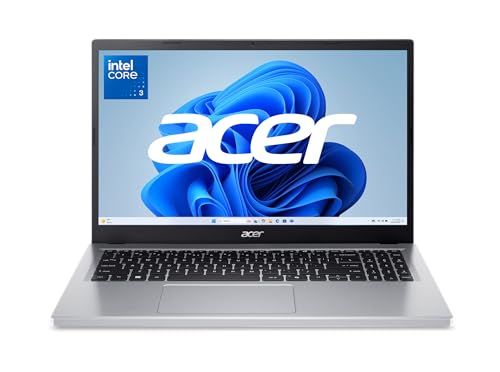
The Aspire Go 15 tests the outer boundary of the word ultraportable. Its screen is 15.6 inches — the traditional full-size laptop format — with a Full HD IPS panel at 1920 by 1080, and that single fact reorganises everything about how the machine is used. Documents sit side by side without squinting, spreadsheets show more columns, video fills the view, and the whole experience feels like a desk laptop that happens to be carryable rather than a travel machine that happens to have a screen. Buyers whose work is visual and whose carrying is limited to a backpack between home, office, and classroom will find that trade easy to accept.
The supporting specification is a mixture of the modern and the minimal. The processor is an Intel Core 3 N355 with Intel graphics, memory is 8GB of DDR5 — a current memory standard, welcome at this level — and Wi-Fi 6 covers wireless duties. Storage is where the minimal side shows: 128GB of UFS is the smallest internal capacity in this guide, shared only with the HP bundles, but without an external drive in the box to relieve it. Windows 11 Home in S Mode is the other item to understand before ordering: S Mode restricts installations to the Microsoft Store catalogue, which suits a buyer whose tools are a browser and mainstream applications, and frustrates one who needs to install traditional desktop programs from elsewhere.
That S Mode point deserves emphasis because it is the detail most likely to surprise an owner after delivery. Students whose course requires a specific downloadable program, and home users attached to a favourite utility bought outside the Store, should confirm their software situation first. For a household machine devoted to browsing, streaming, schoolwork in web applications, and documents, the Aspire Go’s combination of a generous screen and a simple, locked-down environment is arguably a virtue — fewer ways for the machine to be misconfigured, and a clear view for everything it does.
Approach the Aspire Go 15 as the comfort pick: the largest, easiest-on-the-eyes display here, bought with full knowledge that its internal storage is the tightest in the group. Browse its Amazon listing to confirm the configuration matches the title, and plan on cloud storage or an external drive joining it early in its life.
Consider the Acer in the setting where it makes the most sense: a kitchen table that doubles as a classroom, a spare-room desk, a grandparent’s first computer corner. In those places the big IPS screen is not a luxury but the entire argument — text large enough to read without leaning in, video calls where faces are faces rather than thumbnails, and a machine that stays in one or two rooms instead of living in a bag. The locked-down S Mode environment suits a shared family machine, and the modest storage matters least where a household’s photographs already live in a shared cloud account. Judged as a travel laptop the Acer is the weakest entry here; judged as an affordable home computer that can be carried when it must be, it is coherent and honestly specified.
- Display: 15.6 inch Full HD (1920 x 1080) IPS
- Processor and graphics: Intel Core 3 Processor N355, Intel Graphics
- Memory and storage: 8GB DDR5, 128GB UFS
- Operating system: Windows 11 Home in S Mode
- Wireless: Wi-Fi 6
- Model: AG15-32P-352Z; battery capacity Not stated in the listing title — verify with the manufacturer documentation
Strengths
- The largest and most comfortable screen in this guide
- DDR5 memory and Wi-Fi 6 are current standards
- An IPS panel, kinder to viewing angles than basic displays
Trade-offs
- 128GB of UFS storage with no external drive included
- S Mode restricts installations to the Microsoft Store
- A 15.6 inch chassis stretches the meaning of ultraportable
Best for: reading-heavy schoolwork, streaming, and documents on a large screen at home and in class.
Not suited for: software that must be installed from outside the Microsoft Store, or daily carrying in a small bag.

Lenovo Ultra Portable 14 — Student Bundle
Lenovo’s entry is the most explicitly student-shaped package of the six. The title promises a 14 inch HD display, 12GB of memory, a 256GB SSD, a 500GB external hard drive, Office 365, an Intel dual-core processor, Wi-Fi, Bluetooth, and USB-C, running Windows 11. Read in order, that is a semester’s needs itemised: enough memory to keep research tabs and a document alive together, a real internal SSD of workable size, an external drive sized for backups and media, and the office subscription a student will be asked for in the first week of term.
The internal storage arrangement is the healthiest of the three bundles here, and the difference is not trivial. A 256GB internal SSD gives Windows and a student’s applications genuine breathing room, so the external 500GB hard drive can do the job external drives are best at — backups, archives, and media — instead of serving as an overflow ward for a cramped system drive. The 12GB of memory sits between the 8GB machines and the 16GB HPs, and in practice it lands closer to the generous side for coursework loads: browsers, documents, presentations, and a video call coexist without the constant closing and reopening that 8GB owners learn to perform.
Two specifications counsel moderation. The display is HD resolution rather than Full HD, which on a 14 inch screen means text is less crisp than on the Acer’s panel or the smaller machines — noticeable to a reader who spends all day in documents, acceptable to almost everyone else. The processor is described only as an Intel dual-core, an entry-level class that handles coursework, browsing, and media well and should not be asked to do much more; the title names no model, so the specification box leaves it at the seller’s own description. USB-C and Bluetooth round out a connectivity set that covers modern peripherals without fuss.
As a single purchase that arrives ready for a school year, this Lenovo bundle is the most coherent of the three packages in the guide. Open the Lenovo’s Amazon page to verify the bundle contents against the title one final time, then judge it against the HPs on the two axes that separate them: internal storage, where the Lenovo leads, and memory, where the HPs answer back.
Parents buying for a student, rather than students buying for themselves, will find one more argument in this Lenovo: completeness reduces risk. A bare laptop purchased in August still needs software sorted, backup arranged, and storage questions answered, usually during the first chaotic fortnight of term. This bundle answers those questions in the box. The student opens it, signs into Office 365, plugs in the external drive, and the unglamorous infrastructure of a school year is simply present. The HD screen and entry-level processor are the visible compromises, and they are the right compromises to make for a buyer whose greater fear is not a slightly soft display but a lost essay with no backup anywhere.
- Display: 14 inch HD
- Processor: Intel dual-core; exact model Not stated in the listing title — verify with the manufacturer documentation
- Memory and storage: 12GB RAM, 256GB SSD, plus 500GB external hard drive
- Software: Office 365, Windows 11
- Connectivity: Wi-Fi, Bluetooth, USB-C
- Display resolution class: HD, below the Full HD panels elsewhere in this guide
Strengths
- The strongest internal storage of the three bundles: a 256GB SSD
- 12GB of memory, a sensible middle ground for coursework
- Office 365 included, matching what students are asked to use
Trade-offs
- HD resolution is the least crisp display here
- An entry-level dual-core processor sets a clear performance ceiling
- The external hard drive is one more item to keep track of
Best for: a school year of documents, research tabs, and presentations, with backups on the included external drive.
Not suited for: sharp-text reading marathons at small font sizes, or coursework in demanding engineering software.
Side-by-Side Comparison
| Machine | Screen | Memory | Internal storage | Operating system |
|---|---|---|---|---|
| Microsoft Surface Laptop 13 | 13 inch | 8GB | 256GB UFS | Windows 11 |
| ASUS ZenBook 3 UX390UA | 12.5 inch | 8GB | 256GB SSD | Not stated in the listing title |
| HP Ultrabook 14 | 14 inch | 16GB | 128GB UFS, plus 500GB external | Windows 11 Pro |
| HP 14 Ultra Portable | 14 inch | 16GB | 128GB SSD, plus 500GB external | Windows 11 Pro |
| Acer Aspire Go 15 | 15.6 inch FHD IPS | 8GB DDR5 | 128GB UFS | Windows 11 Home in S Mode |
| Lenovo Ultra Portable 14 | 14 inch HD | 12GB | 256GB SSD, plus 500GB external | Windows 11 |
How to Choose Among These Six
Start with the internal storage figure and nothing else. Cross out any headline number that adds an external drive into the total, and compare what remains: 256GB in the Surface, the ZenBook, and the Lenovo; 128GB in both HPs and the Acer. A 256GB internal drive suits a buyer whose active files are documents, photographs in reasonable numbers, and a normal set of applications. A 128GB drive suits a cloud-centred workflow and an owner content to use an included external drive for everything bulky. Choosing a 128GB machine while planning to keep a large local media library is the single most common way buyers in this class end up dissatisfied, and it is entirely avoidable at this desk, now.
Next, weigh memory against screen. The 16GB HPs and the 12GB Lenovo forgive multitasking; the 8GB machines ask for tidier habits but repay with either a cleaner design, in the Surface and the ZenBook, or a far larger screen, in the Acer. There is no universal winner in that exchange, only a match or a mismatch with your actual day. Count the applications you truly keep open at once, honestly, and let that number arbitrate.
Then consider what arrives in the box beyond the laptop, because at this level the extras carry real weight in the total value. An included office licence or subscription removes a purchase nearly every buyer in this class would otherwise make within the first month. An included external drive removes another. Against that, a bare machine from a major maker brings a cleaner warranty conversation and a specification with no seller-assembled components to verify item by item on delivery day. Add the extras you would genuinely buy, at the prices you would genuinely pay, to the bundle’s cost of ownership in your head; ignore the extras you would never use, however prominently the listing photographs them. Value in this class is personal arithmetic, not a headline.
Finally, check the two platform questions that hide inside this price class. If your software includes anything outside the Microsoft Store, the Acer’s S Mode needs a decision before purchase, not after delivery. If your tools include older Windows programs or unusual peripherals, the Surface’s ARM-based Snapdragon platform deserves a compatibility check against each one. Neither point is a defect; both are simply facts that reward being known in advance.
Does UFS Storage Actually Feel Slow in Daily Use?
For the work these machines are bought to do, mostly no — with one honest qualification. UFS is the flash storage class developed for phones, and in a laptop it delivers quick boots and responsive application launches for documents, browsing, and media, because those tasks read many small files rather than moving enormous ones. The qualification appears with sustained heavy writing: copying tens of gigabytes at once, or installing a very large program, is where UFS shows its class and an NVMe SSD pulls away. Shuffling huge video files weekly argues for weighting the SSD machines in this guide more heavily; a buyer whose largest regular file is a presentation will rarely perceive the difference the specification sheets argue about.
How Much Memory Does a Light Laptop Really Need?
Eight gigabytes remains a workable floor for a focused workflow — a document, a browser with a modest set of tabs, email, and a music or video stream — and both the Surface and the ZenBook demonstrate that a well-matched 8GB machine does not feel broken. The pressure arrives with accumulation: a video call layered over thirty research tabs, a spreadsheet, and a presentation begins to crowd 8GB, and the machine responds by closing background tabs and pausing applications. Twelve gigabytes, as in the Lenovo, absorbs that pattern comfortably. Sixteen, in the HPs, absorbs it and the next habit you develop after it. Since memory in this class is not upgradeable later, buying for the workflow you expect in two years is the prudent version of this decision.
Should Students Buy a Bundle or a Bare Machine?
A bundle earns its keep when its extras match obligations the student already has. Office software is the clearest case: coursework assumes it, and the Lenovo’s Office 365 and the HPs’ included Microsoft Office remove a purchase and a setup step during the busiest week of the year. An included external drive earns its place the first time it holds a backup of a semester’s work the night before a deadline. The bare machines answer a different student — one whose school provides software licences, whose files already live in a cloud account, and who would rather spend the whole budget on the laptop itself. Neither route is the discount it first appears or the rip-off cynics assume; each is a different allocation of the same money, and the right allocation is the one that matches accounts and licences the buyer already holds.
How Long Should an Affordable Ultraportable Last?
A realistic horizon for this class is four to five years of everyday service, and the specification choices in this guide map directly onto that span. Memory is the most common expiry date: an 8GB machine bought for a light workflow today meets a heavier browser and a more demanding office suite in three years, and the margin disappears. Storage fills on a similar schedule, which is why the 256GB internal drives here age more gracefully than the 128GB ones unless a bundle’s external drive is used with real discipline. The platform questions age too — an ARM machine and an S Mode machine both depend on their ecosystems continuing to serve the buyer’s software, which is likely but worth a thought. The machines most likely to reach year five still feeling adequate are the ones bought with headroom in the two fixed quantities, memory and internal storage, and that is the strongest argument for the Lenovo’s and the HPs’ configurations despite their bundle compromises.
Software support horizons deserve a mention alongside hardware ones. A machine running a current Windows edition from a major maker receives updates on a predictable cadence, and both HP bundles, the Acer, the Lenovo, and the Surface sit comfortably inside that arrangement. An older design like the ZenBook 3 asks its buyer to think a step further: the hardware may remain willing for years, but the window during which its generation is a priority for updates and parts is shorter than a current model’s. That is not a reason to refuse it — it is a reason its price should acknowledge the shorter runway, which returns the decision, once again, to the deal on the day.
Care habits matter at the margin. A laptop carried daily in a padded sleeve, kept off beds and sofas where its vents suffocate, and updated on a wired connection now and then will outlast a neglected one by a visible margin regardless of brand. None of that rescues an underspecified purchase, but it reliably extends a well-chosen one — and in a guide about affordability, the cheapest year of laptop ownership is always the fifth year of a machine that did not need replacing in the fourth.
Common Mistakes
Reading the bundle headline as internal storage. A figure like 628GB that quietly combines a 128GB internal drive with a 500GB external unit leads buyers to expect room they do not have where it matters. The correction is mechanical: find the internal number, judge the machine on it, and treat anything external as a bonus with a cable.
Ignoring the operating system mode. S Mode and ARM platforms are both legitimate designs, and both become grievances only when discovered after delivery by a buyer whose software does not fit them. Two minutes spent matching your essential programs against the platform, before ordering, is the cheapest insurance in this entire guide.
Buying the older flagship at a current flagship price. The ZenBook 3’s appeal is design value, and design value depends on the deal. When an older premium machine costs what a current machine costs, the current machine wins on support horizon and performance; when the older design is meaningfully cheaper, its finish and speakers become a rational luxury.
Letting screen size choose itself. Buyers routinely drift to the largest screen because it photographs well in a listing, then carry it daily and resent it. Match the size to the carrying pattern first and the viewing pattern second — a machine left at home because it is cumbersome delivers no value at any specification.
Final Recommendation
For the buyer who wants the fewest asterisks, the Microsoft Surface Laptop 13 is the recommendation: a current platform, a single honest storage figure, and a design that disappears into a working day. Students assembling a complete kit in one purchase should look hardest at the Lenovo, whose 256GB internal SSD and included Office 365 cover the semester’s practical needs most completely. Multitaskers on the tightest budget will get the most daily satisfaction from one of the 16GB HP bundles, provided they accept the two-drive filing habit those machines require. The ZenBook 3 remains the connoisseur’s option — an older flagship bought for its finish — and the Acer is the comfort choice for anyone whose priority is a large, easy screen and whose software lives happily inside the Microsoft Store.
One sentence of summary for the undecided: buy the Surface for cleanliness, the Lenovo for completeness, an HP for memory, the ZenBook for design, and the Acer for screen — and whichever name you land on, spend the first evening setting up the filing and backup habits its storage arrangement assumes, because in this class the owner’s habits finish the job the specification started, and the machine that is organised on its first evening is the machine that still feels spacious, honest, and adequate in its third year of service.
Frequently Asked Questions
What makes a laptop an ultraportable rather than just a laptop?
The working definition is a machine designed around being carried: a small-to-midsize screen, a slim chassis, and a specification chosen for efficiency over maximum power. In this guide the Surface at 13 inches and the ZenBook at 12.5 inches sit at the purest end of that definition, the 14 inch machines occupy the mainstream middle, and the 15.6 inch Acer marks the boundary where portability becomes a secondary trait rather than the organising one.
Is 128GB of internal storage enough in 2026?
It is enough for a disciplined, cloud-centred workflow: the operating system, office applications, a browser, and working documents fit, with room to spare if media lives elsewhere. It is not enough for a large local photo library, several big games, or a habit of downloading video for offline viewing. Buyers choosing a 128GB machine should pair it with cloud storage or an external drive from the outset rather than improvising later.
What does Windows 11 in S Mode prevent me from doing?
S Mode limits installations to applications from the Microsoft Store and requires Microsoft’s own browser defaults, in exchange for a tighter, more predictable environment. Mainstream browsing, office work, streaming, and school platforms fit inside it comfortably. Traditional desktop programs downloaded from a maker’s website do not, so anyone depending on such a program should treat the Acer’s S Mode as a decisive specification rather than a footnote.
Will a Snapdragon Windows laptop run my programs?
Mainstream applications — browsers, office suites, communication tools, media players — run well on the Snapdragon platform in the Surface Laptop 13. The caution zone is specialist and legacy software: older utilities, niche professional tools, and drivers for unusual peripherals may lack ARM support. The reliable method is to check the maker’s support page for each essential program before ordering, since the listing title cannot answer that question for you.
Should I choose the Surface or one of the 16GB bundles?
Choose by identifying your binding constraint. If your days are single-task and mobile — documents on trains, email between meetings, a presentation delivered from the machine itself — the Surface’s cleaner design and single internal drive serve that pattern better, and its 8GB rarely becomes the limit. If your days accumulate — many tabs, several documents, a call, a spreadsheet, all open at once at a desk — the bundles’ 16GB will feel faster every afternoon despite their humbler presentation, and the Surface’s memory ceiling will be the thing you notice. Neither answer is the respectable one; each is simply the match between a specification and a routine.
Why do several listings add an external drive into the storage figure?
Because the combined number is larger, and large numbers sell laptops. The practice is not hidden — each title here does disclose the split in parentheses — but it rewards a careful reader. Judge every machine in this class on the internal figure alone, then value the external drive separately for what it genuinely is: backup and archive space that connects by cable.
Related Guides
Portability is one axis of the laptop decision, and neighbouring questions deserve their own shortlists: best thin laptops for travel for machines chosen around journeys rather than desks, best high performance thin and light laptops for real power inside a slim chassis, and best convertible laptops for students for folding machines that take notes as readily as they type essays.


