What's inside
- Where to Buy
- Key Takeaways
- Quick Picks
- How We Chose These Picks
- Comparison
- How to Choose a Laptop for Streaming
- Can You Stream Without a Discrete Graphics Card?
- How Much Memory Does a Live Broadcast Actually Need?
- Which Screen Matters More for Streaming: Resolution or Refresh?
- What Should a New Streamer Spend On First: the Laptop or the Peripherals?
- Should a Streamer Buy One Machine or Split the Work Across Two?
- Common Mistakes When Buying a Streaming Laptop
- Final Recommendation
- Frequently Asked Questions
- Related Guides
As an Amazon Associate I earn from qualifying purchases. This post may contain affiliate links at no extra cost to you.
[SITE_DOMAIN] is reader-supported. When you buy through links on our site, we may earn an affiliate commission.
Where to Buy
Creators comparing the best affordable streaming laptops will find all six machines on Amazon, each name opening its listing. The Alienware 16 Aurora RTX 5060 leads the set on graphics and screen alike, so check price on Amazon against its full 1TB configuration. The Acer Nitro V RTX 4050 is the high-refresh route into discrete graphics, and its Amazon page prices the ANV15-52-586Z build exactly. The HP Victus 15 RTX 4050 answers with double the memory; look at its listing figure beside that difference. The NIMO 15.6 Light Gaming is the integrated-graphics exception, and Amazon shows its cost after the review below explains what that exception means. The HP Victus 15 RTX 3050 is the older-card route with Windows 11 Pro aboard, priced on its page in Performance Blue. The Acer Nitro V RTX 5050 closes the set with the newest card of the 15.6-inch group — verify its Amazon price under its stated VRAM figure.
Streaming asks a laptop to do two demanding jobs at the same instant: play the game, or run the presentation, or perform the work — and simultaneously capture, encode and broadcast it to an audience that notices every dropped frame. The best affordable streaming laptops are therefore judged here on the hardware that carries that double life. A discrete graphics card is the centre of the serious streaming machine, because the GPU shoulders both the picture being shown and much of the encoding labour behind the broadcast; memory, screen and storage arrange themselves around that centre.
Five of these six picks carry discrete NVIDIA graphics named in their titles, from the RTX 3050 through the RTX 5060, and they form the guide’s core. The sixth, the NIMO, is the deliberate exception: a Ryzen 7 machine whose Radeon 680M graphics are integrated, framed throughout as the light route — software-encoded, modest-bitrate streaming of undemanding content — and never as an equal of the discrete machines. A guide that blurred that line would send a new streamer shopping with a false map of the territory.
Every specification quoted comes from the listing title of the exact model, and the silences are printed where they fall. Streaming buyers should note one silence in particular before they begin: no title here itemises its full port list, and a streamer’s life is lived through ports — capture devices, microphones, cameras, second screens — so the listing page of any finalist deserves a careful read on that point alone.
Key Takeaways
- Discrete graphics lead the set: an RTX 5060 in the Alienware, RTX 5050 in one Nitro, RTX 4050 in a Nitro and a Victus, and an RTX 3050 in the second Victus.
- The NIMO is the integrated exception — a Radeon 680M machine for light, software-encoded streaming, not a discrete-GPU substitute.
- Memory is 16GB on the Alienware, both Victus models and the RTX 5050 Nitro; it drops to 8GB on the RTX 4050 Nitro and the NIMO.
- Screens divide by ambition: a 2560×1600 panel at 120Hz on the Alienware, and 15.6-inch FHD panels at 144Hz or 165Hz on the discrete 15-inch picks.
- Storage is 1TB only on the Alienware; the rest carry 512GB, and the NIMO carries 256GB.
Quick Picks
| Pick | Badge | Why it earns a place |
|---|---|---|
| Alienware 16 Aurora RTX 5060 | The complete streaming centre | An RTX 5060, a 2560×1600 screen, 16GB of memory and a 1TB SSD in one 16-inch machine. |
| Acer Nitro V RTX 4050 | High-refresh entry | An RTX 4050 with a 165Hz FHD IPS screen and an i5-13420H, at the cost of 8GB of memory. |
| HP Victus 15 RTX 4050 | Memory-rich 4050 | The same card and processor class as the Nitro, with 16GB of memory and a 144Hz screen. |
| NIMO 15.6 Light Gaming | The light route | A Ryzen 7 with integrated Radeon 680M graphics, framed for modest, software-encoded streams. |
| HP Victus 15 RTX 3050 | The older-card workhorse | An RTX 3050 with 16GB of memory, a 144Hz screen and Windows 11 Pro. |
| Acer Nitro V RTX 5050 | Newest card, fast screen | An RTX 5050 with 8GB of GDDR7 VRAM stated, a 165Hz IPS screen and 16GB of memory. |
How We Chose These Picks
Selection began with the double workload that defines streaming, because a machine that games beautifully and broadcasts badly is, for this guide’s reader, simply a bad machine. Candidates needed a graphics story capable of carrying a game and an encode together, which in practice meant a discrete card — the five RTX picks — plus one integrated machine admitted deliberately as the boundary of the possible. Memory was audited against the streamer’s real desktop: the game, the broadcasting software, the chat, the browser of dashboards and alerts, all resident at once, all competing while the audience watches.
The second pass read the titles for the streamer’s supporting figures. Screen refresh matters because the streamer plays on the same panel the audience’s picture is born from, and the 144Hz and 165Hz figures across the 15.6-inch picks — with the Alienware’s 2560×1600 at 120Hz as the resolution-led alternative — were weighed as playing surfaces, not as decorations. Storage was read against a creator’s archive of recordings, clips and game installations, which is why the Alienware’s terabyte stands out and the NIMO’s 256GB is treated as a defining limit.
Honesty about classes formed the third filter, and it is the spine of the article. The RTX generations are not interchangeable — a 5060, a 5050, a 4050 and a 3050 represent ascending and descending tiers of graphics power, and the reviews keep them ranked as such — while the integrated NIMO belongs to a different class entirely, useful for a defined light workload and mis-sold by any framing stronger than that. Streamers invest money and an audience’s patience in these distinctions; a guide that blurred them for tidiness would fail at its only job.
Finally, the set had to cover the streamer’s real career stages: the beginner testing whether broadcasting is for them, the growing channel whose games are demanding, the variety streamer whose screen and storage matter as much as the card, and the professionalising creator for whom the Alienware’s completeness is the point. Six machines, one double workload, and a ladder that a reader can climb or descend with their eyes open.
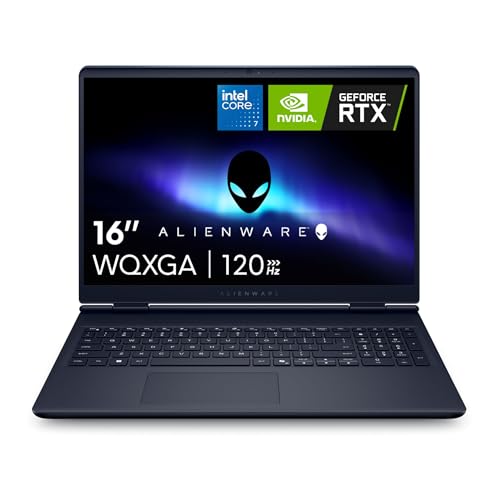
Alienware 16 Aurora RTX 5060 — The complete streaming centre
The Aurora is the only pick in this guide that never asks its owner to compromise in a column, and its title assembles the completeness methodically: an NVIDIA RTX 5060 with an Intel Core 7 240H, a 2560×1600 display at 120Hz in 16:10, 16GB of DDR5 memory, a 1TB SSD, Windows 11 Home and a backlit keyboard, in blue. For a streamer, each figure answers a named pain. The RTX 5060 is the strongest card here, carrying the game and the broadcast’s graphical labour together; the terabyte holds the game library and the recordings archive in one place; the high-resolution screen gives the streamer a playing surface with room for the broadcast’s own windows beside the game.
That screen deserves a streamer’s reading rather than a gamer’s. At 2560×1600, the Aurora’s panel is the sharpest in the set, and a streamer lives on their screen differently from a pure player: it is simultaneously the stage, the control room and the confidence monitor. The 16:10 shape adds vertical room that broadcasting layouts quietly consume — chat docks, scene panels, the game’s own interface — and 120Hz keeps motion honest for fast titles. A streamer whose audience watches at ordinary broadcast resolutions still benefits, because the picture they play, judge and react on is the clearest one this guide offers.
Sixteen gigabytes of DDR5 is the set’s mainstream memory figure and suits the streaming desktop well: game, broadcasting software, chat and dashboards resident together without the swapping that drops frames. The title does not itemise ports, and a streamer’s peripheral thicket — microphone, camera, capture gear for a console, a second screen — makes the listing-page port check genuinely important on this pick, because a flagship centre deserves a confirmed connection story rather than an assumed one. The same applies to its webcam, which the title does not grade.
Who it suits is the committed streamer: the creator whose channel is a going concern, whose games are demanding, whose recordings archive matters, and who wants one machine to be the whole studio. Beginners should measure themselves against the Victus and Nitro picks before paying for completeness they may not use — a channel’s first hundred hours rarely tax an RTX 4050 — but a streamer who already knows the double workload’s weight will recognise this specification as the one in the guide that never makes them apologise to their audience for their hardware.
- Display: 2560×1600, 120Hz, 16:10
- Processor: Intel Core 7 240H
- Graphics: NVIDIA RTX 5060
- Memory: 16GB DDR5 RAM
- Storage: 1TB SSD
- Keyboard: backlit keyboard
- Operating system: Windows 11 Home
- Ports: Not stated in the listing title — verify with the manufacturer documentation
- Finish: Blue
Strengths
- The RTX 5060 is the strongest discrete card in this guide.
- A 2560×1600 screen gives the streamer the clearest stage and control room.
- 1TB of storage holds games and a recordings archive without negotiation.
Trade-offs
- Ports are not itemised in the title, and streamers live through their ports.
- Beginners may pay for completeness their first hundred hours never tax.
- The webcam is not graded in the title for face-camera streamers.
Best for: a committed streamer running demanding games who wants one machine as the whole studio centre. Not suited for: a first-time broadcaster testing the hobby, whose audience and games will not yet spend an RTX 5060’s advantage — the 4050 picks serve that apprenticeship fully.
Build the studio around this machine deliberately: decide the port story from the listing before the peripherals arrive, organise the terabyte into games, recordings and exports from the first week, and let the big screen’s layout become a fixed habit so broadcasts start from muscle memory. A streaming centre earns its name through routine as much as hardware, and the Aurora gives a creator the specification to make the routine invisible — which is when audiences start complimenting the stream instead of the setup.

Acer Nitro V RTX 4050 — High-refresh entry
The Nitro V is the fastest screen in the guide attached to its most instructive compromise. Its title specifies an Intel Core i5-13420H, an NVIDIA GeForce RTX 4050 laptop GPU, a 15.6-inch FHD IPS display at 165Hz, 8GB of DDR5 memory and a 512GB Gen 4 SSD, with Wi-Fi 6 and a backlit keyboard, model ANV15-52-586Z. The playing surface is genuinely excellent for a streamer — 165Hz of IPS smoothness for fast games, where the broadcast’s source picture is born — and the RTX 4050 is a real discrete card, placing this machine categorically inside the serious streaming class.
The compromise is memory, and a streamer’s review must weigh it more heavily than a gamer’s would. Eight gigabytes must hold the game, the broadcasting software, the chat and the dashboards simultaneously, because that simultaneity is streaming’s definition. Undemanding games with a lean broadcast setup will live inside it; demanding titles with a busy overlay ecosystem will press against it, and memory pressure during a broadcast announces itself exactly where a streamer can least afford it — in the smoothness of the picture the audience is watching. The Nitro’s buyer should therefore be a streamer whose games are moderate, or whose broadcast setup is deliberately light.
Set against its natural rival, the Victus below with the same card and processor class, the trade is cleanly drawn: the Nitro offers the faster screen, 165Hz against 144Hz, and the Victus offers double the memory. For a player-streamer of fast, light titles, the screen may honestly win. For a streamer whose games are heavy or whose setup is elaborate, memory is the working specification and refresh is the garnish. The guide refuses to call either answer wrong; it insists only that the choice be made knowing which workload you actually broadcast.
Who it suits is the fast-game streamer on a disciplined setup: esports-shaped titles, a lean broadcasting configuration, an audience built on gameplay rather than production sprawl. The Gen 4 SSD and Wi-Fi 6 keep the supporting specification modern, and the backlit keyboard serves the dim room that streaming so often happens in. Buyers should confirm the port list on the listing with the same care as the Alienware’s, since a capture device or a console in the setup makes ports a purchasing fact, not a detail.
- Display: 15.6-inch FHD IPS, 165Hz
- Processor: Intel Core i5-13420H
- Graphics: NVIDIA GeForce RTX 4050 Laptop GPU
- Memory: 8GB DDR5 RAM
- Storage: 512GB Gen 4 SSD
- Wireless: Wi-Fi 6
- Keyboard: backlit keyboard
- Model: ANV15-52-586Z
Strengths
- A 165Hz IPS screen is the fastest playing surface among the 15.6-inch picks.
- The RTX 4050 places it firmly inside the discrete streaming class.
- A Gen 4 SSD and Wi-Fi 6 keep the supporting specification current.
Trade-offs
- 8GB of memory must hold game, broadcast software and chat at once.
- 512GB is shared between a game library and a recordings archive.
- Ports are not itemised in the title for capture-device users.
Best for: a streamer of fast, moderate games running a lean broadcast setup who values the 165Hz screen. Not suited for: a streamer of demanding titles with an elaborate overlay and dashboard ecosystem — 8GB of memory makes that simultaneity a dropped-frame risk the audience will see.
Run this machine’s broadcast lean and it will shine: keep the overlay count honest, close the browser tabs the dashboard does not need, and let the 165Hz screen do the showing off. Streamers who treat memory as a production budget — spent deliberately, never by accident — can run a sharp, fast channel on this Nitro. The specification rewards discipline so visibly that it almost teaches it.

HP Victus 15 RTX 4050 — Memory-rich 4050
HP’s Victus 15 is the Nitro’s mirror image, and the pairing is the most instructive comparison in the guide. The title specifies a 15.6-inch FHD screen at 144Hz, an Intel Core i5-13420H, an NVIDIA GeForce RTX 4050 with 6GB of graphics memory stated, 16GB of DDR4 memory and a 512GB SSD, in Mica Silver, a 2024 model. Same card class, same processor, and then the deliberate divergence: double the memory, a step slower on the screen. For the streaming workload — where the desktop’s simultaneity is the whole game — this review regards the Victus’s side of the trade as the one most broadcasters should take.
Sixteen gigabytes changes the broadcast’s texture. The game, the broadcasting software with its scenes and sources, the chat client, the dashboard browser and the music or alert stack all stay resident, and the machine stops mediating between the performance and the production. That is not a luxury for a streamer; the audience experiences memory shortage as stutter in the one product the streamer sells. The RTX 4050’s own 6GB of graphics memory, stated in this title where the Nitro’s is not, is a further small honesty in the Victus’s favour for GPU-side headroom.
The concessions are the screen’s 144Hz against the Nitro’s 165Hz — a difference competitive players may feel and most broadcast audiences will never see, since broadcasts themselves run at far lower rates — and the DDR4 memory standard, a generation behind the DDR5 in several rivals, whose practical effect at equal capacity is modest beside the capacity difference itself. The 512GB drive repeats the class’s storage negotiation between games and recordings, and the 2024 dating places the model a season behind the freshest here without making its specification obsolete.
Who it suits is the mainstream working streamer: demanding-enough games, a proper broadcast setup with scenes and dashboards, an audience that punishes stutter. It is arguably the guide’s best-balanced discrete pick for the broadcast workload specifically, because it spends its specification on the resource streaming actually exhausts. Players who stream only occasionally, and play competitively always, may reverse the Nitro comparison with a clear conscience; broadcasters should not.
- Display: 15.6-inch FHD, 144Hz
- Processor: Intel Core i5-13420H
- Graphics: NVIDIA GeForce RTX 4050, 6GB
- Memory: 16GB DDR4 RAM
- Storage: 512GB SSD
- Finish: Mica Silver (2024)
- Wireless: Not stated in the listing title — verify with the manufacturer documentation
- Keyboard: Not stated in the listing title — verify with the manufacturer documentation
Strengths
- 16GB of memory serves the streaming desktop’s simultaneity properly.
- The RTX 4050’s 6GB graphics memory is stated outright in the title.
- A 144Hz screen keeps fast games fluid for player and broadcast alike.
Trade-offs
- 144Hz trails the Nitro’s 165Hz for the most competitive players.
- DDR4 is a generation behind the DDR5 in several rival picks.
- Storage remains the shared 512GB negotiation of its class.
Best for: a working streamer whose broadcast setup is elaborate and whose games are demanding enough to need memory headroom. Not suited for: a competition-first player who streams lightly and feels refresh-rate differences acutely — the Nitro’s 165Hz screen serves that priority better at this card tier.
The Victus rewards the streamer who builds a real production: scenes prepared, dashboards arranged, the recording of every broadcast kept for clips. Keep the archive discipline the 512GB drive demands — finished recordings moved off on a schedule, not in a panic — and this machine will carry a growing channel through the stage where most creators discover whether broadcasting is their craft. Its specification is aimed at exactly that discovery.

NIMO 15.6 Light Gaming — The light route
The NIMO’s review begins where its honesty must: there is no discrete graphics card in this machine. Its title describes a 15.6-inch FHD light-gaming laptop with an eight-core AMD Ryzen 7 — framed by the seller as beating an i7 12650H at up to 4.75GHz — working through integrated Radeon 680M graphics, with 8GB of DDR5 memory, a 256GB SSD, 100W fast PD charging and a backlit keyboard, positioned for AI content creators, students, entertainment and productivity. In streaming terms, that specification describes the software-encoded route: the processor carries the broadcast’s encoding labour itself, while the integrated graphics carry the picture, and both facts set this pick’s ceiling.
What that ceiling honestly permits is a real, if modest, streaming life. Undemanding games, older titles, creative and just-chatting formats, screen-sharing and presentation-led broadcasts — content whose picture is light — can be streamed from this machine at sensible settings, particularly by a broadcaster who keeps resolution and bitrate ambitions in proportion. The Ryzen 7 is a capable processor, the fast charging suits a creator moving between rooms, and as an apprenticeship machine — is broadcasting for me at all? — it asks the smallest commitment in the guide.
What it cannot honestly promise is the discrete machines’ world. A demanding modern game played and broadcast simultaneously divides its integrated graphics and its processor between two hungry jobs, and the audience sees the compromise. Eight gigabytes of memory repeats the Nitro’s simultaneity problem without the Nitro’s discrete card to compensate, and 256GB of storage is the guide’s smallest figure, shared between even a modest game library and any recordings at all. The seller’s own light-gaming label, read carefully, is the same warning in politer language, and this guide’s framing merely declines to soften it further.
Who it suits is the beginner whose content is light and whose question is exploratory, and the creative streamer whose broadcast is themselves, their screen and their voice rather than a demanding game. Who it does not suit is any streamer whose game is the product and whose audience will judge the broadcast’s smoothness — for them the RTX 4050 picks are the floor, and the saving represented by the NIMO is the most expensive kind: the kind paid in viewers. The guide includes it so that boundary is drawn in print, beside the machine, where a hopeful beginner cannot miss it.
- Display: 15.6-inch FHD
- Processor: AMD Ryzen 7, 8 cores (up to 4.75GHz, as stated)
- Graphics: Radeon 680M integrated graphics — no discrete GPU
- Memory: 8GB DDR5 RAM
- Storage: 256GB SSD
- Charging: 100W fast PD
- Keyboard: backlit keyboard
- Positioning: light gaming, creators and student entertainment
Strengths
- A capable eight-core Ryzen 7 carries light, software-encoded broadcasts.
- Fast 100W PD charging suits a creator working between locations.
- It is the lowest-commitment way in this guide to test a streaming life.
Trade-offs
- Integrated graphics cannot share demanding games and broadcasting well.
- 8GB of memory and 256GB of storage are the guide’s tightest figures.
- The seller’s light-gaming label marks the same ceiling this review describes.
Best for: a beginner broadcasting light games, creative formats or talk-led content while testing whether streaming is for them. Not suited for: streaming demanding modern games to an audience that will judge smoothness — integrated graphics and 8GB of memory make that broadcast a compromise viewers can see.
If this is your first streaming machine, spend your ingenuity where it compensates: strong lighting and sound for a talk-led format, a distinctive scene design, games chosen for charm rather than graphical appetite. Audiences forgive a modest picture sooner than a dull broadcast, and many durable channels began on hardware humbler than their creators now admit. Learn the craft here, and the day a discrete machine becomes necessary will announce itself clearly — in a game you cannot do justice to, in front of an audience you have already earned.

HP Victus 15 RTX 3050 — The older-card workhorse
The second Victus in this guide steps down a graphics generation and compensates with the broadcaster’s essentials. Its title specifies a 15.6-inch Full HD screen at 144Hz, an Intel Core i5-12450H, an NVIDIA GeForce RTX 3050, 16GB of memory and a 512GB PCIe SSD, with Wi-Fi 6 and a backlit keyboard, running Windows 11 Pro, in Performance Blue. The RTX 3050 is the oldest card here, and the review will not pretend otherwise; but a discrete card it remains, which keeps this machine inside the serious streaming class that the integrated NIMO stands outside.
The 3050’s honest territory is the enormous library of games that are not this year’s flagships: competitive titles, older releases, indie games, and modern games at moderated settings, played and broadcast together with the competence a discrete GPU provides. Sixteen gigabytes of memory — the figure this guide keeps identifying as the streaming desktop’s real requirement — supports the full broadcast setup around those games, and the 144Hz screen keeps the playing surface modern even where the card is not. For a variety streamer, whose catalogue spans decades of games, this balance may fit better than a newer card behind half the memory.
Windows 11 Pro is this pick’s quiet distinction — the only Pro edition in the streaming guide — which matters to the streamer who also works on the machine inside any managed environment, and costs the pure broadcaster nothing. The i5-12450H is a generation behind the 13420H in the 4050 picks, a difference that registers at the margins of demanding work rather than in the centre of a broadcast day. Storage repeats the 512GB class standard, with the same archive discipline attached.
Who it suits is the variety and catalogue streamer, the broadcaster whose games are chosen for their communities rather than their graphics, and the working creator who values the Pro edition and the full memory figure over card novelty. Who should step up is the streamer whose flagship modern title is the channel’s centrepiece — the 4050 pair and above exist for that broadcast. Judged as a workhorse rather than a headline, the 3050 Victus is the guide’s reminder that a streaming machine is a system, and that systems are balanced or they are nothing.
- Display: 15.6-inch Full HD, 144Hz
- Processor: Intel Core i5-12450H
- Graphics: NVIDIA GeForce RTX 3050
- Memory: 16GB RAM
- Storage: 512GB PCIe SSD
- Wireless: Wi-Fi 6
- Keyboard: backlit keyboard
- Operating system: Windows 11 Pro
- Finish: Performance Blue
Strengths
- A discrete RTX 3050 keeps it inside the serious streaming class.
- 16GB of memory supports a full broadcast setup around the game.
- Windows 11 Pro is unique in this guide and suits work-and-stream lives.
Trade-offs
- The RTX 3050 is the oldest graphics card in this guide.
- The processor is a generation behind the 13420H in the 4050 picks.
- Flagship modern games will need moderated settings to stream well.
Best for: a variety or catalogue streamer whose games span older and competitive titles, with a full broadcast setup to support. Not suited for: a channel built on a demanding current flagship game, where the RTX 3050’s generation shows in the broadcast — the 4050 and 5050 picks are the step up that broadcast requires.
Treat this Victus as the professional’s spare, reliable instrument: its specification will not trend on any chart, and its broadcasts, properly produced, will not care. Keep the game settings matched honestly to the card, the recordings archive pruned on schedule, and the Pro edition’s advantages used if a working life shares the machine. Channels are built on consistency, and a workhorse that shows up identically every day is a foundation, not a compromise.

Acer Nitro V RTX 5050 — Newest card, fast screen
The second Nitro closes the discrete ladder with the newest card of the 15.6-inch class, and its title is unusually specific about the graphics memory: an Intel Core i5-13420H, an NVIDIA GeForce RTX 5050 with 8GB of GDDR7 VRAM stated, a 15.6-inch FHD IPS display at 165Hz, 16GB of memory and a 512GB PCIe SSD, running Windows 11 Home and bundled with a mouse pad. That combination — the 5050’s newer generation, the joint-fastest screen in the guide, and the full 16GB of memory whose absence limited the other Nitro — reads like a direct answer to its sibling’s review, and it makes this the most complete 15.6-inch streaming specification here.
The RTX 5050 sits a tier above the 4050 pair in generation, and for a streamer the tier matters in the double workload’s hardest moments: a demanding scene, a busy fight, an effects-laden moment where the game and the broadcast compete for the same silicon. The stated 8GB of GDDR7 graphics memory is a figure several rival titles omit, and its presence lets a buyer judge the card’s own headroom rather than its badge alone. Sixteen gigabytes of system memory then removes the simultaneity anxiety that shadows the 4050 Nitro — game, broadcast suite, chat and dashboards resident together, as a working channel requires.
The screen repeats the Nitro line’s 165Hz IPS proposition, now properly supported: fast games look fast on the panel where the broadcast is born. The 512GB drive is the specification’s one ordinary figure, shared with most of the class, and the archive discipline of the other reviews applies unchanged — a streamer’s recordings are a growth stock, and the drive will want its quarterly reckoning. A mouse pad in the bundle is a small, telling inclusion: a maker packing for a player who will set up and play today, which is also, not coincidentally, how streamers begin.
Who it suits is the serious 15.6-inch streamer: demanding games, a full broadcast setup, and no desire to move to the Alienware’s 16-inch, higher-resolution class. It is the pick this guide would hand to a growing channel whose audience has begun to punish stutter and whose games have begun to punish hardware. Buyers whose broadcasts are lighter should save with the Victus 4050’s balance; buyers whose studio ambitions include the sharpest screen should step to the Aurora. Between those poles, this Nitro is the ladder’s most convincing rung.
- Display: 15.6-inch FHD IPS, 165Hz
- Processor: Intel Core i5-13420H
- Graphics: NVIDIA GeForce RTX 5050, 8GB GDDR7 VRAM
- Memory: 16GB RAM
- Storage: 512GB PCIe SSD
- Operating system: Windows 11 Home
- Bundled: mouse pad (as stated in the title)
- Wireless: Not stated in the listing title — verify with the manufacturer documentation
Strengths
- The RTX 5050 with a stated 8GB of GDDR7 is the newest card story here.
- 16GB of memory fixes the simultaneity limit of the 4050 Nitro.
- A 165Hz IPS screen matches the fastest playing surface in the guide.
Trade-offs
- 512GB remains the class’s shared storage negotiation.
- The Alienware’s 2560×1600 screen out-resolves its FHD panel for control-room use.
- Wireless details are not stated in the listing title.
Best for: a growing channel streaming demanding games on a 15.6-inch machine with a full broadcast setup. Not suited for: a streamer who wants the control-room sharpness of a 2560×1600 screen or a terabyte of internal room — the Alienware holds both advantages in exchange for its size and tier.
Let this machine’s completeness set the channel’s standards: scenes built properly rather than improvised, recordings kept and clipped on a rhythm, game settings tuned once for the broadcast rather than per session. A specification without a weak column invites a production without a weak habit, and the streamers who accept that invitation are the ones whose channels start to feel, to their audiences, inevitable. The Nitro’s job is to remove hardware from the list of things that could go wrong live — and on the evidence of its title, it does.
Comparison
| Pick | Display | Graphics | Memory / Storage | Notable from title |
|---|---|---|---|---|
| Alienware 16 Aurora | 2560×1600, 120Hz, 16:10 | RTX 5060 | 16GB DDR5 / 1TB SSD | Core 7 240H, backlit keyboard |
| Acer Nitro V RTX 4050 | 15.6″ FHD IPS 165Hz | RTX 4050 | 8GB DDR5 / 512GB Gen 4 SSD | i5-13420H, Wi-Fi 6 |
| HP Victus 15 RTX 4050 | 15.6″ FHD 144Hz | RTX 4050 6GB | 16GB DDR4 / 512GB SSD | i5-13420H, Mica Silver 2024 |
| NIMO 15.6 Light Gaming | 15.6″ FHD | Radeon 680M integrated | 8GB DDR5 / 256GB SSD | Ryzen 7, 100W fast PD |
| HP Victus 15 RTX 3050 | 15.6″ FHD 144Hz | RTX 3050 | 16GB / 512GB PCIe SSD | i5-12450H, Windows 11 Pro |
| Acer Nitro V RTX 5050 | 15.6″ FHD IPS 165Hz | RTX 5050 8GB GDDR7 | 16GB / 512GB PCIe SSD | i5-13420H, mouse pad bundled |
The graphics column is a ladder and should be climbed deliberately: 5060 at the top, then 5050, then the 4050 pair divided by memory, then the 3050, and finally — off the ladder entirely, on the ground beside it — the integrated NIMO. That last placement is the table’s most important information. A streamer who reads the NIMO’s row as merely the bottom rung will misunderstand their purchase; it is a different kind of machine for a different kind of broadcast, and the reviews above keep it in that separate class on purpose.
Memory is the column that separates broadcasters from players. Two picks carry 8GB, and both carry it as their defining negotiation — the Nitro 4050 trading it for a screen, the NIMO accepting it as part of the light route. The four 16GB machines are the guide’s working broadcasters, and a reader torn between rows should weigh that column as heavily as the graphics ladder itself, because the audience experiences both, without knowing either’s name.
How to Choose a Laptop for Streaming
Start with the broadcast, not the game. Describe your stream concretely: the titles or formats, the resolution and pace you intend to broadcast at, the overlay and dashboard ecosystem around it, and whether a console or a second device feeds the picture. That description sets the graphics tier — light and talk-led content at the integrated boundary, mainstream games on the 4050 class, demanding modern titles on the 5050 and 5060 — and it sets the memory floor, because every element of the production you described must live in memory simultaneously while the audience watches.
Treat 16GB as the working streamer’s floor, as four of these picks do. The 8GB machines are not mistakes; they are negotiations, legible in their reviews — a faster screen on the Nitro, a lighter route on the NIMO — but a streamer building a channel rather than testing one should not begin negotiations with the resource their audience feels most directly. Dropped frames are the one review a streamer cannot argue with, and memory is where many of them are born.
Storage third, because a streamer’s drive holds two growing archives at once: the game library, which expands by the hundred hours, and the recordings, which expand by the broadcast. A terabyte — the Alienware alone here — houses both comfortably; 512GB houses both with a pruning rhythm; 256GB, the NIMO’s figure, houses a small library and a ruthless recordings policy. Choose the figure whose rhythm you will actually keep, because an archive discovered to be full mid-broadcast week is a production problem disguised as a specification.
Finish with the unglamorous physical audit. Ports, which no title here itemises, decide whether your microphone, camera, capture device and second screen connect as a studio or as a thicket of hubs — read the finalist’s listing for its port list as a purchasing step, not a curiosity. The screen you play on, the keyboard under your hands in a dim room, the wireless standard between you and the router: each is a nightly working condition. A streaming laptop is a studio that happens to fold, and studios are chosen on their working conditions as much as their headline power.
Can You Stream Without a Discrete Graphics Card?
Yes, within a defined territory — and the NIMO in this guide exists to map that territory honestly. Its Ryzen 7 processor can carry the encoding labour in software while its integrated Radeon 680M carries a light picture: talk-led formats, creative streams, presentations, older or undemanding games at sensible settings. For a beginner, that territory is not a consolation prize; it is where most channels actually start, and a broadcaster who builds an audience there has lost nothing when they later upgrade, because the audience followed the content, not the card.
The territory’s borders are equally definite. A demanding modern game asks its graphics hardware for everything it has merely to be played; asking the same integrated hardware to sustain a broadcast of that play divides an already-spent resource, and the result reaches the audience as stutter, softness or a lowered resolution that no overlay design can disguise. Memory tightens the border further — the NIMO’s 8GB must hold the production as well — so the integrated route’s honest settings are modest ones, chosen deliberately rather than discovered live.
The decision rule this guide offers is about the product being sold. If the broadcast’s appeal is the host — their craft, commentary, company — the integrated route can carry it while the channel finds its feet. If the appeal is the game at its best, the discrete ladder is the price of the product, and its first rung is the RTX 4050 pair. Streamers who name their product honestly before buying rarely regret the machine they chose; streamers who buy the machine and then discover their product are the ones writing the cautionary posts.
How Much Memory Does a Live Broadcast Actually Need?
Count the residents of a working streamer’s desktop, because memory is spent by residency. The game is the largest tenant. The broadcasting software, with its scenes, sources, filters and preview, is the second. Then the household around them: the chat client, the browser carrying dashboards and alerts, the music or voice applications, the recording writing quietly to disk. Each is modest; together they are the reason this guide treats 16GB as the working floor, and the reason the two 8GB picks carry their memory figures as headline negotiations in their reviews.
The failure mode of insufficient memory is crueller in streaming than in any other workload in this series, because it is public. A home user whose machine swaps sees a pause; a streamer whose machine swaps broadcasts the pause, at scale, to everyone watching, in the middle of the moment the broadcast existed for. That asymmetry is why the guide’s memory advice tilts conservative even where its other advice economises: the graphics tier can be matched to today’s games and revisited next year, but the memory figure will be present at every broadcast, including the biggest one of the channel’s life.
Practical discipline can stretch a given figure, and the Nitro 4050’s review describes it — lean overlays, closed tabs, a production pruned to what the audience actually sees. Discipline is a genuine strategy for a beginner or a light production. But a streamer whose plans are elaborate should buy the headroom rather than the discipline, because productions grow in one direction, and the broadcast that adds a second camera, a guest feed and a new dashboard in the same month is a normal month in a growing channel’s life.
Which Screen Matters More for Streaming: Resolution or Refresh?
The two screen philosophies in this guide divide along the streamer’s own seat. The 15.6-inch picks chase refresh — 144Hz and 165Hz — because the streamer plays on this panel, and fast, fluid motion serves both their performance in fast games and the source picture the broadcast is built from. The Alienware chases resolution — 2560×1600 in 16:10 — because a streamer’s screen is also a control room, and the extra room houses the production’s windows beside the game without shrinking either into uselessness.
The audience’s view argues for humility about both. Broadcasts are delivered at resolutions and rates well below what these panels display, so neither the 165Hz motion nor the full 2560×1600 detail reaches the viewer intact; what reaches them is a well-encoded picture of a well-played game. The screen’s real beneficiaries are the streamer — their aim, their judgement, their comfort across a long session — and that is reason enough to choose carefully, provided the choice is made for the seat it actually serves.
Decide by your failure mode. Streamers who lose fights and moments to motion — competitive players of fast titles — should take refresh, and the Nitro pair exists for them. Streamers who lose time and temper to a cramped production layout — many sources, many dashboards, a game that must share its screen — should take the Alienware’s room. Both are professional answers; the unprofessional one is buying whichever figure is larger in a listing without asking which of your own evenings it improves.
What Should a New Streamer Spend On First: the Laptop or the Peripherals?
The laptop, if the choice is forced — because peripherals amplify a broadcast, and the laptop is the broadcast. A fine microphone on a machine that drops frames produces a beautiful voice over a broken picture; a modest microphone on a machine that holds its broadcast produces a channel. The order of operations in this guide’s tier is therefore: a discrete graphics card and 16GB of memory first, the port audit second, and the peripheral upgrades as the channel’s growth funds them, in the order your audience’s complaints suggest.
That said, the physical audit in the choosing section deserves repeating here, because peripherals decide one laptop question in advance: connections. If your setup already owns a capture device, a particular camera or an audio interface, their requirements belong in the laptop decision — read through the finalist’s listing port list — rather than discovered as an incompatibility on the first night. A streamer planning to grow into peripherals can defer that audit; a streamer who already owns them cannot.
The mature budget, in this guide’s judgement, treats the laptop and its first peripherals as one purchase with two parts: the machine that carries the double workload, and the one or two connections and instruments the format cannot start without. Everything beyond that — the lighting’s refinement, the second screen, the elaborate scene design — is growth spending, best made after the channel has told you, through its audience, what it actually is. Hardware bought in that order rarely gathers dust, which is the quiet test of every streaming purchase.
Should a Streamer Buy One Machine or Split the Work Across Two?
Large productions sometimes separate the playing machine from the broadcasting machine, and beginners occasionally ask whether they should imitate that architecture from the start. For the audience of this guide, the answer is one machine, chosen properly — and the reasoning is practical rather than purist. A second machine doubles the cost, the desk, the audio routing and the number of things that can fail live, while buying a reliability that a single well-specified laptop already provides at this tier. Every pick on the discrete ladder here was chosen to carry the double workload alone, because that is the workload its buyer actually has.
The two-machine pattern earns its complexity only when a single machine demonstrably cannot hold the production: an unusually demanding game at the highest settings, a many-camera broadcast, a professional operation where a failure must never reach the audience. Those are descriptions of established productions with revenue and staff, not of the channels this guide serves. A growing streamer who feels the pull of a second machine should first audit whether the pressure they feel is real capacity — frames genuinely lost on a 16GB discrete machine — or the glamour of a professional’s desk photographed for social media. The audit usually answers itself, and the money returns to where this guide keeps pointing it: the card, the memory, and the archive.
Common Mistakes When Buying a Streaming Laptop
Reading the integrated pick as the ladder’s bottom rung. The NIMO’s Radeon 680M is a different class from the RTX machines, not a cheaper version of them. Bought for light, talk-led streaming it serves well; bought to broadcast demanding games, it disappoints in public.
Choosing 8GB for an elaborate production. Game, broadcast suite, chat and dashboards are simultaneous residents. On 8GB, a busy production presses the ceiling mid-broadcast — where the audience, uniquely, gets to watch the specification fail.
Letting refresh rate outrank the graphics tier. A 165Hz screen behind a card that cannot feed it, while broadcasting, is a garnish on an empty plate. Climb the graphics ladder first; the screen’s turn comes after the card and the memory are settled.
Forgetting the port audit. No title in this guide itemises its ports, and streamers live through theirs. Check the finalist’s listing for the connections your microphone, camera and capture gear require before the first night depends on them.
Planning storage for the launch, not the archive. Games and recordings grow together. A drive chosen for the first month becomes the tenth month’s crisis; adopt the pruning rhythm, or the terabyte, at purchase.
Final Recommendation
Committed streamers should take the Alienware 16 Aurora: the strongest card, the sharpest and roomiest screen, and the only terabyte, in one studio centre. Growing channels on a 15.6-inch brief should take the Acer Nitro V RTX 5050, whose card, memory and screen form the class’s most complete balance. The mainstream broadcaster is best served by the HP Victus 15 RTX 4050 and its memory-first trade; competitive players who stream lightly may reverse that choice for the Nitro 4050’s faster screen. The Victus RTX 3050 is the catalogue streamer’s workhorse, and the NIMO is the honest apprenticeship for light, talk-led beginnings.
A stream is a promise made in real time, in front of witnesses, that the picture will hold. Buy the machine whose graphics, memory and storage let you keep that promise on your channel’s biggest night — not its average one — and the audience will never learn your hardware’s name, which is the highest compliment streaming equipment can earn.
Frequently Asked Questions
Which graphics card should a streamer start with?
The RTX 4050 class is the sensible floor for game streaming — it appears here in the Nitro and the Victus, divided by the memory-versus-screen trade their reviews describe. Demanding modern titles argue for the 5050 or the Alienware’s 5060. Integrated graphics, the NIMO’s route, are for light and talk-led formats rather than game-led channels.
Is 8GB of memory enough to stream?
For a lean production and undemanding games, it can be — the Nitro 4050 and the NIMO both ask the question honestly. For a working channel with scenes, dashboards and a demanding game resident together, this guide treats 16GB as the floor, because memory pressure during a broadcast is visible to the entire audience.
Can the NIMO really stream at all without a discrete card?
Yes, in the light territory its review maps: talk-led formats, creative streams, presentations and undemanding games at sensible settings, with the processor carrying the encoding in software. It cannot carry a demanding modern game and its broadcast together the way the RTX picks can, and it should never be bought as their equivalent.
Why do two picks share the RTX 4050 but feel different?
Because a streaming machine is a system. The Acer Nitro V pairs the card with 8GB of memory and a 165Hz screen; the HP Victus pairs it with 16GB of memory and a 144Hz screen. Players feel the screen; broadcasters feel the memory. Choose by which of those your evenings actually spend.
How much storage does a streamer need?
More than a gamer, because recordings join the game library on the same drive. The Alienware’s 1TB is the comfortable figure; 512GB works with a pruning rhythm for finished recordings; the NIMO’s 256GB suits a small library and a ruthless archive policy. Decide the rhythm at purchase, not at the first full-drive warning.
Does the streaming laptop’s screen resolution reach the audience?
Not directly — broadcasts are delivered at lower resolutions than these panels display. The screen serves the streamer: the Alienware’s 2560×1600 gives control-room room and a sharp playing surface, while the 144Hz and 165Hz panels serve fast play. Choose the screen for your own seat and workload, and let the encoder worry about the audience’s.
Related Guides
Streamers planning a convertible or secondary machine for travel broadcasts should compare the best affordable 2-in-1 laptops, where folding designs and touchscreens serve presenters and creators on the move. Those whose channels are growing into workstation territory will find the processing-first argument in the best affordable i7 laptops, with processor generations separated for heavy multitasking and production. And creators weighing a larger studio screen should finish with the best affordable 17 inch laptops, where the biggest canvases in the affordable class are compared for desk-based work.


