What's inside
- Where to Buy
- Key Takeaways
- Quick Picks
- How We Chose These Picks
- Comparison
- How to Choose an Android TV
- What Is the Difference Between Android TV and Google TV?
- Is a Streaming Box a Substitute for an Android TV?
- Do Android TVs Work for Gaming?
- How Long Will a Google TV Set Stay Current?
- Common Mistakes When Buying an Android TV
- Final Recommendation
- Frequently Asked Questions
- Related Guides
As an Amazon Associate I earn from qualifying purchases. This post may contain affiliate links at no extra cost to you.
[SITE_DOMAIN] is reader-supported. When you buy through links on our site, we may earn an affiliate commission.
Where to Buy
Each of the six televisions below is sold on Amazon under its own listing, and the links throughout this guide lead to those listings so the current figure and the exact model variant can be confirmed. Buyers usually begin with the FPD 43-inch Android TV as the value reference, then compare the FPD 32-inch Google TV for smaller rooms and the FPD 40-inch Google TV for the middle ground. The performance end of the guide lives on the TCL 55-inch T7 and TCL 55-inch QM6K listings, while the TCL 32-inch S3 covers the compact brand-name option. Model years and panel specifications shift quickly in this category, so the listing page is the place to verify both before ordering.
The best android tvs share one defining trait: the television itself runs Google’s television software — Android TV or its successor interface, Google TV — with the Play Store, Google Cast, and Google Assistant woven into the set rather than bolted on through a stick. The six picks below divide into two clear families. Three FPD sets cover the value and compact ground at 32, 40, and 43 inches, and three TCL sets cover the brand-name ground, from a 32-inch Full HD model up to a pair of 55-inch 4K flagships built for sport and gaming. Every platform claim in this guide traces to the sets’ own listing titles, and rival systems are named correctly where they appear for contrast: Roku sets run Roku, Fire TV sets run Amazon’s platform, and neither appears here as a pick.
Why insist on the platform being built in? Because a television’s software is its daily texture — the home screen you navigate half-asleep, the voice search you use with your hands full, the casting that either works from your phone in two taps or does not work at all. Google TV’s particular strengths are its app catalogue through Google Play, its native Cast support from Android phones and Chrome, and an assistant that answers questions and controls the set in the same breath. For households already living in Google’s ecosystem — Android phones, Google accounts, Chromecast habits — a set that speaks the same language removes a layer of friction from every evening.
Sizes and ambitions spread wider here than in most TV guides on this site, deliberately. A 32-inch Google TV for a kitchen or guest room and a 55-inch Mini LED flagship for a living room are both, legitimately, Android TV purchases, and the guide treats them as one category with two altitudes rather than pretending a single recommendation could serve both rooms. Read the verdicts by room and by habit; the right pick announces itself quickly once those are honest.
A final framing note: this category rewards buyers who decide the platform question once and then shop calmly inside it. The sets below were not ranked against Roku or Fire TV rivals, because that contest is settled by the household’s phones and accounts, not by panels. Inside Google’s world, though, the differences are real — interface generation, panel technology, refresh ceiling, and size — and the reviews spend their length on exactly those.
Key Takeaways
- Every pick runs Android TV or Google TV per its listing title, with Google Play and Google Cast appearing across the range — no Roku or Fire TV sets are included.
- The FPD trio covers value: a 43-inch Android TV with HDR10 and Cast, a 40-inch Google TV with Dolby Audio, and a 32-inch 720p set for kitchens and guest rooms.
- The TCL pair at 55 inches is the performance tier: the T7 with a native 120Hz QLED panel and VRR, and the QM6K with Mini LED backlighting at 144Hz.
- The TCL S3 at 32 inches is the compact brand-name option — 1080p, Google Assistant built in, and Alexa compatibility stated in its title.
- Google Cast is the platform’s signature convenience in this guide: five of the six titles name Cast, Google Play, or the Google ecosystem explicitly.
Quick Picks
| Pick | Badge | Why it is here |
|---|---|---|
| FPD 43-inch Android TV | The value centre | A 1080p Android TV with HDR10, built-in Google Cast, and VESA wall-mount support in an ultra-thin LED design. |
| FPD 32-inch Google TV | The compact all-rounder | A 720p Google TV with Play, Cast, HDR10, Dolby Audio, and a voice remote for bedrooms and kitchens. |
| FPD 40-inch Google TV | The middle size, Full HD | A 40-inch 1080p Google TV with HDR10, Dolby Audio, Play, Cast, and a voice remote. |
| TCL 55-inch T7 | The sport and gaming screen | A 4K 120Hz QLED Google TV with Dolby Vision and Atmos, Game Accelerator 240, and VRR. |
| TCL 55-inch QM6K | The flagship | A 4K Mini LED Google TV at 144Hz with high brightness, IMAX Enhanced, and Dolby Vision and Atmos. |
| TCL 32-inch S3 | The small brand-name set | A 1080p Google TV with Google Assistant built in and Alexa compatibility for smaller rooms. |
How We Chose These Picks
Platform verification came first, and it was strict. A candidate’s listing title had to state Android TV or Google TV outright; sets whose Google connections were limited to a compatible app or a casting receiver were set aside, because a guide to Android televisions owes its readers televisions that run the platform, not televisions that merely talk to it. Streaming boxes were excluded on the same principle — a box that plugs into a TV is a different product from a TV, whatever its software, and none appears here as a pick.
The shortlist was then built in two altitudes. The value altitude — the FPD sets — answers the commonest Android TV purchase: a competent Google-powered screen for a bedroom, kitchen, or first flat, where the platform matters more than panel heroics. The flagship altitude — the two 55-inch TCL sets — answers the living-room purchase, where panel technology, refresh rate, and gaming features justify themselves nightly. The TCL S3 bridges the two: a major brand’s platform polish at a compact size.
Within each altitude, picks had to differ in ways a buyer can act on. The FPD 43 runs the older Android TV interface with HDR10 and Cast; the FPD 40 and 32 run Google TV with Play and voice remotes, separated by size and resolution. The T7 and QM6K separate on backlight technology and refresh ceiling — QLED at a native 120Hz against Mini LED at 144Hz. Duplication for its own sake was cut wherever it appeared.
The evidence standard is the site’s usual one. Features — refresh rates, HDR formats, gaming systems — appear only where a listing title states them, verified through the site’s product data, and the spec boxes record silences in the open. In a category where software names blur and marketing borrows freely between Android TV and Google TV, that title-level discipline is what keeps the guide’s platform labels trustworthy.
Readers arriving from rival platforms deserve a word about what this guide is not. It is not a verdict that Google TV beats Roku or Fire TV in the abstract — those platforms have their own guides on this site, and their own households. It is a shortlist for the buyer who has already chosen Google’s ecosystem, or is choosing it now for the phones and accounts in their pocket, and wants the televisions that express it best at each size and altitude. Judged inside that honest frame, the six sets below cover the category’s real territory without a weak seat among them.

FPD 43-inch Android TV — The value centre of the category
The FPD 43 is where this guide’s centre of gravity sits: a 43-inch television running Android TV at 1080p Full HD, in an ultra-thin LED design, with HDR10, built-in Google Cast, and VESA wall-mount support — every one of those details stated in its listing title. It is the set for the buyer whose question is simply what a competent Google-powered television costs in capability terms at a mainstream size, and its answer is reassuringly complete.
Android TV, as distinct from Google TV, is the platform’s earlier interface generation: a rows-based home screen, the same Play Store catalogue, the same Cast plumbing underneath. Buyers choosing between this set and the Google TV models below should know the difference is presentational rather than fundamental — the apps, the casting, and the account are shared, while the home screen’s organisation and recommendation style differ. Households that prefer a straightforward app-forward layout may honestly prefer this older arrangement.
Built-in Google Cast is the feature with the longest daily reach. An Android phone’s video, a Chrome tab’s presentation, a photo library shown to the room — Cast moves all of it to the big screen without a cable or a second remote, and in a 43-inch set destined for a living room or large bedroom, that two-tap convenience gets used weekly. HDR10 support, also in the title, gives streamed content a wider tonal range than a plain Full HD panel offers, which flatters film nights at this size.
The ultra-thin design and stated VESA wall-mount support suit the set’s likely homes: flats and family rooms where the television mounts flat and disappears into the wall’s plane. At 43 inches it is large enough for group viewing from a sofa and small enough for a bedroom’s far wall, the most versatile footprint in the guide. As a first Android television — the purchase that converts a household to the platform — this is the lowest-risk doorway in.
There is a longer game being played with a set like this, and it is worth seeing clearly. A household’s first platform television sets the defaults for every screen that follows: the account, the app habits, the casting reflexes of everyone in the home. Choosing the doorway set well — complete in its essentials, unforced in its interface, honest in its specification — makes every later purchase simpler, because consistency compounds. The FPD 43’s completeness at a mainstream size is exactly the quality a doorway set needs.
- Screen: 43-inch ultra-thin LED panel
- Resolution: 1080p Full HD, per the listing title
- Platform: Android TV Smart OS
- Picture: HDR10 stated in the title
- Casting: built-in Google Cast named in the title
- Mounting: VESA wall mount support stated in the title
- Voice remote inclusion: Not stated in the listing title — verify with the manufacturer documentation
Strengths
- Full HD, HDR10, and Cast cover the platform’s essentials at a mainstream size
- Published VESA support makes wall-mount planning straightforward
- Android TV’s app-forward layout suits households that dislike recommendation-heavy home screens
Trade-offs
- The older Android TV interface rather than the newer Google TV presentation
- No voice remote is confirmed in the title
- Full HD rather than 4K, at a size where 4K sets exist in this guide
Best for: a first flat or family room standardising on Google’s platform at a sensible size.
Not suited for: a voice-first household needing a confirmed voice remote in the box — the title does not state one.
Value hunters can confirm the Cast wording on the product page and check the current price on Amazon for the 43-inch FPD.

FPD 32-inch Google TV — Small room, full platform
The smallest FPD makes no apology for its size, because its title frames it precisely: a 32-inch smart TV running Google TV at HD 720p, with Google Play and Google Cast, HDR10, Dolby Audio, and a voice remote, described by its maker as compact for bedrooms, kitchens, and guest rooms. The proposition is the complete Google platform — store, casting, voice — in the footprint a secondary room can actually host.
720p at 32 inches is the specification to read in context. In a kitchen, where viewing is glance-based and distances vary from counter to table, the resolution serves perfectly well; in a guest room, it covers the news and an evening’s streaming without complaint. The viewer who will feel the ceiling is the one pressing this set into service as a primary screen for film nights or a desk monitor — roles the guide assigns to other picks. Judged in its stated rooms, the panel is matched to the work.
Dolby Audio and HDR10, both in the title, lift the set above bare-minimum secondary screens. Kitchen and guest-room viewing is dialogue-led — news, cooking programmes, talk — and audio processing that keeps voices forward at modest volume matters more in those rooms than bass or spectacle. The voice remote extends the same practicality to control: a cook with wet hands and a guest who has never seen the interface both get to their content by asking.
Google Play and Cast complete the household logic. The set joins the same account, installs the same apps, and receives the same casts as the home’s main television, so a programme started in the living room can follow its viewer to the kitchen without a second ecosystem’s passwords. Secondary rooms fail when they demand separate everything; this set’s whole specification is an argument for one platform, many screens.
Guest rooms deserve their sentence in this set’s story, because they expose a television’s manners. A guest confronted with an unfamiliar interface, in an unfamiliar house, at midnight, needs exactly what this specification provides: a voice remote to ask with, a familiar store’s apps already present, and nothing that requires the host’s credentials or a tutorial. Hosts who have ever been woken to explain a television will recognise the FPD 32’s guest-room virtues as anything but minor.
- Screen: 32-inch panel
- Resolution: HD 720p, per the listing title
- Platform: Google TV
- Store and casting: Google Play and Google Cast stated in the title
- Picture: HDR10 named in the title
- Audio: Dolby Audio stated in the title
- Remote: voice remote included per the title
- Intended rooms: bedrooms, kitchens, and guest rooms, per the title
Strengths
- The full Google TV platform — Play, Cast, voice — in a 32-inch footprint
- Dolby Audio suits the dialogue-led viewing of kitchens and guest rooms
- Shares accounts and apps with the household’s main Google TV set
Trade-offs
- 720p is the softest resolution in this guide, felt if the set is promoted to primary duty
- Compact size underserves group viewing in a living room
- No gaming or high-refresh features are claimed in the title
Best for: a kitchen, guest room, or small bedroom joining a Google household’s existing accounts.
Not suited for: a primary living-room screen for film nights — the title states HD 720p resolution at 32 inches.
Secondary-room shoppers can verify the voice remote wording on the listing and see today’s price on Amazon.

FPD 40-inch Google TV — The middle size done completely
The FPD 40, model CG40-P3 per its title, is the set that splits the difference between its siblings and completes the specification while doing so. The listing describes a 40-inch smart TV at 1080p Full HD running Google TV, with HDR10, Dolby Audio, Google Play built in, Google Cast, and a voice remote for streaming live television. Where the 32-inch model trims resolution to fit its rooms, the 40 keeps Full HD and the full feature set at a size that still fits bedrooms and smaller living rooms.
Forty inches is the overlooked middle of the television market, and in Google TV terms it is a sweet spot. It is large enough that Full HD detail registers from a sofa, large enough for two people to watch sport without crowding the screen’s centre, and small enough for a bedroom wall or a flat’s multipurpose room. Buyers who find 32 inches mean and 43 inches imposing will find this size reads as simply right in more rooms than either.
The feature completeness matters because middle sets often inherit trimmed specifications. Here the title confirms the whole Google TV toolkit — Play for apps, Cast for phones and tabs, a voice remote for search — plus HDR10 for streamed film and Dolby Audio for dialogue. Nothing in the daily experience asks the owner to remember which corners were cut, because on the evidence of the title, the corners were not cut; the panel is Full HD rather than 4K, and that is the honest extent of the compromise.
Live television streaming, named at the end of the title, rounds out a set aimed at cord-free households: broadcast-style channels through the platform alongside the subscription apps, in the rooms where a cable point never existed. For a first flat, a spare-room upgrade, or a bedroom that wants the complete platform without the flagship’s scale, the CG40-P3 is the guide’s quiet overachiever.
It is also the pick that best survives a change of rooms, which is how middle-sized televisions actually live. Bought for a small living room, it can retire to a bedroom when the flagship arrives; bought for a bedroom, it can graduate to the living room of a first flat. The complete feature set travels with it at each move — nothing about the CG40-P3’s specification confines it to the room it was bought for — and that portability of purpose is why the guide places it, rather than either sibling, at the head of the final recommendation.
- Screen: 40-inch panel
- Resolution: 1080p Full HD, per the listing title
- Platform: Google TV
- Store and casting: Google Play built in and Google Cast, stated in the title
- Picture: HDR10 named in the title
- Audio: Dolby Audio stated in the title
- Remote: voice remote control, per the title
- Model: CG40-P3
- Refresh rate beyond standard: Not stated in the listing title — verify with the manufacturer documentation
Strengths
- Full HD plus the complete Google TV toolkit at the versatile 40-inch size
- HDR10 and Dolby Audio cover picture tone and dialogue together
- Voice remote and live TV streaming suit cord-free rooms
Trade-offs
- Full HD rather than the 4K of the TCL flagships
- No high-refresh or gaming features are claimed in the title
- Less wall presence than the 43-inch sibling for group rooms
Best for: a small living room or large bedroom wanting the complete Google TV experience at a moderate size.
Not suited for: a gaming setup chasing high refresh rates — the title states no refresh figure beyond the standard panel description.
Middle-size hunters can read the CG40-P3 specification on the product page and look at the current Amazon price.

TCL 55-inch T7 — The sport and gaming QLED
The T7 is where the guide changes altitude. TCL’s title describes a 55-inch T7 Series 4K 120Hz QLED smart Google TV — model 55T7, billed as the latest — with Dolby Vision HDR and Atmos, HDR10+, Game Accelerator 240 and VRR for sports and gaming, Alexa+, and a native 120Hz refresh rate. That is a specification written for motion: the refresh rate, the variable refresh support, and the game accelerator all address the same viewer, the one watching fast things closely.
Native 120Hz, stated twice in the title in effect, is the foundation. A panel that genuinely refreshes at 120Hz — rather than interpolating toward it — renders sport and games with a clarity of motion that 60Hz sets cannot imitate: the ball stays a ball across the pitch, the camera pan in a game stays legible. VRR, variable refresh rate, completes the gaming side by letting the panel follow the console’s frame output instead of tearing or stuttering against it. For a living room where a console lives under the television, these are the two specifications that decide satisfaction.
Game Accelerator 240, TCL’s gaming mode branding as stated in the title, extends the motion story into the set’s processing, while Dolby Vision and Atmos handle the cinematic side — the film watched on the same screen after the match. HDR10+ support broadens the format coverage further. The QLED panel supplies the colour volume that bright living rooms demand, and Google TV underneath keeps the whole apparatus inside the platform this guide is about, with Alexa+ named for voice duties alongside the Google ecosystem.
Who should skip it is equally clear. A household whose viewing is series, news, and the occasional film will use a fraction of this specification; the FPD sets serve that life at a fraction of the commitment. The T7 earns its place in a room where sport is appointment viewing and a console is a permanent resident — there, its refresh and gaming systems stop being brochure items and become the reasons the set was bought, felt every single session.
One comparison inside the guide sharpens the T7’s identity. Against the QM6K, it trades Mini LED backlighting and the 144Hz ceiling for HDR10+ in its stated format list and a specification aimed squarely at the console-and-sport household rather than the cinema-first one. Neither flagship is the other’s poor relation; they are two answers to the question of what a living room is for. The household that watches films in the dark leans QM6K; the household that watches matches in the light and games after them leans T7, and both leanings are respectable.
- Screen: 55-inch QLED panel
- Resolution: 4K, per the listing title
- Refresh: native 120Hz, stated in the title
- Gaming: Game Accelerator 240 and VRR, named in the title
- Picture formats: Dolby Vision HDR and HDR10+, stated in the title
- Audio: Dolby Atmos named in the title
- Platform: Google TV, with Alexa+ per the title
- Model: 55T7, latest model per the title
- Backlight type: Not stated in the listing title — verify with the manufacturer documentation
Strengths
- Native 120Hz with VRR is a genuine gaming and sport specification, not a marketing echo
- Dolby Vision, HDR10+, and Atmos cover the cinematic formats comprehensively
- QLED colour suits bright living rooms where the set will do its work
Trade-offs
- Its motion talents are wasted on dialogue-led, casual viewing
- No Mini LED backlight claim, unlike the QM6K above it
- A 55-inch flagship footprint exceeds smaller rooms’ geometry
Best for: a living room where a games console and weekend sport are permanent fixtures.
Not suited for: a bedroom or kitchen needing a modest screen — the title states a 55-inch 4K gaming specification.
Sport-first households can verify the native 120Hz wording on the listing and check the current price on Amazon for the T7.
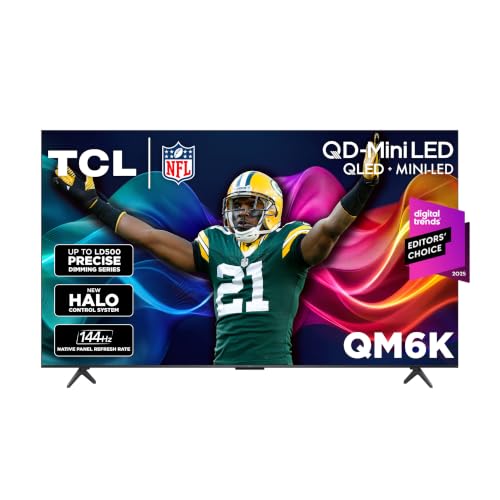
TCL 55-inch QM6K — The Mini LED flagship
The QM6K tops this guide on panel technology. Its title describes a 55-inch QM6K Series QLED Mini LED 4K HDR smart Google TV at 144Hz — the latest model, with high brightness, IMAX Enhanced certification, HDR10, Dolby Vision, Dolby Atmos audio, a voice remote, and a premium gaming positioning. Mini LED backlighting is the headline: a backlight built from far smaller, more numerous light elements, which generally delivers finer brightness control and stronger contrast than conventional LED arrangements.
High brightness, claimed in the title, is the Mini LED story’s practical half. A bright living room — south-facing windows, pale walls, daytime sport — washes out a dim panel, and a set that can push its picture through that environment keeps daytime viewing a pleasure rather than a curtains-drawn compromise. Paired with the contrast control Mini LED enables, the QM6K’s picture case is the strongest in this guide for rooms that cannot or will not be darkened.
The 144Hz refresh ceiling exceeds even the T7’s native 120Hz, and the premium gaming positioning in the title tells you where that headroom is aimed: PC and console players whose sources can feed high frame rates. IMAX Enhanced certification adds a content-side credential for film, while Dolby Vision and Atmos repeat the format coverage that makes the set a complete cinema citizen. The voice remote, stated in the title, keeps control at the level set by everything around it.
Google TV is the constant beneath the spectacle — the same Play catalogue, Cast support, and account structure as the 32-inch FPD across the guide, here driving a flagship panel. That continuity is the platform argument in miniature: a household can learn one interface on a kitchen set and meet it again, unchanged, on the living room’s best screen. Buyers choosing between the QM6K and the T7 are choosing backlight refinement and brightness against a small saving in specification — both are complete; the QM6K is simply the ceiling of what this category currently offers.
A flagship purchase also buys time, and the point deserves stating plainly. Panel and processing headroom — brightness beyond today’s rooms, refresh beyond today’s consoles — is how a television stays satisfying through the sources that have not been released yet. The QM6K’s specification is built with that headroom in every direction its title mentions. Households that replace their main screen reluctantly and rarely are precisely the households that should buy at this altitude, because the set’s surplus is their insurance.
- Screen: 55-inch QLED Mini LED panel
- Resolution: 4K HDR, per the listing title
- Refresh: 144Hz, stated in the title
- Brightness: high brightness claimed in the title
- Certification: IMAX Enhanced, named in the title
- Picture formats: HDR10 and Dolby Vision, stated in the title
- Audio: Dolby Atmos audio, per the title
- Platform: Google TV, with voice remote
- Model: 55QM6K, latest model per the title
Strengths
- Mini LED backlighting with high brightness is the strongest panel specification here
- 144Hz refresh gives gaming sources the highest ceiling in the guide
- IMAX Enhanced plus Dolby Vision and Atmos complete the cinema credentials
Trade-offs
- Flagship specification is surplus for casual, dialogue-led viewing
- Its talents demand a living room’s space and viewing distance to register
- No HDR10+ is named in the title, where the T7 claims it
Best for: a bright main living room doubling as the household’s cinema and high-end gaming screen.
Not suited for: a secondary room or modest setup — the title states a 55-inch Mini LED flagship specification.
Flagship hunters can read the Mini LED wording on the product page and view the current Amazon price for the QM6K.

TCL 32-inch S3 — The compact brand-name set
The S3 closes the guide by answering the buyer who wants a major manufacturer’s Google TV at a small size. TCL’s title describes a 32-inch class S3 1080p LED smart TV with Google TV — model 32S350G, a 2023 model — with Google Assistant built in with a voice remote, compatibility with Alexa, and streaming FHD television in black. The Full HD resolution at 32 inches is the detail that separates it from the guide’s other compact pick, the 720p FPD 32.
That resolution gap matters in the rooms these sets share. A 32-inch set in a bedroom or study sits closer to its viewer than a living-room screen, and Full HD holds text, interfaces, and fine detail together at those distances where 720p begins to soften. A student or home worker whose television doubles as a second display will feel the difference daily; a kitchen viewer glancing at the news will not. The S3 is the compact pick for the close seats.
Google Assistant built in, with the voice remote stated in the title, gives the set the platform’s hands-free layer without accessories, and the Alexa compatibility is a thoughtful bridge for mixed-assistant households — the television can be addressed from an Alexa setup elsewhere in the home while remaining a Google TV at heart. Platform diplomacy of that kind is rare enough to be worth naming when a title offers it.
The 2023 model year in the title deserves an honest sentence: this is not the newest design in the guide, and buyers who prize the latest interface revisions should weigh the FPD Google TV sets accordingly. What the S3 offers instead is a mature, well-understood model from the category’s biggest Google TV name, at the size and resolution the smaller rooms actually need. For many buyers that trade — provenance and panel over novelty — is the right one.
Set directly against its compact rival, the choice is unusually clean. The FPD 32 counters with HDR10, Dolby Audio, and a newer platform presentation at 720p; the S3 counters with Full HD sharpness and a major brand’s name at the same size. A room that watches from a distance and values tone and sound takes the FPD; a room that sits close and reads its screen takes the S3. Few purchasing decisions in this guide resolve so neatly, and buyers should enjoy the clarity rather than suspect it.
- Screen: 32-inch class LED panel
- Resolution: 1080p Full HD, per the listing title
- Platform: Google TV
- Assistant: Google Assistant built in with voice remote, stated in the title
- Compatibility: works with Alexa, per the title
- Model: 32S350G, 2023 model, in black
- HDR format support: Not stated in the listing title — verify with the manufacturer documentation
- Google Cast mention: Not stated in the listing title — verify with the manufacturer documentation
Strengths
- Full HD at 32 inches is the sharpest compact picture in this guide
- Google Assistant and a voice remote are built in, with Alexa compatibility besides
- A major brand’s platform support at a secondary-room size
Trade-offs
- A 2023 model, older than the guide’s other picks
- Neither HDR nor Cast is named in the title, unlike the FPD compact set
- Compact size limits group viewing in larger rooms
Best for: a study, bedroom, or student room needing a sharp 32-inch Google TV from a major brand.
Not suited for: a buyer needing HDR confirmed from the listing — the title states no HDR format for this model.
Compact-room buyers can confirm the 1080p wording on the listing and confirm today’s price on Amazon for the S3.
Comparison
| Pick | Size | Resolution per title | Platform | Title-stated standout |
|---|---|---|---|---|
| FPD 43 | 43-inch | 1080p Full HD | Android TV | HDR10; built-in Google Cast; VESA support |
| FPD 32 | 32-inch | HD 720p | Google TV | Google Play and Cast; Dolby Audio; voice remote |
| FPD 40 (CG40-P3) | 40-inch | 1080p Full HD | Google TV | HDR10; Dolby Audio; Play and Cast |
| TCL T7 | 55-inch | 4K | Google TV | Native 120Hz QLED; VRR; Dolby Vision and Atmos |
| TCL QM6K | 55-inch | 4K HDR | Google TV | Mini LED; 144Hz; IMAX Enhanced; high brightness |
| TCL S3 | 32-inch | 1080p Full HD | Google TV | Google Assistant built in; Alexa compatible |
How to Choose an Android TV
Begin by separating the two interfaces honestly, because the category’s name blurs them. Android TV is the platform’s earlier presentation; Google TV is its current one, with a content-forward home screen and tighter integration of Play and Cast. The software underneath — the apps, the accounts, the casting — is shared, so the choice is about the home screen’s temperament and the set’s other specifications, not about capability cliffs. This guide contains both, labelled per title, and either serves a Google household well.
Size and room come next, in the usual order: 32 inches for kitchens, guest rooms, and studies; 40 to 43 inches for bedrooms and small living rooms; 55 inches for the main room with a sofa’s distance to fill. Resolution follows size — 720p is tolerable only at the smallest size and the longest distances, Full HD is the compact sweet spot, and 4K becomes the sensible default at 43 inches and above in the current market, as the TCL flagships here demonstrate.
Then interrogate your motion habits. Sport and gaming reward refresh rate and VRR in ways no other content does; if a console lives in the room, the T7’s native 120Hz and VRR or the QM6K’s 144Hz ceiling are the specifications that will be felt nightly. If the room’s diet is series and film, panel quality and HDR formats matter more than refresh, and the same flagships justify themselves differently — through Dolby Vision, Atmos, and backlight control.
Casting behaviour is the platform’s daily test, so verify it against your household’s phones. Google Cast, named in most titles here, is native to Android phones and Chrome; households of iPhone users should note that Cast is not AirPlay, and check how their viewing habits actually reach a television before assuming the platform fits. The TCL S3’s Alexa compatibility, meanwhile, shows the category’s diplomacy — assistants can be bridged even when platforms cannot.
Finally, resist the streaming-box shortcut when buying new. A box can add Google TV to an existing set, and that is its honest role; but a television bought today with the platform built in — one remote, one power state, no input juggling — is the cleaner long-term citizen of the room. Buy the box to rescue a good screen, and buy the Android television when the screen itself is being chosen.
Sound is the specification television buyers chronically postpone, and this category is no exception. The titles here offer Dolby Audio on the FPD Google TV sets and Dolby Atmos on the TCL flagships, and the distinction matters by room: Audio’s dialogue clarity serves the secondary rooms, while Atmos support serves the living room that may grow a soundbar. Deciding the room’s sound future at purchase time — set alone, set plus bar, headphones at night — prevents the common second purchase made in frustration a month later.
Connectivity planning closes the checklist. These are streaming televisions in a way broadcast sets never were: their value collapses without a healthy network connection, so the room’s Wi-Fi reality is part of the specification. Walk the intended wall with a phone, note the signal, and plan a wired run or a network improvement into the same project if the corner is weak. A flagship panel on a starving connection performs worse, in every way that matters nightly, than a value set on a strong one.
What Is the Difference Between Android TV and Google TV?
Genealogy, mostly. Android TV is the original platform: an app-row home screen, the Play Store, Cast built in. Google TV is its successor interface, layered on the same foundations, organising the home screen around content and recommendations gathered across your services rather than around apps alone. A set’s title tells you which it runs — the FPD 43 in this guide states Android TV, while its siblings and all three TCL sets state Google TV — and the distinction is worth knowing mainly so the home screen you meet is the one you expected.
Practically, the two share the things that matter across a set’s life: the app catalogue, the Google account, Cast from phones and Chrome, and Assistant voice control where the hardware provides it. Updates and app support follow the platform family rather than the interface generation. A buyer choosing between the FPD 43 and the FPD 40 is therefore choosing screen size, resolution context, and home-screen style — not betting on rival ecosystems.
Is a Streaming Box a Substitute for an Android TV?
It is a substitute for the software, and only the software — which is why no box appears in this guide as a pick. A Google TV streaming box plugged into an older television genuinely delivers the platform: the same home screen, the same Play Store, the same Cast. For a household with a good panel and an obsolete interface, that is a rational, economical rescue, and this guide has no quarrel with it.
The compromises are ergonomic rather than technical. Two remotes or one programmable compromise, an input to select before the platform appears, a second power supply and standby state, and a panel whose own age no box can disguise. When the screen itself is being replaced — the situation this guide addresses — the integrated television removes all four frictions at once. Boxes rescue screens; they do not replace the decision about screens.
Do Android TVs Work for Gaming?
The flagships in this guide answer emphatically, and their titles carry the evidence. The TCL T7 states a native 120Hz refresh rate with VRR and a Game Accelerator 240 mode; the QM6K raises the ceiling to 144Hz with a premium gaming positioning. Those specifications — real refresh headroom and variable refresh support — are the ones that separate a television a console deserves from a television a console tolerates, because they govern motion clarity and frame stability in fast games.
The value sets answer more modestly, and honesty requires the distinction. None of the FPD titles claims a high refresh rate or a gaming mode, so they should be bought as viewing sets that can host casual gaming rather than as gaming displays. The category contains both altitudes legitimately; the buyer’s task is to know which altitude their console habits require before the size and price conversation begins.
There is a middle habit worth naming: the household that games socially — party titles, sports games, a console that appears when friends visit — rather than competitively. That habit is served by screen size, input simplicity, and a panel that handles motion decently, all of which the larger value sets provide without flagship expense. The high-refresh specifications earn their premium on ranked, reactive, frame-critical play; buyers should locate their own gaming honestly on that spectrum before letting a refresh figure steer the whole purchase.
How Long Will a Google TV Set Stay Current?
Longer than most of the television’s other components will stay fashionable, which is the platform’s quiet argument. A television’s panel ages on a decade’s clock; its software ages on the app market’s clock, and a platform with the Play Store’s scale keeps receiving the services households actually adopt. The practical consequence for buyers is that the platform decision deserves the same care as the panel decision, because the interface is the part of the set that will change — mostly for the better — across its life.
Ownership hygiene helps the software age gracefully. Keep the set’s storage uncluttered, uninstall the apps the household tried once, and let updates install rather than deferring them into a backlog. Voice remotes and Assistant integration, present across most of this guide’s titles, also future-proof the daily experience: as services multiply, speaking a title remains faster than navigating to it, whatever the current home-screen fashion happens to be.
The honest boundary is that no television platform is immortal. Manufacturers eventually retire update support for old models, which is one reason this guide notes model years where titles state them — the S3’s 2023 vintage among them. A buyer planning a ten-year service life should weight the newest models; a buyer planning the more typical five-to-seven should buy the specification that fits the room and stop worrying, because every pick here sits inside the platform’s supported mainstream.
Common Mistakes When Buying an Android TV
Confusing a Google-compatible set with a Google TV set. A television that can install one Google app, or receive a cast from a separate device, is not running the platform. The titles in this guide state Android TV or Google TV outright, and that wording — not the presence of a familiar logo in the marketing — is the evidence to buy on. Check the platform line of any listing as carefully as the size line.
Buying the flagship specification for a secondary room. A 144Hz Mini LED panel in a guest room is a splendid waste. The category’s two altitudes exist because rooms differ; the FPD sets are not failed flagships, and the flagships are not sensible kitchen televisions. Match the altitude to the room and the viewing, and both purchases become correct.
Assuming Cast and AirPlay are the same habit. Google Cast serves Android phones and Chrome natively; an iPhone household’s casting habits run through AirPlay, which these titles do not claim. Buyers should test the platform against the phones actually in the house — the finest Google TV in this guide will frustrate a household whose content cannot easily reach it.
Judging the platform by the first evening. Any new interface feels foreign for a week. Google TV’s value compounds as it learns the household’s services and as Cast becomes reflex. Buyers who return a set on day two for unfamiliarity are grading the learning curve, not the television; give the platform a fair fortnight before verdicts, whichever ecosystem you choose.
Forgetting the second screen in the room. Every viewer carries a phone, and the platform’s relationship with that phone — Cast for Android and Chrome, the remote apps, the shared account — shapes daily satisfaction as much as the panel does. Buyers who audition only the television’s own menus miss half the product. Test the casting path with the household’s actual devices before committing, especially in mixed-phone homes.
Final Recommendation
Most buyers should start with the FPD 40-inch Google TV: Full HD, the complete Play and Cast toolkit, HDR10, Dolby Audio, and a voice remote at the size that fits the most rooms. Households furnishing a main living room for sport and gaming step up to the TCL T7 for its native 120Hz and VRR, or to the QM6K where Mini LED brightness and the 144Hz ceiling justify the flagship’s full ambition. Smaller rooms choose between the FPD 32’s platform completeness at 720p and the TCL S3’s sharper Full HD from a major brand, while the FPD 43 remains the value doorway into Android TV’s older, app-forward interface. The platform is the purchase here as much as the panel is — choose the set whose Google experience matches your household’s phones, accounts, and habits, and the screen will feel less like equipment and more like furniture that happens to know everything.
Set the television up on the household’s real accounts from the first evening, teach every regular viewer the voice remote before teaching them anything else, and let Cast become the house reflex for sharing a screen. An Android TV bought well disappears into the home’s routines within a month — and that disappearance, not any single specification, is the platform’s promise kept.
Frequently Asked Questions
What is the difference between the FPD sets and the TCL sets here?
Altitude. The three FPD sets cover value and compact rooms at 32 to 43 inches with Full HD or HD panels, while TCL supplies the guide’s brand-name compact set and both 55-inch flagships, with QLED and Mini LED panels, high refresh rates, and gaming features. All six run Android TV or Google TV per their titles; the difference is panel ambition and price tier, not platform.
Can I install any app I want on these TVs?
Google Play is named in the FPD Google TV titles and is the platform’s storefront across the Google TV range, carrying the mainstream streaming services and a wide catalogue beyond. Exact app availability varies by region and by service, but the platform’s catalogue is the broadest in the television market, which is a large part of the Android TV case.
Do these TVs work with iPhones?
They work as televisions regardless of phone, but the casting story differs: Google Cast is native to Android and Chrome, and none of these titles claims Apple AirPlay. An iPhone household should plan on using the set’s own apps and remote as the primary route, or confirm a workaround through the manufacturer documentation, before buying on casting expectations.
Is 720p acceptable on the FPD 32?
In its stated rooms — bedrooms, kitchens, guest rooms — yes, particularly for dialogue-led and glance-based viewing. It is the guide’s softest panel, and a buyer intending the set for close desk use or primary film duty should choose the Full HD TCL S3 at the same size or step up to the FPD 40.
What do VRR and the refresh rates on the TCL sets actually improve?
Motion. A native 120Hz panel on the T7, and 144Hz on the QM6K, render fast movement — sport, racing, action games — with greater clarity than standard-refresh sets, and VRR lets the T7’s panel follow a console’s varying frame output smoothly instead of tearing. These are specifications for viewers of fast content; dialogue-led households will rarely feel them.
Should I buy a streaming box instead of an Android TV?
If your current television’s panel is good and only its software is tired, a box is a sensible rescue — but it is a different product from a television, which is why none is a pick here. When the screen itself is being replaced, an integrated Android TV like these six removes the second remote, the input juggling, and the extra power state in one purchase.
Which pick suits a bright living room best?
The TCL QM6K, on the strength of its title: a Mini LED panel with high brightness claimed outright, built to hold its picture in daylight rooms. The T7’s QLED panel is the next answer at the same size. In smaller rooms, no title here publishes a brightness figure, so placement away from direct window light remains the practical tool, whatever the set.
Related Guides
Platform decided, the camera half of the kit awaits: our beginner mirrorless camera guide starts the stills journey, the mirrorless cameras for stills photography roundup deepens it, and the quick-autofocus mirrorless picks cover the fast-moving subjects a good television only gets to watch.


