What's inside
- Where to Buy
- Key Takeaways
- Quick Picks
- How We Chose These Picks
- Comparison Table
- How to Choose
- Does a classroom really need 4000 lumens?
- Short throw or ultra short throw for a teaching wall?
- What should a school do in the first week with a new classroom projector?
- Common Mistakes
- Final Recommendation
- Frequently Asked Questions
- Related Guides
As an Amazon Associate I earn from qualifying purchases. This post may contain affiliate links at no extra cost to you.
[SITE_DOMAIN] is reader-supported. When you buy through links on our site, we may earn an affiliate commission.
Where to Buy
Classroom projectors are bought from listings by people with no time, so this guide insists on one habit: let the title carry the weight. The ViewSonic PS502W prints its throw ratio and its lumens together. The BenQ MW560C prints its warranty beside its brightness. The ViewSonic PA503W, the Epson BrightLink 770Fi and the Epson PowerLite X49 each hold their current figure on their own Amazon page — and the BenQ MX560 listing, as its review explains, must be paired with BenQ’s documentation before it can be compared at all.
A classroom is a projector’s hardest ordinary job, and the best av projectors for classrooms are the ones honest about its terms. The lights stay on, because pupils read, write and move around. The audience is thirty strong, spans every quality of eyesight, and sits at angles no cinema would tolerate. The operator is a teacher mid-sentence, one hand on a laptop, whose attention is the scarcest resource in the room. And the content is everything from a phonics slide to a war documentary, often in the same hour. A projector that thrives here is not the brightest or the sharpest in the abstract — it is the one whose stated figures match this room’s actual demands.
This guide reads those figures from listing titles and nowhere else, which produces a more varied article than usual — deliberately. Three titles state 4000 lumens in print. Two state no brightness at all. One states almost nothing, and its review is largely about that silence and how a disciplined buyer handles it. Where a title omits a figure, the spec boxes record the omission with the standard wording this site uses, because a school comparing projectors deserves to know which of its questions each listing actually answers.
The six divide by classroom geometry and school habit. An ultra short throw Epson in a wide 21:9 format serves the teacher who works at the board. A stated-ratio short throw ViewSonic serves the small room. Two 4000-lumen generalists — one ViewSonic, one BenQ — serve the standard classroom and the travelling cart. An XGA Epson serves the legacy archive. And the title-silent BenQ serves the fleet replacement, bought on institutional records rather than on a listing. Geometry first, then brightness, then ports: that is the order this guide will keep recommending.
Key Takeaways
- Three titles state 4000 lumens in print: the PA503W, the MW560C and the PS502W.
- The BenQ MX560 title states no specifications at all — its review explains how fleet buyers handle that honestly.
- Two short-throw philosophies appear: Epson’s ultra short throw in 21:9, and ViewSonic’s stated 0.5 ratio.
- Only the PS502W title claims a built-in speaker; only the MW560C title states a warranty — 3 years.
- The PowerLite X49 is the XGA pick, matched to legacy 4:3 teaching archives.
Quick Picks
| Pick | Badge | Why it is here |
|---|---|---|
| Epson BrightLink 770Fi | The ultra-short-throw front-of-class pick | An ultra short throw 3LCD in a 21:9 format, wall-mountable or tabletop — built to live at the board, inches from the wall it serves. |
| BenQ MX560 | The title-silent workhorse question | BenQ’s classroom staple whose listing title states almost nothing — bought on documentation, not on a title, and reviewed here on exactly that basis. |
| ViewSonic PA503W | The 4000-lumen classroom veteran | 4000 lumens at WXGA from a DLP with optical zoom, vertical keystone, 120Hz and low latency — the fully-titled all-rounder. |
| Epson PowerLite X49 | The compact 3LCD network-room pick | A 3LCD XGA classroom projector with HDMI, sold as a single unit with its dimensions printed in the title — 3.4 by 11.6 by 10.2 inches. |
| BenQ MW560C | The warranted meeting-room crossover | A WXGA business projector stating 4000 lumens, 20,000:1 contrast, HDMI and VGA, auto keystone, SmartEco and a 3-year warranty. |
| ViewSonic PS502W | The stated-ratio short throw | A WXGA short throw stating 4000 lumens and a 0.5 throw ratio, with dual HDMI, VGA, RS232, USB and a built-in speaker. |
How We Chose These Picks
Geometry was the first filter, because a classroom projector’s throw decides where it can live and whether the teacher casts a shadow, and no brightness figure can rescue a machine mounted in the wrong place. The set therefore includes both short-throw answers the market gives — ultra short for the board-hugging teaching wall, a stated 0.5 ratio for the small room — alongside conventional-throw generalists for the standard classroom, so that a school can choose its geometry before it chooses its brand.
Brightness was read strictly as stated. Three picks print 4000 lumens, which experience sets as the working figure for lights-up teaching on a classroom-sized screen, and three print nothing — a fact this guide reports rather than repairs. Schools should notice that the unprinted three are not thereby condemned: they are thereby unverifiable from their listings, which is a different and more useful judgement, sending the buyer to documentation for exactly the figure that matters.
Ports and operating burden completed the selection. Classrooms run on inherited hardware, so VGA’s presence in three titles was counted as the institutional feature it is; dual HDMI, RS232 control, auto keystone and a claimed speaker each earned their pick a distinct role. The aim throughout was a set in which every machine is the right answer to a recognisable school problem — and in which the wrong answers for a given room are stated as plainly as the right ones.

Epson BrightLink 770Fi — The ultra-short-throw front-of-class pick
Every classroom knows the shadow problem: a teacher standing at the board, mid-explanation, with their own silhouette swallowing the diagram they are pointing at. Ultra short throw projection exists to end that geometry, and the Epson BrightLink 770Fi states its membership plainly in its title — an ultra short throw 3LCD projector in a 21:9 format, wall mountable or set on a tabletop. Mounted above the board and projecting down at a steep angle, a machine like this puts the light source behind the teacher instead of in front of them, and the shadow that has haunted front-of-class teaching since the first ceiling projector simply has no room to form.
The 21:9 figure is the second idea in the title and the one timetable planners should dwell on. That wide canvas suits the way modern lessons actually arrange themselves — a document on one side, a video feed or a second source beside it, a working margin for notes — rather than forcing everything through a single narrow frame. The BrightLink name carries an interactive-classroom heritage, but this guide claims only what the title states: the format, the throw, the 3LCD engine and the two mounting attitudes. Brightness, notably, is not stated in this title at all, and the spec box below records that silence honestly rather than borrowing a figure from the model’s reputation.
- Throw named in the title: ultra short throw
- Technology: 3LCD
- Format stated: 21:9
- Mounting named: wall mountable, tabletop
- Brightness: Not stated in the listing title — verify with the manufacturer documentation
- Resolution: Not stated in the listing title — verify with the manufacturer documentation
Strengths
- Ultra short throw geometry removes the teacher’s shadow from the board — the defining classroom problem.
- The 21:9 canvas fits side-by-side lesson content: document plus video, text plus working space.
- Wall-mount or tabletop attitudes let a school install it permanently or deploy it on a cart.
Trade-offs
- The title states no brightness figure, so performance in a sunlit classroom cannot be verified from the listing.
- No resolution is stated in the title; text fineness must be confirmed from Epson documentation.
- Ultra short throw demands a flat, well-aligned board surface — a warped wall shows every ripple at this angle.
Best for: a teaching wall where the instructor works at the board all lesson, in the ultra short throw position, using the 21:9 canvas for paired content.
Not suited for: a purchase that needs a verified brightness figure from the listing — this title states none, unlike the 4000-lumen titles further down this guide.
Installation discipline matters more for this pick than for any other here. An ultra short throw image is a geometry trick performed at a steep angle, and its quality is decided by the flatness of the surface and the precision of the mount far more than by the projector itself. Schools should budget the survey of the wall — its flatness, its material, the board it may replace — as part of this purchase, because a perfect projector on a wavy wall produces a wavy lesson, and no setting inside the machine can straighten plaster.
Front-of-class planners can open the BrightLink 770Fi listing on Amazon for its current figure, then take the wall’s measurements to Epson’s documentation, where the throw and brightness answers live.
There is a safeguarding footnote to the shadow argument that teachers of young children will appreciate. A conventional projector’s beam passes through the space where pupils walk to the board and where a teacher’s eyes meet the light; an ultra short throw beam hugs the wall, out of faces and out of the walkway. Nobody buys a projector for that reason alone, but in a room of seven-year-olds, light that stays against the wall is light that stays out of trouble.
The tabletop attitude in the title deserves more respect than it usually gets. A wall mount is a commitment — to that room, that wall, that board position — while a tabletop ultra short throw can serve a classroom this term, a training room next term and a hall for parents’ evening in between, as long as each surface is flat enough. Schools with one budget line and many rooms should read that single word, tabletop, as the flexibility clause in this pick’s contract.
Finally, the 21:9 canvas changes lesson planning in a way teachers report as quietly liberating: the persistent margin. A timer, the lesson objective, the key vocabulary — the things a teacher wants visible all hour — can live at the edge of the wide frame while the main content changes beside them. On a narrower canvas those fixtures compete with the content; on this one they coexist, and coexistence, in a busy classroom, is a form of calm.

BenQ MX560 — The title-silent workhorse question
This review begins with an admission no other pick in the guide requires: the listing title for the BenQ MX560 states the brand, the model and the words One Size, and nothing else. No brightness, no resolution, no throw, no ports. This guide’s rule — specifications only from titles, silences labelled as silences — therefore produces the most honest spec box in the article below, a row of open questions. That is not a dismissal of the machine. The MX560 name is a familiar sight in classrooms precisely because schools buy it through channels where a specification sheet, a quote and a warranty document do the talking. It is a dismissal of pretending the title says more than it does.
What can be said responsibly is about the buying pattern this pick represents. A school choosing an MX560-class machine is usually replacing like with like inside an existing fleet: the mounts are drilled, the cables are run, the spare is on the shelf, the teachers know the remote. In that world the listing title’s silence barely matters, because the institution’s own records carry the specification. For a first-time buyer without that infrastructure, the same silence is a genuine obstacle — every figure that decides a classroom purchase must be retrieved from BenQ’s documentation before this model can be compared fairly with the fully-titled rivals below.
- Brand and model named in the title: BenQ MX560
- Brightness: Not stated in the listing title — verify with the manufacturer documentation
- Resolution: Not stated in the listing title — verify with the manufacturer documentation
- Ports and connectivity: Not stated in the listing title — verify with the manufacturer documentation
- Throw, zoom and keystone: Not stated in the listing title — verify with the manufacturer documentation
- Warranty: Not stated in the listing title — verify with the manufacturer documentation
Strengths
- A fleet-standard name: schools already running this model gain spares, remotes and mounts that match.
- BenQ’s classroom line is a known quantity to education resellers, simplifying quotes and support.
- The model’s very plainness suits institutions that buy through specification documents rather than listings.
Trade-offs
- The listing title verifies nothing — brightness, resolution and ports all require the manufacturer documentation.
- A first-time buyer cannot compare this pick against the 4000-lumen titles here from listings alone.
- One Size in the title gives no clue about variant or configuration differences a buyer should check.
Best for: a school replacing or extending an existing MX560 fleet, where the institution’s own specification records — not the listing title — carry the verified figures.
Not suited for: a first-time classroom buyer comparing from listings alone: this title states no brightness and no resolution, while rival titles below state 4000 lumens in print.
There is a wider lesson in this sparse title that the rest of the guide depends on, so it is worth stating once, here. A listing title is a marketing surface, not a datasheet, and the six picks in this article sit at every point on its reliability spectrum — from the PS502W’s dense, checkable title at one end to this model’s two-word shrug at the other. The disciplined buyer reads each title for exactly what it verifies, no more and no less, and sends every unanswered question to the manufacturer’s documentation, where the answers carry accountability.
Anyone shortlisting the MX560 should start at BenQ’s own documentation for its figures, then glance at the Amazon listing for the current figure — in that order, because the listing itself will not supply the numbers.
Fleet managers should also note what a like-for-like replacement protects: teacher habit. A classroom projector is operated at arm’s length, mid-sentence, by someone whose attention belongs to thirty pupils. A familiar remote, a familiar menu and a familiar start-up time are genuine educational assets, and they vanish when a fleet is replaced with a cleverer stranger. The MX560’s strongest argument was never going to appear in its title; it lives in the staffroom’s muscle memory.
None of this excuses the title, and this review will not pretend otherwise. A buyer in 2026 is entitled to expect a listing to state the brightness and resolution of a projector, as five of the six titles in this guide manage to do. Schools quoting for an MX560 should write the missing figures into their own purchase documents explicitly — lumens, resolution, ports, warranty — so that the accountability the listing declined to provide is created by the buyer’s paperwork instead.
Considered purely as a classroom proposition, then, this pick is a test of the buyer’s process rather than of the machine. Institutions with strong process — documented specifications, fleet records, a reseller who answers questions in writing — will buy it safely and run it for years. Institutions buying on a title and a hope should choose one of the fully-specified rivals below, not because the BenQ is lesser, but because their process needs the title to do work this one refuses to do.
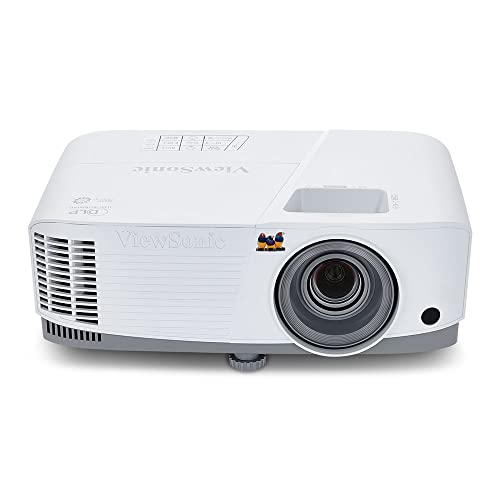
ViewSonic PA503W — The 4000-lumen classroom veteran
If the MX560’s title is a shrug, the PA503W’s title is a specification sheet that wandered into a headline: 4000 lumens, WXGA, DLP, high brightness, HDMI, vertical keystone, optical zoom, 120Hz, low latency, VGA, USB, ceiling mount — and the venues printed outright: classroom, business, presentation, large screen. A teacher reading that title knows nearly everything a classroom purchase turns on. The brightness clears the lit-room bar that school lighting sets; the WXGA resolution matches the widescreen content lessons are made of; the port list spans the modern laptop and the ancient desktop still humming in the corner of the room.
The legacy connections deserve their moment, because classrooms are museums of working technology. VGA in the title means the visiting speaker’s elderly laptop, the department’s backup machine and the document camera from another decade all still connect. USB sits alongside for the accessories schools actually plug in. Add a ceiling mount attitude and optical zoom for the installer, and the PA503W reads as a machine designed by people who have watched real schools buy projectors: bright enough for lights-up teaching, flexible enough for the building as found, and fluent in both the new and the old languages of the classroom wall box.
- Brightness stated in the title: 4000 lumens
- Resolution named: WXGA
- Technology: DLP
- Adjustment named: vertical keystone, optical zoom
- Ports named: HDMI, VGA, USB
- Refresh and latency named: 120Hz, low latency
- Mounting named: ceiling mount
Strengths
- A complete, checkable title — brightness, resolution, ports and adjustment all stated in print.
- VGA alongside HDMI keeps legacy school hardware connected without adapters.
- 4000 stated lumens serve lights-up teaching, the classroom’s normal condition.
Trade-offs
- WXGA resolution softens fine text compared with higher-resolution machines a school might consider.
- The title names no built-in speaker power, so classroom audio should be planned separately.
- No short-throw claim: the mount position must suit a conventional throw in a deep room.
Best for: a general classroom replacing an ageing unit, where 4000 stated lumens, a ceiling mount and both HDMI and VGA cover the school’s whole device zoo.
Not suited for: a small seminar room where the projector must sit a metre from the screen — this title claims no short throw, unlike the PS502W below with its stated 0.5 ratio.
The 120Hz and low-latency lines in the title look like gaming vocabulary, and in a classroom they translate to something more mundane and more valuable: smooth motion. A science video, a scrolling webpage, a pupil’s animation project — each moves across the screen without the judder that makes a class feel the technology instead of the content. Teachers rarely ask for refresh rates by name, but they notice their absence every time a video lesson stutters, and a title that states both figures is promising the absence away.
The PA503W’s Amazon listing is the natural next click for a school shortlist — its current figure sits there, and the title’s own detail rewards the careful read this review gave it.
Longevity in schools is measured in caretakers’ knowledge as much as in components. A model whose installation pattern — ceiling mount, zoom range, keystone — is understood by the site team becomes cheaper to own with every passing year, because every adjustment is a five-minute job rather than a callout. The PA503W’s long presence in classrooms is partly this effect compounding: the machine is known, its remote is known, its habits are known, and a known machine in a school is a machine that gets used to its full extent.
One caution belongs to the WXGA resolution, stated plainly so a school can plan around it. Worksheet text projected small will soften; the remedy is presentational, not technical — teachers using this class of projector learn to enlarge documents, split dense slides and keep fonts generous. Those are good habits in any classroom, since the back row’s eyesight varies more than any specification does, and a projector that enforces readable slides is arguably doing pedagogy a favour.
Finally, the large-screen phrase in the title matters for the rooms schools actually struggle with: the hall, the gym, the combined double classroom with a partition folded back. A 4000-lumen machine asked to fill a hall-sized image is at the edge of its arithmetic, and the honest reading of this title is classroom-first with hall capability for occasional, lights-managed events. Schools whose main problem room is the hall should read the daylight and church guides alongside this one before deciding.

Epson PowerLite X49 — The compact 3LCD network-room pick
The PowerLite X49’s title reads like a stockroom label, and that is its own kind of information: Epson, a part number, the PowerLite X49 name, 3LCD, XGA, classroom projector, HDMI, sold as one each, with dimensions of 3.4 by 11.6 by 10.2 inches printed at the end. A school business manager will recognise the dialect instantly — this is procurement language, written for purchase orders and asset registers. What the title verifies is the essentials of identity: a 3LCD classroom machine at XGA resolution with an HDMI input, in a body whose size can be checked against the cupboard, the cart and the mount before anyone orders.
XGA is the resolution to think about. It is a 4:3-era standard in a widescreen world, and its presence here marks this machine for the classrooms whose content still lives in that shape — the established worksheet libraries, the older interactive-whiteboard material, the department resources built over a decade of lessons. For those rooms, an XGA projector matches the archive exactly, pixel for shape. For a school whose teaching has moved to widescreen video and 16:9 slides, the WXGA picks around it fit the present better. Neither answer is wrong; they are answers about the school’s existing materials as much as about the projector.
- Technology named in the title: 3LCD
- Resolution named: XGA
- Input named: HDMI
- Dimensions stated in the title: 3.4 x 11.6 x 10.2 inches
- Part number stated: EPSV11H982020
- Brightness: Not stated in the listing title — verify with the manufacturer documentation
- Additional ports: Not stated in the listing title — verify with the manufacturer documentation
Strengths
- 3LCD colour serves the diagrams, maps and artwork that fill primary and science lessons.
- The stated dimensions let a school verify cart, cupboard and mount fit from the title alone.
- XGA matches legacy 4:3 teaching archives exactly, without letterboxing a decade of materials.
Trade-offs
- The title states no brightness figure, so lit-room performance is unverified from the listing.
- XGA’s 4:3 shape letterboxes modern widescreen video and slides.
- Only HDMI is named; legacy VGA devices need the documentation checked before assuming a port.
Best for: a classroom with a deep archive of 4:3 materials and an HDMI source, where the X49’s stated XGA format and compact printed dimensions fit the existing cart and board.
Not suited for: a media-rich classroom built on widescreen video — the title’s XGA shape will letterbox that content, and no brightness figure is stated to judge its lit-room strength.
The dimensions in the title, easy to mock as stockroom trivia, are genuinely useful in the setting this machine serves. School projectors live on carts that must fit through doorways, in cupboards shared with the art supplies, and on mounts whose weight and footprint limits were set by a previous machine. A buyer who can check 3.4 by 11.6 by 10.2 inches against the actual shelf before ordering has been spared the most common small-school disappointment: the right projector in a body that fits nowhere it was meant to live.
Procurement-minded buyers will appreciate that the X49’s Amazon listing keeps its stockroom manners — open it for the current figure, and keep the part number from the title beside your purchase order as you do.
The 3LCD engine deserves a classroom-specific defence. Colour in a lesson is rarely decoration: it is the difference between two lines on a graph, two countries on a map, two reagents in a diagram. Three-chip LCD designs have a long classroom history precisely because their colour light is their white light’s equal in character, and teachers of colour-coded subjects — which is to say most subjects, by the time a diagram is involved — feel that fidelity as comprehension in the back row.
Schools should read the missing brightness figure as a task, not a verdict. Epson’s documentation for this exact part number carries the lumen figure, and a buyer who retrieves it can place the X49 on the same ladder as the 4000-lumen titles here. Until that figure is in hand, the honest comparison is the one this review makes: identity, format, engine and size verified; brightness pending. Purchases have been made safely on exactly that basis for decades — the paperwork just has to be done.
A quiet argument also supports the X49 in shared and rented spaces: the village hall classroom, the tutoring centre, the after-school club. A compact, single-HDMI machine that a supervisor can set on a table and connect in a minute is worth more in those rooms than an installed flagship they are not allowed to touch. The title’s tabletop-friendly dimensions and single named input describe that life accurately — small, simple, and sufficient for the lesson in front of it.

BenQ MW560C — The warranted meeting-room crossover
The BenQ MW560C’s title is written for meeting rooms, and a school should not let that label mislead it — the specification it prints is a classroom specification wearing a blazer. WXGA resolution, 4000 lumens stated twice for emphasis, a 20,000:1 contrast figure, HDMI and VGA together, auto keystone, BenQ’s SmartEco technology, and a three-year warranty, all in the title. The auto keystone is the line a busy teacher should underline: a projector that squares its own picture when it is set down at an angle is a projector that survives cart duty, borrowed rooms and the supply teacher’s first morning.
The warranty deserves equal billing, because schools buy time as much as they buy machines. Three years stated in the title is a promise a business manager can write into a plan — three academic years in which this line item will not reappear as an emergency. SmartEco, BenQ’s power-managing mode, speaks to the same ledger from the running-cost side. Read together, the title is making an institutional argument: this machine’s brightness and connections are table stakes, and its real offer is predictability — of picture, through auto keystone; of cost, through the warranty and the eco mode.
- Resolution named in the title: WXGA
- Brightness stated in the title: 4000 lumens
- Contrast stated: 20,000:1
- Ports named: HDMI and VGA
- Adjustment named: auto keystone
- Power feature named: SmartEco technology
- Warranty stated: 3 years
Strengths
- Auto keystone forgives cart duty and angled setups — the classroom’s real daily geometry.
- The 3-year warranty is stated in the title, giving planners a firm horizon.
- HDMI and VGA together cover the school device zoo, as with the PA503W.
Trade-offs
- Its title addresses meeting rooms; classroom-specific features like a speaker are not claimed.
- No optical zoom is stated, so placement flexibility rests on the auto keystone alone.
- WXGA resolution shares the fine-text softness of the other WXGA picks here.
Best for: a school or training provider moving one projector between rooms on a cart, where auto keystone, 4000 stated lumens and a stated 3-year warranty absorb the travelling life.
Not suited for: a fixed installation needing a stated optical zoom to hit an exact screen from a fixed mount — this title names no zoom, only auto keystone.
Contrast, stated here at 20,000:1, is the figure teachers feel without naming. It is the difference between a washed grey rectangle and a picture with blacks in it — the night scene in the history film, the dark slide with white text, the photograph that must hold its shadows to make its point. In a lit classroom no contrast figure performs miracles, but a title willing to print one is at least inviting the comparison, and for video-heavy lessons the invitation is worth accepting when the shortlist is drawn.
Cart-based departments can check the MW560C’s current figure on its Amazon page — and should note the warranty wording there too, since the three years are part of what the school is buying.
SmartEco deserves translation from brochure to staffroom. A power-managing mode that dims the light when the image allows it saves electricity across thousands of school hours and, in lamp-era terms schools remember, stretched the consumable’s life. In daily experience its virtue is simpler: a projector that runs a little cooler and quieter in a small classroom is a projector the teacher stops noticing, and noticed projectors are the ones that get switched off mid-lesson.
The meeting-room framing can even be an asset in one specific school setting: the adult-facing one. Training days, governors’ meetings, parents’ information evenings and lettings all happen in rooms where a business projector’s manners — fast setup, tidy picture, presentation-first design — are exactly right. A school whose projector must serve children by day and adults by evening could do worse than choose the machine whose title admits both shifts exist.
Set against its BenQ stablemate at the top of this guide, the MW560C also demonstrates the guide’s whole method in miniature. Same brand family, same classroom ambitions — but this title verifies its brightness, its contrast, its ports, its keystone and its warranty in print, while the MX560’s verifies none of them. A buyer can prefer either machine for institutional reasons; only one of them, however, lets the buyer know what they preferred, from the listing alone.

ViewSonic PS502W — The stated-ratio short throw
Short throw is a promise that needs a number, and the PS502W’s title provides one: a 0.5 short throw ratio, printed alongside 4000 lumens, WXGA resolution, dual HDMI, vertical keystone, VGA, RS232, USB and a speaker, for business, classroom and conference rooms. That ratio is the most installable fact in this guide — it lets a school calculate, before ordering, exactly how far from the screen the projector must sit to fill it, and the answer at 0.5 is: close. Close enough that the teacher’s shadow shrinks to a minor character, close enough that a small classroom’s depth stops being the deciding constraint.
The port list completes a picture of institutional seriousness. Dual HDMI serves the teacher’s laptop and the room’s permanent source — the classroom PC, the streaming box — without a daily cable swap. RS232 is the control connection that lets a school’s AV system or a simple wall panel run the projector as part of the room, the kind of detail that separates a machine bought for a system from a machine bought for a shelf. And a speaker is named in the title, which five of its rivals here cannot say — classroom audio, the forgotten half of countless installations, is at least claimed by this one in print.
- Brightness stated in the title: 4000 lumens
- Resolution named: WXGA
- Throw stated: 0.5 short throw ratio
- Ports named: dual HDMI, VGA, RS232, USB
- Adjustment named: vertical keystone
- Audio named: built-in speaker
- Named venues: business, classroom, conference room
Strengths
- The 0.5 throw ratio is stated numerically — installation can be planned from the title alone.
- Dual HDMI ends the daily cable swap between teacher laptop and room source.
- A speaker is claimed in the title, and RS232 allows room-system control.
Trade-offs
- Short throw at 0.5 still needs a flat wall; it is less forgiving of surface ripple than a long throw.
- WXGA resolution shares the guide’s fine-text trade.
- The title names no optical zoom, so the image size is set by placement distance alone.
Best for: a small or shadow-plagued classroom with a wall-mounted short throw position, where the stated 0.5 ratio, 4000 lumens and dual HDMI serve teacher and room PC together.
Not suited for: a deep lecture room needing a long throw from the back — a 0.5 ratio machine must sit close to its screen by design, and this title offers no long-throw alternative.
Easy setup, the title’s closing claim, is worth taking seriously as a school criterion rather than as brochure filler. Every minute of setup in a classroom is spent in front of an audience of pupils, and every fiddly adjustment is a small withdrawal from the lesson’s authority. A projector that lands close to its screen, squares itself with a keystone and accepts the room’s two sources without a swap is, in the currency teachers actually spend, a faster start to every lesson of its life — a saving that compounds across a school year like interest.
Small-room planners can find the PS502W’s current figure on its Amazon listing — bring your wall-to-seat measurements, because the stated half-ratio throw rewards buyers who arrive with numbers.
The RS232 line deserves a final word for schools with any kind of room automation, however modest. A projector that a wall panel can switch, a timer can schedule and a system can report on is a projector the site team manages rather than visits. As classrooms accumulate technology, the machines that join the system gracefully are the ones still in service when the standalone units have been retired to a cupboard — connectivity, in the long run, is a longevity feature.
Compare the two short-throw philosophies in this guide and the choice clarifies. The BrightLink goes ultra short and wide — a 21:9 canvas hugging the board for a teacher who works inside the picture. The PS502W goes merely short and standard-shaped — a WXGA lesson at 4000 stated lumens, with the ports and speaker of a complete room machine. Neither is the upgrade of the other; they are answers to different questions asked by different rooms, and the titles, read carefully, say which is which.
For schools replacing a long-throw unit in the same room, expect one pleasant surprise and one task. The surprise is the front of the room: with the projector moved close to the board, the teacher’s working space stops being a stage lit from behind, and lessons feel closer. The task is the mount and cable run, which must move with the projector — a half-day of site work that should be scheduled in a holiday, not discovered in September.
Comparison Table
| Pick | Headline figure from its title | Defining trait | Main limit |
|---|---|---|---|
| Epson BrightLink 770Fi | Ultra short throw, 3LCD, 21:9 | Board-hugging teaching wall | Brightness not stated in title |
| BenQ MX560 | Title states model only | Fleet replacement on school records | No figure verifiable from listing |
| ViewSonic PA503W | 4000 lumens, WXGA, HDMI+VGA | General classroom all-rounder | No short throw claimed |
| Epson PowerLite X49 | 3LCD XGA, HDMI, dimensions stated | Legacy 4:3 archives, compact body | Brightness not stated in title |
| BenQ MW560C | 4000 lumens, WXGA, auto keystone, 3yr warranty | Cart duty between rooms | No zoom stated |
| ViewSonic PS502W | 4000 lumens, 0.5 short throw, dual HDMI, speaker | Small rooms, room systems | Needs a flat wall at close range |
How to Choose
Walk the room before reading another specification. Stand where the projector could mount, look at the board, then sit in the worst pupil seat — the corner, the window side, the back — and look again. That circuit decides the throw you need, the screen size you can fill and the brightness your windows demand, and it takes four minutes. Schools that skip it buy projectors for an imaginary rectangular room and then spend years compensating for the real one.
Inventory the sources next, honestly and completely: the teacher’s laptop, the room PC, the document camera, the visiting speaker’s machine from another decade, the streaming box somebody donated. The correct port list is the one that connects all of them without an adapter hunt, and it is written in the school’s own cupboard, not in any catalogue. Three titles here carry VGA for a reason, and the schools that need it know exactly why.
Finally, decide who operates the machine and how often it moves. A fixed installation rewards the short throws and the room-system control; a cart rewards auto keystone and a warranty stated in years; a fleet rewards sameness above cleverness. Write the answers down — geometry, sources, operator — and the shortlist in this guide usually shortens itself to one name, which is what a good buying process feels like from the inside.
Does a classroom really need 4000 lumens?
For a standard classroom with its lights on and a screen of ordinary size, the three titles here that state 4000 lumens are stating the working figure experience supports — enough for slides, documents and video to read clearly from the back row without darkening the room into a cinema nobody can take notes in. Smaller, well-shaded rooms can thrive below it; halls and glass-walled spaces will want more, and neither case is really a classroom in the sense this guide means.
The sharper point is verifiability. A school can act on a stated 4000 because it can hold the listing to it; it cannot act on an unstated figure at all, which is why two Epson picks and the MX560 send their buyers to documentation. Lumens are not a virtue contest — they are a promise, and promises should be printed where the buyer can check them.
Short throw or ultra short throw for a teaching wall?
The difference is where the teacher stands relative to the light. At the PS502W’s stated 0.5 ratio, the projector sits close enough to shrink shadows and free the room’s depth, while still behaving like a normal projector in format and ports. At the BrightLink’s ultra short throw, the machine hugs the wall above the board, the beam stays out of the room almost entirely, and the 21:9 canvas invites a different, wider style of lesson. Teachers who write and point inside the image all lesson belong to the second; rooms that need a complete, conventional machine belong to the first.
Budget enters it too, through the wall rather than the price tag: ultra short throw is the least forgiving of an uneven surface, so its true cost includes the flat board it deserves. A school with a warped wall and no plan to replace it should take the 0.5 machine and its gentler geometry every time.
What should a school do in the first week with a new classroom projector?
Set it up once, properly, and then freeze the configuration. Align the image, square it, focus it at the size the room will actually use, set the brightness for lights-on teaching rather than for the darkened demonstration that flatters every machine, and save or note those settings where the next teacher can find them. Most classroom projector misery is not hardware failure but configuration drift — a succession of well-meaning adjustments, each solving one lesson and spoiling the next.
Then teach the room, not just the machine: where the remote lives, which input the laptop uses, what to do when the picture is the wrong shape. A laminated card beside the board, written by whoever installed the unit, is worth more than any single feature in this guide, because it multiplies the projector’s value by every teacher who will ever stand in front of it.
Common Mistakes
Buying brightness for a geometry problem is the classic classroom error. A dim-looking lesson is often a shadow problem, a screen-size problem or a washed-out wall problem wearing brightness as a disguise, and a brighter projector installed in the same wrong place produces a brighter version of the same failure. Diagnose from the worst seat first — what exactly is unreadable, the text, the contrast or the teacher’s own silhouette — and let the diagnosis choose between lumens, throw and a proper screen.
Forgetting the legacy device is the second reliable failure. The new projector arrives with a modern port list, the department’s document camera or the head’s elderly laptop does not match it, and an adapter becomes the most important piece of equipment in the room — until it is lost, which is immediately. The titles in this guide that carry VGA are not being nostalgic; they are describing the actual contents of actual classrooms, and buyers should inventory before they sneer.
Treating the listing title as a datasheet completes the set — in both directions. One school buys the MX560 expecting the title’s silence to hide riches it never verified; another dismisses the X49 because its stockroom title looks plain, without noticing the dimensions and format it does verify. Titles are evidence of exactly what they state. The disciplined school builds its comparison table from stated facts, marks the gaps, and sends the gaps to the manufacturers — a habit this guide has modelled on every page.
Final Recommendation
Choose by geometry, verify by title, and the classroom chooses well. Board-centred teaching takes the BrightLink and its ultra short throw canvas. Small rooms take the PS502W and its stated half-ratio. The standard classroom takes the PA503W or the MW560C — the ViewSonic for its complete classroom title, the BenQ for auto keystone and a stated warranty on cart duty. Legacy archives take the X49. Fleets take the MX560, on their own records, with their eyes open about what its listing does not say.
A classroom projector succeeds invisibly — the lesson starts on time, the back row reads everything, and nobody, all year, thinks about the machine on the ceiling. Buy the one your room’s geometry and your school’s habits point to, install it once with care, and let it disappear into the teaching.
One last encouragement for the person holding the budget: the differences among these six are differences of fit, not of worth. Every machine here will teach well in the room it was described for, and struggle in a room it was not. That is a hopeful fact, because it means the school’s own knowledge — of its walls, its windows, its cupboards of elderly laptops — is worth more than any reviewer’s ranking, and the buying meeting can be run as a description of the school rather than as an argument about brands.
Frequently Asked Questions
Which classroom projector is easiest for a supply teacher to use?
The BenQ MW560C makes the strongest title-based case: auto keystone squares the picture when the unit is set down at an angle, and its HDMI and VGA cover whatever laptop arrives. The PS502W counters with easy setup claimed in its title and a speaker built in. Either spares a supply teacher the configuration archaeology that ruins first periods.
Can these projectors work with an interactive whiteboard?
The BrightLink 770Fi is the front-of-class design here — ultra short throw, wall mountable, in a wide 21:9 format — and that geometry is the one interactive boards are built around. Its title does not state interactivity features, so schools pairing it with a specific board should confirm the combination in Epson’s documentation.
Why do two picks state no brightness at all?
[“Because their listing titles do not print a lumen figure — the BrightLink 770Fi and the PowerLite X49 are specified by format, technology and mounting instead. This guide reports titles as they are and directs buyers to the manufacturers’ documentation for the missing figure rather than borrowing one from reputation.”]
Is WXGA sharp enough for worksheets and documents?
For projected documents at classroom sizes, yes, with presentational help: enlarge the document, keep fonts generous and split dense pages. WXGA’s softness appears at small sizes, and the teachers who thrive with the three WXGA picks here are the ones who treat slide design as part of the installation.
What does RS232 on the PS502W actually do for a school?
It lets the projector be controlled by a room system — a wall panel, a timer, a central AV setup — rather than only by its remote. In practice that means the projector wakes and sleeps with the room, and the site team can manage it as part of the building instead of visiting it one remote at a time.
Should a school keep a spare projector?
A spare is the cheapest insurance a multi-classroom school can hold, and this guide’s fleet logic applies to it: the spare should match the fleet’s dominant model, mount and remote, so that a failure becomes a ten-minute swap rather than a cancelled morning. Schools too small for a spare should at least know which of these six they would order in an emergency — a decision made calmly in advance is a better decision than one made with thirty pupils waiting.
Related Guides
The same title-reading discipline serves the building’s other rooms: our church projector guide, where stated lumens climb past four thousand, the daylight projector guide, for the hall with the unshaded windows, our star and galaxy projector guide, for the classroom ceiling after the astronomy lesson.


