Our Top Picks

What's inside
- Best Model Car Sets: Classic American Muscle in 1:24 and 1:25 Scale
- How These Kits Were Chosen
- Understanding Scale: 1:24 vs 1:25
- Skill Levels Explained
- AMT 1968 Chevy Camaro Z/28 1:25 Scale Model Kit
- AMT 1963 Chevy Corvette 1:25 Scale Model Kit
- AMT 1970.5 Camaro Z28 Model Kit
- AMT 1966 Chevrolet Nova Pro Street Skill 2 1/25 Scale Model
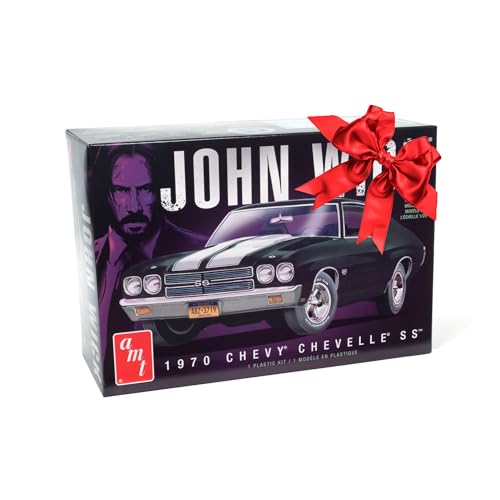
- AMT 1970 Chevy Chevelle John Wick 1:25 Scale Model Kit
- Revell 1970 Plymouth Road Runner 1:24 Scale Plastic Model Kit
- Revell 1970 Dodge Challenger 2N1 1:24 Scale Plastic Model Kit
- Revell 1977 Chevy Street Pickup 1:25 Scale Model Truck Kit
- AMT vs Revell: How the Two Brands Approach Classic Car Kits
- Choosing a Kit by Favorite Car and Decade
- Tools, Glue, and Paint: What a Kit Does Not Include
- The Basic Build Process, Step by Step
- Displaying and Storing Finished Models
- Final Recommendations
- Check prices on Amazon
- Disclosure
As an Amazon Associate I earn from qualifying purchases. This post may contain affiliate links at no extra cost to you.
Best Model Car Sets: Classic American Muscle in 1:24 and 1:25 Scale
A plastic model car kit is one of the most satisfying ways to own a piece of American automotive history. The full-size originals in this roundup — a 1968 Camaro Z/28, a 1963 Corvette, a 1970 Chevelle, a 1970 Road Runner — are the kind of cars that fill auction halls and museum floors. A well-chosen kit puts the same shapes on your workbench at a fraction of the size, and the finished model carries the proportions, badges, and stance that made the real cars famous. This guide covers eight kits from two of the best-known names in the hobby, AMT and Revell, and every one of them is a classic American muscle car or truck from the 1960s and 1970s.
The eight kits were selected based on published specifications and manufacturer descriptions: the car and model year in each kit’s title, the stated scale, the stated part count and skill level where the manufacturer publishes them, and the brand behind the box. Five of the kits come from AMT and three from Revell. Six are molded in 1:25 scale and two in 1:24 scale, a pairing that makes this a useful group for anyone trying to decide which of the two dominant car-model scales suits their shelf and their building habits.
What follows is organized to help you choose with confidence. After the kit-by-kit sections, there are deeper discussions of scale, skill levels, the differences between the AMT and Revell approaches to classic car subjects, the tools and paints a builder typically needs beyond what is in the box, the basic assembly process from sprue to shelf, and how to display and protect a finished model so it still looks sharp years later. If you are buying a first kit, returning to the hobby after a long break, or adding a specific car to an existing collection, at least one of these eight should match the car you have been picturing.
How These Kits Were Chosen
Every kit in this guide is a plastic model car set in the traditional sense: a box of molded plastic parts on sprues, an instruction sheet, and a decal sheet, which the builder assembles with glue and finishes with paint. None of them are die-cast replicas, slot cars, or pre-built display pieces. That distinction matters because the experience is completely different. A kit is a project measured in evenings, not minutes, and the reward is a model you built yourself, in the colors you chose, to the standard your patience allowed.
The subject matter is deliberately narrow. All eight kits depict American performance cars from the heart of the muscle car era, plus one street pickup from 1977. Chevrolet dominates the list, which reflects the real market: the Camaro appears twice, in 1968 and 1970.5 forms, alongside a 1963 Corvette, a 1966 Nova in Pro Street trim, a 1970 Chevelle, and the 1977 Chevy Street Pickup. Mopar fans are covered by the 1970 Plymouth Road Runner and the 1970 Dodge Challenger. If your interest runs to classic American iron rather than modern exotics or European sports cars, this is a focused shortlist rather than a scattershot one.
Only facts stated in the manufacturers’ published product titles and descriptions are used for kit-specific claims in this guide. Where a title states a part count or a skill level, that figure is reported. Where a title does not state one, no figure is invented. General guidance about the hobby — how scale works, what tools builders commonly use, how assembly usually proceeds — is presented as general practice, because those are shared conventions of the category rather than specifications of any single kit.
Understanding Scale: 1:24 vs 1:25
Scale is the single most misunderstood number on a model car box, so it is worth settling before comparing individual kits. A 1:25 scale model is one twenty-fifth the size of the real car in every linear dimension. A 1:24 scale model is one twenty-fourth. The difference sounds trivial, and on a ruler it nearly is: a full-size car that is roughly fifteen feet long becomes a model of about 7.2 inches in 1:25 and about 7.5 inches in 1:24. Side by side on a shelf, the two scales are close enough that casual viewers rarely notice, but dedicated collectors usually pick one scale and stay with it so that every car in the row shares identical proportions relative to the others.
The reason both scales exist is historical. American kit manufacturers settled into two camps generations ago, and the tooling for classic subjects was cut to match each company’s house scale. AMT built its reputation in 1:25, and all five AMT kits in this guide are 1:25 scale. Revell works in both, and its two 1970 Mopar kits here are 1:24 while its 1977 Chevy pickup is 1:25. Neither scale is more accurate or more detailed by definition. Detail is a function of how the kit was engineered and how many parts the manufacturer chose to include, not of the fraction on the box.
Practically, scale affects three things. First, shelf planning: a long row of mixed scales shows subtle steps in roof height and length that some collectors find distracting. Second, parts sharing: builders who customize or combine kits — swapping wheels, engines, or interiors between builds — find that parts interchange far more cleanly within one scale. Third, aftermarket support: accessories such as display cases and some photo-etched or resin detail sets are sized by scale, so knowing your scale before ordering extras saves returns. If you are starting fresh, the honest advice is to choose based on the cars you want most. In this guide, the Mopar pair points you toward 1:24, while the larger Chevrolet selection points toward 1:25.
It is also worth knowing that the stated scale describes the model itself. Retail listings occasionally mix scales in their titles, which is why this guide relies on the scale stated in each manufacturer’s own product title. Six of these eight kits state 1:25 or 1:24 directly in the title. The AMT 1970.5 Camaro Z28 title does not state a scale, so none is claimed for it here; builders who need certainty on that point should confirm the scale on the kit’s packaging before ordering, especially if the model is destined for a scale-matched display.
Skill Levels Explained
Most plastic car kits carry a skill level, and the number is a rough promise about how much patience and technique the build will demand. Lower levels generally mean fewer parts, simpler assemblies, and more forgiving fits. Higher levels mean more parts, more sub-assemblies, more decals to place accurately, and more steps where paint must be applied to small components before they disappear inside the model. The systems are set by each manufacturer, so a given number from one brand is a guide rather than a guarantee of identical difficulty from another brand, but the direction is consistent across the hobby: higher number, more involved build.
Three of the kits in this guide have skill levels stated in their published descriptions. The AMT 1966 Nova is a Skill 2 kit, which places it at the accessible end of the range: a sensible first glue-together build for someone moving up from snap-together models, or a relaxed weekend project for an experienced builder. The Revell 1970 Dodge Challenger and the Revell 1977 Chevy Street Pickup are both listed at skill level 4, and the Revell 1970 Plymouth Road Runner sits at skill level 5, the most demanding rating among the eight. The Road Runner’s published description also notes it is intended for builders ages 13 and up, the Challenger for ages 12 and up, and the pickup for ages 12 and up, which tracks with the skill ratings.
How should a buyer use these numbers? A complete beginner does better starting at the low end, because early success builds the habits — clean part removal, patient gluing, thin paint coats — that harder kits assume. An experienced builder shopping for a long, absorbing project should look at the higher-rated kits, where the extra parts and steps translate into more evenings at the bench and a more intricate finished model. Skill level says nothing about the quality of the finished piece, though. A carefully built Skill 2 Nova will look better on a shelf than a rushed skill level 5 Road Runner every time.
AMT 1968 Chevy Camaro Z/28 1:25 Scale Model Kit
The 1968 Camaro Z/28 is one of the defining shapes of the first-generation F-body, and this AMT kit renders it in 1:25 scale. The Z/28 badge carries real weight among Camaro followers: it marked the high-revving, road-race-bred version of the car, the one built with track competition in mind rather than straight-line cruising. For a modeler, that heritage makes the finished piece more than a generic late-sixties coupe — it is a specific, storied variant, and it anchors a first-generation Camaro collection in a way a base-model car would not.
As a build subject, the 1968 Camaro gives a modeler a clean fastback roofline, the deep grille treatment of the second year of production, and body proportions that sit naturally next to other 1:25 scale AMT subjects, including the 1970.5 Camaro and the Chevelle in this guide. Builders who enjoy paint work will find the first-generation Camaro a rewarding canvas: the body style is closely associated with racing stripes over the hood and deck, and a striped finish makes the finished model read correctly from across the room.
Choose this kit if the late-sixties Camaro is the car you picture when someone says muscle car, or if you are building a 1:25 scale Chevrolet row and want the first-generation car represented by its most competition-focused badge. It is also a sensible pick for a gift: the 1968 Z/28 is instantly recognizable even to people who do not build models, so the finished piece communicates on a shelf without explanation.
AMT 1963 Chevy Corvette 1:25 Scale Model Kit
The 1963 Corvette is the eldest subject in this guide and arguably the most historically significant. It opened the second generation of America’s sports car, the generation that turned the Corvette from a stylish roadster into a serious performance machine with a shape that still anchors design retrospectives. AMT’s kit presents that car in 1:25 scale, the same scale as the other AMT kits here, so it lines up proportionally with the Camaros, Nova, and Chevelle in this roundup.
Modeling an early-sixties car is a different pleasure from modeling a 1970 muscle car. The 1963 Corvette’s styling is more sculpted and more chrome-era in character, with the long hood and tapering tail that defined the new generation. Builders who enjoy brightwork and period-correct color choices — the creams, reds, and silvers of the early sixties palette — will find this subject rewards a restrained, factory-style finish. It also pairs naturally with the later cars in a timeline display: park the 1963 Corvette at one end of a shelf and the 1970 Chevelle at the other, and you have the arc of a remarkable decade in one glance.
This is the kit to pick if your interest leans toward the Corvette lineage specifically, or if your collection skews toward the early sixties and needs its flagship. Because it is the only sports car in a field of muscle cars and one pickup, it also works as the variety piece in a 1:25 scale display — the lower, sleeker silhouette that breaks up a row of upright pony cars.
AMT 1970.5 Camaro Z28 Model Kit
Chevrolet introduced the second-generation Camaro partway through the 1970 model year, which is why the car is universally known as the 1970.5 — and why AMT titles this kit exactly that way. The redesign was dramatic: a longer, lower, more European-influenced body that carried the Camaro through the entire decade. The Z28 version, badged without the slash in this era, was again the handling-and-performance flagship of the line. For Camaro collectors, the 1970.5 is a landmark car, the first year of a generation, and first-year cars are the ones collections are built around.
In a model collection, this kit does specific work. Placed beside the 1968 Z/28 in this guide, it shows the generational handoff in a way no photograph quite matches: same nameplate, same performance badge, completely different design language, separated by only two model years. Builders assembling a Camaro timeline need both ends of that comparison, and this kit supplies the second-generation end of it.
One practical note, stated plainly: the published title for this kit does not include a scale, a part count, or a skill level, so this guide does not assign it one. Builders for whom scale matching is a hard requirement should verify the scale from the kit’s box or the manufacturer’s listing before purchase. Builders who simply want the first of the second-generation Z28 cars on the bench can proceed on the strength of the subject itself, which is among the strongest in the AMT classic lineup.
AMT 1966 Chevrolet Nova Pro Street Skill 2 1/25 Scale Model
Every other car in this guide is a factory performance machine; the 1966 Nova Pro Street is something else — a model of a modified car, in the Pro Street style that celebrates drag-strip hardware adapted for the street. That makes this AMT kit the variety pick of the Chevrolet group. Where the Camaros and Chevelle represent what the factory sold, the Nova represents what owners built, and a shelf that includes both tells a fuller story of the era’s car culture.
The kit’s published details are clear: it is a Skill 2 model in 1/25 scale, catalogued as the AMT636R. The Skill 2 rating is the most approachable in this entire roundup, which makes the Nova the natural recommendation for a first glue-and-paint build among these eight. A new builder gets a charismatic subject — a compact 1966 Nova with Pro Street attitude — without the part counts and complexity of the higher-rated Revell kits. Returning builders who want a satisfying project that does not sprawl across a month of evenings will also appreciate what a Skill 2 build offers.
The 1966 model year matters to Nova followers: it was the first year of the second-generation car, with the crisper, more angular styling that replaced the softer original. In Pro Street form, the compact body becomes a canvas for bold color and stance, so this is a good kit for a builder who enjoys the finishing stage more than the assembly stage. If you are buying for a younger builder who has outgrown snap kits, or stocking a workbench for a first serious project, this is where this guide points you first.
AMT 1970 Chevy Chevelle John Wick 1:25 Scale Model Kit
The 1970 Chevelle is, for many enthusiasts, the peak of the muscle car era — the year the big-block A-body reached its fullest expression and the last year before the industry began its long retreat from horsepower. AMT’s 1:25 scale kit carries an additional distinction in its title: the John Wick name, tying the model to the Chevelle’s starring role in modern film culture. That association gives the finished model a second audience. Even visitors who know nothing about A-bodies recognize the car from the screen, which makes this kit an unusually good conversation piece.
As a modeling subject, the 1970 Chevelle offers the broad-shouldered proportions of the redesigned A-body at its most muscular. It is a larger car than the Camaros and Nova in this guide, and in matching 1:25 scale that size difference shows correctly on the shelf — one of the quiet pleasures of a scale-consistent collection. Builders who favor the heavyweight end of the muscle era, the cars built around big engines and full frames, will find this the most satisfying Chevrolet subject here alongside the Corvette’s sports-car counterpoint.
Pick this kit if 1970 is your year, if the Chevelle is your car, or if the film connection makes the model meaningful to the person who will receive it. It also completes a natural AMT trio with the two Camaros: pony car, pony car successor, and the full-size muscle flagship, all in one scale from one manufacturer.
Shoppers comparing display and viewing gear for a hobby room sometimes ask about projectors for reference photos and build videos; readers researching that side of the room can start with best projectors for movie watching for general background.
Revell 1970 Plymouth Road Runner 1:24 Scale Plastic Model Kit
The Road Runner was Plymouth’s back-to-basics muscle car: a big-engine B-body sold on speed per dollar and a cartoon bird on the flank. Revell’s kit presents the 1970 model in 1:24 scale, and its published description carries the most demanding specifications in this guide — 77 parts and skill level 5, described by the manufacturer as a highly detailed model kit for builders ages 13 and up. That combination marks it clearly: this is the project kit of the eight, the one aimed at builders who want the bench time as much as the finished car.
A skill level 5 build asks more at every stage. More parts mean more sub-assemblies to keep organized, more components to paint before final assembly, and more steps in the instruction sequence where order matters. The payoff is a more intricate finished model and a longer, more absorbing build. Experienced modelers often describe kits at this level as the sweet spot of the hobby — complex enough to stay interesting for weeks, familiar enough in subject to build with confidence.
The 1970 Road Runner is also the right pick for Mopar loyalists who want Plymouth represented rather than Dodge. Together with the Challenger below, it lets a builder put both halves of Plymouth and Dodge’s 1970 performance story on one shelf, in matching 1:24 scale from the same manufacturer. Choose the Road Runner if you are an experienced builder looking for the deepest project in this roundup, or a Plymouth devotee for whom no other badge will do.
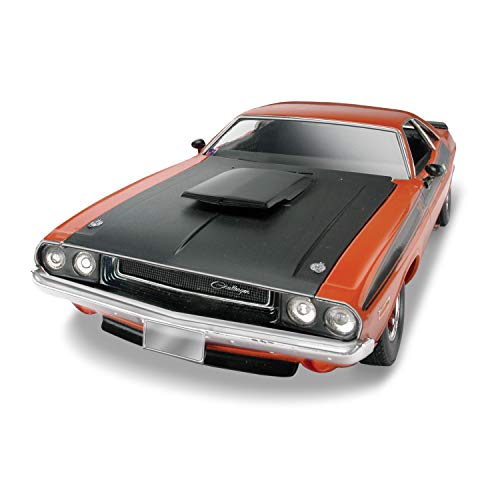
Revell 1970 Dodge Challenger 2N1 1:24 Scale Plastic Model Kit
The 1970 Challenger was Dodge’s entry into the pony car fight, arriving with the widest engine menu in the class and styling that has made it one of the most reproduced shapes in the hobby. Revell’s 1:24 scale kit is published at 78 parts and skill level 4, for builders ages 12 and up. Its headline feature is in the name: 2N1, meaning the box provides the parts and instructions to build the model two ways — the builder chooses one of two versions during assembly rather than being locked into a single factory specification.
The 2N1 format changes how a kit should be bought and built. Before the first part is cut from a sprue, the builder reads through both build paths and commits to one, because the versions typically diverge early: different parts go on the car, and the unused alternatives stay in the box. Those leftover parts are not waste — experienced builders keep them in a spares box as raw material for future projects. For a buyer, 2N1 also means the decision between two looks happens at the bench with the parts in hand, which many builders find more satisfying than choosing between two separate kits on a shelf.
At skill level 4, the Challenger sits one step below the Road Runner in stated difficulty while offering the extra dimension of choice. It is a strong recommendation for an intermediate or experienced builder who has built a few kits and wants a project with a genuine decision at its heart. Paired with the Road Runner, it completes the 1970 Mopar pair in matching scale; on its own, it is the most flexible single purchase in this guide.
Revell 1977 Chevy Street Pickup 1:25 Scale Model Truck Kit
The lone truck in this guide earns its place. Revell’s kit — model 14552 in the manufacturer’s numbering — builds the 1977 Chevy Street Pickup in 1:25 scale, with 83 parts and a skill level 4 rating, described as a detailed model truck building kit for ages 12 and up. The 83 parts make it the highest stated part count in this roundup, one part ahead of the Challenger, and the skill level 4 rating matches that Challenger as the second-highest difficulty tier here.
A pickup changes the geometry of a build in ways car builders enjoy. The separate bed, the upright cab, and the longer wheelbase give the finished model a presence that reads differently from the low coupes around it, and the subject itself — a street truck from 1977 — reaches past the 1970 muscle peak into the era when customized pickups became a scene of their own. In 1:25 scale it matches the AMT Chevrolets in this guide proportionally, so it can join a Chevrolet row without the scale mismatch that a 1:24 truck would introduce.
Choose the pickup if your collection is all cars and needs a silhouette change, if seventies trucks are your subject, or if you want a skill level 4 project with the highest stated part count of the eight. It is also the natural gift for the truck person in a car hobbyist’s family — the one model in this guide that speaks their language.
AMT vs Revell: How the Two Brands Approach Classic Car Kits
AMT and Revell are the two names that defined the American model car hobby, and this guide’s split — five AMT kits, three Revell kits — reflects their catalogs. Understanding each brand’s general approach helps a buyer read any listing from either company with better judgment.
AMT’s identity was built on the annual kit: models of current-year American cars released alongside the real cars, a tradition that made AMT the chronicler of American automotive design. Its classic reissues, including the Camaros, Corvette, Nova, and Chevelle here, carry that heritage. The AMT kits in this guide are uniformly 1:25 scale, which makes mixing and matching within the brand simple, and the range spans from the Skill 2 Nova upward, giving the brand both the entry point and several mid-range builds in this roundup.
Revell’s classic car catalog leans into detailed, higher-part-count presentations of landmark subjects, and the three Revell kits here show that tendency in their published numbers: 77, 78, and 83 parts, with skill levels of 5, 4, and 4. Revell also works across both scales — 1:24 for the two Mopar cars, 1:25 for the pickup — so a Revell buyer should always confirm the scale in the title rather than assuming. The 2N1 Challenger shows another Revell habit worth knowing: offering build options within one box.
Neither brand is the correct choice in the abstract. The practical rule is to buy the subject first and the brand second: decide which car you want, then check the scale, stated skill level, and stated part count of the kit that offers it. A builder loyal to 1:25 will find more choice here from AMT plus the Revell pickup; a builder drawn to the Mopar pair accepts 1:24 as the price of those subjects. Collections built subject-first tend to satisfy longer than collections built brand-first.
Builders setting up a dedicated hobby bench sometimes extend the room’s screen setup for reference material; those comparing outdoor-capable viewing options can look at best home projectors for outdoor movies as a starting point.
Choosing a Kit by Favorite Car and Decade
Most modelers do not shop by specification; they shop by the car they cannot stop thinking about. This section simply organizes the eight kits by the loyalties and eras that usually drive the decision.
For Camaro devotees, the choice is generational. The 1968 Z/28 represents the first generation at its competition peak; the 1970.5 Z28 represents the second generation’s dramatic debut. Many Camaro collections eventually hold both, but a first purchase usually follows the buyer’s favorite body style — the compact, sharp-edged original or the longer, sleeker successor. For Corvette followers, the 1963 kit is the only sports car here and the natural centerpiece of an early-sixties shelf. For Chevelle and big-car fans, the 1970 John Wick edition is the heavyweight flagship of the group.
By decade, the early sixties belong to the 1963 Corvette alone. The late sixties offer the 1968 Camaro and the 1966 Nova — the Nova being the modified-car outlier for builders who prefer owner-built character to factory specification. The year 1970 dominates, as it should in any muscle discussion: the 1970.5 Camaro, the 1970 Chevelle, the 1970 Road Runner, and the 1970 Challenger all come from the era’s peak model year. The seventies beyond the peak are represented by the 1977 Street Pickup, the kit for builders whose interest follows the hobby into the truck era.
By brand loyalty, the Mopar decision is between Plymouth and Dodge: Road Runner for the Plymouth faithful and the deepest stated challenge, Challenger for Dodge loyalists and for builders who want the 2N1 choice. The Chevrolet decision is wider — five of the eight kits wear a bowtie — and is best settled by body style: pony car, sports car, compact street machine, full-size muscle, or pickup.
Tools, Glue, and Paint: What a Kit Does Not Include
New buyers are sometimes surprised to open a model car set and find no glue and no paint. That is the long-standing convention of this category: a kit contains the molded parts, instructions, and decals, while the consumables and tools are the builder’s own, bought once and used across many builds. Budgeting for that basic bench setup is part of buying a first kit, and none of it is exotic.
The core tool list is short. A hobby knife and a pair of sprue cutters or nippers handle part removal; the cutters make the cleaner cut and reduce the trimming a knife must do afterward. Fine sanding sticks or fine-grit sandpaper smooth the small nubs left where parts attached to the sprue. Tweezers help place small parts and decals. Plastic model cement — the standard adhesive for this category — bonds the styrene parts; it is applied sparingly, because excess cement mars painted and clear surfaces. A cutting mat protects the work surface and gives blades a safe place to land.
Paint is where builders personalize a build. The common approach is a body color in a model spray paint or an airbrush-applied enamel or acrylic, with small jars of brush paint for the interior, chassis, engine, and trim details. A primer coat under the body color is standard practice for an even finish. Clear parts such as windows are usually left unpainted and handled carefully, since ordinary cement can fog them; builders often attach clear parts with a gentler adhesive reserved for that step. Decals are applied with water, patience, and a soft brush, and many builders seal finished decal work under a clear coat.
None of these supplies is brand-specific to AMT or Revell, and all of them carry across from one kit to the next. The one kit-specific caution in this guide concerns the 2N1 Challenger: decide which of the two versions you are building before painting parts, because the two paths can call for different components, and painted parts that end up unused represent wasted effort rather than spares.
While a build is underway, many hobbyists keep reference photos open on a second screen; readers comparing screens for that purpose may find best daytime projectors useful background for bright-room viewing.
The Basic Build Process, Step by Step
Every kit in this guide follows the same broad rhythm, because the category’s conventions are stable. Knowing the rhythm in advance makes a first build far less intimidating and helps a buyer understand what the skill level on the box is really describing.
- Read the instructions fully before cutting anything, and identify every part on the sprues.
- Wash or wipe parts if your preferred paint process calls for it, and plan the paint order.
- Build sub-assemblies — typically engine, interior, and chassis — painting small parts on the sprue or after removal as the instructions suggest.
- Prepare the body: remove it from the sprue, clean up attachment points, prime, and apply color coats in thin layers with drying time between them.
- Assemble the painted sub-assemblies into the chassis, fit the interior, and join the body.
- Apply decals, attach clear parts and final brightwork, and make any small touch-ups.
Two habits separate satisfying builds from frustrating ones. The first is dry-fitting: holding parts together without glue to confirm fit and order before committing. The second is patience with paint. Thin coats with full drying time between them produce the deep, even finish that makes a model photograph well; a single heavy coat is the most common cause of runs and obscured detail. Neither habit costs money, and both matter more than the difference between any two kits in this guide.
Time expectations scale with the published numbers. A Skill 2 kit like the Nova is a project of a few focused sessions. The skill level 4 and 5 Revell kits, with their higher part counts, spread naturally across more sessions, especially once paint drying time is respected. Builders who enjoy the process treat that spread as the point of the purchase: the cost of the kit divides across many evenings, which is why experienced hobbyists often judge value by bench hours rather than by the size of the finished model.
Displaying and Storing Finished Models
A finished model car is fragile in specific ways: mirrors, antennas, and other small protrusions break under casual handling, decals and paint fade under strong light, and dust settles into panel lines and interiors where it is hard to remove. Display choices made on the day a build is finished decide how the model looks years later.
The standard protections are simple. A clear display case sized to the model’s scale is the single most effective investment: it blocks dust, discourages handling, and makes the model safe to place almost anywhere. Out of a case, a model does best on a stable shelf away from direct sunlight, which fades paint and yellows clear plastic over time, and away from heat sources. Handling should be by the chassis or body sides with clean hands, never by the roof pillars or small parts. Dust that does settle is best removed with a soft brush or gentle air rather than a cloth, which can snag details.
For storage and transport, the original kit box with soft padding works well for a single model; collectors moving a whole shelf usually wrap each car loosely in soft tissue and pack them so nothing can shift. Scale consistency, discussed earlier, pays off again here: cases and shelf spacing standardize neatly when a collection shares one scale, which is another reason the 1:24 Mopar pair and the 1:25 Chevrolet group in this guide each display so naturally together.
Builders who photograph finished models for forums or club pages often set up a small bench display area; those comparing compact monitors for a desk setup like that can review best 27 1440p 120hz monitors for related background reading.
Final Recommendations
For a first build or a gift to a new builder, the AMT 1966 Nova Pro Street is the clearest recommendation in this guide: the only Skill 2 rating among the eight, a charismatic subject, and a 1:25 scale that leaves every door open for future Chevrolet purchases. For the deepest project, the Revell 1970 Road Runner’s published skill level 5 and 77 parts make it the experienced builder’s pick. For choice within a single box, the Revell 1970 Challenger 2N1 stands alone. For the highest stated part count and a change of silhouette, the Revell 1977 Chevy Street Pickup delivers 83 parts at skill level 4. And for pure subject appeal, the 1968 Camaro Z/28, the 1963 Corvette, the 1970.5 Camaro Z28, and the 1970 Chevelle John Wick edition each represent a car that entire collections are built around.
Whichever kit you choose, choose it by the car first. Specifications — scale, part count, skill level — should confirm the decision, not make it. A model of the car you love, built patiently, is the one that stays on the shelf.
Check prices on Amazon
Live listings for the shortlist in this guide are pulled from Amazon below, so prices and availability are always current at the moment you look.

AMT 1968 Chevy Camaro Z/28 1:25 Scale Model Kit

AMT 1963 Chevy Corvette 1:25 Scale Model kit

AMT 1970.5 Camaro Z28 Model Kit

AMT636R Skill 2 Model Kit 1966 Chevrolet Nova Pro Street 1/25 Scale Model
AMT 1970 Chevy Chevelle John Wick 1:25 Scale Model Kit

Disclosure
This site is a participant in the Amazon Associates program, and the publisher earns from qualifying purchases made through links to Amazon in this article. The eight kits above were selected and described based on published specifications and manufacturer descriptions — the car, model year, scale, part count, and skill level stated in each manufacturer’s own product information — together with general conventions of the model car category, such as the fact that glue and paint are ordinarily bought separately from a kit. No purchase is required to use the guidance in this article, and readers should confirm current kit details on the product page before ordering, since manufacturers occasionally revise packaging and listings.