Our Top Picks

What's inside
- What the Sub-C size actually means
- Two chemistries share the same can
- Capacity figures and what they really promise
- Tabs, flat tops and button tops
- Where Sub-C packs earn their keep
- Discharge behaviour under real loads
- The memory effect, explained without mythology
- Self-discharge and the drawer problem
- Charging Sub-C cells without cooking them
- Matching cells inside a pack
- Reading a listing like a pack builder
- Cadmium, recycling and the rules at end of life
- Safety habits that protect cells and builders
- How cycle life is quoted, and how to read it
- Spotting tired cells inside an ageing pack
- Wrappers, insulation and the unglamorous details
- When rebuilding stops making sense
- Voltage maths for series packs
- Seasonal care and long rests
- Questions worth asking a seller
- Check prices on Amazon
- Choosing by application, not by headline
As an Amazon Associate I earn from qualifying purchases. This post may contain affiliate links at no extra cost to you.
Before the guide begins, a note about how it is funded: some links that leave this page are affiliate links, and a purchase made through one may earn a commission paid by the seller rather than added to your bill. That arrangement plays no part in how cells are ranked or described below. Every comparison rests on specification sheets published by cell manufacturers, pack-building documentation, and patterns that repeat across owner reports from people who rebuild packs for a living or as a serious hobby.
The Sub-C cell occupies a strange corner of the battery world. It is too large for consumer gadgets that run on AA or AAA sizes, too small to interest anyone shopping for lantern batteries, and almost invisible in ordinary retail stores. Yet inside thousands of cordless drills from earlier decades, inside dive lights, radio-controlled cars, emergency lighting units and certain medical devices, this short cylinder is the standard building block. When a pack built from Sub-C cells fades, the device it powers usually remains mechanically sound, which is why a healthy trade exists in bare replacement cells sold for rebuilding.
Choosing those replacement cells well matters more than the modest unit price suggests. A pack is only as strong as its weakest cell, the chemistry inside decides how the pack behaves under heavy current draw, and a tab style chosen carelessly can turn a straightforward rebuild into an afternoon of frustration. This guide works through the dimensions, the two chemistries, the terminal formats, the charging behaviour and the disposal rules that together determine whether a rebuilt pack feels like new equipment or like a compromise you regret by the second charge.
What the Sub-C size actually means
The name describes a cell slightly shorter than a standard C battery. Published dimensional drawings from major cell makers put a typical Sub-C at roughly forty-three millimetres in length and about twenty-three millimetres in diameter, though exact figures drift by a fraction of a millimetre between brands and between flat-top and button-top variants. A full-size C cell, by comparison, stands near fifty millimetres tall with a diameter around twenty-six millimetres, so the Sub-C gives up a noticeable slice of volume in exchange for fitting inside tool handles and light housings designed around its shorter stature.
That size difference is the first trap for newcomers. Listings occasionally blur the naming, and a buyer who orders C cells for a pack designed around Sub-C cells discovers the mistake only when the pack refuses to close. The reverse error is subtler: Sub-C cells dropped into a C-sized compartment rattle, lose contact pressure and can shift under vibration. Before ordering anything, measure the cells coming out of the old pack with calipers, length and diameter both, and compare those numbers against the dimensional line of any candidate listing rather than trusting the headline alone.
Weight offers a rough cross-check. A nickel cadmium Sub-C commonly weighs somewhere in the low-to-mid fifty gram range, while a high-capacity nickel metal hydride version often lands closer to sixty grams because of its denser electrode loading. Neither figure decides a purchase, but a listing whose stated weight sits far outside that neighbourhood deserves a second look, since weight, dimensions and capacity on a spec sheet should tell a consistent story about what is inside the can.
Two chemistries share the same can
Nearly every Sub-C cell you will encounter uses one of two rechargeable chemistries: nickel cadmium, universally shortened to NiCd, or nickel metal hydride, shortened to NiMH. Both deliver a nominal one point two volts per cell, both tolerate the sealed cylindrical format well, and both have powered the same generations of equipment. Beyond those shared traits they diverge in capacity, in memory behaviour, in self-discharge and in the environmental rules that follow them to the recycling bin, so the chemistry decision deserves to be made deliberately rather than inherited from whatever the old pack happened to contain.
Nickel cadmium is the older technology and the one most original packs were built with. Typical Sub-C NiCd capacities sit between about seventeen hundred and twenty-four hundred milliamp-hours depending on whether the cell is tuned for capacity or for very high discharge rates. In exchange for that modest capacity, NiCd offers an unusually rugged constitution: it shrugs off heavy current pulses, tolerates abuse that would shorten the life of other chemistries, keeps working in cold conditions that slow its rivals, and historically costs less per cell than its hydride counterpart.
Nickel metal hydride arrived later and pushed capacity upward in the same physical envelope. Mainstream Sub-C NiMH cells commonly offer capacities from around three thousand milliamp-hours up to figures beyond four thousand in premium lines, roughly double what a comparable NiCd holds. That doubling transforms runtime for lights and tools alike. The trade-offs are a higher purchase price, a faster rate of self-discharge in standard formulations, greater sensitivity to heat during charging, and a discharge personality that suits steady heavy loads well but rewards careful charger selection.
Neither chemistry is universally better, and honest pack builders keep both in the drawer. A demolition driver that gulps current in short violent bursts and then sits in a cold van all week may genuinely suit NiCd. A dive light that must burn steadily for the length of a planned dive almost always suits NiMH. The sections that follow unpack each property in turn so the choice can follow the application instead of habit.
Capacity figures and what they really promise
Capacity, printed in milliamp-hours, describes how much charge a cell can deliver under the conditions stated on its datasheet, usually a slow discharge at a fraction of its capacity spread over five or twenty hours. That standardised slowness matters. A cell rated at four thousand milliamp-hours under a gentle draw will not surrender the same total energy when a power tool demands twenty amperes in pulses, because internal resistance converts part of that energy into heat inside the can. Datasheets from reputable makers publish discharge curves at several rates precisely so builders can see how capacity shrinks as current climbs.
For NiCd, the spread between seventeen hundred and twenty-four hundred milliamp-hours usually reflects electrode design. Cells at the lower end are built for extreme discharge duty, with thinner separators and constructions that keep resistance low when a motor stalls or a screw bites hard. Cells at the upper end trade a little of that violence for longer runtime in moderate service. Reading a listing means noticing which end of the range a cell occupies and matching it to the load, not simply grabbing the biggest number on the page.
NiMH listings demand extra scepticism because the chemistry tempts sellers toward optimistic labelling. A Sub-C can claiming capacities far beyond the mid four-thousands should be weighed against the physical reality that established manufacturers, publishing full datasheets, cluster around four thousand to forty-five hundred for their best cells in this format. When a no-name listing promises dramatically more at a dramatically lower price, owner reports tend to describe the same disappointment: cells that weigh less, measure less capacity on analysing chargers, and drift apart from each other within a season of use.
A practical habit is to treat the printed capacity as a claim to be verified rather than a fact to be assumed. Builders who cycle new cells on an analysing charger before assembly routinely report that quality brands land within a few percent of their rating, while bargain cells scatter widely. That verification step, described more fully later in this guide, is the difference between a pack built from matched cells and a pack assembled from strangers.
Tabs, flat tops and button tops
Sub-C cells reach buyers in three terminal arrangements, and picking the right one is a mechanical decision with electrical consequences. Tabbed cells leave the factory with thin nickel strips already welded to each end, ready to be soldered or folded into the interconnect scheme of a pack. Flat-top cells present bare terminals meant for spot welding during pack assembly. Button-top cells carry a small raised positive nub so they can drop into holders and devices designed for individual cells rather than welded packs.
For rebuilding a welded pack, tabbed cells are the forgiving option for anyone without a spot welder. The factory weld on a tab is made with proper equipment, and the builder then joins tab to tab with solder, keeping the iron’s heat on the strip rather than on the cell itself. That last point matters because prolonged soldering heat applied directly to a cell terminal can damage the internal seal and vent assembly. Tabs move the hot work a few millimetres away from the can, which is exactly where a careful builder wants it.
Flat-top cells belong to the spot-welding workflow. A builder lays nickel strip across a row of terminals and fuses it with brief pulses from a dedicated welder, producing the clean, low-resistance joints seen inside factory packs. Anyone heading down this route should note that the welder, the strip thickness and the cell terminal all form one system, a topic covered in depth in our guide to best lipo balance chargers accessories and pack-building tools, where strip gauges and pulse settings are compared in detail.
Button-top Sub-C cells serve a smaller niche: individual replacement in devices with sprung contacts, some medical equipment, older portable gear and certain lights that accept loose cells. If your device holds cells in a carrier or behind a spring, measure the original cell’s overall length including its button, because a flat-top substitute may sit a few millimetres short and lose contact when the device is bumped. Conversely, a button-top cell forced into a welded pack adds length the pack designer never allowed for, straining the housing when it closes.
Tab material deserves one more sentence. Pure nickel tabs resist corrosion and weld cleanly, while nickel-plated steel tabs cost less and appear on many serviceable cells. In dry indoor tools the distinction rarely decides longevity. In dive lights and marine-adjacent equipment, where humidity hunts for any weakness, pure nickel earns its small premium, and owner reports from saltwater users consistently favour it.
Where Sub-C packs earn their keep
The classic home of the Sub-C cell is the cordless power tool from the era before lithium-ion took over the category. Drills, drivers, saws and flashlights sold through the nineties and two-thousands commonly ran on packs of four to fifteen Sub-C cells wired in series, producing nominal voltages from four point eight up to eighteen volts. Those tools were built heavily, their motors remain strong, and their owners often prefer rebuilding the original pack to discarding a tool that still works. Replacement cells for this duty need genuine high-drain capability, because a stalled drill motor draws current that would embarrass a cell designed for gentle service.
Dive lights form the second great stronghold. A torch that must burn for the duration of a dive, at depth, in cold water, with no possibility of a mid-dive battery swap, places unusual weight on predictable capacity and on seals that tolerate pressure. Many respected dive light designs standardised on Sub-C packs precisely because the format balances energy against housing diameter. Builders servicing these lights favour NiMH cells for runtime, choose tabbed formats for tidy pack geometry, and pay close attention to shrink wrapping and strain relief because a flooded pack at depth is a lost light.
Radio-controlled vehicles provide the third classic application. Older RC cars, trucks and boats ran on six or seven cell sticks of Sub-C size, wired for seven point two or eight point four volts, and the hobby still maintains classes and vintage fleets built around those packs. RC service is brutal in a particular way: acceleration demands arrive as repeated current spikes, runs end with cells hot, and packs may be fast-charged at the track between heats. Cells for this work need low internal resistance above almost everything else, which is why RC-oriented Sub-C lines advertise discharge performance so prominently.
Medical and institutional equipment rounds out the picture quietly. Certain portable medical devices, emergency lighting units, exit signs and alarm systems were certified around Sub-C packs, and their maintenance regimes specify like-for-like replacement. In that world the governing documents are service manuals rather than hobby forums, and the correct move is to match chemistry, capacity class and terminal style to the original specification exactly, since certification attaches to the pack design as a whole rather than to any single cell that happens to fit.
Discharge behaviour under real loads
A cell’s discharge curve describes how its voltage behaves from full charge to empty at a given current. NiCd produces a famously flat curve: voltage holds near its plateau for most of the run, then falls off a cliff near the end. Tools on NiCd therefore feel strong until quite suddenly they do not, a personality many tradespeople remember well. NiMH curves slope a little more through the middle of the discharge, so a light dims more gradually and a tool softens earlier, giving the user more warning at the cost of a less crisp feel near the end of the pack.
Internal resistance sits underneath those curves. Every cell resists the flow of current to some degree, and that resistance turns into voltage sag when the load spikes. A drill that pulls twenty amperes from a tired, high-resistance pack may see its voltage collapse so far that the motor feels gutless even though the cells still hold charge. This is why two packs with identical printed capacity can perform completely differently in a demanding tool, and why builders who measure resistance, or who buy cells with published high-drain ratings, report such different satisfaction from those who shop on capacity alone.
Continuous and pulse ratings deserve separate attention on any datasheet. A cell might be rated to sustain ten amperes continuously yet handle far higher pulses for a few seconds, which suits tools whose loads arrive in bursts. Lights, by contrast, draw a steady current for hours, so the continuous rating and the discharge curve at that specific current are the figures that predict runtime. Matching the rating style to the load style is a quiet skill that separates a well-chosen cell from a merely adequate one.
Heat is the tax on all of this. High current through any resistance generates warmth inside the cell, and sustained warmth ages both chemistries, NiMH more quickly than NiCd. Packs that return from service noticeably hot are telling their owner something about either the load, the cells or the ventilation of the housing. Owner reports across tool forums repeat the same observation in different words: packs built from genuinely high-drain cells come back merely warm where packs built from general-purpose cells come back hot, and the hot packs fade sooner.
The memory effect, explained without mythology
Few battery topics attract more folklore than the NiCd memory effect. The genuine phenomenon is narrow and specific: a cell repeatedly discharged to precisely the same shallow depth, then recharged, can develop a voltage depression near that habitual stopping point, delivering slightly less voltage for the remainder of the discharge. It was documented most clearly in aerospace applications where discharge patterns repeated with machine regularity. In workshop and hobby service, where discharge depths vary from job to job, true memory is rare, and what owners usually call memory is something else entirely.
That something else is usually a mixture of cell imbalance and simple ageing. In a series pack, cells never discharge in perfect unison, and over many cycles one cell drifts lower than its companions. During discharge that weak cell empties first and can be driven into reversal by the current of its stronger partners, which damages it further. During charging the same imbalance leaves some cells overcharged while others never quite fill. The pack then behaves as if it remembers a shorter runtime, when in fact one or two members of the team are quietly failing.
The practical response is maintenance rather than ritual. Periodically discharging a NiCd pack to about one volt per cell under a moderate load, then recharging fully, exercises the cells through their real range and can recover capacity lost to voltage depression. Reputable charger designs automate this as a refresh or conditioning cycle. What experienced builders avoid is the deep, uncontrolled discharge of a whole pack down to zero volts, which almost guarantees reversal damage to the weakest cell and shortens the pack’s life instead of extending it.
NiMH is often described as immune to memory, and while it can show a milder form of voltage depression after long shallow cycling, the effect is smaller and usually reversible with a couple of full cycles. The more relevant NiMH weakness is heat sensitivity during charging and a tendency for capacity to fade when cells sit fully charged in warm places. Buyers choosing between the chemistries for a pack that will be shallow-cycled daily, such as an emergency light on a maintenance charger, should weigh NiCd’s tolerance for that regime against NiMH’s capacity advantage, because the duty pattern matters as much as the datasheet.
Self-discharge and the drawer problem
Every rechargeable cell loses charge while it sits, and the rate of that loss decides whether a pack pulled from a drawer after two months is ready to work or ready only to disappoint. Standard NiMH cells are the thirstiest sitters in this comparison, commonly surrendering a noticeable share of their charge in the first day after charging and continuing to bleed steadily thereafter, with figures around a fifth to a third of capacity per month quoted in manufacturer literature for conventional formulations at room temperature. NiCd typically loses charge more slowly, often cited in the region of ten to twenty percent per month under similar conditions.
Temperature steers both numbers. Warm storage accelerates self-discharge markedly, which is why packs left in a hot vehicle or a sunlit workshop age on the shelf even when unused. Cool, dry storage slows the process for both chemistries. Builders who keep spare packs for emergencies often adopt a simple calendar habit: a scheduled top-up charge every few months, logged on a strip of tape on the pack itself, so that readiness never depends on memory.
The practical consequence for tool users is modest but real. A NiMH pack charged on Friday and used on Monday behaves indistinguishably from a NiCd pack charged the same day. A NiMH pack charged in spring and grabbed in autumn may deliver a fraction of its expected runtime, while the NiCd pack beside it retains more of its charge. Neither outcome indicates a defective cell; both are the chemistries behaving exactly as their published characteristics describe. Choosing NiMH for capacity means accepting a rhythm of more frequent top-ups for stored packs.
Self-discharge also interacts with pack imbalance. Cells within a pack do not lose charge at identical rates, so a long rest spreads their states of charge apart. The first deep discharge after storage then stresses the cell that sat lowest. A gentle full cycle or two after long storage, rather than an immediate maximum-effort job, is the kind treatment that experienced owners describe, and it costs nothing but a little patience.
One further wrinkle deserves mention: two packs of identical construction can leave the same shelf with different charge levels simply because they were packed at different times. Retailers and distributors rarely rotate or maintain stock of bare cells, so a freshly purchased set may arrive anywhere from nearly full to nearly empty depending on its journey. Builders who plan assembly around arrival day should allow time for a full charge and characterisation cycle first, treating the delivery state of charge as unknown rather than as a clue about quality. A cell that arrives empty is not necessarily a tired cell; it may simply be an old traveller, and only a measured cycle can tell the difference honestly.
Charging Sub-C cells without cooking them
Charging is where Sub-C packs most often die early, usually at the hands of a charger that cannot tell when the cells are full. Nickel-based chemistries signal fullness subtly: the pack voltage peaks and then dips very slightly, a behaviour chargers detect as negative delta V, while cell temperature begins rising more quickly. A charger designed for these chemistries watches for those signals and stops or drops to a maintenance rate. A crude timed charger simply keeps pushing current for a fixed period, and every unnecessary hour of that push becomes heat and wear inside the cells.
Charge rate is expressed relative to capacity, so a one C rate for a four thousand milliamp-hour cell means four amperes, while a tenth of C means four hundred milliamperes. Slow overnight charging at around a tenth of C remains the gentlest regime and the one least dependent on precise termination, which is why many original tool chargers worked that way. Faster charging, at half C or above, demands reliable termination detection and reasonable ventilation, and it suits RC and trade users who need packs turned around quickly. The datasheet for any quality cell states its recommended standard and maximum charge rates, and those figures outrank the optimistic claims printed on charger boxes.
NiMH asks for more finesse than NiCd at the top of charge. Its voltage dip at fullness is smaller, its heating begins earlier, and repeated overcharging erodes capacity in a way owners notice within a season. Chargers with adjustable sensitivity for the termination signal, or with temperature monitoring, earn their keep on NiMH packs. Our comparison of best automatic battery chargers walks through termination methods and temperature cutoffs in detail for readers speccing a charger around a rebuilt pack.
Individual-cell charging is mostly unavailable to Sub-C users, because the cells live welded inside packs, but analysing chargers that accept single cells do exist for the loose-cell formats, and builders use them before assembly to characterise new cells. That pre-assembly check, measuring actual capacity cell by cell, is the single most effective quality step in pack building. Cells that arrive far below rating, or far from their siblings, can be returned or relegated to low-stakes duty instead of being welded into a pack where they would govern its performance.
Matching cells inside a pack
A series pack multiplies voltage by stacking cells, but it cannot multiply strength: the whole string is limited by its weakest member on every discharge and stressed by imbalance on every charge. Matching is the discipline of making the members as alike as possible. Builders match on measured capacity first, then on internal resistance where equipment allows, and they prefer cells from the same production batch bought at the same time, because age and storage history leave fingerprints on both figures.
The numbers do not need laboratory perfection to be useful. A spread of a few percent in measured capacity across a set is workable for tool and light duty, while a spread approaching a tenth of capacity predicts a pack that will feel tired early and age unevenly. When a single cell in an existing pack fails, replacing only that cell with a fresh one creates exactly this mismatch in reverse: the new cell outlasts its aged partners on discharge and receives different treatment on charge. Experienced rebuilders therefore replace full sets, or at minimum measure the survivors honestly before deciding they deserve new company.
Assembly order offers one more refinement. Some builders place the marginally strongest cells in the middle positions of a pack, reasoning that middle cells run warmest because their neighbours insulate them, and warmth accelerates ageing. Others dismiss the refinement as negligible for consumer duty. Either way, the habit that clearly matters is recording what went into each pack: chemistry, brand, batch, measured capacities and build date, written on the pack or in a notebook, so that future behaviour can be interpreted against facts rather than recollection.
Reading a listing like a pack builder
A good Sub-C listing answers a specific set of questions, and learning to scan for them turns shopping from guesswork into specification matching. The chemistry should be stated plainly, not implied. Dimensions should appear in millimetres, ideally with a diagram distinguishing flat-top, button-top and tabbed variants. Capacity should be paired with the discharge rate at which it was measured. A maximum continuous discharge figure, or at least a statement of intended application class, should separate high-drain cells from general-purpose ones.
Tab details matter more than listings usually admit. Tab width, thickness and material affect both weldability and the current a joint can carry, and a tab that is generous on a product photograph may prove narrow in the hand. Where a listing omits tab dimensions, seller questions and owner photographs in reviews often fill the gap. Similarly, the presence or absence of shrink wrap, and whether tabs arrive pre-bent or straight, changes the assembly experience enough that builders mention it constantly in feedback.
Brand accountability is the quiet divider in this market. Established cell manufacturers publish full datasheets with discharge curves, cycle life expectations under stated conditions, and charging parameters, and they print date codes on their cells. Anonymous cells arrive with a capacity claim and little else. Cycle life claims deserve the same scrutiny as capacity: a figure quoted at shallow depth of discharge and gentle rates describes a different life from the same figure quoted at full depth and tool-level currents, and honest datasheets say which conditions produced their numbers.
Price per cell, finally, should be read against the cost of the whole rebuild. A pack for a quality tool may need ten or more cells, so small per-cell savings multiply, but so does the cost of failure, because a pack built from erratic cells wastes the labour of assembly and the price of every good cell welded beside a bad one. Owner reports in this category are strikingly consistent: builders who bought recognised cells once describe the purchase as unremarkable, while builders who chased the lowest price describe buying twice.
Cadmium, recycling and the rules at end of life
NiCd cells carry an obligation that NiMH cells do not. Cadmium is a toxic heavy metal, and regulators in many jurisdictions treat cadmium-bearing batteries as hazardous waste that must never enter ordinary household rubbish. Collection schemes, retailer take-back programmes and municipal hazardous waste facilities exist precisely for this stream, and in some regions the sale and disposal of NiCd products are governed by specific battery directives that place collection duties on producers and sellers. The practical instruction for owners is simple: a retired NiCd cell goes to a battery collection point, every time, without exception.
NiMH cells face a lighter regime because their materials are less hazardous, but they still belong in battery recycling rather than landfill, both for the recovery of their metal content and because local rules now more often require it for all rechargeable formats. Taping the terminals of any loose cell before drop-off is a small courtesy that prevents short circuits in collection bins, a precaution facility guidance repeats for every chemistry. Packs should be recycled whole where facilities accept them, rather than being cut open by owners curious about the contents.
The environmental ledger also informs the chemistry choice at purchase time. A buyer with easy access to proper collection may weigh NiCd’s ruggedness fairly, while a buyer whose local facilities are limited may reasonably prefer NiMH and accept its charging demands. What neither buyer should do is stockpile dead NiCd cells in a drawer for years, since ageing cells can leak and corrode, turning a simple drop-off into a messier cleanup. Marking packs with their chemistry at build time makes the eventual disposal decision effortless for whoever handles them last.
Safety habits that protect cells and builders
Loose rechargeable cells store enough energy to demand respect, particularly in a format as large as Sub-C. A short circuit across a fully charged high-drain cell can heat a conductor fiercely in seconds, which is why builders keep cells in cases or trays rather than loose in a toolbox among screws and strip offcuts. Nickel strip, solder and tools should be cleared from the work area before cells come out, and any cell whose wrapper is torn should be re-wrapped or retired, because the can beneath the wrapper forms part of the electrical path on many designs.
Soldering technique carries its own safety dimension. Where tabs are used, the iron touches the tab, briefly and with adequate wattage, so heat does not soak into the cell. Builders who must solder nearer the terminal work quickly with a hot iron rather than slowly with a weak one, since total heat transferred is what damages seals. A cell that becomes hot to the touch during assembly, or that hisses, swells or smells unusual at any point in its life, is finished: it should be isolated on a non-flammable surface and taken to a collection point, not coaxed back into service.
Storage discipline completes the picture. Nickel-based cells prefer cool, dry conditions, stored partly charged rather than brim-full or bone-empty, and separated from metal objects. Packs stored inside tools should be checked periodically for corrosion at terminals and for the slow swelling that signals a cell nearing its end. None of these habits requires special equipment; all of them appear, in one wording or another, across the safety sheets that reputable manufacturers publish for exactly this cell family.
How cycle life is quoted, and how to read it
Manufacturers describe endurance in cycles, meaning one full discharge followed by a full recharge, but the conditions attached to that number vary enough to make headline comparisons misleading. A cell cycled at a gentle rate, discharged only partway each time and kept at room temperature may be credited with many hundreds of cycles. The same cell driven to complete emptiness by a hungry tool, fast-charged hot and stored in a van through summer will live a much shorter life, through no dishonesty on anyone’s part. Datasheets that state depth of discharge, charge rate and temperature beside their cycle figure are the ones worth trusting, because they let a buyer map the claim onto real duty.
Depth of discharge does most of the quiet work in that calculation. A pack regularly used for half its capacity before recharging can deliver far more total service than a pack wrung dry on every outing, even though the second pack feels more productive per charge. Owners of emergency lighting and standby equipment benefit from this arithmetic automatically, since their packs idle near full and discharge deeply only during genuine outages or scheduled checks. Tool users cannot always choose shallowness, but they can choose to own two packs and rotate them rather than flogging one pack to exhaustion twice a day.
End of life, when it comes, rarely announces itself as total failure. The common pattern is a pack that still charges, still shows a healthy voltage on the bench, and still runs a light or a drill briefly, yet sags within minutes under genuine load. That behaviour points to risen internal resistance and lost capacity together, the twin signatures of age in nickel chemistries. Measuring a suspect pack under a known load, rather than with a voltmeter alone, separates a tired pack from a merely discharged one and prevents the classic error of replacing cells that only needed a proper charge.
Spotting tired cells inside an ageing pack
When a pack fades, curiosity about which cell failed is natural, and a methodical check can answer it. After a full charge and a rest of several hours, measuring each cell’s voltage individually, where the pack construction allows access, often reveals one cell sitting noticeably below its neighbours. Under load the spread widens further. A cell that also warms faster than its partners during charging is confessing the same weakness through a second symptom. Builders record these observations because a pack with one failed cell among healthy ones tells a different story from a pack where every cell has declined together.
The distinction decides the repair. Uniform decline means the set has served its life and deserves wholesale replacement. A single early failure in a young pack suggests a defective cell or a joint problem, and in welded packs a poor interconnect can imitate a bad cell convincingly: a high-resistance weld drops voltage under load and heats locally just as a failing cell does. Inspecting joints before condemning cells has saved many builders money, and it is one reason experienced hands photograph pack internals before disturbing anything during a rebuild.
Temperature during charging offers a free diagnostic that needs no instruments beyond a palm. A healthy pack warms evenly and mildly as it approaches full charge. A pack with one area distinctly hotter than the rest is flagging either a cell converting charge into heat instead of stored energy, or a joint doing the same. Owner reports repeat this observation across tool, light and hobby communities, and manufacturer guidance echoes it: localised heating is information, and the wise response is investigation rather than another hopeful cycle.
Wrappers, insulation and the unglamorous details
Pack building succeeds or fails on details that never appear in capacity headlines. The cardboard or plastic insulating discs that sit on cell ends, the fishpaper barriers between rows, the quality of the shrink wrap holding the bundle, and the strain relief where leads leave the pack all determine whether the assembly survives vibration inside a tool handle or pressure inside a light housing. Rebuilders who reuse a factory shell should preserve or replace these insulators faithfully, because a chafed wrapper against a sharp housing edge is a short circuit waiting for the wrong moment.
Nickel strip selection belongs in the same conversation. Strip that is too thin for the current a tool demands becomes the bottleneck of the whole pack, heating at the joints and stealing voltage that the cells worked to provide. Strip that is excessively thick resists proper welding on modest equipment and can tear terminals when flexed. Published pack-building guidance matches strip cross-section to expected current in a way listings for strip rarely explain, which is why builders lean on community documentation and manufacturer application notes rather than marketplace descriptions when speccing materials.
Shrink wrap, finally, is more than cosmetics. It compresses the bundle into a unit that slides into housings without snagging, protects wrappers from abrasion, and provides the surface on which the builder writes the pack’s identity: chemistry, cell brand, build date and measured capacity. That handwritten label, humble as it looks, is what allows a pack pulled from a shelf in three years to be charged on the correct settings, judged against its original performance and recycled through the right stream at the end of its life.
When rebuilding stops making sense
Honesty requires one section against the whole premise. Some packs should not be rebuilt: housings cracked around their screw posts, contacts corroded beyond cleaning, tools whose motors already labour on a known-good pack, and devices whose makers have withdrawn support and whose safety certifications depend on sealed factory assemblies. Cells are cheap compared with the equipment around them, and a rebuild poured into a dying tool buys frustration rather than service. The satisfying rebuilds, the ones owner reports celebrate, begin with equipment that is mechanically sound and electrically understood.
There is also a generational question to face squarely. Modern lithium-ion platforms outperform Sub-C packs in energy density by a wide margin, and adapter schemes exist for some tool lines. Owners who keep nickel-based equipment running usually do so for reasons that survive scrutiny: the tools are paid for and well made, the work pattern suits the older packs, the fleet is large enough that consistency matters, or the equipment, like a certified light or medical device, cannot simply change chemistry. Rebuilding Sub-C packs is not nostalgia when those reasons hold; it is maintenance, practised the way maintenance has always been practised, by replacing the part that wears while keeping the machine that works.
Voltage maths for series packs
Because each nickel-based cell contributes a nominal one point two volts, pack voltages follow simple multiplication, and understanding that arithmetic helps buyers decode both tool labels and cell listings. Four cells make the four point eight volt pack of a light driver, ten cells make the twelve volt pack that powered a generation of drills, and fifteen cells make the eighteen volt pack at the top of the classic ranges. Fresh off the charger each cell sits higher, near one point four volts, which is why a freshly charged twelve volt pack can measure close to fourteen volts on a meter and why that reading alone proves nothing about health.
Series wiring also explains why a single wrong cell poisons a rebuild. Substitute one cell of a different capacity or chemistry and the string inherits a member that fills earlier, empties earlier and ages on a different schedule from its partners. Listings that sell cells singly are convenient for holders and loose-cell devices, but pack builders should think in sets, buying the full complement from one source at one time so the cells share a production history. Where a seller offers cells drawn from bulk trays, asking whether a matched quantity from the same tray is available is a reasonable, ordinary question that serious sellers answer without fuss.
Parallel arrangements appear less often in this format, mostly inside larger lights and specialty packs where two strings share the load. Paralleling doubles capacity and halves the current each string carries, at the cost of demanding even closer matching, because strings at slightly different voltages trade current between themselves. Builders encountering a parallel design inside an original pack should reproduce its layout exactly rather than improvising, and should treat any sign of uneven heating between strings as a prompt to measure rather than to guess.
Seasonal care and long rests
Packs that work hard all summer and rest all winter, a rhythm familiar to garden tools, boats and seasonal site equipment, benefit from a deliberate putting-away routine. Manufacturer storage guidance for nickel chemistries generally favours a partial state of charge, a cool and dry location, and a check every few months rather than a forgotten year. Bringing a rested pack back with a gentle full cycle before its first heavy job lets the cells rebalance after months of uneven self-discharge, and it reveals any cell that failed quietly in storage while the stakes are still low.
The return-to-service check can be as simple as timing a known load. A light that originally burned for a documented span on a fresh pack, run on the same setting after storage, gives a rough but honest capacity reading without special instruments. Builders who logged the original figure at rebuild time, on that handwritten label, can spot a pack that has lost a third of itself over the winter and plan its replacement calmly instead of discovering the loss mid-job, mid-dive or mid-event.
Questions worth asking a seller
A short exchange with a seller can reveal more than a polished listing page. Asking for the cell’s production date code, or at least its approximate age, matters because nickel-based cells age on the shelf as surely as they age in service, and a bargain struck on cells manufactured many years ago may deliver a fraction of their printed capacity from the first cycle. Asking whether capacity figures come from the maker’s datasheet, and at what discharge rate they were measured, separates sellers who trade in documented stock from sellers repeating numbers copied from other listings.
Tab questions belong in the same message when tabbed cells are the goal: material, width and whether the tabs are welded on both ends or only one. So does a question about packaging, since cells shipped loose in a shared bag can arrive with dented cans and torn wrappers, while cells shipped in individual sleeves or trays arrive ready to build with. None of these questions is exotic, and the pattern of answers, prompt and specific versus vague and evasive, is itself data about the stock behind the listing.
Returns policy deserves a glance for a practical reason. Builders who characterise cells before assembly occasionally find an outlier worth sending back, and a seller whose terms accept returns on unassembled cells is signalling confidence in consistency. That signal, like the presence of a real datasheet, costs the seller something to offer, which is precisely why it means more than any adjective in a headline.
Check prices on Amazon
Live listings for the shortlist in this guide are pulled from Amazon below, so prices and availability are always current at the moment you look.
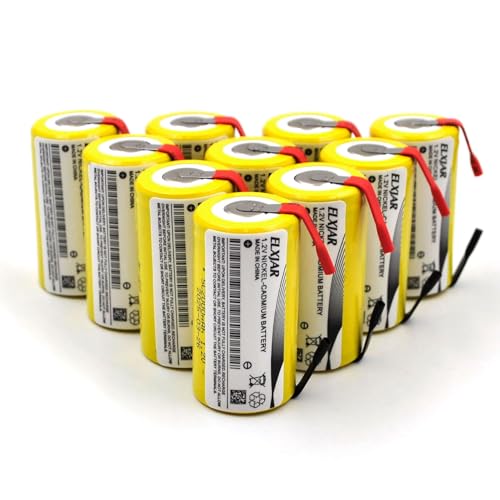

Tenergy 1.2V NiCd SubC 2200mAh Paper Wrapped Rechargeable Battery Flat Top – 15 Pack

Tenergy NiCd SubC 2200mAh Paper Wrapped Rechargeable Battery Flat Top with Tabs, 15 Pack

Odstore Ni-Cd Rechargeable Battery Sub C SC Batteries (Green*20)


Tenergy SubC 2200mAh NiCd Flat Top Rechargeable Battery (No Tabs) – 15 Pack


Energizer MAX C Batteries (2 Pack), C Cell Alkaline Batteries

Energizer Alkaline Power C Batteries (12 Pack), Long-Lasting Alkaline C Cell Batteries
Choosing by application, not by headline
For a legacy cordless drill or driver returning to regular trade or workshop duty, the deciding traits are discharge capability and charger compatibility. A high-drain NiCd set in the traditional capacity band remains a defensible, economical rebuild where the original charger was designed around that chemistry, while a high-drain NiMH set suits owners who also upgrade to a charger with proper termination for the more delicate chemistry. Either way, tabbed cells simplify the rebuild for anyone without welding equipment, and measured matching before assembly decides whether the finished pack feels factory-fresh.
For a dive light, runtime predictability rules. NiMH’s capacity advantage translates directly into minutes of burn, and the cell choice should be checked against the light maker’s stated pack configuration and the charger’s behaviour, because a light that fades mid-dive is worse than a light that was honestly shorter-rated from the start. Pure nickel tabs, careful wrapping and conservative charge rates recur throughout the guidance published for this application, and the reasoning is consistent: the marine environment punishes every shortcut eventually.
For RC use, internal resistance is the headline figure even when listings bury it. Cells marketed for racing and high-load hobby duty publish the discharge data to prove their suitability, and pairing them with fast charging at the rates their datasheets allow keeps a race day moving. For medical, emergency and institutional equipment, the answer is the least creative of all: match the original specification exactly, document the replacement, and let certification rather than enthusiasm guide the purchase.
Across all four applications, the same short checklist resolves most purchases. Confirm the physical size with calipers. Choose the chemistry for the duty pattern and the charger you actually own. Select the terminal format for your assembly method. Buy cells whose maker publishes real data, measure them before assembly, and build the full set at once. Dispose of the old set through proper collection, especially where cadmium is involved. A Sub-C pack rebuilt on those principles stops being a gamble and becomes what it was for the toolmakers who standardised on this cell in the first place: a renewable heart for equipment that still has years of work in it, swapped on the bench in an afternoon and forgotten about, in the best possible sense, every time the trigger is pulled or the light sinks below the surface and simply burns.