Our Top Picks




What's inside
- What a complete seven-piece set actually contains
- Acrylic and resin, the everyday materials
- Metal dice and the appeal of real heft
- Stone, gemstone-style and other specialty materials
- Weight and hand feel, the qualities you notice first
- Balance and the long-running argument about fairness
- Sharp edges, rounded edges and how a roll behaves
- Rolling surfaces and the humble dice tray
- Reading the numbers without leaning in
- Finish, polish and the flaws worth rejecting
- Storage, cases and keeping a set together
- A first set versus a collector set
- Matching a set to your kind of game
- Caring for dice so they stay worth using
- The buying mistakes that repeat endlessly
- Check prices on Amazon
- A practical way to choose, step by step
As an Amazon Associate I earn from qualifying purchases. This post may contain affiliate links at no extra cost to you.
This guide contains affiliate links, and if you buy through one of them the retailer may pay a small commission that helps support the writing here without influencing which sets are recommended or how their strengths and weaknesses are described. Everything that follows is drawn from published specifications, maker documentation and the accumulated feedback of buyers who use these dice week after week, rather than from any claim that a set was handled behind the scenes.
A good set of dice disappears into the game in the best possible way. You pick it up, you roll, you read the result at a glance, and the story moves on. A poor set does the opposite. It interrupts the moment with squinting, arguments about whether a six is actually a nine, and a faint suspicion that the twenty-sided die favours some numbers over others. Quality, in this small and surprisingly technical category, is mostly about removing those interruptions.
That is why the word quality deserves unpacking before any shopping begins. It does not simply mean expensive, and it does not simply mean pretty, although a beautiful set is a genuine pleasure to own. It means the dice are complete, consistently made, honestly weighted, easy to read under ordinary room lighting, and durable enough that the numbers and edges still look respectable after a year of Friday nights. Each of those qualities can be judged from specifications and owner reports if you know where to look.
This article works through the decision in the order most players actually experience it. First comes the composition of the standard seven-piece set and what each shape does during play. Then come materials, weight, balance, edge design and legibility, followed by finish, storage, and the difference between a sensible first set and a collector purchase. Along the way there are the common buying mistakes, which are remarkably consistent, and which are easy to avoid once somebody names them plainly.
What a complete seven-piece set actually contains
The standard polyhedral set contains seven dice: a four-sided die, a six-sided die, an eight-sided die, two different ten-sided dice, a twelve-sided die and a twenty-sided die. That line-up is not arbitrary decoration. It maps directly onto the dice notation used throughout modern fantasy roleplaying rules, where instructions such as roll a d8 for damage or make a d20 check appear constantly. If a set is missing one shape, the game does not stop, but somebody ends up borrowing, substituting or rerolling, and the rhythm suffers.
The twenty-sided die carries the heaviest workload. Ability checks, attack rolls and saving throws all turn on its result, so it is the die players stare at most and argue about most. Because it gets handled far more than the others, its balance, edge condition and number clarity matter disproportionately. When people describe a set as feeling right, they are very often describing the d20 without realising it, because that single die has shaped most of their impressions during the session.
The two ten-sided dice work as a pair, and newcomers sometimes mistake them for duplicates. One is numbered in single units from zero to nine, while its partner, the percentile die, is marked in tens from ten through ninety, with the double zero face representing one hundred. Rolled together they produce a result between one and one hundred, which certain tables, loot rolls and older rule systems call for regularly. A quality set makes the distinction between the two dice obvious at a glance, ideally through clear tens markings rather than colour alone, because colour cues vanish for some players and under dim light.
The remaining shapes divide the supporting work. The d4, small and pyramid-like, tends to serve for modest damage and healing effects. The familiar d6 handles everything from weapon damage to generating character statistics by older methods. The d8 and d12 cover larger weapons, class features and the occasional table that needs a wider spread of outcomes. None of these dice is glamorous on its own, yet a set where the d12 is beautifully finished while the d4 has blurred numbers is a set that will annoy its owner in small ways forever.
Size consistency across the seven pieces is a quiet marker of manufacturing care. Makers publish nominal sizes for each shape, and while the shapes naturally differ, a well-made set looks and feels like a family. Dice that are wildly out of scale with each other usually signal loose mould tolerances, which raises fair questions about the tolerances you cannot see, such as internal density. When product photographs show the set gathered together, compare the proportions carefully rather than admiring the colour first.
Some players eventually add a second d20 for rolls made with advantage or disadvantage, or extra six-sided dice for spells that call for handfuls of them. Those additions are conveniences, not requirements, and they should come after the core seven are sound. A buyer choosing a first set does better to secure one complete, legible, well-finished seven than to chase a sprawling bundle whose extra pieces distract from mediocre fundamentals. Completeness first, abundance later, is the ordering that experienced players tend to recommend.
Acrylic and resin, the everyday materials
Most sets a new player will encounter are moulded from acrylic or cast in resin, and understanding the difference helps set expectations. Acrylic dice are typically produced by injection moulding, which suits large runs and produces consistent, affordable sets with a hard, glossy surface. Resin dice are poured into moulds, a process that accommodates layered colours, suspended glitter, tiny inclusions and other decorative effects that moulding handles less gracefully. Neither method is automatically superior; they simply lead to different strengths.
Acrylic earns its popularity through consistency and price accessibility. A straightforward acrylic set usually arrives with even colour, predictable weight and numbers that are cleanly formed, because the process is mature and repeatable. For a player who wants several sets in different colours for different characters, or a game master who needs loaner sets for a whole table of beginners, acrylic is the pragmatic backbone of most collections. It also shrugs off casual handling well, which matters when dice get swept into a bag with pencils and bottle caps.
Resin opens the door to artistry. Because it is poured, makers can suspend colour in translucent layers, create swirling patterns that differ slightly from die to die, and embed decorative elements that give a set a theme. The trade-off is variability. Two resin sets from the same design can look noticeably different, inclusions can sit closer to one face than another, and tiny bubbles occasionally appear near the surface. Buyers who love the handmade character accept this readily; buyers who want uniformity should look at photographs of actual sets rather than a single polished sample image.
Sharp-edged resin dice have become a distinct subculture within the hobby, produced by casting followed by hand polishing rather than tumbling. Their faces are flat, their edges crisp, and their clarity can be striking, especially in translucent colours that catch the light. They also tend to cost more, reflecting the labour involved, and they reward gentler handling. A player who tosses dice into a shared bowl without thinking may be happier with tumbled acrylic, while a careful owner who rolls on a padded tray will see the appeal immediately.
Whichever plastic family you choose, judge the material by published descriptions rather than by marketing adjectives. A listing that states the material plainly, gives sizes and weight for the set, and shows the numbers up close is giving you something to verify. A listing that leans entirely on words like premium or luxury without a single measurement is asking you to buy a mood. Moods fade after the third session; measurements remain useful for as long as you own the dice.
How plastic dice age with regular play
Plastic dice age gracefully when they are treated reasonably. The numbers, usually filled with paint after moulding or casting, are the most vulnerable element, because the fill sits slightly proud or flush in a shallow recess and takes friction every time the die slides across a surface. On hard tabletops the fill wears slowly; in a loose bag with metal dice it wears faster. Owners who report numbers fading after a year almost always describe rough storage or abrasive rolling surfaces somewhere in the story.
Surface scratching is the other slow change. Fine scratches dull a glossy finish gradually, turning crystal clarity into a softer sheen. Many players find this patina pleasant, a visible record of campaigns played, but anyone buying a display-worthy translucent set should accept that regular play will change it. Rolling on a felt-lined tray and storing the set in its own case slows the process considerably. Neither habit requires effort once established, and both preserve the legibility that made the set worth buying.
Metal dice and the appeal of real heft
Metal dice announce themselves the moment you lift them. A metal twenty-sided die can weigh several times as much as its plastic counterpart, and that density changes everything about the roll: the sound, the distance travelled, the way the die settles, and the care you must take with the surface underneath. Players who love metal usually cite the ceremony of it. Rolling feels like an event rather than a flick of the wrist, and for a climactic check that weight can be genuinely satisfying.
The practical consequences deserve equal attention. Metal dice will dent soft wood, chip tile, and leave marks on glass or polished tabletops, which is why owners almost universally pair them with a rolling tray or mat. They also travel less far when thrown, because mass carries them downward rather than skittering across the table, and many players find the shorter, more decisive roll easier to control in a crowded play space full of character sheets, drinks and miniature figures.
Construction varies more than listings sometimes admit. Solid metal dice are machined or cast from a single alloy throughout, while hollow designs enclose an empty core to reduce weight and sometimes add a faint ringing note when rolled. Plated finishes in antique, darkened or bright tones sit on top of the base metal, and that plating is where wear shows first, typically on the sharpest corners and the raised edges of numbers. Buyer feedback about finish rubbing through after months of weekly play is worth reading closely before choosing an ornate plated design.
Number treatment on metal deserves scrutiny too. Engraved numbers filled with enamel or paint read beautifully when new, but shallow engraving combined with a dark finish can produce poor contrast under warm indoor lighting. Photographs taken in bright studio conditions flatter every finish, so look for owner pictures taken at ordinary tables. If several owners independently mention squinting at the d20, believe them, because legibility complaints are rarely invented and they never improve with familiarity.
Metal suits some tables better than others. In a quiet apartment late at night, the clatter of metal on a tray can carry through walls in a way plastic never does. In a game shop or a lively kitchen, that same sound is part of the atmosphere. Think about where you actually play, who else is in the building, and whether the table surface belongs to you, because the finest metal set becomes a burden if every roll requires an apology.
Stone, gemstone-style and other specialty materials
Stone dice occupy the far end of the material spectrum, cut from natural or reconstituted stone into polyhedral shapes. Each set carries the veining and colour variation of its source material, which means the set you receive will never be identical to the photograph that persuaded you. For many buyers that uniqueness is the entire point. For others, particularly anyone ordering a gift to match a specific character portrait or colour scheme, the variation is a risk that should be acknowledged before ordering.
Stone is beautiful and brittle in equal measure. A die dropped onto a hard floor can chip or, in the worst case, crack, and corners are especially vulnerable because the geometry concentrates impact there. Makers and experienced owners consistently advise rolling stone dice only on padded surfaces and storing each piece so it cannot knock against its neighbours. A compartmented case is not an accessory for stone; it is closer to a requirement, and its cost belongs in the total budget from the start.
Weight sits between plastic and metal for most stone types, giving a roll that feels substantial without the aggressive clatter of metal. The numbers are usually engraved and filled, and engraving depth matters because stone cannot be re-inked as casually as plastic if the fill wears. Ask how the numbers are finished, and look for close photographs of the smallest die, the d4, where engraving space is tightest and shortcuts become visible first.
Specialty materials make the most sense as a second or third set, bought with open eyes after a player knows their habits. Someone who reliably uses a tray, stores dice carefully and plays in one place will enjoy stone for years. Someone whose dice live in a backpack and get rolled on whatever surface is available will watch the same set deteriorate, and the disappointment will feel like the product failed when really the match was wrong.
Weight and hand feel, the qualities you notice first
Before balance, before edges, before numbers, a player notices how a set feels gathered in one hand. Weight, size and surface temperature combine into an impression within seconds, and that impression colours everything that follows. Cold, dense dice suggest seriousness. Light, warm dice suggest speed and casual fun. Neither impression is a measure of quality in itself, but a mismatch between the feel you enjoy and the set you bought will quietly push that set to the back of the drawer.
Oversized dice deserve a specific warning. They photograph well, read easily from across the table, and feel gloriously substantial, yet a full handful for a multi-die damage roll becomes awkward, and the d20 alone can dominate a small rolling tray. Standard sizes evolved through use, not accident. Players with larger hands or reduced grip strength may genuinely prefer a bigger format, and for them the trade is worthwhile, but most buyers should handle the idea of oversized dice as a deliberate choice rather than a default upgrade.
Undersized and miniature sets sit at the opposite pole. They travel beautifully, fit into tiny tins, and charm everyone who sees them, right up until somebody has to read a percentile result across the table in poor light. Miniatures work best as travel backups or novelties alongside a full-size primary set. Judged as a sole set for a long campaign, their legibility and handling compromises accumulate session after session.
Surface texture also shapes hand feel in ways listings rarely describe. High-gloss dice can feel almost slippery when hands are dry, while matte or lightly textured finishes give the fingers purchase and tend to show fingerprints less. Glitter-heavy resin adds a faint grain that some players love and others find distracting. Owner feedback is the best guide here, because texture vocabulary in product descriptions is vague, whereas buyers describing a set as surprisingly grippy or oddly slick are reporting something real.
The honest way to think about hand feel is as a matching exercise. Match the weight to the surfaces you roll on, the size to your hands and tray, and the finish to how much maintenance you will realistically do. A set matched on those three points gets used constantly, and a set that gets used constantly delivers more value than a theoretically superior set that stays in its box because rolling it feels like a chore.
Balance and the long-running argument about fairness
Few topics in the hobby generate as much folklore as dice fairness. Every group has a story about a die that rolled an impossible number of critical successes, or a d20 that seemed cursed for an entire campaign. Separating genuine manufacturing bias from the ordinary clustering of random results matters, because the remedies differ. A truly biased die should be retired. A merely unlucky die should be forgiven, since randomness produces streaks far more often than intuition expects.
Real bias has physical causes. An air bubble trapped near one face during casting shifts the centre of mass toward the opposite side. An inclusion suspended unevenly in resin can do the same. Excess material left on one corner after tumbling, or a face polished more aggressively than its neighbours, subtly changes how the die settles. These defects are matters of degree, and in a casually manufactured set they are usually small, but they are not imaginary, and they are more likely in decorative dice with heavy internal features.
The famous float check, in which a die is suspended in a dense salt solution and watched for a tendency to rotate toward a particular face, can reveal gross imbalance in plastic dice. It cannot certify perfection, and it says nothing useful about metal or stone dice, which sink regardless. Treat the method as a screening tool for obvious problems rather than a laboratory verdict. A die that stubbornly presents the same face upward in solution deserves suspicion; a die that drifts lazily in different directions is probably fine.
Rolling tallies offer the other popular check: record a few hundred results and see whether the distribution looks wildly uneven. The weakness is statistical patience. A few hundred rolls can easily produce lopsided-looking counts from a perfectly honest die, and players routinely over-read those fluctuations. If you enjoy tallying, treat it as entertainment and a rough sanity check, not as grounds to accuse a set. Persistent, extreme skew across very large samples is the pattern that actually means something.
Precision-machined dice, made to exacting tolerances with flush-filled numbers, exist in the six-sided world but are not the standard polyhedral sets are built to. Expecting that level of certification from a decorative resin d20 misunderstands the product. The reasonable expectation is simpler: no visible bubbles near faces, no heavy inclusion parked against one side, no obvious flat spots, and no consistent behaviour that the whole table can predict. Sets from makers who discuss their curing, polishing and inspection process tend to meet that expectation more reliably.
Why the whole table cares about one player’s dice
Fairness is partly a social property. A die that everyone suspects, fairly or not, creates friction every time it produces a timely success, and the suspicion itself damages the game even if the die is innocent. This is why many groups prefer dice that can be read by everyone and whose provenance is unremarkable. Translucent dice have a small social advantage here, because internal bubbles or inclusions are visible to anyone who cares to look, whereas an opaque die asks the table to take its interior on faith.
House rules about rolling in the open, using a shared tray, and leaving the die untouched until the result is announced do more for trust than any manufacturing claim. If your group argues about dice, fix the rolling ritual first. A new set bought into an unchanged ritual will inherit the same arguments within a month, because the argument was never really about the plastic.
Sharp edges, rounded edges and how a roll behaves
Edge design is the most visible engineering choice in modern dice. Traditional sets are tumbled after moulding, which rounds the edges and corners, softens the look, and produces a die that rolls freely and keeps rolling. Sharp-edged dice skip the tumbling in favour of careful polishing, leaving flat faces that meet at crisp lines. The difference is not cosmetic only; it changes the physics of every throw and the way the die comes to rest.
Rounded dice travel further and tumble longer, which many players experience as more random and more dramatic. The downside appears on smooth or slightly slanted surfaces, where a rounded d20 can wander off the rolling area, under a book, or onto the floor with depressing regularity. Rounded corners also catch light less distinctly, so a glossy rounded set can look softer and less jewel-like in photographs than its sharp-edged equivalent, even when the material is identical.
Sharp-edged dice stop sooner and settle with a certain decisiveness that their fans describe as honest. Because the faces are flat and the edges resist rolling, each throw covers less distance, which suits small trays and crowded tables. The crisp geometry also displays translucent colours beautifully, since light passes through flat faces with less distortion. For players who roll in a confined space and prize that gem-like appearance, the sharp style solves two problems at once.
The costs of sharpness are fragility and price. Crisp edges chip more readily when dice collide with each other in a bag or strike a hard surface, and the hand-finishing labour raises the price considerably. Sharp sets should be stored separated or in a fitted case, and rolled on padding as a matter of routine. Owners who treat them like tumbled acrylic, tossing the whole set loose into a backpack pocket, reliably report edge damage and then blame the maker for a predictable outcome.
Between the extremes sit lightly tumbled designs that soften only the corners, preserving a defined face while forgiving casual handling. For many players this middle path is the sensible default: better stopping behaviour than a fully rounded die, better durability than a fully sharp one, and a price closer to ordinary sets. When a listing describes its edge treatment honestly, including whether the dice were tumbled, that candour is itself a useful signal about the maker.
Rolling surfaces and the humble dice tray
Where a die lands matters almost as much as what it is made from. Bare hardwood gives a lively, noisy roll and gradually damages both the table and the numbers. Glass and stone surfaces are harsher still, and they are genuinely risky for metal and stone dice. Paper scatters the roll unpredictably, and a die that lands half on a character sheet and half off it invites the oldest argument in the hobby: whether a cocked die counts, and how it should be rerolled.
A lined tray solves these problems in one inexpensive stroke. Felt, leather or soft synthetic lining absorbs impact, quiets the roll, protects edges and numbers, and defines a clear area where results are valid. The walls keep enthusiastic throws contained, which speeds play more than newcomers expect, because nobody is retrieving dice from under the sofa. Players who invest in one accessory for a good set should make it the tray, ahead of any decorative extra.
Whatever surface you choose, consistency helps fairness and trust. Rolling every die the same way, in the same place, removes a whole category of table disputes before they start. It also protects the dice evenly, so wear patterns stay uniform instead of concentrating on whichever die keeps escaping onto the floor. Boring as it sounds, the tray habit is the single practice most strongly associated with sets that still look good years later in owner reports.
Readers comparing gaming furniture and accessories alongside dice will find our seating coverage useful too, since long sessions punish poor chairs quickly; the guide at best computer gaming chairs under 200 looks at that side of the setup in detail.
Reading the numbers without leaning in
Legibility decides whether a set is pleasant or tiresome more surely than any other single factor, because you perform the reading task hundreds of times per session, often in imperfect light, often while tired, and often while three other people wait for the story to continue. A number style that looks charming in a product photograph can become a genuine obstacle at midnight in a living room lit by a single lamp. Judge legibility pessimistically and you will rarely regret it.
Contrast does most of the work. Dark numbers on a pale, opaque background and bright numbers on a deep background both read instantly, while mid-tone numbers on a swirling mid-tone background force the eye to hunt. Multicoloured and galaxy-style designs are the usual offenders, because the pattern behind the number changes from face to face; a digit that is clear against a dark patch may vanish against a light swirl two faces later. When a design mixes several background colours, examine every face in the photographs, not just the hero angle.
The way numbers are formed matters as much as their colour. Engraved or recessed numbers filled with paint tend to stay legible longest, because the recess protects the fill and gives the digit a defined edge even as the surface ages. Surface-printed numbers can look crisp initially but have nothing protecting them from abrasion, so their lifespan depends heavily on how and where the dice are rolled. Makers who state the method plainly are easier to trust than those who leave you to guess from a photograph.
Typeface choices carry practical consequences disguised as style. Highly decorative fonts with flourishes, runes or fractured strokes slow reading and occasionally create genuine ambiguity between similar digits. The classic traps are six and nine, which responsible makers distinguish with an underline, a dot, or a clear orientation mark, and the one and seven on certain stylised fonts. If a listing photograph leaves you uncertain which way up the d20 sits, that uncertainty will return at the table, magnified by distance and haste.
Number size interacts with die size in obvious but frequently ignored ways. The d4 is the hardest die to read in almost every set, because its faces are small and its result is presented either at the top point or along the base edge depending on the design convention. Two conventions exist and both are valid, yet a set should apply one consistently and a buyer should know which they are getting. Confusion about the d4 is a rite of passage, but a well-designed set shortens it considerably.
Lighting, eyesight and the rest of the table
Your own eyes are not the only ones that matter. A set that you read easily at close range may be opaque to the player across the table who is asked to witness important rolls. Larger, high-contrast numbers are a courtesy to the whole group and a quiet contribution to trust, because results everyone can verify are results nobody disputes. Players with reduced vision, or groups that include them, should weight this factor above colour, material and novelty combined.
Gloss complicates reading under directional light. A highly polished face can reflect a window or lamp exactly where a number sits, hiding it behind glare until the die is tilted. Matte and satin finishes scatter that reflection and stay readable across more angles. This is one reason some veteran players prefer understated sets for serious campaigns and keep the mirror-bright novelties for display or short, light-hearted games.
Finish, polish and the flaws worth rejecting
Finish is where manufacturing care becomes visible. A well-finished die has flat, even faces, numbers centred in their fields, paint contained within the engraving rather than smeared across it, and edges that are uniform all the way around. None of this requires magnification to assess. Hold the d20 to the light, turn it slowly, and the difference between careful work and rushed work announces itself within a minute.
Certain flaws justify returning a set without hesitation. A visible bubble breaking the surface of a face will worsen with use and may affect the roll. Paint bleeding outside the numbers suggests the whole batch was hurried. A face that is noticeably domed or sunken changes rolling behaviour and indicates a mould or curing problem. Scratches present on arrival, on a set sold as new, point to handling or storage failures that the seller should answer for.
Other imperfections belong in the category of character rather than defect, especially with cast and handmade sets. Slight colour variation between dice, a swirl pattern that differs from the sample photograph, or a tiny inclusion fully enclosed in the centre of a die are normal consequences of the process. Buyers who want machine uniformity should buy moulded sets, where that uniformity is achievable, rather than ordering handmade work and grading it by factory standards.
Gate marks and sprue traces, the small blemishes where material entered the mould or where a piece was separated after casting, reveal how much finishing a maker actually does. On quality sets these marks are sanded and polished until they are hard to find. On rushed sets they remain as rough spots that catch the fingertip. Because a sprue mark on one face can influence how a die settles, its removal is not merely cosmetic, and makers who describe their sanding stages are telling you something meaningful.
Packaging condition offers a final clue. Dice that arrive loose in a thin bag have been treated as a commodity at every stage, and the condition of their corners usually reflects that journey. Dice that arrive in a fitted box, separated tin or individual compartments have been protected by people who expect the product to be examined closely. You are not buying the box, but the box predicts the dice more reliably than most advertising copy.
Session comfort extends beyond dice, of course, and players setting up a dedicated game space sometimes ask about seating that supports long evenings; our overview at best reclining massage gaming chairs covers that quite different purchase for anyone furnishing a room around the table.
Storage, cases and keeping a set together
More dice are ruined by storage than by rolling. Loose in a bag, dice abrade each other continuously: numbers wear, sharp edges chip, polished faces dull, and metal sets batter everything they touch. The damage is slow enough to escape notice week by week and obvious enough after six months to cause real regret. Storage is therefore not an afterthought for a quality set; it is the second half of the purchase.
The simplest adequate solution is a soft pouch dedicated to one set, which prevents contact with other objects even if the dice still touch each other. A step up is a case with individual slots or compartments, which stops dice-on-dice contact entirely and suits metal, stone and sharp-edged resin. Rigid tins protect against crushing in a packed bag, while soft wraps protect surfaces but not structure. Choose according to how the set travels, not according to which case looks best on a shelf.
Capacity planning matters as collections grow. Most players who stay in the hobby accumulate several sets, each associated with a character or a mood, and a storage system bought for one set becomes inadequate quickly. A case or box that organises multiple sets, with the current character’s dice in a separate removable pouch, serves both the collection and the weekly routine. Labelling, even informally, prevents the small chaos of three similar blue sets merging into one anonymous pile.
Moisture and heat deserve a brief mention. Dice should live in ordinary indoor conditions, away from prolonged direct sunlight, which fades some pigments and can soften certain resin formulations over time, and away from damp, which threatens metal finishes and any wooden components. A drawer or shelf in the room where you play is ideal. The car glovebox, with its temperature extremes, is close to the worst storage place available, however convenient it feels.
Finally, keep the set complete by giving it a homecoming ritual. Dice roll under furniture, hide inside tray folds, and migrate into other people’s bags by accident. Counting seven pieces back into the case at the end of a session takes seconds and prevents the slow tragedy of a beloved set becoming a set of six. Replacement singles exist for common designs, but matching the colour batch of a decorative set bought a year earlier is often impossible.
A first set versus a collector set
The right purchase depends heavily on whether the buyer is equipping themselves to play or adding to a collection, and confusing the two purposes wastes money in both directions. A first set should be legible, durable, complete and inexpensive enough that losing one die at a friend’s house is an annoyance rather than a small tragedy. It should also be a set the owner is willing to lend, because new players in a group often learn with borrowed dice.
For that first purchase, a well-made acrylic or tumbled resin set in a high-contrast colourway is difficult to beat. It will survive being rolled on bare tables while the owner learns tray habits, its numbers will stay readable, and its price leaves budget for the rulebooks, pencils and snacks that a new group actually needs. Sentiment will attach to it anyway; the set you played your first campaign with becomes a keepsake regardless of what it cost.
A collector set answers different questions. It may commemorate a character, display an unusual material, showcase a maker’s artistry, or simply be beautiful enough to justify its existence on a shelf between sessions. Legibility and durability still matter if the set will be played, but collectors reasonably trade some practicality for character. The mistake is pretending no trade happened. A delicate, low-contrast art set bought for weekly play in a dim room will frustrate its owner no matter how lovely it looks in daylight.
Gifts sit between the two categories and deserve their own logic. Dice are an excellent gift for a player precisely because sets are personal, portable and endlessly varied, yet the giver should prioritise readability and the recipient’s known tastes over novelty. A set themed to the recipient’s current character, in colours they already favour, with numbers that can be read across a table, will be used for years. A joke set with eccentric shapes or miniature size will be laughed at once and shelved.
Players who run games for others should think in terms of a small fleet rather than a single set. Several inexpensive, clearly distinct sets let each newcomer keep one colour for the whole session, which reduces confusion about whose roll is whose and speeds up teaching. Distinct colours matter more than matched quality here; a borrowed set that is a different colour from everyone else’s prevents more errors than a beautiful set that blends into the pile.
Matching a set to your kind of game
Campaign style shapes what good means in practice. A group deep in a two-year campaign with the same characters benefits from dice that feel ceremonial and personal, because the same set will mark hundreds of consequential rolls. A group that plays short, self-contained adventures with rotating characters benefits from variety and durability instead, since the emotional attachment per set is lower and the handling is rougher.
Genre and setting influence material and colour choices more legitimately than players sometimes admit. Stone or dark metal suits a grim campaign of gothic horror; bright translucent resin suits a whimsical seafaring adventure. This is not frivolous. Tabletop play runs on shared imagination, and physical objects that reinforce the fiction genuinely help a table stay in the mood. Choosing a set that fits your story is a reasonable use of money, provided the numbers remain readable while doing it.
Players who split their time between home games and organised public play should consider the social environment of a shop or convention table. Dice there must be readable by strangers, quick to gather, and replaceable if lost, which argues for a dedicated travelling set rather than the prized shelf piece. Many experienced players keep exactly this arrangement: one set that goes out into the world, and one that never leaves the house.
Digital hybrids add a modern wrinkle. Groups that meet partly online, with one player rolling physical dice on camera, need numbers that read clearly through a webcam at an angle, which is a stricter test than reading across a table. Large digits, matte finishes and strong contrast all help, while reflective glitter and pale inks fail badly on camera. If your group’s arrangement is hybrid, judge candidate sets by how they would appear on a screen, not only in your hand.
Displays in a game room raise similar questions of clarity at a distance, and readers planning a full setup sometimes compare screens as carefully as dice; the discussion at best 100 hz gaming monitors is relevant to that broader project, though the dice themselves will always be the cheapest component in the room.
Caring for dice so they stay worth using
Routine care is brief and unglamorous. Wash plastic and metal dice occasionally in lukewarm water with a drop of mild soap, using a soft cloth rather than anything abrasive, then dry them thoroughly before they go back into their case. Skin oil, snack residue and drink splashes accumulate invisibly and make surfaces tacky, and a set that feels unpleasant gets handled less carefully, which accelerates every other kind of wear.
Stone and delicate resin deserve gentler treatment: a soft, slightly damp cloth, no soaking, and no ultrasonic cleaners or harsh solvents, which can attack fillers, inks and surface sealants. Wooden dice should be kept dry and cleaned with a barely damp cloth at most. When a maker supplies specific care guidance, follow it over general advice, because they know the sealants and inks involved in their own process.
Re-inking faded numbers is a legitimate rescue for a beloved set whose numbers were engraved and filled. Fine-tipped paint pens and similar tools let a patient owner refresh the fill, wiping the excess from the face before it dries. The work is slow, the d4 will test your patience, and the result rarely matches factory neatness, but for a set with sentimental value it beats retirement. Practise on the least-used die first, and accept that printed, non-engraved numbers cannot be rescued the same way.
Know when to retire a die instead. A chip that changes how a d20 settles, a crack running through a face, or wear so uneven that the table has started predicting results are all sound reasons to replace a piece or a set. Sentimental attachment is a virtue in this hobby, but it should not extend to defending a die whose results nobody trusts. Retire the set to a display shelf, where its history can be appreciated without its physics being debated.
The buying mistakes that repeat endlessly
The most common mistake is buying with the eyes alone, choosing the most dramatic colourway in the photographs without checking contrast, number style or material description. Product photography is designed to seduce: dramatic lighting, macro lenses and dark backgrounds flatter translucent and glitter designs enormously. The same set under kitchen lighting at arm’s length is the product you actually own. Mentally translate every photograph into that ordinary scene before deciding.
The second mistake is ignoring the rolling surface implications of the material. Buyers fall for metal or stone, roll the set on a bare wooden table exactly once, and then either damage something they care about or quietly stop using the set. The tray or mat should be bought in the same order, treated as part of the price, because functionally it is. A set plus its surface is the real product; the set alone is an incomplete purchase.
Third comes the bundle trap. Large multi-set bundles promise variety at a tempting per-set cost, and some are perfectly decent, but the format also hides inconsistent quality, duplicated colourways and numbers printed rather than filled. For a game master equipping a classroom or a club, bundles make sense. For an individual seeking one good set, the money concentrated on a single, well-described seven almost always buys more satisfaction than the same money scattered across a sack of strangers.
Fourth, buyers neglect the percentile pair and the d4 when inspecting photographs, because the d20 dominates every product image. Yet those smaller dice generate a disproportionate share of reading complaints. Ask how the six and nine are distinguished, confirm the tens die is marked in tens, and check which reading convention the d4 uses. Three small confirmations before ordering prevent the three most predictable disappointments after delivery.
Fifth, people choose a set for the player they wish they were rather than the player they are. The meticulous collector’s set bought by a chaotic backpack player, the subtle low-contrast set bought by someone who plays in a dim basement, the oversized set bought for a tiny café table: each purchase fails on fit, not on quality. Honest self-knowledge about habits, spaces and eyesight is the cheapest upgrade available in this entire category.
Finally, there is the mistake of hunting for fairness perfection. Players sometimes cycle through set after set, convinced each new one will roll more honestly than the last, when the underlying experience is simply what randomness feels like from the inside. Buy one well-made set whose construction you can inspect and whose numbers you can read, then play with it long enough for the streaks to even out in your memory. Confidence in a set is mostly built through familiarity.
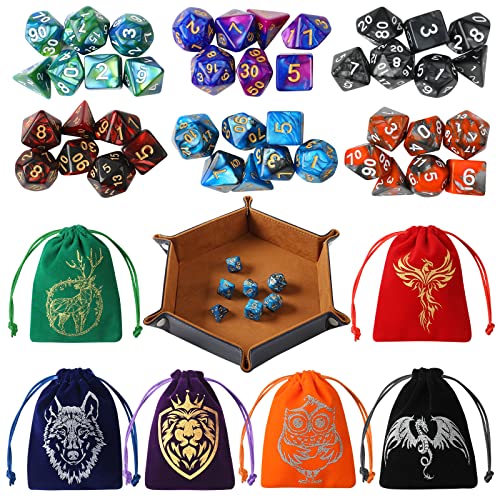
Check prices on Amazon
Live listings for the shortlist in this guide are pulled from Amazon below, so prices and availability are always current at the moment you look.



A practical way to choose, step by step
Begin by fixing the non-negotiables: a complete seven-piece set, numbers you can read in ordinary light, and a material compatible with your table and your storage habits. Those three filters eliminate most unsuitable options quickly and leave a shortlist where taste can safely take over. If a candidate fails any of the three, no amount of beauty or discount should rescue it, because those are the properties you will interact with every single session.
Next, decide the edge style according to your rolling space. A small tray or a crowded table points toward sharp or lightly tumbled edges that settle quickly; a large open surface and a love of drama point toward fully rounded dice that travel. Neither answer is more correct, but choosing deliberately beats inheriting whatever the prettiest listing happened to use, and it determines the storage care the set will need.
Then weigh the finish and number treatment as a durability question. Engraved, filled numbers and a maker who describes polishing and inspection are long-term virtues, worth favouring if this set is meant to serve a long campaign. Printed numbers and vague descriptions are acceptable in an inexpensive starter set whose job is to get a new player to the table this weekend; just hold them to a starter set’s expectations.
Players furnishing a dedicated room sometimes extend the same contrast logic to their screens, and the guide at best 10 bit monitors explores colour depth for that purpose. The principle transfers neatly: specifications that sound like luxuries often turn out to be the properties you notice every hour of use.
Last, buy the storage and the rolling surface in the same decision, and then stop shopping. Dice invite endless browsing because they are affordable, beautiful and easy to justify, and many collections grow by accident rather than intention. A deliberate set, properly housed and rolled on a proper surface, will serve for years. When a character truly earns a new set, you will know, and that purchase will mean something precisely because the others were restrained.
Choose the set whose numbers you can read without thinking, whose weight feels honest in your palm, and whose edges suit the surface you own, and you will have bought the only kind of luck this hobby actually sells: the confidence to roll in front of your friends, accept whatever number appears, and get on with the story together.