Our Top Picks
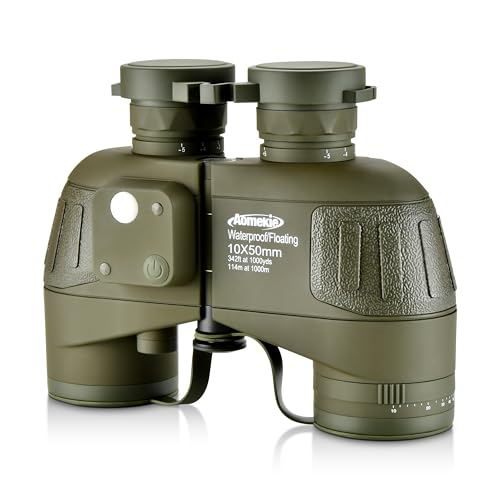
 Bushnell Marine 7x50 Waterproof Binoculars with CompassOne Size9.5 x 8.7 x 3.9 inches2.3 poundsCheck on Amazon


What's inside
- Why a compass inside binoculars changes the job
- Why 7×50 became the marine standard
- The compass itself: damping, light and legibility
- Sealing, fogging and the slow enemy called salt
- Weight, balance and the fourth hour of a watch
- Choosing by the way you actually go to sea
- Care after salt water, and the habits that add years
- The buying mistakes that repeat every season
- Night work, harbour entries and other honest tests
- Stabilised and electronic rivals, judged fairly
- Check prices on Amazon
- A final word on training your eyes, not just your kit list
As an Amazon Associate I earn from qualifying purchases. This post may contain affiliate links at no extra cost to you.
This guide contains affiliate links, and a purchase made through one of them may earn a commission paid by the retailer at no extra cost to you. That arrangement never decides which models are discussed here or how their strengths and weaknesses are described.
A good pair of marine binoculars earns its place on board long before anything dramatic happens. Most days the job is ordinary: reading a distant channel marker, checking whether that speck near the horizon is a fishing boat or a buoy, or confirming that the headland you think you recognise really is the one on the chart. Add a built-in compass to the same instrument and the task changes in a useful way. Instead of simply seeing an object more clearly, you can also note the direction to it, in degrees, at the exact moment you are looking at it. That single extra piece of information turns a vague observation into something a navigator can plot, repeat and hand over to the next person on watch.
That is the real reason compass binoculars have remained a staple on sailing boats, fishing boats and workboats while so many other gadgets have come and gone. Electronics fail when batteries die, screens wash out in hard sunlight, and a phone tucked in a waterproof pouch is a poor tool when both hands are busy and spray is coming over the bow. A well-made marine binocular asks for nothing except a steady grip and a clear view. It works at dawn, it works in rain, and it keeps working when the chartplotter is showing a fault you do not have time to diagnose. Choosing one well, however, means looking past the headline magnification and asking harder questions about light, sealing, compass behaviour and comfort over a long watch.
Why a compass inside binoculars changes the job
On land, direction is easy to take for granted because landmarks stay still relative to you. At sea your platform moves in every direction at once. The bow swings as the helm corrects, the whole boat rolls through a swell, and a bearing taken with a separate hand compass forces you to look away from the target, read a card, then look back and hope you are still sighting the same object. Anyone who has tried to take a bearing on a low, grey navigation mark in a choppy anchorage knows how quickly that look-away-and-back routine falls apart. The mark disappears behind a wave, another similar mark drifts into view, and confidence drains out of the reading.
Compass binoculars solve that sequence problem by putting the bearing scale inside the field of view. You centre the target, read the number that lines up beneath it, and you are done. The observation and the measurement happen in the same glance, which matters most in the situations where bearings matter most: checking whether another vessel is on a steady bearing and therefore on a collision course, fixing your position from two or three shore marks, or giving a crew member an unambiguous instruction such as steering toward a light that bears a particular number of degrees. In each case the value lies not in the compass alone or the optics alone, but in the two working together without a pause between them.
There is also a quieter benefit that experienced skippers mention often. A bearing you can repeat is a bearing you can trust over time. If you note the direction to an anchored neighbour at dusk and check it again an hour later, a change tells you something has moved, either them or you. If you watch a ship crossing ahead and its bearing stays stubbornly constant while its size grows, seamanship says the situation needs action, not optimism. The compass turns binoculars from a viewing aid into a simple, honest monitoring tool, and that monitoring habit is one of the cheapest forms of safety a small boat can carry.
What a bearing can and cannot tell you
It helps to be clear about the limits. A binocular compass shows magnetic direction as seen from your boat, steadied as well as its damping allows. It does not know about variation, deviation from nearby metal, or the swing of your own heading while you read it. A careful navigator treats the number as a good observation that still needs the usual corrections before it becomes a line on a chart. That is not a flaw in the instrument; it is the nature of magnetic bearings from any handheld device. The practical lesson is to take two or three readings, average them in your head, and be suspicious of any single reading taken while the boat was mid-turn or while you were standing beside a steel winch or a running engine.
Placement on the boat matters for the same reason. Ferrous metal and electrical currents bend the local magnetic field, and binoculars are often used close to binnacles, speakers, tools and engine blocks without anyone thinking about it. If your readings seem to disagree with a known transit or a trusted reference bearing, move a few steps away from the metal and try again before blaming the instrument. Good makers design the compass capsule to be as forgiving as the physics allows, but no capsule can repeal magnetism. Learning where on your own boat the compass reads cleanly is part of learning the boat, and it takes only one calm afternoon of comparisons to build that knowledge.
Why 7×50 became the marine standard
Walk along any marina pontoon and count the binoculars hanging in cockpits and wheelhouses, and one specification dominates: seven times magnification with fifty-millimetre front lenses. That pairing survived decades of marketing pressure toward bigger numbers for sound physical reasons. Magnification multiplies everything, including the tremor in your hands and the roll of the deck beneath your feet. At seven power, a target stays findable and readable from a moving boat. Push to ten power on the same deck and the image starts to swim, buoys slide out of the field before you can read their numbers, and a bearing scale that should sit steady beneath the target dances too much to trust.
The fifty-millimetre objective earns its keep at the edges of the day. Harbours are busiest at first light, fishing grounds often demand a pre-dawn departure, and the last hour before dark is exactly when an unlit mark or a returning tender is hardest to pick out. A larger front lens gathers more light, and when that light is divided by the magnification the result is the exit pupil, the bright disc of light that reaches your eye. Divide fifty by seven and the answer is a little over seven millimetres, which matches what a dark-adapted human pupil can accept. In plain terms, a 7×50 hands your eye all the brightness it can use at dusk, whereas a compact glass with a small exit pupil throws some of that hard-won light away.
Field of view completes the picture. A wider field means a bigger slice of sea in the eyepieces, which makes searching faster and helps you keep a moving target framed while the boat pitches. Specifications express this either as an angle or as a width at a set distance, and either form rewards comparison. On the water, field of view is not a luxury for birdwatchers; it is the difference between sweeping a harbour entrance methodically and hunting in circles for a mark you glimpsed once and lost. When two models share the same magnification, the one with the broader, edge-to-edge clear field usually proves kinder in daily use.
Reading the numbers without being misled by them
Specification sheets invite a kind of scoreboard shopping that serves buyers poorly. Twilight factors, relative brightness indices and similar derived figures can help compare close rivals, yet none of them captures coating quality, internal baffling or the simple honesty of the glass. A modest specification with excellent coatings routinely outperforms an ambitious specification built down to a price, especially when you look toward a low sun and stray light floods a poorly baffled barrel. Treat the printed numbers as a shortlist filter: confirm the magnification suits a moving deck, confirm the exit pupil suits dawn and dusk work, then let build quality and sealing decide between the survivors.
Eye relief deserves the same practical reading. It describes how far your eye can sit from the eyepiece while still seeing the full field, and it decides whether spectacle wearers get the whole picture or a tunnelled version of it. Sunglasses count here too, because marine binoculars spend much of their life in front of polarised lenses on bright days. Generous eye relief with eyecups that fold or twist to repeatable positions keeps the instrument usable for every crew member, not only the one whose eyesight matches the designer. Shared cockpit equipment has to fit the whole crew, and a binocular that only works beautifully for one person will quietly stop being shared, checked and carried.
Focus design splits the marine market in two, and the choice shapes daily handling. Individual eyepiece focus, where each barrel is set separately, suits the sealed marine tradition: fewer moving seals, settings that stay put, and a depth of field that keeps most distances acceptably sharp once dialled in for your eyes. Centre focus suits quicker shifts between near and far targets, which birders and harbour watchers may prefer, but the moving bridge mechanism must still keep water out year after year. Neither system is automatically superior. The honest question is whether your typical target sits at chart-table distance or at the horizon, and whether gloved, cold fingers can still work the mechanism you choose.
The compass itself: damping, light and legibility
Not all built-in compasses behave alike, and the differences show up within seconds of lifting the binoculars on a lively deck. The compass capsule floats in a damping fluid so the card settles instead of spinning with every roll. Cheap damping lets the card oscillate long after you have steadied the glass, forcing you to wait, guess, or read a number that is still travelling. Better damping brings the card to rest promptly without making it sluggish when you pan across a harbour. You cannot learn this from a photograph of the product. Published owner feedback, read carefully for repeated comments about settling time and readability in swell, is one of the more reliable guides available before purchase.
Illumination is the second dividing line. Some compasses rely on ambient light gathered through a small window, which works on bright days and fades exactly when bearings get serious at dusk. Others add a battery-powered light, often red or soft white, switched by a button you can find by feel. Night lighting preserves more than convenience; it protects your night vision and lets a watchkeeper take a bearing without a torch that would ruin everyone else’s adaptation to the dark. Check how the light is powered, how the battery is replaced, and whether the seal around that compartment inspires confidence, because a clever light behind a flimsy cover is a future leak with a switch attached.
Legibility sounds mundane until you try to read fine numerals through spray-flecked eyepieces while wearing gloves and bracing against a cabin top. The best compass displays use bold graduations, sensible spacing between marked degrees, and a lubber line that leaves no doubt about which number belongs to the centre of the view. Some designs show the bearing in a separate window below the main field, others overlay it, and personal preference plays a part. What matters is that your eyes should not have to go hunting. If reading the scale requires squinting, tilting, or a second attempt in calm conditions during a shop demonstration, it will require three attempts in the conditions where the reading actually counts.
The ranging reticle and what the little marks mean
Many marine models add a reticle, a scale of vertical and horizontal marks etched into one barrel, and skippers who learn to use it gain a rough but genuinely useful rangefinder. The principle is simple trigonometry dressed in practical clothes. If you know the height of an object, a lighthouse, a ship’s masthead, a cliff-top structure, and you measure the angle it subtends on the reticle, a short calculation or a printed table converts that angle into distance off. Charts publish the heights of major lights for exactly this kind of work. The result will never rival a laser for precision, yet at sea an honest estimate of distance off a headland, refreshed every few minutes, supports good decisions about clearing a shoal or timing a tack.
The reticle also helps with the humbler task of judging whether a gap is closing. Watching a crossing vessel’s bearing on the compass while its size grows against the reticle graduations gives two independent warnings instead of one uneasy feeling. None of this requires advanced mathematics on a wet deck. Most owners who use the scale at all precompute a small card for the handful of charted heights along their home waters and keep it with the binoculars. That modest preparation, done once at the kitchen table, is what separates an etched decoration from a working navigation aid, and it explains why two owners of the identical model can report completely different levels of usefulness.
While comparing navigation aids, it is worth remembering that binoculars sit inside a wider kit rather than replacing it. The crew that keeps an eye on power for lights and instruments will find our guide to best automatic marine battery chargers relevant, because a flat house bank silences far more than the compass light on a long night passage.
Sealing, fogging and the slow enemy called salt
Water resistance claims on binoculars range from a shrug to a promise, and marine buyers need to know which end of that range they are holding. A splashproof instrument tolerates rain and spray, which covers many honest days on the water. A genuinely waterproof one survives immersion to a stated depth for a stated time, which covers the day the binoculars slide off the cockpit seat into a flooded footwell or go over the side on their floating strap and get hauled back dripping. Published standards and depth ratings give these claims some structure, so compare the actual figures and test conditions rather than the adjectives in the headline copy.
Internal fogging is the quieter failure. Warm, moist air sealed inside a barrel condenses on the inner lens surfaces when the temperature drops, and no amount of wiping the outside will clear it. Makers prevent this by purging the air during assembly and filling the body with dry nitrogen, sometimes another inert gas, then sealing the unit so the dry fill stays inside. Nitrogen purging is therefore not a marketing garnish; it is the difference between an instrument that mists on the first cold dawn of autumn and one that stays clear for years. Seals age, though, and a hard knock that shifts an O-ring can undo the factory’s careful work, which is why warranty terms and service networks deserve a line in any serious comparison.
Salt attacks from the outside while fog threatens from within. Spray dries into crystals that creep into focus mechanisms, stiffen hinges and pit exposed metal. Rubber armour slows the assault and good seals keep crystals away from moving parts, but no design makes a binocular maintenance-free in a salt environment. The owners who get a decade from one instrument are rarely the ones who bought the most exotic glass. They are the ones who rinsed, dried and stored the thing properly after wet days, a theme this guide returns to later because it decides real-world longevity more than small differences in specification ever will.
Coatings, prisms and the view toward the sun
Optical coatings exist to stop light bouncing where it should pass through. Every uncoated glass surface reflects a share of the light striking it, and a binocular contains many surfaces, so losses and stray reflections compound quickly. Fully multi-coated optics, where all air-to-glass surfaces receive multiple coating layers, deliver the brightest, highest-contrast view the underlying glass can support. Partial coating schemes cost less and can still serve well in bright midday conditions, but they give ground at dawn, at dusk and when looking across glittering water toward a low sun, which is to say in precisely the conditions where marine users most need help.
Prism design shapes both the view and the silhouette. Porro prism bodies, with their offset barrels and familiar cranked shape, traditionally offer generous depth perception and strong value, and they sit naturally in two hands. Roof prism bodies run straight and compact, packing neatly into a chart table drawer, though achieving equal optical quality in that layout historically costs more. Phase correction coatings on roof prisms sharpen contrast in ways that matter when you are trying to separate a grey hull from a grey sea. Neither layout wins in the abstract. The marine priorities are sealing integrity, grip security and brightness, and both architectures can deliver them when built with care.
Chromatic aberration, the coloured fringing around high-contrast edges such as a white sail against dark cliffs, is the flaw owners notice most once it is pointed out. Extra-low dispersion glass tames it, at a price, and whether that price is justified depends on how much fine identification work you do. Reading buoy numbers and recognising faces on a returning crew boat are forgiving tasks. Distinguishing one gull species from another, or picking a thin racing mark out of shore clutter, is less forgiving. Photographers who share this pickiness will understand the trade-off, and those who split time between deck and shoreline may also enjoy our look at best 1 inch sensor travel zoom cameras for the same reason: sensor or glass quality only matters when the task demands it.
Weight, balance and the fourth hour of a watch
Every buying guide praises brightness, yet the characteristic that decides whether binoculars get used at three in the morning is weight in the hands during minute four of a scan. Marine 7×50 models are not light. Big objectives, armoured bodies and compass capsules add mass, and that mass has two faces. Held steadily, weight damps tremor and helps the image settle, which is why some skippers actively prefer a heavier glass offshore. Held at arm’s length through a long, fruitless search for a faint light, the same weight burns forearms, creeps into shoulders and tempts the watchkeeper to shorten each sweep of the horizon.
Balance matters as much as the figure on the scale. A binocular that carries its weight between your hands, rather than hanging nose-heavy from your fingers, can be braced against the brow and held with far less effort. Technique helps enormously and costs nothing: tuck elbows against the body or a cockpit coaming, rest the barrels on the heels of the hands, and let bone rather than muscle do the supporting. On a wheelhouse boat, a padded rail or a beanbag on the dash can serve as a rest that transforms long-distance identification work. Buyers comparing two finalists should hold each at eye level for a full minute in the shop, because ten seconds of novelty hides the fatigue that four hours of watchkeeping will reveal.
The neck strap is part of the weight system, not an accessory tossed in the box. A wide, padded strap spreads the load during a harbour walk or a long stand on a pier, while a proper marine harness keeps the instrument against the chest, silent and secure, when you need both hands for lines or a helm. What the strap must never do is let the binoculars swing freely against a winch or compass binnacle, because repeated small impacts are how alignment dies. Collimation, the precise parallel alignment of the two barrels, fails gradually: headaches, eye strain and a faint doubling at the edge of the view are its early signatures, and repair is a workshop job rather than a kitchen-table one.
Armour, grip and the floating strap question
Rubber armour earns its thickness in three ways. It absorbs the knocks that cockpit life guarantees, it keeps the body from skating across a wet chart table, and it gives cold or sunscreen-slick hands something honest to hold. Texture matters more than thickness alone. Deep, well-spaced ribbing works with gloves, while a smooth cosmetic coating can turn treacherous in rain. Check also that the armour does not shroud the compass light button or focus adjusters you need by feel, because an instrument you must look down at to operate steals attention from the water at exactly the wrong moment.
Should the strap float? For open boats, dinghy work and anyone who regularly leans over a rail with binoculars around the neck, a buoyant strap in a loud colour is cheap insurance that converts a sinking loss into an embarrassing retrieval. On larger vessels where the glass lives in a cockpit holder and rarely travels, buoyancy matters less than comfort and quick release. Lens covers belong in the same practical conversation. Tethered objective covers that cannot blow away, and a rainguard that keeps spray off the eyepieces between uses, will be appreciated on the first wet passage far more than any accessory that arrives as a separate purchase and lives forgotten in a drawer.
Underwater and action cameras have taught many boat owners to think in terms of sealed housings and sacrificial gear, and readers who divide their time between looking at the water and getting into it may find best 10 underwater cameras a useful companion read. The binocular philosophy runs the other way: one durable instrument, protected by habit and armour, kept ready for a decade rather than replaced each season.
Choosing by the way you actually go to sea
The best compass binocular for a racing sailor is not the best one for a pottering angler, and honest buying advice starts with the pattern of your boating rather than a universal ranking. Sailors under way for hours, often heeled and always moving, benefit most from the classic recipe: moderate magnification for stability, the widest comfortable field for finding marks early, individual focus that stays set, and a compass that can be read at a glance while the other hand holds a shroud. Weight is a genuine cost here because the instrument will be lifted hundreds of times in a season, so a model at the lighter end of the armoured class deserves a serious look even if its dawn brightness trails the leaders by a shade.
Day-boat and harbour use tilts the balance. Distances shrink, light is usually plentiful, and the targets are pot markers, mooring buoys, wildlife and other people’s interesting boats. A slightly more compact glass with centre focus can be the happier tool, especially if children or guests with different eyesight will share it, since refocusing for each user takes seconds rather than a per-eyepiece ritual. The compass still earns its place, teaching younger crew members how bearings work and settling anchorage arguments with a number instead of an opinion, but sealing against a full immersion matters less than surviving spray and the occasional drop onto a sole board.
Anglers scan differently again. The search is for working birds, surface disturbance and distant boats already on fish, which means long sweeps at first light and a premium on brightness and field rather than fine detail. A reticle adds little here, while fast, forgiving focus and armour that shrugs off fish slime, scales and sunscreen matter daily. Offshore crews on passage face the sternest test: night watches, green water over the bow, and bearings taken on ship lights whose identity decides whether to alter course. For them the illuminated, well-damped compass stops being a feature and becomes the point of the purchase, and optical brightness at dusk justifies carrying the heaviest reputable glass the budget allows.
Sharing the glass across a crew
Boats are communal, and binoculars pass from hand to hand more than almost any other instrument aboard. That reality argues for designs that forgive different users: interpupillary adjustment that moves smoothly and stays where it is set, dioptre compensation clearly marked so each regular user knows their number, and eyecups that return to a known position instead of drifting. A small card taped inside the case lid, listing each crew member’s settings, sounds fussy until the night a relief watchkeeper picks up the glass and gets a sharp, correctly scaled view in seconds instead of fumbling while a light pattern changes on the horizon.
It also argues for a brief, shared vocabulary. Crews work better when a bearing is always given the same way, when the person calling a target describes it by bearing and description rather than by pointing, and when everyone knows the binoculars live in one specific holder and return there after use. Instruments that wander a boat get sat on, kicked and left in the rain. Instruments with a home get maintained, because the person who puts them away notices the cracked eyecup or the fraying strap while the problem is still small. The finest optics in the catalogue cannot compensate for a boat culture that treats shared gear carelessly.
Action footage has its own place in this ecosystem, usually for reliving a good day rather than navigating through a bad one, and crews who record their fishing or sailing may browse best 1080 sports cameras for that separate purpose. Keeping the roles distinct is healthy: cameras document, radios communicate, and compass binoculars quietly answer the oldest questions on the water, namely where things are and whether they are getting closer.
Care after salt water, and the habits that add years
Rinsing is the single most valuable maintenance act, and the most commonly skipped because the day has been long and the harbour bar is open. Salt left to dry on lenses, hinges and armour does its damage slowly and then all at once, in stiff mechanisms and bloom-like marks on coatings that no cloth will polish away. Manufacturers of properly sealed models generally endorse a gentle rinse under fresh running water, followed by shaking off the excess and drying with a clean, soft cloth before the instrument goes into its case. A case that is still damp from the last trip will undo the good work, so storage means a dry case in a ventilated locker, not a sealed plastic box in a hot cabin where condensation cycles daily.
Lens cleaning deserves restraint. The instinct to rub a spray-speckled objective with the corner of a shirt has scratched more coatings than storms ever have. Blow or rinse loose grit away first, because grit dragged across glass under pressure is what cuts. Then use a proper lens cloth or tissue, working lightly from the centre outward, and accept that a faint smear visible only under a lamp is preferable to a clean-looking scratch that scatters light forever. Cleaning fluids made for coated optics have their place for sunscreen and fingerprints, used sparingly on the cloth rather than flooded onto the lens where fluid can creep toward a seal.
Once a season, give the whole instrument a slow inspection in good light. Work the focus and dioptre adjustments through their full travel and feel for grit or stiffness. Examine the strap anchors and stitching, since a strap failure over a hard deck is a common and preventable catastrophe. Check the compass light before the first night passage of the year rather than during it, and replace its battery on suspicion rather than on failure if the maker allows owner replacement. Finally, test the compass against two known bearings from your berth. A capsule that has grown sticky or developed a large bubble will announce itself there, in calm conditions, while there is still time to arrange service before the cruise that matters.
The buying mistakes that repeat every season
Pursuing bigger magnification figures leads the list, because the bigger number feels like more capability on a product page and behaves like less capability on a rolling deck. Close behind comes buying compact travel binoculars for marine duty because they are light and charming in the shop. Small objectives starve the view at dusk, narrow fields make searching tedious, and sealing designed for a rain shower on a city walk is not sealing designed for a cockpit. The reverse mistake exists too: buying the heaviest professional glass for a small open boat where it will live in a wet locker, be feared for its value, and eventually be left ashore, which is the one place binoculars help nobody.
Ignoring the compass while comparing compass binoculars sounds absurd, yet it happens constantly because optical specifications are easier to tabulate. Buyers compare coatings and fields for an hour and never ask how the bearing is displayed, whether it lights, or how the card behaves in motion. Published owner feedback helps here if it is read for patterns rather than scores: repeated remarks about a compass that settles slowly, a light that failed early, or numerals that vanish against bright water are worth more than any single glowing verdict. A related trap is assuming every reticle follows the same scale. If you intend to range with the marks, confirm the graduation system in the manual and that the formula or table for it is available before money changes hands.
The last trap is assuming that paying for the binoculars finishes the job. Binoculars arrive, get used twice, and disappear into a locker without settings recorded, without the crew shown the compass, and without a home holder fitted. Six months later they surface with flat light batteries, salt in the hinge and eyepieces set for nobody. A half hour of setup on the first day, dioptre numbers noted, strap adjusted, holder chosen, rinse routine agreed, converts the same purchase into a working navigation station. Boats reward that kind of follow-through out of all proportion to the effort involved.
A short pre-purchase checklist worth keeping
Start with the platform: confirm that seven power suits your sea conditions, or argue explicitly for the exception. Confirm the exit pupil supports the dawn and dusk work you actually do. Read the waterproof claim as a figure with conditions, not an adjective, and look for a dry-gas purge behind it. Establish how the compass is lit, how its card is damped according to owner reports, and whether the bearing reads clearly without tilting the glass. Handle the finalists long enough for weight and balance to tell the truth, check spectacle compatibility if anyone aboard wears glasses, and price the whole system honestly, including a decent strap, covers and a case that will survive the locker. A model that passes those gates will not embarrass you offshore, whatever badge it carries.
Value, finally, should be judged across seasons rather than at the till. A marine binocular is not a consumable; the good ones cross decades, move between boats and get handed down with the stories attached. Spread across that life, the difference between a merely adequate instrument and a well-chosen one shrinks to very little per year, while the difference in use is felt on every passage: bearings taken without fuss, marks found earlier, watches that end with less eye strain. Buy for the boating you genuinely do, maintain the result with fresh water and a dry home, and the glass will repay the care each time the horizon needs interpreting. When the light fails and the shore lights smear through spray, the binoculars you trust are the ones already in your hands, already set for your eyes, pointing true while the deck rolls beneath a sky with no landmarks left at all.
Night work, harbour entries and other honest tests
Harbour entries after dark separate confident equipment from fair-weather equipment more ruthlessly than any specification table. The scene is familiar to anyone who cruises: shore lights multiply, reflections smear across wet water, and the one unlit mark you need hides between a lit pontoon and the glare of a waterfront car park. In that visual clutter, brightness alone does not save you. Contrast does, because contrast is what lets a black buoy read as a shape against black water. This is where coating quality, clean internal baffling and a well-blackened interior repay their cost in a single minute, and where a bargain glass that looked perfectly cheerful at noon can leave a crew guessing at the very moment guessing feels worst.
The compass earns its night wages in the same entry. A bearing to the harbour entrance light, taken from a known position outside the fairway, gives the helm a reference that survives the confusion of shore lights. Repeat the bearing as you close the shore and its steady change, or stubborn refusal to change, tells a story about set and drift that a glance at a screen sometimes buries under menus. None of this replaces proper pilotage, lights lists or local knowledge. It simply means the oldest backup on the boat still speaks clearly when the crew is tired, the rain has started, and the margin for a cheerful mistake has narrowed to the width of a channel.
Consider also the humble anchorage check on a windy evening. Boats swing, scopes differ, and neighbours who looked comfortably distant at teatime can loom surprisingly close by midnight as the tide turns the whole fleet. A bearing to two fixed shore objects, noted before dark and checked again from the same spot on deck, turns anxiety into evidence. If the bearings hold, the anchor is holding, whatever the creaks suggest. If they creep, you have early warning while there is still time, light and goodwill to do something about it. That small ritual, repeated across a season, teaches more about how your boat behaves at anchor than a shelf of anxious theory.
Deviation, dip and other compass realities
Handheld compasses live close to the messy magnetic reality of a small boat, and a little understanding prevents a lot of misplaced blame. Steel keels, engine blocks, loudspeakers, toolboxes and even a bunch of keys in the observer’s pocket all tug at the needle’s world. The effect fades quickly with distance, which is why the same binoculars can read sensibly from the companionway and oddly from a perch beside the engine box. Professional compass adjusters exist for the ship’s main compass; nobody adjusts a binocular compass. Instead, the owner learns the clean spots on deck, uses them consistently, and treats readings taken elsewhere with polite suspicion.
Latitude plays a subtler part. Compass capsules are balanced for broad magnetic zones, because the vertical pull of the earth’s field changes between northern and southern waters and can make a card drag or tilt far from its home zone. Most recreational buyers will never cross that boundary, but anyone planning to buy in one hemisphere and cruise in another should check the maker’s zone information before assuming the display will behave. It is an obscure detail right up to the moment it becomes the explanation for a card that never quite settles, and obscure details are exactly what careful pre-purchase reading exists to catch.
Temperature and age leave fingerprints too. Damping fluid thickens in deep cold, so a winter dawn watch may find the card a touch slower than the same instrument in summer. Bubbles can appear in older capsules as seals and fluids age, and a small bubble that sits harmlessly at the top differs greatly from one that wanders through the scale. Makers and service agents can advise which symptoms merit repair. The broader point for buyers is that a compass binocular is a mechanical instrument with a service life and a service path, not a sealed mystery, and brands that publish clear support arrangements deserve credit for it in any comparison.
Stabilised and electronic rivals, judged fairly
Image-stabilised binoculars answer the stability problem with gyroscopic or electronic correction, and on a small boat in a steep chop the effect can feel like a conjuring trick: the buoy stops dancing, the name on a distant stern becomes readable, and higher magnification suddenly becomes practical. For identification work at long range, that steadiness is a real capability rather than a gimmick. The costs are equally real. Stabilised models carry more complexity, depend on battery power for their headline feature, and usually command prices that could fund a very good conventional marine glass with money left for charts. Sealing and compass integration also vary more across this class, so each specification needs checking rather than assuming.
Electronic aids compete from another direction. Thermal imagers reveal warm bodies and engines through darkness that defeats any optical glass, and modern plotters overlay radar and chart data with a fluency no handheld instrument can match. Yet each electronic layer brings power draw, software, mounting and failure modes of its own. The enduring case for the conventional compass binocular is not nostalgia. It is independence. It cannot run out of updates, refuse to boot, or dim its screen to save a dying battery. On the night everything else aboard is being coaxed, the glass in the cockpit holder simply works, and crews who have lived that night tend to stop describing binoculars as old-fashioned.
There is a sensible middle path for many boats: let electronics do what they do best, and let the binoculars be excellent at their narrower job. Use the plotter for position, the radio for intentions, and the compass glass for direct observation of the world as it actually looks. Bearings cross-check electronics beautifully, because they derive from a completely separate chain of evidence. When screen and eyeball agree, confidence is earned. When they disagree, the disagreement itself is valuable information, delivered early enough to slow down, look again and ask better questions.
Buying used without buying trouble
The second-hand market in marine binoculars is active, because good instruments outlive boats and owners upgrade for reasons that have little to do with failure. A used purchase can be shrewd, provided the inspection is disciplined. Look through the instrument at a bright, plain surface and search for internal spots, haze or the fine web of fungus that grows in neglected, damp-stored optics. View a straight edge near the field boundary and move the glass slowly; a visible step or double image hints at alignment trouble that will punish your eyes long before it becomes obvious in a photograph.
Then work every control. Focus should travel smoothly without gritty patches or sudden slack. Hinges should hold the chosen barrel spacing under gentle pressure. Eyecups should stay where they are placed. The compass deserves the longest test: sight a distant object, read the bearing, look away, and repeat several times from the same spot. Consistent readings within a small spread suggest a healthy capsule; wild variation suggests sticking, damage or a nearby magnetic bully you have not noticed. Ask about storage history if the seller knows it, because a decade in a dry house and a decade in a damp locker produce very different instruments wearing the same badge.
Finally, weigh the saving against the support you give up. A new instrument brings a warranty, a return window and a known start to its seal life. A used one brings a lower price and some uncertainty that inspection can reduce but never erase. Either route can be right. What neither route excuses is skipping the inspection ritual in a hurry because the listing looked handsome, since optics hide their worst faults from cameras and reveal them, politely but completely, to anyone patient enough to look through them properly.
Choose well, set the glass up for your own eyes, give it a dry home and a floating chance of survival, and it will keep answering the same two questions season after season: what is that, and which way does it lie? On the last quiet watch of a long passage home, with the entrance light finally steady ahead and the kettle on below, that dependable pair of answers feels less like a specification and more like an old shipmate leaning close to say the coast is exactly where you left it.
Check prices on Amazon
Live listings for the shortlist in this guide are pulled from Amazon below, so prices and availability are always current at the moment you look.



A final word on training your eyes, not just your kit list
Equipment threads run through every discussion of marine binoculars, yet the skill of the person holding them quietly decides how much of their capability ever gets used. Scanning is a learnable craft. Work the horizon in overlapping bands rather than random sweeps, pause at each band long enough for a slow-moving target to reveal itself against the water, and resist the urge to chase every gull that crosses the field. Peripheral vision notices movement better than the centre of the eye, which is why experienced watchkeepers sometimes catch a flicker at the edge of the view and only then bring the glass to bear. Practising that rhythm on calm days, when nothing depends on it, builds the habit that a rough night will later borrow.
Logbooks close the loop between observation and seamanship. A bearing scribbled with a time beside it becomes evidence an hour later; the same bearing held in memory becomes an opinion, and opinions drift. Skippers who jot compass readings during pilotage, anchorage checks and crossing situations build a private archive of how their local waters actually behave, including the sets and eddies that charts describe only in general terms. Over seasons those small entries teach judgement, and judgement, far more than any single instrument, is what other crews mean when they describe someone as handy to have aboard.
So let the purchase be deliberate, let the setup afternoon be unhurried, and then let practice do its slow work every time you leave the berth. The sea will keep offering ambiguous specks, shifting lights and neighbours who drag just a little, and a trusted compass glass, lifted without thinking by a crew that knows its ways, turns each of those moments from a worry into a reading, a decision, and a story told later with the bearing still remembered.
One last habit costs nothing and pays every season: hand the binoculars to the newest crew member early, on a calm leg, and let them take real bearings on real marks while an old hand talks them through the scale, the reticle and the meaning of a steady bearing. Confidence with the instrument cannot be issued in an emergency; it has to be grown in easy weather, one harbour entrance at a time. Boats that teach their tools this way rarely find them neglected, because people protect what they understand. And when the newest hand lifts the glass at dusk, reads the entrance bearing aloud without fumbling, and hears the helm answer with quiet approval, the instrument has done the finest work any piece of marine equipment can do: it has turned a passenger into a watchkeeper.