What's inside
- Key Takeaways
- Quick Picks
- How Did We Choose These Adventure Watches?
- What Makes a Watch an Adventure Watch Rather Than a Sports Watch?
- How Should You Read Battery and Solar Claims for Expeditions?
- How Should You Pack Power for a Multi-Day Trip?
- Which Adventure Watches Earned a Detailed Look?
- What About Water, Altitude and Cold?
- How Should You Use an Adventure Watch Alongside a Phone?
- How Do You Navigate When the Watch Is All You Have?
- What About Skiing, Water Sports and Winter Expeditions?
- How Should You Maintain an Expedition Watch Between Trips?
- How Do You Choose Between AMOLED Beauty and Monochrome Endurance?
- What About Emergency Features and Being Found?
- A Note on Group Expeditions and Sharing the Instruments
- A Note on Choosing by Expedition Length
- One Last Check Before You Spend
- How Should You Prepare an Adventure Watch Before a Big Trip?
- How Do the Six Expedition Watches Compare in the Field?
- What Mistakes Do Adventure Buyers Make Most Often?
- Final Recommendation
- Frequently Asked Questions
- Related Guides
As an Amazon Associate I earn from qualifying purchases. This post may contain affiliate links at no extra cost to you.
widgetverdict.com is reader-supported. When you buy through links on our site, we may earn an affiliate commission.
Where to buy: all six expedition-grade watches below link out to Amazon, where the case-size and bezel choices matter enough that we suggest checking your wrist measurement before you fall for a finish.
The best adventure smartwatches are bought for the day everything goes slightly wrong: the ridge walk that outlasts the daylight, the trail race where the weather turns at the highest point, the multi-day trek where the phone stays off to save its battery for photographs. On ordinary days any watch in our active guide would do. An adventure watch earns its price in the margin — battery that thinks in weeks, navigation that works with gloves and no signal, and a case that treats rock, ice and salt water as weather rather than as damage.
Garmin dominates this shortlist for a defensible reason: it has spent decades building instruments for exactly this margin, and four of the six picks wear its badge in different materials and at different weights. Amazfit’s T-Rex 3 Pro crashes the expedition party with rugged credentials at a friendlier price, and Apple’s Ultra 2 represents the ecosystem traveller who wants adventure features inside a watch that also runs their digital life. Each pick below states its navigation style, its battery character and its honest limit, because in the hills a misunderstood specification is not a disappointment — it is a planning error.
A note on expectations before the picks: no wristwatch replaces a map, a compass and the judgement to turn back. These are instruments that make a prepared person harder to lose and easier to find, and our verdicts judge them as exactly that. Buy the watch that matches the adventures you actually take, and spend the difference on boots, layers and a course that teaches you to use all three.
Key Takeaways
- Battery in weeks, not days, is the defining adventure-watch trait.
- Physical buttons beat touchscreens with gloves, rain and cold hands.
- The Instinct 3 Solar can stretch charge dramatically in bright conditions.
- Apple Watch Ultra 2 adventures brilliantly but charges like a phone.
- Navigation you have practised at home is the only navigation you own.
Quick Picks
| Pick | Badge | Why it earns its place |
|---|---|---|
| Garmin Fenix 8 | Best all-round adventure watch | Maps, multi-band GPS, a flashlight and weeks of stamina in one expedition instrument. |
| Garmin Epix Pro (Gen 2) | Best screen for map readers | A brilliant AMOLED map display with the full Garmin expedition toolkit behind it. |
| Garmin Instinct 3 AMOLED | Best rugged value with a bright screen | The indestructible Instinct formula, finally with a vivid AMOLED display. |
| Garmin Instinct 3 Solar | Best for maximum endurance | Solar-assisted battery that can stretch expedition life dramatically in bright conditions. |
| Amazfit T-Rex 3 Pro | Best rugged value challenger | Expedition-grade toughness, maps and battery from the value brand that keeps improving. |
| Apple Watch Ultra 2 | Best adventure watch for iPhone owners | A titanium expedition tool with superb navigation aids — and a phone-like charging habit. |
How Did We Choose These Adventure Watches?
Our filters were expedition filters. A candidate needed multi-day battery life with GPS running, offline mapping or breadcrumb navigation that works beyond phone signal, a case and screen rated for immersion and impact, and controls that function with gloves on and rain running down the display. Watches that were merely styled rugged — the digital equivalent of a fashion boot — were excluded however handsome, because this category’s promises get tested in places where failure has consequences beyond a refund.
We then separated the picks by expedition style. Screen-first navigators who follow maps from the wrist want the AMOLED flagships. Weight-obsessed fastpackers and solar maximalists want the Instinct family. Budget-conscious adventurers who still demand real durability get the T-Rex argument, and iPhone owners who adventure at weekends get the Ultra 2’s honest bargain: superb tools, short leash. Every verdict below names its expedition style so readers can match watch to itinerary rather than to marketing.
Durability claims were read sceptically. Military-standard testing, sapphire glass and dive ratings all appear in these picks, yet we weight design evidence — recessed screens, metal bezels that take the first impact, straps that can be replaced in the field — over badge counts. A watch that survives is usually a watch whose vulnerable parts were defended by shape before they were defended by certificates.
What Makes a Watch an Adventure Watch Rather Than a Sports Watch?
Time is the first answer. A sports watch measures a session; an adventure watch accompanies a journey, and journeys are measured in days of battery with the GPS running, not hours. That single demand cascades through the design: bigger batteries, thriftier screens or solar assistance, and power modes that let the owner trade fix frequency for endurance mid-route. The Garmin picks below offer that trade explicitly, which is why expedition users trust them — the watch tells you what a setting costs and lets you decide, rather than dying politely at mile forty.
Navigation is the second answer. Adventure navigation means offline maps or at least a breadcrumb trail you can reverse in fog, waypoints you can mark at a bothy door in the dark, and a compass that works when the phone is a frozen brick in your pack. It also means buttons. Every experienced hill person has watched a touchscreen become a lottery in rain; every pick in this guide can be driven entirely by physical controls, and that fact alone separates this category from the active watches in our companion guide.
Construction is the third. Sapphire or hardened glass, a bezel standing proud of the screen, water resistance rated for swimming and beyond, and a case that shrugs at being dropped on granite — these are not luxuries at altitude. Neither is the flashlight fitted to several picks, which begins as a curiosity and becomes, by the second night in a tent, the most-used feature on the watch.
How Should You Read Battery and Solar Claims for Expeditions?
Convert every claim into your itinerary before believing it. A watch promising weeks in smartwatch mode may promise days with continuous GPS, and an expedition lives in the second figure. Work backwards from your longest planned day: hours of navigation, plus a safety margin for the day going wrong, plus the discipline of charging at basecamp if the trip allows it. The Instinct 3 Solar complicates the maths pleasantly — in sustained bright conditions its solar lens can offset GPS drain to a degree that changes packing decisions — but solar assistance is a bonus harvested from weather, never a promise to plan a life around.
Power modes are the owner’s half of the bargain. Dropping GPS fix frequency on a featureless plateau, disabling the always-on display overnight, and silencing notifications for the duration can double a watch’s field life, and the Garmin picks expose those levers honestly. Practise them on a day walk, because the middle of a whiteout is no classroom. The Apple Watch Ultra 2 sits at the other pole: its expedition tools are excellent and its endurance is measured in a long weekend at best, so its owner plans charging the way they plan water — deliberately, and in advance.
How Should You Pack Power for a Multi-Day Trip?
Power planning for an expedition is a small logistics exercise with an outsized effect on morale. Start with the audit: the watch’s honest GPS-mode endurance, the phone’s standby drain in flight mode, and every other device — headtorch, camera, satellite communicator — competing for the same power bank. Total the trip’s worst day, multiply by the days between charging opportunities, add a third again for cold and for plans changing, and size the power bank to that figure rather than to optimism. The Garmin picks in this guide exist to shrink the watch’s line in that audit to near irrelevance, which is the deepest reason expedition veterans are loyal to them.
Charging order matters when power is rationed. The phone, as the communication reserve, charges first; the watch, as the navigation instrument, charges second and gets priority the night before any day where the route is uncertain; luxuries charge from what remains. Solar panels earn their pack weight only on trips long enough and bright enough for their harvest to exceed their grams, a calculation the Instinct Solar keeps tilting by needing so little in the first place. Write the plan into the expedition notes, because the time to decide priorities is at a desk, not in a tent at midnight with one bar of power bank remaining.
And build the failure drill before you need it: if the watch dies on day six, what navigates? The answer — phone rationed for the purpose, paper map, compass, a partner’s watch — should be a sentence the whole group can recite. Instruments fail individually; systems fail only when nobody designed them.
Which Adventure Watches Earned a Detailed Look?
Six instruments follow, spanning sapphire flagships, solar endurance specialists, a rugged value challenger and Apple’s expedition entry. Read the battery character in each verdict as the headline; everything else is commentary.

Garmin Fenix 8 — Best all-round adventure watch
In adventure trim the Fenix 8 is less a watch than a basecamp that straps on. Its offline maps render trails, contours and points of interest on the wrist, its multi-band GPS holds a fix in the gorges and forest canyons where single-band watches smear your line, and its battery treats a week of daily navigation as a warm-up. The LED flashlight earns a paragraph of its own in every honest review because expedition life is full of dark tents, pre-dawn starts and map checks at midnight, and a wrist light that is always there gets used ten times a day.
The AMOLED screen is the generational change that matters here: maps are finally legible in the way paper users expect, with colour and detail that make junction decisions at a glance. Buttons still drive everything when rain or gloves defeat touch, and the case shrugs at the impacts that expedition life distributes. Weight is the tax — this is a substantial instrument, and ultralight purists will feel every gram by day four, which is precisely the trade the Instinct models below exist to answer.
Choose the Fenix 8 when your adventures involve navigation you cannot afford to lose and durations that punish lesser batteries. It is the most complete adventure watch in this guide and the one we would stake a big trip on, provided its size suits your wrist and its price suits a budget that still has boots to buy.
- Display: AMOLED with button and touch control
- GPS: multi-band, offline maps on the wrist
- Battery: weeks of wear, long days of full GPS
- Build: rugged case options with sapphire lens
- Extras: LED flashlight, dive-rated water resistance
Strengths
- Offline maps with multi-band accuracy
- Battery for weeks of real expedition use
- Flashlight and buttons that work in any weather
Trade-offs
- Noticeable weight on long multi-day carries
- Flagship price before straps and accessories
- AMOLED tempts brightness settings that cost endurance
Best for: mountaineers, thru-hikers and expedition travellers navigating daily.
Not suited for: ultralight fastpackers counting every gram.

Garmin Epix Pro (Gen 2) — Best screen for map readers
The Epix Pro exists for the navigator’s oldest complaint: that wrist maps were too dim, too small or too crude to trust. Its AMOLED display renders contour lines, trail junctions and shading with a clarity that changes behaviour — you navigate from the wrist confidently instead of fishing for a phone at every fork. Multiple case sizes, including a genuinely compact option, make it the flagship adventure watch that smaller wrists can actually wear, and the full Garmin training and expedition suite sits behind the screen without compromise.
Field manners match the Fenix family’s: buttons for weather, a flashlight on the larger cases, multi-band positioning in difficult terrain, and battery life that stretches across a week of hiking when the display is managed with expedition discipline. Managed is the operative word — run the screen at full blaze with always-on mapping and the Epix drinks power like the bright instrument it is. Owners who learn its power modes on training walks get flagship navigation and honest endurance; owners who do not, get a beautiful watch and a charging cable in the bothy.
As a previous-generation flagship it now often sells below the Fenix 8, which makes it the value connoisseur’s route into top-tier Garmin navigation. Buy it for the screen and the sizes, accept a step less battery than the newest flagship, and you will own one of the finest map-reading watches ever put on a wrist.
- Display: AMOLED, multiple case sizes including compact
- GPS: multi-band with offline mapping
- Battery: days to weeks depending on display settings
- Build: sapphire options, rugged bezel
- Extras: flashlight on larger sizes, full training suite
Strengths
- Superb AMOLED clarity for maps and data
- Case sizes that include smaller wrists
- Full expedition and training feature set
Trade-offs
- Battery endurance a step behind Fenix 8
- Always-on brightness punishes field life
- Being superseded may shorten feature updates
Best for: map-led navigators and smaller wrists wanting flagship tools.
Not suited for: expeditions where maximum battery outranks screen clarity.

Garmin Instinct 3 AMOLED — Best rugged value with a bright screen
The Instinct line has always been the watch that looks like it was designed by people who drop things professionally: a reinforced case with the screen recessed behind a protective bezel, huge high-contrast numerals, and a personality that treats a building site and a summit as the same office. The third generation’s AMOLED version answers the one complaint the formula collected — that its monochrome screen felt dated — with a bright, colourful display that keeps the toughness and most of the stamina that made the name.
Navigation here is breadcrumb and waypoint based rather than full mapping, and for a great many adventures that is the honest requirement: mark the car, the camp and the bothy, follow the line back through fog, and let the phone or paper map handle the cartography from the safety of a pocket. Battery life remains a headline, the flashlight is standard, and the whole watch invites abuse in a way the sapphire flagships, for all their hardness, somehow do not. It is the watch we would lend a friend for their first winter Munro without a flicker of anxiety.
Choose the Instinct 3 AMOLED if your adventures are rough, wet and long but your navigation is route-following rather than map-reading. Photographers of specification sheets will note what it lacks; owners tend to note, a year later, that it has never once been the thing that went wrong.
- Display: AMOLED set into a reinforced rugged case
- GPS: multi-band satellite positioning
- Battery: weeks in smartwatch use
- Build: fibre-reinforced case, high water resistance
- Extras: LED flashlight, bold high-contrast design
Strengths
- Exceptionally tough, worry-free construction
- Bright screen without surrendering stamina
- Flashlight and simple, glove-friendly operation
Trade-offs
- Breadcrumb navigation instead of full maps
- Bold styling divides opinion at the office
- Fewer premium materials than flagship siblings
Best for: hillwalkers, climbers, soldiers and outdoor workers who abuse kit.
Not suited for: navigators who need full colour mapping on the wrist.

Garmin Instinct 3 Solar — Best for maximum endurance
The Instinct 3 Solar is the endurance extremist of this guide, built around a simple proposition: in the right conditions, sunlight is a charging cable you do not have to carry. Its solar lens feeds a frugal monochrome display and a battery already measured in weeks, and in sustained bright weather — alpine summers, desert crossings, long days above the treeline — the combination can stretch field life to a degree that changes what trips are possible without a power bank. Garmin’s power manager shows the harvest honestly, hour by hour, which turns charging into a game owners play with sleeve position and lunch stops.
Understand the condition in that promise. Solar assistance is weather made visible: a Scottish November offers the watch almost nothing, and the honest baseline underneath — still weeks of ordinary use and long days of GPS — is what your planning should stand on, with sunlight treated as found money. The monochrome screen, meanwhile, is a deliberate trade: supremely readable in harsh glare, miserly with power, and incapable of the map beauty the AMOLED picks display. Navigation is breadcrumb-grade, as with its AMOLED sibling.
Buy the Solar for expeditions where duration outranks display, and for the particular joy of a watch that gains charge while you walk toward the sun. It is the least compromising endurance instrument here, aimed at the smallest and most serious audience in the guide.
- Display: monochrome memory-in-pixel with solar lens
- GPS: multi-band satellite positioning
- Battery: weeks to months with strong solar exposure
- Build: fibre-reinforced rugged case
- Extras: flashlight, expedition power modes
Strengths
- Solar assistance can transform expedition endurance
- Monochrome screen readable in the harshest glare
- Same bombproof Instinct construction
Trade-offs
- Solar gains vanish in dull, northern weather
- No colour maps; breadcrumb navigation only
- Display feels austere beside AMOLED rivals
Best for: long-distance trekkers and sunny-climate expeditions measured in weeks.
Not suited for: map readers and travellers in persistently overcast country.
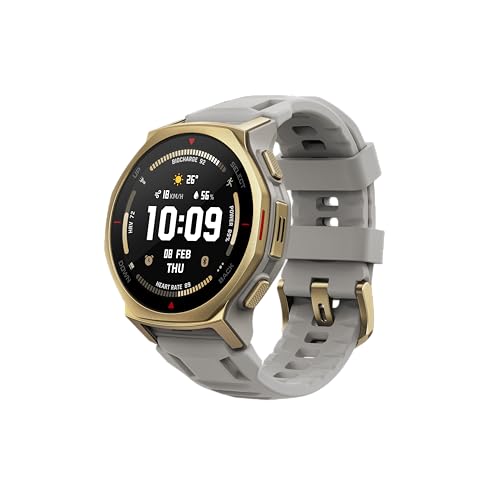
Amazfit T-Rex 3 Pro — Best rugged value challenger
Amazfit’s T-Rex line has been circling the adventure establishment for years, and the 3 Pro is the version that stops being a curiosity. The construction is properly rugged — a metal-bezel case that takes the first knock, serious water resistance, a big bright screen — and the specification reaches where value watches historically feared: dual-band GPS, offline maps, a flashlight, and battery life counted in weeks. On a trail in the rain, performing the jobs an adventure watch exists for, the price gap to the Garmin flagships becomes genuinely difficult to justify for many buyers.
The differences live in the software’s finish. Amazfit’s app is capable and improving, yet its training analysis, route tools and long-term platform polish still trail Garmin Connect’s decade of refinement, and the ecosystem of accessories, integrations and fellow users is smaller. Expedition features work; they simply arrive with fewer of the small, lived-in touches — the thoughtful power profiles, the refined waypoint handling — that Garmin’s iterations have sanded smooth. None of this appears on a spec sheet, and all of it appears across a season of use.
That balance makes the T-Rex 3 Pro the easiest value recommendation in this guide: most of the expedition hardware, most of the endurance, at a price that leaves serious money for the trip itself. Buy it knowing the software is a step behind, and if your adventures are measured in weekends and weeks rather than in expedition seasons, that step may never matter to you.
- Display: large bright AMOLED
- GPS: dual-band with offline maps
- Battery: weeks of typical use
- Build: rugged metal-bezel case, high water resistance
- Extras: flashlight, extensive sport profiles
Strengths
- Rugged build and maps at a challenger price
- Battery life in the genuine expedition class
- Big, bright screen that suits navigation
Trade-offs
- App and training analysis trail Garmin polish
- Smaller accessory and user ecosystem
- Long-term update record still being proven
Best for: budget-conscious adventurers wanting real expedition hardware.
Not suited for: data devotees who live inside Garmin Connect analysis.

Apple Watch Ultra 2 — Best adventure watch for iPhone owners
The Ultra 2 is Apple’s expedition instrument, and taken tool by tool it is formidable: a titanium case with a sapphire face, the brightest screen Apple makes, dual-frequency GPS that threads city canyons and forest valleys alike, a precision compass with waypoint marking and backtrack, a siren audible across a hillside, and a customisable action button that starts a workout or a dive with gloves on. As a weekend warrior’s watch — trail races, ski tours, coastal swims, a long day’s hike with a pub at the end — it is superb, and it returns to civilisation as the finest iPhone companion in existence.
The expedition ledger has one entry in red. Battery life, even nursed through low-power settings, is measured in days, and a week-long trek means carrying charging for the watch alongside the phone it depends on. Every other pick in this guide treats a week off-grid as a starting assumption. Ultra owners solve this with power banks and planning, and for trips of two or three days the problem never arises; for genuine expeditions it is the first and last consideration, and our verdict respects readers enough to keep it in the headline rather than the footnotes.
Buy the Ultra 2 if your adventures are intense but bounded, your phone is an iPhone, and your daily life values the ecosystem as highly as your weekends value the hills. It is a magnificent instrument on a short leash, and owners who accept the leash’s length rarely regret the instrument.
- Case: titanium with sapphire front
- Display: very bright flat AMOLED-style screen
- GPS: precision dual-frequency positioning
- Battery: up to roughly a long weekend in low-power use
- Extras: audible siren, depth gauge, action button
Strengths
- Superb navigation aids and emergency siren
- Brightest, toughest Apple Watch by a distance
- Returns from the hills as a flawless iPhone companion
Trade-offs
- Battery demands charging on multi-day trips
- Adventures depend on the paired iPhone ecosystem
- Premium price plus pricey straps and accessories
Best for: iPhone owners whose expeditions run to long weekends.
Not suited for: week-plus off-grid trekkers who refuse to carry chargers.
What About Water, Altitude and Cold?
Adventure specifications hide three different tests inside one rugged label. Water resistance rated for swimming covers rain, rivers and a dunking at a crossing, while genuine dive ratings — carried by the flagship picks — are a different engineering class that most hill users will never need and should not pay a premium to admire. Altitude brings pressure changes that test seals on every ascent, and cold attacks the battery rather than the case: lithium cells deliver less in freezing conditions, so a watch worn outside a cuff in winter genuinely outlasts the same watch buried under three layers, starved of the wrist’s warmth. Plan winter endurance from the pessimistic end of every figure in this guide.
Straps are the overlooked survival component. Silicone and nylon survive water, cold and abrasion that destroy leather and stiffen cheap rubber, and a strap that can be swapped without tools lets a failure in the field become an inconvenience instead of an ending. Carry the spare strap in the repair kit on any trip longer than a weekend; it weighs almost nothing and it is the single most likely component to be tested by a snagged branch or a frozen buckle.
How Should You Use an Adventure Watch Alongside a Phone?
The healthiest expedition relationship between watch and phone is a division of labour agreed in advance. The watch navigates, tracks and times, because it is on the wrist, weatherproof and miserly with power. The phone stays off or in flight mode, reserved for photographs, detailed map study at camp and communication at agreed moments, because its battery is the expedition’s shared reserve. Pairs who set this rule at home stop draining both devices doing the same job twice, and the watch’s offline competence — the quality this guide keeps returning to — is exactly what makes the rule possible.
At camp each evening, give the data five minutes: check the day’s track against the plan, mark tomorrow’s waypoints while the map is open anyway, and glance at the battery with the same honesty you give the water bottles. That small ritual catches navigation errors while they are still one day old and turns the watch from a recording device into a planning partner, which is the role it was priced for.
How Do You Navigate When the Watch Is All You Have?
The scenario every adventure watch is quietly bought for deserves a rehearsal rather than a hope: cloud on the ridge, the path gone, the phone conserving its last battery for the call you may need at the bottom. In that moment the watch’s job narrows to three acts — tell you where you are, point you at a known waypoint, and guide you back along the ground you have already proven. Every pick in this guide can perform those acts, but they perform them at different speeds of understanding, and the time to learn your model’s particular choreography is a bright afternoon on home ground, with a deliberate wrong turning taken on purpose to watch the correction happen.
Practise the specific drills until they are boring. Mark a waypoint at a gate, walk away until the landscape is unfamiliar, and navigate back by watch alone. Reverse a recorded track from its midpoint. Find your grid reference or coordinates and read them aloud as you would to a rescue coordinator, because in the real event that reading, calmly given, is the most valuable sentence the watch will ever help you say. Then teach the drills to your walking partner on their watch too, because redundancy in skills beats redundancy in devices when one wrist is injured or one battery is dead.
Accept, finally, the watch’s place in the hierarchy of navigation. It is the fastest orientation tool you own and the one most likely to be working in foul weather, and it remains a battery-powered interpretation of a landscape that a map shows whole. Carry both, weight be forgiven, on any route where the consequences of a blank screen would be measured in more than embarrassment. The guides who taught us this carry both themselves, and their watches are better than yours.
What About Skiing, Water Sports and Winter Expeditions?
Ski touring and winter mountaineering stress an adventure watch in ways summer hiking never rehearses. Cold drains batteries that August found generous, gloves turn every interface into the button test this guide keeps setting, and altitude plus exertion produces heart-rate and oxygen data that should be read as trends rather than truths at the best of times. The Garmin flagships answer with ski and backcountry profiles that understand ascent and descent as different sports, barometric altimeters that track weather as faithfully as height, and storm alerts that have genuinely changed plans for the better on more ridges than marketing will ever know.
Water tells a parallel story. Swimmers and paddlers need a watch whose buttons can be locked against accidental presses, whose screen ignores droplets rather than obeying them, and whose water resistance is a rating rather than a hope — specifications the Fenix and Ultra lines carry into genuine dive territory, and the Instinct and T-Rex families honour for surface sports completely. Sailors and surfers should read each model’s tide and wind integrations individually, because this corner of the feature map varies more between brands than any other in the guide.
The unifying advice is seasonal honesty: buy for the harshest season you actually practise, not the mildest you photograph. A watch chosen against a February standard will cruise through July; the reverse purchase is the one that ends, expensively and occasionally dangerously, in a bothy at midnight.
How Should You Maintain an Expedition Watch Between Trips?
Adventure watches die at home more often than on mountains, usually of neglect dressed as toughness. Rinse salt, sand and sunscreen off after trips, because all three work quietly at seals and straps; dry the watch before charging, and inspect the strap and its pins each season with the same seriousness you give boot leather. Software deserves a calendar note too — update at home, on Wi-Fi, a week before a big trip rather than the night before, so that any surprise in a new release introduces itself on a training walk and not at altitude.
Battery care is the long game. A watch that lives at full charge on a shelf ages its cell faster than one kept around half charge between expeditions, and a monthly top-up-and-wear routine keeps both battery and owner honest about whether the instrument still holds what the brochure promised. Log that check with your trip notes; a watch whose endurance has quietly halved is a planning fact you want in writing before the route is drawn around the old figure.
Finally, keep the expedition profile you built — power settings, data screens, waypoint habits — documented somewhere a replacement watch could inherit in an hour. Instruments get lost, lent and broken at the least convenient moments, and the owner who can rebuild their setup from notes owns a system, while the owner who cannot, owned a gadget.
How Do You Choose Between AMOLED Beauty and Monochrome Endurance?
This guide contains both display religions, and the choice between them is a genuine fork rather than a ranking. The AMOLED flagships — Fenix 8, Epix Pro, the AMOLED Instinct and the T-Rex — render maps as maps, with colour, contour and clarity that change how confidently you navigate, and they present data at a glance in the dark of a tent without waking a partner. Their cost is appetite: every glance at that beauty is paid for in battery, and expedition discipline on an AMOLED watch is largely the art of refusing glances you do not need.
The monochrome Instinct Solar represents the older faith: a display that sips power, reads perfectly in the glare where AMOLED fights the sun, and never tempts its owner into treating the watch as a phone. Its maps are lines rather than landscapes, and its data is numerals rather than charts, and for the traveller whose navigation is waypoint-and-bearing, that austerity is not a compromise but a match. Expeditions measured in weeks tilt the argument its way; weekends of complex navigation tilt it back.
Decide by rehearsing your own worst day. If that day is a whiteout on unfamiliar, junction-rich ground, buy the map you can read and manage its battery like water. If that day is the ninth consecutive day of a trek where the route is a valley and the sky is a furnace, buy the endurance and let the map live in your pocket. Both answers are correct, which is why both watches are in this guide.
What About Emergency Features and Being Found?
Modern adventure watches carry a quiet portfolio of emergency tools, and an expedition is the wrong place to discover yours. Incident detection on the Garmin flagships can alert contacts after a hard fall during an activity; the Ultra 2 adds its siren and Apple’s emergency calling; several picks can transmit a live track to a contact when a connection exists, turning a worried evening at home into a map with a moving reassurance on it. None of these is a beacon, all of them require setup in advance, and every one should be tested — contacts entered, permissions granted, a drill performed — before the trip, because an unconfigured safety feature is a story you tell yourself.
The honest hierarchy bears repeating in this section because it saves lives rather than feelings. A filed plan with a person who will act on it outranks every device. A dedicated satellite communicator outranks a watch for remote country. The watch outranks hope, which is the instrument it usually replaces. Equip yourself in that order, spend in that order, and let the watch be what it superbly is: the layer that works when you can still work it, and the witness that speaks when you cannot.
One practical addition: record your emergency details where a stranger can find them. Medical information on the watch or phone’s lock screen, a card in the pack’s top pocket, and a partner who knows both exist — these unglamorous arrangements are what rescue teams actually use in the first ten minutes, long before any satellite earns its subscription.
A Note on Group Expeditions and Sharing the Instruments
Groups change what an adventure watch is for. In a party of four, the watches stop being personal trackers and become a distributed system: one navigates, one monitors the group’s pace and the daylight remaining, one carries the emergency plan and the charged reserves, and the fourth is the spare whose battery nobody is allowed to spend on photographs of their heart rate. Agree those roles at the trailhead with the same seriousness as rope teams agree theirs, because a group where everyone navigates follows four opinions into the same fog, while a group with one navigator and three attentive witnesses moves like a single, safer animal.
Sharing data afterwards is the group’s second dividend. Tracks compared at the hostel table reveal where the route actually went versus where memory insists it went, whose pacing judgement the climb rewarded, and which descent the whole party would reroute next time. Expeditions debriefed this way get safer and faster across a season in a manner no individual upgrade can purchase. The watches in this guide all export their tracks in formats the others can read, a small interoperability that deserves more gratitude than it receives — insist on it in any future purchase, because a track that cannot leave its maker’s garden is a diary in a locked room.
A Note on Choosing by Expedition Length
Let itinerary length arbitrate what brand loyalty cannot. A long weekend in the hills asks for navigation, weather sense and a battery that survives until Sunday night: every pick in this guide qualifies, and the Ultra 2’s ecosystem charms are free to tip its owner’s decision. A week of trekking narrows the field to the Garmins and the T-Rex, because charging stops being a habit and becomes cargo. A month of expedition travel narrows it again, to the Instinct Solar and the Fenix with a power plan, because at that duration every device is a logistics problem wearing a dial, and the winners are the ones whose appetite is smallest and whose failure modes are understood.
Write the itinerary’s longest unsupported day at the top of your shopping list and buy for that day, not for the average. Average days forgive everything; the longest day, in the worst weather the season keeps in reserve, is the one the watch was actually purchased for.
One Last Check Before You Spend
Expedition purchases deserve a proving walk, and every pick here should survive one before its returns window closes: a local day route, deliberately overlong, with the navigation loaded, the power profile set as you configured it in our how-to section, and one deliberate wrong turning taken to watch the watch respond. Note the battery percentage at the start, at the summit and at the car, and extrapolate your longest planned day from those three numbers rather than from any brochure, ours included. A watch that proves itself on home ground earns the mountain; a watch that surprises you on home ground has done you a favour at the cheapest possible price.
How Should You Prepare an Adventure Watch Before a Big Trip?
Preparation begins a fortnight out, on local walks, not at the trailhead. Load the route, download the offline maps for the whole region rather than the single line you intend to walk, and follow the watch’s navigation on familiar ground until its prompts, vibrations and junction behaviour are boring. Mark waypoints the way you will need them — start, water, camp, escape route — and practise reversing your track, because the return-to-safety drill is the one feature that must work first time, in weather, with cold hands.
Configure power before you need it. Build the expedition profile at home: GPS fix rate matched to your terrain, display brightness and always-on settings chosen deliberately, notifications silenced, and the low-power thresholds understood rather than discovered. Charge to full the night before, then top up during the final morning routine, and pack the charging cable even on trips where the battery should outlast you — cables weigh grams, and a dead watch on day nine of ten is a story nobody enjoys telling.
Finally, agree the watch’s role in the group. One person’s instrument is navigation backup, another’s is the emergency beacon carrier, and everyone should know whose wrist holds what before the weather closes in. Check that emergency contacts and any satellite or phone-based safety features are current, tell someone at home which watch and route you carry, and remember the hierarchy that every mountain rescue team repeats: the watch assists the plan, the plan assists the judgement, and the judgement — to turn back, to wait, to reroute — outranks every instrument on every wrist.
How Do the Six Expedition Watches Compare in the Field?
| Pick | Badge | Standout trait | Main compromise |
|---|---|---|---|
| Garmin Fenix 8 | Best all-round adventure watch | Complete navigation and multi-week battery character | Heavy on the wrist and priced like the flagship it is |
| Garmin Epix Pro (Gen 2) | Best screen for map readers | The clearest wrist maps in the guide | Previous-generation model; battery trails the Fenix 8 |
| Garmin Instinct 3 AMOLED | Best rugged value with a bright screen | Tank-like build with a modern bright screen | No full offline maps; navigation is breadcrumb style |
| Garmin Instinct 3 Solar | Best for maximum endurance | Solar charging layered on the toughest Garmin formula | Monochrome display; solar gains depend on your weather |
| Amazfit T-Rex 3 Pro | Best rugged value challenger | Serious durability and battery for considerably less money | App ecosystem and polish trail Garmin |
| Apple Watch Ultra 2 | Best adventure watch for iPhone owners | Precision compass, siren and the brightest Apple display | Battery lasts days, not weeks; iPhone required |
Notice how the table’s compromises cluster: the AMOLED flagships trade a little endurance for maps you can read, the Instinct pair trade maps for endurance and toughness, and the Ultra 2 trades endurance for ecosystem. There is no row without a trade, because expedition design is the art of choosing which scarcity you prefer. Choose yours by itinerary, not by aspiration.
A final lens for reading the table: cover the price column entirely and rank the rows by the expedition you described in your own trip notes, then uncover the prices and notice how rarely the ranking changes. Where it does change, the difference is almost always the screen — beauty costs money and battery in this category, and each buyer must decide, once, what a beautiful map is worth to them per day of walking.
What Mistakes Do Adventure Buyers Make Most Often?
Believing the smartwatch-mode battery figure. Brochure endurance describes a watch sitting politely on a wrist, not one navigating for eight hours a day. Plan expeditions from the GPS-mode figure, subtract a margin for cold — batteries tire faster in winter — and treat any solar gain as a gift rather than a guarantee.
Learning navigation at the trailhead. Downloading maps in a car park with one bar of signal, then meeting the interface for the first time in fog, is the standard prologue to a miserable day. Every navigation feature in this guide rewards an hour of practice on home ground and punishes its absence without malice or exception.
Choosing a touchscreen-only routine for winter. Rain, gloves and cold fingers turn touch into guesswork at exactly the moments precision matters. Practise driving your watch entirely by its buttons before a winter trip, including marking a waypoint and starting backtrack, and keep that muscle memory current.
Spending the safety margin on the watch. The finest instrument in this guide costs less than the rescue it cannot perform. Buy the watch that fits the budget after boots, waterproofs, insulation and training are funded, because those unglamorous purchases are the actual safety equipment; the watch is their very capable assistant.
Final Recommendation
One more consideration belongs in the final reckoning, because expeditions are remembered in photographs as much as in summits: every watch here will be in your summit pictures, on your wrist, in the weather it survived with you. Choose the instrument whose presence in those photographs will please you in a decade — battered, faithful and unmistakably yours — because that oddly sentimental test has a way of identifying the watch you will actually keep charged, maintained and worn, which is the only kind that ever saves a day.
If one watch must carry the recommendation for serious adventure, it is the Fenix 8: the most complete combination of navigation, endurance and construction we can put on a wrist. The Instinct 3 Solar is the specialist’s alternative for journeys measured in weeks of sunlight, the T-Rex 3 Pro is the value pick that embarrasses watches costing far more, and the Ultra 2 remains the right answer for the iPhone owner whose expeditions end where the weekend does.
Whichever row you choose, practise with it before the trip that matters, and the watch will repay the hour every time the weather turns.
Frequently Asked Questions
Can an adventure watch replace a handheld GPS?
For most hikers and trekkers, the flagship picks here cover route-following, waypoint marking and track-back completely, and the handheld stays home. Expedition navigators crossing featureless or pathless terrain still value a dedicated unit’s larger screen, replaceable power and redundancy, because two independent instruments fail less often than one.
How long will an adventure watch battery really last on a trek?
Plan from GPS-mode figures: the Garmin flagships handle many days of daily navigation, the Instinct Solar can stretch far longer in bright weather, and the Ultra 2 should be planned as a two-to-three-day instrument. Cold, bright screens and frequent map checks all shorten every figure in this paragraph.
Is solar charging worth paying for?
If your expeditions run long in sunny country, yes — the Instinct 3 Solar can harvest meaningful charge from ordinary daylight. If your hills are northern, forested or wintery, the same money buys more value in the AMOLED model’s screen, because solar assistance you never receive is a feature you never bought.
Do I need sapphire glass?
Sapphire resists the scratches that granite, ice tools and climbing hardware distribute freely, and for a watch bought for years of rough use it earns its premium. Careful hikers on soft trails will find hardened glass perfectly adequate, which is why both appear across these picks without apology.
Can these watches call for help without a phone?
They can mark your position, guide you back and, where a model offers satellite or cellular features through its ecosystem, summon help under the right conditions and subscriptions. None replaces a dedicated emergency beacon for remote expeditions, and our how-to section’s advice stands: file a plan with a person, not just a device.
How do I load offline maps and a GPX route before a trek?
Download the map region while you still have fast Wi-Fi, then import the GPX file through the watch maker’s phone app or desktop tool and sync it before leaving coverage. Open the route on the watch itself, zoom across the start, major junctions and finish, and confirm place names and contour detail actually appear rather than assuming the transfer worked.
What should I check after using an adventure watch in salt water or mud?
Rinse the watch gently in fresh water once the maker confirms that model tolerates it, dry the case and strap fully, and check that buttons still move freely before grit works into the seals. Inspect the charging contacts for corrosion or trapped sand, clean them with a soft dry cloth, and never charge a damp watch.
Related Guides
Best active smartwatches for training Best smartwatches for battery life Best GPS watches for hiking


