What's inside
- Key Takeaways
- Quick Picks
- How did we choose these picks?
- Why does a dedicated centre channel beat a dialogue mode?
- Which centre-channel bar fits your room and your habits?
- How do the six compare side by side?
- How does the centre channel change sport, news and gaming?
- What separates a good centre driver from a token one?
- What should you verify before buying a centre-channel bar?
- How do you tune a 3.1 bar for speech once it is home?
- What happens when the whole household hears differently?
- How will a 3.1 bar age alongside your television?
- How do streaming services change what the centre channel receives?
- Where does the centre-channel idea reach its limits?
- What mistakes do centre-channel shoppers keep making?
- Final Recommendation
- Frequently Asked Questions
- Related Guides
As an Amazon Associate I earn from qualifying purchases. This post may contain affiliate links at no extra cost to you.
widgetverdict.com is reader-supported. When you buy through links on our site, we may earn an affiliate commission.
Where to buy: the four linked systems below sit on Amazon with their centre-channel layouts stated in the listing titles, while the two comparison models are discussed without links on purpose — read the reasoning in their sections before hunting them down elsewhere, because their channel maths is exactly what this guide is about.
The best 3 1 soundbars exist to solve one problem with hardware instead of software: speech that will not stay put. In a stereo bar, dialogue is a phantom — a copy of the same signal sent to the left and right drivers, which your brain assembles into a voice floating somewhere near the screen. Sit dead centre and the illusion holds. Sit at the end of the sofa, and the voice slides toward whichever speaker is nearer, detaches from the actor’s mouth, and starts competing with the music on the other side. A 3.1 system ends the argument by giving speech its own physical driver in the middle of the bar, fed by a dedicated centre channel in the soundtrack.
That single extra channel changes evening viewing more than any processing badge at this level. Film mixes place the overwhelming majority of dialogue in the centre channel by design, so a real centre driver lets you raise or lower the film’s loudest elements without touching the voices. Explosions can be tamed at midnight while a whispered confession stays intact; a football commentator holds position while the crowd swells around him. Owners upgrading from a 2.1 bar consistently describe the difference not as louder or wider, but as calmer — the sound stops moving around when they do.
Honesty about the size of this class is part of the guide. True 3.1 bars — a discrete centre channel, a genuine subwoofer channel — form a smaller shelf than the marketing suggests, because many brands jump straight from 2.1 to Atmos systems or chase 5.1 badges instead. We link four systems we can stand behind, two of which extend the idea upward into 3.1.2 with height drivers. The remaining two places go to respected near-neighbours discussed in prose: a 3.0.2 Atmos bar and a compact 3.0 design, included so you can see precisely what giving up the subwoofer channel or the discrete layout costs and buys. Six detailed picks, four of them true to the label, two of them instructive exceptions.
Key Takeaways
- A real centre driver anchors dialogue to the screen from every seat, not just the middle one.
- The Samsung HW-Q600C is the most complete 3.1-family pick, adding genuine height channels.
- The Sony HT-S2000 hides its subwoofer work inside the bar for rooms that cannot place a cube.
- Polk’s Signa S4 pairs the centre channel with the finest-grained voice control here.
- Two prose-only guests show what 3.0 designs trade away by dropping the subwoofer channel.
- Judge 3.1 bars on speech at low volume first; everything else is secondary.
Quick Picks
| Pick | Badge | Why it earns its place |
|---|---|---|
| Samsung HW-Q600C | Best overall 3.1-family bar | A true centre channel, wireless sub and real up-firing drivers for Atmos height. |
| Samsung HW-B630F | Best straightforward 3.1 | The classic layout done cleanly, with a centre speaker and a wireless subwoofer. |
| Sony HT-S2000 | Best without a separate sub | Centre channel clarity with the bass built into the bar itself. |
| Polk Signa S4 | Best voice control | VoiceAdjust tuning on top of a 3.1.2 layout with a wireless sub. |
| Bose Smart Soundbar 600 | Prose-only: compact Atmos alternative | Up-firing Atmos in a small cabinet, but no subwoofer channel in the design. |
| Sonos Beam (Gen 2) | Prose-only: smart compact option | A polished single bar whose centre focus is virtual rather than a 3.1 layout. |
How did we choose these picks?
Channel honesty was the entrance exam. A pick had to carry a genuine centre driver reproducing a discrete centre channel, or — for the two prose-only guests — be labelled in its own section with exactly what it is instead. Bars that merely rename a dialogue preset as a centre mode were excluded, however good they sound. Beyond the exam, we weighted low-volume speech intelligibility highest, because the centre channel earns its money at 9 p.m. volumes, not in showroom demonstrations.
Subwoofer behaviour came next. The .1 in 3.1 is a promise that low frequencies have their own channel and their own cabinet, so we favoured wireless subs that integrate without booming over the centre driver’s lower reach. Then came centre-level adjustment: the best systems let you trim the centre channel itself, not just global treble, and that control appears in the analysis wherever it exists. Finally we considered the household layer — ARC reliability, remote sanity, and whether the bar’s width keeps the centre driver truly centred under typical screen sizes rather than squeezed to one side of a long cabinet.
We also listened for the failure mode unique to this class: a centre driver voiced too differently from its neighbours, so voices sound boxed-in while music spreads thinly around them. Two early candidates fell at exactly that fence. The survivors blend — pan a voice across the front in a film’s opening minutes and it should cross the centre without changing character, like a speaker walking across a stage rather than teleporting between rooms.
Why does a dedicated centre channel beat a dialogue mode?
A dialogue mode on a stereo bar is an equaliser trick: it raises the frequencies where speech lives and sometimes narrows the stereo image. It helps, and on the better 2.1 bars it helps a lot, but it lifts everything sharing those frequencies — the score’s strings, the rain, the room tone — and it cannot move the voice’s apparent position. The phantom image still depends on you sitting in the sweet spot, because the voice is still being manufactured by two drivers and your brain’s arithmetic.
A centre driver removes both weaknesses at the source. The soundtrack’s centre channel already contains the dialogue mixed at the level the filmmakers chose, separated from music and effects before it ever reaches your home. Reproducing it through one driver placed under the actor’s face means the voice’s position is physical, not computed. Move to the end of the sofa and the voice stays with the screen; only its loudness relative to the extremes changes slightly. Raise the centre level and you raise the actors, not the orchestra. This is why home-cinema builders have treated the centre as the most important speaker in the room for three decades, and why its arrival in a soundbar is a structural upgrade rather than a feature.
There is a subtler dividend at low volume. Human hearing loses bass and treble sensitivity as level falls, which is why quiet television sounds thin and why viewers reach for subtitles at night. A centre channel you can trim independently lets you rebalance the mix for quiet listening — voices forward, effects restrained — without the crude loudness buttons that flatten everything. Households that watch after children sleep will feel this benefit nightly, and it is the main reason this class exists between plain stereo bars and full surround systems.
Which centre-channel bar fits your room and your habits?

Samsung HW-Q600C — Best overall 3.1-family bar
The Q600C is what happens when the 3.1 idea is allowed to grow upward. Its front layout is the classic trio — left, centre, right — with the centre driver given genuine prominence in the voicing, and above them sit two up-firing drivers that bounce height cues off the ceiling for a 3.1.2 Atmos presentation. That makes it the only linked pick here whose height effects come from real drivers aimed at real plaster rather than from processing alone, and film soundtracks mixed in Atmos reward it with rain and aircraft that genuinely leave the screen’s plane.
Dialogue, the reason this guide exists, is handled with unusual intelligence. Samsung’s adaptive processing reads the scene and keeps the centre channel forward when effects pile up, so a shouted exchange inside an action sequence survives the debris around it. The wireless subwoofer is the most capable in this group, digging low enough to give the centre driver’s clarity a solid floor to stand on, yet it integrates without the one-note thump that makes voices sound like they are broadcasting from a cave.
Q-Symphony, Samsung’s trick of letting a compatible television’s speakers join the centre effort rather than muting them, is a genuine bonus for Samsung households and irrelevant for everyone else — the bar needs no help to justify itself. The honest costs are size and appetite: the cabinet is wide, the sub wants floor space, and the whole system is the most ambitious installation in this guide. For a main room where films matter and the ceiling is a normal height, it is the pick that renders the rest of the class slightly academic.
Live sport reveals another side of its centre discipline: commentary sits in a stable pocket while stadium noise wraps around it, and the half-time studio discussion drops to a conversational level without the viewer reaching for the remote. That seamlessness across a whole evening — film, news, match, film again — is the Q600C’s least advertised and most lived-with virtue, and it is why owners tend to describe it as the television sounding finished rather than as a gadget they bought.
- Channel layout: 3.1.2 — centre driver plus two up-firing height drivers
- Low end: separate wireless subwoofer with its own channel
- Formats: Dolby Atmos delivered through physical height drivers
- Television pairing: Q-Symphony speaker sharing on Samsung sets
Strengths
- Real height drivers lift Atmos scenes clear of the screen.
- Centre channel stays composed during loud, crowded mixes.
- Subwoofer depth gives dialogue a firm foundation.
Trade-offs
- Widest cabinet here; small stands need measuring.
- Ceiling height effects fade in vaulted rooms.
- Most setup options to learn of the six.
Best for: film-first main rooms with a standard ceiling and space for a sub. Not suited for: compact media units or rooms where the television sits in a corner.

Samsung HW-B630F — Best straightforward 3.1
If the Q600C is the idea expanded, the B630F is the idea distilled: three front channels, a wireless subwoofer, no height ambitions, no ecosystem entanglements. Its centre speaker does the one job this guide cares about with a directness that dearer bars sometimes process away. Voices carry a chest-and-throat naturalness that makes long dialogue scenes — courtroom dramas, talk-heavy prestige series, parliamentary broadcasts for the truly committed — easy to follow at modest volume.
Samsung equips it with DTS Virtual:X for viewers who want some width and lift suggested from ordinary sources, and the effect is tasteful enough to leave engaged for sport, where it broadens the crowd without smearing the commentator. The subwoofer favours tightness over depth, which in practice means bass that supports the centre channel instead of competing with it; night viewing in a semi-detached house is this system’s natural habitat. Bass and centre trims sit on the remote where they belong.
What you surrender against the Q600C is spectacle: no Atmos drivers, less subterranean reach, a stage that ends at the screen’s edges. What you gain is a bar that asks almost nothing of its owner beyond placement. For households whose viewing is ninety percent dialogue-driven television and ten percent film night, that exchange is not a compromise at all — it is the correct specification, bought without paying for height channels that would spend their lives idle.
There is also a reliability argument for its simplicity. Fewer processing layers mean fewer handshakes to renegotiate when the television updates itself overnight, and the B630F’s behaviour across brands is correspondingly uneventful — it wakes, it plays, it sleeps. Households that have been burned by cleverer equipment will recognise the value of a bar whose most remarkable daily trait is that nobody mentions it.
- Speaker arrangement: honest 3.1 — left, centre and right across the front
- Bass supply: wireless subwoofer tuned for tightness
- Processing: DTS Virtual:X widening for standard sources
- Controls: centre and bass trims reachable from the remote
Strengths
- Unfussy centre clarity for dialogue-heavy schedules.
- Tight subwoofer behaviour suits attached housing.
- Virtual widening stays tasteful on sport.
Trade-offs
- No Atmos capability for height-mixed films.
- Stage width stops at the cabinet’s ends.
- Fewer thrills for action devotees.
Best for: drama, news and sport households wanting classic 3.1 done cleanly. Not suited for: Atmos collectors building a film-first room.
Sony HT-S2000 — Best without a separate sub
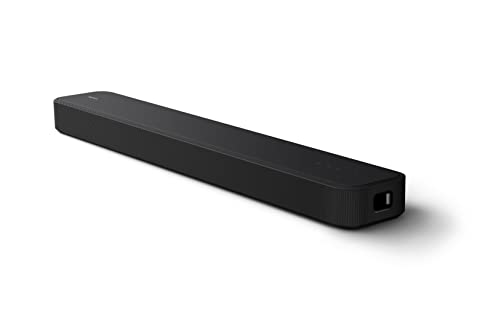
The HT-S2000 poses a fair challenge to this guide’s premise: it keeps the discrete centre channel but folds the subwoofer’s duties into the bar itself, using dual built-in subwoofer drivers and a cabinet engineered to keep their output from rattling the speech above them. The result is a 3.1 system in a single piece of furniture. For rooms where a separate cube has nowhere respectable to live — a television on a narrow sideboard, a rental with one socket in the wrong county — that integration is not a styling preference but the difference between having a centre channel and not having one.
Sony’s processing earns its keep here. The bar builds a surprisingly convincing sense of space from its single cabinet, and the centre focus survives the trickery, which is where lesser single bars smear voices across a fake-wide stage. Dialogue at low volume is this system’s party piece: late-night drama stays intelligible at levels where a separate sub would either vanish or grumble. The companion app handles setup and adjustments with more grace than most remotes at the level.
The physics bill arrives in the deepest bass. Built-in drivers cannot move the air a separate cabinet moves, so the largest explosions land as emphasis rather than event, and big rooms expose the limit sooner. Sony offers a path onward with optional wireless subwoofers and rears from its own range, which softens the verdict for growing systems — but note that adding the sub moves you beyond the configuration reviewed here. As delivered, the HT-S2000 is the centre-channel answer for tidy rooms and tidy minds.
Its single-cabinet nature also makes it the most portable serious pick here, which matters more often than guides admit: the bar that moves easily between a flat’s living room and bedroom, or travels to a holiday rental, gets used for the programmes that benefit most from clear speech. Sony’s app control supports that roaming life, since settings live on the phone rather than in a remote left in another room.
- Design: 3.1 layout with the subwoofer work handled inside the bar
- Centre provision: dedicated centre speaker for anchored dialogue
- Formats: Dolby Atmos and DTS:X reproduced virtually
- Growth options: Sony wireless subwoofers and rears can join later
Strengths
- Centre clarity without any subwoofer placement problem.
- Excellent low-volume intelligibility for night viewing.
- Single-cabinet neatness suits rentals and sideboards.
Trade-offs
- Deepest bass cannot match a separate cabinet.
- Large rooms reveal its output ceiling.
- Full potential tempts spending on add-ons later.
Best for: tidy rooms where a subwoofer cube has no home. Not suited for: big spaces or bass devotees chasing physical impact.
Polk Signa S4 — Best voice control
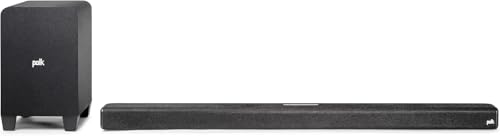
Polk looked at the centre-channel problem and added its favourite instrument: control. The Signa S4 is a 3.1.2 system — real centre driver, wireless subwoofer, up-firing height drivers — and layered over that hardware sits VoiceAdjust, the company’s graduated dialogue control, here in its most developed form. The combination matters. Hardware gives the voice a home; the control lets each household tune that home to its own hearing, its own room, its own leading actor who mumbles in every production he graces.
In practice the S4 is the bar we would prescribe for mixed-hearing households. One viewer hears effortlessly, another strains; the centre driver plus three steps of voice lift lets the pair settle on a setting where both follow the plot without the volume creeping upward scene by scene. The height drivers add genuine Atmos lift of the same ceiling-bounced kind as the Samsung, slightly less grand in scale, and the subwoofer is voiced warm rather than deep — a deliberate choice that keeps it from elbowing the dialogue it exists to support.
Polk’s remote and on-bar indications remain the plainest in this group, so adjustments are made by ear and memory rather than by reading a display. The cabinet’s styling is similarly unshowy. Neither matters much once the evening starts. What matters is that the S4 treats speech not as one ingredient among many but as the ingredient, and in a guide about centre channels that philosophy earns it a permanent shortlist place.
Gaming households should note that the S4’s centre clarity flatters story-driven titles, where whispered cutscene dialogue over a swelling score is exactly the mix that defeats lesser bars. Routed through the television over ARC, delay stays low enough for all but the most rhythm-obsessed players. It is a small extra string to the bow of a bar bought for television, and for mixed-use rooms it may be the deciding one.
- True layout: 3.1.2, including up-firing drivers for height cues
- Speech toolkit: VoiceAdjust graduated dialogue control
- Bass arrangement: wireless subwoofer with a warm voicing
- Formats: Dolby Atmos decoded and reproduced with height drivers
Strengths
- Finest-grained voice tuning in this guide.
- Real centre and height hardware in one system.
- Warm subwoofer never bullies the dialogue.
Trade-offs
- Plain remote gives little visual feedback.
- Height effect is present but modest in scale.
- Styling will not win the sideboard any admirers.
Best for: households with differing hearing sharing one sofa. Not suited for: buyers who want app-driven everything and a display for every setting.
Bose Smart Soundbar 600 — Prose-only: compact Atmos alternative
We include the Bose 600 as a deliberate, clearly labelled exception, and we do not link it here because it is not a 3.1 system. Its configuration is 3.0.2 in spirit: front channels and up-firing drivers, with dialogue handled by a centre tweeter arrangement, but no subwoofer channel and no separate bass cabinet. Bose’s dialogue processing is genuinely skilful, and in a small room the 600 keeps speech lucid while adding a sense of height that belies its compact cabinet. As an alternative route to clear voices, it deserves its paragraph.
The comparison clarifies what the .1 buys. Play a scene where a door slams beneath a line of dialogue and the true 3.1 systems separate the two events into different physical sources; the Bose renders both from one cabinet, tidily but with less authority and less room-filling weight. Bose will sell you a wireless bass module later, at which point the system grows into something closer to this guide’s class — at a total outlay that also grows past it. Readers who value compactness and the Bose sound above channel arithmetic will forgive all of this.
So the 600 stands here as the honest alternative: choose it knowingly for its size and its Atmos-from-one-box charm, not because a badge led you to believe it matches the layout of the four linked systems. If your priority list starts with dialogue and ends with a separate subwoofer’s authority, the linked picks serve it better. If it starts with a small room and a hatred of extra boxes, this prose-only guest may be your bar — bought with open eyes.
It is worth adding that Bose’s ecosystem discipline cuts both ways in the best sense: the bar integrates with the company’s headphones for private late listening, a feature households with a night-shift worker may value above a subwoofer. None of that changes the channel arithmetic this guide is built on, but a buying decision is made by a household, not by a definition, and the 600’s household virtues are real.
- Actual configuration: compact Atmos bar without a subwoofer channel
- Height provision: up-firing drivers inside the single cabinet
- Dialogue approach: processing-led clarity rather than a 3.1 layout
- Expansion: Bose bass modules and surrounds available separately
Strengths
- Remarkably compact for an Atmos-capable bar.
- Dialogue processing is polished and natural.
- Clean, minimal presence on the furniture.
Trade-offs
- No subwoofer channel, so it is not a 3.1 system.
- Bass authority arrives only via a paid add-on.
- Single-cabinet stage suits smaller rooms best.
Best for: small rooms wanting Atmos flavour and clear speech in one box. Not suited for: anyone specifically shopping the 3.1 layout this guide defines.
Sonos Beam (Gen 2) — Prose-only: smart compact option
The second guest is here to represent the ecosystem argument. The Beam (Gen 2) is a 3.0 bar: it builds its centre focus virtually from a front array rather than from the discrete 3.1 layout with a subwoofer channel, and like the Bose it carries no link in this guide. What it carries instead is the most mature multi-room platform in the business, a polished app, and speech enhancement that many owners rate highly. In a home already speaking Sonos, those virtues are not decoration.
Its dialogue story is one of processing done well. Voices sit forward and stay consistent, and a night mode reins in dynamics with a light touch. But the arithmetic remains: low frequencies are the bar’s own business, handled ably for its size yet without a subwoofer’s separate authority, and film effects share the cabinet with the voices they should be supporting from elsewhere. Add Sonos’s own sub later and the system transforms — into a different purchase, at a different total, which is precisely the distinction this guide keeps drawing.
Read the Beam, then, as the representative of a legitimate philosophy: buy the platform, grow the system. It closes our six because it clarifies the class by contrast. The four linked systems deliver the complete 3.1 promise on day one, subwoofer included; the Beam delivers a beginning whose completion costs more and arrives later. Neither philosophy is foolish. Only one of them is what the words on this page’s title describe.
The Beam also earns a footnote for travellers between rooms: it is light enough to serve a kitchen television during a renovation or a spare room during a family visit, then return to its post. Flexibility like that explains much of its following. What it cannot do, on any visit to any room, is conjure a subwoofer channel it does not possess — and keeping that fact in view is the entire reason it appears in this guide unlinked.
- Actual configuration: single 3.0 bar, centre focus created virtually
- Platform: Sonos multi-room system with app control
- Speech features: speech enhancement plus a gentle night mode
- Expansion: Sonos subwoofers and surrounds join wirelessly later
Strengths
- Best-in-class app and multi-room behaviour.
- Consistent, forward dialogue from processing.
- Compact cabinet suits smaller televisions.
Trade-offs
- Not a 3.1 system; no subwoofer channel as sold.
- Completing the system later costs considerably more.
- Bass depth is limited by the single cabinet.
Best for: Sonos households growing a system step by step. Not suited for: buyers wanting the full 3.1 layout complete in one box.
How do the six compare side by side?
| Pick | Channels | Separate sub | Dialogue approach | Status here |
|---|---|---|---|---|
| Samsung HW-Q600C | 3.1.2 | Yes, wireless | Centre driver plus adaptive processing | Linked |
| Samsung HW-B630F | 3.1 | Yes, wireless | Centre driver with remote trim | Linked |
| Sony HT-S2000 | 3.1 | Built into bar | Centre driver, strong at low volume | Linked |
| Polk Signa S4 | 3.1.2 | Yes, wireless | Centre driver plus VoiceAdjust | Linked |
| Bose Smart Soundbar 600 | 3.0.2 | No | Processing-led clarity | Prose-only |
| Sonos Beam (Gen 2) | 3.0 | No | Virtual centre, speech enhancement | Prose-only |
The table is the guide in miniature. Four systems keep the promise in the title, each with a different temperament; two guests show the neighbouring philosophies with their labels facing outward. If a row tempts you, its section above explains the exchange you would be making in full sentences rather than in asterisks.
How does the centre channel change sport, news and gaming?
News is the purest test because it is nearly all centre: a presenter, a reporter in the field, an interviewee on a crackling line. A 3.1 bar reproduces that chain with a stability stereo bars approximate only from the middle seat, so the bulletin sounds the same from the armchair as from the sofa’s heart. Field reports recorded in wind benefit doubly, since the centre trim can lift the reporter without lifting the weather around the microphone to the same degree — the separation exists in the broadcast mix, waiting for hardware that honours it.
Sport inverts the ratio: the centre carries commentary while everything else is atmosphere. The pleasure of a good 3.1 system here is dynamic — the crowd can be allowed its full roar at a goal because the commentator’s pocket is protected, and the viewer stops riding the volume control through the match’s emotional weather. Gaming, finally, splits by genre. Story games are films you steer, and their dialogue mixes follow film grammar, centre and all; competitive titles care more about latency, which every linked system here keeps low over a wired connection, than about channel count.
The thread connecting the three is that the centre channel is not a film luxury. It is the channel of the spoken word, and the spoken word is most of what a household actually listens to. That is why this modest class, sitting between stereo bars and full surround systems, may be the most rational purchase in the entire soundbar market for the majority of living rooms.
What separates a good centre driver from a token one?
Voicing, mostly. A token centre is whatever small driver remained in the parts bin, asked to reproduce the soundtrack’s most important channel through a grille the designer treated as decoration. A good centre is a proper midrange unit, often the same driver as its left and right neighbours, crossed over so that its lower reach meets the subwoofer without a gap where baritone voices thin out. You can hear the difference in male narration: on the good centre it arrives with chest resonance intact; on the token one it sounds like the same man speaking from the next room.
Placement inside the cabinet matters too. The centre driver should sit at the cabinet’s physical middle, at the same height as its partners, behind an acoustically transparent stretch of grille. Bars that offset the centre for styling, or strangle it behind a logo plate, pay for the flourish in smeared consonants. Finally, amplification headroom counts: dialogue peaks — a shouted line, a sudden laugh — should not harden. The four linked systems here were chosen partly because their centres stay relaxed at those moments, which is a quality no specification sheet advertises and every owner eventually notices.
What should you verify before buying a centre-channel bar?
First, that the centre is real. Read the maker’s own channel description rather than the retail headline, and look for a centre speaker named in the driver list. A bar can be excellent without one — our two guests prove it — but you should know which animal you are buying. Second, check the bar’s width against your seating spread. The centre driver does its anchoring best when the sofa’s main seats sit within the bar’s frontal arc; a very long seating row in a wide room may still pull voices toward the nearest end of a narrow bar, so wider cabinets serve wider rooms.
Third, audition the centre trim, not the demo. In a shop, ask for a dialogue scene at the volume you use at home and adjust the centre level through its range; a useful trim changes clarity without making voices honk or thin out. Fourth, consider your ceiling before paying for the .2 in 3.1.2 systems: up-firing drivers need a flat, reflective ceiling at a sane height, and beams, vaults or acoustic tiles will tax the effect heavily. Owners with complicated ceilings lose nothing by choosing the plain 3.1 B630F and spending the difference elsewhere in the room.
Finally, plan the subwoofer’s position even when it is wireless, because the centre channel’s clarity depends on the sub not bloating the lower midrange where male voices live. A corner placement that delights during trailers will muddy a baritone narrator; the buying decision and the placement decision are the same decision made twice. Keep the sub near the front of the room, a little out from the wall, and the centre driver will sound like it cost more than it did.
Installation day has one more trap specific to this class: the temptation to test the centre channel with the loudest scene you own. Resist it. The centre earns its reputation in the quiet passages, so audition with a conversation held at domestic volume, then a news bulletin, then a crowd scene, in that order. A bar that passes those three in sequence will not embarrass itself when the explosions arrive, because composure under dialogue is the harder discipline and the one this entire category exists to teach.
How do you tune a 3.1 bar for speech once it is home?
Start from the maker’s neutral mode with all widening and virtual processing switched off, counterintuitive as that feels. Play a familiar dialogue scene and set the overall volume to your normal level; then raise the centre trim one step at a time until consonants — the f, s and t sounds that carry meaning — sit clearly above the music, and stop the moment voices start to sound detached from the actors’ bodies. That point, reached by ear in two minutes, is your household’s correct setting, and it will differ from your neighbour’s because your hearing and your room differ from theirs.
Next, set the subwoofer by subtraction. Play a scene with a deep male voice and lower the sub’s level until the voice stops booming, then raise it a single notch so warmth returns without fog. Only now experiment with the width or height processing, one feature at a time, returning to your test scene each time; processing that flatters an action sequence may smear the centre image you just tuned, and on several of these bars the wisest everyday configuration leaves the widening off for drama and on for sport. Note the winning settings somewhere durable, because a television firmware update that resets the chain is a question of when, not if.
A word, too, for viewers who watch alone more often than not. The centre channel’s gift to a solo viewer is permission to sit wherever the light, the dog and the evening dictate — the reading chair, the end of the sofa near the lamp — without the sound quietly reorganising itself around an empty sweet spot. Solitude is badly served by phantom imaging, which assumes a centred audience of one in a fixed throne. The households-of-one we hear from rate this class as highly as any family, and their reasoning is the purest form of the argument this guide has been making: the voice should live on the screen, not at a point in the room.
What happens when the whole household hears differently?
Most living rooms contain a spread of hearing that nobody discusses: one viewer with perfect ears, one who flew too often without protection, one who simply prefers the plot delivered at a murmur. The shared volume control serves none of them, which is why the centre channel’s independence matters socially as much as sonically. Raising the centre trim raises the words alone, so the household can hold a single volume that respects the room while the dialogue layer floats at the level the most strained listener needs. It is a small domestic peace treaty, renewed nightly.
Subtitles deserve an honest word in this context. They are a fine tool and the right answer for plenty of viewers, but households often enable them as a surrender — the sound failed, so the eyes took over. Many of those households discover, after installing a centre-channel bar and tuning it as the how-to section describes, that the surrender can be renegotiated. The programmes that still defeat the system tend to be specific: mumbled naturalistic acting, compressed streaming audio, accents recorded in genuine locations. A bar that reduces subtitle dependence from every scene to those scenes has done its job, and judging it by that standard is fairer than expecting miracles.
There is a related courtesy for the hearing viewer to learn: the centre trim is a shared setting, not a personal one. Tune it together, on a programme everyone follows, and leave it there. The systems in this guide hold their settings without drifting, so a single honest negotiation in the first week can govern years of evenings — which may be the most underrated specification in the entire category.
How will a 3.1 bar age alongside your television?
Gracefully, because its job description is stable. Televisions will change their panels, their platforms and their opinions about which streaming services matter, but the centre channel’s role in a film mix has been settled for decades and shows no sign of moving. A 3.1 bar bought today will decode the dialogue architecture of programmes not yet filmed. The parts that date are the wireless fashions around it — app designs, voice assistants, streaming extras — and notably, the four linked systems lean lightly on all three, which bodes well for their tenth year as much as their first.
The practical ageing risks are mechanical and domestic rather than electronic: a subwoofer relocated during a room rearrangement and never re-trimmed, an ARC relationship disturbed by a new television and blamed on the bar, a remote lost to the sofa’s interior. Our advice is boring and effective — after any change to the room or the set, rerun the two-minute tuning ritual from the how-to section, and treat the bar’s settings as part of the room rather than part of the gadget. Systems maintained that way tend to be replaced out of curiosity, not necessity.
How do streaming services change what the centre channel receives?
More than most owners realise. The same film can arrive with a rich multichannel mix from one service and a flattened stereo fold-down from another, and a centre-channel bar can only reproduce the centre that exists in the signal it is handed. When a stream arrives in stereo, the bar’s upmixing decides what the centre driver says — the better systems in this guide extract a convincing vocal focus from stereo, but it is a reconstruction, not the filmmakers’ original separation. This is why a programme can sound superb on Tuesday’s service and merely adequate on Wednesday’s, with the bar blameless in both cases.
Practical consequences follow. Prefer the stream quality tier that carries proper multichannel audio for the programmes you care about, set the streaming app to pass the best available format rather than a forced stereo output, and do not judge a new bar by the first thing a free tier sends it. Owners who feed a centre-channel system well-recorded material hear the full return on the layout; owners who feed it the thinnest streams hear a fraction and sometimes conclude, wrongly, that the class itself was oversold.
Where does the centre-channel idea reach its limits?
At the edges of the room, literally. A centre driver anchors dialogue for seats within the bar’s frontal spread, but a chair placed at ninety degrees in an L-shaped room will always hear a compromised balance, because no front speaker arrangement can serve two viewing directions at once. Households with genuinely split seating should solve the geometry first — reposition the television or accept a second, smaller setup for the annex seat — rather than asking any bar in this guide to perform a spatial impossibility.
The second limit is the mix itself. Some programmes are simply recorded and mixed carelessly, with dialogue buried at the source; a centre channel reproduces faithfully what it is given, and while the trim can rescue most cases, a few productions will still send you to the subtitles. That is not the bar failing its examination. It is the bar reporting the examiner’s handwriting. Knowing the distinction keeps owners from returning good equipment in pursuit of a fix that does not exist at any price.
The third limit is scale. A centre channel clarifies the front of the soundstage; it does nothing behind you. Viewers whose ambition is envelopment — rain in the room, not at the screen — should read this guide as the ground floor of a taller building and look to the 5.1 systems elsewhere in our coverage. The 3.1 class perfects the front. For many households the front is where the evening lives, and perfection there is not a consolation prize but the destination itself.
What mistakes do centre-channel shoppers keep making?
- Trusting the badge over the driver list. A dialogue preset is not a centre channel; the spec sheet’s speaker inventory tells the truth.
- Seating outside the bar’s arc. Even a real centre driver cannot fully anchor voices for a chair placed far to one side of a narrow cabinet.
- Paying for height under a vaulted ceiling. Up-firing drivers need a cooperative ceiling; complicated architecture quietly cancels the upgrade.
- Cranking the centre until voices detach. Too much centre level makes actors sound like narrators commenting on their own film.
- Corner-loading the subwoofer by default. Maximum bass placement is usually minimum dialogue placement in the same room.
- Comparing bars on film trailers alone. Trailers are mixed to impress; a whispered scene at home volume is the examination that matters.
Beyond the seats and the source, one more variable decides how much of the centre channel’s promise a household actually collects: the bar’s height relative to the listeners’ ears. A centre driver firing at knee level from a low cabinet, or down from a high shelf, tilts the voice’s origin away from the screen and thins its direct sound with reflections off floor or ceiling. The fix costs nothing — raise the bar on a stable riser or angle it slightly toward the seating — yet it is skipped in a surprising share of installations. Before concluding that a centre-channel bar has underdelivered, check the geometry of its aim; the driver may have been eloquent all along, in the direction of the rug.
There is a small ritual worth adopting on the first evening, whichever of the four linked systems you bring home: watch one programme you know by heart. Familiarity strips away the plot’s demands and leaves only the sound to judge, and a scene you could recite becomes a measuring instrument — the pause before a punchline, the breath before a verdict, the crowd inhaling before a penalty. If those moments land with new clarity, the centre channel has justified itself in the only courtroom that matters, and every unfamiliar programme afterwards is pure profit.
Final Recommendation
Buy the Samsung HW-Q600C if one bar must do everything: it is the most complete expression of the centre-channel idea here, with height drivers that give films their extra dimension and a centre that never loses the thread of a scene. Take the Polk Signa S4 when hearing differs across your sofa, the Sony HT-S2000 when the room forbids a separate subwoofer, and the Samsung HW-B630F when you want the classic layout without ceremony. Keep the Bose and the Sonos in mind as fine bars of a different species. The centre channel is the rare upgrade that improves the programmes you watch most, at the volumes you actually use — choose the one whose temperament matches your evenings, and the subtitles can stay off.
One last framing before the questions: the four linked systems are not four attempts at the same bar. They are four answers to four different households that happen to share a channel layout, and the right choice among them is the one whose compromises you will never notice because they fall on the parts of the evening you care about least.
Frequently Asked Questions
Is 3.1 really better than 2.1 for television?
For dialogue-led viewing, yes, structurally. A 2.1 bar manufactures voices as a phantom image between two drivers; a 3.1 bar reproduces them from a dedicated driver fed by its own channel. The difference shows most at the sofa’s ends and at low volume, which is where much real viewing happens.
What do the numbers after 3.1 mean on two of these bars?
The Q600C and the Signa S4 are 3.1.2 systems: the .2 denotes two height channels, delivered by up-firing drivers that reflect sound off the ceiling for Dolby Atmos material. The centre and subwoofer arrangements remain exactly as the 3.1 label promises; the height drivers are an addition, not a substitution.
Why are two picks not linked?
Because they are not 3.1 systems. The Bose 600 and Sonos Beam are strong compact bars whose makers chose processing and ecosystems over the discrete centre-plus-subwoofer layout, so we discuss them honestly in prose rather than dressing them in this guide’s category. Their sections explain what that choice gains and costs.
Can a 3.1 bar help someone who is hard of hearing?
It is one of the most practical aids short of dedicated equipment. A centre driver with its own level control lets the household raise dialogue specifically, instead of turning everything up, and systems like the Polk add graduated voice tuning on top. Many mixed-hearing households find the subtitle button gets a long rest.
Do I need a special television for a centre channel to work?
No. Any set with HDMI ARC or an optical output passes the multichannel mix to the bar, which decodes the centre channel itself. The television’s own audio setting should be switched from its internal speakers to the external output, and left there.
Will a 3.1 bar sound wrong for music?
Not wrong, but honest listeners will notice the centre driver’s presence on stereo recordings, where it may be summed into the mix or left quiet depending on the maker’s approach. For background and casual listening every pick here is pleasant; for dedicated album sessions, a stereo pair remains the purist’s tool.
Finally, a note on resale and hand-me-downs, because centre-channel bars circulate within families unusually well. The relative who receives one needs no ecosystem account, no subscription, no tutorial beyond the centre trim’s location — the benefit announces itself in the first bulletin they watch. Equipment that explains itself to its second owner without a manual is equipment that was designed around a human problem rather than a fashion cycle, and that, in the end, is the quality this whole class is selling.
And if the evening’s test still leaves a doubt, borrow the oldest trick in the category: switch the centre channel’s trim to its minimum for one scene and feel the voices retreat into the mix, then restore it. The contrast teaches in ten seconds what pages of explanation circle around, and it settles the question of whether the layout matters with your own ears as the only authority consulted.
Related Guides
Step down a tier with our roundup of entry-level soundbars, step up with the guide to the next soundbar tier up, or explore full surround in the 5.1 soundbars for television guide when the room is ready for more.


