What's inside
- Key Takeaways
- Quick Picks
- How did we choose these picks?
- What exactly does the step up from the lower tier buy?
- Which of the six spends the tier’s money the way you would?
- How do the six compare side by side?
- How does this tier change a film night, scene by scene?
- What role does the subwoofer really play at this level?
- Which questions separate a wise purchase at this level from a hasty one?
- How do you get the height effect working at home?
- How should households split the decision when tastes differ?
- What does ownership look like after the first month?
- How do games and live events fit this tier’s strengths?
- Where does this tier sit in a longer upgrade path?
- What should the first film be?
- Where do shoppers at this level most often go wrong?
- Final Recommendation
- Frequently Asked Questions
- Related Guides
As an Amazon Associate I earn from qualifying purchases. This post may contain affiliate links at no extra cost to you.
widgetverdict.com is reader-supported. When you buy through links on our site, we may earn an affiliate commission.
Where to buy: every system in this guide is listed on Amazon, linked through the table below, and the listing page matters more at this tier than the one below it — check whether the box holds the full system or a bar-only variant, because several of these names are sold both ways and the difference is the whole purchase.
The best 300 soundbars occupy the most argued-over shelf in home audio, because the step from the $200 tier is not a gentle slope but a change of species. Around $300, three things arrive that the tier below cannot honestly offer: Dolby Atmos reproduced by real up-firing drivers rather than pure processing, a dedicated centre channel as a common feature rather than a rarity, and subwoofers with enough cabinet and amplifier behind them to pressurise a room instead of decorating a corner. Buyers cross this line for a reason, and this guide is organised around naming that reason precisely for each of the six systems.
It is equally important to say what the extra money does not buy. It does not buy rear speakers — every system here still renders the surround field from the front, by drivers or by processing. It does not buy the flagship room-correction microphones or the multi-room polish of the premium names. What it buys is the film mix reproduced with its architecture intact at the front of the room: left, centre, right, height and bass each given somewhere real to live. For the majority of film and series viewing, that front architecture is where the soundtrack spends its life.
We have deliberately mixed the philosophies on this shelf rather than crowning one layout. Two systems pursue Atmos height with centre channels, one folds everything into a single cabinet, one spreads into a genuine 5.1 front presentation, one miniaturises Atmos into a compact Bose cabinet, and one keeps the classic 3.1 faith at the tier’s calmer end. The right choice depends on which of the tier’s three arrivals — height, centre, bass — your room and your viewing have been missing most.
Key Takeaways
- The step to this tier buys real height drivers, common centre channels and serious subwoofers.
- The Samsung HW-Q600C is the most complete film system of the six.
- The JBL Bar 500 is the pick when a wide, cinematic front stage matters most.
- Polk’s Signa S4 brings the tier’s height and centre hardware plus elite voice tuning.
- The Bose 600 is the compact route into Atmos for smaller rooms.
- Rear speakers still live a tier higher; everything here is front-based surround.
Quick Picks
| Pick | Badge | Why it earns its place |
|---|---|---|
| Polk Signa S4 | Best for dialogue plus Atmos | 3.1.2 hardware with VoiceAdjust, the tier’s finest speech toolkit. |
| Samsung HW-Q600C | Best complete film system | Centre clarity, real height drivers and the deepest subwoofer here. |
| Sony HT-S2000 | Best single-cabinet system | A 3.1 layout with its bass built in, for rooms without subwoofer space. |
| JBL Bar 500 | Best cinematic width | A 5.1 front presentation with MultiBeam spread and a hefty wireless sub. |
| Bose Smart Soundbar 600 | Best compact Atmos bar | Up-firing Atmos and polished dialogue from one small cabinet. |
| Samsung HW-B630F | Best calm 3.1 value | The classic centre-channel layout without height ambitions or fuss. |
How did we choose these picks?
We judged this tier against the tier below, because that comparison is the purchase. Each pick had to demonstrate at least one capability that $200 systems structurally lack: physical height drivers, a centre channel with its own trim, a subwoofer that changes what a room feels like, or a front stage wide enough to pass for surround. Bars that merely played louder than their cheaper cousins without adding architecture were set aside, however impressive their demonstrations sounded.
Dialogue remained a first-class citizen in the judging, because this tier’s buyers watch the same dialogue-led television as everyone else between film nights. A system could win on spectacle and still lose its place if a whispered scene collapsed. We also weighed eARC support, since televisions at this level of spending increasingly pass full-quality audio from their apps and consoles, and a bar that bottlenecks that path wastes the set it hangs from. Finally, we favoured systems whose extra capability arrives switched on and usable, not buried behind accessories sold separately.
One more filter deserves stating: honesty of configuration. Every channel figure in the spec boxes is the maker’s real layout, and where width or height is synthesised by processing — the JBL’s surround spread, the Sony’s virtual Atmos — the analysis says so in plain words. The tier’s marketing blurs those lines enthusiastically; this guide’s usefulness depends on not blurring them at all.
What exactly does the step up from the lower tier buy?
Height, first and most visibly. Up-firing drivers are small speakers angled at the ceiling inside the bar’s top face, and they give Dolby Atmos soundtracks a vertical dimension that processing alone only gestures toward. Rain acquires a ceiling, a cathedral acquires air, an aircraft crosses above the screen rather than through it. The effect depends on a cooperative ceiling — flat, reflective, ordinary height — and within those conditions it is the single most cinematic difference between the two tiers.
Second, the centre channel becomes normal. At the lower tier, speech rides a phantom image between stereo drivers; here, most systems give it a driver of its own, and with it the ability to trim dialogue independently of the effects around it. Third, bass grows up: the subwoofers at this level are larger, better amplified and better behaved, delivering the low notes as pressure rather than as a located buzz in the corner. Add smaller mercies — eARC sockets, better remotes, app control that is actually pleasant — and the tier’s identity emerges: not louder television, but a film’s mix with its skeleton intact.
What remains for the tiers above is envelopment and polish: physical rear speakers, calibration microphones, ecosystems. Naming that boundary matters, because a buyer who needs sound behind them will not be satisfied here no matter which badge they choose, while a buyer whose films live at the front of the room — as most mixes, honestly assessed, largely do — may find this tier is not a waypoint at all but the destination.
Which of the six spends the tier’s money the way you would?
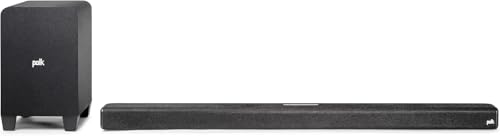
Polk Signa S4 — Best for dialogue plus Atmos
Considered as a spending decision, the Signa S4 is the tier’s money allocated by a dialogue lover. Its 3.1.2 layout covers the tier’s checklist — centre driver, wireless subwoofer, up-firing height drivers — and then Polk spends its remaining effort where the company has always spent it: on VoiceAdjust, the graduated speech control that lets a household tune dialogue in steps rather than toggling a blunt mode. In a tier where rivals compete on spectacle, that priority reads almost old-fashioned, until the first mumbled prestige drama of the week proves its worth.
The height presentation is honest mid-scale Atmos: ceiling-bounced cues that open a film’s sky without pretending to be a installed speaker array. The subwoofer is voiced warm and supportive, deliberately kept from grandstanding, so the centre channel’s work is never undermined from below. Streaming-era touches are modest — this is a bar that expects the television to be the smart part of the system — and the remote remains stubbornly plain, a Polk tradition owners either forgive or actively prefer.
Against the Q600C below, the S4 trades a measure of bass depth and Samsung’s ecosystem tricks for that voice control and a slightly gentler overall temperament. Households that watch films loudly will lean Samsung; households that watch everything, at every hour, with mixed hearing at the table will lean Polk. At this tier that is not a consolation distinction — it is the main fork in the road, and the S4 stands proudly on its side of it.
Ownership of the S4 tends to follow a recognisable arc: the first week is spent demonstrating the height effect to visitors, and every week after is spent not thinking about the bar at all, because the dialogue problem it was bought to solve has quietly left the household’s list of irritations. Equipment that graduates from toy to furniture that quickly is equipment whose priorities were set by someone who watches television the way its owners do.
- Layout in full: 3.1.2 — centre driver, wireless sub, two height drivers
- Speech provision: VoiceAdjust graduated dialogue tuning
- Sound signature: warm subwoofer support under a forward centre
- Best paired with: televisions that handle the streaming duties
Strengths
- Voice tuning remains the finest at this level of spending.
- Complete 3.1.2 hardware without ecosystem lock-in.
- Balanced temperament suits all-evening viewing.
Trade-offs
- Subwoofer depth yields to the Samsung’s.
- Smart features are minimal by design.
- Remote gives little feedback for adjustments.
Best for: dialogue devotees who also want genuine Atmos height. Not suited for: buyers chasing the deepest bass this tier offers.

Samsung HW-Q600C — Best complete film system
If the tier has a reference product, this is it. The Q600C assembles the full front architecture — left, centre and right across the bar, two up-firing drivers above, a wireless subwoofer with genuine reach below — and drives it with processing that understands film grammar. Its adaptive sound handling keeps the centre channel composed when a mix gets violent, so the story stays followable inside the spectacle rather than being sacrificed to it, and that composure is what separates a film system from a loud one.
The subwoofer is the tier’s heavyweight in the useful sense: not the loudest at any cost, but the one whose low notes arrive as events in the room — a hull groaning, a distant engine felt through the sofa — while staying clear of the centre driver’s territory. Samsung television owners gain Q-Symphony, which recruits the set’s own speakers into the centre effort; owners of other brands lose that garnish and keep the meal. The cabinet is wide and means business, and the system rewards a proper front-of-room installation rather than a corner exile.
Its demands are the honest kind: floor space for the sub, a ceiling that cooperates with the height drivers, and an owner willing to spend ten minutes in the settings. Viewers whose rooms meet those terms get the most complete answer this guide can give at the tier — the system against which the other five are, in their different ways, specialised alternatives.
It is also the system in this group most likely to change how a household uses its room. Once a film sounds this composed at home, the Friday trip to the multiplex loses its technical argument and survives only as a social one. Owners consistently report the subwoofer placement ritual — front corner, then beside the unit, then front corner again — as the only fiddly chapter in an otherwise immediate relationship.
- Full configuration: 3.1.2 with physical up-firing height drivers
- Bass: the deepest wireless subwoofer in this group
- Processing: adaptive scene handling that protects dialogue
- Samsung extra: Q-Symphony centre reinforcement on matching sets
Strengths
- Most complete front architecture at the tier.
- Height effects come from real drivers, not suggestion.
- Dialogue survives the loudest mixes intact.
Trade-offs
- Needs ceiling cooperation for its party trick.
- Wide cabinet and large sub demand real estate.
- Settings depth will daunt the set-and-forget crowd.
Best for: film-first rooms ready to use the tier’s full checklist. Not suited for: corner installations or minimalist furniture.
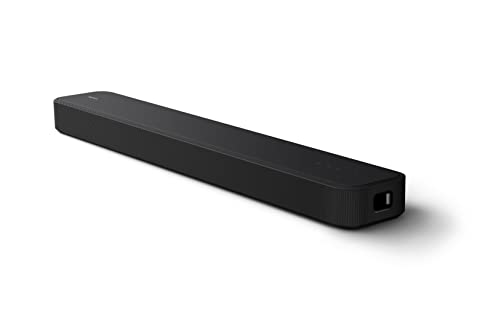
Sony HT-S2000 — Best single-cabinet system
The HT-S2000 spends the tier’s budget on integration instead of separation. Its 3.1 layout — including the centre driver this tier’s buyers have learned to want — lives in one cabinet, with dual built-in subwoofer drivers handling bass duties that every rival here outsources to a separate cube. Judged purely on floor plan, it is the only system in the group that a small flat, a rented room or a fiercely tidy household can adopt without negotiation.
Sony’s signal processing does the heavy lifting that the missing boxes cannot. Virtual Atmos and surround widening are executed with the company’s characteristic restraint, and the centre focus — the feature most easily destroyed by such processing — emerges intact, which is a genuine engineering compliment. The bar is at its best in the evening register: drama, series and sport at civilised volumes, where its low-volume clarity and freedom from subwoofer boom flatter both the programme and the neighbours.
The ceiling on its performance is physical and admitted freely in its own section of any honest review: internal drivers cannot pressurise a large room or reproduce the lowest octave of a blockbuster. Sony’s optional wireless subwoofers and rears exist for owners who later find space and appetite, and their existence makes the HT-S2000 the tier’s most forgiving first step. Bought as a complete answer for a modest room, it is one; bought as a foundation, it is also one. Few products manage both identities without lying about either.
There is a travel argument for it as well, rarely made in reviews and often made in households: a single cabinet moves between rooms for a visiting grandparent’s stay or a projector night in the garden room without a subwoofer hunt. The HT-S2000’s completeness is portable in a way its rivals’ distributed systems are not, and for renters who rearrange their lives yearly, that portability is a feature with a long memory.
- Configuration as sold: 3.1, with bass drivers inside the bar
- Processing: virtual Atmos and surround with centre focus kept
- Control: companion app handles setup and adjustment
- Expansion route: Sony wireless subwoofers and rears available
Strengths
- Centre-channel clarity with zero subwoofer footprint.
- Superb manners at evening volumes.
- Optional add-ons give it a second life later.
Trade-offs
- Deep bass is emphasis, not physical event.
- Big rooms expose its output limits.
- Virtual height is a sketch beside real drivers.
Best for: smaller rooms and tidy households wanting tier quality in one box. Not suited for: large spaces or listeners who measure films by their rumble.

JBL Bar 500 — Best cinematic width
The Bar 500 is the extrovert’s answer to the tier, a 5.1 system that builds its surround impression from the front using JBL’s MultiBeam approach — carefully aimed drivers and wall reflections that stretch the stage well past the cabinet’s physical ends. Where the 3.1 bars organise the front, the JBL theatricalises it: a street scene feels like a street, a stadium like a stadium, and the wireless subwoofer supplies the scale to match, with the kind of low-end enthusiasm that action directors mix for.
Its centre performance deserves a precise description, because a 5.1 badge can hide a multitude of dialogue sins. The Bar 500 keeps voices anchored and clear at ordinary volumes, using its centre provision properly rather than as a spec-sheet ornament, though in the very widest MultiBeam settings the edges of the stage can steal a little focus from the middle on quiet scenes. The sensible owner treats the widest mode as a film-night setting and the calmer one as the everyday default — a small ritual the bar rewards handsomely.
Streaming is built in rather than delegated, with the major casting and voice platforms supported, which suits households that play music through the bar daily. That breadth makes the Bar 500 the group’s most sociable system: films on Friday, the match on Saturday, a playlist through Sunday lunch. If your room is wide, your tastes are loud and your definition of cinema includes feeling the room participate, this is your tier money spent in your accent.
Concert films are its secret showcase. A live recording’s crowd, hall and stage spread across the MultiBeam stage with a scale the narrower bars cannot imitate, and the subwoofer keeps a bass guitar’s weight physical without swallowing the vocal. Households whose screens double as the house stereo for streamed concerts will find the Bar 500 working hardest of the six across the whole week, not merely on film night.
- System layout: 5.1, surround rendered from the front by MultiBeam
- Bass supply: substantial wireless subwoofer with real scale
- Formats: Dolby Atmos supported through its front array
- Streaming: built-in casting and platform support
Strengths
- Widest, most theatrical front stage of the six.
- Subwoofer scale flatters action and sport.
- Built-in streaming suits music-heavy households.
Trade-offs
- Widest modes can dilute quiet dialogue focus.
- Surround is reflected, never truly behind you.
- Enthusiastic bass needs taming in small rooms.
Best for: wide rooms and viewers who want cinema scale from the front. Not suited for: purists who want every effect from a physical speaker.

Bose Smart Soundbar 600 — Best compact Atmos bar
In this guide the Bose 600 is linked and recommended on its own terms, and its terms are these: genuine Dolby Atmos with up-firing drivers, delivered from a cabinet compact enough for a bedroom dresser or a small media unit, with dialogue handled by processing refined over generations of Bose television products. It is not a 3.1 system — there is no subwoofer channel in the box — and this tier’s buyers should hold that fact and its virtues in view at the same time, because the 600’s whole proposition is that for smaller rooms, the virtues win.
The height effect from such a small cabinet startles first-time listeners, and unlike cheaper virtual attempts it survives familiarity: the up-firing drivers are real, the ceiling does its share, and Atmos series gain a vertical breathing space that transforms how a modest room receives them. Dialogue, meanwhile, benefits from Bose’s long obsession with television speech; voices are lucid without the etched quality that makes some clarity processing fatiguing across a long evening.
Bass is the admitted boundary — present, tidy, and insufficient for viewers who want a soundtrack in their sternum. Bose’s own wireless bass module is the designed remedy, and adding it moves the system’s total cost beyond this tier, which buyers should count before falling for the compact cabinet. As a one-box Atmos instrument for a smaller room, though, the 600 has no rival in this group, and its restraint will suit households that find the bigger systems faintly exhausting.
The 600 also suits the television-as-guest-room reality of many homes: the second set, the study screen, the bedroom where a full system would be absurd and television speakers are an insult to the programmes. Placing genuine Atmos hardware in those rooms used to require disproportionate money and furniture; the Bose compresses the proposition into something nearer a large loaf of bread, and the compression itself is the engineering story.
- Configuration: compact Atmos bar with up-firing drivers, no sub in the box
- Dialogue: Bose speech processing, lucid at low volume
- Footprint: the smallest cabinet among the six picks
- Growth: Bose bass modules and surround speakers pair later
Strengths
- Real Atmos height from a genuinely small cabinet.
- Dialogue polish that stays easy on the ears.
- Ideal dimensions for bedrooms and small units.
Trade-offs
- No subwoofer channel as sold; bass stays modest.
- Completing the system exits this price tier.
- Large rooms overwhelm its scale.
Best for: smaller rooms wanting real Atmos without furniture drama. Not suited for: bass-led film nights in a big living room.

Samsung HW-B630F — Best calm 3.1 value
Every tier needs its sceptic’s pick: the system that declines the headline feature and does the fundamentals at a level that embarrasses fancier rivals. The B630F is that pick here. It is a classic 3.1 — centre driver, wireless subwoofer, no height drivers and no Atmos decoding beyond virtual widening — placed at this tier’s calmer end for buyers whose viewing is overwhelmingly series, sport and news, and whose films arrive without height mixes to reproduce.
What the forgone Atmos budget buys instead is composure. The centre channel is voiced for the long haul of dialogue television, the subwoofer is tuned tight rather than deep, and the whole system’s manners at ordinary volumes are the most civilised in this group. DTS Virtual:X widening is available for the match or the occasional blockbuster, and it behaves like a guest who knows when to leave. Samsung television owners additionally get the brand’s seamless control relationship, which removes the small daily frictions that accumulate into buyer’s remorse.
The honest question this pick asks is whether your household will ever feed the height drivers its rivals carry. If your streaming habits say no — if the Atmos logo rarely appears in your library — then the B630F is not the compromise of this guide but its most rational entry, spending the tier’s money on the ninety percent of viewing rather than the ten. Buyers unsure of their answer should choose Atmos hardware as insurance; buyers certain of it can take the calm.
Longevity flatters the B630F’s philosophy as well. With no height drivers to be orphaned by a future format shuffle and no app ecosystem whose redesign can strand it, the bar’s value is stored in drivers and tuning rather than in software promises. A decade from now its centre channel will still be doing the job it was bought for, in a household that may have changed televisions three times around it.
- Layout: traditional 3.1 — centre driver plus wireless subwoofer
- Processing: DTS Virtual:X for occasional widening
- Temperament: tight bass and civilised everyday manners
- Control: natural pairing with Samsung televisions
Strengths
- Everyday dialogue composure leads the group.
- No money spent on height hardware you may never feed.
- Tight subwoofer suits ordinary housing.
Trade-offs
- No Atmos decoding for height-mixed films.
- Stage width is processing, not architecture.
- Least cinematic ceiling of the six.
Best for: series, sport and news households with occasional film nights. Not suited for: Atmos subscribers who watch height-mixed films weekly.
How do the six compare side by side?
| Pick | Channels | Height method | Subwoofer | Character |
|---|---|---|---|---|
| Polk Signa S4 | 3.1.2 | Up-firing drivers | Wireless, warm | Dialogue-led |
| Samsung HW-Q600C | 3.1.2 | Up-firing drivers | Wireless, deepest | Complete film system |
| Sony HT-S2000 | 3.1 | Virtual | Built into bar | Integrated and tidy |
| JBL Bar 500 | 5.1 | Front-array Atmos | Wireless, large | Wide and theatrical |
| Bose Smart Soundbar 600 | Atmos bar | Up-firing drivers | None in box | Compact and polished |
| Samsung HW-B630F | 3.1 | Virtual widening | Wireless, tight | Calm classic |
The comparison that matters is not row against row but row against your own viewing diary. Count last month’s evenings honestly — how many carried the Atmos logo, how many were dialogue in a room where someone was sleeping — and the table sorts itself with embarrassing speed.
How does this tier change a film night, scene by scene?
Take an ordinary sequence: two people talking in a kitchen while rain builds outside. On the tier below, the scene arrives as competent stereo — voices somewhere central, rain as general weather noise, the room tone thin. On the systems in this guide, the same scene acquires geography. The voices sit in the centre driver’s keeping, stable as the camera cuts; the rain finds the height and width of the room’s front, so its intensifying is something you feel approach; and when the door closes on the weather, the subwoofer’s low note tells you the house is sealed. Nothing has been added to the film. Its own mix has simply been given the rooms it was designed to occupy.
Action exposes the tier’s composure rather than its volume. A chase that would smear into noise on lesser systems stays legible here because each element has somewhere to be: dialogue in the centre, score spread wide, impacts below. Viewers often describe the result as being able to watch at lower volume while feeling more, which is the precise signature of architecture replacing loudness. It is also why this tier, more than the one below, rewards viewers who sit through whole films rather than grazing clips — the dividend compounds across two hours of organised sound.
The honest counterweight is that prestige television, mixed carefully for ordinary systems, gains less than cinema does. A dialogue-led series will sound better here — calmer, clearer, better anchored — but the transformation is incremental rather than theatrical. Buyers should therefore weight their film-to-series ratio as the tier’s deciding statistic, and the buying-guide section’s library audit is the tool for measuring it without self-deception.
What role does the subwoofer really play at this level?
A larger one than its size in the mix suggests. The subwoofer at this tier is not primarily an effects machine; it is the foundation that lets every other driver work within its competence. When the lowest frequencies are handed to a cabinet built for them, the bar’s midrange drivers stop straining at notes they cannot reproduce, and the audible dividend is paid in the centre channel — voices gain body without boom, scores gain floor without fog. This is why the Q600C’s dialogue sounds expensive even in quiet scenes: its subwoofer is quietly doing structural work under every word.
Placement decides whether that structure helps or harms. A subwoofer exciting a room’s corner modes will bloat exactly the frequencies where male voices live, and the owner will blame the bar’s centre while the true culprit sits in the corner glowing innocently. The remedy is unglamorous and universal across this guide’s systems: start the sub beside the front unit, keep it clear of tight corners until proven innocent, and set its level against a baritone narrator rather than against an explosion. Explosions forgive everything; narrators forgive nothing.
Households in attached housing should hear the good news inside this: a well-integrated larger subwoofer often needs less level than a small one straining at its limit, because its output is cleaner at the frequencies that matter. The result is more foundation at the sofa and less complaint through the wall — the opposite of the intuition that bigger bass means worse neighbours.
Which questions separate a wise purchase at this level from a hasty one?
Your ceiling, before anything else, if height drivers are part of the appeal: flat, reflective and of ordinary height is the requirement, and a room that fails it redirects the sensible money toward the B630F or the JBL. Next, your television’s audio output — eARC unlocks the full-quality path these bars are built for, while plain ARC still serves well but with more format negotiation. Then measure the furniture honestly. Two of these systems carry subwoofers that need a real home, and the wide cabinets will not apologise to a narrow stand.
Audit your library with the same honesty. Streaming services label their Atmos titles; scroll your watchlist and count. A household whose films genuinely carry height mixes will use the Q600C’s and S4’s drivers weekly, while a household living on broadcast and back-catalogue series will not, and both households are right — about different bars. Finally, decide whether the bar or the television will be the household’s streaming brain, because the JBL and Bose build that brain in while the Polk and Samsungs largely leave it to the set, and duplicating it is harmless but pointless to pay for twice.
How do you get the height effect working at home?
Placement first: the bar must sit unobstructed, with nothing overhanging its top face — a shelf directly above an up-firing bar strangles the very reflections you paid for. Keep the bar’s front at the furniture’s edge so the upward path is clean, and sit within the reflection zone, roughly the central seats at normal distances, for the strongest effect. In the television’s menu, confirm the audio path is passing the Atmos signal rather than downmixing it; more height systems are defeated by a set’s default output setting than by any acoustic flaw.
Then calibrate expectations with the right material. A purpose-mixed Atmos scene — rainfall, a flyover, a cathedral interior — should place sound unmistakably above the screen’s plane; ordinary dialogue scenes will and should sound grounded, because height channels in a good mix are seasoning, not the meal. If the effect seems absent everywhere, work through the chain methodically: source format, television output, bar’s displayed format, ceiling path. The fault is almost always a link in that chain, and it is almost always fixable in a menu rather than in a shop.
How should households split the decision when tastes differ?
By naming the evenings, not the specifications. One partner’s film Fridays, the other’s nightly series, the children’s Saturday cartoons and the household’s shared sport all draw on different strengths in this group, and a decision made by counting evenings rather than by arguing about drivers tends to survive contact with reality. The film partner’s height drivers and the series partner’s centre channel coexist happily in the Q600C and S4; where they conflict is on temperament — the JBL’s theatre against the B630F’s calm — and temperament is settled by a demonstration, not by a debate.
Volume politics deserve the same honesty. A household where someone sleeps early will live inside the winning bar’s night behaviour, and the systems here differ more in that register than their daylight demonstrations suggest. The Sony’s low-volume clarity, the Polk’s voice lift at modest levels and the Samsung’s adaptive restraint are all, in effect, peacekeeping technologies. Judge them after nine in the evening if your household keeps such hours; the bar that wins the afternoon showroom may finish third in the only audition that repeats nightly.
And when the argument truly deadlocks, choose the system whose remote and app the less technical partner prefers. Sound quality differences at this tier are real but livable; a control scheme that one household member refuses to touch becomes a daily tax on every programme. The best bar in this guide is the one the whole household will actually operate without negotiation.
What does ownership look like after the first month?
The novelty sequence is predictable: height effects are demonstrated to guests, the subwoofer is shown off with a favourite scene, and then — if the purchase was right — the equipment vanishes from conversation. What remains is a set of small, durable satisfactions. Dialogue stops being a negotiation. The television remote governs everything again. A film’s quiet scenes hold the room instead of losing it to phone screens. Owners reporting back on this tier rarely praise a specification; they report that the living room feels finished, which is the sensation the extra money over the tier below was actually selling.
Maintenance is close to nil, with two exceptions worth a calendar note. Television updates occasionally reset the audio output path, and the first symptom — a silent bar or a downmixed stream — sends owners hunting in the wrong device; check the set’s output setting first, always. And rooms change: a new rug, a moved sofa, a subwoofer displaced by a Christmas tree and never returned. Any of these can tilt a careful setup, and the ten-minute tuning ritual from the how-to section is the standing remedy. Systems at this tier hold their settings faithfully; it is the world around them that drifts.
How do games and live events fit this tier’s strengths?
Story-driven games are films with a controller attached, and they inherit this tier’s virtues wholesale: centre-anchored cutscene dialogue, height cues in Atmos-mixed titles, and subwoofer weight that sells scale without masking speech. The wired path through the television keeps delay where it belongs — governed by the set’s game mode rather than by the bar — so even competitive players are served, provided nobody routes the console through Bluetooth and blames the equipment for the physics of radio.
Live events reward the tier differently. A concert stream’s hall ambience spreads across the wider systems with real conviction, and the centre channel keeps a presenter or vocalist nailed to the stage while the crowd breathes around them. Sport’s commentary-over-crowd geometry is the same shape. The systems that handle both — spectacle with an anchored middle — are the ones this guide ranks highest, because that geometry is not a genre; it is the shape of most things a household watches together, and getting it right nightly is worth more than any single demo scene.
Where does this tier sit in a longer upgrade path?
For many households it is the end of the path, and there is no shame in the terminus. The architecture it completes — front channels, height, bass — covers the overwhelming majority of what soundtracks contain, and the systems here will serve a decade of televisions without embarrassment. Owners who later crave genuine rear envelopment are not trapped, exactly: the Sony and Bose routes accept wireless additions, and the complete-as-sold systems hold their value in the family hand-me-down economy, where a composed 3.1.2 bar transforms a relative’s television as thoroughly as it transformed yours.
The less comfortable truth is for serial upgraders: this tier’s systems are good enough to make the next tier’s gains feel incremental, because the remaining improvements — physical surrounds, calibration, flagship processing — refine an experience whose foundations are already laid. That is an argument for buying this tier carefully rather than cheaply within it. A household that chooses its system by the analysis above, instead of by the week’s discount, is buying the version of the next ten years it actually wants to live with.
It is also worth saying plainly that no bar in this guide, at any setting, replaces the social fact of a shared room listening together. The equipment’s job is to disappear so the programme can do its work. The systems that understand that — and at this tier, most of them do — earn their shelf not by the scenes they spectacularise but by the evenings they stop interrupting.
What should the first film be?
Not the loudest one you own — the one you know best. Familiarity turns a favourite film into a measuring instrument: you already know where the whispered line sits, how the rain should feel, when the score is supposed to lift the room. Play it at your honest evening volume, resist the settings menu for its full length, and only afterwards adjust the one thing that genuinely bothered you. A system tuned against a beloved film will serve unfamiliar ones faithfully, because it was calibrated against your memory rather than against a demonstration’s exaggerations.
Then, sometime in the first week, deliberately watch the least spectacular programme in your rotation — the panel show, the regional news, the documentary narrated by one calm voice. This tier’s systems were bought for films but will be judged by households across thousands of ordinary hours, and the bar that flatters both registers is the bar that was chosen well. The six above were selected to survive exactly that double life.
Where do shoppers at this level most often go wrong?
- Buying height drivers for a hostile ceiling. Beams and vaults tax up-firing systems heavily; the money serves better elsewhere in those rooms.
- Assuming the tier includes rear speakers. Every system here is front-based; envelopment from behind belongs to the surround guides.
- Letting the television downmix silently. A set left on the wrong output setting can strangle Atmos before the bar ever hears it.
- Judging by the loudest demo scene. This tier’s real dividend is composure — dialogue inside spectacle — which trailers never demonstrate.
- Ignoring the bar-only variant trap. Some names here sell without their subwoofer; the listing’s box contents decide what you actually bought.
- Shelving the bar under an overhang. Up-firing drivers need a clear path to the ceiling, not a shelf six inches above them.
One more scene deserves the tier’s defence: the quiet one at the end of the film, where the score withdraws and two people say the thing the plot has been circling. Lesser systems make viewers reach for the remote at exactly this moment, and the spell breaks. The bars in this guide hold such scenes at the volume they were mixed for, because their dialogue does not depend on loudness for clarity. If a single capability justifies the step up from the tier below, it is arguably this — not the helicopter, but the sentence after the helicopter has gone.
There is a corollary for households with children asleep beyond the wall. The same composure that protects quiet dialogue also contains the loud scenes, since a system that separates its elements does not need brute level to feel dramatic. Night viewing at this tier stops being a compromise negotiated in whispers and becomes simply a lower-volume version of the same film, which is a quality of life improvement no specification sheet has ever managed to name.
It bears repeating, because showrooms work hard to obscure it, that none of these six will put a single sound behind your head. What they do — organise the front of the room so completely that most viewers stop missing the back — is a different and, for most households, sufficient achievement. Buyers who internalise that sentence before ordering almost never return their bar; buyers who discover it afterwards sometimes do, and the difference between those groups is information, which is what this guide exists to provide.
One more household pattern is worth naming before the verdict: the weekend film is watched by everyone, but the weekday set is watched by one person at a time, often with headphones considered and rejected. A bar that behaves at whisper-adjacent volumes — and the centre-channel systems here are built for exactly that register — serves the solo weekday viewer as faithfully as the Friday crowd. Versatility across the week’s shapes, not supremacy in one of them, is the quality that separates a purchase from a possession.
Final Recommendation
Make the Samsung HW-Q600C the default at this tier and argue yourself out of it only with a specific reason: it delivers the tier’s complete promise — centre, height, bass, composure — in one system. The specific reasons are honourable ones. Choose the Polk Signa S4 when dialogue tuning leads your household, the JBL Bar 500 when width and theatre lead it, the Sony HT-S2000 or Bose 600 when the room itself forbids the big boxes, and the Samsung HW-B630F when your viewing diary says the height drivers would gather dust. The step up from the tier below is worth taking precisely because each of these systems spends it on architecture rather than volume — pick the architecture your evenings actually use.
Frequently Asked Questions
Is the step from the $200 tier worth it for series and sport?
Partly. Series gain the centre channel’s dialogue stability, which most of these systems carry, and sport gains the wider, calmer staging. The height drivers, by contrast, will idle through broadcast content. Households that never watch Atmos films should weigh the B630F’s calm against its rivals’ unused hardware.
Do I need eARC to enjoy these bars?
Not strictly, but it is the cleanest path. eARC carries the full-quality formats from a television’s apps and connected consoles without negotiation, while plain ARC may compress or downmix some sources. If your set has eARC, use it; if it has only ARC, every pick here still performs, with the height systems occasionally fed a slightly leaner signal.
Can I add rear speakers to any of these later?
The Sony and Bose live inside ecosystems that sell wireless rears and subwoofers as later additions, which is part of their appeal as foundations. The Samsung, Polk and JBL systems here are principally complete-as-sold designs. If a staged build toward full surround is the plan, choose the ecosystem route deliberately rather than hoping a closed system opens.
Why does one pick have no subwoofer at this price?
Because Bose spent the budget on miniaturised Atmos hardware and processing instead. The 600 trades bass authority for a cabinet that fits rooms the others cannot enter. It is a legitimate exchange at this tier, provided the buyer makes it knowingly — which is why its section states the trade in its first paragraph.
How large a room can this tier handle?
Comfortably, the medium living room: the Q600C and Bar 500 stretch furthest, the compact Bose and single-cabinet Sony suit the smaller end. Very large open-plan spaces will expose every system here eventually, and owners of such rooms should read our surround coverage with an eye to systems built for volume rather than asking this tier to shout.
Should I wait for a sale or buy the right system now?
This tier’s models rotate through promotions regularly, so patience is usually rewarded — but choose the system first and the week second. A discounted bar whose architecture mismatches your room is not a bargain at any figure, while the right system bought at its ordinary price will be forgiven by your household within a month. Decide by the analysis, then let the calendar save what it can.
A closing observation about value, since this tier invites the question most sharply. The money here buys engineering that ages slowly — drivers, cabinets, amplifiers — wrapped in a thin layer of software that ages quickly. The systems ranked highest in this guide are the ones whose worth lives in the slow layer: their height drivers will still be drivers in a decade, their centre channels still centred, whatever happens to apps and assistants in between. Buy the slow layer, tolerate the fast one, and the tier’s arithmetic works in your favour for years.
And a practical coda for the undecided: if you are reading this guide on the sofa you will watch from, look at the room once with a buyer’s eyes — the ceiling’s flatness, the stand’s width, the corner where a subwoofer would live, the seat where the least-hearing viewer sits. The room has already voted among these six systems. The analysis sections simply translate its ballot into product names, and the translation rarely surprises anyone who has honestly looked.
Finally, remember that the tier’s systems are at their most persuasive in your own room, with your own ceiling and your own programmes, and every seller here operates a returns window for a reason. Order the system the analysis points to, install it with the care the how-to section describes, and give it three evenings of real viewing before judging. That probation, honestly served, has settled more soundbar decisions than any review — including, we are content to admit, this one.
Three evenings is also enough time for the household’s quiet verdict to form — the one delivered not in words but in behaviour: remotes consolidated, subtitles retired, the good seats argued over a little less because every seat now hears the film. Watch for those signs rather than for a single spectacular moment, and you will know whether the tier has done for your room what it promises on paper.
If those signs appear, stop shopping. The tier above will always exist, gleaming; the finished room in front of you is the rarer achievement, and it is the one this guide was written to deliver.
Related Guides
Compare the tier below in our entry-level soundbar roundup, isolate the dialogue question in the centre-channel soundbar guide, or move to genuine surround with the 5.1 soundbars for television roundup.


