What's inside
- Key Takeaways
- Quick Picks
- How We Chose These Picks
- Coaxial or Component — Which Architecture Fits Your Car?
- What Do Sensitivity and Impedance Actually Decide?
- How Much Power Do Door Speakers Really Need?
- What Does the Door Itself Do to the Sound?
- How Should You Listen Before You Spend?
- What About the Rear Doors — Matching, Downgrading or Disconnecting?
- How Do Crossovers Shape What You Hear?
- Which 6.5 Speakers Deserve Your Doors?
- How Do the Six 6.5 Speakers Compare Side by Side?
- How Should You Set the Head Unit After the Swap?
- How Do You Fit 6.5 Speakers Without Creating Rattles?
- Where Should the Rest of the Budget Go?
- When Is a 6.5 the Wrong Answer Entirely?
- What Mistakes Do 6.5 Buyers Keep Making?
- How Do These Speakers Age Over Five Years in a Door?
- Final Recommendation
- Frequently Asked Questions
- Related Guides
As an Amazon Associate I earn from qualifying purchases. This post may contain affiliate links at no extra cost to you.
widgetverdict.com is reader-supported. When you buy through links on our site, we may earn an affiliate commission.
Where to buy: All six picks below are sold as pairs through Amazon, and each name in this guide links to its checked listing. The six cover three different jobs — coaxial drop-ins, proper component sets with separate tweeters, and one marine-rated outlier — so start by deciding which job your doors actually need, then use the comparison table to narrow the field.
The phrase best 6.5 speakers hides an argument, because a 6.5-inch driver is not one product category but a mounting size shared by several. Behind that single diameter sit cheap coaxial speakers meant to revive a tired factory system, component sets that split the tweeter away from the woofer so the soundstage can climb up to ear level, pro-style midbass drivers that need a tweeter partner and a crossover to make sense, and marine-rated coaxials built to shrug off the moisture that collects inside a car door. Anyone who ranks all of those on one ladder and declares a winner has not thought about what the speakers are for. This guide takes the size seriously and the jobs separately: six picks, each chosen because it does one particular job convincingly, with the trade-offs of that job stated plainly.
Start with the honest baseline. A 6.5 in a car door works in a hostile, leaky, oddly shaped enclosure, fed in most cars by a head unit or a modest factory amplifier, and asked to cover everything from kick drum to cymbal with help from nothing else. No single driver does all of that brilliantly, which is why the format splits. Coaxials put a small tweeter in front of the woofer and accept that treble will fire at your ankles in exchange for a one-hour install. Components move the tweeter up to the sail panel or A-pillar and charge you an afternoon of trim removal for a stereo image that actually floats in front of you. The six below include both, plus a marine-rated coaxial whose weatherproofing turns out to matter in ordinary cars more than most buyers expect, because door cavities get wet every time it rains.
Key Takeaways
- The 6.5-inch size is a mounting standard, not a sound category — coaxial, component and marine-rated designs sharing the diameter behave very differently.
- Infinity’s Kappa 63XF is the coaxial for listeners who will add amplification later; its low impedance and glass-fibre cone reward power instead of merely tolerating it.
- Focal’s ASE 165 and JBL’s Club 64C are the two component routes here: Focal for a composed, European top end, JBL for efficiency that flatters a factory head unit.
- Kicker’s KSS6504 component set is the flexible installer, with tweeter mounting options that suit cars where the factory tweeter location is awkward or absent.
- Rockford Fosgate’s P1650 is the durable Punch-series coaxial — the pick when the car will keep its factory wiring and the owner wants reliability over fireworks.
- Polk’s DB652 carries genuine marine certification, which in practice means door cavities, convertibles and older cars with tired window seals stop being a slow death sentence.
Quick Picks
| Pick | Badge | Why it earns its place |
|---|---|---|
| Infinity Kappa 63XF | Best coaxial for amplified systems | A glass-fibre cone and low-impedance design that wake up properly once real amplifier power arrives. |
| Focal ASE 165 | Best component set for tonal balance | Focal’s Auditor-series components deliver a calm, detailed treble that never turns glassy on long drives. |
| JBL Club 64C | Best component set on factory power | A 3-ohm, high-sensitivity design that extracts surprising volume and clarity from an ordinary head unit. |
| Kicker KSS6504 | Best component set for tricky installs | Multiple tweeter mounting options and a compact crossover make awkward factory layouts manageable. |
| Rockford Fosgate P1650 | Best durable coaxial workhorse | The Punch-series coaxial that has survived years of doors, heat and factory wiring without drama. |
| Polk DB652 | Best for wet doors and open cars | Marine certification and a polypropylene cone shrug off the moisture that quietly kills paper-cone speakers. |
How We Chose These Picks
Six slots had to represent a whole format, so the first filter was coverage: at least two component sets, at least two coaxials, and room for the designs that solve problems the mainstream ignores. Within each family we favoured speakers with a long, consistent production history, because car speakers are bought against a specific door and a specific factory system, and a model that disappears after one season leaves owners of half-finished four-door projects stranded. We weighed sensitivity figures carefully but refused to rank by them, since a sensitivity number measured at 2.83 volts flatters low-impedance designs and says nothing about how a cone behaves at the bottom of its range in a leaky door.
Materials mattered more than marketing. Cone material decides how a driver survives a door’s humidity and how it breaks up at the top of its travel; tweeter material decides whether female vocals sound like voices or like steam. We also looked hard at mounting depth and basket shape, because the finest-sounding 6.5 ever made is worthless in the large minority of doors where the window glass passes within a few millimetres of the magnet. Finally, every pick had to make sense at the power level its buyer will actually feed it — a speaker that only shines behind an amplifier is a poor recommendation for the reader who will never fit one, and this guide labels that distinction on every pick rather than burying it.
Coaxial or Component — Which Architecture Fits Your Car?
The coaxial-versus-component decision is really a decision about where treble comes from. In a coaxial, the tweeter sits on a post through the middle of the woofer, firing from low in the door. Your ears are a metre above that, off to the side, and human hearing localises high frequencies precisely — so the music’s image stays down by your shins, and fine detail is softened by the seat and your own legs absorbing the direct sound. None of that makes coaxials bad. It makes them honest background-and-foreground speakers for cars where the listening is casual, the install must be quick, or the budget needs to stretch across four doors.
Components separate the two drivers. The woofer stays in the door, where its size belongs, and the tweeter goes up high — in the sail panel at the mirror, on the A-pillar, or in a factory tweeter pod on the dash corner. Lift the tweeters and the whole presentation changes: voices move to the windscreen, the left-right image separates, and detail survives because the tweeters now have a clear line to your ears. The cost is labour and a crossover network to wire and hide. If your car already has factory tweeters up high, a component set drops into an architecture the manufacturer already built, and wasting that wiring on a coaxial is leaving the best part of the upgrade unclaimed. If your car has no tweeter location at all, budget the extra hour to create one, or accept the coaxial compromise knowingly.
What Do Sensitivity and Impedance Actually Decide?
Sensitivity tells you how much sound a speaker makes from a fixed input, and in a car running on head-unit power it is the closest thing to a free lunch. A speaker rated a few decibels higher does not sound a few decibels better; it sounds clearly louder at the same volume-knob position, which matters because head units run out of clean power early and distort when pushed. High sensitivity is achieved with light cones, efficient motors and sometimes low impedance, and each of those tools has a shadow side — light cones can lack low-end authority, and low impedance asks more current from the amplifier stage.
Impedance deserves a plain explanation because two of this guide’s picks use it deliberately. Most car speakers are nominally 4 ohms. A 3-ohm or lower design draws more current from the same amplifier and so plays louder, a trick Infinity and JBL both use to make their speakers shine on weak factory power. Modern head units and quality amplifiers handle this without complaint, but a few older or very cheap amplifiers run hot into low loads, and in a multi-speaker factory system with unusual wiring the safe move is to check the factory speaker’s marked impedance before assuming lower is free. None of this is a reason to fear the low-impedance picks below; it is a reason to know which one you are buying and why.
How Much Power Do Door Speakers Really Need?
Less than the box art implies, and the relationship is not linear. Doubling amplifier power buys only a modest step in loudness, so the jump from a head unit’s small real-world output to a compact amplifier’s output transforms a system mainly by adding clean headroom, not raw volume. Distortion, not quietness, is what makes factory systems unpleasant at motorway volume: the amplifier clips, the clipped signal sounds harsh, and owners blame the speakers. Fitting efficient speakers postpones clipping. Fitting an amplifier removes it. Fitting both is the finished job, but the order matters for budgets — speakers first, because no amplifier makes a torn paper cone sound good.
Power handling ratings, meanwhile, should be read as survival limits rather than targets. A speaker rated to handle generous power is not asking to be fed all of it continuously; it is telling you its voice coil can shed the heat of an amplified system driven hard. The practical question for each pick below is the reverse one: how does it behave at the low power most owners will actually give it? That is why the analysis for each pick leads with its behaviour on factory power and treats amplified performance as the second paragraph, not the headline.
What Does the Door Itself Do to the Sound?
A car door is the worst loudspeaker cabinet most people will ever own, and understanding its crimes explains half of what separates the picks in this guide. A proper speaker enclosure is rigid, sealed and lined; a door is a thin steel shell full of holes, with a window mechanism inside it, a drain at the bottom, and an interior trim panel that flexes and buzzes in sympathy with bass notes. The woofer’s rear wave escapes through every access hole and arrives at the listener’s ear out of phase with the front wave, cancelling the lowest frequencies the driver worked hardest to produce. This is why two cars fitted with identical speakers can sound obviously different, and why installation materials — deadening mat, sealing foam, rigid adapters — consistently buy more audible improvement per unit of money than stepping one tier up the speaker range.
The door also decides where the speaker sits in the car’s acoustic map, and it is never a kind place. Front door woofers fire at the occupants’ legs from below and to the side, at distances that differ hugely between driver and passenger, which is why the stereo image in most cars leans toward whichever door is nearer. Component tweeters mounted high partly correct the geometry; time alignment in a modern head unit corrects more of it; but the underlying asymmetry is why serious car audio treats the front doors as a system to be managed rather than a hole to be filled. When you read the pick analyses below, keep the door in mind: speakers with strong off-axis response and controlled dispersion, like the Focal set, are compensating for exactly this placement, while a speaker voiced hot and forward, like the JBL, is compensating for road noise instead. Both are rational answers to the same hostile room.
How Should You Listen Before You Spend?
Demo boards in shops are honest about tone and dishonest about everything else, because a speaker on a board in a quiet room tells you nothing about how it behaves in your door at motorway speed. A more useful pre-purchase discipline is to audit your own car first. Play familiar music at the volume you actually use on the road and note precisely what bothers you: if the complaint is harshness and shouting at volume, the problem is usually distortion from the head unit or ragged factory tweeters, and an efficient, smooth-topped replacement fixes it. If the complaint is thinness — voices with no chest, drums with no body — the problem is midbass and door sealing, and a speaker swap alone will only partly cure it. If the complaint is that everything sounds like it is happening in the footwell, that is tweeter placement, and only a component set answers it.
Bring the same two or three tracks to every comparison and listen for the same events in each: the decay of a piano note, the edge on a female vocal, the separation between kick drum and bass guitar in a dense chorus. Speakers reveal themselves in transitions — the moment a quiet verse steps into a loud chorus is where cheap cones lose their composure and good ones merely get louder. The picks in this guide were separated largely on that test in spirit: the Kappa holds its midrange together under load, the Focal refuses to turn glassy, the JBL stays articulate at the low wattage where rivals mumble. If your listening is mostly talk radio and podcasts at moderate volume, be honest about that too, because intelligibility of speech lives in the midrange, and several budget speakers that impress with music’s extremes are oddly poor at making a voice sound like a person.
What About the Rear Doors — Matching, Downgrading or Disconnecting?
Rear speakers divide owners into camps, and the honest answer depends on who sits in the back and how the system is used. For the front seats, rear speakers contribute fill and a sense of envelopment; run too loud, they drag the stereo image backwards and smear the front stage that component tweeters worked to create. The common upgrade path — best speakers in front, the budget stretched thin behind — is sound, provided the rear choice comes from the same tonal family as the front. A bright rear set behind calm front components will announce itself on every fade adjustment, and passengers in the back deserve better than the system’s leftovers if they regularly ride there.
Families should think about the rear doors as a separate listening zone with its own brief: children in the back hear mostly the rear speakers, at close range, so a smooth tweeter matters more there than midbass heroics, and the Polk or Rockford coaxials serve that role well. Owners who rarely carry rear passengers sometimes disconnect the rears entirely and spend the whole budget up front, a purist move that genuinely improves the front stage in cars with poor rear locations. What nobody should do is fit a heavy, power-hungry speaker in the rear doors and run it from the same fading factory amplifier as the fronts; the system’s limited current gets shared, and the front stage that matters most is the part that suffers.
How Do Crossovers Shape What You Hear?
Every 2-way speaker in this guide contains a crossover, but they are not the same animal. A budget coaxial often crosses its tweeter with a single capacitor — the simplest possible filter, which protects the tweeter and little else, leaving the woofer to run full range into frequencies where its cone breaks up raggedly. Better coaxials and all the component sets here use fuller networks that roll the woofer off properly and shape the tweeter’s level, and the audible difference is a midrange that stays clean where the two drivers overlap. That overlap region, roughly where voices and guitars live, is where cheap crossovers confess themselves: a hardness or congestion that owners misattribute to the tweeter is often the woofer misbehaving above its station.
Component crossovers add a practical dimension, because the box has to live somewhere — inside the door, where it must be secured against vibration and kept clear of the window’s path, or inside the cabin at the cost of running two wire pairs through the door jamb boot. Several sets here use compact or in-line networks precisely to ease that problem, and the Kicker’s flexible design goes furthest in forgiving awkward installations. If you add an amplifier with electronic crossovers later, the passive networks can stay in place and simply work; active bi-amping is a deeper project that none of these speakers require. The buying lesson is to treat the crossover as part of the product you are paying for: two speakers with similar cones and magnets can sound like different price classes purely because one manufacturer spent money on the network and the other spent it on chrome trim.
Which 6.5 Speakers Deserve Your Doors?

Infinity Kappa 63XF — Best coaxial for amplified systems
The Kappa name has sat near the top of Infinity’s range for decades, and the 63XF shows why the line survives: this is a coaxial built like a component set that happens to share an axis. The cone is glass fibre rather than the polypropylene most coaxials use, and glass fibre’s stiffness shows up as a midrange that stays articulate when the bass line underneath it gets busy — the kick drum and the bass guitar stop smearing into each other, and a snare keeps its crack at volumes where cheaper cones have given up and gone woolly. The edge-driven textile dome tweeter is larger than the token tweeters on budget coaxials, and it sounds it: cymbals carry body instead of a thin hiss, and there is a tweeter level adjustment so the door’s low mounting position can be compensated rather than endured.
The honest condition attached to all that ability is power. The 63XF’s low-impedance design helps it on factory systems, and it will certainly play from a head unit, but its character — controlled, extended, a little reserved at low volume — opens up when an amplifier gives it current to work with. Owners planning an amplifier within the life of the car should buy this speaker now and enjoy the second upgrade when the amp arrives. Owners who will never amplify should shortlist the JBL and Rockford picks first. Fit is the other check: the Kappa’s basket and magnet are not the shallowest here, so measure the door before ordering, particularly in compact cars where the window regulator crowds the speaker’s home.
- Format: 6.5-inch 2-way coaxial, sold as a pair
- Cone: glass-fibre woofer with edge-driven textile dome tweeter
- Design note: low-impedance voice coil aimed at drawing more from factory and aftermarket amplifiers
- Tweeter adjustment on the speaker for balancing the low door position
Strengths
- Midrange clarity under bass load is a class above ordinary coaxials
- Tweeter has real size and an adjustment, not a decorative dome
- Built and finished like a speaker meant to stay in the car for years
Trade-offs
- Only shows its full character with amplifier power behind it
- Mounting depth needs verifying in shallow doors
- Sits at the serious end of coaxial pricing, close to component money
Best for: owners building toward an amplified system who want coaxial simplicity now. Not suited for: buyers who will run head-unit power forever and want maximum loudness from it.

Focal ASE 165 — Best component set for tonal balance
Focal builds speakers in France with a house sound that reviewers reach for words like composure to describe, and the ASE 165 from the Auditor EVO series is the affordable doorway into that sound. The woofer uses a polypropylene cone with a butyl surround — unfashionable materials on paper, chosen because they behave predictably and survive car doors — while the tweeter is an inverted dome, Focal’s signature geometry, which spreads treble widely and keeps it smooth off-axis. In a car, off-axis is the only axis there is, and that is where this set earns its place: the treble stays even as you move your head, voices sit naturally at the windscreen, and nothing in the top end spikes or spits on rough recordings.
What the ASE 165 will not do is impress in the first ten seconds of a demonstration. There is no boosted presence region and no bass shelf engineered to wow; the balance is closer to a good home speaker than to typical car-audio theatre. Listeners whose reference point is a loud, bright factory system sometimes call it polite for the first day and then notice, a week later, that they are listening for hours without fatigue and hearing backing-vocal lines they had never picked out. The included crossovers are compact and the tweeters can be flush or surface mounted, which keeps the install within reach of a careful first-timer. Feed it an amplifier eventually and the composure simply scales; the set never becomes the weak link.
- Configuration: component system, 6.5-inch woofers with separate tweeters and crossovers
- Woofer: polypropylene cone with butyl rubber surround
- Tweeter: inverted dome, flush or surface mount
- Character: neutral, low-fatigue balance in the Focal house style
Strengths
- Treble stays smooth and even from both front seats
- Long-drive listening without the fatigue bright speakers cause
- Tweeter mounting options suit most factory locations
Trade-offs
- Understated first impression compared with louder rivals
- Bass output is honest rather than generous for the size
- Component install still demands trim removal and crossover placement
Best for: listeners who value balance and detail over impact, especially in cars with factory tweeter locations. Not suited for: buyers wanting the loudest possible set or heavy bass from the doors alone.

JBL Club 64C — Best component set on factory power
Most component sets quietly assume an amplifier is coming, and sound thin and apologetic until it does. The Club 64C was engineered around the opposite assumption. JBL rates it at 3 ohms with high sensitivity, a combination aimed squarely at the few real watts a factory head unit produces: the lower impedance draws more current, the efficient motor converts it to sound, and the result is a component set that plays at a satisfying volume with the stereo image properly raised to the pillars, all before any amplifier enters the picture. For the large group of owners who want the component soundstage but will never rewire the car, that is not a minor convenience — it is the whole product.
The woofer cone is polypropylene with JBL’s Plus One architecture, which enlarges the effective cone area within the same mounting diameter, buying back some of the low-frequency output that efficiency usually costs. The edge-driven silk dome tweeter keeps JBL’s lively top end on the right side of harsh, and the crossovers are small enough to tuck inside a door or behind a kick panel without a fight. Add an amplifier later and the set grows louder and tidier, but it never depends on one. The one discipline required is the impedance check mentioned earlier: confirm your factory amplifier or head unit is comfortable with a 3-ohm load, as the vast majority are, before treating the trick as free.
- Layout: two-way components, 6.5-inch woofer plus separate tweeter
- Impedance: 3 ohms, with high sensitivity for factory power
- Woofer: Plus One polypropylene cone for enlarged effective area
- Tweeter: edge-driven silk dome with compact external crossovers
Strengths
- Genuine component soundstage without needing an amplifier
- Loud, clean output from ordinary head units
- Compact crossovers simplify hiding the wiring
Trade-offs
- 3-ohm load deserves a quick compatibility check on older systems
- Bass is tidy rather than deep, as efficiency requires
- Voicing leans lively; Focal suits calmer tastes better
Best for: factory-system owners who want raised tweeters and real clarity with no amplifier planned. Not suited for: bass-first builds, which should look at dedicated midbass drivers and a subwoofer.
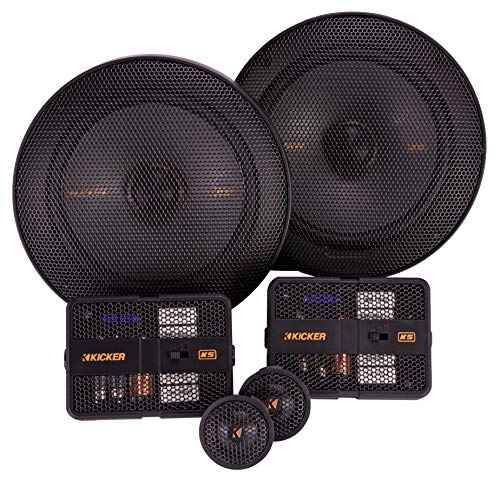
Kicker KSS6504 — Best component set for tricky installs
Every component set promises great sound; the KSS6504’s distinguishing work happens before a note plays, in the mounting hardware. Kicker supplies the KS tweeters with a kit of housings that lets the same tweeter flush-mount into a factory pod, surface-mount on a sail panel, or sit in an angled pod aimed at the listener — and it can even be mounted coaxially in the centre of the woofer if a particular car defeats every other plan. Anyone who has opened a door card to discover the factory tweeter location is the wrong size, the wrong angle or simply absent will understand why this flexibility is a feature worth ranking. The crossover network is compact, and the woofers use a polypropylene cone with a rubber surround built for door life.
Sonically the KS set plays to Kicker’s strengths: a solid, punchy midbass foundation and a tweeter with enough presence to hold vocals clear over road noise, voiced a notch more forward than the Focal but short of the glare that makes long trips tiring. It is a set that flatters the music most people actually play in cars — rock, hip-hop, podcasts with music beds — and its efficiency is respectable on factory power while its power handling welcomes an amplifier later. Choose it when the install itself is the risk in your project; the sound will take care of itself.
- Type: component set with 6.5-inch woofers, 4-ohm
- Tweeter: 1-inch, multiple mounting housings including angled and coaxial options
- Woofer: polypropylene cone, rubber surround
- Crossovers: compact in-line style networks, easy to conceal
Strengths
- Tweeter mounting kit solves awkward factory layouts
- Punchy midbass suits mainstream music at road speed
- Works acceptably on factory power, better with an amplifier
Trade-offs
- Presentation is more forward than the Focal’s calm balance
- Coaxial fallback mounting wastes the component advantage if overused
- Grille and trim choices in some cars still need improvisation
Best for: cars with difficult or missing factory tweeter locations, and first-time component installers. Not suited for: purists chasing the flattest, most neutral balance available.
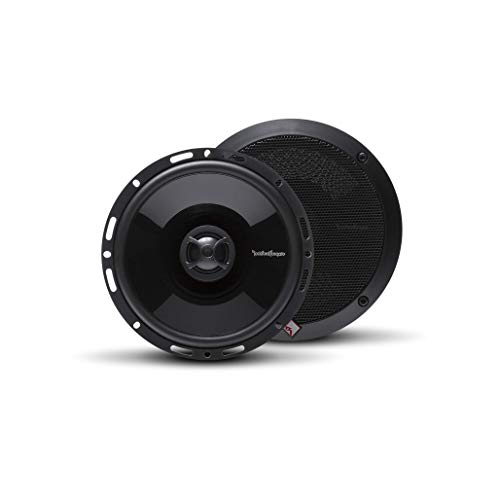
Rockford Fosgate P1650 — Best durable coaxial workhorse
The P1650 has been in Rockford Fosgate’s Punch line for years, and longevity in car audio usually means one of two things: a speaker is fashionable, or it simply refuses to generate returns and complaints. The P1650 is the second kind. Its recipe is conservative — a mineral-filled polypropylene cone, a soft dome tweeter on a post, a basket and motor sized for reliability rather than spec-sheet theatre — and the result is a coaxial that installers reach for when the brief is to fix a car’s sound once and not see the car again. It plays cleanly from factory power, takes an amplifier without complaint, and its voicing, a mild lift in the presence region, is well judged for cutting through tyre roar without turning sharp.
Within this guide the P1650 is the reference point for what a mainstream coaxial should be, which also defines its limits. It will not raise the soundstage — no coaxial can — and it will not match the Kappa’s midrange resolution or the component sets’ imaging. What it offers instead is the highest ratio of improvement to effort on the page: out with the worn factory speakers, in with the P1650s on the factory wiring, and an ordinary car sounds like itself on a good day. For second cars, work trucks, family hand-me-downs and any vehicle whose owner values done over perfect, that is the correct recommendation, and it is why this unglamorous speaker keeps its slot against newer rivals.
- Design: full-range coaxial pair in the 6.5-inch size
- Cone: mineral-filled polypropylene (injection moulded)
- Tweeter: soft dome, integrated on the woofer axis
- Role: long-running Punch-series design with broad fitment
Strengths
- Proven durability across years of production and installs
- Voicing cuts through road noise without harshness
- Performs well on factory wiring with no other changes
Trade-offs
- Soundstage stays low, as with every coaxial
- Resolution trails the Kappa and the component sets
- Design is evolutionary; nothing here is novel
Best for: straightforward factory replacements where reliability and easy improvement matter most. Not suited for: imaging-focused builds, which need tweeters up high.

Polk DB652 — Best for wet doors and open cars
Every car door is a marine environment that nobody certified. Rain runs down the inside of the window glass, past seals that were never perfect and get worse with age, and drips through the door cavity where the speaker lives. Paper and treated-paper cones absorb that moisture over years, soften, and eventually tear — which is why so many factory speakers die from the bottom edge up. Polk’s DB652 answers with a certification most car speakers never attempt: it is marine rated, with a polypropylene cone, a rubber surround that will not rot, stainless mounting hardware and a design tested against water and salt exposure for boats. Bolted into a car door, that specification reads as simple longevity.
The DB652 is not a compromise you accept for the waterproofing. Its silk dome tweeter is one of the sweeter units at this level, the bass is fuller than its modest motor suggests, and the whole speaker has a relaxed competence that suits convertibles, Jeeps, older cars with perished window seals and anything that lives outside in a wet climate. Boats and off-road vehicles are its marketed home, but the sleeper application is the fifteen-year-old daily driver whose doors have been quietly raining inside since the warranty expired. If your old speakers came out with tide marks on them, this is your pick, and it sounds good enough that dry-door owners choose it on merit too.
- Build: marine-certified coaxial pair, 6.5-inch
- Cone: polypropylene with rubber surround
- Tweeter: 3/4-inch silk dome
- Hardware: water- and corrosion-resistant construction throughout
Strengths
- Genuine marine rating ends moisture-related cone failure
- Sweet, easy treble from the silk dome tweeter
- Equally at home in boats, convertibles and ageing cars
Trade-offs
- Absolute detail trails the Kappa coaxial
- Marine hardware is wasted money in a dry, garaged car
- Voicing is relaxed; listeners wanting bite may prefer JBL
Best for: convertibles, off-road vehicles, boats and older cars with wet door cavities. Not suited for: show builds chasing maximum resolution per door.
How Do the Six 6.5 Speakers Compare Side by Side?
| Pick | Format | Power it suits | Defining trait |
|---|---|---|---|
| Infinity Kappa 63XF | Coaxial | Amplifier, now or later | Glass-fibre clarity |
| Focal ASE 165 | Component | Factory, better amplified | Calm, even balance |
| JBL Club 64C | Component | Factory head unit | 3-ohm efficiency |
| Kicker KSS6504 | Component | Factory or amplifier | Mounting flexibility |
| Rockford Fosgate P1650 | Coaxial | Factory head unit | Proven durability |
| Polk DB652 | Coaxial, marine | Factory or amplifier | Water resistance |
Read the table by job rather than by brand. If the car keeps factory power and the owner wants the raised soundstage, the Club 64C is the engineered answer. If the car will be amplified, the Kappa and Focal divide the field by taste — resolution and adjustability against balance and calm. The KSS6504 is the problem-solver’s set, the P1650 the set-and-forget coaxial, and the DB652 the insurance policy for any door that gets wet inside, which on a long enough timeline is most of them.
How Should You Set the Head Unit After the Swap?
The settings that flattered worn factory speakers will sabotage new ones, so the last step of the install happens on the touchscreen, not in the door. Start by flattening everything: tone controls centred, loudness off, any sound-enhancement or surround processing disabled, and the fader and balance returned to the middle. Factory systems often ship with a bass boost and a loudness contour engaged to make weak paper cones sound fuller at low volume; fed into capable speakers, those same settings produce boom at one end and glare at the other, and owners who skip this reset routinely conclude that their new speakers are worse than the old ones when the opposite is true.
From that flat baseline, adjust in small steps over days rather than minutes. Most systems need nothing more than a gentle treble trim to taste — down a notch for the forward JBL and Kicker voicings in a hard, glassy cabin, up a notch for the relaxed Polk in a soft-trimmed one — and a bass setting left alone once the doors are sealed, because door speakers asked to produce deep bass only distort sooner. If the head unit offers a high-pass filter, setting one in the region where door speakers naturally roll off cleans the midrange audibly by relieving the cones of travel they were wasting. Resist re-engaging loudness for quiet listening; at low volume a small volume-independent bass-and-treble lift is what loudness is for, but on most factory units its curve is crude enough to undo the balance you just bought. Live with the flat-plus-trim result for a week of real driving before judging the upgrade finished.
How Do You Fit 6.5 Speakers Without Creating Rattles?
More upgrades are ruined by installation than by speaker choice. Begin by confirming the car truly takes a 6.5: many vehicles listed as 6.5 actually use a 6.75 oversize basket or a shaped factory pod, and an adapter bracket is the difference between a solid mount and a speaker hanging from two screws. While the door card is off, add a small amount of sound deadening on the outer skin behind the speaker and seal the speaker to its mounting surface with foam tape; a door’s factory holes leak air, and sealing the front of the cone from the back of it recovers bass that owners otherwise blame the speaker for lacking. Check window clearance by lowering the glass fully before the card goes back on, route wires away from the regulator, and use a wiring harness adapter rather than cutting factory plugs, so the job can be undone and nothing corrodes at a twisted joint.
Set expectations for the first week. New surrounds are stiff, and most of these speakers loosen noticeably over their first hours of playing, gaining a little low-end ease. Judge the upgrade after that settling period, at your normal listening volume, on a road you know — not in a quiet driveway in the first five minutes, where every new speaker sounds impressive and none of them sound like they will at speed.
Where Should the Rest of the Budget Go?
A speaker budget rarely exists alone, and the order in which the surrounding money is spent decides how much of the speakers’ ability ever reaches your ears. The highest-value companion purchase is door treatment: a modest quantity of butyl deadening mat on the outer door skin and a foam sealing kit typically costs less than the step from one pick in this guide to the next, and it buys bass definition and quiet that no speaker tier can supply on its own, because it repairs the enclosure rather than the driver. Second in value is the wiring and mounting hardware — proper adapter brackets, harness plugs and foam gaskets — which looks unglamorous in a basket and determines whether the install is solid or a rattling compromise you will reopen within a month.
An amplifier is the third spend, and its timing depends on the pick. Buyers of the JBL Club 64C or the Rockford P1650 can defer it indefinitely; the speakers were chosen to complete the job without one. Buyers of the Kappa 63XF should treat the amplifier as a scheduled second act rather than an optional extra, because a meaningful share of what they paid for only wakes up with current behind it. What should never absorb the budget is a head-unit swap bought purely for power: modern factory systems are entangled with the car’s controls, cameras and alerts, and the sensible modern route is to keep the factory source, take its signal properly, and let speakers and, if needed, a compact amplifier do the audible work. Spend on the room, the mount and the drivers, in that order of value, and a 6.5 upgrade stops being a gamble.
When Is a 6.5 the Wrong Answer Entirely?
Honesty about the format’s ceiling saves money. A 6.5 in a door, however good, will not reproduce the bottom octave of music with authority; physics gives it a small cone in a leaky box, and the picks here are chosen for punch and clarity in the midbass, not for sub-bass. Systems whose owners listen to bass-led music at volume need a subwoofer, after which the door speakers’ job gets easier and several cheaper picks become viable because they no longer strain at frequencies they cannot reach. At the other extreme, owners of cars with factory premium systems — Bose, Harman Kardon and their rivals — should pause before ordering anything in this guide: those systems often use low-impedance speakers, dedicated amplification and equalisation tuned to the factory drivers, and a like-for-like swap can sound worse until the whole chain is reconsidered. The 6.5 swap is the right answer for the mainstream case — a standard factory system, worn or underwhelming speakers, an owner who wants the car to sound like music again — and this guide’s six picks divide that mainstream case between them without remainder.
What Mistakes Do 6.5 Buyers Keep Making?
The classic error is buying by peak power numbers, which are marketing arithmetic rather than engineering, and ignoring sensitivity, which decides how the speaker behaves on the power actually available. Second is fitting component tweeters in the door beside the woofer because it is easier, discarding the imaging that justified components in the first place. Third is leaving the factory head unit’s loudness and bass-boost settings engaged after the upgrade, so the new speakers are fed a distorted, overcooked signal and judged for the head unit’s sins. Fourth is mixing families randomly between front and rear doors, which smears the tonal balance; the rear doors matter less, but they should not fight the fronts. Finally, owners chase door bass with ever-heavier 6.5s when the honest answer below the lowest notes is a small subwoofer — door speakers should be chosen for clarity and midbass punch, and asked to do nothing more.
How Do These Speakers Age Over Five Years in a Door?
Car speakers rarely die dramatically; they fade. The surround is the first casualty — foam surrounds crumble, and even rubber ones stiffen and micro-crack after years of heat cycles in a door that bakes in summer sun and freezes overnight in winter. Every pick in this guide uses a rubber or butyl surround rather than foam, which is a deliberate selection criterion, because a speaker whose surround fails in year four was never the bargain its price suggested. The second slow failure is corrosion: terminals, tinsel leads and crossover components live in the damp air of the door cavity, and plated hardware and sealed construction, the Polk’s marine brief most obviously, postpone the crackles and intermittent dropouts that owners misdiagnose as head-unit faults.
Voicing, too, drifts as a speaker ages. A stiff new surround loosens over the first weeks — the break-in that owners notice as the bass arriving — and then the suspension continues to soften almost imperceptibly for years, which is why a five-year-old set can sound warmer and looser than the same model new. None of that is a defect; it is the physics of moving parts, and it argues for buying the speaker whose new sound sits a fraction brighter or tighter than your ideal, since time will relax it toward you. It also argues for doing both front doors at once and, when a single speaker fails years later, replacing the pair: a new driver beside a softened veteran will pull the stereo image sideways in a way no balance control fully repairs.
Final Recommendation
Decide the job first and the shortlist writes itself. Amplified or heading there: the Kappa 63XF for coaxial clarity, the Focal ASE 165 for component composure. Staying on factory power: the JBL Club 64C if you want the component image, the Rockford P1650 if you want the job done by lunch. Awkward car: the Kicker KSS6504. Wet car: the Polk DB652, without a second thought. Whichever pair lands in your doors, fit them carefully, seal them properly, and give them a week before you judge them — because a well-chosen 6.5, honestly installed, is the point where a car stops sounding like an appliance and starts sounding like somewhere you want to spend the journey.
Frequently Asked Questions
Will any 6.5 speaker fit any car listed as taking 6.5 speakers?
Not quite. The diameter is standardised loosely, but basket shape, mounting-hole pattern and depth vary, and some cars use oversize 6.75 openings or integrated factory pods. An adapter bracket solves most mismatches cheaply; the dimension to verify before ordering is mounting depth against window travel.
Do component speakers always sound better than coaxials?
They image better, because the tweeter sits near ear level, and that advantage is real. But a good coaxial on a well-sealed mount beats a component set with its tweeters badly placed, and in cars with no sensible tweeter location the coaxial’s simplicity can be the smarter spend.
Can I run these speakers from a factory head unit?
Yes — the JBL Club 64C, Rockford P1650 and Polk DB652 are all chosen with factory power in mind. The Kappa and Focal will also play from a head unit, but both were selected for what they become when an amplifier is added later.
Why do my new speakers have less bass than expected?
Usually the mount, not the speaker. Air leaking around the basket or through the door’s access holes cancels low frequencies. Foam sealing tape, a rigid adapter and a modest amount of deadening behind the speaker recover most of what owners think the speaker failed to deliver.
Should the front and rear doors use the same speakers?
Ideally the front stage gets the better set, since that is where the listeners and the image are. Repeating the same family in the rear keeps tonal balance coherent; a cheaper coaxial from the same brand is a reasonable economy for rear fill.
How long should a decent set of door speakers last?
With rubber surrounds and synthetic cones, a decade of service is a fair expectation in a dry door. Foam surrounds and paper cones shorten that considerably in wet doors, which is precisely the failure the marine-rated DB652 is built to avoid.
Is it worth upgrading only the front doors?
Yes — it is the standard recommendation for a limited budget. The front stage carries the image and the detail for the people up front, and a good front pair with the factory rears faded slightly down will outperform a mediocre set spread across all four doors. Add the matching rear pair later when funds allow, choosing the same family so the tonal balance stays coherent.
Related Guides
Keep exploring the 6.5 family with Best 6.5 Inch Car Speakers for a Real Factory Upgrade, then look at the no-amplifier component route in Best 6.5 Component Speakers That Run Well Without an Amp, and if your factory speakers are failing rather than merely disappointing, start with Best 6.5 Replacement Speakers for Worn Factory Doors.


