What's inside
- Key Takeaways
- Quick Picks
- How We Chose These Picks
- Why Do Most Component Sets Sound Weak Without an Amplifier?
- How Should You Read Sensitivity and Impedance for This Job?
- Where Do the Tweeters Go When the Car Has None?
- How Much Headroom Does a Head Unit Really Have?
- Why Does Crossover Design Matter More at Low Power?
- What Should Happen to the Rear Speakers in a No-Amp Component Build?
- Which No-Amp Component Sets Deserve Your Doors?
- How Do the Six No-Amp Component Sets Compare Side by Side?
- How Should You Set the Head Unit for a No-Amp Component System?
- How Do You Wire a Component Set From Factory Wiring?
- How Do You Troubleshoot a Finished Install That Disappoints?
- When Does No-Amp Stop Being Enough?
- What Mistakes Do No-Amp Component Buyers Keep Making?
- Components Without an Amp, or Coaxials? The Honest Comparison
- Final Recommendation
- Frequently Asked Questions
- Related Guides
As an Amazon Associate I earn from qualifying purchases. This post may contain affiliate links at no extra cost to you.
widgetverdict.com is reader-supported. When you buy through links on our site, we may earn an affiliate commission.
Where to buy: All six component sets below link to their Amazon listings. Every one was screened against a single hard test — it must sound complete, balanced and loud enough fed only by a factory head unit — because a set that needs an amplifier to wake up has no business in this particular guide, however good it may be elsewhere.
Component speakers have a reputation problem, and it is mostly deserved: the format is associated with amplifiers, sound processors and weekends of installation, so owners who simply want better sound from the stereo they already own assume the whole category is not for them. That assumption used to be safe. Many component sets are indeed voiced and built on the assumption of real amplifier power, with heavy cones and modest sensitivity that leave them sounding starved and dull behind a head unit. But a distinct minority of sets are engineered the other way — light, efficient drivers, crossovers that do not waste power, impedances chosen to draw more current from small amplifiers — and those sets deliver the component format’s one great prize, a soundstage lifted to the windscreen, on nothing more than factory power. Finding the best 6.5 component speakers without amp is a matter of separating that minority from the rest of the catalogue, and it is the only job this guide does.
The physics of the problem is worth stating plainly, because it explains every pick below. A factory head unit delivers a small amount of clean power — far less than its marketing suggests — and it distorts when asked for more. A speaker converts that power into sound with an efficiency described by its sensitivity rating, and a few decibels of sensitivity are worth more to a head-unit system than any other specification on the box, because they move the whole performance up the dial before distortion begins. Add a low-impedance design, which draws more current from the same amplifier, and a crossover that keeps its losses small, and a component set can play at genuine road volume from a source that looks hopeless on paper. The six sets here each solve that equation by a different route.
One clarification before the picks, because the terminology misleads many buyers: running without an amp means without an aftermarket amplifier. Every system has amplification somewhere — inside the head unit, or in a separate factory amplifier module in many mid-trim cars — and this guide’s sets are chosen for those built-in sources, whichever box they live in. If your car has a factory amplifier, the same sensitivity logic applies, with one addition: check its rated load, because factory amplifiers are the one place where a low-impedance set deserves a genuinely careful look rather than a routine one. The advice throughout assumes the common case, a head unit driving the doors directly, and flags the exceptions where they matter.
Key Takeaways
- The deciding specification for a no-amplifier component set is sensitivity, followed by impedance — not power handling, which describes a future the system will never have.
- Hertz’s K 165 Uno is the efficiency champion of the group, with a sensitivity figure in the low nineties that makes factory power feel twice its size.
- JBL’s Club 602C uses a 3-ohm design to draw extra current from the head unit, the other proven route to loudness without an amplifier.
- Rockford’s P165-SI hides its crossover inside the tweeter assembly, cutting install work — valuable when the whole point is a simple system.
- Focal’s ASE 165 is the calm, refined choice that still behaves on factory power, for listeners who fear efficient speakers will sound brash.
- Kicker’s KSS6504 brings the most forgiving tweeter mounting kit, and Rockford’s P165-SE adds an external crossover with tweeter level control for owners who want to tune the balance.
Quick Picks
| Pick | Badge | Why it earns its place |
|---|---|---|
| Rockford Fosgate P165-SI | Best install-friendly no-amp set | An integrated concealed crossover removes the hardest part of a component install. |
| JBL Club 602C | Best low-impedance loudness | A 3-ohm component set that pulls more from a factory head unit by design. |
| Hertz K 165 Uno | Best sensitivity in the group | Efficiency in the low nineties makes small factory power sound generous. |
| Focal ASE 165 | Best refined no-amp balance | Focal composure that remains present and detailed at head-unit volumes. |
| Kicker KSS6504 | Best for awkward tweeter locations | A mounting kit that solves cars with no sensible factory tweeter spot. |
| Rockford Fosgate P165-SE | Best adjustable no-amp set | An external crossover with tweeter level adjustment for fine-tuning. |
How We Chose These Picks
The screening began with published sensitivity and impedance, treated sceptically: sensitivity figures are not measured identically across brands, so we used them as a coarse filter and leaned on each design’s architecture — cone weight, motor design, crossover type — to judge which sets would genuinely wake up on a handful of watts. Sets known to need power were excluded even when their amplified reputation is excellent, because recommending them here would betray the brief. We also weighted crossover design heavily, for a reason specific to this guide: a passive crossover consumes a little of the power passing through it, and on a system with power to spare that loss is invisible, but on head-unit power every fraction matters, so compact, efficient networks scored well.
Install burden was the second screen, and it is not a soft criterion. The owner who refuses an amplifier is usually also refusing a major build, so sets that simplify the tweeter and crossover work — integrated crossovers, in-line networks, generous mounting hardware — earned their places partly on that mercy. Finally, each set had to leave the door open to an amplifier later without embarrassment: tastes change, budgets recover, and a no-amp purchase should be a first stage, not a dead end. All six qualify, though they divide on how much they gain when power eventually arrives.
Why Do Most Component Sets Sound Weak Without an Amplifier?
Three reasons, working together. The first is sensitivity: many component woofers use heavier cones and stronger motors built to handle amplifier power and produce deep bass, and mass is the enemy of efficiency, so at head-unit levels they simply move less air per watt. The second is the crossover. A component set’s passive network sits between the amplifier and the drivers, and its inductors and capacitors absorb a share of the small power available, particularly in elaborate networks with steep slopes; a coaxial’s single capacitor, by contrast, wastes almost nothing, which is one reason cheap coaxials often sound louder than expensive components on the same head unit. The third is voicing intent: sets designed for amplified systems are often tuned flat or gentle in the presence region, expecting the system’s power and processing to supply the excitement, and behind a weak source that restraint reads as dullness.
None of these are flaws in the sets themselves; they are mismatches between a design brief and a power supply. The sets in this guide avoid the trap by attacking at least one of the three causes head-on — very light, efficient cones in the Hertz; low impedance in the JBL; simple, low-loss crossovers in the Rockford P165-SI; and in the Focal and Kicker, a balance of moderate sensitivity with voicing that stays alive at low level. Understanding which cause a given set addresses tells you how it will behave in your car better than any star rating, which is why each analysis below names the mechanism rather than merely praising the volume.
How Should You Read Sensitivity and Impedance for This Job?
Sensitivity is quoted in decibels for a standard input, but the standard hides a trap: some brands measure at one watt, others at 2.83 volts, and 2.83 volts into a low-impedance speaker is more than one watt, so the low-impedance speaker’s figure is flattered by the method. Compare within a brand freely; compare across brands with a grain of salt, and treat a difference of a decibel as noise while a difference of three or more is a genuine, audible step — roughly the loudness change owners describe as clearly louder without being dramatic. For a head-unit system, the practical threshold is a set that stays composed and complete at the volume position where you actually drive, and sensitivity is the best available predictor of that before you buy.
Impedance is the second lever. A nominal 3-ohm set draws roughly a third more current than a 4-ohm set from the same amplifier voltage, converting directly into output, which is why JBL and others build head-unit-friendly lines at lower impedance. Modern head units tolerate this comfortably in normal use; the cautions are narrow ones — very old units, a few factory amplifiers with protection tuned tightly, and systems where speakers share channels in unusual factory wiring. Check the impedance printed on your factory woofer when the door is open: if the factory fitted 2- or 3-ohm drivers, a low-impedance replacement is not merely safe but correct. If the factory fitted 4 ohms, a 3-ohm set remains a modest, widely used step rather than a gamble.
Where Do the Tweeters Go When the Car Has None?
The component format’s benefit lives or dies at the tweeter, and cars without a factory tweeter location force a choice among three imperfect homes. The sail panel — the small triangle at the front of the window frame, opposite the mirror — is the classic answer: it is high, forward, angled roughly toward the listeners, and usually hollow enough to accept a flush-mount cup with a single hole. The A-pillar offers similar height with more aiming freedom, at the cost of working near airbag hardware in many modern cars, a job that demands the battery disconnected and genuine care. The dash corner, using a surface or angled pod, is the least invasive and often surprisingly effective, because the windscreen’s reflection reinforces the image, though it leaves the tweeter visible and vulnerable to sun.
What unites the good solutions is aim and symmetry: both tweeters at the same height, angled toward the opposite listener’s shoulder or the centre of the cabin in the usual cross-aiming arrangement, and fixed firmly enough not to buzz. What ruins the format is the lazy fourth option — tweeters mounted low in the door beside the woofer for convenience, which reproduces a coaxial’s geometry at component prices. Every set in this guide includes at least two mounting styles in the box, and the Kicker’s kit is the most complete, which is why it is recommended precisely for cars where the tweeter’s home is undecided. Decide the location before ordering if you can; it determines which set’s hardware serves you best.
How Much Headroom Does a Head Unit Really Have?
Headroom is the distance between the loudest clean moment in the music and the loudest sound the system can produce, and it is the resource a no-amplifier system is shortest of. Music is not a steady tone: a vocal sits at an average level, and the drum hits and crescendos above it demand brief bursts of power many times greater. A head unit cruising at half its clean output handles those bursts gracefully; the same unit pushed near its ceiling clips them, and clipping is audible as a hardening and flattening that listeners blame on speakers. This is the mechanism behind the most common no-amp complaint — that the system sounds fine at moderate volume and falls apart exactly when the favourite chorus arrives.
Efficient speakers defend headroom from the other side. If a set produces your cruising volume several steps lower on the dial, the bursts above that volume fit beneath the ceiling again, and the system sounds not just louder but calmer, because the amplifier has stopped struggling. That calm is the real product this guide is selling, and it explains why sensitivity differences that look trivial on a specification table feel disproportionate in the car. It also explains the limit of the whole approach: a listener whose cruising volume is itself at the ceiling — loud music, loud car, long motorway — has no headroom to defend, and for that listener the honest recommendation is an amplifier first and components second, whatever any speaker guide says.
Why Does Crossover Design Matter More at Low Power?
A passive crossover is a small electrical machine for dividing frequencies, and like every machine it has losses. Inductors have resistance; capacitors in the signal path absorb a little energy; elaborate networks with steep slopes and impedance correction use more parts and lose more. Behind a healthy amplifier those losses are a rounding error, repaid instantly by turning the volume a fraction. Behind a head unit they are a tax on the scarcest resource in the system, which is why the architecture of each set’s network is named in the analyses below rather than treated as packaging. The P165-SI’s integrated network and the Hertz’s simple filter are not cost-cutting confessions; at this power level they are efficiency features.
There is a second, subtler crossover effect at low power: level matching. The tweeter in a component set is almost always more efficient than the woofer, so the network pads it down to balance — energy deliberately discarded as heat in a resistor. Sets that manage this padding elegantly, or give the owner a switch as the P165-SE does, waste less of the system’s small budget than sets with clumsy fixed networks. None of this makes complex crossovers bad in themselves; in an amplified system they buy control that is worth every lost fraction of a watt. It makes them a considered choice rather than a default, and in a no-amp build the burden of proof sits on every extra component in the box.
What Should Happen to the Rear Speakers in a No-Amp Component Build?
Upgrading the front stage to components while the factory rears remain creates a system with two accents, and the management of that mismatch decides whether the finished car sounds coherent. The rear speakers in most listening should be felt rather than heard — a low level of fill that gives the cabin depth without pulling the image backwards — so the first move costs nothing: fade the system forward until the rears are a presence rather than a location. Factory coaxials, for all their faults, are adequate in that supporting role for a long time, and their dullness is nearly a virtue at fill levels.
When the rears are replaced, the sensible purchase is a coaxial from the same family as the front components, run at the same modest level; matching the family’s voicing matters more than matching its price. What the no-amp brief forbids is the ambitious rear upgrade — heavy, inefficient speakers in the back doors sharing the head unit’s small output with the new front stage. Every watt the rears consume is taken from the fronts that carry the music, and in a system defined by scarce power, the hierarchy should be explicit: the front components are the system, and everything else is garnish. Owners who regularly carry rear passengers can revisit that hierarchy with clear eyes, but they should know they are spending the front stage’s headroom to do it.
Which No-Amp Component Sets Deserve Your Doors?

Rockford Fosgate P165-SI — Best install-friendly no-amp set
The P165-SI’s defining idea is subtraction: its crossover is integrated and concealed within the tweeter assembly, so the component install loses its most fiddly element. There is no separate crossover box to mount inside the door, no second run of wire to route and secure — the woofer connects, the tweeter connects, and the network that divides them lives invisibly in the tweeter’s housing. For the owner whose refusal of an amplifier is really a refusal of complexity, that design decision matters as much as any specification, because the gap between a finished install and an abandoned one is usually measured in small frustrations rather than large ones.
The sound suits the brief honestly. The Punch woofer gives a full, warm midbass account that flatters head-unit power, and the 1-inch tweeter has the presence to lift the image to the pillars where it belongs. Sensitivity is respectable rather than class-leading, so in a loud car at motorway speed the Hertz and JBL sets will play a step cleaner at the top of the head unit’s range; around town and at ordinary volumes the difference disappears and the Rockford’s warmth is arguably the friendlier listen. Choose the P165-SI when you want the component soundstage with the least possible installation theatre — it is the set most likely to be finished on the Saturday it was started.
- Architecture: Punch component system, 6.5-inch woofer plus 1-inch tweeter
- Crossover: integrated and concealed in the tweeter assembly
- Grilles: included for the midrange drivers
- Character: warm, full voicing that flatters low power
Strengths
- Integrated crossover removes the hardest install step
- Warm midbass suits factory head units and their voicings
- Tweeter lift transforms the image with minimal wiring
Trade-offs
- No tweeter level adjustment — the balance is fixed
- Ultimate clean volume trails the most sensitive sets
- Concealed crossover cannot be upgraded or repositioned
Best for: first-time component installers who want the simplest path to a raised soundstage. Not suited for: owners who like to tune tweeter level to taste.

JBL Club 602C — Best low-impedance loudness
The Club 602C attacks the no-amplifier problem electrically. Built at 3 ohms where most component sets are 4, it draws meaningfully more current from a factory head unit, and JBL pairs that load with an efficient design so the extra current becomes sound rather than heat. The result is the component set for owners whose head unit feels genuinely feeble — the ones who already drive with the volume near the top of its clean range and hear the sound thin out there. In such a car the 602C does not merely sound better than the factory speakers; it sounds like a slightly bigger stereo was fitted while nobody was looking, with the component tweeter placement adding the image on top of the volume.
Its woofer uses JBL’s Plus One cone architecture to recover bass area that efficiency usually costs, and the edge-driven silk dome tweeter keeps the lively JBL top end civilised. Owners should know the Club 602C differs from the Club 64C in the general 6.5 guide: the 602C is the earlier Club component design, warmer in the midrange and a fraction less extended on top, which in a no-amp context is no hardship — the midrange is where head-unit systems live. Run the standard impedance check on elderly factory amplifiers, keep the crossovers tucked clear of the window’s path, and this is the set that most convincingly disproves the idea that components need an amplifier to justify themselves.
- Architecture: Club component system, 6.5-inch
- Impedance: 3 ohms, aimed at factory head units
- Woofer: Plus One polypropylene cone
- Tweeter: edge-driven silk dome
Strengths
- Low impedance extracts real extra output from head units
- Warm, full midrange where low-power systems need it
- Silk tweeter stays composed at high volume positions
Trade-offs
- 3-ohm load warrants a check on older factory amplifiers
- Top end is smooth rather than sparkling
- External crossovers still need a home in the door
Best for: cars with notably weak factory stereos and owners who listen loud. Not suited for: very old or unusual factory amplifiers that dislike low loads.

Hertz K 165 Uno — Best sensitivity in the group
The K 165 Uno carries the most persuasive single number in this guide: a sensitivity figure in the low nineties, achieved the honest way, with a light cone and an efficient motor from a brand whose competition heritage is built on getting loud from limited power. Hertz’s Uno line is the company’s entry range, but the engineering priorities are exactly right for this brief — a water-repellent treated paper cone that stays light, a compact neodymium tweeter with a PEI dome, and a simple included filter network that wastes little of the head unit’s output. On factory power the K 165 does not sound like a compromise being managed; it sounds awake, immediate and present in a way that makes rival sets at the same volume position seem to be playing from the next room.
That efficiency shapes the whole character. Because the set reaches road volume low on the dial, the head unit stays in its clean zone, so clarity at speed is the Hertz’s real party trick — podcasts intelligible on the motorway, lyrics followable without leaning on the volume. The balance is lively in the upper midrange, which talk and acoustic music love, though long sessions of brightly recorded pop may want a gentle treble trim. Bass is quick and articulate rather than deep, the inevitable tax on a light cone, and owners chasing door bass should look elsewhere in this guide. As a demonstration that sensitivity is a specification with consequences, nothing else here argues the case as well.
- Architecture: Uno component system, 6.5-inch
- Sensitivity: in the low nineties — the group’s efficiency benchmark
- Woofer: water-repellent treated cone, light and fast
- Tweeter: PEI dome with neodymium motor, filter included
Strengths
- Plays clearly at volume positions rivals cannot reach
- Keeps the head unit in its clean, undistorted zone
- Speech and acoustic detail are outstanding for the class
Trade-offs
- Bass weight is sacrificed to efficiency
- Lively presence can want a treble trim on bright recordings
- Entry-line cosmetics are plain beside the Focal
Best for: quiet-power cars, talk and acoustic listening, and anyone whose head unit distorts early. Not suited for: bass-led listening from the doors alone.

Focal ASE 165 — Best refined no-amp balance
Judged purely as a no-amplifier tool, the ASE 165 makes a subtler argument than the Hertz or JBL: that what head-unit listeners actually suffer from is not only low volume but poor balance at low volume. Human hearing at modest levels perceives less bass and treble relative to the midrange, so a set voiced dead flat sounds thin and dull in a quiet car at town speeds — precisely the conditions where no-amp systems spend their lives. Focal’s Auditor voicing, with its even, slightly warm balance and an inverted-dome tweeter that disperses widely, keeps music coherent and voices natural at those levels instead of merely at full chat. It will not win a loudness contest against the Hertz; it wins the evening drive, the podcast at moderate volume, the jazz record that efficient shouty sets turn into a presentation.
Its sensitivity is adequate rather than exceptional, so the honest boundary is this: in a quiet, well-sealed car the ASE 165 on factory power is a complete answer, while in a loud car driven at motorway volume daily, the head unit will run out of clean output sooner than it would with the Hertz, and the Focal’s refinement will be spent fighting noise. Owners should also know it is the set here that gains most if an amplifier ever does arrive, its composure simply scaling with power. Buy it when your listening is varied, your car is reasonably civilised and your taste runs to balance over impact — the no-amp brief does not oblige anyone to buy a loudspeaker that shouts.
- Architecture: Auditor EVO component system, 6.5-inch
- Woofer: polypropylene cone, butyl surround
- Tweeter: inverted dome, wide dispersion for off-axis seats
- Character: even balance that stays coherent at low volume
Strengths
- Most natural voices and acoustic balance in the group
- Wide tweeter dispersion suits both front seats equally
- Scales gracefully if an amplifier is added later
Trade-offs
- Sensitivity is mid-pack; loud cars may outrun it
- Least overtly exciting set here on first listen
- Bass is accurate rather than generous
Best for: refined, varied listening in reasonably quiet cars. Not suited for: noisy cars where clean volume is the first requirement.
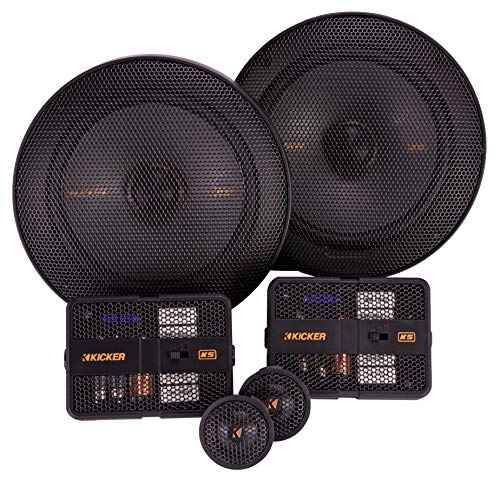
Kicker KSS6504 — Best for awkward tweeter locations
In a no-amplifier build, the installation is the project — there is no rack of electronics to occupy the weekend — so the KSS6504’s contribution here is measured in problems removed. Its tweeter arrives with housings for flush mounting, surface mounting and angled pods, and can even sit in the woofer’s centre as a convertible arrangement while a better location is prepared, which means the set can be fitted, listened to and finalised in stages rather than demanding every decision up front. For cars with no factory tweeter location, that flexibility is the difference between a component upgrade that happens and one that stays in its box while the owner researches sail panels.
On the electrical side the KS set is efficient enough to be convincing on factory power, with a forward, energetic voicing that holds vocals clear at road speed, and its midbass has the punch Kicker builds its name on. Against the Focal it trades polish for presence; against the Hertz it trades ultimate sensitivity for a fuller low end. The convertible tweeter option deserves one warning in this guide’s context: used permanently, it gives away the raised soundstage that is the entire reason to buy components without an amp, so treat it as scaffolding, not the building. Plan the tweeter’s final home on a sail panel or dash corner, and the KSS6504 becomes the most adaptable route to it in the group.
- Architecture: KS component system, 6.5-inch, 4-ohm
- Tweeter: 1-inch, with flush, surface and angled housings
- Convertible option: tweeter can mount within the woofer temporarily
- Voicing: energetic, with Kicker’s characteristic midbass punch
Strengths
- Mounting kit fits cars with no tweeter provision at all
- Staged install possible — fit now, finalise placement later
- Punchy, clear presentation on factory power
Trade-offs
- Convertible mounting tempts owners to skip the real benefit
- Less refined than the Focal at low volume
- Midbass punch can overwhelm small, lively cabins
Best for: cars without factory tweeter locations and first-time component fitters. Not suited for: listeners who prize calm, flat balance above presence.
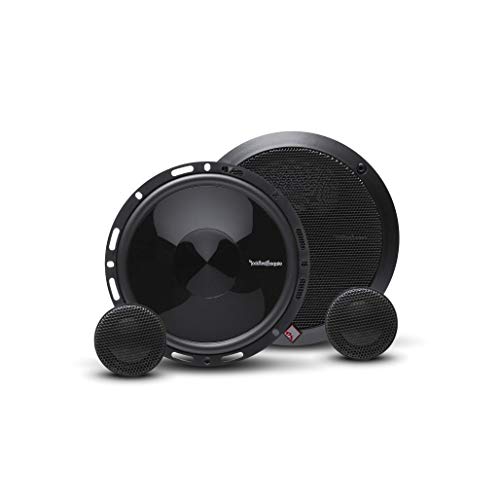
Rockford Fosgate P165-SE — Best adjustable no-amp set
The P165-SE is the P165-SI’s more deliberate sibling: where the SI hides its crossover to save effort, the SE provides a proper external network with a tweeter level adjustment, and in a no-amplifier system that single control earns its keep. Head-unit systems cannot be re-tuned with a processor, and the factory equaliser’s coarse tone controls are a blunt instrument, so a hardware switch that trims the tweeter by a step is often the only precise balance tool the owner will ever have. Cars with reflective glass-heavy cabins take the lower setting; soft, carpeted interiors take the higher one; and the set stops being a fixed opinion and becomes a small range of answers.
That adjustability costs the install effort the SI saves — the crossover boxes need mounting inside the door, secured against vibration and clear of the window mechanism — and buyers should weigh the trade honestly rather than assuming more hardware is automatically better. Sonically the SE shares the Punch family’s warm, full foundation, with a cleaner top end than the SI’s fixed tuning once the level is set for the car. Sensitivity sits mid-group, adequate on factory power without challenging the Hertz. Choose the SE when you know your cabin is acoustically extreme in either direction, or when you simply refuse to buy a sound you cannot trim; choose the SI when you would rather never think about it again.
- Architecture: Punch components with a 1-inch tweeter and 6.5-inch woofer
- Crossover: external network with tweeter level adjustment
- Grilles: included for the midrange drivers
- Character: warm Punch foundation with a tunable top end
Strengths
- Tweeter level switch adapts the set to the cabin
- Full, warm midbass flatters factory sources
- External crossover can be serviced and repositioned
Trade-offs
- Crossover boxes add real installation work
- Sensitivity is mid-pack for a no-amp brief
- Adjustment invites endless fiddling for some owners
Best for: acoustically bright or dull cabins that need the balance trimmed. Not suited for: owners wanting the fastest possible install.
How Do the Six No-Amp Component Sets Compare Side by Side?
| Pick | How it copes without an amp | Crossover | Install effort |
|---|---|---|---|
| Rockford Fosgate P165-SI | Warm voicing, decent sensitivity | Integrated in tweeter | Lowest |
| JBL Club 602C | 3-ohm load draws more current | External, compact | Moderate |
| Hertz K 165 Uno | Highest sensitivity in group | Simple included filter | Low |
| Focal ASE 165 | Balance that survives low volume | External | Moderate |
| Kicker KSS6504 | Good sensitivity, forward voicing | Compact network | Flexible |
| Rockford Fosgate P165-SE | Mid sensitivity, tunable treble | External, adjustable | Highest |
Two philosophies divide the table. The Hertz and JBL extract more from the head unit electrically, and they are the picks when volume and clarity at speed are the complaint. The Rockfords, Focal and Kicker accept the head unit’s limits and manage them — through warmth, balance, adjustability or install mercy — and they are the picks when the complaint is tone rather than loudness. Naming your complaint correctly is once again the whole of the art.
How Should You Set the Head Unit for a No-Amp Component System?
Every processing feature in a factory head unit spends headroom, so the settings discipline for this system is subtraction. Loudness contours boost the extremes at low volume and consume the amplifier’s clean range doing it; switch them off. Bass and treble controls belong at or near centre, because a bass boost asks the woofers to travel further on the same small power and brings clipping closer, while the efficient sets here were chosen to sound complete without cosmetic help. Sound-stage and surround simulations are the worst offenders of all on a component system, because they process the signal to fake the width that your raised tweeters now produce honestly, and the two effects fighting each other produces a phasey, unstable image. Turn the simulation off and let the hardware do its job.
Two settings do earn their place. The fader, moved a step or two toward the front, protects the front stage’s headroom from being shared with the rear speakers. And if the head unit offers a selectable high-pass filter for the door speakers, engaging a gentle one relieves the woofers of the lowest frequencies they cannot reproduce anyway, returning excursion and clarity to the range they can. Beyond those, the correct setting is restraint: a flat, unprocessed signal, a volume position inside the clean zone that your efficient speakers have made generous, and the discipline to leave it alone for the first week while the surrounds loosen and your ears recalibrate to an image that now floats at the windscreen instead of pooling at your ankles.
How Do You Wire a Component Set From Factory Wiring?
The factory door wiring carries a full-range signal to the old speaker, and the component set divides that signal itself, so the electrical job is simpler than the number of boxes suggests. The factory pair feeds the crossover input — or, on the P165-SI, the woofer and tweeter arrangement directly — and short runs of the supplied wire carry the divided outputs to woofer and tweeter. Polarity discipline matters twice over: reverse one woofer and the bass cancels, reverse one tweeter and the image smears in a way that is hard to diagnose by ear alone, so work methodically, one side at a time, and test before the door card returns. Where the factory car already has separate tweeter wiring, as many component-from-new cars do, the cleanest method is to feed the new crossover from the woofer’s feed and run fresh tweeter wire from it, rather than trying to reuse the factory’s separately filtered tweeter line.
Tweeter wire routing is the fiddly part: from the door into the cabin through the rubber jamb boot if the crossover lives inside, or entirely within the door if it does not, and up to a sail or pillar location by paths that avoid the window regulator and the door’s drain channels. Secure every run — a wire chafing on a regulator edge is a fault scheduled for next winter. Set any tweeter level switches before the crossovers are buried, photograph their positions, and only then refit the trim. The whole job, done carefully, is an afternoon; done hastily, it is an afternoon plus a second afternoon.
How Do You Troubleshoot a Finished Install That Disappoints?
Work the faults in order of likelihood, not glamour. If the image will not centre — voices smeared or pulled to the nearer door — suspect tweeter aim and level before anything else: both tweeters should sit at the same height, aimed symmetrically, and a single reversed-polarity tweeter will hollow the centre image in a way no balance control repairs, so check the wiring against the crossover’s markings on the suspect side. If the sound is loud enough but hard at the top of the dial, that is the head unit clipping rather than the speakers failing, and the remedies are the efficient-set remedies: lower any bass boost, disable loudness processing, and accept a cruising volume a step lower until the system’s ceiling is respected.
If the bass vanished compared with the factory speakers, the cause is almost never the components themselves. One woofer wired in reverse cancels the pair’s low end; a missing foam seal lets the door leak the rest; and a crossover mistakenly fed from a factory wire that was already filtered — as happens in cars where the door feed was crossed over upstream — starves the woofer of its range. That last fault is the diagnostic prize of component installs in cars that had factory components: if the door feed sounds thin on a test speaker, the car’s own network is upstream, and the new crossover should be fed from the full-range side of it. Methodical checking, one variable at a time, finds every one of these within an hour, and nearly all of them are wiring or sealing rather than product.
When Does No-Amp Stop Being Enough?
The honest guide names its own boundary. A no-amplifier component system is the right answer while three conditions hold: the car is reasonably quiet, the listening level is moderate to brisk rather than maximum, and the music’s demands are ordinary. It stops being enough when any one of them fails persistently — the work truck on all-terrain tyres whose cabin noise forces the dial to its ceiling, the listener whose commute is an hour of loud rock, the owner who adds a subwoofer and discovers the front stage cannot keep its composure at the new system’s levels. In those cases the components bought from this guide are not wasted money; they become the front stage of the amplified system, and the efficient sets here are unusually good citizens in that role because they reach a given volume with less amplifier power than their power-hungry rivals.
Recognising the boundary also protects the format’s reputation. Most disappointed component owners did not buy bad speakers; they bought a system brief — no amplifier, loud car, loud listening — that no speaker can fulfil, and then blamed the product category. If your honest self-assessment puts you past the boundary, the correct purchase order is a compact amplifier first, fitted to the factory speakers as an interim step if the budget demands staging, and components from the wider market second. If you are inside the boundary, as most owners are, the six sets above are not a compromise at all. They are the finished system, and the amplifier money is better spent on the door treatment and the next tank of fuel for the roads you will now enjoy more.
What Mistakes Do No-Amp Component Buyers Keep Making?
The founding mistake is buying a power-hungry set on reputation and blaming the format when it sounds dull — the set was never designed for the job, and this guide exists to prevent exactly that purchase. Second is mounting the tweeters low for convenience, discarding the soundstage while keeping all the installation cost. Third is burying adjustable crossovers before setting them, then living with a balance chosen by default. Fourth is leaving the head unit’s loudness and enhancement features engaged, which on a low-power system consumes headroom the speakers needed for music. Fifth is judging the sets at a standstill in a quiet street, where the efficient sets’ great virtue — clarity at speed, inside the head unit’s clean range — never gets a chance to demonstrate itself. Take the car onto your normal road before you decide anything is wrong.
Components Without an Amp, or Coaxials? The Honest Comparison
Since both formats can run from the same head unit, the choice deserves a direct answer rather than a format prejudice. Coaxials win on effort and on loudness per unit of money: their single-capacitor crossovers waste almost nothing, the install is four screws, and a good pair will play a touch louder than components at the same dial position. Components win on the one thing coaxials cannot do at any price — placing the tweeter where ears can use it — and that advantage compounds at low power, because detail that reaches your ears directly does not need volume to register. A coaxial at the ankle must be turned up to deliver the clarity a component tweeter at the pillar delivers conversationally, and in a head-unit system, volume is the currency in shortest supply.
So the decision reduces to what your listening lacks. If the complaint is purely that the car is too quiet and too dull, and the budget is tight, coaxials are the efficient purchase and this guide will not pretend otherwise. If the complaint includes the flat, low, smeared quality of the factory presentation — voices in the footwell, no separation between instruments, a stereo image that collapses to whichever door is nearer — then only components answer it, and the six sets here prove the answer does not require an amplifier’s ransom. Many owners do both in sequence, coaxials first in a young car’s early years and components when they decide to keep the car properly; the staged path wastes nothing, because the coaxials retire to the rear doors where their simplicity is a virtue.
Final Recommendation
Match the mechanism to your car’s weakness, and resist the urge to buy the set with the biggest power-handling figure, because that number describes a system you have decided not to build. Feeble head unit: the JBL Club 602C’s low impedance or the Hertz K 165 Uno’s sensitivity, with the Hertz ahead for speech and the JBL for warmth. Simple life: the Rockford P165-SI. Strange cabin or strong opinions about treble: the P165-SE and its level switch. No tweeter location and a first install: the Kicker KSS6504. Quiet car, refined taste: the Focal ASE 165. Any of the six will put voices on the windscreen where they belong, from the stereo the car already has — and that, not the absence of an amplifier, is the sentence your passengers will remember.
Frequently Asked Questions
Will these sets really be loud enough on a factory head unit?
For ordinary and moderately loud listening, yes — that is the screening this guide applied. The efficient sets here reach comfortable road volume well inside the head unit’s clean range. Owners who listen at sustained maximum volume in a noisy car are describing an amplifier’s job, and no speaker choice changes that arithmetic. A useful home test before ordering: if your current system at your normal volume position sounds merely dull rather than strained, an efficient component set will complete it; if it already sounds strained at that position, the ceiling is the amplifier’s, and speakers alone will only move the problem a step.
What sensitivity should I look for in a no-amp component set?
Treat the low nineties as excellent, the high eighties as workable, and be suspicious of sets that publish no figure at all. Remember that measurement methods differ between brands, so use the number to separate classes of speaker rather than to split hairs between near equals. A set a full class above another will still be audibly louder in the car even after every measurement caveat is applied, and in a system built on scarce power that class difference is the purchase.
Is a 3-ohm component set safe for my head unit?
In the great majority of modern cars, yes. The cautions are very old head units, a few tightly protected factory amplifiers, and unusual factory wiring where channels are shared. Checking the impedance printed on your factory woofer when the door is open settles most cases before you order.
Can I add an amplifier to these sets later?
Every set here accepts one happily, and the Focal and Kicker gain the most from the upgrade. Buying for today’s head unit does not lock you into it; the crossovers and drivers all work unchanged when power arrives. When that day comes, the efficient sets need surprisingly little amplifier to reach their best, which keeps the second stage of the project cheaper than owners of power-hungry components face.
Where is the best place for the tweeters in a car with no factory location?
The sail panel at the base of the A-pillar is the usual answer — high, forward and roughly aimed at the listeners. Dash-corner pods are the less invasive alternative. Avoid mounting them low in the door, which surrenders the imaging you paid for. Before drilling anything, hold the tweeters in position with removable adhesive and live with them for a few days of driving; placement judged on real roads, with real reflections from the windscreen and side glass, beats any amount of driveway theory, and several sets here include angled housings precisely so that experiment costs nothing.
My car already has factory component speakers — is this guide still relevant?
Yes, and your install is easier than most. The factory tweeter locations can be reused, and the main task is feeding the new crossover from a full-range signal rather than from the factory’s already-filtered woofer feed. Check whether the door wiring carries the full range or a divided one before assuming, because feeding a crossover with a pre-filtered signal is the most common reason such upgrades sound thin.
Do I need to run new speaker wire from the head unit?
Almost never for this brief. The factory wiring carries the modest power involved without meaningful loss, and the component crossover divides the signal inside the door. New wire becomes worth discussing only when an amplifier enters the system.
Related Guides
Start from the replacement angle in Best 6.5 Replacement Speakers for Worn Factory Doors, compare the coaxial route to the same head unit in Best 6.5 Speakers to Run Off a Head Unit, and finish with the single-brand deep dive in Best 6.5 Kicker Speakers: CS, DS, KS and QS Compared.



[…] the component route on the same factory power, read Best 6.5 Component Speakers That Run Well Without an Amp; if the factory speakers are damaged rather than merely poor, go to Best 6.5 Replacement Speakers […]