What's inside
- Key Takeaways
- Quick Picks
- How We Chose These Picks
- Why Is a Truck Cab a Different Listening Problem?
- What Should You Prioritise: Loudness, Clarity or Bass?
- Diesel, Petrol or Electric: Does the Powertrain Change the Pick?
- What Makes a Towing Day the Real Test?
- Mid-Size Trucks: the Same Rules in a Smaller Cab
- How Do the Six Compare Side by Side?
- How Should You Treat Truck Doors?
- How Should You Set the Head Unit for Highway Listening?
- Trucks Keep Their Speakers Longer: What Does Ownership Look Like?
- What Are the Most Common Mistakes in Truck Audio?
- What Should Rear Passengers in a Crew Cab Hear?
- How Does a Working Truck’s Audio Survive Working Life?
- What Does the Installation Sequence Look Like?
- Which Listening Matters in Your Truck?
- A Note for Fleets and Shared Trucks
- When Is an Amplifier Worth It in a Truck?
- What About the Centre Console and Rear Wall?
- A Short Word on Resale and Returning a Truck to Stock
- Final Recommendation
- Frequently Asked Questions
- Related Guides
As an Amazon Associate I earn from qualifying purchases. This post may contain affiliate links at no extra cost to you.
widgetverdict.com is reader-supported. When you buy through links on our site, we may earn an affiliate commission.
Where to buy: The six sets below are all sold through checked Amazon listings, with each Quick Picks name linked to its product page. Truck doors vary more than car doors — mounting depth and even the factory size differ between a regular cab, an extended cab and a crew cab of the same model — so confirm your exact cab’s fitment before ordering, especially on the deeper Punch-series Rockford.
The best 6.5 speakers for truck cabs and crew doors have a harder job than the same speakers in a car, and this guide exists because generic car-audio advice underserves it. A truck cab is louder: diesel or big petrol engines, all-terrain tyres, upright aerodynamics and a large, flat-sided cabin that collects road noise rather than shedding it. The doors are bigger and often deeper, the seating is higher and further from the speakers, and in a crew cab the rear doors are real listening positions carrying real passengers, not an afterthought for groceries. A speaker that charms in a quiet hatchback can simply vanish in a truck at seventy miles an hour — not because it is bad, but because the truck asked it questions it was never built to answer.
So the picks below are judged by truck criteria. Output and clarity at highway volume, because that is where truck systems live. Midbass with enough body to be felt over tyre roar. Tweeters that keep words intelligible without turning harsh across a long towing day. And installation manners suited to truck doors — generous depth in most, but factory locations that vary by cab style and trim in ways that punish assumptions. Whether your truck is a daily workhorse, a tow rig or the family vehicle that replaced a car, the six below cover the honest range of answers, from a budget four-door refresh to a front stage with genuine authority.
Key Takeaways
- Truck cabs are louder than cars, so the deciding qualities are efficiency, clarity at volume and midbass body — not refinement at low level.
- Crew cabs need the rear doors planned as real listening positions; regular cabs concentrate everything in one pair and reward spending more there.
- The Rockford Fosgate P1650 is the strongest all-round truck pick; the R165X3 is its budget three-way sibling for four-door refreshes.
- Kicker’s CSC65 and DSC650 are the head-unit-friendly options — the CSC for clarity, the DS for maximum fullness per watt.
- Door depth is a truck advantage: most truck doors swallow speakers that cars reject, but verify by cab style, because trims differ.
Quick Picks
| Pick | Badge | Why it earns its place |
|---|---|---|
| Rockford Fosgate R165X3 | Best budget four-door refresh | A three-way Prime-series pair priced for doing every door in the truck at once. |
| Rockford Fosgate P1650 | Best overall for trucks | Punch-series midbass and composure that hold a big cab together at highway volume. |
| Kicker CSC65 | Best clarity on factory power | CS-series balance and a tweeter that keeps talk and lyrics intelligible over road noise. |
| Skar Audio TX65 | Best bass-leaning value | Low-end generosity that fills a big cab, at a price that suits work trucks. |
| Kicker DSC650 | Best on head-unit power alone | The efficiency pick — fullest sound from a factory radio, shallow fit for tight doors. |
| Infinity REF-6532EX | Best shallow-mount refinement | A shallow Reference-series pair for the trims and rear doors where depth runs out. |
How We Chose These Picks
We started from the noise. A truck at highway speed presents a noise floor a car never reaches, and a speaker’s first truck qualification is whether its voice stays intelligible and composed at the volumes that floor demands. That favoured efficient designs and tweeters with real output, and it marked down delicate speakers whose virtues live at conversational level. Midbass came second: in a large cab, the distance from door to ear is greater, and the low-mid body that gives music its physical presence has further to travel — drivers with genuine punch, like the Punch-series Rockford, hold a truck cab together in a way lighter designs do not.
Fitment breadth was the third filter, applied with a truck-specific suspicion. The same truck model can carry different factory speakers across its cab styles and trim levels — a work-truck regular cab and a top-trim crew cab are different audio environments wearing one badge. We favoured speakers with standard mounting patterns and a range of depths across the list, so that between the deep-door and shallow-door picks, most trucks find a bolt-in answer. Every pick is a current verified listing, and each review states the truck situation it suits rather than pretending universality.
Finally, we weighted the four-door reality. Most trucks sold today are crew cabs, which means most readers are buying two pairs, not one — and the honest budget conversation is about the set. The list is therefore built in tiers that mix sensibly: a premium front pair with a value rear pair from the same broad voicing family beats four mediocre speakers, and the comparison section maps those combinations explicitly.
Why Is a Truck Cab a Different Listening Problem?
Volume, in both senses. The cab is a bigger air space than a car’s, with more glass, more flat reflective panel and seats that put ears further from the door speakers and higher above them. Sound that fills a hatchback at moderate amplifier output merely decorates a crew cab. At the same time the competing noise is bigger — tyre roar from tread patterns chosen for grip rather than silence, wind around mirrors the size of dinner plates, and on diesels an engine note that occupies exactly the low frequencies where music wants body. The system’s whole job is harder, in both directions, at once.
The doors, at least, offer compensation: truck doors are generally deeper and more spacious than car doors, with room for larger magnets and less quarrel with window mechanisms. That depth is why the P1650-class of speaker, which can be a squeeze in a compact car, is a relaxed fit in most full-size truck front doors. The exception that proves the rule is the rear doors of some crew cabs and the doors of certain mid-size trucks, where the space closes up again — which is why this list deliberately includes shallow designs and keeps repeating the unfashionable advice to measure your exact cab.
What Should You Prioritise: Loudness, Clarity or Bass?
In a truck, clarity is the honest first priority, because clarity is what noise attacks. A system can be loud and still useless — plenty of cheap speakers produce high volume with the vocal band smeared into the roar, so the driver turns it up further and hears more noise-shaped sound. The speakers that serve trucks best present the voice, the lyric and the melody with enough definition that the ear can separate them from the road at sane volume. That is a tweeter-and-midrange quality before it is a wattage quality, and it is why the CSC65 and P1650, neither of them the loudest possible choice, anchor this list.
Bass in a truck is a tale of two expectations. The cab’s size flatters midbass — there is air to move and the doors are big enough to act as enclosures — so a punchy door speaker delivers satisfying physical low end for most music. True sub-bass still belongs to a subwoofer, and trucks have the space for one under a rear seat, but that is a second project. Loudness, finally, is mostly a headroom question: a system cruising at two-thirds of its clean output sounds better than a louder system at its ragged edge, and on a six-hour tow the composed system is the one you can still stand at hour five.

Rockford Fosgate R165X3 — Best budget four-door refresh
The R165X3 from Rockford’s Prime line is the crew-cab value play: a three-way design — woofer, midrange and tweeter in one coaxial frame — at a price that makes replacing all four doors a single decision instead of a staged campaign. The three-way layout suits truck duty better than its price suggests, because the dedicated midrange element carries the vocal band that truck noise attacks first, leaving the woofer to the body and the tweeter to the edges. In a big cab at highway volume, that division of labour is audible: talk radio stays talk, lyrics stay lyrics.
Prime is Rockford’s entry tier and the materials say so — a mica-injected polypropylene cone and a silk dome tweeter that behave well, in a basket built to a price. It does not have the P1650’s low-end authority or its composure at the top of its range, and on an amplifier it reaches its limits sooner. But most crew cabs run factory power to four doors, and in that exact job — four doors, factory radio, real passengers — the R165X3 is the most complete answer per pound in this guide. Buy two pairs, deaden the front doors if the budget stretches, and the truck’s whole cabin changes character in one weekend.
- Format: 6.5-inch three-way coaxial, Prime series
- Cone: mica-injected polypropylene
- Tweeter: silk dome, with dedicated midrange element
- Role: four-door refresh on factory power
- Impedance: 4 ohm
Strengths
- Three-way clarity at a two-way price — the vocal band gets its own driver.
- Priced for four doors at once, which is how crew cabs actually buy.
- Friendly on factory power; no amplifier required to justify it.
Trade-offs
- Entry-tier materials and headroom — an amplifier finds its ceiling quickly.
- Midbass is adequate rather than authoritative next to the P1650.
- The integrated grille look is plain in visible door locations.
Best for: crew-cab owners refreshing every door on a sane budget. Not suited for: amplified front-stage builds, or regular cabs where one premium pair serves better.
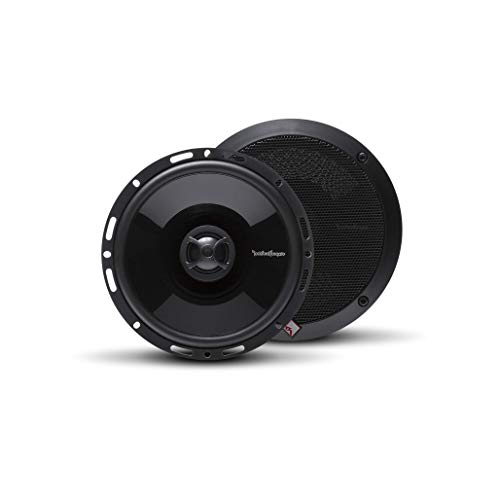
Rockford Fosgate P1650 — Best overall for trucks
If one pair must carry a truck, this is the pair. The P1650’s Punch-series recipe — injection-moulded mineral-filled cone, butyl rubber surround, silk dome tweeter behind an integrated concealed crossover — reads like a car specification until you hear it in a cab, where its two decisive qualities turn out to be truck qualities: midbass with genuine travel and weight, so the music has a floor under it at distance, and composure at volume, so a long climb at full throttle with the stereo up does not turn the sound to gravel. Its FlexFit slotted basket also quietly suits trucks, whose factory hole patterns vary by trim more than cars’ do.
Fit it in the front doors of a crew cab with a value pair behind, or as the only pair in a regular or extended cab, and it defines the system. On factory power it is good; on even a modest amplifier it is the best sound in this guide, because its headroom is where its price went. The depth is the one check to make — most full-size truck front doors accept it easily, but mid-size trucks and some rear doors should be measured. Owners who tow will understand its value fastest: it is the speaker that makes hour five sound like hour one.
- Design: Punch-series 6.5-inch two-way coaxial
- Cone: injection-moulded mineral-filled polypropylene
- Surround: butyl rubber
- Basket: FlexFit slotted mounting for varied factory patterns
- Impedance: 4 ohm
Strengths
- Midbass authority and high-volume composure — the two truck virtues in one speaker.
- Scales with an amplifier better than anything else here.
- Forgiving mounting suits the trim-to-trim variation of truck doors.
Trade-offs
- Deepest of the mainstream picks — measure mid-size and rear doors.
- Price makes a four-door set a real decision, not an impulse.
- On factory power alone, part of its advantage stays in reserve.
Best for: the front doors of any truck, and the only doors of regular and extended cabs. Not suited for: the shallowest rear doors, or strict four-door budget refreshes.

Kicker CSC65 — Best clarity on factory power
Kicker’s CS series is the company’s mainstream line, and the CSC65 is its 6.5-inch standard-bearer: a polypropylene cone with a ribbed surround, a balanced dome tweeter, and a voicing that puts intelligibility first. In a truck that means the morning news survives the motorway, the podcast narrator stays a person rather than a mumble, and lyrics resolve at volumes where the road is doing its worst. Kicker tunes the CS for the factory-power world most trucks live in, and its efficiency makes a stock radio sound like it grew a size.
Against its own sibling, the DSC650 below, the CS is the refinement step: cleaner tweeter behaviour, better composure as volume rises, a little more money. Against the P1650 it gives away low-end weight and ultimate headroom while asking less of everything — depth, power, budget. For the truck that tows a family rather than a trailer — school runs, long holiday drives, a cab full of people talking over the music — that balance of clarity and ease is often the correct purchase, and it is why the CSC65 is the pick we would hand a crew-cab owner who said the words “mostly factory, mostly family.”
- Design: CS-series 6.5-inch two-way coaxial
- Cone: polypropylene, ribbed surround
- Tweeter: balanced dome
- Character: clarity-first voicing, factory-power efficiency
- Impedance: 4 ohm
Strengths
- Speech and lyric intelligibility over road noise — the truck virtue that matters daily.
- Works at its best on the factory radio most trucks keep.
- Moderate depth fits a wide spread of truck doors, front and rear.
Trade-offs
- Less midbass weight than the P1650 in big cabs.
- Not the amplifier platform its price neighbour is.
- Kicker’s own DS undercuts it for buyers who only need fullness.
Best for: family crew cabs on factory power, where clarity is the daily requirement. Not suited for: bass-led builds, or owners planning an amplifier soon.

Skar Audio TX65 — Best bass-leaning value
A big cab swallows bass, and the TX65 is the value answer to that appetite. Skar’s Elite-series coaxial is voiced generously in the low and midrange — the house sound of a subwoofer company — and in a truck that generosity reads as fullness: the system sounds bigger, warmer and more relaxed at volume, because the cab’s size gives the low-end emphasis somewhere to live instead of turning it to boom as it can in a small car. For work trucks and older trucks, where the audio brief is “make the long drive feel shorter” and the budget is guarded by a dozen other demands, the TX65’s price-to-fullness ratio is the argument, and it is a strong one.
The familiar Skar caveats apply and matter more in trucks: the foam surround will age faster than rubber in a hot-climate work truck that lives outdoors, and the treble is serviceable rather than sparkling — in a quiet cab you would notice; over all-terrain tyres you mostly will not. It also pairs naturally as the rear-door choice behind a P1650 front stage for owners building in stages, since its warmth fills the cabin without fighting the front pair’s clarity. Bought with eyes open about its materials, it is the working truck’s speaker.
- Design: Elite-series 6.5-inch two-way coaxial
- Cone: treated pressed paper pulp
- Surround: foam
- Character: bass-forward voicing suited to large cabs
- Impedance: 4 ohm
Strengths
- Fullness that fills a big cab, at a work-truck price.
- Sounds generous on factory power — no amplifier courtship needed.
- Natural rear-door partner to a stronger front pair in staged builds.
Trade-offs
- Foam surround ages fastest here in hot, outdoor-kept trucks.
- Treble is the plainest of the six; clarity seekers should take the CSC65.
- Bass emphasis can thicken with factory EQ boosts — run the lows flat.
Best for: work trucks, older trucks and rear-door duty where fullness per money rules. Not suited for: hot-climate trucks kept outdoors for a decade, or clarity-first family cabs.

Kicker DSC650 — Best on head-unit power alone
The DSC650 is Kicker’s DS-series efficiency specialist, and trucks are full of the exact situation it was designed for: a factory radio of no great power, doors that need filling, and an owner who will not be adding an amplifier because the truck has other jobs for that money. Its high sensitivity converts modest wattage into the fullest sound a stock system can make, and its shallow mounting depth solves the doors — certain mid-size fronts, many crew-cab rears — where the deeper picks will not go. In fleet and work-truck life, where trucks are bought by the dozen and audio is a comfort line-item, this is the speaker that gets specified, because it installs fast, fits broadly and satisfies immediately.
Its ceiling is the honest trade: composure at high volume and low-end depth both trail the P1650 clearly, and an amplifier buys it loudness more than quality. But judge it in its brief and it is close to unbeatable — no other pick here returns so much sound from a factory radio. If your truck’s system plan begins and ends with speakers, the DSC650 is where the plan should start, with the CSC65 as the step up if the budget breathes.
- Design: DS-series 6.5-inch two-way coaxial
- Cone: polypropylene with ribbed surround
- Tweeter: balanced dome
- Character: high sensitivity, shallow mounting depth
- Impedance: 4 ohm
Strengths
- Fullest result from a factory radio of any pick here.
- Shallow depth fits the truck doors the others cannot.
- Fast, forgiving install — the fleet and work-truck favourite for a reason.
Trade-offs
- Composure and depth run out first when power and volume rise together.
- Basic crossover limits fine detail against the CSC65 and REF-6532EX.
- A finished answer, not a foundation — outgrown by amplifier plans.
Best for: speaker-only upgrades, work trucks, tight doors and rear positions. Not suited for: staged builds, or drivers who listen loud for hours.

Infinity REF-6532EX — Best shallow-mount refinement
The REF-6532EX is the problem-solver with polish: a Reference-series coaxial in a shallow-mount design, built for the locations where depth runs out — and trucks, for all their general spaciousness, contain such locations in surprising places, from certain mid-size front doors to the rear doors of crew cabs whose inner structure crowds the speaker. Infinity’s Reference voicing brings a cleaner, more detailed top end than the value picks, with the brand’s edge-driven tweeter design and a cone built for low distortion, so the shallow locations do not have to sound like the cheap seats.
Its low-impedance design deserves the standard note: Infinity rates these speakers to draw more from compatible amplifiers and head units, and while they run happily in most factory systems, owners of marginal factory amplifiers should confirm compatibility. In return, the REF is the connoisseur’s rear door — the pair that keeps a crew cab’s second row in the same tonal world as a strong front stage — and the front-door answer wherever depth is the binding constraint and refinement is still wanted. It will not out-punch the P1650 and does not pretend to; it out-refines everything here except at the price of depth it does not need.
- Design: Reference-series shallow-mount 6.5-inch two-way coaxial
- Tweeter: edge-driven textile dome
- Design: shallow basket for depth-restricted doors
- Note: low-impedance design — confirm amplifier compatibility
- Role: refined shallow fit, premium rear doors
Strengths
- Reference-level detail in a basket that fits where others cannot.
- Keeps rear-seat passengers in the front stage’s tonal world.
- Clean at moderate volumes — the long-drive, low-fatigue choice.
Trade-offs
- Shallow design caps low-end authority against the deeper picks.
- Low-impedance design needs a compatibility thought for weak factory amps.
- Premium price for a speaker whose party trick is fitting.
Best for: depth-restricted truck doors and premium crew-cab rear positions. Not suited for: buyers whose doors are deep and whose priority is punch.
Diesel, Petrol or Electric: Does the Powertrain Change the Pick?
Diesel trucks set the hardest brief. The engine’s low-frequency presence at cruise occupies the same territory as musical body, and its note is constant, so the speakers must produce midbass with enough definition to stay separate from the drone rather than adding to it — a clarity argument for the P1650’s controlled punch over the TX65’s warmth, which in a diesel cab can blur into the engine’s own voice. The tweeter’s job also grows: consonants and lyrics must cut a noise floor that never pauses. Petrol trucks are kinder by degree, not by kind; the same ranking holds with the volume simply lower. Electric trucks invert the problem delightfully — the cab is quiet enough that refinement becomes audible again, road and tyre noise dominate what remains, and the REF-6532EX and CSC65’s detail suddenly earns its keep at ordinary volumes. The same six picks serve all three; the powertrain just changes which virtue you are really buying.
What Makes a Towing Day the Real Test?
Anyone’s system sounds fine on the school run. The tow day — five to eight hours, a trailer’s worth of extra wind and tyre noise, a driver whose attention is spent and whose entertainment is the only thing keeping the miles civilised — is where truck audio is judged in the owner’s memory. Fatigue is the metric: a system that is harsh, boomy or strained at hour one is unbearable at hour six, and the driver arrives having listened to the radio less and less as the day wore on, which is the market’s quietest product review. Composure is therefore a safety-adjacent feature in this guide’s judgement, and it is why the P1650 and CSC65, neither the cheapest nor the loudest, sit where they do. When you test a new install, test it on a long drive at towing volume with the material you actually consume — talk, in many towers’ case — and judge it by whether you are still happily listening at the destination.
Mid-Size Trucks: the Same Rules in a Smaller Cab
Mid-size trucks — the Ranger, Colorado, Tacoma class — compress everything: the cab is smaller, the doors are shallower, the noise floor is a little lower and the distances are a little shorter. The ranking logic survives intact but the fitment warnings double in importance, because these are the doors where the P1650’s depth must be proven with a tape rather than assumed, and where the shallow DSC650 and REF-6532EX stop being niche picks and become the default answers. The smaller cab also flatters efficiency: a mid-size on factory power with CSC65s is a genuinely complete system, and the money a full-size crew cab spends on a second pair of doors simply does not exist here to spend. Owners of mid-size trucks should read every “crew cab rear door” note in this guide as applying to their front doors, tape measure first.
How Do the Six Compare Side by Side?
| Model | Series | Truck virtue | Power appetite | Depth |
|---|---|---|---|---|
| Rockford R165X3 | Prime | Four-door value clarity | Low | Moderate |
| Rockford P1650 | Punch | Authority and composure | Moderate | Deepest here |
| Kicker CSC65 | CS | Factory-power clarity | Low | Moderate |
| Skar TX65 | Elite | Cab-filling fullness | Low | Moderate |
| Kicker DSC650 | DS | Efficiency and fit | Very low | Shallow |
| Infinity REF-6532EX | Reference | Shallow refinement | Low | Shallow |
Combinations matter more than individual crowns in a truck. The staged crew-cab build most owners end up loving is a P1650 front pair with CSC65 or TX65 rears. The one-weekend full refresh is R165X3 all round. The speaker-only work truck is DSC650s and done. Regular cabs should concentrate the whole budget in one front pair — P1650 if it stretches, CSC65 if it does not — because there is no rear door to share the load or the bill.
How Should You Treat Truck Doors?
Truck doors are big, flat and often lightly damped from the factory, because trucks are built to a work brief and door resonance was not on it. The same sealing discipline as any door applies — cover the service holes, add mass behind the speaker, gasket the mount — with two truck emphases. First, scale: there is simply more panel to calm, and the larger outer skin sings at lower frequencies, so coverage matters more than in a car. Second, duty: truck doors collect dust, water and in agricultural or site use a working environment’s worth of grit through their drains. Keep drains clear, expect to rinse door bottoms, and choose your deadening placement so it never dams the water path.
The reward is proportionally larger too. A treated truck door is a big enclosure by car standards, and a midbass-capable speaker like the P1650 in a sealed truck door produces the kind of low-end body that makes passengers ask where the subwoofer is hidden. On a truck that tows or travels, also chase the cab’s other noises while the panels are off — a loose door check strap or a worn window seal admits more highway noise than any speaker can politely cover, and fixing the noise is always cheaper than out-shouting it.
How Should You Set the Head Unit for Highway Listening?
Set it at highway speed, because every other setting is fiction. Start with tone controls flat and any loudness feature off — factory curves are tuned to flatter anaemic factory speakers in a showroom, and through capable speakers they boost exactly the boom and tizz a truck already has too much of. Then, at your cruising speed, judge speech first: a newsreader should sound like a person in the cab, not a voice fighting through a wall. If the words are present but effortful, a small treble adjustment is legitimate; if the whole sound is thin, resist the bass boost and check the door sealing first, because in trucks the missing body is usually escaping through the door, not hiding in a menu. Save the settings, then leave them alone for a week — the ear recalibrates, and most systems that seemed bright on day one were simply honest.
Phone and streaming sources need the same discipline as in any vehicle, with a truck multiplier: their own EQ and volume stack on the head unit’s, and a phone set to its bass-heavy preset will make a well-chosen TX65 sound like a mistake. Flatten the phone, set its volume near but not at maximum, and let one device do the shaping. Half the disappointing installs in big cabs are two EQs arguing, and the argument is always audible from the driver’s seat.
Trucks Keep Their Speakers Longer: What Does Ownership Look Like?
Trucks are kept — often for a decade, sometimes by two owners — and a speaker purchase should be made at that horizon. Rubber surrounds and honest baskets, the P1650 and both Kickers’ construction, are decade parts in a door that drains properly. Foam surrounds are five-year parts in a hot climate, which does not make the TX65 a bad buy; it makes it a buy with a date in mind, priced accordingly, and for a truck on a five-year plan that arithmetic is entirely respectable. What does not respect the horizon is casual installation: a decade of vibration and door slams audits every shortcut, so the gaskets, sealed holes and secured wiring of the install sections are really longevity purchases wearing overalls.
Second owners inherit all of it, which cuts the other way too: if you are buying a used truck, its audio is a legible record of its previous life. Fresh, sensibly chosen speakers with tidy wiring suggest an owner who maintained things; a chaos of mismatched drivers and twisted-tape joins suggests the rest of the truck was kept the same way. More than one good purchase has been priced by what was found behind a door panel.
What Are the Most Common Mistakes in Truck Audio?
Assuming the fitment from the badge is the first: the same model name covers regular, extended and crew cabs with different doors, and trims within them differ again. Measure your cab. The second is buying car-refinement speakers for a truck noise floor and concluding the truck is hopeless. The third is doing the front doors of a crew cab beautifully and leaving factory speakers behind the passengers, so the cabin never agrees with itself. The fourth is EQ compensation — boosting bass and treble to fight road noise until the system distorts, when the actual faults were noise paths and speaker placement.
Fifth is ignoring the rear doors’ depth until the panels are off and the new speakers do not fit, which is why this list carries two shallow designs. Sixth is forgetting that trucks work: a system wired casually will be found out by vibration, dust and the door-slamming reality of a working vehicle long before a car’s system would be. Secure every run, gasket every mount, and the install will last as long as the truck’s reputation says it should.
What Should Rear Passengers in a Crew Cab Hear?
In most crew cabs the rear doors were specified by the factory as an afterthought — the cheapest driver that filled the hole — and rear passengers, who are often the owner’s family, judge the truck’s whole system from the worst seat in it. A matched rear pair changes the cabin’s politics: the sound field becomes continuous front to back, conversation over the music works from every seat, and children in the rear stop requesting volume changes that serve their row at the front’s expense. Level discipline matters: set the fader so the front stage still leads slightly, because the driver is the one following navigation prompts and traffic reports, and a rear-heavy balance smears exactly the information the driver needs. The REF-6532EX and CSC65 are the two rear picks this guide keeps returning to for a reason — rear passengers sit close to their doors, so refinement is audible back there even when the front row is mostly hearing the road.
How Does a Working Truck’s Audio Survive Working Life?
Dust is the working truck’s audio enemy, ahead of water. Site and farm dust enters door cavities through every drain and seam, coats cones and settles in terminals, and over years it stiffens and corrodes in ways a suburban truck never learns about. The defences are unglamorous: speakers with protected cones and honest surrounds — the rubber-surround picks here age better in dust than foam — connections made tight and kept accessible, and a compressed-air blow-out of the door bottoms whenever the truck gets a real clean. Vibration is the second enemy, administered by rough roads and corrugations; it loosens mounting screws and chafes casual wiring, so the install section’s discipline about gaskets, secure runs and thread-checked fasteners is not fastidiousness, it is the difference between a system that survives the truck’s job and one that becomes another job.
What Does the Installation Sequence Look Like?
Front doors first, completely: speakers, sealing, gaskets, rattles hunted with a bass-heavy track before the panels go back. Live with the fronts for a week of real use — the truck will tell you whether the rear doors need the same tier or the step down you planned, and whether the factory head unit’s settings, flattened and re-tuned at highway speed, suit the new balance. Then the rears, with the depth check done by tape before the order, not by hope during the install. Throughout, photograph the factory wiring at each door; truck trims share looms in ways that make colour codes lie between model years, and the photograph is the only witness that never misremembers. Finish with the polarity check from the driver’s seat — a mono source, a centred image — because in a cab this wide, one reversed rear door hides remarkably well until a passenger mentions the music sounds strange from back there.
Which Listening Matters in Your Truck?
Talk is the truck format nobody shops for and everybody uses: news on the commute, podcasts and audiobooks on the long haul, hands-free calls that are legally and practically part of driving a working vehicle. Talk is a clarity specification — it lives entirely in the vocal band, it must survive the noise floor without volume heroics, and it fatigues the listener faster than music when it is poor, because the brain works to reconstruct smeared words in a way it never works for a guitar. If your truck hours are talk hours, weight this list toward the CSC65 and P1650 and treat their tweeter quality as the purchase. Music-first owners can lean warmer — the TX65’s generosity, the R165X3’s body — and sports-radio households should know that a clear midrange makes commentary followable at volumes a passenger can still talk over, which is a family feature disguised as an audio one.
A Note for Fleets and Shared Trucks
A truck that is driven by whoever is free has different audio needs from a personal truck: the system must satisfy immediately, survive indifference and ask nothing of the driver. That is the DSC650’s home ground, and fleet buyers specify it for the same reasons this guide recommends it to individuals — shallow fit across trims, maximum result from the factory radio, an install a workshop can repeat identically forty times. The fleet lesson transfers to any household with two drivers of different tastes: choose the speaker whose balance nobody objects to over the one somebody loves, set it once, and let the truck be a truck. Personalisation is for the truck that has one driver; the shared cab rewards the same neutrality as the shared radio station on a long group drive.
When Is an Amplifier Worth It in a Truck?
The honest trigger is a sentence you catch yourself saying: that the system is clear and balanced but simply runs out of clean volume against the road on the drives that matter. That sentence describes a headroom shortage, and headroom is the one thing an amplifier genuinely sells. It does not fix muddiness, rattles or a noise path — those are speaker, door and seal problems, and amplifying them produces louder faults. Trucks make the amplifier decision easier in one respect: there is space for the unit and the battery and charging system are sized for work, so the installation compromises cars impose mostly vanish. Sequence it after the doors, buy it for the front pair first, and let the P1650 show you what its reserve was for. Owners who follow that order rarely regret the purchase; owners who amplify factory speakers first usually buy the speakers within the season anyway, having paid for the lesson in the correct order reversed.
What About the Centre Console and Rear Wall?
Some trucks offer or invite speakers beyond the doors — centre-dash locations on certain trims, rear-wall or pillar positions in regular cabs. Treat them as seasoning, never the meal. A centre speaker can help the front image in a wide cab when the system was designed for it; added casually to a system that was not, it smears the stereo the doors are working to build. Regular cabs deserve a specific note, because their rear wall tempts owners toward extra speakers behind the seats: the money almost always serves better in the single door pair and its treatment, since the listeners sit directly in the doors’ near field and the cab is small. One excellent pair, close, in sealed doors, beats a scattered committee in every regular cab this guide’s logic can construct.
A Short Word on Resale and Returning a Truck to Stock
Trucks change hands with their usefulness intact, and audio is one of the few upgrades a buyer can evaluate in a thirty-second test drive — which makes a clean, sensibly chosen system a small but real asset, and a butchered one a negotiation point against you. Keep the factory speakers boxed if they came out intact, keep any adapters and harnesses you used labelled by door, and avoid cutting factory looms where a plug-in harness exists. The next owner may restore the truck to stock for a fleet sale, or may simply be reassured, as used-truck buyers are, by evidence that the person before them did jobs properly. Either way, the tidy install you did for acoustic reasons pays a second dividend at the handshake, and on a vehicle class where handshakes are still how business closes, that is worth the modest discipline it costs.
Final Recommendation
Match the purchase to the cab, to the powertrain’s noise and to the hours you actually spend at highway speed, because a truck’s sound system is judged on the longest drive of the year, not the shortest. The owners who end up satisfied are the ones who bought for that drive — its noise, its duration, its passengers — rather than for a driveway demonstration, and every pick in this guide was ranked with that longest drive in mind.
Match the purchase to the cab. Crew cabs: P1650 fronts with CSC65 or TX65 rears if the budget is staged, R165X3 all round if it is not. Regular and extended cabs: one pair, the best you can justify — P1650 first, CSC65 behind it. Speaker-only and work trucks: DSC650, everywhere, and spend the change on door treatment. Shallow doors anywhere: REF-6532EX, without apology. Do that, seal the doors like the enclosures they are, and your truck will finally sound at seventy the way it always looked like it should.
Frequently Asked Questions
Are truck speakers different from car speakers?
The products overlap — most picks here are car-range speakers — but the selection criteria differ: trucks reward efficiency, clarity at volume, midbass body and depth tolerance, and punish low-level refinement that road noise erases. This guide is the car catalogue re-judged by truck rules.
Should I replace all four doors in a crew cab at once?
Ideally yes, so the cabin agrees with itself; the R165X3 exists for exactly that budget. If staging, do the fronts first with the better pair and the rears within the same broad voicing family later — and do not leave the rears factory indefinitely, because passengers judge the system from back there.
Do I need an amplifier in a truck?
No — five of the six picks are chosen to satisfy on factory power, and the DSC650 is built for nothing else. An amplifier lifts the P1650 in particular to another level and helps any truck that tows long and loud, but it is an enhancement here, never a rescue.
Will these fit my truck’s doors?
Most full-size front doors accept all six; the checks that matter are mid-size trucks, rear crew-cab doors and base trims with different factory sizes. Measure mounting depth and confirm the factory size for your exact cab and year before ordering — truck fitment varies by trim more than cars’ does.
What about a subwoofer under the rear seat?
A fine second project that many truck owners add, since the space exists and the cab rewards it. It does not change the door choice — the P1650 front stage remains the foundation — but sequence it after the doors, because door clarity and midbass are what a truck system is judged by at speed.
My truck has a factory premium audio system. Can I still use these?
Often, with a check first. Premium factory systems sometimes use lower-impedance speakers or active crossovers that feed the door only part of the signal, and a standard 4-ohm coaxial dropped into such a system can play quietly or lose its tweeter’s signal entirely. Identify what your trim’s system actually does — owner forums for your exact model and year are unusually reliable on this — before assuming the standard pick applies.
How long does a four-door truck install take?
Speakers alone, roughly an hour a door once the panel technique for your truck is learned. Speakers plus proper sealing and deadening of the front doors is a full day done carefully. The second day, if you stage the rears, is faster — every lesson from the fronts transfers, including which clips your truck’s panels use and how they forgive being removed.
Does a lift or bigger tyres change the speaker choice?
Indirectly, yes. Aggressive tyres raise the road-noise floor substantially, and a lift adds wind noise around the cab; both push the decision toward the clearer, more efficient picks — CSC65, P1650, DSC650 — and away from warmth-first choices whose detail the new noise floor will tax. The speakers do not change; the room got louder, and the ranking inside this guide already encodes which virtues survive that.
Should I sound-deaden the whole cab or just the doors?
Doors first, always — they are the speakers’ enclosures and the largest noise-admitting panels at ear level. A floor and rear-wall treatment is a legitimate second project on a truck you keep, and it lowers the noise floor for every seat, but it should never be bought instead of the door work. Sequence by return: doors, then the seals and glass runs that admit wind noise, then the broad panels.
What is the single best first step if I can only do one thing?
The front door pair, chosen from this list by your power plan, installed with the doors sealed. That one job changes clarity, body and volume together, and every later step — rears, amplifier, subwoofer — builds on it coherently. If the budget will not stretch to speakers yet, sealing and deadening the front doors around the factory speakers is the honest preliminary: it improves what is there and remains fully useful when the new drivers arrive.
Why do my new truck speakers sound worse on the motorway than in the driveway?
Because the driveway test removes the opponent. Road noise masks the low and lower-midrange first, so a balance that sounded full at a standstill turns thin and bright at speed, and owners respond by boosting the ends of the EQ, which distorts. Set the final tune at cruising speed, keep the tone controls near flat, and treat persistent thinness as a door-sealing or noise-path issue rather than a speaker verdict — the truck at seventy is the room the system actually lives in.
Do I need to disconnect anything special before removing truck door panels?
Follow your truck’s service guidance for any door-mounted airbag sensors or modules — some modern trucks integrate safety hardware into the doors, and those connectors deserve the manual’s procedure rather than improvisation. Beyond that, the job is the usual one: battery awareness where the manual asks for it, clips released with trim tools rather than force, and every connector photographed before it is separated.
Related Guides
Best 6.75 Car Speakers for Oversized Factory Holes · Best 6.75 Component Speakers for a Stepped-Up Front Stage · Best 6×9 Speakers for Rear Decks and Big Bass


