What's inside
- Key Takeaways
- Quick Picks
- How We Chose These Picks
- Comparison
- What Does “Affordable” Actually Buy — and What Does It Quietly Leave Out?
- Which Sealing Rating Do You Need for Showers, Rain and Pools?
- How Do You Get Two Small Speakers to Sound Like One Big One?
- Where Should a Small Speaker Sit to Sound Its Biggest?
- How Do You Match a Speaker to a Room, a Garden and a Trail Without Buying Twice?
- What Separates a Speaker You Keep for Five Years From One You Replace Next Spring?
- Why Do Some Cheap Speakers Sound Fine at Home and Fall Apart at a Party?
- How Should You Clean and Store a Sealed Speaker Between Adventures?
- What Should You Check During the First Week With a New Speaker?
- Does the Bluetooth Version on the Box Change Anything You Will Hear?
- Do Colours, Bundles and Listing Variants Change What You Are Buying?
- Which Mistakes Turn a Good Budget Speaker Into a Disappointing One?
- Final Recommendation
- Frequently Asked Questions
- Related Guides
As an Amazon Associate I earn from qualifying purchases. This post may contain affiliate links at no extra cost to you.
widgetverdict.com is reader-supported. When you buy through links on our site, we may earn an affiliate commission.
Finding the best affordable bluetooth speakers used to mean accepting tinny sound as the price of saving money, and that trade no longer holds. Drivers, batteries and waterproofing have all trickled down, so the interesting question at the lower end of the market is not whether a small speaker can sound good — several plainly can — but which corners each maker chose to cut, and whether those corners sit in places you will ever notice. A speaker that trims its app features hurts nobody. A speaker that trims its sealing, its battery or its bass output hurts exactly the people most likely to buy it.
Six models anchor this guide, and they split into two honest families. The JBL Flip 6, the JBL Clip 5 and the Sony SRS-XB100 are pocket-and-bag speakers: light, sealed, built to be carried without thought. The Soundcore Boom 2, the Ultimate Ears Wonderboom 4 and the Soundcore Boom 3i are the stay-outside family: bigger voices, longer claims on playtime, bodies designed to sit on a patio table or a beach towel and fill open air. Affordable means something different in each family, and judging a clip-on speaker by patio standards — or a patio speaker by pocket standards — produces bad purchases in both directions.
Every figure quoted for a linked pick below comes from that pick’s own Amazon listing title, checked through this site’s Creators API pool. Where a listing states a playtime, an output wattage or a sealing rating, the guide repeats it and says so. Where a listing stays silent — and a few do, on purpose or by accident — the guide describes the quality in plain words instead of inventing a number. That discipline matters most at this end of the market, where spec sheets are shortest and marketing adjectives are longest.
Read the six picks as a map of compromises rather than a ladder. The cheapest way to get loud is not the cheapest way to get sealed, and the cheapest way to get sealed is not the cheapest way to get through a long day on one charge. Your own pattern of use — kitchen counter, bicycle bottle cage, shower shelf, garden fence, campsite — decides which compromise is free and which one costs you something every single week.
Key Takeaways
- The JBL Flip 6 is the default recommendation for most people: IP67 sealing, a stated 12 hours of playtime and a shape that fits a bike bottle cage as readily as a backpack pocket.
- Soundcore’s Boom 2 is the loud end of affordable: its listing claims 80W of output, 24 hours of playtime, IPX7 sealing and a floatable body with RGB lights.
- The Wonderboom 4 trades raw volume for placement freedom — a floating, dustproof body with 360-degree sound and a stated 131-foot wireless range.
- Sony’s SRS-XB100 is the smallest serious option here, with a stated 16-hour battery, IP67 sealing, a carry strap and hands-free calling in a genuinely pocketable cylinder.
- The JBL Clip 5 removes the last excuse for leaving music behind: an integrated carabiner, IP67 sealing and a stated 12 hours of play, clipped to whatever you already carry.
- The Soundcore Boom 3i carries the strongest sealing claim in the set, IP68 with saltwater resistance and floating playback, at a stated 50W.
Quick Picks
| Pick | Badge | Why it earns its place |
|---|---|---|
| JBL Flip 6 | The one most people should buy | IP67 waterproof and dustproof sealing, a stated 12 hours of playtime and a bold, grippable cylinder that has become the shape everyone else copies. |
| Soundcore Boom 2 | The affordable loud one | A claimed 80W, 24 hours of playtime, IPX7 sealing, a floatable body, RGB lights and a custom EQ in the Soundcore app. |
| Ultimate Ears Wonderboom 4 | The floater for small spaces | Balanced 360-degree sound from a dustproof body that floats, with a stated wireless range of 131 feet. |
| Sony SRS-XB100 | The pocketable traveller | A stated 16-hour battery, IP67 sealing, a versatile strap and hands-free calling in Sony’s smallest X-series cylinder. |
| JBL Clip 5 | The clip-and-forget option | An integrated carabiner, waterproof and dustproof construction, punchy bass for its size and a stated 12 hours of play. |
| Soundcore Boom 3i | The saltwater-ready compact | IP68 sealing with saltwater resistance, floating playback, a stated 50W output, Bluetooth 5.3 and 16 hours of playtime. |
How We Chose These Picks
Affordability was treated as a relationship between price and durability rather than a hunt for the lowest sticker. A speaker that dies in its second summer costs more per year than a sturdier one bought once, so sealing ratings, battery claims and build reputation were weighted ahead of novelty features. Each candidate also had to earn its place against a specific job: pocket carry, bag carry, patio duty, poolside duty, shower duty or trail duty. Models that duplicated a job already covered better were dropped, which is why this list holds two Soundcore models with genuinely different briefs instead of three near-identical cylinders.
Claims discipline shaped the final six as much as sound did. Every linked pick’s listing title was read closely, and only the facts printed there — output, playtime, sealing, Bluetooth version, extras such as straps and lights — are stated as facts in the reviews below. Anything a listing leaves out is discussed as an unknown, never filled in from a sibling model or an older generation. Readers comparing generations should note that habit carefully, because affordable speakers are refreshed often and last year’s specification has a way of attaching itself to this year’s product name in second-hand write-ups.
Sound judgements at this level are qualitative by necessity and by honesty. None of these six will reproduce the bottom octave of a recording, and none pretends to. What separates them is how gracefully they handle that limit: whether voices stay clear at modest volume, whether bass stays tidy when the volume climbs, and whether the speaker sounds strained or relaxed doing the job it was bought for. Those are the terms used in each review, and they are the terms that predict whether you will still be using the thing in three years.

JBL Flip 6 — The one most people should buy
Some products become the default answer in their category so thoroughly that recommending them feels lazy, right up until you try to argue against them. The Flip 6 is that product among affordable speakers. Its listing promises louder, more powerful sound than its predecessors, IP67 waterproof and dustproof sealing, and 12 hours of playtime, wrapped in a bold design that comes in colours beyond the usual black. None of those claims is exotic. Their combination, in a cylinder that fits a bicycle bottle cage, is what rivals keep failing to match at a similar cost.
The Flip shape earns its popularity through a hundred small conveniences. It stands on either end, lies on its side without rolling away, shrugs off rain and dust, and its passive radiators at each cap give bass a physical presence that similarly sized rivals often fake with harsh equalisation. Podcasts stay intelligible at kitchen volume; guitar-driven rock keeps its edges at patio volume. Push it to its ceiling outdoors and it thins out, as every speaker this size does, but it reaches that ceiling later and more gracefully than most of the affordable field.
Twelve hours of stated playtime deserves a moment of interpretation. That figure covers a long weekend of casual listening — a few hours each evening — without a charge, which changes how a speaker gets used. Kit that needs constant tending gets left behind; kit that simply works gets carried. The Flip 6’s battery claim, modest next to the 24-hour figures elsewhere in this guide, is still comfortably past the threshold where charging stops being a chore you plan around.
- Sealing: IP67 waterproof and dustproof, per the listing
- Playtime: up to 12 hours, per the listing
- Form: portable cylinder, sold here in blue
- Sound character: JBL’s louder, more powerful tuning for this generation
Strengths
- Sealing and playtime claims cover nearly every casual use, from shower shelf to campsite, without asking the owner to baby the unit.
- The shape is genuinely versatile — bottle cages, cup holders, backpack pockets and tent corners all accept it without adapters or cases.
- Sound stays composed at the volumes small rooms and small gatherings actually use, which is where affordable speakers usually fall apart.
Trade-offs
- Twelve hours is the shortest headline playtime among the larger picks here, so multi-day trips without power favour the Boom models.
- There is no float claim in the listing, so a knock into deep water is a retrieval problem rather than a shrug.
- It carries no strap, loop or clip of its own; hands-free carrying means a pocket, a cage or an accessory.
Best for: a first speaker purchase covering home, garden and travel duties in one unit.
Not suited for: week-long off-grid trips where charging stops simply do not exist.

Soundcore Boom 2 — The affordable loud one
Volume is the most expensive thing in portable audio, which is why the Boom 2’s listing reads like a misprint from a higher price class: 80W of output, 24 hours of playtime, IPX7 waterproofing, a floatable body, RGB lights, USB-C charging and a custom EQ through the Soundcore app. Treat headline wattage with the usual caution — makers measure it generously — but even discounted heavily, the claim signals a speaker built around a proper woofer and radiators rather than a token driver in a pretty shell. In a guide about affordable speakers, this is the pick that redefines what the word can stretch to cover.
Size explains most of it. The Boom 2 is a boombox-format unit with a carry handle, not a pocket cylinder, and that larger cabinet is precisely what lets bass exist outdoors instead of evaporating. Soundcore’s BassUp 2.0 processing leans into the low end, and the app’s custom EQ matters more than such features usually do, because a speaker this capable of boom benefits from being tamed for podcasts or small rooms. The RGB lights are garnish — pleasant at dusk, irrelevant at noon — and the honest buyer will value them last among the listing’s claims.
Floating deserves its sentence. An IPX7 rating alone promises survival after immersion; a body that floats promises retrieval, and beside a lake or a pool that difference decides whether a fumble is a story or a loss. Pair that with 24 hours of stated playtime and the Boom 2 becomes the natural centre of a whole weekend outdoors: beach day, evening fire, next morning’s coffee, all on one charge, all at volumes a pocket speaker cannot approach.
- Output: 80W claimed in the listing, with BassUp 2.0 processing
- Playtime: 24 hours stated
- Sealing: IPX7 waterproof, and the body floats
- Extras: RGB lights, USB-C charging, custom EQ via the Soundcore app
Strengths
- Headroom changes everything outdoors; this is the one affordable pick that can hold a conversation-sized gathering without strain.
- A full day of stated playtime plus floatability makes it the lowest-maintenance party anchor in the set.
- The app EQ lets one speaker serve both bass-heavy evenings and speech-heavy mornings without sounding wrong in either role.
Trade-offs
- Boombox dimensions end any thought of pocket or bottle-cage carry; it travels by handle, in a car or not at all.
- IPX7 covers immersion but the listing makes no dustproof claim, so sandy environments deserve a rinse-and-shake routine.
- Its strengths are wasted in small rooms, where its output will spend its life idling at a fraction of capacity.
Best for: gardens, beaches and campsites where one speaker must serve a group all day.
Not suited for: commuters or cyclists counting grams and litres in a daily bag.

Ultimate Ears Wonderboom 4 — The floater for small spaces
Ultimate Ears built its reputation on a simple observation: most portable speakers spend their lives within a few metres of their owners, in bathrooms, on kitchen counters, beside pools — and for those jobs, sound thrown in every direction beats sound thrown louder in one. The Wonderboom 4’s listing describes balanced 360-degree sound and bass from a dustproof body that floats, with a wireless range stated at 131 feet. It is the smallest complete idea in this guide: a sealed, floating ball of sound you drop wherever the day is happening.
That 360-degree character changes placement habits. A directional speaker asks to be aimed; the Wonderboom asks only to be present. Set it in the middle of a picnic blanket, a workshop bench or a bathroom shelf and everyone hears roughly the same balance. The bass claim should be read in scale — a body this compact will not thump a chest — yet the tuning favours warmth over the thin, shouty character small speakers often adopt to seem louder than they are.
Range is the quiet headline. A stated 131 feet of wireless reach means the phone can stay inside, dry and safe, while the speaker sits out by the water; it also means fewer of the dropouts and stutters that plague cheaper radios when a body walks between phone and speaker. Combined with dustproofing and flotation, the picture is of a speaker designed around where speakers actually get used and abused, rather than around a spec-sheet duel.
- Sound: balanced 360-degree output with an emphasis on bass for its size
- Body: dustproof and floating, per the listing
- Wireless range: 131 feet (40 m) stated
- Colourway in this listing: black
Strengths
- Flotation plus dustproofing covers the two classic small-speaker deaths: the pool drop and the beach burial.
- Omnidirectional sound suits groups seated around it, which is how small gatherings actually arrange themselves.
- Generous stated range keeps the phone out of the splash zone and reduces dropouts across a house or garden.
Trade-offs
- The listing states no playtime figure, so marathon sessions rest on faith rather than a printed number.
- Its compact body sets a hard ceiling on volume; a large, noisy gathering will simply talk over it.
- Buyers wanting app-based EQ tweaks or lighting effects will find neither promised here.
Best for: bathrooms, kitchens, pool edges and picnic blankets where the speaker sits in the middle of things.
Not suited for: anchoring a loud outdoor party or a big open lawn.

Sony SRS-XB100 — The pocketable traveller
Sony’s smallest X-series speaker makes a case that the most useful speaker is the one already in your bag when you want it. The listing for the SRS-XB100 describes a super-compact, lightweight travel speaker with a 16-hour battery, IP67 waterproof and dustproof sealing, a versatile strap and hands-free calling. Read that combination slowly: sixteen hours is longer than several bigger speakers here claim, and sealing at IP67 in a body this small means the shower, the rain shower and the spilled drink are all non-events.
Hands-free calling is the feature rivals skip and owners quietly love. A speaker that doubles as a speakerphone earns a permanent place on a desk or a kitchen counter, because it stops being an entertainment gadget and becomes part of how the household communicates. The strap does similar work outdoors: looped over a branch, a hook or a backpack, the XB100 plays from wherever it hangs, and its sound — modest in absolute terms, carefully balanced in Sony’s style — suits speech, acoustic music and background listening better than it suits a dance floor.
Judged as a travel object, the XB100’s virtues compound. It asks for almost no space, tolerates being tossed into a wash bag, and its battery claim covers a long weekend of hotel-room listening. Travellers who have abandoned bulkier speakers after one trip of carrying them will recognise the logic: fidelity you actually bring beats fidelity you left at home, every single time.
- Battery: 16 hours stated in the listing
- Sealing: IP67 waterproof and dustproof
- Carry: versatile strap included in the design
- Calls: hands-free calling supported
- Finish in this listing: light gray
Strengths
- The strongest playtime-to-size ratio in this guide; it outlasts speakers several times its bulk.
- Speakerphone duty gives it a weekday job, not just a weekend one.
- Full IP67 sealing at this size removes any need to think about where it can go.
Trade-offs
- Physics caps its bass and volume; it accompanies a small group rather than entertaining a crowd.
- The strap invites hanging it in places where a fall onto stone is possible, and no drop-proof claim appears in the listing.
- Listeners who want stereo pairing or app extras will find the listing silent on both.
Best for: travellers, shower singers and desk workers wanting one tiny speaker that also takes calls.
Not suited for: outdoor gatherings where music must compete with wind and conversation.

JBL Clip 5 — The clip-and-forget option
Every speaker in this guide asks you to carry it somehow — except this one, which simply attaches itself to what you are already carrying. The Clip 5’s listing centres on its integrated carabiner, wrapped in an ultra-portable waterproof and dustproof body, with big JBL Pro Sound and punchy bass claimed for the size, up to 12 hours of play, and construction made in part with recycled materials. The carabiner is not a gimmick. It is a carrying strategy that survives contact with real life: belt loops, bag straps, tent loops, fence wire, the handle of a cooler.
Clipped carry changes the listening geometry in ways that flatter a small speaker. Hanging at chest height on a backpack strap, the Clip 5 plays near its listener’s ears at modest volume instead of shouting from the ground, which saves battery and keeps music personal on a trail. Hikers, dog walkers, gardeners and site workers share that pattern: one listener, moving, outdoors, wanting company rather than a concert. For that pattern this is arguably the best-designed object in the guide.
Twelve stated hours covers a full working day or a long hike with charge to spare, and the waterproof and dustproof build means the speaker that lives on the outside of a bag — exposed to every shower and dust cloud — is built for exactly that exposure. The recycled-materials note will matter to some buyers and not others; either way it costs the design nothing. What the Clip 5 cannot do is fill space. It is a personal speaker with a clever mount, and buying it to serve a patio is a category error the Quick Picks table exists to prevent.
- Carry: integrated carabiner, the defining feature of the line
- Sealing: waterproof and dustproof, per the listing
- Playtime: up to 12 hours stated
- Build note: made in part with recycled materials
- Colourway in this listing: black
Strengths
- The carabiner guarantees the speaker is present for exactly the moments pocket speakers get left behind.
- Chest-height playback at low volume sounds better and lasts longer than ground-level playback turned up.
- Sealing suits a device that lives permanently outside the bag, in the weather.
Trade-offs
- One small driver near one listener is the whole concept; group listening is off the menu.
- The clip invites knocks against rock, railings and door frames, and the listing promises no drop rating.
- Its 12-hour claim matches the Flip 6, but there is no larger-battery sibling in this design to upgrade to.
Best for: walkers, riders, gardeners and workers whose listening happens alone and on the move.
Not suited for: any job where the audience is more than two people standing still.
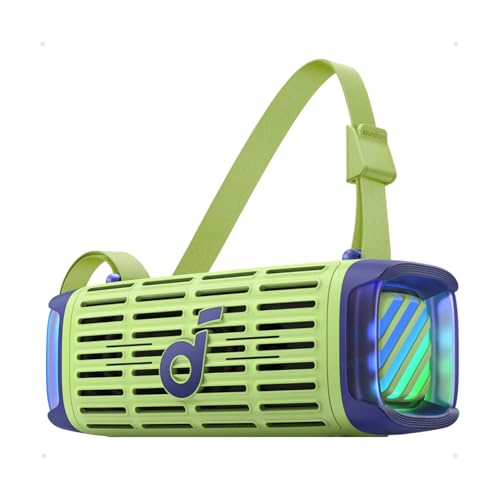
Soundcore Boom 3i — The saltwater-ready compact
Salt water is the examination most waterproof speakers quietly fail. Seals and membranes rated for a freshwater dunk corrode, stiffen and perish after repeated exposure to the sea, and warranties tend to go vague at exactly that point. The Boom 3i’s listing confronts it directly: IP68 waterproofing, saltwater resistance named outright, floating playback, BassUp 2.0 behind a stated 50W of output, Bluetooth 5.3, TWS pairing and 16 hours of playtime, aimed by Soundcore at kayaking, fishing and camping. In an affordable guide, that is a remarkable amount of environmental honesty in one title.
Floating playback is a subtler feature than floating survival. A speaker that merely floats can be fished out and dried; a speaker designed to keep playing while floating can ride beside a kayak or drift in a pool as part of the activity, oriented to sound right in the water. Owners of earlier floating speakers will know the genre’s usual flaw — music muffled the moment the body tips. Soundcore’s explicit playback claim suggests the acoustic design accounts for the waterline, and the 50W claim gives it enough output to stay useful over splashing and open-air noise.
On dry land the Boom 3i reads as a compact outdoor speaker with unusually strong paperwork: the highest sealing grade in this guide, a modern Bluetooth version, TWS pairing for a second unit, and a 16-hour battery that covers a long day afloat. Buyers whose summers happen near salt — sailors, surf fishers, beach-house regulars — have historically had to pay premium prices for corrosion-aware design. This pick is the affordable route into that category.
- Sealing: IP68 waterproof with saltwater resistance stated
- Output: 50W claimed, with BassUp 2.0
- Playtime: 16 hours stated
- Wireless: Bluetooth 5.3, TWS pairing for two units
- Water behaviour: designed for floating playback
Strengths
- Saltwater resistance is named in the listing, a claim most rivals avoid making at any price.
- IP68 is the strongest sealing grade among these six picks, with dust and immersion both covered.
- Output and playtime figures are sized for real outdoor days, not just patio evenings.
Trade-offs
- Its talents are priced and shaped for the water; indoor listeners pay for sealing they will never test.
- TWS stereo needs a second Boom 3i, doubling the outlay for the full effect.
- The listing makes no hands-free calling claim, so desk-and-phone duty belongs to the Sony instead.
Best for: kayakers, anglers, sailors and beach regulars whose speakers meet salt water weekly.
Not suited for: purely indoor listening, where its armour buys nothing.
Comparison
| Pick | Headline claim from its listing | Sealing | Playtime stated | Carry style |
|---|---|---|---|---|
| JBL Flip 6 | Louder, more powerful sound in a bold portable design | IP67 waterproof and dustproof | 12 hours | Hand, pocket or bottle cage |
| Soundcore Boom 2 | 80W output with BassUp 2.0 and app EQ | IPX7 waterproof; body floats | 24 hours | Boombox handle |
| Ultimate Ears Wonderboom 4 | Balanced 360-degree sound, 131 ft range | Dustproof; body floats | Not stated in listing | Drop it in a bag or by the pool |
| Sony SRS-XB100 | Super-compact travel speaker with hands-free calling | IP67 waterproof and dustproof | 16 hours | Strap, pocket or hook |
| JBL Clip 5 | Big JBL Pro Sound with punchy bass for its size | Waterproof and dustproof | 12 hours | Integrated carabiner |
| Soundcore Boom 3i | 50W output, floating playback, Bluetooth 5.3, TWS | IP68, saltwater-resistant | 16 hours | Compact outdoor body |
What Does “Affordable” Actually Buy — and What Does It Quietly Leave Out?
Spread these six listings side by side and a pattern emerges in what survived the cost-cutting. Sealing survived: every pick here carries a waterproof claim, and four carry dustproofing too. Batteries survived: stated playtimes run from 12 to 24 hours, figures that would have headlined premium speakers a few product cycles ago. What got trimmed lives elsewhere — in app ecosystems, in multi-speaker pairing systems, in exotic materials, in the second and third drivers that create true stereo from one cabinet. Understanding that pattern turns shopping from guesswork into accounting: you are not buying a worse speaker, you are buying a speaker whose maker spent the budget on survival instead of ornament.
The wattage column deserves scepticism of a particular kind. An 80W claim and a 50W claim in this guide come from different makers with different measurement habits, and neither number tells you how loud a speaker plays in your garden. Treat output figures as a rough size class — personal, room, gathering, field — rather than a ranking. Cabinet volume, driver count and tuning move real-world loudness more than a headline number does, which is why the reviews above talk about gatherings and rooms instead of decibels nobody measured.
One more thing affordable buys now that it did not used to: freedom from the charging cable as a daily concern. When playtime claims sit between 12 and 24 hours, a speaker becomes like a good flashlight — something you charge occasionally and use constantly. That shift in habit is worth real money, and it is available at every size in this guide, from the strap-hung Sony to the boombox Soundcore.
Which Sealing Rating Do You Need for Showers, Rain and Pools?
The IP codes in these listings follow a simple grammar. The first digit grades dust, the second grades water, and an X means that axis was not rated. IP67 — carried by the Flip 6 and the XB100 — promises dust-tight construction and survival after immersion at a metre for half an hour under test conditions. IPX7, on the Boom 2, makes the same immersion promise without a dust grade. IP68, on the Boom 3i, extends the immersion side beyond the IPX7 test, with the exact depth set by the maker. For shopping purposes: any of these shrugs off rain, splashes, shower steam and an accidental dunking. The differences appear at the margins — dust storms, repeated deep immersion, salt exposure — and the listings here are unusually clear about which margin each model addresses.
Two cautions keep those ratings honest. First, immersion tests happen in still, clean, fresh water; a wave slamming a speaker against a pool wall is a different event, and hot soapy shower water attacks seals faster than cold tap water does. Second, ratings describe a new product. Seals age, ports wear, and a speaker dropped on concrete may carry invisible damage. Rinse salt and chlorine off after swims, let ports dry before charging, and a sealed affordable speaker will repay the small effort with years of indifference to weather.
How Do You Get Two Small Speakers to Sound Like One Big One?
Pairing is the affordable buyer’s volume cheat code. The Boom 3i’s listing names TWS explicitly — true wireless stereo, where two identical units split left and right channels — and several other makers here offer party-style linking under their own names, though only claims printed in a listing are treated as fact in this guide. Two small speakers placed apart do three things one bigger speaker cannot: they widen the soundstage so music stops coming from a point, they cover a long space more evenly, and they let each unit play at a relaxed volume instead of one unit straining.
Setup follows a ritual worth learning before the guests arrive. Charge both units fully. Pair the first to your phone, then use the maker’s pairing button or app to link the second, and confirm the stereo split with a track you know — a vocal that sits centre, a guitar that leans left. Place the pair at ear height where possible, angled slightly inward, with a few metres between them for a patio or a long room. Test at the far seat, not beside the speakers. Done an hour early, this turns two modest purchases into the best-sounding system most households will ever own; done as guests arrive, it turns into a comedy everyone remembers instead of the music.
Where Should a Small Speaker Sit to Sound Its Biggest?
Placement is free performance. A speaker on a hard surface near a wall gains bass reinforcement from the boundary; the same speaker in the middle of a lawn loses that help and sounds thin by comparison. Corners multiply the effect further — sometimes welcome at a party, sometimes boomy for speech. Outdoors, elevate the speaker on a table or a cooler rather than grass, which swallows high frequencies and aims the rest at everyone’s ankles. Indoors, a bookshelf at head height flatters almost every model in this guide, and the 360-degree Wonderboom forgives placement entirely by design.
Distance discipline matters as much as position. Bluetooth range claims like the Wonderboom’s stated 131 feet describe open-air conditions; walls, water tanks and human bodies all shorten real reach. Keep the phone within a room or two of the speaker indoors, and keep line-of-sight where you can outdoors. Most dropouts blamed on cheap speakers are placement problems wearing a disguise.
How Do You Match a Speaker to a Room, a Garden and a Trail Without Buying Twice?
Start with the honest census of your listening. Count the hours by location for a typical week: kitchen radio while cooking, podcasts in the bath, music on the patio, a podcast on the dog walk, background jazz in the workshop. Most people discover their listening clusters into two habitats, not five, and the right purchase is the speaker that serves the larger cluster brilliantly and the smaller one adequately. The Flip 6 and the XB100 cover indoor-plus-garden clusters elegantly. The Clip 5 owns the moving cluster. The two Boom models own the outdoor-stationary cluster, at two different scales of ambition.
Room size translates into speaker size more directly than buyers expect. A small sealed speaker in a tiled bathroom sounds enormous, because hard surfaces return every decibel. The same speaker on a lawn sounds lost, because the sky returns nothing. Gardens therefore want the largest cabinet you will genuinely carry out there, while bathrooms and kitchens reward the smallest unit that seals well. Trails invert the logic again: the audience is one pair of ears at close range, so clarity at low volume — the Clip 5 clipped at chest height, the XB100 hung from a branch at the lunch stop — beats any amount of unused output.
Households with children or dogs should add a durability rider to the census. A speaker that will be knocked off tables, buried in sand and retrieved from paddling pools needs the strongest sealing and the fewest delicate appendages, which pushes the Wonderboom 4 and the Boom 3i up the order regardless of sound preferences. A speaker for a quiet study answers to different masters entirely. The census takes ten minutes with a notebook and saves the cost of the second purchase that corrects the first — which is the real definition of affordable.
What Separates a Speaker You Keep for Five Years From One You Replace Next Spring?
Longevity in this category is rarely about the driver wearing out. Speakers die of batteries that no longer hold a useful charge, seals that perish after summers of heat and salt, charging ports corroded by damp cables, and — most often — irrelevance, when a unit’s one party trick stops matching its owner’s life. The picks in this guide were chosen partly as insurance against those deaths: sealing grades that tolerate real weather, playtime claims generous enough that even a battery at seventy per cent of its youth still covers a day out, and designs without fragile gimmicks to snap off in a bag.
Battery care is the owner’s share of the bargain. Lithium cells age fastest at the extremes: stored fully flat, stored fully charged in heat, or charged with a damp connector. The gentle routine — charge after big days, store part-charged in a cool drawer, dry the port before plugging in — costs nothing and routinely doubles useful life. Speakers with stated playtimes of 16 to 24 hours also age more gracefully in practice, because their owners run fewer deep cycles per hour of music; a 12-hour speaker worked hard every day accumulates cycles at nearly twice the rate of a 24-hour speaker played the same hours.
Physical sympathy matters too. A speaker that lives on the outside of a bag, like the Clip 5, should be clipped where it swings least. A floating speaker should be rinsed after chlorinated water, not just salt. A boombox that serves every garden party should get a shelf indoors rather than a permanent home on the patio, because ultraviolet light and frost degrade rubber and plastic regardless of any IP code. None of this is elaborate. It is the same respect you would give a good pair of boots, and it is why two owners of the identical model can report wildly different lifespans — the speaker is the same; the custody is not.
The final longevity factor is honesty at purchase. A speaker bought for the job it will actually do gets used constantly and cared for naturally. A speaker bought for an imagined life — the pocket speaker expected to run parties, the boombox expected to travel — gets resented, abused and replaced. Read the trade-offs under each pick above as a contract: if you can sign it cheerfully, that speaker will probably still be playing, and still be liked, when speakers bought on fantasy have been forgotten in drawers.
Why Do Some Cheap Speakers Sound Fine at Home and Fall Apart at a Party?
Headroom is the invisible specification. Every speaker has a volume where its driver, amplifier and cabinet stop cooperating, and below that point most decent affordable speakers sound genuinely pleasant. A party raises the required volume relentlessly: more bodies absorbing sound, more conversation to rise above, more open air if the party spills outside. A speaker bought for a kitchen gets pushed past its cooperative zone and into distortion, and distortion reads to the ear as cheapness even when the speaker is blameless. It was not a bad speaker; it was a small speaker given a big speaker’s job.
That is why this guide separates its picks by gathering size so insistently, and why the Boom 2’s output claim matters despite all the caveats about wattage. Extra headroom is not about playing louder for fun; it is about keeping the speaker inside its graceful zone at the volume the occasion demands. When in doubt between two sizes, and when the price gap is survivable, buy the headroom. Nobody at a party has ever complained that the music sounded too relaxed.
There is a placement rescue worth knowing before you upgrade, though. Moving a straining speaker from the centre of a lawn to a table against a wall, or from a table to a corner, can recover a surprising amount of body and volume, because boundaries do acoustic work the amplifier no longer has to. Try the corners and the walls first. If the speaker still shouts, the census above will tell you which of the six picks is its proper successor.
How Should You Clean and Store a Sealed Speaker Between Adventures?
Sealed speakers ask for little, but the little matters. After a beach day, rinse the unit under a gentle tap to clear salt and sand from seams and port covers, then shake it dry and leave it somewhere airy before charging. Sand is the quiet enemy of every seal in this guide: grains work into flap edges and button surrounds, and a flap closed over grit is a flap that no longer seals. A soft brush — an old toothbrush kept for the purpose — clears the grille and the seams in a minute.
Storage habits decide winter survival. Charge the battery to a comfortable middle rather than leaving the speaker flat for months, because lithium cells dislike deep discharge far more than they dislike sitting partly full. Keep the unit out of car boots and attics where summer heat cooks cells and softens adhesives. Once a month, a speaker in storage benefits from being played for an hour; it reminds the battery to be a battery and reminds you the speaker exists before the day you reach for it. Owners who follow that dull little routine routinely get five or more years from speakers that careless owners replace in two.
One cleaning warning deserves emphasis: never use a pin, a SIM tool or compressed air on a waterproof speaker’s ports and membranes. The acoustic meshes and pressure-equalising membranes behind the grilles are delicate by design, and a punctured membrane converts a sealed speaker into an ordinary one without any visible sign. Water alone, patience and air-drying handle everything a beach or a garden can deposit.
What Should You Check During the First Week With a New Speaker?
Week one is when returns are easy and habits form, so spend it deliberately. Run the speaker at the volumes and in the places you actually bought it for — the shower, the garden, the workshop — rather than admiring it on a desk. Listen for rattles at bass-heavy moments, which can reveal a loose radiator or a grille that will only worsen. Test the sealing claims the gentle way first: splashes and rain before any deliberate dunk, so a defective unit reveals itself while the remedy is a refund rather than an argument.
Charge it fully and time a real day of use against the listing’s playtime claim, remembering that loud outdoor playback draws more than the test conditions behind any printed figure. Pair it with every device it must serve — phone, laptop, the old tablet in the kitchen — because Bluetooth quirks are device-specific and discovering one mid-party is miserable. If the model has an app, install it now, set the EQ you like, and check for firmware updates while the speaker is new and the process is painless.
Finally, register the practical details: where the charging cable will live, which flap hides the port, how the pairing button feels with wet hands. These sound like trivia. They are, in fact, the difference between a speaker that integrates into your routines and one that migrates to a drawer by autumn.
Does the Bluetooth Version on the Box Change Anything You Will Hear?
Mostly, no — and the exception is worth understanding. The audio itself travels over codecs and profiles that have been stable for years, so a speaker’s Bluetooth generation rarely alters its sound. What newer versions improve is the plumbing around the music: connection stability at range, faster pairing, lower power draw and, on some implementations, the ability to stay connected to two devices or to broadcast to several speakers. The Boom 3i’s listing names Bluetooth 5.3; the other listings here stay silent on version, and that silence should not scare anyone off a speaker whose sealing, battery and sound suit the job.
Where version talk does matter is future-proofing a speaker you intend to keep for years and use with new phones. Even there, Bluetooth’s backward compatibility is thorough: a new phone will talk to an older speaker without drama. Buy the speaker for the water it will meet, the hours it will play and the way it will be carried. Let the radio generation be the tiebreaker it deserves to be — considered last, worried about least.
Do Colours, Bundles and Listing Variants Change What You Are Buying?
Speaker listings multiply confusingly: the same model appears in several colours, in bundles with cases or cables, and occasionally in renewed form, all under near-identical names. The pool entries behind this guide describe specific variants — the Flip 6 in blue, the XB100 in light gray, the Clip 5 and Boom 3i in black — and the claims quoted here belong to those listings. A different colourway of the same model normally changes nothing but the finish, yet bundles deserve a careful read, because a case or a second cable can be genuinely useful or pure padding, and only the listing’s contents list can tell you which.
Renewed variants deserve their own sentence of caution. A renewed speaker can be excellent value, but its battery has a history you cannot see, and battery history is precisely what decides a portable speaker’s remaining life. If you shop renewed, weigh the saving against the playtime claim: a small saving on a speaker whose battery may already be aged is a poorer bargain than the same saving on a mains-powered product. None of the six picks in this guide is a renewed listing; each was verified as a standard listing through the site’s pool on the date recorded in the sources file.
Which Mistakes Turn a Good Budget Speaker Into a Disappointing One?
Buying by wattage alone heads the list. A big number on a small box still describes a small box, and shoppers who chase output figures end up with harsh, shouty speakers they play quietly — the worst of both worlds. Judge by job first: who listens, where, and for how long.
Ignoring the carry method comes second. A speaker without a strap, clip or handle that fits your routine will be left at home, and a speaker left at home has a sound quality of exactly zero. Third is charging neglect: sealed speakers with USB ports hidden under flaps get charged rarely and die at gatherings, so build the habit of charging after any full day of use. Fourth is freshwater thinking — taking a non-salt-rated speaker into the sea repeatedly and being surprised when it sickens. The Boom 3i exists in this guide precisely because that fourth mistake is so common. Finally, many owners never update or explore the companion app where one exists; on the Boom 2, the EQ is the difference between a party speaker and an all-day speaker, and it costs nothing but ten minutes.
Final Recommendation
Buy the Flip 6 if you want one speaker and no further thought: it is sealed, honest, easy to carry and easy to live with. Buy the Boom 2 if your listening happens in groups outdoors, the Boom 3i if salt water is part of your life, the Wonderboom 4 if the speaker will live by the pool or in the bathroom, the XB100 if travel and calls dominate, and the Clip 5 if your listening happens on foot. Affordable speakers stopped being a compromise when the makers started spending the savings on sealing and batteries instead of taking them as profit — and for a garden party next summer, the speaker that started this whole search, the Flip 6 in a bottle cage with twelve hours in reserve, is still the one I would hand to a friend without a word of explanation.
Frequently Asked Questions
Can an affordable speaker really survive being dropped in a pool?
Survival depends on the rating and the retrieval. IP67 and IP68 models here are built to withstand immersion under test conditions, and the Wonderboom 4, Boom 2 and Boom 3i also float, which turns a drop into a quick grab rather than a dive. Rinse chlorine or salt off afterwards and let the speaker dry before charging.
Why do two listings claim very different wattage for similar loudness?
Makers measure output differently, and no shared standard governs the headline figure. Use wattage as a size class, then weigh cabinet volume, sealing, playtime and the job you need done. The reviews above flag what each claim can and cannot tell you.
Is a strap or carabiner worth paying attention to?
Yes — carry method decides whether a speaker gets used. The XB100’s strap and the Clip 5’s carabiner exist because speakers that attach to bags, hooks and branches are present for far more listening than speakers that must be deliberately packed.
How long will the battery in a budget speaker keep its capacity?
Lithium cells age with charge cycles and heat. A speaker charged after heavy days rather than left flat or baking in a car will hold most of its capacity for years. The long stated playtimes in this guide help, because fewer cycles accumulate for the same hours of music.
Should I buy last year’s model on discount instead?
Sometimes. Sealing and battery technology move slowly, so a previous generation with the same IP rating can be a sound saving. Check that the listing you buy from describes the generation you think it does, and prefer sellers whose returns policy covers a unit that arrives with a tired battery.
What is the smallest speaker here that still feels like a real speaker?
The SRS-XB100, by design. Its listing pairs a genuinely pocketable body with a 16-hour battery claim and full IP67 sealing, so the compromises are confined to bass depth and maximum volume rather than spread across battery, sealing and build as well. For one listener at arm’s length — a desk, a shower shelf, a hotel room — it never feels like a toy, which is the line that separates it from novelty mini speakers.
Related Guides
Chasing low end instead of low prices? the bass-focused speaker roundup where output figures get cross-examined picks up where this guide stops. When the guest list grows teeth, our party speaker guide covering lightshows, wheels and microphone inputs covers the big-format end of the catalogue. And for the days when the music has to survive the deep end, a poolside speaker guide built around flotation and sealing grades narrows the field to models that swim.



[…] cartoonists still building fundamentals should begin with our guide to forgiving first tablets for learning to draw, and those whose pages head into Photoshop for colour and effects will want the workflow depth of […]