What's inside
- Key Takeaways
- Quick Picks
- How We Picked the Party Line-Up
- Comparison
- What Turns a Loud Speaker Into a Party Speaker?
- How Do You Run a Karaoke Hour Without Losing the Room?
- Which Lightshow Habits Separate a Magical Garden From a Migraine?
- How Should a Party Speaker Be Positioned for a Hall, a Garden and a Beach?
- What Does Splash Proof Actually Cover When Drinks Start Flying?
- How Do You Keep a Party Speaker Neighbourly After Midnight?
- How Do You Plan Power for an All-Day Event With No Socket in Sight?
- What Should the Host’s Phone Be Doing All Night — and What Should It Never Do?
- How Do You Store a Party Speaker So It Survives Its Own Off-Season?
- Which Party Speaker Suits a Wedding, a Street Party and a Children’s Birthday?
- How Much Does the Room Itself Contribute to a Party Speaker’s Sound?
- Why Do Hosts Keep the Party Speaker They Bought Second?
- What Goes Wrong at Parties That a Better Checklist Would Have Prevented?
- Final Recommendation
- Frequently Asked Questions
- Related Guides
As an Amazon Associate I earn from qualifying purchases. This post may contain affiliate links at no extra cost to you.
widgetverdict.com is reader-supported. When you buy through links on our site, we may earn an affiliate commission.
The best bluetooth party speakers are not simply loud speakers with lights glued on, though the market would love you to believe otherwise. A party is a workload: six to ten hours of continuous play, a crowd whose volume rises with the evening, drinks in motion, a microphone appearing at the worst possible moment, and a host who cannot spend the night crouched beside a speaker troubleshooting it. The six picks below were chosen against that workload. Four come from JBL’s PartyBox line, which has effectively defined this category; Sony’s XG300 represents the house-party end of the idea; and Soundcore’s Boom 2 Plus crashes the category from the boombox side, carrying party output in a body with no lightshow pretensions beyond its RGB trim.
Read the listings behind these picks and a vocabulary lesson emerges. JBL prints playtime for three of its four PartyBox models here — up to 18 hours for the Stage 320, up to 12 for the Club 120, up to 15 for the Encore Essential 2 — while the PartyBox 310’s listing promises only a long lasting battery, so this guide repeats exactly that and no invented figure. Inputs divide the line just as sharply: the Club 120’s title names dual mic and guitar inputs, the Encore Essential 2 names mic and guitar inputs too, and the two larger models’ titles say nothing about inputs at all. Those silences are information. A party speaker is a system of trade-offs between size, stamina, inputs and spectacle, and the right system depends on the parties you actually throw.
One more framing note before the picks. Party speakers live at the boundary between appliance and furniture: big, visible, stored somewhere in the home for the 340 days a year they are not performing. Wheels, handles and footprint therefore appear in these reviews as first-class specifications, because the speaker that is a misery to move becomes the speaker that stays in the garage — and a party speaker in the garage is a rumour, not a resource.
A note on how to use the reviews that follow: each one opens with the job its pick does best, because party speakers are bought for jobs. Readers in a hurry can read the badges in the Quick Picks table and the verdict lines under each review and make a sound decision in five minutes. Readers planning a specific event — a wedding, a street party, a season of beach days — will find the later sections organised around those occasions deliberately, with the karaoke, power and positioning guidance written to be lifted straight into a checklist. Either way, nothing in this guide asks you to trust an adjective: every load-bearing claim traces back to a listing line you can verify yourself before spending anything.
Key Takeaways
- The PartyBox Stage 320 is the complete party machine in this set: telescopic handle, wide sturdy wheels, a futuristic lightshow, splash-proof construction and up to 18 hours of playtime.
- The PartyBox Club 120 is the performer’s pick, with dual mic and guitar inputs printed in its listing alongside a foldable handle and up to 12 hours of play.
- The Encore Essential 2 adds AI Sound Boost, app control and an Auracast stereo link to its mic and guitar inputs, in the most compact PartyBox format here.
- The PartyBox 310 remains the big-room anchor of the line — powerful JBL sound and an exciting light show — with a long lasting battery whose hours its listing leaves unnumbered.
- Sony’s XG300 skips the spectacle entirely and wins on stamina and manners: IP67 sealing and a stated 25-hour battery behind a retractable handle.
- Soundcore’s Boom 2 Plus brings a claimed 140W and a power-bank function to the party without wheels or a lightshow, for hosts who want muscle in a boombox body.
- Inputs are the line’s sharpest dividing line: only the Club 120 and the Encore Essential 2 have mic and guitar inputs named in their listings, so karaoke households should start their shopping with those two and treat the remaining four as music-only machines.
Quick Picks
| Pick | Badge | Why it earns its place |
|---|---|---|
| JBL PartyBox Stage 320 | The complete party machine | Telescopic handle and wide, sturdy wheels, powerful JBL Pro Sound, a futuristic lightshow, splash-proof build and up to 18 hours of playtime. |
| JBL PartyBox Club 120 | The performer’s PartyBox | Dual mic and guitar inputs, a foldable handle, futuristic lightshow, splash-proof construction and up to 12 hours of play. |
| JBL PartyBox Encore Essential 2 | The compact entertainer | AI Sound Boost, a dynamic lightshow, mic and guitar inputs, Auracast stereo link, app control and up to 15 hours of battery. |
| JBL PartyBox 310 | The big-room anchor | Powerful JBL sound with an exciting light show and a long lasting battery, in the larger classic PartyBox format. |
| Sony SRS-XG300 | The stamina pick with manners | IP67 waterproof and dustproof sealing, a 25-hour battery claim and a retractable handle, without lights or inputs. |
| Soundcore Boom 2 Plus | The boombox that parties | A claimed 140W with BassUp 2.0, 20 hours of playtime, RGB lights and a power-bank function in a handle-carried body. |
How We Picked the Party Line-Up
A party speaker was judged on the evening it must survive, in sequence. First, stamina: the event runs longer than the playlist, so stated playtime was read against realistic party volume rather than test-bench volume, which is why the unnumbered promise on the 310 is reported as a promise and nothing more. Second, participation: parties turn participatory — speeches, karaoke, a guitarist cousin — so inputs printed in a listing were treated as major features, and their absence was noted with equal clarity. Third, spectacle: lightshows were assessed as atmosphere tools that must also switch off gracefully, because the same speaker often owes the household quiet background music on Sunday.
Movement formed the fourth test, and it eliminated more candidates than any sound criterion. A party speaker is fetched, positioned, repositioned at midnight and returned, usually by one tired person. Wheels with a telescopic handle, a foldable handle, a retractable handle, a plain boombox grip — the listings here describe four different answers, and the reviews grade them as the serious engineering they are. Splash-proofing and sealing grades were read last and literally: a splash-proof promise covers drinks and drizzle, an IP67 grade covers a great deal more, and confusing the two at a pool party is how speakers die.
Sound itself was judged on party terms rather than hi-fi terms. A party speaker’s first duty is coherence at the back of the gathering: voices in the music must stay intelligible, bass must arrive as rhythm rather than weather, and the whole must hold together for hours without listening fatigue. Delicate near-field virtues — the micro-detail a desk speaker trades in — were explicitly discounted, because nobody at a wedding has ever praised a speaker’s imaging. Conversely, a model that stayed composed and clear at the volumes and distances parties actually use earned more credit than a model with prettier manners in a quiet room. Readers cross-shopping the bass guide on this site will find the overlap deliberate: the Boom 2 Plus and the XG300 appear in both because parties and bass are neighbouring countries, but the questions asked of them here are party questions, and the answers are graded accordingly.
Finally, the line-up was balanced across party sizes on purpose. A karaoke night for eight in a flat, a wedding-adjacent garden party for sixty, and a beach gathering with no power for miles are three different products wearing one category name. The six picks map those scales so that a reader can locate their own parties on the map and stop reading there — the surest sign a guide has done its job.

JBL PartyBox Stage 320 — The complete party machine
Start with the wheels, because the Stage 320’s listing does: a telescopic handle and wide, sturdy wheels, the luggage solution applied to a party speaker, and the single feature that most changes what owning a big speaker feels like. A unit you wheel from the car to the garden like a suitcase gets used at every opportunity; a unit you deadlift gets used when the occasion justifies the effort. Around that mobility JBL wraps the full party specification — powerful JBL Pro Sound, a futuristic lightshow, splash-proof construction and up to 18 hours of play time — making this the most complete single answer in the guide to the question of what a party speaker should be.
Eighteen hours reframes the evening. It covers setup music in the afternoon, the party itself, the after-party drift and the next morning’s clear-up, with the charger never becoming a plot point. Splash-proofing suits the same realism: drinks will be knocked, drizzle will arrive uninvited, and a speaker rated for splashes rather than immersion asks only that it not be thrown in the pool — a reasonable treaty between engineering and human behaviour. The lightshow, described by JBL as futuristic, does the atmospheric work that turns a loud speaker into an event: patterns and colour that give a dark garden a centre.
What the listing does not promise deserves equal billing. No microphone or guitar inputs are named for the Stage 320, so a household whose parties reliably become karaoke should route its money to the Club 120 or the Encore Essential 2, or plan a separate microphone path. That is not a flaw in the Stage; it is the line’s internal division of labour, and reading it correctly is worth more than any single feature. As the big, mobile, long-running centrepiece for hosts whose parties are about the crowd and the music, nothing else in this set is as thoroughly thought through.
- Movement: telescopic handle with wide, sturdy wheels
- Playtime: up to 18 hours stated
- Protection: splash proof, per the listing
- Spectacle: futuristic lightshow built in
- Sound: powerful JBL Pro Sound
- Colourway in this listing: black
Strengths
- Wheeled mobility converts a large speaker from an effort into a habit, which decides how often it ever performs.
- An 18-hour claim swallows a whole event arc — setup, party, clear-up — without a charging subplot.
- The lightshow gives dark outdoor spaces a focal point that guests photograph and remember.
Trade-offs
- No mic or guitar inputs are named in its listing, so live performance needs another route.
- Splash-proof is not immersion-proof; the pool’s edge is fine, the pool itself is not.
- Wheels favour hard ground — deep sand and soft lawns still mean carrying it the last stretch.
Best for: hosts running garden and hall parties who move the speaker often and run long evenings.
Not suited for: karaoke-centred households that need performer inputs built in.

JBL PartyBox Club 120 — The performer’s PartyBox
Two words in the Club 120’s listing change its entire character: dual inputs — specifically, dual mic and guitar inputs, printed plainly alongside powerful JBL Pro Sound, a futuristic lightshow, up to 12 hours of play time, splash-proof construction and a foldable handle. Dual means a duet, or a singer with a guitarist, or a speech and a spare microphone for the toast nobody rehearsed. Most party speakers accept an audience; this one accepts participants, and parties that turn participatory are the ones guests describe for months.
The foldable handle tells the size story. Where the Stage 320 wheels like luggage, the Club 120 carries like a substantial briefcase — a format for flats, small houses and car boots, where a wheeled tower would be furniture with delusions. Twelve stated hours covers the standard evening with room to spare, and splash-proofing covers the standard accidents. The lightshow keeps the spectacle brief intact at this smaller scale, because a living-room karaoke night deserves atmosphere as much as a garden does, merely at closer range.
Consider who should choose this over its bigger sibling. The household whose parties peak at twenty people, whose storage is a cupboard rather than a garage, and whose evenings reliably produce a singer — that household gets more joy per litre from the Club 120 than from anything above it in the line. Its inputs also give it a second career: school events, community halls, a busking-adjacent garden performance, anywhere a voice needs amplifying with music behind it. Versatility of that kind is rare in a category that usually optimises for one loud evening repeated forever.
- Inputs: dual mic and guitar inputs, per the listing
- Playtime: up to 12 hours stated
- Protection: splash proof
- Movement: foldable handle for carry
- Spectacle: futuristic lightshow
- Colourway in this listing: black
Strengths
- Dual inputs open the door to duets, speeches and guitar accompaniment without extra equipment.
- A carry format suits flats and small houses where wheeled towers cannot live.
- The full PartyBox lightshow survives the downsize, so small rooms get the atmosphere too.
Trade-offs
- Twelve hours is the shortest stated stamina in the JBL party line here; long festivals will find the charger.
- A smaller cabinet gives up the last measure of outdoor throw the Stage 320 commands.
- Microphones and cables are separate purchases; the inputs are an invitation, not a kit.
Best for: karaoke households, small venues and parties that turn into performances.
Not suited for: all-day outdoor events where twelve hours runs out before the guests do.

JBL PartyBox Encore Essential 2 — The compact entertainer
The Encore Essential 2’s listing reads like a negotiation between the party line and the living room, settled in the living room’s favour without surrendering the party: AI Sound Boost, a dynamic lightshow, up to 15 hours of battery, mic and guitar inputs, an Auracast stereo link, app control and splash-proof construction. That is the fullest feature list of any pick in this guide relative to its size, and it positions the Encore as the entertainer for people whose parties happen indoors, in gardens of modest size, and in homes where the speaker must earn its shelf space on ordinary days too.
Auracast deserves its paragraph. It is the broadcast-style linking technology that lets compatible speakers share one stream, and in a party context it solves the oldest layout problem: one speaker is either too loud near itself or too quiet far away. Two linked units at moderate volume cover a long room or a terrace evenly, and the same link builds a genuine stereo pair for everyday listening. App control supports the same philosophy — the host adjusts volume, lights and sound from the phone in their pocket rather than crouching at the speaker during a toast — and AI Sound Boost manages output so the compact cabinet plays louder and cleaner than its dimensions suggest.
Fifteen stated hours sits comfortably between the Club 120’s twelve and the Stage 320’s eighteen, matching the Encore’s middle position in every respect. The mic and guitar inputs keep the karaoke door open. Splash-proofing covers the drinks. What the Encore gives up against its siblings is sheer physical scale — the last word in outdoor throw belongs to bigger cabinets — and what it gains is the highest density of party capability per litre in the line. For most households, most of the time, density wins.
- Inputs: mic and guitar inputs, per the listing
- Battery: up to 15 hours stated
- Linking: Auracast stereo link for compatible speakers
- Control: app control, with AI Sound Boost managing output
- Spectacle: dynamic lightshow
- Protection: splash proof
Strengths
- The most complete small-party feature set here: inputs, linking, app control and lights in one compact body.
- Auracast pairing turns a second unit into even coverage or true stereo, indoors or out.
- Fifteen hours covers the standard party arc without the Stage 320’s footprint.
Trade-offs
- A second unit for the full Auracast effect doubles the investment.
- Compact dimensions cap outdoor throw; a large field will still outrun it.
- Splash-proof construction asks for the usual care around pools and downpours.
Best for: indoor and garden parties where features matter more than maximum scale.
Not suited for: single-handedly covering a big outdoor venue.
JBL PartyBox 310 — The big-room anchor
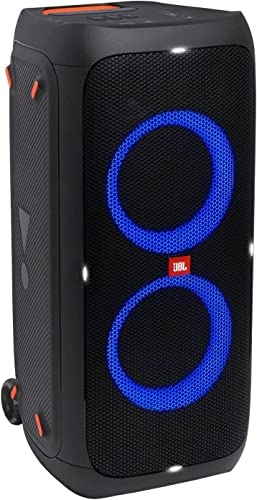
The PartyBox 310 is the elder of this line-up, the model that taught the market what a party speaker was, and its listing keeps the description admirably plain: a portable party speaker with a long lasting battery, powerful JBL sound and an exciting light show, in black. No hours are printed for that battery, and this guide will not invent any; “long lasting” is the claim, and it is reported as such. What the 310 offers instead of paperwork is presence — a large-format cabinet from the generation that established the template, built to anchor a room or a garden corner and be heard from everywhere in it.
There is a case for the established design that spec sheets cannot make. A model with years of parties behind it has known behaviour: owners understand its controls in the dark, its light show is a proven crowd-pleaser rather than a promise, and its sound — described by JBL simply as powerful — has filled enough halls and gardens that its capabilities are a matter of record rather than projection. Households buying for a known calendar of big events — the annual barbecue, the milestone birthdays, the street party — often value that certainty above a newer model’s longer feature list.
The honest cautions belong to the listing’s silences. No inputs are named, so performers should not assume microphone or guitar connections exist on the unit they receive; no playtime hours are printed, so an all-day event should be planned with a charging opportunity in reserve; and no protection grade is stated in the title, so treat weather with respect rather than confidence. Judged as a big, proven, spectacular anchor for crowds that gather around music rather than perform with it, the 310 remains entirely defensible — the patriarch of the party, unbothered by its grandchildren’s extra features.
- Battery: described in the listing as long lasting; no hours printed
- Sound: powerful JBL sound, in the maker’s words
- Spectacle: exciting light show
- Format: large classic PartyBox cabinet
- Colourway in this listing: black
Strengths
- A proven big-format design whose party behaviour is a matter of long record, not promise.
- The light show and cabinet scale give large rooms a natural centre of gravity.
- Simple, established controls reward hosts who value reliability over novelty.
Trade-offs
- Unnumbered battery claims make all-day planning a matter of caution and a spare charging slot.
- No inputs are named in the listing; karaoke plans need verification or another pick.
- Newer siblings add wheels, apps and linking that this generation answers with scale alone.
Best for: big indoor gatherings and hosts who prize a proven, spectacular anchor.
Not suited for: planners depending on printed playtime hours or guaranteed performer inputs.

Sony SRS-XG300 — The stamina pick with manners
Every party line-up needs the pick for people who flinch at the word lightshow, and the XG300 fills that role with unusual completeness. Sony’s listing describes an X-series wireless portable party speaker with IP67 waterproof and dustproof sealing, a 25-hour battery and a retractable handle, in black. No lights are promised. No inputs are promised. What is promised is the strongest weather grading of any pick in this guide and the longest stated battery — a speaker for hosts whose parties are long, whose gardens are exposed, and whose taste runs to music without a disco attached.
Twenty-five hours changes the planning of a weekend. The XG300 can soundtrack a Friday evening, a Saturday working party in the garden and a Sunday lunch on one charge, and its IP67 grade — dust-tight, immersion-rated — means a sudden downpour is a reason to move the chairs, not the speaker. The retractable handle keeps the wide, low body tidy on a shelf between events, and that low stance is itself a party feature: wide speakers do not get knocked over by dancing guests, passing dogs or the host’s own enthusiasm.
Its absence from the karaoke conversation is total, and deliberately so. Households that will never plug in a microphone should not pay for inputs, lights or the circuitry of spectacle; they should pay for exactly what the XG300’s listing offers — stamina, sealing and sound in a body that behaves like furniture. In a guide full of extroverts, it is the pick for hosts whose parties are conversations with excellent music underneath, running from lunch to long past midnight without a single thought given to the charger.
- Battery: 25-hour claim stated in the listing
- Sealing: IP67 waterproof and dustproof — the strongest grade in this guide
- Movement: retractable handle on a wide, low cabinet
- Series: Sony X-series party format
- Colourway in this listing: black
Strengths
- Stamina and sealing together make it the lowest-maintenance party anchor here.
- A wide, low, handle-free-when-parked body integrates into homes that reject the festival look.
- IP67 grading shrugs off the downpour that sends splash-proof rivals under cover.
Trade-offs
- No lightshow, no inputs: the entertainment is the music and the company, full stop.
- The listing prints no output wattage, so comparisons rest on format and the series’ reputation.
- Its width demands a sideboard or a sturdy shelf, not a bookcase slot.
Best for: long, weather-exposed gatherings where the music must outlast the guests’ small talk.
Not suited for: karaoke nights or any party brief that includes a light show.
Soundcore Boom 2 Plus — The boombox that parties
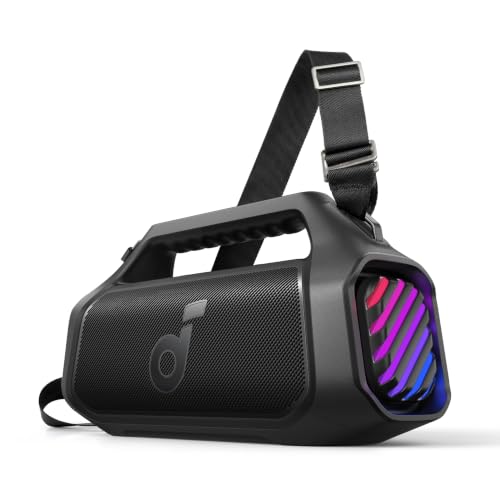
Not every party wants a tower. The Boom 2 Plus arrives in this guide from the boombox direction — a handle-carried unit whose listing claims 140W of output through a 2+2 channel system, BassUp 2.0, 20 hours of playtime, fast charging, RGB lights, a power-bank function, Bluetooth 6.0 and IPX7 waterproofing — and it earns its party seat by treating the gathering as an outdoor endurance event rather than a stage show. There is no telescopic handle, no microphone input, no lightshow in the PartyBox sense. There is, instead, a great deal of organised power in a body one person carries in one hand.
The power-bank function is the party feature nobody lists as one. Phones die at parties — they are the camera, the playlist source and the taxi booking system — and a speaker that can donate charge from its own large battery quietly prevents the three most common endings to a good night. Twenty stated hours means the donation rarely costs the music anything. Fast charging covers the forgotten-charge scenario an hour before guests arrive. IPX7 waterproofing goes beyond the splash-proof treaty of the PartyBox models here: immersion survival, for the speaker that works beside pools and on boats rather than merely near drinks.
Choose the Boom 2 Plus when the party moves — beach days that become beach evenings, campsite gatherings, a sports club’s away day — and when the entertainment is the playlist and the people rather than performances. Its RGB lights give a nod to atmosphere without committing to theatre. Its 2+2 channel layout keeps the music coherent at the volumes a field demands. It is the party pick for hosts who think in logistics, and logistics, at hour seven of a good party, are what separate the hosts still dancing from the hosts crouched over a dead speaker.
- Output: 140W claimed, arranged as 2+2 channel audio with BassUp 2.0
- Playtime: 20 hours stated, with fast charging
- Sealing: IPX7 waterproof
- Extras from the listing: RGB lights, power-bank function, Bluetooth 6.0
- Movement: boombox handle, one-hand carry
Strengths
- Party-grade output in a body that travels like luggage rather than furniture.
- The power-bank function rescues the phones the party depends on.
- IPX7 immersion grading exceeds the splash-proof promise of the tower models here.
Trade-offs
- No microphone or guitar inputs; performers need a different pick or a separate mixer path.
- RGB trim is atmosphere-lite compared with a full PartyBox lightshow.
- No dust grade is claimed, so desert and site use call for extra care.
Best for: mobile outdoor parties — beaches, campsites, club days — powered by playlists.
Not suited for: stage-style events built around singers and speeches.
Comparison
| Pick | Playtime stated | Inputs named in its listing | Protection | How it moves |
|---|---|---|---|---|
| JBL PartyBox Stage 320 | Up to 18 hours | None named | Splash proof | Telescopic handle and wide wheels |
| JBL PartyBox Club 120 | Up to 12 hours | Dual mic and guitar inputs | Splash proof | Foldable handle |
| JBL PartyBox Encore Essential 2 | Up to 15 hours | Mic and guitar inputs | Splash proof | Compact carry format |
| JBL PartyBox 310 | Long lasting; hours not printed | None named | No grade stated in the listing | Large cabinet, carried |
| Sony SRS-XG300 | 25 hours | None named | IP67 waterproof and dustproof | Retractable handle |
| Soundcore Boom 2 Plus | 20 hours | None named | IPX7 waterproof | Boombox handle |
What Turns a Loud Speaker Into a Party Speaker?
Three transformations separate the categories. The first is duration: a loud speaker performs a song, a party speaker performs an evening, which is why battery claims and charging speed run through this guide like a refrain. The second is participation: the moment a party produces a speech, a song or a guitarist, the speaker stops being a jukebox and becomes a small PA system, and inputs — dual on the Club 120, single sets on the Encore — decide whether that moment delights or deflates. The third is atmosphere: light, in the PartyBox sense, gives a gathering a visual centre after dark, and hosts consistently underestimate how much of a party’s memory is carried by how it looked.
There is a fourth transformation nobody advertises: forgiveness. Party speakers get knocked, splashed, borrowed, stored badly and fetched at short notice for years. Sealing grades, sturdy wheels and handles that fold away are forgiveness engineered in advance. When two models tie on sound, buy the one that forgives more — it will attend more parties.
How Do You Run a Karaoke Hour Without Losing the Room?
Karaoke succeeds or fails on logistics, not singing. Begin by choosing the input-equipped pick and testing the whole chain a day early: microphone, cable, input gain, and the balance between voice and backing track at the volume the room will actually use. Set the speaker where the singer faces the audience rather than the speaker itself, because a microphone pointed at its own sound source is a feedback machine; a few metres of separation and a slight angle cure most squeals before they start. Keep a second microphone, where dual inputs allow, for duets and for the compère work of introducing singers — dead air between songs is where karaoke hours go to die.
Curate ruthlessly. A queue managed by one volunteer, a rule of one song per person per round, and a house playlist filling every gap will carry an evening further than any hardware. Lower the music slightly under nervous singers and raise it under confident ones; the mix is an act of hospitality. And end the karaoke while it is still loved — forty brilliant minutes beat two grinding hours, and the speaker returns to playlist duty with the room’s affection intact.
Which Lightshow Habits Separate a Magical Garden From a Migraine?
Lightshows earn their keep after sunset, aimed at spaces rather than faces. A PartyBox placed where its patterns wash a fence, a wall or the ground around a dance area creates depth; the same show pointed at seated guests becomes an interrogation. Use the app or onboard controls to slow patterns down as the evening matures — frantic strobing suits the peak hour and exhausts everyone by midnight — and learn the lights-off path by heart, because every party reaches a conversation phase where the correct lightshow is none at all.
Colour tells a story too. Warm, slow washes flatter food, faces and gardens; rapid multi-colour cycling flatters nothing except excitement itself, in short doses. The Encore’s dynamic lightshow and the Stage 320’s futuristic patterns both reward hosts who treat them as lighting design rather than as a switch labelled fun. Photograph the setup once, early, at the settings you like — future parties will thank the reference, and so will the guests who appear in the pictures.
How Should a Party Speaker Be Positioned for a Hall, a Garden and a Beach?
Halls reward height and restraint. Raise the speaker so its drivers clear the crowd’s bodies — sound absorbed by the first two rows never reaches the rest — and keep it out of corners unless the room is swallowing the bass, in which case a corner is a free amplifier. Gardens reward boundaries: a fence or house wall behind the speaker returns low end that open air steals, and a position sheltered from wind keeps both the sound and the lightshow steady. Face the music across the longest dimension of the gathering, not into its shortest wall of neighbours.
Beaches are the honest examination. Soft sand swallows placement and wheels alike, so carry the speaker the final stretch, set it on something solid — a board, a cooler, a crate — and accept that open coastline demands more volume than any garden. The Boom 2 Plus’s IPX7 grading and the XG300’s IP67 sealing were made for this venue; the splash-proof PartyBox towers belong on the patio above the sand rather than in it. Wherever the venue, walk the perimeter once with the music playing before guests arrive. The far chair is the only honest seat in the house.
What Does Splash Proof Actually Cover When Drinks Start Flying?
Splash-proof, as printed for the Stage 320, Club 120 and Encore Essential 2, describes resistance to light water contact from any direction — rain spots, drink splashes, a hose’s distant mist. It is a treaty with ordinary party accidents, and within those terms it is trustworthy. It is not a promise about immersion, pressure or duration: the speaker left in a downpour, knocked into the pool or blasted by a pressure washer has left the treaty’s territory. Hosts should site splash-proof speakers the way they site the good glasses — inside the party, out of the traffic lanes of chaos.
The IP-graded picks operate under stronger paperwork. IPX7 on the Boom 2 Plus rates immersion survival under test conditions; IP67 on the XG300 adds dust-tightness to the same idea. Even there, party reality adds salt, chlorine, heat and knocks that no laboratory test combines. Rinse graded speakers after pool or sea exposure, dry them before charging, and remember that a rating describes the unit as it left the factory — seals age, and courtesy extends their lives considerably.
How Do You Keep a Party Speaker Neighbourly After Midnight?
Bass is the diplomatic problem: it crosses fences and walls that stop every other frequency, arriving in the neighbour’s bedroom as a disembodied pulse. The midnight routine therefore starts with the low end — trim it, turn the speaker to face into your own space, and move it off shared boundaries and resonant decking. Volume reductions that feel modest at the speaker feel enormous two gardens away, because distance and diplomacy compound.
The Encore’s app control and the general principle behind it shine here: adjustments made from a phone, gradually, without a visible ceremony at the speaker, keep a party’s mood intact while its footprint shrinks. Warn the neighbours before big events, invite the ones you like, and end the outdoor chapter at the hour you announced. A party speaker is a long-term resident of a street as much as of a house, and the hosts who keep theirs welcome keep their parties possible — the most practical specification in this entire guide.
How Do You Plan Power for an All-Day Event With No Socket in Sight?
All-day events fail electrically before they fail socially, so plan the power like a caterer plans ice. Start from the stated figures and discount them for party volume: an 18-hour claim at full tilt is not 18 hours, and the wise host treats every printed figure as a fair-weather friend. Sequence the day so the speaker’s hardest work — the peak hours — happens on the fullest battery, with quieter background duty in the afternoon drawing less. If the event truly outruns one charge, the answers are a second linked unit where the technology allows it, a charging rotation during a meal break, or a generator-and-socket plan arranged before the invitations, not during the speeches.
Phones belong in the same plan. The playlist device should start full, run in a low-power mode, and stay near the speaker rather than circulating for photographs. A power-bank speaker like the Boom 2 Plus collapses two plans into one, which is why that feature keeps earning mentions in this guide; households with other picks should pack a standalone power bank with the same seriousness as the speaker itself. Label the cables. Someone at every event will need the label to be right at midnight.
What Should the Host’s Phone Be Doing All Night — and What Should It Never Do?
The host’s phone is the party’s control tower and its single point of failure. Its jobs: hold the playlist, run the speaker’s app where one exists, and stay connected. Its forbidden activities: being handed to guests to choose songs without a queue rule, leaving the speaker’s range on photo expeditions, and running the torch, the camera and the taxi apps on the same battery that feeds the music. A dedicated playlist device — an old phone, a tablet — is the veteran host’s quiet upgrade, and it costs nothing if the household drawer holds a retired handset.
Playlists deserve the same discipline as power. Build the evening in arcs: arrival music at conversation level, a rising middle, a peak that respects the lightshow, and a landing strip of gentler tracks that tells guests the night is completing rather than collapsing. Download everything; a garden’s Wi-Fi edge and a hall’s dead spot have ended more dances than any speaker fault. The host who prepares the phone properly disappears as a technician and reappears as a guest at their own party, which is the entire point of the technology gathered in this guide.
How Do You Store a Party Speaker So It Survives Its Own Off-Season?
Party speakers hibernate badly when stored carelessly. Charge the battery to a comfortable middle before the quiet months, since lithium cells resent both flat storage and months at full charge in a warm garage. Store the unit indoors, dry, with its handles and wheels unloaded — a tower left leaning on its telescopic handle all winter can take a set in the mechanism — and run it for an hour every month or so. That monthly session is not nostalgia; it exercises the battery, keeps seals from taking a permanent compression set, and reminds the household the speaker exists before the invitation that needs it.
Clean before storage, not after. Drink residue and dust left on grilles and seams all winter become next spring’s archaeology, and sticky lightshow lenses dim the spectacle the speaker was bought for. A damp cloth, a soft brush for seams, a full dry before the cupboard — ten minutes of custody that returns a speaker indistinguishable from the one that was put away. The models in this guide are built to be the loudest objects in a home; stored with this small respect, they will be ready to prove it on the first warm evening of the year.
Which Party Speaker Suits a Wedding, a Street Party and a Children’s Birthday?
Three archetypal events stress three different virtues. A wedding needs stamina, elegance and speech clarity: the XG300’s 25-hour claim and lightshow-free discretion suit the afternoon-to-midnight arc, while an input-equipped PartyBox earns its place the moment speeches and a first-dance announcement enter the script — many wedding hosts end up wanting both virtues, which is an argument for the Encore’s combination of inputs, app control and presentable scale. Speeches, note, punish bass-heavy tuning; a minute spent flattening the EQ for the toast is the difference between a moving moment and a muffled one.
A street party needs throw and mobility above all: the Stage 320’s wheels and 18 hours were designed for tarmac, kerbs and a speaker that must relocate when the road reopens. Children’s birthdays invert every priority — the speaker will be splashed, knocked and operated by small hands, the playlist is non-negotiable, and the correct volume is lower than any adult expects; here the sealed, wide, stable XG300 or the IPX7 Boom 2 Plus forgive the chaos, and the lightshow models earn their keep purely as decoration at a safe distance. Read your own calendar honestly: the speaker that suits your most frequent event, bought well, beats the speaker bought for the grandest event you hosted once.
How Much Does the Room Itself Contribute to a Party Speaker’s Sound?
More than the brochure admits. A hard-surfaced hall adds reflections that can double a speaker’s apparent loudness while smearing speech; soft furnishings in a living room absorb the same energy and make a big speaker feel civilised. Gardens sit between, their fences and walls acting as partial rooms. This is why identical speakers earn opposite reviews from different hosts, and why the setup advice in this guide keeps returning to placement and a perimeter walk: the room is an unlisted component in every system, and the host is its only engineer.
Practical consequences follow. Buy slightly more speaker than the room needs and run it gently, rather than exactly enough speaker run at its ragged edge. Treat the first party in a new venue as a rehearsal with guests — note where the sound pooled, where it died, where the bass boomed — and write the winning position on a note kept with the speaker. Veterans of community halls do exactly this, and their parties sound professional for reasons that have nothing to do with money.
Why Do Hosts Keep the Party Speaker They Bought Second?
Talk to experienced hosts and a pattern surfaces: the beloved speaker is rarely the first one bought. The first purchase is usually made on a single number — output, hours, size — and replaced when real parties reveal the missing virtue: the tower that could not be moved, the loud box with no microphone input on speech night, the elegant unit that faded at hour five. The second purchase is made on a system: movement, stamina, inputs, protection and spectacle weighed together against a known calendar of events. This guide is structured to make your first purchase behave like a second one, which is why its reviews spend as many words on handles and listings’ silences as on sound.
There is a corollary worth stating for readers mid-decision. If you already own a decent loud speaker and your parties keep failing on participation, the upgrade you need is an input, not more volume. If they fail on stamina, the upgrade is battery. If they fail on logistics, it is wheels. Diagnose the failure before shopping the catalogue; the category is mature enough that every failure mode has a model designed against it, and the six above cover the full diagnostic chart between them.
What Goes Wrong at Parties That a Better Checklist Would Have Prevented?
The failures are drearily consistent. The speaker arrives uncharged because it was charged for the last party, not this one. The microphone exists but its cable does not, or the cable exists and the input belongs to a different pick than the one that was brought — the Club 120 and Encore carry inputs; the Stage 320 and 310 listings name none, and discovering that at 9 p.m. is a special kind of silence. The phone running the playlist becomes the camera, the taxi service and the torch, and dies doing all four jobs; the Boom 2 Plus’s power-bank function exists for precisely this obituary.
Placement failures follow: the tower in the middle of the lawn sounding thin, the boombox on the hollow deck booming through the floor, the lightshow aimed at the seated grandparents. Weather failures complete the set — a splash-proof speaker trusted in a downpour, a graded speaker never rinsed after the pool. Every one of these is a checklist item disguised as bad luck. Charge the day before. Test inputs with the actual microphone. Walk the perimeter. Check the forecast against the protection grade. Parties are remembered for their music and their ease; the ease is manufactured in advance, by exactly this kind of unglamorous preparation.
Final Recommendation
Match the speaker to the party you throw most, not the largest you can imagine, and let your calendar — not a catalogue photograph — have the final vote on size. Karaoke households should start at the Club 120 and consider the Encore Essential 2 for its linking and app polish. Garden hosts who move their speaker constantly should wheel the Stage 320 home and stop thinking. The 310 anchors big indoor gatherings with proven spectacle; the XG300 serves long, wet, conversation-rich weekends; the Boom 2 Plus follows the party wherever it migrates. If one recommendation must stand for the whole guide, it is the Stage 320 — not for any single figure in its listing, but because on the wet Saturday when the garden party moved indoors at speed, wheels, eighteen hours and a lightshow turned a relocation into a procession, and the music never once stopped.
Frequently Asked Questions
Do I need microphone inputs if I only karaoke twice a year?
Twice a year is exactly when built-in inputs pay: renting or borrowing a separate PA for two evenings costs more in effort than the feature costs in the purchase. The Club 120 and Encore Essential 2 carry their inputs permanently, so the twice-yearly karaoke night needs no logistics at all — just a microphone and a cable you own.
Can two party speakers really play together?
Where the listing says so, yes. The Encore Essential 2 names an Auracast stereo link, which lets compatible speakers share a stream or form a stereo pair. Other models’ listings here make no linking promise, so confirm on the specific product page before planning a two-speaker layout around them.
Is splash proof enough for a pool party?
For a speaker stationed on the patio near a pool, splash-proofing covers the realistic accidents. For a speaker that will sit at the water’s edge or might be knocked in, choose an immersion-graded pick — the IPX7 Boom 2 Plus or the IP67 XG300 — and rinse it afterwards.
How long before a party should I charge the speaker?
The day before, fully, and then leave it off the charger. Big batteries forgive much, but arriving at setup with a full unit removes the most common failure in this category. Models with fast charging, like the Boom 2 Plus, soften a forgotten charge; treat that as insurance, not a plan.
Will a party speaker work for everyday home listening?
The smaller and more adjustable models do it gladly — the Encore with its app control, the XG300 with its furniture manners. The big towers can, but their tuning and scale are aimed at gatherings; households wanting one speaker for both lives should audition quietly before committing, as the bass guide on this site also advises.
Should the party speaker live indoors or in the garage?
Indoors, if the household can bear it. Batteries prefer room temperature, seals prefer dry air, and a speaker stored where life happens gets used for the small occasions — a Tuesday barbecue, a kitchen disco — that justify its existence between the big events. Garage storage is survivable with the off-season routine described above: part-charged, clean, dry, and exercised monthly. What shortens lives is the damp corner, the freezing boot of a car, and the shelf where a leaking paint tin shares the speaker’s air.
What is the one accessory every party speaker owner should buy?
A known-good microphone and cable if your pick has inputs — owned, tested and stored with the speaker, rather than borrowed in hope on the day. For input-free picks, the equivalent accessory is a long charging cable and a labelled power bank for the playlist phone. Both answers share a principle: the accessory that prevents the known failure is worth more than any decorative extra.
Related Guides
For evenings when the guest list shrinks back to normal size, the pool speaker guide where flotation and sealing grades decide everything covers the water-adjacent end of outdoor listening. Battery stamina across a whole product class gets its own treatment in our battery-powered speaker guide comparing stated playtime figures pick by pick. And when the party moves onto the water itself, a boat speaker guide covering installed marine systems, head units and tower pods explains the fixed-audio world that begins where portable party speakers end.


