What's inside
- Key Takeaways
- Quick Picks
- How Did We Judge the Best Bag for 2 Mirrorless Cameras?
- Why Carry Two Bodies at All?
- What Layout Does a Two-Body Bag Need?
- Six Bags for Two Mirrorless Cameras, Reviewed
- How Do the Six Two-Body Bags Compare?
- How Should You Set Up a Two-Body Bag Before an Event?
- What Mistakes Do Two-Body Shooters Make With Bags?
- How Do You Carry Two Bodies Comfortably All Day?
- Which Lens Pairings Make Two Bodies Worth Carrying?
- How Do You Keep Two Bodies’ Files and Settings in Sync?
- How Do You Protect Double the Investment on the Move?
- What About Rollers and Shoulder Bags for Two Bodies?
- How Does Two-Body Carrying Change Travel Photography?
- What Should You Check in the First Week With a Two-Body Bag?
- How Much Should a Two-Body Bag Cost, Relative to the Kit?
- Which Two-Body Bag Suits Each Kind of Assignment?
- How Do You Maintain a Two-Body Bag and Its Layout?
- Final Recommendation
- Frequently Asked Questions
- Related Guides
As an Amazon Associate I earn from qualifying purchases. This post may contain affiliate links at no extra cost to you.
widgetverdict.com is reader-supported. When you buy through links on our site, we may earn an affiliate commission.
Carrying two mirrorless bodies is a working method, not an indulgence: one body wears the wide lens, the other the telephoto, and the photographer never changes a lens in the rain, the dust or the three seconds a moment allows. But two bodies rewrite the bag problem completely. The best bag for 2 mirrorless cameras must give each body its own protected, instantly reachable home — with lenses mounted, because a two-body system whose bodies travel unmounted has missed its own point — plus room for the third lens, the batteries two bodies consume, and dividers that keep expensive glass from ever touching. This guide is deliberately distinct from a general camera-backpack roundup: every pick here is judged first on the two-body test, and several excellent single-body bags were excluded for failing it.
Where to buy: five picks link to checked Amazon listings. One further option is discussed in prose only, clearly marked, because we could not verify a current listing for it. Confirm capacities against your own bodies and lenses on the listing pages, and check live prices there when you order — two-body bags are bought carefully and kept for years.
Key Takeaways
- The Cwatcun 2-in-1 Camera Sling Backpack is the standout: it is designed to hold two mirrorless bodies with lenses plus a third lens, in a sling that keeps both cameras fast to reach.
- Full backpacks — the K&F Concept and Cwatcun’s backpack — suit two-body shooters who also carry a laptop, a tripod or a long day’s supplies.
- The MOSISO’s hard shell protects a two-body kit best in luggage and crowds, where two cameras double the value at risk.
- CADeN’s backpack is the budget route to two-body carrying, with space doing the work that premium hardware does elsewhere.
- Both bodies should travel with lenses mounted and hoods reversed; a bag that forces unmounting defeats the two-body method.
- Divider discipline matters twice as much with two bodies: each camera gets a dedicated cell, and nothing shares a wall with a screen.
Quick Picks
| Pick | Badge | Why it earns its place |
|---|---|---|
| Cwatcun 2-in-1 Camera Sling Backpack | Best for two bodies | Purpose-sized for two bodies with lenses plus a spare lens, with sling-speed access to both. |
| K&F Concept Camera Backpack | Best two-body backpack | A configurable compartment that builds two proper body cells, plus laptop and tripod carrying. |
| Cwatcun Camera Backpack | Best urban two-body bag | Tidy organisation, rain cover and commuter polish for the city-based two-body shooter. |
| MOSISO Camera Backpack | Best protection for two bodies | Hard-shell front guards double the investment through luggage and crowds. |
| CADeN Camera Backpack | Best budget two-body option | Generous space and water resistance at a price that suits a growing second-body kit. |
| Peak Design Everyday Backpack 30L | Best premium alternative (prose only) | A benchmark divider system and side access from both flanks for two-body professionals. |
How Did We Judge the Best Bag for 2 Mirrorless Cameras?
Every candidate faced the same loading test: two mirrorless bodies, each with a lens mounted — a standard zoom on one, a fast prime or short telephoto on the other — plus a third lens, two spare batteries per body, cards, and the photographer’s daily extras. Bags were scored on whether both bodies could be packed mounted without force, whether each could be drawn without disturbing the other, and whether the divider system could build two genuine cells rather than one compartment with two cameras rattling in it. A bag that technically fits two bodies but makes the second one an excavation project failed the spirit of the test, however impressive its capacity figures.
Access philosophy counted double, because the two-body method exists to save seconds: the wide body and the telephoto body must each be reachable in the moment their focal length is needed. We also weighed protection per body — screens and dials are the vulnerable faces, and a proper layout keeps both turned toward padding — and carrying comfort, since two bodies with lenses approach loads where harness quality stops being a luxury. Laptop and tripod capacity were scored as secondary virtues: welcome, but never at the cost of the two-body core.
Why Carry Two Bodies at All?
The case rests on three pillars. The first is time: at a wedding, a match, a safari or a street festival, the photograph that matters announces itself once, and the photographer with the right focal length already mounted takes it while the lens-changer is still holding a rear cap. Two bodies convert lens changes from an event into a non-event — you simply lower one camera and raise the other. The second pillar is environment: every lens change opens the camera to dust, rain and pollen, and on a beach, a building site or a wet hillside, the two-body shooter changes lenses approximately never, keeping sensors clean and seals unbroken through the whole assignment.
The third pillar is insurance. Cameras fail rarely and choose their moments sadistically; the professional with a second body in the bag finishes the job, and the enthusiast on a once-a-decade trip keeps photographing. Against this stands the honest cost: double the weight, double the batteries, double the value at risk, and a bag problem that this entire guide exists to solve. Two-body carrying is justified by events, environments and stakes — a photographer whose work is unhurried and single-lensed should enjoy the lightness of one body and a general backpack instead. But for those whose shooting matches the case above, the method is transformative, and the bag is where the transformation either works or falls apart.
What Layout Does a Two-Body Bag Need?
Think in cells, not compartments. Each body deserves a dedicated padded cell sized to the body with its lens mounted, arranged so the camera’s screen faces a padded wall and its grip faces your retrieving hand. The two cells should be independent: drawing the telephoto body must not drag the wide body’s strap, shift its dividers or expose it to a knock. Between or beside the cells sits the third lens in its own vertical well, and above or below, a shallow stratum for the flat clutter — batteries in a case, cards in a wallet, cables coiled — that must never migrate into the body cells.
Straps are the layout detail beginners botch. Two cameras mean two straps, and unmanaged straps tangle, catch on dividers and slow every draw. The working solutions are to route each strap into its own cell as part of the packing ritual, to use quick-release strap systems that let the strap live on your shoulder rather than in the bag, or to carry one body on a strap outside the bag and one inside — a hybrid many event photographers prefer, with the bag as the second body’s home and the day’s base. Whichever you choose, rehearse it: the two-body draw should be a single smooth motion for either camera, achievable in the dark, because eventually it will need to be.
Finally, plan the failure layout. If one body is out working, the empty cell is not wasted space to be casually filled with a jacket — it is the returning camera’s home, kept clear so the swap at the next moment is instant. Discipline about empty cells is what separates a two-body system from two cameras sharing a bag.
Six Bags for Two Mirrorless Cameras, Reviewed

Cwatcun 2-in-1 Camera Sling Backpack — Best for Two Bodies
Most bags in this category are single-body bags that can be persuaded to hold two cameras; the Cwatcun 2-in-1 is the rare design that starts from two. Its stated capacity — two camera bodies with lenses, plus a third lens — matches the two-body loading test exactly, and its sling format serves the method’s purpose: swing the pack to your front, and the body you need is in your hand without setting anything down or opening a cavernous main compartment. For event, street and travel photographers who work on foot, that combination of genuine two-body capacity and sling speed is unique at its level.
The 2-in-1 carry adds flexibility the method appreciates: sling mode for shooting, when access is everything, and a more settled backpack-style carry for the journey to and from the venue. The interior’s dividers build the two dedicated cells the layout section demands, and the whole package stays compact enough to remain discreet — two bodies carried without advertising two bodies, which in a crowd is a security feature.
Its limits are the sling format’s own. There is no meaningful laptop space, personal carrying is minimal, and two bodies plus lenses on one shoulder is a load with a time limit — this is a shooting bag for hours of active work, not a trekking bag for a day of hiking between locations. Two-body shooters whose assignments are urban and mobile will find it the most purpose-built answer in this guide.
- Capacity: 2 bodies with lenses + 1 spare lens
- Carry: sling and backpack-style 2-in-1
- Access: swing-around draw for either body
- Profile: compact and discreet
- Role: events, street and travel on foot
Strengths
- Designed for two bodies from the start
- Fastest two-body access here
- Compact despite the dual capacity
Trade-offs
- No laptop accommodation
- Shoulder load limits long carries
- Little room for personal items
Best for: two-body event, street and travel photographers working on foot.
Not suited for: laptop-carrying or hiking-based two-body work.

K&F Concept Camera Backpack — Best Two-Body Backpack
When the two-body day also includes a laptop, a tripod and hours of walking, the answer is a real backpack, and the K&F Concept is the strongest here. Its configurable camera compartment has the volume and divider granularity to build two proper body cells — each body mounted, screened against padding, independently drawable — with the third lens and the day’s batteries arranged around them. The laptop rides in its own space rather than competing with the cameras, and the dedicated tripod carrying matters more to two-body shooters than most, since the tripod is usually serving the wide body for the long-exposure work while the telephoto body stays in hand.
Comfort is the other half of its case. Two bodies with lenses, a laptop and a tripod is a serious load, and the K&F’s harness carries it with the composure that separates a camera backpack from a sack with straps. Materials and weather resistance suit field days, and the bag’s structure keeps the two-cell layout intact when the bag is set down on rough ground and opened like a workstation.
It is the largest commitment in this guide after the prose-only premium pick, and for a two-body shooter whose work is a short walk from a car it is more infrastructure than necessary — the sling serves that life better. For the full expedition version of two-body photography, it is the complete answer.
- Capacity: 2 bodies, lenses, laptop
- Tripod: dedicated carrying arrangement
- Dividers: fine-grained configurable layout
- Harness: built for full-day loads
- Materials: weather-resistant field build
Strengths
- Two proper body cells plus laptop
- Carries the heaviest two-body days well
- Tripod solution suits landscape workflows
Trade-offs
- Bulk exceeds short-trip needs
- Slower access than the sling
- Premium of the linked backpacks
Best for: two-body photographers carrying laptop, tripod and a full day kit.
Not suited for: quick, light, close-to-home shooting.

Cwatcun Camera Backpack — Best Urban Two-Body Bag
Cwatcun’s full backpack fits the two-body shooter whose territory is the city: weddings in hotels and registry offices, corporate events, street work between cafés, content days across locations. Its camera compartment takes two mirrorless bodies with lenses in divided cells, the organisation for the doubled battery and card load is tidy, and the included rain cover answers the urban photographer’s reality that the day continues regardless of weather. The external USB port keeps a phone alive through a long event day from a power bank inside — a small feature that two-body shooters, whose attention is fully spent on cameras, disproportionately appreciate.
Presentation counts in its world: the bag looks like smart luggage rather than expedition gear, which matters when your workplace is a wedding venue. The laptop space covers the event photographer’s same-day backup ritual, and the overall organisation — pockets with purposes rather than a void — suits a kit that must be audited at a glance between venues.
Its field limits mirror its urban strengths: tripod carrying is secondary, and the harness is tuned for pavements and platforms rather than trails. Within the city brief, it is the two-body bag we would carry; outside it, the K&F takes over.
- Capacity: 2 bodies with lenses, laptop
- Extras: USB port, rain cover included
- Organisation: purposeful pockets for doubled kit
- Style: venue-appropriate urban look
- Access: practical event-day layout
Strengths
- Two-body cells with commuter polish
- Rain cover included for event days
- Tidy audit-friendly organisation
Trade-offs
- Tripod carrying is secondary
- Harness tuned for city distances
- Less rugged than field-first rivals
Best for: urban event and wedding photographers running two bodies.
Not suited for: trail-based landscape work with two bodies.
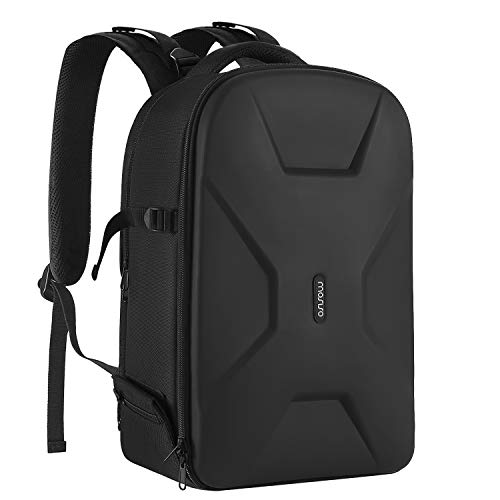
MOSISO Camera Backpack — Best Protection for Two Bodies
Two bodies double the value riding in the bag, and the MOSISO’s hard-shell front is the most direct answer to that arithmetic in this guide. The rigid panel faces the world — the luggage pile, the crowd crush, the boot of the car — while inside, the padded compartment divides into cells for two mirrorless bodies with lenses and the day’s support kit. For the travelling two-body shooter, whose bag endures airports and transfers that a local photographer’s never meets, that shell is not a styling choice but the point of the purchase.
The rest of the package supports the travel brief: water-resistant materials, a laptop space for the road workflow, and a structured shape that packs predictably into overhead lockers and car boots alike. The shell also keeps the bag’s silhouette constant, which helps a two-body layout stay exactly as arranged rather than slowly collapsing around the cameras.
Rigidity’s costs apply doubly here: the shell cannot yield to squeeze a slightly larger load, so a two-body kit with long lenses should be measured honestly against the interior before ordering, and access is conventional rather than quick. Photographers whose two bodies travel gently will not need it; those whose bags live hard lives will consider it the most sensible money in the guide.
- Front: hard-shell protective panel
- Capacity: 2 bodies with lenses, laptop
- Materials: water-resistant exterior
- Interior: padded two-cell potential
- Role: travel and transit protection
Strengths
- Shell protects double investment best
- Structured shape preserves the layout
- Travel-friendly packing behaviour
Trade-offs
- No flex for oversize loads
- Conventional access speed
- Long lenses need careful measuring
Best for: travelling two-body shooters and gear that rides in luggage.
Not suited for: shooters needing the fastest possible draw.

CADeN Camera Backpack — Best Budget Two-Body Option
A second body often arrives before the budget for a premium bag does, and the CADeN is how that photographer carries two bodies properly without postponing the lens fund. Its generous, water-resistant interior divides into two body cells with room for the spare lens and support kit, and its simplicity — no elaborate access systems, no modular ecosystem — keeps both the price and the learning curve low. For the enthusiast stepping into two-body shooting at events, matches or family occasions, it covers the fundamentals completely: separation, padding, weather sense and a harness adequate for the load.
The value framing deserves respect rather than apology. Two-body photography is a method, not a price tier, and a photographer running two modest bodies for a school sports day needs exactly what this bag provides. Its capacity generosity is its headline: where tighter bags force hard choices, the CADeN’s space absorbs the second body, the third lens and the jacket besides.
The compromises are the familiar value ones — hardware and fabrics that serve rather than delight, access that requires setting the bag down, and a harness that is adequate rather than engineered. None prevents the method. If the second body is new and the bag budget is what remains, this is the correct order of priorities.
- Capacity: generous two-body interior
- Materials: water-resistant exterior
- Interior: movable dividers, two cells
- Role: budget route into two-body method
- Extras: room for personal items
Strengths
- Lowest-cost proper two-body carry
- Space absorbs kit and extras
- Simple, learning-curve-free layout
Trade-offs
- Access requires setting the bag down
- Hardware finish is basic
- Harness comfort merely adequate
Best for: enthusiasts adding a second body on a real budget.
Not suited for: professionals needing instant access all day.
Peak Design Everyday Backpack 30L — Best Premium Alternative (Prose Only)
We discuss the Everyday Backpack 30L in prose only, as no verified listing is used in this guide, but two-body photographers deserve to know the benchmark. Peak Design’s divider system — origami-like shelves that fold into custom cells — builds two-body layouts with a precision few rivals match, and its dual side access means whichever body you need is reachable from whichever shoulder the bag hangs on, a genuinely thoughtful answer to the two-body draw. The materials, hardware and weatherproofing sit at the premium standard, and the bag’s expansion and compression adapt it between the two-body event day and the lighter travel day.
Its costs are the premium tier’s usual: the highest price in this conversation, a weight that reflects its hardware, and a design language some find busy. For the professional whose two bodies earn money weekly, it is a defensible flagship; for everyone else, it defines what the picks above are sensibly trading away, and at what saving.
- Capacity: 30L class, two-body layouts
- Dividers: folding shelf system
- Access: dual side access, top opening
- Build: premium materials and hardware
- Availability: covered in prose only here
Strengths
- Divider system of benchmark flexibility
- Either body reachable from either side
- Premium weatherproof build
Trade-offs
- Highest cost in this guide’s field
- Hardware adds carry weight
- Design is visually busy
Best for: working professionals wanting a flagship two-body system.
Not suited for: budget-conscious or minimalist shooters.
How Do the Six Two-Body Bags Compare?
| Bag | Style | Two bodies mounted | Laptop | Best role |
|---|---|---|---|---|
| Cwatcun 2-in-1 Sling | Sling / mini backpack | Yes, purpose-built | No | Fast two-body access |
| K&F Concept Backpack | Backpack | Yes, two cells | Yes | Full expedition days |
| Cwatcun Backpack | Urban backpack | Yes, two cells | Yes | City events and weddings |
| MOSISO Backpack | Hard-shell backpack | Yes, measured fit | Yes | Travel protection |
| CADeN Backpack | Backpack | Yes, generous space | Basic | Budget two-body start |
| Peak Design Everyday 30L | Premium backpack | Yes, shelf dividers | Yes | Professional flagship |
How Should You Set Up a Two-Body Bag Before an Event?
Prepare the night before, in a fixed order. Charge every battery — two bodies consume them asymmetrically, because the telephoto body usually works harder — and load the spares into their case in the bag’s flat stratum. Format both bodies’ cards in-camera after confirming the previous job is backed up twice, and set both clocks to the second: matched timestamps are what let you merge two bodies’ files into one chronological story in the edit, and discovering a seven-minute drift between bodies at midnight is a rite of passage best skipped. Match the bodies’ settings where it helps — picture profile, white balance approach, file format — so the two streams of images arrive already speaking the same language.
Then pack by the layout discipline: wide body in its cell, telephoto body in its, third lens in its well, straps routed as rehearsed. Do the draw test at home — each body out and to your eye, five times each, until the motion is thoughtless. Check the weather and place the rain cover where the bag’s design intends it. Finally, weigh the loaded bag and walk it around the house; two-body loads creep upward as extras accumulate, and the time to remove the unnecessary is the night before, not the morning of. An event photographer whose bag ritual is this boring is an event photographer whose attention, on the day, is entirely free for the photographs.
What Mistakes Do Two-Body Shooters Make With Bags?
The founding mistake is buying a big single-body bag and assuming volume equals a two-body solution. Volume without cell structure gives you two cameras in a padded void, screens against dials, straps in a knot, and a draw that requires excavation — the exact frictions the method exists to eliminate. The second mistake is packing the bodies unmounted to save space, which reinstates lens changes at the worst moments and exposes two sensors instead of none. If a bag forces unmounted packing for your lens pair, it is the wrong bag for your kit, whatever its other virtues.
Third, shooters neglect the doubled logistics: one spare battery where two bodies need a rotation, one card wallet where two bodies fill cards at different rates, settings drifted apart so the merged files fight in the edit. Fourth, they carry both bodies in the bag and work from it like a base station when the assignment rewards wearing one — the bag’s job is to home the resting body and the support kit, and many events flow better with one camera on a strap and one in the sling or backpack, swapping as the light and the programme change. Finally, photographers forget that two bodies double the audit: the pre-event checklist in the previous section exists because a one-body habit scaled carelessly is how a professional arrives with one charged camera and one expensive paperweight.
How Do You Carry Two Bodies Comfortably All Day?
Distribute the load across time as well as across your frame. The working rhythm of experienced two-body shooters alternates the burden: both bodies in the bag for the journey, one worn and one bagged during the event’s long middle, both worn only for the peak passages where moments come fastest. Dual-strap harnesses exist for the both-worn hours and spread the weight across both shoulders — a worthwhile accessory for wedding and sports shooters — while a single cross-body strap serves the one-worn rhythm with less ceremony.
In the bag itself, placement is posture: the two bodies belong against your back, centred, with the lighter clutter at the outer face, and the bag adjusted to ride high so its weight moves with your hips rather than levering from your shoulders. Take the bag off at every genuine pause rather than wearing it through entire receptions; cumulative load is measured in hours, and the photographer who rests the bag keeps their shoulders for the evening’s peak. And be honest about the total: two bodies, three lenses, a laptop and a tripod is a load that justifies the K&F’s harness or a rethink about the tripod — comfort problems in two-body work are usually inventory problems wearing a disguise.
Which Lens Pairings Make Two Bodies Worth Carrying?
The classic pairing divides the world at arm’s length: a wide-to-standard zoom or a wide prime on one body for context, scenes and groups, and a short-to-medium telephoto on the other for faces, details and compression. At weddings that reads as the wide body for the room and the telephoto for the vows; at wildlife outings, the telephoto body does the reaching while the wide body waits for the landscape the animal is standing in. The pairing works because the two fields of view barely overlap, so the choice of which camera to raise is instant and almost never wrong.
Prime pairs are the connoisseur’s version: a fast wide prime and a fast portrait prime, each chosen for a look rather than a range, giving the shooter two distinct visual voices and the low-light reach that zooms cannot match. Zoom pairs suit the unpredictable — sports days and festivals — where the standard zoom and the telephoto zoom together cover everything from the crowd to the far touchline without a gap. What all good pairings share is a rehearsed logic: the photographer should be able to say, for any scene, which body rises, without deliberation. If your two lenses overlap heavily, you are carrying two bodies to make one decision repeatedly, and the second body is earning less than its weight.
The bag follows the pairing. Prime pairs are compact and suit the sling beautifully; zoom pairs, especially with a long telephoto mounted, push toward the backpacks and toward honest measuring of the longest mounted combination against the cell dimensions. Choose the pairing first, the bag second, and the bodies — as heretical as it sounds — last of all, because the pairing is the method and the rest is equipment.
How Do You Keep Two Bodies’ Files and Settings in Sync?
The two-body method continues into the edit, and a little systems thinking prevents its characteristic headaches. Beyond the clock sync described earlier, the highest-value habit is a file-naming or folder discipline that identifies which body shot what: most cameras let you set a custom file prefix, so one body writes WIDE and the other TELE, or the bodies write into separate folders that your ingest preserves. In the editing software, the two streams then sort, filter and colour-match as groups rather than as an interleaved puzzle.
Colour matching deserves its own sentence, because two bodies — even identical models — render slightly differently, and mixed bodies render noticeably differently. Shoot a grey card or a colour reference under the day’s main light with both bodies at the start of the job; thirty seconds then saves an hour of per-image correction later, and gives you the anchor from which a single preset can bring both streams together. White balance set manually to the same value on both bodies, rather than left to two independent auto systems, removes the other great source of mismatch.
Backup discipline scales too: two bodies fill cards at unpredictable relative rates, so the mid-event card check must audit both, and the end-of-day backup is complete only when both bodies’ cards are copied and verified. Photographers new to the method consistently report that the photography felt easier and the administration heavier; the ones who thrive are the ones who built the small rituals above into a checklist and stopped relying on memory.
How Do You Protect Double the Investment on the Move?
Two bodies concentrate value, and the security habits scale accordingly. The first principle is separation of risk: the two bodies should rarely be in the same vulnerable place at the same moment outside the bag — one worn while the other rests in the bag at an event, cards carried on your person rather than in the bag, and the bag itself never left visible in a vehicle. The sling and the urban backpack in this guide earn quiet credit here, because neither announces its contents the way a boxy professional case does, and discretion compounds: a bag that looks ordinary, carried without fuss, attracts the attention of nobody.
In crowds, position is policy. A sling rides to the front when the crowd thickens; a backpack’s access points stay zipped and, where the design allows, the bag comes around to the front on packed transport. At venues, the bag lives within your sightline or your foot’s contact, never under a distant table. These are small disciplines, but two-body kits are precisely the kits worth them — the replacement conversation involves two bodies, three lenses and a photographer’s livelihood or a decade of saving.
Administration completes the defence: serial numbers for both bodies and every lens photographed and stored away from the bag, receipts retained, insurance checked for away-from-home cover at true replacement value, and the kit’s firmware and settings backed up so a replacement body can be configured in minutes. None of this will ever appear in your photographs, and all of it decides whether a bad day stays a bad day or becomes the end of a system.
What About Rollers and Shoulder Bags for Two Bodies?
Backpacks and slings do not own the two-body world, and honest guidance should name the alternatives. Roller cases rule the airport-and-studio circuit: two bodies, many lenses, zero shoulder load, and protection that doubles as a seat — but they surrender on stairs, cobbles, mud and crowds, which is why they complement rather than replace a backpack for most working photographers. If your two-body life runs airport to hotel to venue floor, a roller plus the sling from this guide is a formidable system; if it runs anywhere with weather and terrain, the backpack remains the spine.
Shoulder bags occupy the other flank: the fastest access of any format and a professional discretion that suits documentary and wedding work, at the cost of one shoulder carrying everything and a capacity that tops out around exactly our subject — two bodies with modest lenses is the classic large shoulder bag load. Photographers who work from a base — a car, a venue corner — often run a shoulder bag as the working bag and a backpack as the transport bag. The six picks in this guide were chosen for carry-away-from-base work, where most two-body photography happens; but the shooter whose day is a series of short walks from a parked car should know the shoulder format exists and serves that pattern beautifully.
How Does Two-Body Carrying Change Travel Photography?
Travel is where two-body discipline pays its most photogenic dividends. The dusty safari road, the rainy old town, the beach at golden hour — each is an environment where the one-body traveller either changes lenses and cleans sensors nightly, or quietly stops changing lenses and shoots the whole trip at one focal length. The two-body traveller simply raises the other camera. Travel also sharpens the bag decision, because the bag must now pass airline, hotel and street tests simultaneously: cabin-sized, discreet, quick at security, and comfortable across a full day of walking in a city where you cannot set it down casually.
That combination is why the sling and the MOSISO both appear in a two-body travel kit so often — the backpack as the transit and base bag, the sling unpacked as the day bag, each body migrating between them as the day demands. Splitting the bodies across two bags in transit also splits the risk elegantly: one body worn or in the sling under your seat, one in the backpack above, so no single incident owns your whole system. Travellers who adopt the method rarely return from the first trip willing to give it up, and their explanation is always the same photograph — the one that lasted four seconds, in the rain, at the far end of the telephoto, that a lens change would have spent.
What Should You Check in the First Week With a Two-Body Bag?
Run the loading test with your actual bodies and your longest mounted lens, and be brutally honest about force: a cell that requires persuasion will require it in the dark, in the rain, at the worst moment. Time the draws — not with a stopwatch but with attention — for each body, from each carry position, and repeat the lens-to-bag and bag-to-eye motions until neither requires looking. Then walk the loaded bag for a genuine hour on your real ground, because two-body loads expose harness truths that a trip across the room conceals.
Test the peripherals of the system too: both bodies’ chargers and the full battery rotation packed and retrievable, the rain cover deployable one-handed, the bag’s behaviour on the transport you actually use. Simulate the failure the method insures against — put one body away mid-walk and continue with the other — and confirm the bag swallows the resting body without a repack. A two-body bag that passes your week becomes invisible infrastructure; one that fails it has given you the cheapest possible warning, while an exchange is still a errand rather than an expense.
How Much Should a Two-Body Bag Cost, Relative to the Kit?
A useful sanity frame: the bag is insurance and infrastructure for everything inside it, and its sensible price rises with the value and the working tempo of the kit — but the relationship rewards judgement rather than proportion. The CADeN demonstrates that the two-body method’s essentials — two cells, padding, weather sense — are available at a modest spend, and a photographer running two entry-level bodies loses nothing by starting there. What the steps upward buy is tempo and endurance: the sling’s instant draw, the K&F’s harness over expedition loads, the premium tier’s divider precision and hardware longevity. Those are professional currencies, worth real money to the photographer whose income or once-only occasions depend on seconds and stamina, and worth much less to the hobbyist whose events forgive a slower bag.
The error at both ends is mismatch: a flagship bag nursing a starter kit while the lens fund starves, or a bargain bag entrusted with a professional system whose failure mid-assignment would cost more than every bag in this guide combined. Price the bag against the cost of the day it could ruin — a wedding, a safari, a product launch — and the right tier usually identifies itself. And hold a little of the budget back for the system’s small completions: a dual strap, a battery case, a card wallet, the rain cover if your pick lacks one. Two-body photography is a system purchase disguised as a bag purchase, and the photographers who budget for the system are the ones still praising it in year three.
Which Two-Body Bag Suits Each Kind of Assignment?
Let the calendar arbitrate, as it should. The wedding day — long, mobile, weather-exposed, unforgiving of delay — divides between the sling for the photographer who moves through the celebration and the Cwatcun backpack for the one who also carries the laptop for same-day previews and backup. Sports and wildlife days, with their telephoto emphasis and waiting hours, belong to the K&F: the harness for the walk in, the tripod solution for the hide or the touchline, the cells for a telephoto body that is genuinely large. Street and documentary work in cities is the sling’s home ground, where discretion and the two-second draw decide what gets photographed at all.
Travel assignments layer the system: the MOSISO or the K&F as the transit spine, the sling as the day bag, bodies migrating between them as each day’s risk and distance dictate. Studio-adjacent and corporate work, with its base-and-roam pattern, suits the Cwatcun backpack’s organisation and polish. The enthusiast’s mixed life — family events, school matches, holidays — is the CADeN’s honest territory, covering the method completely at a spend that leaves the second body’s fund intact. No assignment in this list requires the most expensive option, and several point at the cheapest; what they share is the demand that the bag respect the two-body method’s core — mounted, separated, instantly reachable — and every pick here was retained only because it does.
How Do You Maintain a Two-Body Bag and Its Layout?
A two-body layout is a small machine, and it drifts out of tune the way machines do: dividers migrate a centimetre at a time, the battery case wanders, a borrowed lens’s temporary cell becomes permanent, and one day the draw that was thoughtless requires thought. The countermeasure is a monthly five-minute reset — empty the bag completely, brush out the grit that accumulates in the corners and zip tracks, restore the two cells to their rehearsed dimensions, and return every item to its assigned place. Monthly sounds fussy until you price the alternative: the layout discovered to have drifted is always discovered mid-assignment.
The reset is also the audit. Batteries that no longer hold a day’s charge announce themselves when counted; the card wallet’s gaps show which cards never came home; straps show their fraying before it becomes a dropped body. Photographers who run two bodies professionally treat this as part of the craft rather than housekeeping, and their bags look boringly identical in every photograph of them at work — which is precisely the point. A two-body system is a promise you make to a moment that has not happened yet, and the maintenance ritual is how the promise is kept.
Final Recommendation
For most two-body mirrorless shooters, start with the Cwatcun 2-in-1 sling: it is the only pick designed around two bodies from the first sketch, and its access speed is the method’s whole point made physical. Move to the K&F Concept when your two-body days add a laptop, a tripod and distance; choose the Cwatcun backpack for city events, the MOSISO when the kit travels hard, and the CADeN when the second body is new and the budget is honest. The Peak Design remains the premium reference if your work justifies it. Whichever you choose, judge it by the only test that matters: both bodies, mounted, in hand within seconds, all day, without a single lens change in the rain. Do the bed test before you order — both bodies with their working lenses mounted, the third lens, the battery case and the card wallet laid out and measured against the compartment of your chosen pick — because two-body capacity is a physical fact that no product photograph can confirm for your specific kit, and ten minutes with a tape measure is the difference between a system and a compromise.
Frequently Asked Questions
Can a sling bag really hold two mirrorless bodies?
Yes — the Cwatcun 2-in-1 in this guide is specified for two bodies with lenses plus a third lens, which is precisely why it leads a two-body roundup despite its compact size. The qualification is lens size: standard zooms and primes ride happily, while very long telephotos exceed what any sling should carry. Measure your longest mounted combination before ordering, as with any bag here.
Should both bodies be the same model?
Identical bodies simplify everything — shared batteries, cards, menus and muscle memory — and professionals standardise for exactly those reasons. Mixed bodies are common and workable, often an older body serving as the wide or backup camera, provided you accept separate chargers and a settings-matching ritual before events. The bag does not care either way; your checklist should.
Is it better to carry two bodies or one body and faster lens changes?
It depends on the cost of a missed moment and a dirty sensor in your photography. Events, wildlife, sport and weather-exposed work reward two bodies decisively. Unhurried landscape, studio and travel photography usually does not, and there the weight saved buys comfort and a better tripod. Answer from your last ten shoots: count the moments a lens change cost you, and let that number decide.
How do I stop two cameras knocking together in a bag?
Give each body its own divider cell, with screens turned toward padded walls and no shared boundary against a hard item. If two bodies must share a compartment in a pinch, place a divider, a lens cloth wrap or even a folded microfibre between them and pack so nothing can shift — movement is what turns proximity into damage. The bags recommended here all support proper two-cell layouts; use that capability rather than their raw volume.
What spare kit doubles when you carry two bodies?
Batteries and cards first — plan a full rotation for each body, since they drain unevenly. Chargers can often be shared if the bodies match; if they do not, both travel. Add a second strap or a dual harness to the system, and double the pre-event checks: two clocks to sync, two card sets to format, two firmware versions to be aware of. The method’s power is real, and so is its administration.
What is the best bag shape for a wedding photographer with two bodies?
It depends on how you work the room. Photographers who circulate constantly — ceremony to drinks to dance floor without a base — are served best by the sling or by wearing both bodies on a dual harness with the bag as a nearby base for the third lens and spares. Photographers who work from a fixed position for long stretches, moving between two or three stations, get more from a backpack whose drawer-like organisation keeps the resting body and the support kit ordered. Many wedding photographers own both shapes and choose per venue: the sling for the compact registry office, the backpack for the all-day estate. Let the venue list, not habit, make the call.
Can a two-body bag also work on one-body days?
Yes, and it should: the second cell becomes the home for a longer lens, a flash or a compact drone, and the layout discipline transfers unchanged. The sling in particular converts gracefully to a one-body, three-lens walk-around bag. Buying a two-body-capable bag before the second body arrives is a legitimate strategy — it is the one case where buying for the near-future kit beats buying for today’s.
Do I need a bigger bag if my second body has a battery grip?
Possibly, and it is the fit detail most often discovered too late. A gripped body is taller and squarer, and cells sized for a bare body may refuse it or hold it under strain that stresses zips and dividers. Measure the gripped body’s height against the compartment before ordering — the full backpacks here, the K&F especially, absorb gripped bodies most readily — or plan to carry that body on a strap with the bag homing the ungripped one. Many event photographers detach the grip for bag travel and refit it at the venue, which is a workable ritual if your assignments have a base.
What if my two bodies are different sizes?
Mixed pairs — a compact body for the wide work and a larger, gripped body for the telephoto — are common, and the layout adapts by sizing each cell to its own camera rather than forcing symmetry. Build the larger cell first, against the bag’s back panel where structure supports it, and let the smaller body take the more flexible space. The full backpacks in this guide absorb size differences most easily; the sling prefers a matched, compact pair. If one body dwarfs the other, rehearse the pack with particular care, because asymmetric loads also ride asymmetrically, and the harness adjustment that felt right in the shop may pull to one side by the second hour of an event.
How should I pack two bodies for a flight?
Both bodies travel in the cabin, always, with batteries installed or carried per airline rules and lenses mounted or capped in their cells. Split the risk where the system allows it: one body in the sling as your personal item, one in the backpack overhead, cards on your person, and the chargers wherever they fit since they are replaceable in a way bodies are not. At security, a bag whose layout is orderly — cells, not clutter — passes faster and with less handling of your gear by strangers, which is one more dividend of the layout discipline this guide keeps recommending.
Related Guides
For the broader picture, read our guide to the best backpack for mirrorless cameras, compare carry options in best camera straps for two-body shooting, or learn the workflow in how to shoot an event with two camera bodies.


