What's inside
- Key Takeaways
- Quick Picks
- How Did We Choose These Picks?
- Why Does a Bigger Case Actually Work Better?
- What Do Steel and Titanium Actually Buy You?
- Our Six Picks in Detail
- How Do the Six Compare Side by Side?
- How Do You Get the Fit Right on a Larger Wrist?
- What Mistakes Do Men Make Buying a Big Smartwatch?
- How Do Buttons, Crowns and Bezels Behave When It Matters?
- What About the Working Week — Office, Site and Uniform?
- How Should You Think About Longevity in a Big Watch?
- How Do They Handle Calls, Payments and the Daily Smart Stuff?
- What Does a Training Week Look Like Across These Six?
- Why Do Round Cases and Real Crowns Keep Winning?
- Final Recommendation
- Frequently Asked Questions
- Related Guides
As an Amazon Associate I earn from qualifying purchases. This post may contain affiliate links at no extra cost to you.
widgetverdict.com is reader-supported. When you buy through links on our site, we may earn an affiliate commission.
Where to get these watches: each of the six below links to a checked Amazon listing, spanning Samsung’s titanium Ultra and Garmin’s Fenix 8 at the flagship end, Google’s and OnePlus’s big-case Wear OS models in the middle, Amazfit’s rugged T-Rex 3 Pro for endurance, and the steel-cased Fossil Gen 6 as the clearly-labelled clearance route.
The best Android smartwatches for men start from a simple physical truth: a watch is one of the few objects a man wears every day, in every setting, and its size is its signature. The six watches in this guide are chosen for larger wrists and larger intentions — cases of 44 millimetres and up, cases in steel and titanium rather than apologetic plastic, straps with the width and length to sit properly on a broad forearm, and screens that use their acreage for data rather than decoration. Every one pairs with an Android phone as its home platform. Some run Wear OS itself; the Garmin and Amazfit entries run their own systems but live happily alongside Android handsets, and they earn their places because no honest guide to big, serious watches for Android users can omit the two brands that define rugged and flagship outdoors wear.
What “for men” means here is proportion and presence, not a colour palette. A 47 millimetre titanium case with a sapphire lens makes a statement a 40 millimetre aluminium pebble cannot, and it also does practical work: bigger batteries, bigger displays for maps and data fields, crowns and buttons operable with gloves or wet hands, and straps that do not look like afterthoughts on a 20-centimetre wrist. This guide weighs those things alongside the usual health and training depth, and it keeps one honesty rule from our fitness coverage: the Fossil Gen 6 appears with its ended software support stated plainly, because a bargain you understand beats a bargain that surprises you.
Key Takeaways
- Every pick measures 44mm or larger, with cases in titanium, stainless steel or armour-grade builds — presence is the brief, and these deliver it.
- The Galaxy Watch Ultra and Fenix 8 are the true flagships: titanium, sapphire, serious water resistance and the deepest toolsets in the guide.
- Pixel Watch 5 and OnePlus Watch 2 bring Wear OS to big wrists — one for Google’s ecosystem polish, one for multi-day battery.
- The Amazfit T-Rex 3 Pro is the endurance-and-value rugged pick, trading app depth for weeks-scale stamina and military-grade toughness.
- The Fossil Gen 6 offers real steel and a rotating crown at clearance money, with the explicit caveat that its software updates have ended.
- Strap width and length matter as much as case size: check that the included band fits larger wrists without living on its last hole.
Quick Picks
| Pick | Badge | Why it earns its place |
|---|---|---|
| Samsung Galaxy Watch Ultra (2025) | The titanium flagship | A 47mm titanium case, sapphire glass, 100-metre water resistance and Samsung’s full health suite in its toughest form. |
| Garmin Fenix 8 | The outdoors instrument | The 47mm AMOLED flagship of the Fenix line — maps, training depth, flashlight and weeks of battery for men who measure weekends in summits. |
| Google Pixel Watch 5 (45mm) | The polished all-rounder | Google’s biggest Pixel Watch with Fitbit’s health brain — the smartest everyday big watch for Android loyalists. |
| OnePlus Watch 2 | The steel endurance pick | A 46mm stainless case, sapphire crystal and a dual-chip design that gives Wear OS a multi-day battery. |
| Fossil Gen 6 | The clearance classic | A 44mm steel case and proper crown at a fraction of launch price — bought knowing Fossil has left the business. |
| Amazfit T-Rex 3 Pro | The rugged value tank | Military-grade toughness, dual-band GPS and battery measured in weeks, at a price the flagships cannot approach. |
How Did We Choose These Picks?
The entry ticket was physical: a case of at least 44 millimetres, construction that reads as equipment rather than accessory, and a strap system sized for larger wrists — including enough length that a big wrist is not living on the final hole with the keeper straining. Materials were scored honestly: titanium and sapphire at the top, stainless steel next, and reinforced polymers admitted only where the design intent is overtly rugged, as with the T-Rex. Buttons and crowns had to be operable with wet or gloved hands on the outdoors picks, because a flagship that cannot be used on the mountain it advertises is a photograph, not a tool.
Platform fit came second. Each watch had to pair fully with Android phones — Wear OS models natively, Garmin and Amazfit through their mature Android apps — and each had to carry a health and training suite deep enough for the men who buy big watches: structured workouts, GPS that holds a line, sleep and recovery interpretation, and water resistance that survives the swimming, showering and weather of an active life. We also verified current listings for every linked pick, and where a model’s story includes a caveat — one does, prominently — the caveat is printed in its review rather than footnoted.
What fell away: compact models however excellent, fashion-first watches whose cases are plating over lightness, and any big watch whose size was its only idea. The six survivors each bring a distinct argument — ultimate Samsung, ultimate Garmin, Google’s polish, OnePlus’s stamina, Fossil’s steel-at-clearance, Amazfit’s rugged value — and the rest of this guide exists to help you decide which argument matches your wrist and your week.
Why Does a Bigger Case Actually Work Better?
It is tempting to treat case size as pure vanity, and for some buyers it honestly is — but the engineering case for size is stronger than the aesthetic one. A larger case holds a larger battery, and in a category where endurance is the standing complaint, the 45-to-47 millimetre class is where Wear OS watches stop apologising and rugged watches start measuring battery in weeks. A larger display shows a map you can navigate by, four to six data fields you can read at the bottom of a rowing stroke, and notification text that does not require a squint and a scroll. Larger buttons and crowns work under gloves, with numb fingers, mid-race, mid-rain.
Proportion is the other half. Watch sizing is architecture: a 40 millimetre case on a 20-centimetre wrist looks like a coin on a plate, its strap pinched narrow at the lugs, the whole object reading as borrowed. The watches here are designed at scale — lug widths of 22 millimetres and beyond, straps that taper like they mean it, case profiles that sit flat despite their diameter because their designers expected a substantial wrist underneath. If you have ever tried on a flagship compact and felt it vanish, this guide is the correction: six watches built to be present, in the boardroom and on the ridgeline alike.
What Do Steel and Titanium Actually Buy You?
Materials are where men’s watches separate into jewellery and equipment, and the two flagship picks here make the case for paying the difference. Titanium, as in the Galaxy Watch Ultra, delivers steel’s strength at roughly half the heft, shrugs off scratches into a patina rather than a scar, and never feels cold-shocking on a winter wrist. Stainless steel, as in the OnePlus Watch 2 and Gen 6, brings the traditional watchmaker’s virtues: it polishes, it weighs with reassuring density, and it matches a century of men’s jewellery convention. Sapphire crystal, fitted to the Ultra, the OnePlus and the Fenix in this guide, is the quiet hero — effectively scratch-proof against everything except diamond and carelessness, it keeps a hard-used watch looking new years after coated glass would be a map of its owner’s life.
The honest counterweight: premium materials insure the parts of a watch that rarely fail, while the battery and software age on their own schedule regardless of case metal. A titanium watch with a tired battery in year four is a beautiful paperweight, which is why this guide pairs every materials discussion with a support discussion. Buy the metal for the daily pleasure of it — the heft, the finish, the way a sapphire lens catches light — and buy the platform for the years. The flagships below are the rare picks that let you do both at once.
Before the detailed reviews, one sizing courtesy this guide insists on: if you are buying as a gift for a man whose wrist you cannot measure, err toward the 45–46 millimetre middle of this guide rather than the 47 millimetre flagships, and keep the receipt in the box without embarrassment. Watch fit is personal in a way phone size never was, and the return of a flagship for its smaller sibling is a normal transaction in this category — retailers expect it, and the recipient will think better of a watch that fits than of a guess that was defended past its usefulness.
Read the detailed reviews with your own calendar open beside them. The specifications will look similar at a glance — big cases, bright screens, deep health suites — but the watches diverge the moment they meet an actual week of weather, work and training, and that divergence, not the spec sheet, is what the next six sections are for.
Our Six Picks in Detail

Samsung Galaxy Watch Ultra (2025) — The titanium flagship
Samsung’s Ultra is the company’s answer to a question its regular Galaxy Watches could not address: what does Samsung’s health empire look like when it is built like expedition equipment? The answer is a 47 millimetre titanium case with a raised sapphire lens, a cushion-shaped chassis that shrugs off impacts, water resistance rated to 100 metres, and an operating envelope spanning mountain cold to desert heat. The 2025 edition carries the line’s refinements forward — the newest Wear OS, Samsung’s most complete sensor stack and its longest battery showing yet, stretching toward two days of ordinary use and further in its endurance modes.
The health suite is Samsung Health without restraint: the BioActive sensor’s heart rate, ECG and body-composition readings, Energy Score each morning, advanced sleep analysis, and training tools that include race predictions and personalised zones. A dedicated Quick Button launches workouts or the emergency siren — a genuinely loud, genuinely useful safety feature for solo trail runners — and dual-frequency GPS keeps the trace honest in cities and canyons alike. On a large wrist the Ultra looks inevitable, like it was traced from the forearm outward; the orange-accented trail band in the box completes a design language that owes more to dive watches than to phones.
Reservations are the flagship usuals. The price sits at the top of the Android market, the case is a commitment that smaller wrists should not make, and Samsung’s best health features continue to assume a Galaxy phone in your pocket. Battery life, while the best of Samsung’s Wear OS line, remains a two-day conversation rather than the Fenix’s fortnight. But as the single most complete Android-native smartwatch for a man who wants one object for the office, the ocean and the ultra-distance start line, the Ultra has no peer on its own platform — it is the pick this guide would hand to a buyer who said “just give me the best one” and meant it.
- Case: 47mm titanium, cushion chassis
- Display: Super AMOLED under sapphire crystal, very high brightness
- GPS: dual-frequency onboard GPS
- Battery: up to about 2 days typical; longer in power-saving modes
- Water resistance: 100 metres (10 ATM) plus IP68
- Health: BioActive sensor, Energy Score, ECG, body composition, sleep suite
Strengths
- Titanium, sapphire and 100-metre resistance — the toughest build in Samsung’s history.
- The full Samsung health and training suite with no features held back.
- Quick Button and siren add real outdoor safety utility, not marketing garnish.
Trade-offs
- Top-of-market pricing, and a 47mm case that excludes smaller wrists entirely.
- Battery life still trails dedicated outdoors watches by weeks.
- Full health features are happiest paired with a Galaxy phone.
Best for: men who want the definitive Android smartwatch — flagship health, flagship materials, no compromises discussed. Not suited for: slim wrists, tight budgets, or anyone whose phone loyalty lies elsewhere and hates asterisks.

Garmin Fenix 8 — The outdoors instrument
The Fenix 8 is not really a smartwatch that does sport; it is a professional outdoors instrument that learned smartwatch manners. This 47 millimetre AMOLED edition wraps Garmin’s deepest capability set in a case built for decades: multi-band GPS with SatIQ efficiency, full-colour topographic maps on the wrist, a built-in LED flashlight that sounds like a gimmick until a tent, a trailhead car park or a dark gear cupboard converts you in one use, and a microphone and speaker that bring calls and voice commands to a line that historically disdained them. Training readiness, endurance score, hill score, race widgets, structured workouts for everything from ultras to skiing — the Fenix does not summarise your athletic life, it files it in triplicate.
Battery life redraws the category’s expectations: the AMOLED Fenix 8 runs well over two weeks in smartwatch mode for typical users, and the solar siblings stretch further still. That stamina changes behaviour — sleep tracking every night without arithmetic, multi-day expeditions without a charging plan, a watch that is simply always ready in the way a mechanical tool is ready. The health side matches the training side: HRV status, Body Battery, sleep coaching, jet lag advice, ECG where approved. Paired with an Android phone, notifications and Garmin’s ecosystem work completely; you surrender Google’s app store and wrist payments vary by region and bank, and in exchange you receive the most capable outdoors computer ever strapped to a wrist.
The costs are literal and figurative. This is among the most expensive watches in this guide, the case is a substantial 47 millimetres with the thickness to match, and Garmin Connect’s depth asks for a learning investment measured in weekends. Men whose training is a gym membership and a Sunday run will use a tenth of it. But for the man whose calendar holds summits, ultras, open-water swims or backcountry anything — or who simply wants the best instrument and resents charging — the Fenix 8 is not one option among six. It is the benchmark the other five are photographed against.
- Case: 47mm, fibre-reinforced polymer with metal rear, AMOLED edition
- Display: AMOLED touchscreen with button control, sapphire options in range
- GPS: multi-band GNSS with SatIQ
- Battery: over two weeks typical smartwatch use
- Extras: built-in LED flashlight, speaker and microphone, dive-rated water resistance
- Health: training readiness, HRV status, Body Battery, sleep coach, ECG (region dependent)
Strengths
- The deepest training, mapping and navigation suite available on any wrist.
- Weeks of battery with an AMOLED screen — the endurance argument ended.
- Flashlight, calls and dive capability make it a genuine multi-tool.
Trade-offs
- Flagship pricing and a learning curve to match the capability.
- Large, thick case is pure equipment — formal settings will notice.
- No Wear OS app store; Garmin’s ecosystem is a walled garden of its own.
Best for: serious outdoorsmen, endurance athletes and tool-watch men who want the definitive instrument. Not suited for: casual exercisers, small wrists, or buyers who want Google’s apps on the wrist.

Google Pixel Watch 5 (45mm) — The polished all-rounder
If the Ultra is Samsung in armour and the Fenix is a field instrument, the Pixel Watch 5 in 45 millimetres is the executive’s big watch — the one designed to look right with a suit at noon and a sweatshirt at seven, while quietly running the most coherent health software in the Android world. The domed glass design scales up gracefully to this size, the display is the brightest and most legible Google has shipped, and the Fitbit engine underneath delivers the morning readiness score, training-load guidance and sleep insight that owners consistently cite as the features they actually use, as opposed to the features they were sold.
Daily life is this watch’s home turf. Google Assistant, Maps with offline support, Wallet, and the full Play Store bench of apps make it the most capable wrist computer in this guide; calls are clear, notifications are actionable in the way only a native platform watch manages, and pairing with any Android phone — Pixel most seamlessly — takes minutes. The 45 millimetre case finally gives that polish the presence larger wrists require: this is a big watch that reads as designed rather than inflated, with a strap system and accessory range deep enough to dress it up or down across a week.
The compromises are refinement’s usual taxes. Battery life is a day to a day and a half — the shortest runway here alongside the Gen 6 — so the charging habit must fit your mornings. Fitbit Premium gates the deepest health insights, an ongoing cost to weigh against Samsung’s largely included suite. And while the build is premium aluminium and glass, it is not titanium-and-sapphire expedition armour; treat it as the finest city watch in the guide rather than a tool for the crag. For the Android man whose life is meetings, training sessions and travel in rotation, that is precisely the right specialisation.
- Case: 45mm aluminium, domed glass design
- Display: AMOLED Actua, highest brightness in Google’s line
- GPS: onboard, offline Maps support
- Battery: roughly 1–1.5 days typical use
- Strap: Active band standard; deep first-party accessory range
- Health: Fitbit readiness, cardio load, ECG, SpO2, temperature, sleep stages
Strengths
- The most polished everyday Wear OS experience, in a properly large case.
- Fitbit’s readiness and load coaching turns health data into decisions.
- Works at full strength with any Android phone brand.
Trade-offs
- Daily charging rhythm required; the shortest battery here besides the Gen 6.
- Premium subscription needed for the deepest Fitbit layer.
- City-premium build, not expedition armour.
Best for: Android professionals who want the smartest big watch for work, training and travel in one polished object. Not suited for: multi-day off-grid use or buyers who refuse subscriptions on principle.

OnePlus Watch 2 — The steel endurance pick
The OnePlus Watch 2 makes its argument in two materials and one number. The materials are stainless steel and sapphire crystal — a traditional watchmaker’s pairing that gives this 46 millimetre case the heft, polish and scratch resistance of a serious men’s watch rather than a gadget. The number is its battery life: a dual-processor design, where a frugal chip runs the everyday watch and the full Wear OS processor wakes on demand, stretches smartwatch endurance to roughly three to four days — a figure that embarrasses every other Wear OS entry in this guide and changes the ownership experience from nightly ritual to occasional errand.
Capability backs the headline. Dual-frequency GPS tracks runs and rides with flagship accuracy, the AMOLED display is bright under hard sun, and the build carries military-grade toughness credentials beneath its polished manners. OHealth covers workouts, sleep, stress and heart-rate variability competently, and when you need the full Google arsenal — Maps, Wallet, Assistant, the Play Store — it is all there at a tap, because this is a true Wear OS watch and not a fitness band in a steel costume. On a large wrist it sits with the quiet confidence of a mid-century sports watch, which is exactly the register most men are shopping for.
Where rivals pull ahead is depth of interpretation. OHealth reports more than it coaches; there is no readiness score with Fitbit’s polish or body composition with Samsung’s flair, and the single large size, while on-brief for this guide, is the only size — wrists at the smaller end of “large” should try it in person. Update cadence from OnePlus is respectable rather than legendary. None of that displaces the core truth: for the man who wants a steel-and-sapphire Wear OS watch and refuses to charge it nightly, this is the only serious candidate in the guide, and it is a very good one.
- Case: 46mm stainless steel, sapphire crystal
- Display: AMOLED, high outdoor brightness
- GPS: dual-frequency onboard GPS
- Battery: roughly 3–4 days smart mode; longer in power saver
- Strap: fluoroelastomer sport strap, standard lugs
- Health: workouts, sleep, HRV, stress via OHealth
Strengths
- Multi-day battery in a full Wear OS watch — the endurance benchmark of its platform.
- Steel and sapphire construction reads as a real men’s watch.
- Dual-frequency GPS and rugged credentials suit serious training.
Trade-offs
- Health coaching is thinner than Fitbit’s or Samsung’s layers.
- One size only, and it is unapologetically large.
- No ECG or body-composition features.
Best for: men who want traditional watch materials and Wear OS apps without the nightly charge. Not suited for: buyers wanting deep coaching scores or a choice of case sizes.
Fossil Gen 6 — The clearance classic
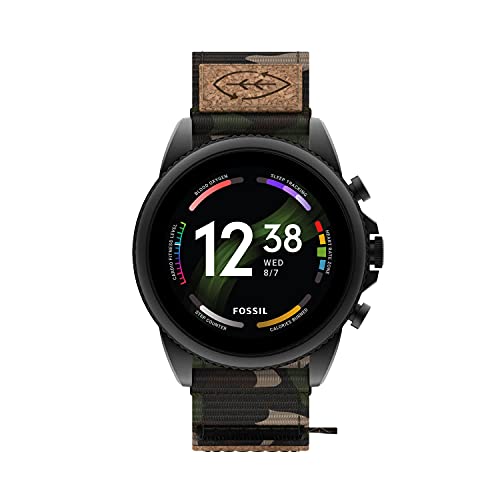
Read this review as two reviews sharing a case, because the Gen 6 is two products now: the watch it is, and the platform it no longer has. The watch itself remains handsome in the way Fossil’s fashion heritage guarantees — a 44 millimetre stainless case with a proper rotating crown and pushers, a bright AMOLED face, the still-fluid Snapdragon Wear 4100+ inside, onboard GPS, heart-rate and blood-oxygen sensing, and fast charging that remains the quickest top-up in this guide. In a metal bracelet configuration it passes for a conventional men’s watch more convincingly than anything else here with a touchscreen, and its clearance pricing puts steel-cased Wear OS within reach of budgets the flagships laugh at.
The platform, however, has left. Fossil Group exited the smartwatch business, and software updates for the Gen 6 have ended: the Wear OS version it runs is its final one, Google’s newer health features will not arrive, and the app ecosystem will age around hardware that deserved better. Security patches are finished. A buyer who understands that — who wants a good-looking notification-and-basic-fitness watch for a couple of years at a steep discount, trains with a phone in pocket anyway, and treats the purchase as a consumable rather than an heirloom — can still extract real value here, and this guide respects that buyer too much to hide the option from them.
Everyone else should hear the warning as the recommendation. A smartwatch is software wearing a case, and buying frozen software at any discount is renting yesterday. The steel is real, the crown is lovely, and the price is tempting — and the Galaxy and Pixel picks above will still be receiving features when the Gen 6 is a drawer artefact. Choose it knowingly or not at all.
- Case: 44mm stainless steel, rotating crown and pushers
- Display: AMOLED touchscreen
- GPS: onboard GPS
- Battery: roughly a day; fastest charging in this guide
- Strap: varies by configuration; metal bracelet options exist
- Health: heart rate, SpO2, workout and sleep basics via Wear OS
- Support status: Fossil exited smartwatches; updates have ended
Strengths
- Genuine steel-case watchmaking presence at clearance pricing.
- Rotating crown and fluid performance still feel premium in hand.
- Fast charging forgives its one-day battery better than rivals manage.
Trade-offs
- Software support has ended — no future Wear OS or health features.
- No readiness or coaching ecosystem comparable to rivals’.
- A purchase for the short term, however solid the case feels.
Best for: style-led bargain hunters who fully accept a frozen platform for a season or two. Not suited for: long-term owners, gift buyers, or anyone expecting Google’s latest features.
Amazfit T-Rex 3 Pro — The rugged value tank
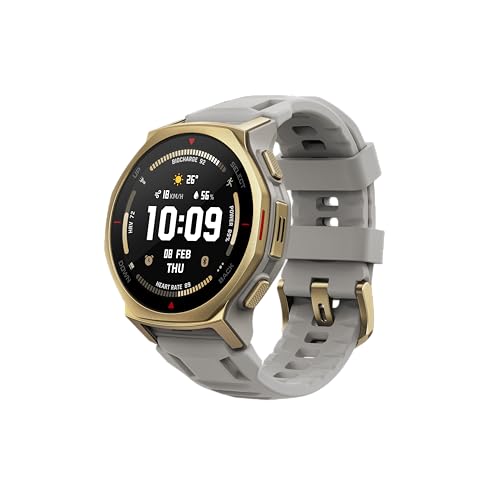
The T-Rex line has always been Amazfit’s argument that toughness should not cost flagship money, and the 3 Pro is its most complete statement: a chunky, military-grade-tested case that treats knocks as a design brief, dual-band GPS with offline maps and route support that undercut rivals costing far more, and a battery that operates on the weeks scale — long enough that charging becomes a monthly calendar event rather than a daily habit. For men whose work or play involves gloves, weather, dust and distance, this is the watch in the guide that looks back at those conditions without blinking.
Amazfit’s Zepp platform has matured into a credible health home: readiness scoring, sleep and HRV tracking, training load and recovery views, and an AI-coached layer that keeps improving. The T-Rex 3 Pro adds the outdoors furniture its audience actually uses — a bright display readable in direct sun, a flashlight function, barometric altitude, compass, and water resistance fit for swimming and worse. It pairs with Android phones completely, notifications and all, and asks for no subscription to unlock the health features it advertises, a pricing honesty that deserves naming in a guide where two rivals keep their best insights behind a paywall.
The trade-offs are ecosystem depth and refinement. Zepp’s app, while capable, lacks the third-party breadth of Wear OS — no Google Wallet ubiquity, a thinner bench of installable apps — and the watch’s personality is unapologetically rugged, which pairs with a suit the way a hiking boot pairs with a tuxedo. Sensor polish at the extremes, particularly wrist heart rate during violent intervals, trails the Fenix’s best. But weighed as a package — toughness, maps, weeks of battery, no subscription, at a mid-market price — the T-Rex 3 Pro is the value engineering triumph of this guide, and the pick we would hand to the man who breaks things for a living.
- Case: large rugged case, military-grade toughness testing
- Display: AMOLED, high brightness for direct sun
- GPS: dual-band GNSS with offline maps
- Battery: weeks-scale, typically two to three weeks of mixed use
- Extras: flashlight, barometer, compass, swim-ready water resistance
- Health: readiness, sleep, HRV, training load via Zepp — no subscription
Strengths
- Weeks of battery plus genuine ruggedness at a mid-market price.
- Offline maps and dual-band GPS shame pricier outdoors rivals.
- No subscription wall between you and the advertised health features.
Trade-offs
- Third-party apps and payments trail the Wear OS picks clearly.
- Rugged styling is a uniform, not a wardrobe — formal settings need not apply.
- Interval heart-rate polish sits a step behind the Fenix 8.
Best for: tradesmen, soldiers, hikers and heavy users who want toughness and stamina without flagship money or subscriptions. Not suited for: app collectors, Wallet devotees, or boardroom-first buyers.
How Do the Six Compare Side by Side?
| Watch | Case | Material highlight | GPS | Battery | Character |
|---|---|---|---|---|---|
| Galaxy Watch Ultra (2025) | 47mm | Titanium, sapphire | Dual-frequency | ~2 days | Platform flagship |
| Garmin Fenix 8 | 47mm | Metal bezel, AMOLED | Multi-band | 2+ weeks | Outdoors instrument |
| Pixel Watch 5 | 45mm | Aluminium, domed glass | Onboard | ~1–1.5 days | Polished all-rounder |
| OnePlus Watch 2 | 46mm | Stainless steel, sapphire | Dual-frequency | ~3–4 days | Steel endurance |
| Fossil Gen 6 | 44mm | Stainless steel | Onboard | ~1 day | Clearance classic |
| Amazfit T-Rex 3 Pro | Large | Military-grade build | Dual-band | 2–3 weeks | Rugged value |
How Do You Get the Fit Right on a Larger Wrist?
Big watches fail in two directions: the case that is right but the strap that is not, and the strap cinched so hard the sensors read your pulse through a tourniquet. Before ordering, measure your wrist circumference and compare it against the strap’s stated range for the exact model — several watches here include generous bands, but “generous” varies by brand, and living on the last hole means the watch migrates toward your hand all day, smearing heart-rate readings and annoying you in equal measure. If you fall between ranges, budget immediately for the longer strap or a third-party band in the correct lug width; every pick here uses standard or well-supported fittings, so the aftermarket is deep.
On the wrist, the training fit and the office fit are different notches. For workouts, seat the watch a finger’s width above the wrist bone and snug it until it cannot slide — optical sensors need that stability, especially on larger, hairier forearms where light leakage is the enemy. For the desk and the evening, one notch looser lets the case sit as jewellery rather than equipment. And give a big watch a full day before judging its weight: titanium’s lightness surprises, steel’s heft grows on most men within a week, and the Fenix’s presence becomes reassurance. The return window exists for the honest minority whose wrist and watch simply disagree — use it without sentimentality.
What Mistakes Do Men Make Buying a Big Smartwatch?
The first is buying diameter without checking thickness and lug-to-lug length; a 47 millimetre watch with long lugs can overhang a medium wrist that a differently shaped 47 sits on perfectly, and overhang is where comfort goes to die. The second is paying flagship money for capability your life never invokes — topographic maps for a man whose wilderness is a golf course — while skimping on the unglamorous specification you will feel daily, which is battery life. Match the toolset to the calendar you actually keep, not the one in the advertisement or the one you describe at parties.
Third, buyers ignore the platform asterisk: Samsung’s fullest health features want a Samsung phone, Google’s deepest insights want a subscription, Garmin and Amazfit want you inside their apps rather than Google’s. None of these is disqualifying; all of them should be chosen knowingly. Fourth, they buy the frozen platform on looks — the Gen 6’s steel has ended more rational analyses than any feature in this guide — without pricing its ended support into the decision. And fifth, they never swap the strap: a big watch on its boxed silicone band is wearing one outfit forever, and half the pleasure of this size class is dressing it — steel bracelet for the week, trail band for the weekend — with thirty seconds of spring-bar work.
One more consideration belongs in this section because men ask it constantly and spec sheets answer it badly: weight is a relationship, not a number. A steel watch that alarms you on the shop counter becomes unnoticeable by the third day for most wearers, while a featherweight case that shifts and rattles on a loose strap annoys forever. Judge heft after a day of wear, never after a minute.
How Do Buttons, Crowns and Bezels Behave When It Matters?
Touchscreens fail in the exact conditions big watches are bought for: rain on the lens, gloves on the hands, sweat on everything. That is why the control hardware of this guide’s picks deserves a section of its own. The Fenix 8’s full button array remains the gold standard — every function reachable by feel, mid-storm, without looking — and its touchscreen is best understood as a convenience layered over a button watch rather than the other way round. The Galaxy Watch Ultra’s Quick Button and rotating-bezel heritage answer the same need in Samsung’s dialect, while the Pixel Watch 5’s crown-and-button scheme is elegant in the dry and merely adequate in the wet. The OnePlus and Gen 6 crowns scroll lists satisfyingly, a small tactile pleasure that owners use a hundred times a day without noticing they are doing it.
The practical test to run in any shop or return window: start a workout, pause it, and lap it three times with wet hands, then once with the gloves you actually train or work in. A watch that passes becomes invisible in use; a watch that fails will be cursed at precisely the moments it was bought for. Men shopping this category tend to compare screens and sensors for hours and controls for seconds — invert that ratio and you will choose better, because the controls are the part of the watch your fingers will know best.
What About the Working Week — Office, Site and Uniform?
A big smartwatch lives a double life, and the six here divide by how gracefully they cross between their two worlds. The Pixel Watch 5 and OnePlus Watch 2 are the natural diplomats: polished cases, quiet profiles under a cuff, faces that default to a clock rather than a cockpit — they attend the meeting without commenting on it. The Galaxy Watch Ultra crosses over in the manner of a luxury sports watch, its titanium and orange accents reading as intentional style rather than escaped gym equipment, particularly on a metal or leather strap. The Fenix 8 and T-Rex 3 Pro make no such promise and keep none; they are uniforms of a different kind, and in trades, services and outdoor professions that honesty is itself the correct dress code.
Strap-swapping is the working week’s cheat code, and every pick here supports it in seconds. Silicone for the site and the session, steel or leather for the office and the evening: the same watch head covers both lives for the price of a second band, which is why this guide keeps returning to lug widths and quick-release fittings as if they were features — because across a five-day week, they function as two watches. Buy the second strap with the watch, not after a month of meaning to, and the big case you chose for its presence will earn that presence in every room you enter.
How Should You Think About Longevity in a Big Watch?
Men keep watches — it is the category’s founding habit — and a smartwatch purchase should be interrogated with the same decade-mindedness, even if the honest answer is a shorter horizon. The electronics set the ceiling: batteries fade measurably across three to five years, and software support, as the Gen 6 testifies, can end sooner than the hardware does. Against that ceiling, the picks rank themselves plainly. Garmin’s support culture and the Fenix’s replaceable-strap, sapphire-armoured build give it the longest plausible service life here; Samsung and Google publish multi-year update commitments that make the Ultra and Pixel 5 sound four-year purchases; Amazfit and OnePlus occupy the respectable middle; and the Gen 6 is, by its own section’s admission, a short story rather than a novel.
Care extends whatever life the platform allows. Rinse salt and chlorine, keep the charging contacts clean, avoid leaving any of these on a hot dashboard, and replace straps before they fail rather than after — a dropped flagship teaches the price of a worn spring bar in one lesson. Do those small things and the watch you buy from this guide should still be on your wrist, legible and loyal, when the phones it has outlived are forgotten in a drawer.
How Do They Handle Calls, Payments and the Daily Smart Stuff?
Beneath the steel and the training suites, these remain smartwatches, and their daily manners differ enough to matter. The Wear OS trio — Ultra, Pixel 5, OnePlus 2 — share Google’s full toolkit: wrist calls with proper speakers, Google Wallet tap payments, Maps navigation, an assistant that answers with your hands full, and app stores deep enough to hold your airline, your bank’s companion and your smart-home controls. Between them the differences are of polish: Google’s own watch integrates most seamlessly, Samsung’s adds its own flourishes for Galaxy owners, and OnePlus covers the essentials with the least fuss and the most battery left over at bedtime.
The Fenix 8 surprises here — its speaker and microphone make calls entirely respectable, and Garmin Pay covers contactless payment where banks support it — while the T-Rex 3 Pro handles notifications and Bluetooth calls competently within Zepp’s smaller universe, and the Gen 6 retains the Wear OS daily toolkit in its frozen form. The honest summary: if your wrist is a second phone screen for payments, transit and apps, stay with the Wear OS picks; if the smart features are a convenience layered over an instrument, the Garmin and Amazfit entries will not leave you feeling short-changed, and their batteries will leave you feeling positively indulged.
What Does a Training Week Look Like Across These Six?
Picture the same week worn six ways — Monday intervals, Wednesday weights, a Friday swim, a long Saturday outside, Sunday rest — and the guide’s personalities snap into focus. The Fenix 8 records everything, judges your readiness each morning, and ends the week with most of its battery unspent and a opinion about next week. The T-Rex 3 Pro covers the same week with slightly less analytical ceremony and the same indifference to its charger. The Galaxy Ultra tracks it in Samsung’s rich detail, composes your body along the way, and asks for one charge mid-week. The Pixel 5 coaches it most personably through Fitbit’s lens and charges twice without resentment if the habit is built. The OnePlus 2 logs it cleanly and charges once, late in the week, while you make coffee. And the Gen 6, bless its steel heart, records the week’s outline perfectly well and charges whenever you do — a reminder that a training week is survived on habits as much as hardware, and that the best watch here is the one whose habits match yours.
Why Do Round Cases and Real Crowns Keep Winning?
There is a reason five of these six watches are round and most carry a crown or a serious button array, and it is not nostalgia alone. A round case distributes impact, sheds water and reads as a watch to every culture on earth without translation; it also frames analogue-style faces — still the most glanceable way to tell time yet devised — in the geometry they were designed for. The crown, meanwhile, is the finest small-machine interface ever fitted to a wrist: it scrolls without covering the screen, works with gloves and wet fingers, and gives the hand something certain to find in the dark. Smartwatch design spent a decade trying to abolish these conventions and has quietly re-adopted both, which tells you they were never fashion. They were ergonomics wearing fashion’s clothes.
For the buyer, the lesson is to trust the hand over the render. Pick the watch up, work its crown, press its buttons, and notice whether the case’s edges and the strap’s first link let it settle or make it perch. Presence, the quality this whole guide is organised around, is not diameter on a spec sheet — it is the settled, centred, unignorable rightness of a well-proportioned object on the wrist it was sized for. Every pick above achieves it in its own dialect; your hand will tell you which dialect is yours faster than any comparison table can.
A closing note on value, because this guide spans from clearance steel to titanium flagships and the spread deserves a principle rather than a shrug. Money in this category buys three things in descending order of daily impact: the platform’s future, the battery’s size, and the case’s material. Rank your own spending in that order — support first, stamina second, steel third — and every pick above finds its correct buyer. Rank it in reverse, chasing titanium on a frozen platform or sapphire over a one-day battery you will hate, and the market will happily sell you a beautiful mistake. The men who love their watches longest are, without exception in our experience, the ones who bought the future and the battery and let the material be the bonus rather than the argument.
Final Recommendation
Decide by the life the watch must survive. If that life is summits, start lines and weather, the Garmin Fenix 8 is the instrument, full stop — and the Amazfit T-Rex 3 Pro delivers most of its spirit for a fraction of the money and none of the subscription. If the life is the Android flagship experience at full size, the Galaxy Watch Ultra is Samsung’s definitive answer for Galaxy owners, while the Pixel Watch 5 gives every other Android user the polished big watch with the smartest health brain. The OnePlus Watch 2 remains the steel-and-sapphire choice for the man whose first question is always about battery. And the Gen 6 stands as this guide’s standing lesson in reading the whole label: beautiful steel, honest hardware, ended future — a bargain only for the buyer who walks in with both eyes open.
Frequently Asked Questions
What case size should a man actually choose?
Start with your wrist: circumferences around 17–19 centimetres wear 44–46 millimetre cases comfortably, and larger wrists carry 47 millimetres and beyond with ease. More important than diameter alone are lug-to-lug length and thickness — the watch should sit within your wrist’s width, not overhang it, and slim enough to pass a shirt cuff if your week includes shirts.
Do Garmin and Amazfit watches count as Android smartwatches?
They are not Wear OS watches, but they pair fully with Android phones — notifications, health sync, app control — which is how most buyers mean the question. This guide includes them because a big-watch shortlist for Android users that omitted the Fenix and T-Rex would be answering a narrower question than the one men actually ask.
Is titanium worth it over stainless steel?
For daily wear, titanium’s lightness is a genuine comfort upgrade on a 47 millimetre case, and it resists visible scratching gracefully. Steel counters with traditional heft, easier polishing and lower prices. Neither changes the electronics inside, so treat the choice as comfort and character rather than capability — and try both metals on the wrist if you can.
Which of these has the best battery life?
The Garmin Fenix 8 and Amazfit T-Rex 3 Pro operate on a weeks scale that the Wear OS watches cannot approach. Among the Wear OS picks, the OnePlus Watch 2’s three-to-four days leads, followed by the Galaxy Watch Ultra at around two days, with the Pixel Watch 5 and Gen 6 in daily-charging territory.
Can these watches handle swimming and the gym?
Yes — every pick carries water resistance suited to showers, rain and pool swimming, with the Ultra and Fenix rated for far more serious immersion. Rinse after salt or chlorine, and for heavy barbell work consider that any large case can meet a knurled bar unhappily; a protective bumper for training days is cheap insurance on the flagship models.
Why does the Fossil Gen 6 appear if its support ended?
Because its price tempts buyers who deserve the full picture in one place. The hardware — steel case, crown, bright screen — remains pleasant, but Fossil has exited the business and updates have ended, so we include it clearly labelled as a short-term bargain rather than letting readers discover the caveat after purchase.
Are bigger smartwatches less accurate for heart rate?
Not inherently — accuracy follows fit, and fit on a larger wrist often improves with a larger case whose sensor array sits flatter and moves less during exercise. The enemies are looseness and light leakage, both cured by correct strap tension and seating the watch above the wrist bone for sessions. A properly fitted 47 millimetre watch on a big wrist will out-measure a small watch sliding around on the same arm every time.
Should I buy last year’s flagship instead of this year’s?
Often, yes — with one test applied. Previous-generation flagships like the earlier Galaxy and Pixel models keep their sensors, their cases and most of their coaching, and their discounts are the most honest money in this category. The test is support runway: confirm the model still sits inside its maker’s published update window with at least a couple of years to run, and the bargain is sound. The moment a watch falls outside that window — the Gen 6’s situation — the discount stops being value and becomes the price of a countdown, which is a different purchase entirely and should be made, if at all, with the deliberateness this guide gives it.
Do these watches work for formal occasions?
Google’s largest Pixel and the steel OnePlus cross over most gracefully, especially on leather or metal straps, and the Galaxy Watch Ultra reads as a luxury sports watch in the manner of the mechanical divers it imitates. The Fenix 8 and T-Rex 3 Pro remain unapologetically instrumental — wear them proudly where their honesty fits, and let a strap swap or a second, quieter watch cover the black-tie end of the calendar.
Related Guides
Related reading: the best Android smartwatches for fitness, the best Android smartwatches for Pixel phones and the best analog smartwatches.


