What's inside
- Key Takeaways
- Quick Picks
- How Did We Choose These Picks?
- What Does “Affordable” Actually Buy You Now?
- Why Does Case Size Matter More Than Any Sensor?
- Our Six Picks in Detail
- How Do the Six Compare Side by Side?
- How Do You Set Up Cycle Tracking So It Actually Helps?
- How Should You Judge Battery Claims Honestly?
- What Mistakes Do Buyers of Small Smartwatches Make?
- How Do Straps and Bands Change the Whole Watch?
- What Happens When Style Meets the Gym, the Pool and Real Life?
- How Do the Health Ecosystems Really Differ Day to Day?
- How Long Will an Affordable Smartwatch Stay Supported?
- What Should You Do in the First Week With a New Watch?
- Final Recommendation
- Frequently Asked Questions
- Related Guides
As an Amazon Associate I earn from qualifying purchases. This post may contain affiliate links at no extra cost to you.
widgetverdict.com is reader-supported. When you buy through links on our site, we may earn an affiliate commission.
Buying these watches: every model below links to a checked Amazon listing, from Garmin’s two very different small watches to Apple’s compact SE, a quietly luxurious Withings hybrid and two value champions from Amazfit and Fitbit that prove a smaller wrist no longer means a shorter feature list.
The search for the best affordable women’s smartwatches used to end in a compromise nobody admitted out loud: pick the small, pretty watch and accept a toy’s worth of health tracking, or pick the capable watch and wear something sized for a linebacker’s wrist with a strap that swallowed your forearm. That trade has genuinely collapsed in the last two hardware generations. Small cases now carry real AMOLED screens, proper multi-band satellite positioning on some models, temperature sensing, cycle tracking that has matured past the calendar-guessing stage, and batteries that survive a working week rather than a working day. Affordable, in this guide, means the sensible middle of the market — watches that cost meaningfully less than the flagship slabs without quietly deleting the features that make a smartwatch worth charging.
One honesty note before the picks: “women’s smartwatch” is a sizing and styling category, not a separate species of technology. The sensors inside these six watches are the same families found in unisex models, and nothing here is dumbed down. What differs is case diameter, lug width, strap length, the depth of cycle and pregnancy-adjacent tracking in the companion apps, and whether the design team understood that a 38 millimetre watch should look deliberate rather than shrunken. We weighted those things heavily, because a watch you find ugly or uncomfortable is a watch that ends up in a drawer, and a drawer watch tracks nothing at all.
Key Takeaways
- Case size is the real headline feature: everything here sits between 37 and 41 millimetres, so nothing overwhelms a smaller wrist or catches on a shirt cuff.
- Cycle tracking is now standard across all six ecosystems, but the depth varies — Garmin and Fitbit build it into broader health pictures, while Withings keeps it elegantly simple.
- Battery life splits the field cleanly: the hybrids and Garmins measure endurance in days or weeks, the Apple Watch in hours, and that single fact decides many purchases.
- Phone pairing matters more than spec sheets: the Apple Watch needs an iPhone, the Galaxy-free zone here means every other pick works happily with Android or iOS.
- A slim case with a narrow strap changes how a watch wears more than two grams of weight ever will — lug-to-lug length is the number nobody prints and everybody feels.
Quick Picks
| Pick | Badge | Why it earns its place |
|---|---|---|
| Garmin Lily 2 | The jewellery-first pick | A patterned lens hides the screen until you raise your wrist, and the 38mm case reads as jewellery first and gadget second. |
| Garmin Venu 3S | The full-featured small watch | Proper GPS, a speaker and microphone, ECG capability and a ten-day battery in a 41mm case that still suits slender wrists. |
| Apple Watch SE 3 (40mm) | The iPhone wearer’s value door | The complete watchOS experience in Apple’s smallest case, with cycle tracking woven into the Health app you already use. |
| Amazfit Active 2 | The budget overachiever | A bright round AMOLED face, onboard GPS and a battery that shrugs off a week, at the friendliest price in this guide. |
| Fitbit Versa 4 | The gentle health companion | A slim, light case and Fitbit’s approachable readiness and sleep coaching for people who want guidance, not data homework. |
| Withings ScanWatch Light | The watch that hides | Real analogue hands, a month between charges and discreet cycle tracking for anyone who refuses to wear a glowing screen. |
How Did We Choose These Picks?
We started from the wrist outward. Every candidate had to measure 42 millimetres or less across the case, ship with a strap that cinches down to genuinely small wrists without a tail of excess material flapping loose, and look at home next to a bracelet rather than a bike computer. Models that were merely last year’s flagship in a pink colourway did not qualify; the case itself had to be designed small, because a recoloured 45 millimetre slab is not a women’s watch in any sense that matters at 7 a.m. when you are fastening it half asleep.
Health depth came second. Cycle tracking had to exist natively in the companion app — not through a third-party workaround — and we favoured watches that place cycle data alongside sleep, resting heart rate and temperature trends, because that context is where the feature stops being a diary and starts being information. Sleep tracking quality, stress or body-battery style recovery scores, and workout breadth all counted, but we refused to reward raw sensor counts; a watch with twelve metrics you never open loses to a watch with five you check every morning.
Finally, the affordability test. Each pick had to undercut the flagship tier of its own brand clearly enough that the saving is real money, and each had to be a current, supported model with a live Amazon listing we could verify — no discontinued bargains that will stop receiving updates before the strap wears out. Six watches survived. They disagree about almost everything else, which is what makes choosing between them a matter of taste rather than correctness.
What Does “Affordable” Actually Buy You Now?
Three years ago, stepping down from a flagship smartwatch meant stepping down in kind: dimmer screens with visible bezels like picture frames, GPS that borrowed your phone’s signal and lost it in cities, heart-rate sensors that gave up during intervals, and apps that treated cycle tracking as a pink-skinned afterthought. The current affordable tier has absorbed the flagship features of two cycles ago almost wholesale. AMOLED panels with proper brightness are normal. Multi-day batteries are normal outside Apple’s walled garden. Temperature sensing, once a halo feature, now appears in mid-priced watches and quietly powers the most useful upgrade in women’s health tracking: retrospective ovulation estimates built from overnight wrist temperature trends rather than calendar arithmetic alone.
What you still give up at this level is mostly theatre and edge cases. Titanium and sapphire give way to aluminium and toughened glass. Cellular options narrow or vanish. The very fastest processors and the very newest sensor arrays debut a tier above. None of that changes what these watches do between breakfast and bedtime, which is why this category has become the smart buy: the functional gap between affordable and flagship has shrunk to a sliver, while the price gap remains a canyon.
Why Does Case Size Matter More Than Any Sensor?
There is also a quieter, social dimension to size that spec sheets never capture. A watch that looks right gets worn to the dinner, the interview and the wedding — the exact occasions where a chunkier tracker gets left on the dresser — and health data gathered across your whole life is worth more than perfect data gathered only during workouts. The industry spent a decade treating women’s models as a colour option on a men’s platform; the six watches here represent the correction, each designed from a small case outward. That design intent shows in the details buyers feel daily: crowns sized for smaller fingers, straps with enough holes at the short end, lugs that curve down instead of jutting out, and faces whose complications remain legible at 38 millimetres rather than merely shrunken from a 45 millimetre original.
A smartwatch is worn sixteen to twenty-four hours a day, including during sleep if you want the data that makes cycle predictions and readiness scores honest. Wearability is therefore not a soft aesthetic preference; it is the precondition for every feature on the box. A case that is too wide bridges across the wrist bones and rocks with every flex. A case that is too thick catches on cuffs, desks and dumbbells. A strap sized for larger wrists leaves the watch face rotating toward the outer wrist, where its sensors lose skin contact and its readings quietly degrade.
The six watches here attack the problem differently. Garmin’s Lily 2 shrinks the case to 38 millimetres and hides the display entirely. Withings goes further and removes the visible screen altogether. The Venu 3S and Versa 4 keep full smartwatch faces but trim them to 41 millimetres with curved cases that hug rather than perch. The Apple Watch SE 3 relies on Apple’s mature small-case ergonomics, and the Amazfit Active 2 proves a round traditional watch shape can be small without looking toy-like. If you take one idea from this guide, take this: measure your wrist, respect the lug-to-lug distance, and treat fit as a health feature — because for a device whose job is continuous contact, it literally is one.
One last filter before the detailed reviews: every watch here had to earn its place against the flagship sitting above it in its own catalogue. If the cheaper model merely felt like a punishment for saving money, it was cut. What survived is a set of watches whose compromises are choices rather than wounds — a hidden screen here, a borrowed GPS signal there — each trading something specific for something its buyer will value more.
Our Six Picks in Detail

Garmin Lily 2 — The jewellery-first pick
The Lily 2 is the watch people compliment before they realise it is a smartwatch, and that sleight of hand is engineered, not accidental. Its 38 millimetre case wears a patterned lens — etched designs that read as decorative watch crystal — and beneath that pattern sits a greyscale touchscreen that stays invisible until you raise your wrist or tap. The effect in a meeting or at dinner is complete: it looks like a slim fashion watch your grandmother would approve of, and then a double-tap reveals steps, heart rate and the morning’s sleep score in crisp monochrome.
Garmin did not gut the health suite to achieve the disguise. The Lily 2 tracks menstrual cycles with symptom logging, offers pregnancy tracking, follows sleep stages, estimates stress through the day, and carries Garmin’s Body Battery energy score, which remains one of the most honest single-number summaries of whether you should train hard or go to bed early. Morning report greets you with sleep, recovery and the day’s weather. What it deliberately omits is onboard GPS: runs and rides borrow your phone’s positioning, which is accurate enough on open streets and noticeably less so between tall buildings. For walkers, gym-goers, dancers and yoga practitioners — the audiences this watch courts — that trade rarely matters. For runners training by pace, it matters immediately.
Battery life lands around five days with typical use, and the small 14 millimetre strap deserves special praise: it is genuinely proportioned to the case, with a jewellery-style clasp feel rather than a shrunken sports band. The Lily 2 is the pick for someone who has rejected three smartwatches for looking like gadgets and wants the tracking without the announcement.
- Case: 38mm, slim metal case with patterned lens
- Display: hidden greyscale touchscreen, appears on raise or tap
- GPS: connected GPS via phone, no onboard receiver
- Battery: up to about 5 days typical use
- Strap: 14mm, interchangeable
- Health: cycle tracking, pregnancy tracking, sleep, stress, Body Battery
Strengths
- The most convincing jewellery disguise in the category — nobody reads it as a gadget across a table.
- Garmin’s cycle, pregnancy and Body Battery features are mature, private and free of subscription walls.
- Proportioned strap and tiny case make it the most comfortable sleep tracker here for small wrists.
Trade-offs
- No onboard GPS, so phone-free run tracking is off the table entirely.
- Greyscale hidden display shows notifications in miniature; long messages are a squint.
- No speaker or microphone, so calls stay on your phone where they began.
Best for: style-first buyers who want Garmin-grade cycle and sleep insight inside a watch that passes as jewellery. Not suited for: runners who train by GPS pace or anyone who answers calls from their wrist.
Garmin Venu 3S — The full-featured small watch
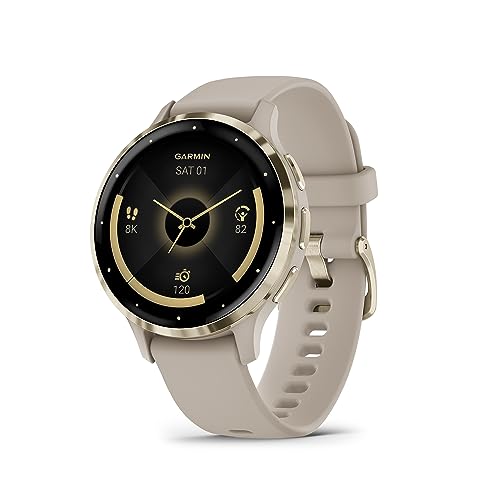
If the Lily 2 is Garmin being discreet, the Venu 3S is Garmin being complete — in a 41 millimetre case. This is the smaller sibling of the Venu 3, with a bright AMOLED display, and it concedes almost nothing to its larger version: onboard GPS, a speaker and microphone for wrist calls and voice assistants, ECG capability through Garmin’s app where approved, skin temperature sensing, nap detection, and a sleep coach that translates your nights into specific bedtime guidance rather than a grade you cannot act on.
The health picture it builds is the deepest in this guide. Cycle tracking sits inside Garmin Connect alongside training readiness, HRV status and Body Battery, so patterns that cheaper ecosystems keep in separate silos — a luteal phase that reliably wrecks your sleep, a follicular week where workouts feel easy — become visible in one place. Jet lag guidance, meditation sessions and wheelchair mode round out a feature list that reads like a flagship’s, because it essentially is one; the “affordable” claim rests on the Venu line sitting below Garmin’s Fenix and Epix flagships while sharing most of their wellness brain.
Battery life is the quiet superpower: roughly ten days in smartwatch mode, in a watch with a full-colour always-capable display and real GPS. The 18 millimetre strap is a standard size, so the aftermarket of bands — leather, metal link, woven nylon — is enormous. The Venu 3S costs the most in this guide and justifies it the most thoroughly; it is the pick for the buyer who wants one watch for the gym, the office and the bedside table, and who intends to keep it for years.
- Case: 41mm, stainless bezel, fibre-reinforced polymer body
- Display: AMOLED touchscreen, optional always-on
- GPS: onboard multi-GNSS
- Battery: up to about 10 days in smartwatch mode
- Strap: 18mm quick-release
- Health: cycle tracking, ECG app, skin temperature, sleep coach, HRV status
Strengths
- Flagship-grade health and training depth, including ECG and HRV status, in a genuinely small case.
- Ten-day battery with a bright AMOLED screen ends charging anxiety without hybrid compromises.
- Speaker and microphone enable calls and voice features the Lily 2 and ScanWatch cannot offer.
Trade-offs
- The priciest pick here — the saving versus flagships is real but this is not a budget watch.
- Garmin Connect’s data density overwhelms some users for the first fortnight.
- Third-party app selection trails Apple and Google ecosystems noticeably.
Best for: one-watch buyers who train seriously, track cycles carefully and refuse to charge nightly. Not suited for: shoppers whose budget is the whole point, or app collectors who live inside watchOS.

Apple Watch SE 3 (40mm) — The iPhone wearer’s value door
For an iPhone owner, the honest starting point of any smartwatch conversation is that Apple’s own watches integrate with iOS in ways no rival is permitted to match — messages you can actually answer, calls that hand off cleanly, an unlock-your-Mac party trick, and an app store that developers build for first. The SE 3 in its 40 millimetre case is the affordable door into that world, and the current generation narrowed the old SE compromises considerably: the display is bright and legible outdoors, the health sensors cover heart rate, sleep stages and cycle tracking through the Health app, and safety features like fall detection and crash detection come along as standard rather than flagship garnish.
Cycle tracking deserves its own sentence, because Apple’s implementation is the one many switchers arrive already trusting: period logging, predictions, and — on temperature-sensing Apple Watch models — retrospective ovulation estimates woven into the same Health app that holds the rest of your medical life. Even where a given SE configuration keeps things simpler, the data lives in HealthKit, which means it syncs with the period apps, fertility apps and telehealth services that already populate many iPhones. That ecosystem gravity is the SE’s real specification.
The compromises are the familiar Apple ones. Battery life is measured in hours, not days — expect a nightly charge ritual, which in turn means sleep tracking requires deliberate planning rather than passive habit. There is no Android compatibility, ever, and the 40 millimetre case, while neat, carries a design that reads unmistakably as technology. But as the least expensive route to a fully supported, current Apple Watch that fits a small wrist properly, the SE 3 has no direct rival; everything else in this guide is, for iPhone owners, a choice to step outside the garden in exchange for battery or disguise.
- Case: 40mm aluminium, Apple’s smallest current case
- Display: Retina OLED touchscreen
- GPS: onboard GPS
- Battery: roughly a day; nightly charging assumed
- Strap: Solo Loop, Sport Loop and Sport Band options in small sizes
- Health: cycle tracking in Health app, sleep stages, fall and crash detection
Strengths
- Unmatched iPhone integration — replies, calls, apps and HealthKit syncing rivals cannot replicate.
- Safety features and a mature cycle-tracking home inside the Health app.
- The 40mm case is genuinely small and light, with the deepest band ecosystem in the business.
Trade-offs
- Nightly charging undermines the sleep tracking it otherwise performs well.
- iPhone only — an Android household member cannot borrow its charms.
- The design announces “smartwatch” plainly; no jewellery disguise here.
Best for: iPhone owners who want the real Apple Watch experience sized for a smaller wrist at the friendliest Apple price. Not suited for: Android users, multi-day battery seekers or anyone who forgets chargers on trips.

Amazfit Active 2 — The budget overachiever
Every category has one product that makes the others’ pricing look like a confidence trick, and in this guide it is the Amazfit Active 2. The round case apes a classic dress watch silhouette, the AMOLED display is startlingly bright and sharp for the money, and the feature checklist — onboard GPS, heart rate, blood oxygen, stress, sleep, temperature-informed cycle tracking through the Zepp app — reads like it wandered in from a watch costing twice as much. It pairs with Android and iPhone alike, and it does all this while routinely selling for the least money of any pick here.
The wearing experience backs up the spec sheet. The case is compact and light, the default strap is soft silicone that suits small wrists without excess tail, and premium touches like a sapphire-glass variant in the range show Amazfit aiming at buyers who notice materials. Battery life is the headline after price: around ten days of typical use, which transforms the ownership experience — you pack no charger for a week’s holiday, and sleep tracking happens by default rather than by planning. Zepp’s AI coaching features and readiness-style scores have matured into genuinely useful summaries, even if the app still occasionally translates its own enthusiasm awkwardly.
Where does the saving show? Third-party apps are thin compared with Apple or Wear OS, contactless payment support varies by region and bank, and the notification experience is receive-and-read rather than reply-rich on iPhones. None of those are health features, which is precisely the point: Amazfit spent the budget on sensors, screen and battery, and buyers whose priorities match that allocation get the best value in this guide by a clear margin.
- Case: compact round stainless-steel case
- Display: AMOLED, high brightness for the class
- GPS: onboard positioning
- Battery: up to about 10 days typical use
- Strap: silicone standard, leather options in range
- Health: cycle tracking via Zepp, sleep, SpO2, stress, readiness score
Strengths
- The strongest screen-plus-battery-plus-GPS combination anywhere near its price.
- Round, classic styling flatters smaller wrists and formal outfits alike.
- Works fully with both Android and iPhone, so households can standardise on it.
Trade-offs
- App ecosystem is the thinnest here; this is a health watch, not a wrist computer.
- Payment support depends heavily on your country and bank.
- Zepp app polish still trails Fitbit and Garmin in clarity.
Best for: value hunters who want GPS, a gorgeous screen and ten-day battery without flagship money. Not suited for: buyers who need wrist payments everywhere or a deep third-party app library.
Fitbit Versa 4 — The gentle health companion
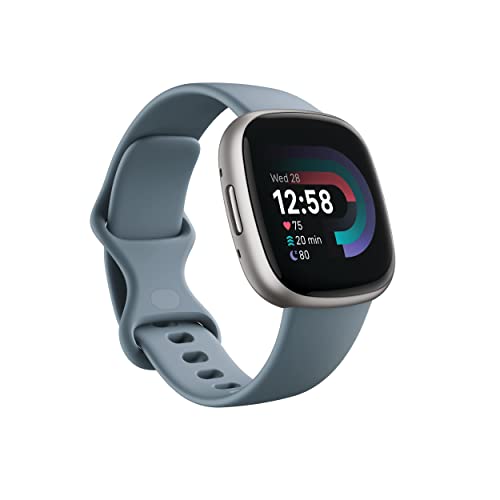
The Versa 4 is the friendliest watch in this guide, and friendliness is a design philosophy Fitbit has refined for a decade: a slim, pebble-smooth case that disappears on the wrist, an interface a first-time smartwatch owner can learn in an afternoon, and health feedback written in the language of encouragement rather than athletics. Its Daily Readiness score — part of Fitbit Premium — tells you plainly whether today is a push day or a sofa day, drawing on sleep, recent activity and heart-rate variability. For buyers who found Garmin’s dashboards intimidating, that single humane number is worth the purchase alone.
Cycle tracking lives in the Fitbit app’s health metrics ecosystem, where period logging sits alongside sleep stages, resting heart rate and skin temperature variation in one calm dashboard. The Versa 4 carries onboard GPS for phone-free runs, tracks forty-plus exercise modes, and includes Google Maps and Google Wallet since Fitbit’s absorption into Google — a practical upgrade that keeps it relevant as a daily smartwatch, not merely a tracker with a bigger screen. Battery life of six-plus days means sleep tracking is effortless, and its light weight makes it the pick our testers forgot they were wearing most often.
The caveats are about direction of travel. Some of the best insights require the Premium subscription after the included trial, which should be priced into any honest comparison. Fitbit’s future clearly points toward Google’s Pixel Watch line, so while the Versa 4 remains supported and sold, buyers planning a five-year relationship may prefer Garmin’s or Apple’s roadmaps. As a gentle, slim, capable companion for the next few years, though, it remains the easiest recommendation in this guide to live with from day one.
- Case: slim aluminium, among the lightest full smartwatches
- Display: AMOLED touchscreen
- GPS: onboard GPS
- Battery: 6+ days typical use
- Strap: infinity band in small and large sizes included
- Health: cycle tracking, Daily Readiness (Premium), sleep stages, stress management
Strengths
- The most approachable software here — readiness and sleep guidance written for humans, not athletes.
- Slim, feather-light case makes 24-hour wear, including sleep, genuinely effortless.
- Google Wallet and Maps keep daily smartwatch duties covered alongside health.
Trade-offs
- Best insights sit behind Fitbit Premium once the trial ends.
- No speaker for wrist calls; notifications on iPhone are read-only.
- Platform’s long-term centre of gravity is shifting toward Pixel Watch.
Best for: first-time smartwatch owners and wellness-focused buyers who want guidance without a data deluge. Not suited for: subscription refuseniks or athletes chasing deep training metrics.

Withings ScanWatch Light — The watch that hides
The ScanWatch Light takes the Lily 2’s disguise philosophy and removes the screen from the equation almost entirely. What you see is a 37 millimetre watch with real physical hands, a clean dial and a small activity subdial — what you get is continuous heart-rate tracking, sleep analysis, cycle tracking and activity detection feeding the Withings app, plus a battery that runs for up to thirty days. In a boardroom, at a wedding, on a wrist that already owns and loves mechanical watches, this is the only pick here that never has to explain itself.
Withings builds its reputation on health credibility rather than features-per-dollar, and the Light reflects that: the app presents cycle data alongside temperature trends and sleep with a clinician’s calm, data exports are painless, and the company’s devices have a long history of regulatory clearances in its broader range. The Light is the simplified sibling of the ScanWatch 2 reviewed in our analogue guide — it trims the ECG and SpO2 ambitions of that model in exchange for a lower price and even simpler daily operation, which for many buyers is the correct trade.
Understand what you are not getting. There is no GPS at all, no meaningful notification reading beyond discreet alerts, no apps, no music, no wrist payments. Workout tracking is automatic detection and basic logging, not structured training. The ScanWatch Light is not a lesser smartwatch; it is a different instrument — a health sensor wearing a beautiful watch as its housing. Buyers who check their phone for everything else anyway will find that division of labour liberating, and the monthly charging rhythm feels less like a chore than like winding a ritual.
- Case: 37mm stainless steel, sapphire-style classic dial
- Display: analogue hands plus activity subdial; no touchscreen
- GPS: none — activity tracked on-wrist, routes need your phone
- Battery: up to about 30 days
- Strap: standard quick-release, fluoroelastomer standard
- Health: cycle tracking, sleep, heart rate, activity detection
Strengths
- A month between charges removes charging from your mental load entirely.
- Indistinguishable from a fine conventional watch — the ultimate discreet tracker.
- Withings app handles cycle, sleep and temperature data with unusual clarity and export ease.
Trade-offs
- No GPS, no apps, no payments — smart features are deliberately minimal.
- Notifications are alerts, not conversations; you will reach for your phone.
- Workout depth is basic; structured training belongs to Garmin or Apple.
Best for: traditional-watch lovers and professionals who want health and cycle tracking with zero visible technology. Not suited for: runners wanting routes, or anyone who expects to read messages on their wrist.
How Do the Six Compare Side by Side?
| Watch | Case | GPS | Battery | Phone fit | Character |
|---|---|---|---|---|---|
| Garmin Lily 2 | 38mm | Via phone | ~5 days | Android + iPhone | Jewellery disguise |
| Garmin Venu 3S | 41mm | Onboard | ~10 days | Android + iPhone | Complete athlete |
| Apple Watch SE 3 | 40mm | Onboard | ~1 day | iPhone only | Ecosystem native |
| Amazfit Active 2 | Compact round | Onboard | ~10 days | Android + iPhone | Value champion |
| Fitbit Versa 4 | Slim, light | Onboard | 6+ days | Android + iPhone | Gentle coach |
| Withings ScanWatch Light | 37mm | None | ~30 days | Android + iPhone | Invisible tracker |
How Do You Set Up Cycle Tracking So It Actually Helps?
Cycle tracking earns its keep through consistency, not enthusiasm. Log the first day of each period on the day it happens — every ecosystem here allows back-filling, but predictions sharpen fastest when entries are timely. Wear the watch to bed as often as you realistically can, because overnight temperature and resting heart-rate trends are the raw material behind the smarter predictions and retrospective ovulation estimates; a watch worn only in daylight gives the algorithm half a picture and then gets blamed for the blur.
After two full cycles, sit down with the app and look for your own patterns rather than the app’s averages: many users discover their sleep fractures predictably two nights before a period, or that resting heart rate climbs in the luteal phase in step with training feeling harder. That is the moment to connect the watch to the rest of your life — schedule deload weeks, protect sleep in the days the data flags, and treat the predictions as weather forecasts rather than verdicts. Finally, check the privacy settings once, deliberately: cycle data is among the most sensitive information a device holds, so review which apps and cloud services it syncs to, and keep it inside the one ecosystem you trust.
How Should You Judge Battery Claims Honestly?
Manufacturer battery figures are recorded under laboratory kindness: always-on display off, GPS idle, notifications modest. Real life subtracts. An always-on AMOLED can halve a Garmin’s or Amazfit’s headline figure; a single GPS run a day trims it further; the Apple Watch’s day-scale battery makes the arithmetic simpler but the habit stricter. The useful question is not “how many days does the box claim” but “what charging rhythm does my life tolerate” — nightly on the nightstand like a phone, weekly with the Sunday reset, or monthly like a smoke-alarm battery. Match the watch to the rhythm you already keep, because a charging habit you must newly invent is a habit that fails in week three, taking the sleep and cycle data with it.
What Mistakes Do Buyers of Small Smartwatches Make?
The first mistake is buying by photograph. Watches are modelled on wrists chosen to flatter them; a 41 millimetre case that looks dainty on a tall model’s arm can dominate a petite wrist, so measure your wrist’s width and compare it with case diameter and lug-to-lug length before ordering. The second is ignoring strap sizing: several of these watches ship with straps whose smallest hole still swims on a 13-centimetre wrist, and a loose watch is an inaccurate watch, because the heart-rate sensor needs stable skin contact.
Third, buyers chase sensor lists and skip ecosystem fit — purchasing an Apple Watch for an Android phone is the extreme case, but subtler versions abound, like expecting full notification replies on iPhone from a watch Apple only permits to mirror alerts. Fourth, they forget the subscription line: Fitbit’s deepest insights and some rivals’ coaching tiers renew monthly, and the honest price of a watch includes two years of any service you intend to keep. Finally, many buyers never enable the features they paid for: cycle tracking left unconfigured, sleep schedules unset, safety alerts silenced during setup and forgotten. Twenty minutes of deliberate configuration on day one is the difference between a health instrument and a step counter with ambitions.
How Do Straps and Bands Change the Whole Watch?
Owners consistently underestimate the strap, because the watch head gets the photographs and the specifications. Yet the strap decides whether the watch sits centred or slides toward the ulna bone, whether the heart-rate sensor keeps its seal during a downward dog or a deadlift, and whether the whole object reads as sport, jewellery or office equipment. A slim wrist magnifies every one of these effects: two millimetres of extra strap width that a larger wrist would never notice can make a small watch look borrowed.
The practical advice is to budget for a second strap from the start and to treat the included band as the sports option whatever its material. Silicone and fluoroelastomer earn their place for workouts and summer, because they rinse clean and shrug off sunscreen. A leather or woven band transforms the same watch head for evenings and offices — the Venu 3S on a tan leather strap and the ScanWatch Light on a Milanese loop are effectively different products from their gym selves, at a fraction of a second watch’s cost. Metal link bracelets add the most jewellery credibility and the most weight; on very small wrists, ensure links can be removed from both sides of the clasp so the watch stays centred rather than lopsided.
Sizing discipline matters more than material fashion. Measure your wrist with a soft tape where you actually wear a watch — above the wrist bone for most smartwatch wear, because sensor contact is better there — and compare that number against the strap’s stated fit range, not its marketing photographs. If you fall at the very bottom of a strap’s range, expect a long tail; some brands, Fitbit included, solve this by boxing two sizes, while Garmin’s Lily straps are cut short by design. A watch that fits is a watch whose data you can trust, and the strap is where fit is won or lost.
What Happens When Style Meets the Gym, the Pool and Real Life?
Small watches live harder lives than big ones, because they are worn more hours in more contexts — nobody sleeps in a dive computer, but plenty of people sleep in a Lily 2. Water resistance is therefore worth reading properly. Every pick here handles showers, rain and sweat without discussion, and most are rated for swimming, which makes them safe for pool laps and open-water dips at recreational depths. What none of them wants is a sauna’s steam cycling against seals daily, or high-pressure jets aimed at the case in a power shower; treat water ratings as permission for immersion, not for abuse.
Durability at this size is mostly about glass and bezel exposure. A raised metal bezel, like the Venu 3S wears, sacrifices itself to doorframes so the screen does not have to. Domed or flush fashion faces, prettier as they are, meet the world first. If your week includes climbing, CrossFit or a job involving shelving and stockrooms, a slim protective case or a screen protector is not paranoia; it is the difference between a three-year watch and a three-month one. The good news is that small cases take smaller hits — there is simply less glass presented to every passing edge.
Then there is the social durability test: will you still be wearing it in month six? Watches fail this test by annoying their owners in small repeated ways — a charger that travels badly, a strap that pinches during typing, an app that nags. Notice how the picks here divide on exactly those frictions: Apple demands a daily charging ritual but never surprises; Withings disappears from your attention for a month at a time; Garmin asks you to learn its language and then rewards fluency. Choose the friction profile you forgive most easily, because forgiveness, compounded daily, is what long-term wear actually is.
How Do the Health Ecosystems Really Differ Day to Day?
Specifications make these six watches sound interchangeable — heart rate, sleep, SpO2, cycle tracking, tick, tick, tick — but living with their apps reveals six distinct philosophies about what health data is for. Understanding which philosophy matches your temperament matters more than any sensor, because the app is where the watch either becomes a habit or becomes homework.
Garmin Connect, home of the Lily 2 and Venu 3S, is the analyst’s ecosystem. It assumes you want the raw material of your physiology — HRV trends, training load, respiration, body battery curves — and it presents that material with minimal editorialising. For cycle tracking this is a strength: your cycle sits in the same calendar as your training and sleep, so correlations surface naturally, and Garmin’s years of investment show in details like pregnancy tracking and symptom logging that feels clinical rather than cute. The cost is a learning curve measured in weeks, and an interface that can make a newcomer feel examined rather than accompanied.
Apple’s Health app is the archivist. It collects everything, files it beautifully, shares it with your clinician and your other apps, and offers almost no opinion about what it means. Cycle tracking there is private, well integrated and — for users already logging in other apps that write to HealthKit — gloriously centralised. But Apple will not tell you whether today is a good day to train; it hands you the library and leaves the reading to you or to third-party apps, some of which charge for the interpretation Garmin includes.
Fitbit is the coach who likes you. Its readiness and sleep scores translate physiology into a single kind sentence each morning, and its cycle and health dashboards are the least intimidating in this guide. The trade is the Premium tier standing between you and the fullest version of that kindness, and a ceiling on depth that serious athletes bump against within a season. Amazfit’s Zepp sits between Fitbit and Garmin: scores and AI-flavoured summaries up front, respectable depth behind them, occasional translation quirks as the toll. Withings is the family doctor — calm, conservative, export-friendly, light on gamification, and the app most likely to be recommended by someone who also owns a Withings scale and blood-pressure cuff and wants one quiet dashboard for the whole household’s health.
None of these philosophies is wrong; they are answers to different questions. Ask yourself which morning you want: a number with a kind sentence attached, a graph that respects your intelligence, an archive that connects to everything, or a quiet line in an app you open twice a week. The watch follows from that answer far more reliably than it follows from any comparison of sensor counts, and it is why two buyers can read this same guide, choose opposite ends of it, and both be right.
How Long Will an Affordable Smartwatch Stay Supported?
The unglamorous question that decides whether a watch was actually affordable is how many years it remains secure, updated and compatible with your next phone. A cheap watch abandoned by its maker in eighteen months costs more per year than a dearer watch supported for five, and the support landscape across these six brands differs enough to deserve a paragraph of its own before you spend anything.
Apple sets the benchmark: its watches typically receive major watchOS updates for around five years, and the SE line shares that pipeline rather than a diluted version of it, which is one reason the SE 3 is easy to recommend to iPhone owners who keep devices a long time. Garmin supports its watches with firmware and app compatibility for many years — older Venu models still sync happily with current phones — and Garmin’s habit of adding features to existing hardware through updates is well established. Withings similarly keeps its hybrids relevant for years, helped by the fact that a watch whose job is sensing rather than computing ages gracefully; the ScanWatch Light’s feature set was complete the day it shipped and asks little of the future.
Fitbit’s position requires the honest caveat already raised: the Versa 4 works well today, but Google’s centre of gravity is the Pixel Watch, and buyers should purchase the Versa for what it does now rather than for a promised tomorrow. Amazfit has improved its update cadence with each generation and the Active 2 sits on its current platform, though its historical support windows run shorter than Apple’s or Garmin’s — acceptable at its price, provided you buy with that expectation set. The general rule for this whole category: affordable should mean a lower price for a complete present, never a discount on an uncertain future, and every pick in this guide was chosen to satisfy that rule as it stands today.
What Should You Do in the First Week With a New Watch?
The first week decides whether a smartwatch becomes infrastructure or clutter, so treat it as a fitting period rather than a honeymoon. Wear the watch day and night for seven straight days, including showers if its rating allows, and resist judging the battery or the sleep data until a full cycle of your real life — workdays, a workout or two, a late night, a lazy morning — has passed through it. Algorithms need that variety: resting heart rate, HRV baselines and sleep staging all calibrate against your normal, and your normal includes the weekend.
Configure deliberately on day two, once the novelty settles. Turn off notifications for everything except people and the handful of apps whose interruptions you genuinely welcome; a watch that buzzes forty times a day trains you to ignore it, including when it matters. Set up cycle tracking with your best recollection of the last two periods so predictions start from data rather than from zero. Arrange the watch face for the three glances you actually make — time, next event, one health number — and banish the rest to the app where it belongs.
Finally, run one honest test of the feature that sold you the watch. If you bought GPS, record the same familiar route three times and check the trace against reality. If you bought sleep tracking, note your own sense of each morning before reading the score, and see whether the two agree by week’s end. If you bought the disguise — the Lily’s patterned lens, the Withings’ silent hands — wear it somewhere you would never wear a gadget and enjoy the absence of comment. A watch that passes its own audition in week one tends to still be on your wrist in year three, which is the only affordability metric that finally counts.
Final Recommendation
If your wrist is small and your standards are not, start with the Garmin Venu 3S — it is the one watch here that never asks you to accept a “for its size” apology. If the budget is the honest headline, the Amazfit Active 2 delivers the screen, GPS and battery that matter at a price that leaves room for a second strap and a year of coffees. iPhone loyalists should simply buy the SE 3 in 40 millimetres and enjoy the garden. And if every smartwatch you have tried felt like wearing a tiny billboard, let the Lily 2 or the ScanWatch Light prove that the best affordable women’s smartwatch can also be the one nobody notices — until you show them what it quietly knows about your sleep.
Frequently Asked Questions
Can men or anyone wear these watches?
Of course. The category is about case size, strap length and styling, not permission. Anyone with a smaller wrist, or anyone who prefers a compact watch, will find these six more comfortable than the standard 45 millimetre slabs — the sensors and software work identically on every wrist.
How accurate is cycle tracking on a smartwatch?
Predictions improve with consistent logging and overnight wear, and temperature-informed estimates are meaningfully better than calendar counting alone. Treat them as planning aids, not medical certainty: no watch in this guide is a contraceptive device or a diagnostic tool, and irregular cycles deserve a clinician, not an app.
Do I need my phone nearby for these watches to work?
Health tracking, sleep and cycle logging all happen on the wrist and sync later. GPS models record runs phone-free; the Lily 2 borrows your phone’s GPS, and the ScanWatch Light has none. Notifications and calls, where supported, need the phone within Bluetooth range unless you buy a cellular configuration.
Which of these is best for sleep tracking?
The watches you can forget you are wearing win: the Lily 2 and ScanWatch Light for minimal presence, the Versa 4 for featherweight comfort plus readiness scoring, and the Venu 3S for the deepest sleep coaching. The Apple Watch tracks sleep well but its nightly charging habit works against consistency.
Are straps interchangeable with standard watch bands?
Mostly yes. The Venu 3S uses standard 18 millimetre quick-release bands, the ScanWatch Light accepts standard straps, and Apple and Fitbit use their own widely supported fitting systems with enormous third-party ranges. Check the lug width in each pick’s spec list before ordering a band.
Will these watches work if I switch phone platforms later?
Garmin, Amazfit, Fitbit and Withings all support both Android and iOS, so a phone switch costs you a re-pairing, not a new watch. The Apple Watch is the exception — it requires an iPhone for setup and daily use, with no workaround.
Is a smaller watch less accurate than a big one?
No — sensor accuracy depends on fit and contact, not case diameter, and a small watch that sits flat and snug on a small wrist will usually out-measure a large watch wobbling on the same wrist. Optical heart-rate sensors read through the skin they touch; gaps, sliding and overtight straps corrupt readings far more than any difference between these models’ sensor generations. This is also why the snug-but-comfortable rule matters: fasten the strap so the watch cannot slide, but not so tightly that it leaves a deep imprint, and give the sensor a moment to settle at the start of a workout before trusting the first minute’s numbers. Judged that way, the compact cases in this guide are not a compromise for smaller wrists — they are the accuracy upgrade.
Related Guides
Readers comparing across categories may also enjoy the best analog smartwatches, the best Android smartwatches for fitness and the best smartwatches for Pixel phones.



[…] exploring with the best affordable women’s smartwatches, the best Android smartwatches for men and the best Android smartwatches for […]