Our Top Picks
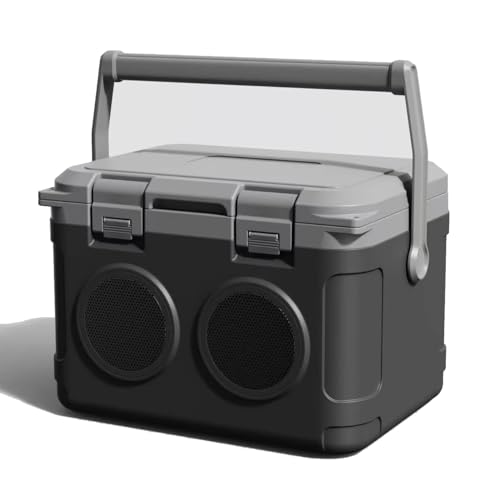 GETUHAND Camp Cooler with Bluetooth Speaker 22 Quart,4822 quarts14.17 x 12.6 x 12.2 inches8.8 PoundsCheck on Amazon
 LIVICE 52L Wheeled Cooler with Bluetooth Speaker52L20.87 x 18.74 x 17.32 inches17.2 poundsCheck on Amazon


What's inside
- What counts as a cooler with a speaker, and what does not
- Capacity: quarts, litres, and the can-count trick
- How the box itself is built
- Ice retention claims, and why the hour figures do not line up
- Handles, tie-downs and the sand-wheel problem
- The speaker half: drivers, watts and honest loudness
- Bluetooth versions, range claims and pairing two units
- Power: cells, playback hours and charging reality
- Water, sand and sun: reading the IPX scale properly
- Listing literacy: spotting the numbers that were staged to mislead
- Sizing the combination to the group and the day
- Between trips: drying, storage charge and gasket care
- Accessories that earn their space, and those that do not
- Check prices on Amazon
- Weighing the whole compromise
As an Amazon Associate I earn from qualifying purchases. This post may contain affiliate links at no extra cost to you.
Disclosure: As an Amazon Associate, this site earns from qualifying purchases. Everything that follows rests on documents anyone can open: specification sheets printed by cooler makers, owner manuals with their warnings and care pages, Bluetooth and ingress-protection standards, and battery data published by cell suppliers. No cooler was opened on a workbench for this guide, no speaker was carried to a shoreline, and no claim here depends on private handling. Where a maker leaves a number vague, that vagueness itself gets treated as evidence, because a beach buyer has to decide from the printed record alone.
Sand changes the arithmetic of cold drinks and music. A box that performs politely on a patio must survive grit in its hinges, sun that softens pale plastic by noon, wind that steals spoken lyrics, and a walk across soft ground that turns small wheels into anchors. Adding a loudspeaker to that box sounds simple until the two jobs collide: insulation wants a sealed, thick, undisturbed wall, while sound wants an opening, a vibrating panel, and electronics that dislike heat, salt mist, and immersion in equal measure. This guide pulls those competing demands apart, section by section, so the compromise in any given model becomes visible before money changes hands.
What counts as a cooler with a speaker, and what does not
Three distinct products hide under one search phrase. First come hard coolers with a speaker module factory-fitted into the lid, its drivers firing upward or forward through a grille that sits flush with the lid surface. Second, a smaller group places the electronics in a body wall, usually the front face, trading some insulation thickness at that spot for a driver aimed at seated listeners. Third, aftermarket lids and drop-in trays promise to convert an ordinary cooler, yet their fit depends on rim geometry measured in millimetres, and a lid that seals one brand of 45-quart box may rock on another. Lumping these together flatters the weakest of them, so keep the construction type in view whenever a headline number appears.
Standing outside the class, and quietly setting the bar for it, is the separate portable speaker kept in a dry bag or a zippered beach tote. That rival arrangement lets each device do one job well: the cooler keeps a continuous insulation envelope with no electronic intrusion, and the speaker can be replaced, upgraded, or left home without touching the cold storage. Anyone weighing a combined unit should therefore ask a blunt question at the start. What does integration buy that a dry bag does not? Honest answers include one fewer item to carry, a speaker that cannot be forgotten in a car, playback controls at cooler height, and a single charging routine. Dishonest answers promise concert volume, week-long ice, and total waterproofing all at once.
Soft-sided cooler bags with a pocket-sized speaker clipped to a strap belong in a different conversation altogether. Their insulation is a few millimetres of foam sheet rather than a moulded wall, their zips leak cold air with every opening, and their intended outing is a two-hour picnic rather than a full tide cycle. Likewise, novelty boxes shaped like boomboxes, where the speaker is real but the cooler cavity holds little more than a sandwich, invert the priorities of a beach day. A useful combined cooler still begins life as a cooler: food safety, ice economy, and a lid seal come first, with audio layered on top rather than substituted for them.
The lid is where the compromise lives
Look closely at any lid-integrated design and the engineering tension becomes physical. A conventional premium lid carries insulation across its whole span, often 50 millimetres or more at the centre, because warm air pooling above the ice attacks through the top. Cutting a circular recess for a 100-millimetre driver removes insulation exactly there, and the module that replaces it is mostly air, magnet, and circuit board. Makers answer this in different ways: some foam-fill the remaining lid volume more densely, some add a reflective barrier under the module, and some simply accept a thinner spot and stay silent about it. Manuals rarely publish a lid cross-section, so the weight of the lid, the stated wall thickness elsewhere, and the honesty of the ice-retention staging are the clues available from outside.
Heat adds a second, less discussed penalty. A dark grille baking in direct sun can push the small cavity around a lithium cell well past the temperature printed on that cell data sheet, and protection circuits respond by throttling charge or shutting playback down. Pale lid colours, a grille set into a raised and ventilated boss, and a module that can be shaded by a towel without muffling it completely are not styling trivia. They decide whether music survives the hottest hour, which is usually the hour people most want it.
Capacity: quarts, litres, and the can-count trick
American cooler sizing speaks in quarts, most of the rest of the world in litres, and the conversion is close enough to memorise: one quart is 0.946 litres, so a 45-quart box holds about 42.6 litres and a 65-quart box about 61.5 litres. Trouble starts because quoted capacity is usually brim volume, the amount of water the open cavity would hold filled to the rim with the lid off and nothing else inside. Nobody beaches that way. Ice, food, and drink share the cavity, and the widely used two-to-one guidance from cooler manuals, two parts ice to one part contents by volume, shrinks the usable drink space dramatically. A 45-quart cooler loaded by that rule carries roughly 15 quarts of cans and food, a figure that feels very different from the number on the carton.
Can counts deserve outright suspicion. The standard trick counts standard 355-millilitre cans packed into an empty box with no ice at all, sometimes with cans laid in orientations no one would use for chilled storage, and then prints the total as if it described a beach load. Sixty cans and zero ice is a geometry puzzle, not a picnic. When a listing gives a can count, look for the footnote stating whether ice was included; when no footnote exists, assume none was. A more honest maker states capacity with a stated ice ratio or publishes interior dimensions, length by width by depth in centimetres, from which a buyer can model real loads: a layer of block ice at the base, cans standing upright, food containers that refuse to tessellate.
Interior shape matters as much as raw volume. Tapered walls, wider at the top than the floor, stack and mould easily yet steal space where block ice wants to sit. Wheel wells intrude on two corners of many rolling models. The speaker module on a body-wall design can push a shallow shelf into the cavity. None of this appears in a quart figure. Published interior dimensions, where given, expose it at once, and their absence on a premium-priced listing is a small but telling editorial choice by the seller.
- Convert every quart figure to litres before comparing brands sold in different markets, because rounding at conversion quietly inflates some listings.
- Treat any can count without an ice statement as a no-ice count, and mentally halve it for a normally iced load.
- Prefer interior dimensions over brim volume when planning for block ice, wine bottles standing upright, or rectangular food tubs.
- Remember that lid insulation and baskets, dry-goods trays, and dividers all consume volume the headline number still claims.
How the box itself is built
Rotomoulding dominates the serious end of the market for structural reasons that spec sheets state plainly. A hollow mould is charged with polyethylene powder, heated, and rotated on two axes until the plastic coats the interior evenly, yielding a one-piece body with corners thicker than the walls and no seam to split on a dropped corner. Into that shell, makers inject or pour polyurethane foam until the cavity between inner and outer walls is filled, and that foam, often around 50 to 75 millimetres thick on the sides, does the actual insulating. The resulting box is heavy even empty, shrugs off being sat upon, and costs accordingly. When a listing says rotomoulded, it should also be able to state wall thickness and empty weight; a feather-light so-called rotomoulded cooler is a contradiction worth walking away from.
Below that tier sit injection-moulded boxes with foam cores, perfectly respectable for shorter outings, and below them the thin-wall picnic boxes whose hollow walls trap still air and little else. Air alone insulates poorly once the sun loads the outer skin, so these boxes hold a morning rather than a day. Their lids flex, their hinges are living plastic rather than pinned hardware, and their latches, if present at all, merely keep the lid from sliding. Price separates these tiers reliably even when photography does not, and so does empty weight per litre of capacity. Dividing the two published numbers gives a rough density of construction that marketing copy cannot easily disguise.
Plastic grade is the quiet line item. Virgin polyethylene with UV stabiliser packages is formulated to resist the embrittlement that turns a three-year-old box chalky and crack-prone at the hinge line. Recycled content is environmentally attractive and mechanically variable. Manuals that specify a storage recommendation, keep out of prolonged direct sun when not in use, are telling the truth about polymer limits rather than being fussy. A beach cooler lives in sun by definition, so stabiliser content, pale colour options, and a warranty that names UV damage or pointedly omits it all belong in the comparison.
Gaskets, latches, hinges and drains
Cold retention lives or dies at the lid seal. Better coolers borrow the freezer pattern: a continuous gasket, often silicone or a closed-cell foam strip, seated in a channel around the lid underside, compressed evenly when the latches close. T-shaped rubber latches stretch over a catch and pull the lid down with real force, and that compression is why two-finger latch effort is a feature rather than an inconvenience. Friction-fit lids on cheaper boxes rely on gravity, and gravity loses every time warm air expands inside a sun-heated box. If a product photo shows no gasket and no latch, the ice figures beside it deserve the deepest discount of all.
Drain design splits into three camps. Large threaded plugs with a gasket and a tether empty a big box quickly and can accept a garden-hose fitting on some models. Small press-fit bungs dribble and clog with sand grains. A few designs omit a drain entirely, forcing a tip-and-pour that becomes a two-person job at 30 kilograms of meltwater and ice. The plug thread and its spare availability matter because a lost plug on a beach weekend reduces a premium cooler to a leaky bucket, and manuals that list the plug as a replaceable part number are quietly promising a longer service life.
Hinges take the punishment of a lid opened scores of times a day, often by children sitting on the box or leaning on the raised lid. Pinned stainless hinges with a lid stay that stops travel near vertical protect both the hinge and the speaker wiring that, on lid-speaker models, must cross that hinge line somehow. How that cable crossing is handled, flexible conduit, contact pins, or a fully self-contained lid module with its own cell, is one of the most consequential design choices in the whole product. A self-contained lid removes the cable problem entirely and lets the lid be carried to a charging point alone, at the cost of a smaller cell squeezed beside the driver.
Ice retention claims, and why the hour figures do not line up
Every maker stages its ice test differently, and the staging variables swamp the differences between competent boxes. A typical favourable protocol pre-chills the cooler overnight, fills it with a high proportion of ice, sometimes the full two-to-one ratio or beyond, opens the lid rarely or not at all, and holds ambient temperature at a mild figure near 21 to 24 degrees Celsius. Move any one variable and the result collapses: a warm box loaded at the car park, a half-ice load, eight lid openings an hour by a group helping itself, or an ambient of 32 degrees on shadeless sand can halve the hours. Two brands quoting five days and three days may own nearly identical insulation, separated only by how cruelly each chose to run its own test.
No single compulsory standard governs consumer ice-retention claims the way crash testing governs cars, which is why the small print matters more than the headline. Search the manual or the long-form product page for four disclosures: whether the box was pre-chilled, the ice-to-contents ratio, the ambient temperature, and the endpoint definition, because retention can mean ice still present, interior still below 4 degrees Celsius, or drinks still feeling cold, three very different finish lines. A claim missing all four is advertising copy wearing a lab coat. A claim that publishes them invites arithmetic, and makers who invite arithmetic usually survive it.
Ice form changes outcomes as surely as insulation does. Block ice melts slowly thanks to its low surface-area-to-volume ratio and anchors a load through a long day, while cubed ice chills cans faster at the start and vanishes sooner. Many manuals quietly recommend a mixture, blocks below and cubes filling voids above, which also explains test results achieved with a full block load that a buyer using service-station cubes will never reproduce. Frozen gel packs add another variable, since their phase-change temperature and total mass are rarely stated on the pack. None of this is deception by itself; it becomes deception when a single hour figure is printed as if ice form were irrelevant.
For beach planning, a more useful mental model ignores the maximum claim and works from load discipline. Pre-chill drinks before they enter the box. Freeze what food tolerates freezing. Open the lid in planned rounds rather than continuously. Keep the box shaded under a canopy or a pale towel, because radiant load on a dark lid can exceed the conductive load through the walls. Under those habits, a mid-tier foam-core cooler covers a long beach day comfortably, and the rotomoulded premium buys margin for a second day or a hotter, shadeless site rather than magic on the first.
Handles, tie-downs and the sand-wheel problem
Carrying a loaded 65-quart cooler is a two-person lift of 25 to 35 kilograms, and handle design decides whether that lift is awkward or injurious. Rope handles with moulded grips swing and let the box be hauled over obstacles, but they offer little control on stairs. Moulded side handles give a firm, close grip for a car-boot lift yet pinch fingers against the body when the load shifts. Full-length steel handles on rolling models double as the towing grip, and their pivot points are a known wear site. Published empty weight plus a realistic load estimate should be added together before purchase, not discovered on the first dune crossing.
Tie-down slots moulded through the lid lip or body let straps hold the box in a truck bed or boat while still allowing the lid to open, a detail campers value and beach drivers borrowing a pickup will too. Slots that pass only through the lid defeat the purpose, since opening the lid loosens the strap. Padlock brackets, bear-resistant certification on a few wilderness models, and accessory rails all belong to the same hardware conversation: they cost little at moulding time and cannot be retrofitted later, so their presence signals a maker thinking about years of use rather than a single season.
Wheels deserve a section of their own because sand defeats most of them. Narrow hard-plastic wheels, fine on boardwalks and car parks, cut into soft sand like a knife and demand a dragging force that doubles every few metres. Wide treaded wheels do better, and the very widest, low-pressure balloon-style wheels fitted to beach carts rather than coolers, float across soft surfaces by spreading load. Almost no speaker cooler fits balloon wheels, which sets a practical rule: plan the route from car to pitch around hard sand near the waterline, a boardwalk, or a short carry, and treat any claim of all-terrain rolling as a claim about gravel and grass. Wheel diameter, width, and whether the tyre is solid or pneumatic are all published figures, and they predict sand behaviour better than any terrain adjective.
Axle and bearing exposure completes the picture. Sand worked into an unsealed axle grinds quietly all season until a wheel develops a wobble that no rinse fully cures. Designs that let the wheels pop off without tools for rinsing and storage show an understanding of the environment the marketing photographs depict. A fixed axle with no cleaning access, paired with salt water and grit, is a countdown rather than a feature.
The speaker half: drivers, watts and honest loudness
Driver diameter sets the physical ceiling on what a cooler speaker can do outdoors. A single 76-millimetre full-range driver, roughly three inches across, reproduces speech and pop vocals clearly at conversational distance and gives up entirely below the region where bass notes live. Twin drivers near 100 millimetres, sometimes paired with a passive radiator that uses trapped air to reinforce low frequencies, move enough air to hold a group of eight listeners in light wind. Physics charges for that output in grille area, magnet weight, and cell capacity, so a cooler claiming huge sound from a grille the size of a coffee coaster is claiming something its own dimensions refute. Published driver size, driver count, and the presence or absence of a passive radiator are the three lines to read first.
Wattage is where listing literacy pays for itself most quickly. RMS watts describe continuous power an amplifier can deliver without distress, measured under stated conditions, while peak watts describe a momentary ceiling that can be two to four times higher and musically almost meaningless. A listing shouting 40 watts with no qualifier is nearly always quoting peak output summed across channels, perhaps 10 honest RMS watts per driver. Look for the letters RMS, a distortion figure such as total harmonic distortion at rated power, and a frequency response range with a tolerance in decibels. Silence on all three fronts tells its own story. Readers comparing standalone units in the guide to best bluetooth outdoor speakers for pool will notice the same pattern there: honest makers print RMS figures and let competitors print larger, emptier numbers.
Loudness itself is properly expressed in decibels of sound pressure level at a stated distance, usually one metre, and the logarithmic scale punishes intuition. Ten extra decibels are perceived as roughly twice as loud and demand roughly ten times the amplifier power, which is why battery life falls off a cliff at maximum volume. Outdoor listening also fights distance: sound pressure drops about six decibels each time distance doubles in open air, so a speaker that sounds full at two metres is a background murmur at eight, before wind and surf noise enter the contest. Surf at a moderate beach generates a broad wash of noise in the same frequency region as music, masking quiet passages and tempting listeners into volume levels that drain cells and annoy neighbours in equal measure.
Tuning is the part no number captures. Some cooler speakers are voiced bright, emphasising vocal clarity that carries over ambient noise at modest volume, while others chase low-end warmth that disappears outdoors and wastes power producing frequencies the setting erases. Manuals occasionally publish equaliser presets or name a tuning partner; more often the voicing must be inferred from driver layout and radiator design. A downward-firing radiator coupled to a hard surface behaves differently on sand, which absorbs rather than reflects, one more reason output figures gathered on a laboratory bench translate loosely to a beach towel.
Bluetooth versions, range claims and pairing two units
Bluetooth revision numbers describe capability, not quality. Version 5.0 brought longer coded range options and higher broadcast speed than 4.2, 5.1 added direction finding that portable speakers rarely use, 5.2 introduced LE Audio groundwork, and 5.3 refined connection management and power use. For a cooler speaker, the practical differences are connection stability around bodies and beach clutter, power draw during long low-volume sessions, and how gracefully the link renegotiates after a phone wanders to the water and back. A well-implemented 5.0 radio outperforms a careless 5.3 one, so the revision belongs in the comparison without dominating it.
Range figures on listings assume an unobstructed line of sight between phone and speaker, with no human body, full of water and very effective at absorbing 2.4-gigahertz signals, standing between them. Ten metres is the classic Class 2 figure, thirty metres appears for Class 1 radios, and a hundred-metre claim should prompt a search for the test condition. On a real beach the phone usually sits within three metres of the cooler anyway, in the shade of the same canopy, so range beyond stability at short distance buys little. What matters more is multipoint support, the ability to hold two phones so a second person can queue a song without a pairing fight, and the reconnection behaviour after the link drops, which better implementations handle silently within seconds.
Stereo pairing between two units of the same model splits a true left and right channel across two boxes, widening the sound field for a seated group far beyond what one box, however loud, can stage. The constraints hide in the fine print: pairing usually demands identical models, sometimes identical firmware, it can add latency that matters for video, and it often disables when an auxiliary cable is used. Two coolers also means two cells to charge and two lids to keep sand-free. For most single-family pitches, one competent unit placed centrally beats a stereo experiment, yet for larger gatherings the feature is genuinely transformative and worth confirming in the manual rather than trusting a badge on the carton. Anyone whose priority is paired sound above cold storage may find the dedicated route through best battery powered bluetooth speakers more flexible, since those units pair across wider model families.
Buttons you can use with wet hands
Control design separates beach-ready speakers from patio speakers wearing a tan. Raised physical buttons with distinct shapes for play, volume, and track skip can be found by touch, work with sandy fingers, and respond when a wet thumb would slide uselessly across a touch panel. Capacitive surfaces look cleaner and seal better, with no gaps for grit, but they misread droplets as touches and refuse gloves entirely. App-only control is the weakest answer outdoors: it demands a dry phone, an unlocked screen, and attention diverted from children and tides to a settings page. Better designs put every essential function on the body, treat the app as an optional equaliser and firmware channel, and keep a physical power switch that cannot be triggered accidentally inside a packed car.
Port layout belongs to the same tactile audit. A charging socket hidden under a tethered rubber cover on the rear face stays cleaner than an exposed socket on top, where it collects every grain and droplet that lands on the lid. Covers should be checkable at a glance, because an open cover silently voids the water rating the buyer paid for. Some modules add a small status lamp visible in bright sun, a detail that sounds trivial until a user is squinting at a dim indicator through polarised sunglasses wondering whether the unit is charging, paired, or off.
Power: cells, playback hours and charging reality
Battery capacity appears in two currencies. Milliamp hours describe charge at a stated voltage, while watt hours describe actual energy, and only watt hours compare cleanly across designs using different cell arrangements. A 5,000 milliamp-hour cell at 3.7 volts stores 18.5 watt hours; a maker quoting 10,000 milliamp hours at an unstated voltage may be describing two such cells in parallel or, occasionally, presenting the larger number precisely because it looks larger. Convert before comparing: watt hours equal milliamp hours multiplied by nominal voltage, divided by one thousand. Listings that publish watt hours directly, as air-transport rules require for larger packs, are doing the buyer a courtesy that should be rewarded with trust.
Playback-hour claims obey the same staging logic as ice claims. A figure like twenty hours is typically measured at a moderate fraction of maximum volume, often around half, playing a defined test signal or a standard playlist in a quiet room. At full volume outdoors, with the amplifier working against wind, expect a third to a half of the printed figure. Bass-heavy material costs more energy than speech, high temperatures reduce effective capacity, and an ageing cell surrenders a few percent each year. Manuals that state the volume level behind the hour figure are rare and valuable; manuals that print only the figure leave the buyer to discover the staging on the first long afternoon.
Charging input decides how painful the night before a beach day becomes. A module that accepts USB-C power delivery at 18 watts or more can refill an evening-sized cell in roughly two hours, while an older 5-volt, 1-amp input stretches the same job past six hours and invites being forgotten half-charged. Published charge times should state the charger wattage assumed, because the figure doubles when a weak adapter is used. Some lids add a USB output for topping up a phone, a genuinely useful beach feature that must be budgeted honestly: every phone charge is music time spent, at conversion losses near twenty percent, and the cooler cell is small next to a modern phone cell.
Sealed versus swappable cells is a longevity fork. A swappable pack lets a dead unit return to service in seconds and lets the whole product survive the cell natural decline after several hundred cycles, at the price of a door, a gasket, and another seam for sand to attack. A sealed module keeps the water rating simpler and the construction cheaper, while committing the owner to factory service when capacity fades. Neither answer is wrong, yet the choice should be conscious, and the manual replacement-part list, or its absence, reveals which future the maker intends. Pass-through playback, playing while charging, also deserves explicit confirmation, since some protection circuits mute output during charge or limit volume, a surprise best learned from a document rather than at a birthday gathering.
Water, sand and sun: reading the IPX scale properly
The ingress-protection code, defined in the IEC 60529 standard, rates enclosures with two digits: the first for solid particles, the second for water. Speaker listings often print only the water digit, as IPX5 or IPX7, the X signalling that dust ingress was not formally assessed in that test. Walking the water scale as published clarifies what each step buys. IPX1 and IPX2 cover dripping water, vertical or slightly tilted. IPX3 tolerates spray at angles up to sixty degrees. IPX4, the first level with real beach relevance, resists splashing from any direction. IPX5 withstands low-pressure water jets from a 6.3-millimetre nozzle, and IPX6 raises that to powerful jets from a 12.5-millimetre nozzle. IPX7 permits immersion at one metre for thirty minutes under laboratory conditions, and IPX8 extends immersion beyond those parameters as the maker specifies.
Three cautions keep those ratings honest. First, the tests use fresh water, still and clean, not salt water carrying abrasive grit or chlorinated pool water, both of which manuals routinely warn against despite the rating. Second, the rating describes the tested component in its tested state, covers closed, gasket new, no cable attached; a charging cable plugged in usually suspends the rating entirely. Third, and most often missed in this product class, the rating belongs to the speaker module, not to the cooler as a whole. The cooler body neither needs nor claims immersion protection, its drain plug and lid seal are built for meltwater and rain, and submerging the box because the lid speaker carries IPX7 is a misunderstanding with expensive consequences. Shoppers who care most about deep bass outdoors will find a parallel discussion of driver protection in best bass bluetooth speakers, where the same fresh-water caveat applies.
Dust deserves its sentence even when the code hides it behind an X. A full IP6X dust-tight rating means talc-fine dust in a test chamber did not penetrate, and beach sand, coarser but wind-driven and mixed with salt, attacks differently: it lodges in grille perforations, grinds inside port covers, and scores glossy surfaces. A module with no dust digit may still handle sand well through labyrinth grilles and recessed sockets, yet the buyer has only design photographs and manual cleaning guidance to judge by. That guidance, typically a rinse with fresh water, a soft brush for the grille, and a ban on compressed air that drives grains deeper, is worth reading before purchase because it forecasts the maintenance temperament the product expects.
Sunlight, salt and the slow damage
Ultraviolet exposure degrades this product class on two fronts at once. Polyethylene bodies chalk and lose impact strength over seasons of sun, while the elastomer in lid gaskets hardens, takes a compression set, and gradually stops sealing, which shows up as ice life shrinking year by year in a way owners often blame on the ice. Speaker surrounds, the flexible ring around each driver cone, face the same chemistry; foam surrounds crumble fastest, rubber lasts longer, and silicone longer still, which is why surround material is a legitimate spec-sheet question. Pale body colours run cooler, literally measurably cooler at the surface in midday sun, and reduce both plastic ageing and the thermal throttling of the lid cell discussed earlier.
Salt accelerates every failure that water starts. It crystallises inside grille holes as spray dries, creeps under port covers, and corrodes charging contacts into intermittent faults that masquerade as battery failure. The manual remedy is unglamorous and effective: rinse the module with fresh water after salt exposure, dry it fully before charging, and never charge with a damp connector, a warning printed in bold in better manuals because the failure it prevents, a short at the socket, is both common and entirely avoidable. Gasket channels benefit from an occasional wipe and a check for trapped grains, since one grain held under compression can channel meltwater outward and warm air inward all day.
Listing literacy: spotting the numbers that were staged to mislead
Certain omissions repeat so reliably across weak listings that they form a diagnostic pattern. A retention claim with no ambient temperature is the first. A wattage figure with no RMS qualifier is the second. A capacity quoted to the brim alongside a can count with no ice is the third, and a water rating printed without naming the component it covers is the fourth. Any one omission might be carelessness; two or more together describe a selling strategy. The corrective habit is to move from the marketing page to the manual, usually a PDF linked in small type, and to compare the two documents line by line. Manuals are written under legal and warranty pressure, and their numbers are consistently more modest, more qualified, and more useful.
Photography stages its own claims. Lifestyle images place coolers in full sun beside surf while the manual advises shade, show lids propped open during playback while open lids dump cold air, and depict groups gathered at distances the quoted decibel figure cannot serve. Scale is manipulated by seating small adults on large boxes and by cropping out the second person needed to carry the loaded unit. None of this is unique to coolers, yet the antidote is specific: trust dimensions over depictions, and read the weight line before admiring the picture of one person carrying the box by one handle through dunes.
Bundle language needs translation as well. A speaker described as detachable may detach only for charging, not for independent use away from the lid. A solar panel offered in the product name may be a small trickle panel sold separately. Extra features such as bottle openers, cup holders moulded into the lid, cutting-board dividers, and dry baskets are pleasant and cheap to mould, and their prominence in a listing often rises as the core numbers weaken. Cup holders in a speaker lid deserve a particular warning, because a sweating cup placed beside a grille will share its condensation with the electronics below, and manuals for such designs sometimes warn against their own feature in the care pages.
A pre-purchase checklist drawn from manuals, not marketing
- Find the stated wall and lid insulation thickness, and set any model that will not publish either aside until the rest of its record is unusually strong.
- Locate the ice-test conditions: pre-chill, ice ratio, ambient temperature, and the endpoint definition. Missing conditions mean the hour figure cannot be compared with anything.
- Confirm driver count and diameter, RMS power, and whether a passive radiator is fitted. Peak-only wattage counts as no wattage information at all.
- Convert the cell to watt hours, note the volume level behind the playback figure, and check the assumed charger wattage behind the charge-time figure.
- Identify exactly which component carries the IP rating, whether the rating survives with a cable attached, and what the manual says about salt water specifically.
- Measure the carry: empty weight plus a realistic load, handle type, wheel width, and the route from vehicle to pitch at the beach actually visited.
- Check the replacement-part list for gaskets, latches, drain plugs, port covers and cells. A maker selling spares is planning for the product to be repaired.
- Read the storage instructions before buying, since a product demanding climate-controlled storage or monthly charge cycles must fit the owner actual habits.
Budget-minded readers will naturally compare this combined class against pairing a plain cooler with one of the units covered in best affordable bluetooth speakers, and that comparison often wins on pure audio per unit of money while losing on carry simplicity. Framing the decision that way, as logistics versus modularity, produces better outcomes than framing it as good versus bad products.
Sizing the combination to the group and the day
A couple walking to a small cove needs a different machine from a family driving onto a broad strand with a canopy, chairs, and lunch for seven. For two people and a half day, a 25- to 35-quart box with a modest single-driver lid keeps weight manageable and ice demands low; oversizing here punishes every carry and wastes ice cooling empty air. For four to six people across a full day, the 45- to 55-quart band is the working centre of the class, enough cavity for the two-to-one ice rule to hold, and enough lid area for twin drivers to make sense. Groups larger than that often do better with two mid-size coolers than one giant, because drinks and food can be separated, the drinks box taking the constant opening while the food box stays sealed, and because two 25-kilogram lifts beat one 40-kilogram ordeal.
Speaker sizing follows listener geometry rather than cooler volume. A tight circle of chairs around one pitch needs clarity at three metres, not power. A volleyball-adjacent gathering spread over fifteen metres needs either realistic expectations or a different plan altogether, since no lid speaker fills that field without punishing volume for those seated nearest. Beach regulations and simple courtesy cap the question anyway: many managed beaches restrict amplified sound, and even where no rule exists, sound carries far over water and hard wet sand at dusk. A buyer honest about group size will often discover that the mid-tier speaker, played at half volume all day on one charge, serves better than the flagship run hard for three hours and silent by late afternoon.
Vehicle space closes the sizing loop. Exterior dimensions, not capacity, decide whether the box fits a boot floor between a pushchair and a canopy, whether it rides on a rear seat footwell, or whether its height clears a tonneau cover. Speaker lids add height, and tall wheels add more. Makers publish exterior dimensions to the millimetre; measuring the vehicle once with a tape is the cheapest research in this entire guide and the step most often skipped.
Between trips: drying, storage charge and gasket care
The hour after returning home decides much of a speaker cooler service life. Meltwater should be drained fully, the cavity washed with mild detergent, and the box left open in moving air until the gasket channel and the drain threads are dry to the touch, because a closed damp cooler grows mildew colonies in the seal channel that flavour later loads and stain the liner. The lid electronics need their own version of the same ritual: port covers opened after a fresh-water rinse so trapped droplets can escape, the grille brushed once dry rather than wet, and no charging until the socket area is demonstrably dry. Manuals phrase this as a warning; experience recorded in warranty exclusions phrases it as a condition.
Lithium cells dislike two storage states intensely: sitting fully charged for months, and sitting empty. Published guidance from cell makers and most cooler manuals converges on a partial charge for storage, commonly around half to three-fifths of capacity, kept in a cool dry place, with a top-up every few months for products stored across a winter. Heat is the multiplier on every ageing process, so a garage roof space that bakes all summer is the worst cupboard in the house for a speaker lid. Owners who follow the partial-charge rule routinely get years more useful capacity than owners who store the lid flat and discover the loss on the first hot weekend, when the module protection circuit may refuse a deeply discharged cell altogether.
Gaskets repay a few minutes of attention per season. The channel should be wiped clear of sand and food residue, the gasket itself checked for nicks, flat spots, and sections pulling free of the channel, and the latch tension confirmed by the resistance felt at closing. Some manuals permit a thin film of food-safe silicone grease on the gasket; others forbid any dressing, so the document for the specific model governs. Replacement gaskets are inexpensive when the maker lists them, and fitting one restores ice performance that owners often misattribute to the box growing old. Hinges, latch springs, and wheel axles benefit from the same rinse-and-inspect habit, with salt residue treated as the enemy in every joint.
Electronics storage adds one modern caution. Firmware-driven speakers occasionally receive updates that change pairing behaviour or equaliser defaults, and updating the night before a trip, with no time to discover a new quirk, is poor timing. The off-season is the moment for updates, for re-pairing phones that have changed, and for a full charge-discharge-charge cycle that recalibrates the fuel-gauge estimate shown in an app. A module that enters spring already paired, updated, and stored at the right charge asks nothing of its owner on the first beach morning except to be filled with ice.
Accessories that earn their space, and those that do not
A dry-goods basket that suspends sandwiches and fruit above the ice line solves a genuine problem, since bread and meltwater are natural enemies, and it costs the load almost no cold performance. A divider that doubles as a cutting board helps groups preparing food at the pitch, provided its edges are cleaned as carefully as any food surface. Spare port covers, a second charging cable kept in the vehicle, and a labelled spare drain plug are unglamorous purchases that rescue whole outings for very little money. By contrast, decorative light strips drawing power from the speaker cell trade scarce watt hours for a glow that daylight erases, and novelty mounts that clamp extra gadgets onto the lid raise the centre of gravity of an already top-heavy loaded box. Judge every accessory by whether it protects cold, power, or the seal; those three budgets govern the day, and anything spending from them without repaying should stay in the shop.
Shade deserves listing as an accessory in its own right, even though it is sold separately from every cooler. A canopy, an umbrella angled against the afternoon sun, or even a pale beach towel draped over the lid while leaving the grille clear can cut the surface temperature of the lid dramatically, and surface temperature drives both melt rate and cell throttling more than any other single variable the owner controls. Groups that already carry shade for themselves should simply extend its footprint over the box. Groups that do not may find that shade, rather than a larger cooler, is the upgrade their ice figures have been asking for all along.
One further accessory decision concerns sound itself on crowded sand. A short playlist downloaded to the phone before departure removes dependence on a patchy coastal signal, and it also removes the mid-song silence that follows a streaming dropout. Downloading is a small act of preparation, yet it protects the exact moment the speaker exists for, the settled hour when nobody wants to troubleshoot a connection. Pair that habit with an agreed volume ceiling inside the group, set before the first track, and most neighbour friction and most battery anxiety disappear together, leaving the cooler to do its quieter job underneath the music without interruption or argument.
Check prices on Amazon
Live listings for the shortlist in this guide are pulled from Amazon below, so prices and availability are always current at the moment you look.


Weighing the whole compromise
Step back and the class resolves into a clear trade. Integration removes a device, a cable, and a decision from every outing, and it guarantees that music and cold drinks arrive together or not at all. In exchange, the buyer accepts a lid with an insulation gap, a speaker that cannot be upgraded without replacing the cooler, a cell ageing inside a product otherwise built to last a decade, and performance figures that must be audited twice, once for the cold half and once for the loud half. For households that beach weekly in season, carry short distances, and value a grab-and-go routine, that trade is often worth making with a mid-size, honestly specified model. For occasional users, long carries over soft sand, or listeners who already own a good portable speaker, the separate-devices route remains stubbornly hard to beat.
Either way, the documents tell the truth to anyone willing to read past the headline numbers. Thickness, ratios, temperatures, RMS figures, watt hours, and the small print of an IP rating form a complete portrait of a product character, and they do so before any money moves. That is the standard this guide has applied throughout, and it is the standard worth carrying to any listing in this class, whatever badge the lid wears. Keep the four staging questions from the checklist beside every product page, refuse to compare an hour figure that hides its ambient temperature with one that publishes it, and remember that a modest specification stated completely is worth more than a spectacular one stated in fragments, because fragments are where disappointment hides until the first hot afternoon exposes it. When the printed record and the marketing page disagree, believe the record, choose the box whose documents survive scrutiny, and let the music be the least complicated part of a day built around tide, shade and cold drinks.


