What's inside
- Where to Buy
- Key Takeaways
- Quick Picks
- How We Chose These Picks
- Comparison
- How to Choose a Camper TV
- Can a Camper TV Really Run Straight From a Leisure Battery?
- Do You Still Need a DVD Player in a Camper?
- How Much Battery Does an Evening of Television Use?
- How Should a Camper TV Be Mounted for Travel Days?
- Common Mistakes When Buying a Camper TV
- Final Recommendation
- Frequently Asked Questions
- Related Guides
As an Amazon Associate I earn from qualifying purchases. This post may contain affiliate links at no extra cost to you.
[SITE_DOMAIN] is reader-supported. When you buy through links on our site, we may earn an affiliate commission.
Where to Buy
All six televisions below are sold on Amazon, and the links throughout this guide lead to the individual listings where the current figure and the exact configuration can be confirmed. Road-bound shoppers usually start with the SYLVOX 24-inch Smart RV TV, the set whose wide-voltage design suits the widest range of vehicles, then compare it against the SYLVOX 22-inch model with a built-in DVD player if discs still feature in their travel library. The continuus 32-inch RV Smart TV covers buyers wanting a larger screen on 12-volt power, and the SYLVOX 40-inch RV TV serves the biggest rigs. The Westinghouse 24-inch DVD combo and the SYLVOX 32-inch RV TV round out the set on their own listings. Camper equipment pricing shifts with the season, so the listing page is the only figure worth trusting on the day you order.
The best camper tvs solve a power problem before they solve a picture problem. A television in a camper, caravan, or motorhome lives on a leisure battery and a 12-volt circuit, not on the limitless mains supply a house takes for granted. Every pick below was chosen against that reality: five of the six state 12-volt or wide-voltage DC power directly in their listing titles, and the sixth — a DVD combo set — is included honestly as a shore-power and inverter option, with that limitation stated wherever it matters.
Road life adds stresses a living room never applies. Vibration over thousands of miles works on circuit boards and connectors; voltage from a vehicle system swings as batteries charge and drain; space is measured in centimetres and every watt drawn is a watt the battery must replace. Two of the SYLVOX titles answer the vibration point directly with seismic, shock-resistant design language, and several answer the voltage point with a 9-to-32-volt operating window that tolerates a vehicle electrical system’s moods. Those title-stated details, not showroom specifications, are what separate a camper television from a small television that merely happens to be in a camper.
Sizes here run from 22 to 40 inches, and the right one is dictated by the rig. A 22 or 24-inch set suits campervans and small caravans where the screen mounts within arm’s reach of the seating. The 32-inch models fit mid-size motorhomes with a dedicated lounge wall. The 40-inch SYLVOX is for large rigs and fifth wheels where the living area genuinely resembles a small apartment — and where the battery bank has been sized to feed it.
A note on evidence before the reviews begin. Everything asserted about a set below comes from its own listing title, checked through this site’s product data. Camper televisions attract especially loose marketing — the word camper gets attached to ordinary small sets with no vehicle power at all — so the guide holds a strict line: a feature appears here only when the title states it, and a silence in the title appears in the spec boxes as a silence. That discipline produces one uncomfortable moment, around the Westinghouse’s power supply, and several reassuring ones, around the SYLVOX sets’ voltage windows. Both kinds of moment are the point.
Key Takeaways
- Power is the deciding specification: five picks state 12V or 9–32V wide-voltage DC operation in their titles, so they can run from a leisure battery without an inverter.
- The Westinghouse DVD combo does not state 12V power anywhere in its title. Treat it as a hookup or inverter pick, never as a battery-direct set.
- SYLVOX dominates this category: four of the six picks carry wide-voltage input, and two of them state seismic shock-resistant construction in their titles.
- Built-in DVD players appear only where a title says so — on the SYLVOX 22 and the Westinghouse 24 — which suits travellers with disc libraries and patchy signal.
- Screen sizes span 22 to 40 inches; match the set to the rig’s mounting space and battery capacity, not to living-room habits.
Quick Picks
| Pick | Badge | Why it is here |
|---|---|---|
| SYLVOX 24-inch Smart RV TV | The all-round road pick | 1080p, 9–32V wide-voltage DC/AC power, seismic shock resistance, and low power consumption in one 24-inch set. |
| SYLVOX 22-inch 12V TV with DVD | Discs on board | A 22-inch Google OS smart TV with a built-in DVD player, ATSC and NTSC tuners, and AC/DC power. |
| continuus 32-inch 12V RV Smart TV | Bigger screen, 12 volts | Android TV with Google Assistant and Chromecast on a 32-inch 720p panel built for RV power. |
| SYLVOX 40-inch RV TV | For large rigs | A 40-inch 1080p smart TV with 9–32V input and seismic design for motorhomes with real living space. |
| Westinghouse 24-inch DVD combo | Shore-power DVD pick | A non-smart HD set with a built-in DVD player for campers on hookup or inverter power. |
| SYLVOX 32-inch RV TV | Voltage protection | A 32-inch 12V Google OS set with a 178-degree viewing angle and voltage protection for camper use. |
How We Chose These Picks
Power architecture came first, ahead of every picture consideration. A camper television that needs mains voltage forces its owner into inverter losses and faster battery drain, so priority went to sets whose titles state 12V DC or wide-voltage DC/AC operation outright. That single filter shapes this entire guide, and it is why household small TVs — however good — do not appear here: their titles promise nothing about vehicle power, and a camper guide has no business assuming it.
Roadworthiness came second. Titles that state seismic or shock-resistant design earned their emphasis because vibration is the silent killer of vehicle electronics; a set built for a static wall lives a different life from one bounced down a forest road. Low power consumption, where a title claims it, mattered for the same practical reason: an off-grid evening of television is paid for in amp-hours, and a frugal set extends the trip between charges.
Each pick then had to justify itself as a distinct answer. Two DVD-equipped sets stayed because they serve different power situations — one battery-direct, one hookup-based. Two 32-inch sets stayed because one runs Android TV with Chromecast and the other runs Google OS with stated voltage protection. The 40-inch set stayed because large rigs exist and their owners deserve a native 12V option rather than a household set on an inverter.
We also considered the second life of each set. Camper equipment gets sold on, moved between rigs, and repurposed into boats, cabins, and home kitchens — several titles here name those settings themselves. A television whose power system works across 12-volt and 24-volt vehicles, or whose maker positions it for marine and coastal homes as well, holds its usefulness through those transitions. Specialisation is valuable on the road, but a set that can only ever serve one vehicle is a riskier purchase than its specification suggests.
As with every guide on this site, claims are limited to what each listing title states, verified through the site’s own product data. Where a title is silent — about a tuner, a mount pattern, a power figure — the spec boxes record that silence in the open. Nowhere is that discipline more important than on the Westinghouse: its title never mentions 12V, so this guide never claims it, and the review below positions the set accordingly.

SYLVOX 24-inch Smart RV TV — The wide-voltage all-rounder
The SYLVOX 24 is the set this guide would install first in a typical camper, because its listing title reads like a checklist written by someone who has lived on leisure batteries. It states a 24-inch smart RV television running at 1080p Full HD, powered by 12V DC with a 9-to-32-volt wide-voltage window across DC and AC, built with seismic shock resistance, and designed for low power consumption, with WiFi and Bluetooth on board. Each of those phrases answers a specific failure mode of road life.
Wide voltage deserves the deepest look. A vehicle electrical system is not a steady 12 volts: it sags under load and climbs while the alternator or a solar controller charges the battery. A set rated across 9 to 32 volts rides those swings without browning out or taking damage, which is precisely the behaviour a camper needs and a household television never promises. It also means the same set can move between a 12-volt camper and a 24-volt truck system, a flexibility the title explicitly supports by naming trucks alongside campers.
Seismic shock-resistant construction addresses the other road hazard. Mounts flex, cupboards vibrate, and a television’s internals absorb thousands of small impacts over a season of touring. A set designed with that environment in mind starts from a stronger position than a living-room model pressed into service. Combined with low power consumption — again, the title’s own words — the design brief is coherent: draw little, tolerate much, keep working.
At 24 inches with a 1080p panel, the picture side of the bargain holds up its end. That resolution at that size stays sharp from the close seating distances campers impose, where viewers often sit a metre from the screen. WiFi and Bluetooth cover streaming and private listening when a partner is asleep two feet away, and the title’s mention of yacht, home, and kitchen use underlines that the set is equally content on hookup power in a static setting.
Ownership over a season is where this specification compounds. A set that sips power stretches every battery cycle; a set that shrugs off vibration avoids the intermittent faults that ruin trips and defy diagnosis; a set that accepts whatever voltage the system offers never becomes the reason a charger or battery gets blamed unfairly. None of those virtues photographs well, and all of them decide whether a camper television is still earning its wall space three summers later. On the evidence of its title, this is the pick engineered for the long view.
- Screen: 24-inch panel
- Resolution: 1080p Full HD, per the listing title
- Power: 12V DC with 9–32V wide-voltage DC/AC input, stated in the title
- Construction: seismic shock-resistant design, per the title
- Power draw: low power consumption claimed in the title
- Connectivity: WiFi and Bluetooth stated in the title
- Tuner type: Not stated in the listing title — verify with the manufacturer documentation
Strengths
- The 9–32V window tolerates charging spikes and battery sag that would trouble a fixed-voltage set
- Seismic shock-resistant design is aimed at vehicle vibration rather than adapted to it
- 1080p at 24 inches stays crisp at camper seating distances
Trade-offs
- No built-in DVD player, so disc libraries need another playback route
- The title does not state a tuner type for broadcast reception planning
- 24 inches will feel small in a large motorhome lounge
Best for: a campervan or mid-size caravan running a 12V leisure-battery system and streaming over WiFi.
Not suited for: a traveller carrying a DVD library as the main entertainment — the title states no built-in disc player.
Tourers whose rigs run standard 12-volt electrics can confirm the wide-voltage wording on the product page and check the current price on Amazon in the same visit.

SYLVOX 22-inch 12V TV with DVD — Discs, tuners, and battery power
This 22-inch SYLVOX answers the traveller whose entertainment cannot depend on a data signal. Its title states a smart television with a DVD player built in, running 1080p on Google OS, with ATSC and NTSC tuners, WiFi, Bluetooth, HDMI, and USB, powered by AC/DC as a 12-volt set in the maker’s Marine Series. That is three independent ways to watch — discs, broadcast, and streaming — in the smallest footprint in this guide.
The DVD player is not nostalgia; it is logistics. Campsites sit in valleys, forests, and coastal pockets where streaming collapses to a buffering wheel, while a shelf of discs plays identically everywhere. Families who tour with children understand this in their bones: the film that works at a rainy site with no signal is worth more than a catalogue that needs one. A built-in player also means one less device to power, store, and wire in a small cabin.
The tuner pairing in the title — ATSC and NTSC — covers North American broadcast standards, letting the set pull free over-the-air channels through an antenna wherever reception exists. Combined with the DVD player, the set can fill an evening with no internet involvement at all, which conserves both data allowances and battery charge. When a site does offer usable WiFi, Google OS brings the streaming apps, so the set is not limited to its offline talents.
The Marine Series designation and the title’s mention of boats and coastal homes signal that the design brief extends beyond campers to damp, moving environments generally. At 22 inches it mounts where larger sets cannot — above a campervan’s bed, in a boat’s cabin, on a small caravan’s only free wall — while still delivering a Full HD picture at the close range those spaces impose.
Storage is the unglamorous detail this set handles well by implication. A separate DVD player in a small rig means another box in a cupboard, another remote, another power lead competing for the same sockets. Folding the player into the television removes all three, and in a campervan where every cupboard is already allocated, that reclaimed space is a real feature. Travellers who count their storage in individual drawers will weigh this more heavily than any platform comparison.
- Screen: 22-inch panel
- Resolution: 1080p, per the listing title
- Disc playback: DVD player built in, stated in the title
- Platform: Google OS smart system
- Tuners: ATSC and NTSC named in the title
- Power: 12V, AC/DC powered, per the title
- Connections and wireless: HDMI, USB, WiFi, and Bluetooth stated in the title
- Voltage window: Not stated in the listing title — verify with the manufacturer documentation
Strengths
- Built-in DVD playback keeps entertainment working where streaming signals fail
- ATSC and NTSC tuners add free broadcast viewing with no data usage
- Google OS covers streaming on the sites where WiFi is genuinely usable
Trade-offs
- The title does not publish a wide-voltage window like its 24-inch sibling
- 22 inches is the joint-smallest screen here, tight for group viewing
- Disc viewing depends on travelling with a physical library
Best for: a small caravan or boat cabin touring beyond reliable signal, with a DVD shelf as the evening backup.
Not suited for: a streaming-only household expecting a stated wide-voltage range — the title lists 12V AC/DC power without a voltage window.
Disc-carrying travellers can verify the built-in player wording on the listing and see the current Amazon price before adding it to the packing list.

continuus 32-inch 12V RV Smart TV — Family-size screen on battery power
The continuus CT-32TS10 exists for the motorhome lounge that seats a family. Its title describes a 32-inch 12V RV smart TV running Android TV with Google Assistant, Chromecast, and free streaming apps, at 720p HD. The significance is the combination: a genuinely lounge-sized screen that still feeds directly from the vehicle’s 12-volt system, with no inverter humming in a cupboard and no mains hookup required.
Android TV with Chromecast shapes how the set gets used. Phones and tablets in the family can cast to the big screen, which suits travel viewing habits — a parent finds a programme on a phone where the data connection lives, then throws it to the television everyone can see. Google Assistant adds voice control, useful when the remote has migrated into the sofa cushions of a moving vehicle, as remotes in campers reliably do.
The 720p resolution is the honest compromise in this pick, and it should be weighed rather than waved away. On a 32-inch panel, HD is visibly softer than the 1080p SYLVOX sets when you sit close, though motorhome lounges usually place viewers a little further back, where the difference narrows. Against that, a lower-resolution panel in a power-sensitive setting aligns with the guide’s priorities: the set’s job is family viewing on a battery, and its specification spends its budget on size and power compatibility rather than pixel density.
Free streaming apps, named in the title, round out a set aimed at households watching their data. Broadcast-style free content costs nothing to stream beyond the connection itself, and in a vehicle where every gigabyte may arrive through a metered mobile plan, a platform that surfaces free programming has practical value beyond its novelty.
Families should also weigh how this set handles the hand-off between campsites. Android TV keeps profiles and apps in the set itself, so arriving at a new site means joining a new network and resuming where the last evening stopped — no re-pairing of phones, no guest accounts. For a household touring in short hops, that continuity is the difference between television that feels like home and television that feels like a fresh setup every third night.
- Screen: 32-inch panel
- Resolution: 720p HD, per the listing title
- Power: 12V RV power, stated in the title
- Platform: Android TV with Google Assistant
- Casting: Chromecast named in the title
- Apps: free streaming apps stated in the title
- Model: CT-32TS10
- Shock-resistance claim: Not stated in the listing title — verify with the manufacturer documentation
Strengths
- A 32-inch screen that runs natively on 12V vehicle power
- Chromecast fits phone-centred family viewing and metered data plans
- Google Assistant voice control helps when the remote goes missing in the rig
Trade-offs
- 720p is the softest picture in this guide at the joint-largest size class below 40 inches
- No seismic or shock-resistance language appears in the title
- No disc player for signal-free evenings
Best for: a family motorhome lounge with 12V power and phone-driven viewing habits.
Not suited for: a close-seating campervan layout demanding fine detail — the title states 720p HD resolution on a 32-inch panel.
Families can confirm the Android TV and Chromecast wording on the product page, then look at today’s price on Amazon for the CT-32TS10.

SYLVOX 40-inch RV TV — The big-rig native
Most televisions at 40 inches assume a house. This SYLVOX assumes a large motorhome, and its title says so in the specifics: a 40-inch RV television, 12V for RV and camper use, 1080p smart, with DC/AC power across a 9-to-32-volt window, low energy consumption, a seismic design, and Bluetooth and WiFi support. It is the only pick in this guide that gives a big living area a native vehicle-power screen instead of a household set behind an inverter.
The case rests on the electrical system of a large rig. Fifth wheels and Class A motorhomes carry substantial battery banks, but every watt still routes through them when the hookup is absent, and an inverter feeding a household 40-inch set wastes energy in conversion while adding a failure point. A set that accepts the vehicle’s DC supply directly, across a wide voltage window, simplifies the whole chain — and the low energy consumption the title claims speaks directly to how long the evening viewing can run off-grid.
Seismic design matters more, not less, at this size. A 40-inch panel is a large, heavy object in a moving vehicle; its mount and internals absorb real forces on rough roads. A television designed with that duty in its brief starts ahead of a household model of identical screen size, which was engineered for a wall that never moves. Owners of large rigs who have replaced a cracked household set after a bad stretch of road will not need the point argued.
Picture and platform are straightforward: 1080p on a flat smart screen, with WiFi for streaming and Bluetooth for a soundbar or headphones. At 40 inches, Full HD is a reasonable match for lounge viewing distances in a rig, where the sofa sits a sensible span from the screen. The title also names home kitchen use among its settings, a reminder that the set can retire to a house later without becoming an oddity.
There is a social dimension to the big screen that smaller rigs never encounter. A 40-inch set in a large motorhome becomes the rallying point for travelling companions — match nights with neighbouring tourers, films shared across two families on a long stay. The Bluetooth support in the title allows a portable speaker or soundbar to lift the audio for those occasions without permanent installation, then pack away when the audience goes home. It is a different category of touring, and this set is specced for it deliberately.
- Screen: 40-inch flat panel
- Resolution: 1080p, per the listing title
- Power: 12V with 9–32V wide-voltage DC/AC input, stated in the title
- Power draw: low energy consumption claimed in the title
- Construction: seismic design, per the title
- Connectivity: Bluetooth and WiFi stated in the title
- Tuner type: Not stated in the listing title — verify with the manufacturer documentation
Strengths
- The only large-screen pick here engineered for native 12V vehicle power
- Wide 9–32V input tolerates the voltage behaviour of big-rig electrical systems
- Seismic design addresses the real risk to a large panel in a moving vehicle
Trade-offs
- Its size and mounting demands exceed what campervans and small caravans can host
- A 40-inch screen draws more from the battery bank than the smaller picks, whatever the efficiency claims
- No tuner type is published in the title for broadcast planning
Best for: a large motorhome or fifth wheel with a dedicated lounge wall and a generously sized battery bank.
Not suited for: a compact campervan conversion — the title states a 40-inch screen, beyond small-rig mounting space.
Big-rig owners can verify the 9–32V input wording on the listing and check the current Amazon price for the 40-inch model.

Westinghouse 24-inch TV with DVD Player — The hookup-site disc player
This Westinghouse needs its positioning stated before anything else, because honesty about power is the whole point of a camper guide. Its listing title describes a 24-inch TV with a DVD player built in — an HD small non-smart television, a DVD combo for RV or camper and bedrooms, working with Fire Stick, Roku, and Apple TV type streaming devices. What the title does not state, anywhere, is 12-volt power. So this guide treats the set as what its evidence supports: a combo television for campers who tour between hookups, or who run an inverter, and who want discs without a separate player.
Within that honest frame, the set earns its place. A large share of caravan touring is hookup touring — serviced pitches where mains power is part of the booking — and on those sites the Westinghouse’s simplicity is a virtue. The DVD player is built in, the screen is a sensible 24 inches, and there is no smart platform to configure, update, or sign into. Films from the travelling disc wallet play with one remote and zero network involvement.
The non-smart design cuts both ways and the review should say so. Nothing streams from the set itself; the title’s answer is compatibility with streaming sticks and boxes of the Fire Stick, Roku, and Apple TV type. For a camper who already carries a stick for other screens, that is a tidy arrangement — one account, one familiar interface, plugged into a straightforward panel. For a camper wanting apps built into the television, the SYLVOX picks above are the correct direction instead.
Bedrooms are named in the title alongside RV and camper use, and the crossover makes sense: the same qualities — compact size, built-in discs, no platform fuss — serve a spare room or a child’s bedroom at home. A set bought for the caravan can winter in the house without feeling like specialist equipment, which softens the purchase for households whose touring season is short.
None of this rescues the set for off-grid touring, and the review will not pretend otherwise. If your trips centre on wild camping and battery discipline, the honest move is to pass this pick by and choose from the 12-volt sets above. Its presence here is a service to the other large constituency — the hookup tourers — who deserve a guide that names their option plainly instead of quietly letting them buy a battery set they do not need, or worse, letting them assume this set runs on 12 volts when its title never says so.
- Screen: 24-inch panel
- Resolution: HD, per the listing title
- Disc playback: DVD player built in, stated in the title
- Platform: none built in — non-smart TV, stated in the title
- Works with: Fire Stick, Roku, and Apple TV type streaming or set-top devices, per the title
- Power input: Not stated in the listing title — verify with the manufacturer documentation
- 12V operation: Not stated in the listing title — verify with the manufacturer documentation
Strengths
- Built-in DVD playback with no network, account, or platform setup involved
- Non-smart simplicity suits hookup touring and occasional-use rigs
- Doubles as a household bedroom set outside the touring season
Trade-offs
- No 12V power is stated in the title, so battery-direct use is not supported by the listing evidence
- Streaming requires a separate stick or set-top device
- HD rather than the 1080p of the SYLVOX picks
Best for: a hookup-based caravan tourer carrying a DVD library and a streaming stick.
Not suited for: an off-grid camper needing battery-direct 12V operation — the listing title states no 12V power input.
Hookup tourers can read the full combo specification on the product page and view the current price on Amazon there.
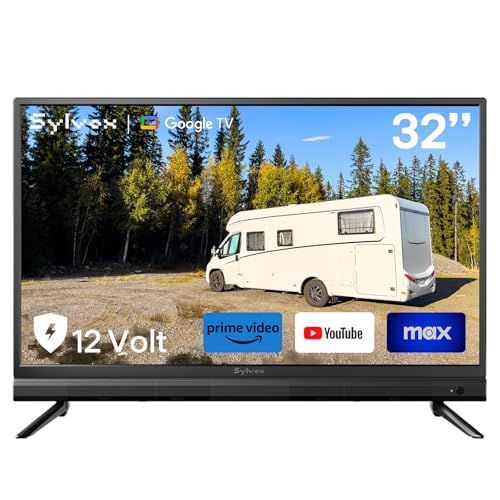
SYLVOX 32-inch RV TV — Voltage protection and a wide viewing angle
The second 32-inch SYLVOX in this guide differentiates itself with two title-stated details: voltage protection and a 178-degree wide viewing angle. Its listing describes a 32-inch RV television, a 12-volt smart TV with Google OS, HDMI and USB ports, and AC/DC power, built for camper, motorhome, and RV use. Where the continuus at this size leans on casting, this set leans on electrical robustness and seating flexibility.
Voltage protection is a phrase worth dwelling on, because vehicle power is dirty power. Chargers connect and disconnect, loads switch, and spikes travel the same wiring the television drinks from. A set whose title calls out voltage protection is claiming a defence against exactly that environment — the electrical equivalent of the seismic design its siblings advertise against physical shock. For an owner wiring a television permanently into a rig, that claim belongs near the top of the decision list.
The 178-degree viewing angle answers a layout problem specific to campers. Seating in a motorhome wraps around — a dinette on one side, a swivel cab seat, a sofa along the wall — and rarely faces the screen as squarely as a living-room sofa does. A panel that holds its picture at wide angles keeps the image watchable from the dinette seat where half the audience actually sits, rather than reserving a good picture for one privileged chair.
Google OS supplies the streaming layer, with the app ecosystem and account structure Google households already know. HDMI and USB ports are stated outright in this title — a small mercy in a category where port details often go unpublished — so connecting a console, a media drive, or a laptop for a rainy-day slideshow is planned-for rather than hoped-for. As a permanent-install set for a mid-size rig, the specification hangs together convincingly.
Set the two 32-inch picks side by side and the choice clarifies. The continuus spends its specification on screen-sharing and a familiar Android TV interface; this SYLVOX spends its own on the electrical and geometric realities of the vehicle — protection against the supply, and a picture that holds from the awkward seats. A rig that mostly tours between serviced sites may value the casting more. A rig that wild-camps, with the set hard-wired and the family spread around a dinette, will feel this set’s priorities every single evening.
- Screen: 32-inch panel
- Power: 12 volt, AC/DC, stated in the listing title
- Electrical protection: voltage protection named in the title
- Viewing angle: 178 degrees, per the title
- Platform: Google OS smart system
- Ports: HDMI and USB stated in the title
- Resolution: Not stated in the listing title — verify with the manufacturer documentation
Strengths
- Voltage protection is claimed in the title, aimed at vehicle electrical spikes
- A 178-degree viewing angle suits wrap-around camper seating layouts
- HDMI and USB ports are confirmed in the title rather than left to assumption
Trade-offs
- The title does not state the panel resolution, so picture class needs a documentation check
- No built-in DVD player for disc-based viewing
- No wide-voltage window is published in the title, unlike the 24 and 40-inch SYLVOX sets
Best for: a permanently wired motorhome installation with dinette-and-sofa seating spread around the screen.
Not suited for: a buyer needing confirmed resolution from the listing alone — the title omits the panel’s resolution figure.
Permanent-install planners can confirm the voltage protection wording on the listing and confirm today’s Amazon price for this 32-inch model.
Comparison
| Pick | Size | Power per title | Platform | Title-stated standout |
|---|---|---|---|---|
| SYLVOX 24 Smart RV TV | 24-inch | 12V DC, 9–32V wide voltage DC/AC | Smart (platform not named in title) | Seismic shock resistance; low power consumption; 1080p |
| SYLVOX 22 with DVD | 22-inch | 12V, AC/DC | Google OS | Built-in DVD player; ATSC and NTSC tuners |
| continuus CT-32TS10 | 32-inch | 12V | Android TV | Chromecast and Google Assistant; 720p |
| SYLVOX 40 RV TV | 40-inch | 12V, 9–32V DC/AC | Smart (platform not named in title) | Seismic design; low energy consumption; 1080p |
| Westinghouse DVD combo | 24-inch | Not stated in the listing title | None — non-smart | Built-in DVD player; works with streaming sticks |
| SYLVOX 32 RV TV | 32-inch | 12 volt, AC/DC | Google OS | Voltage protection; 178-degree viewing angle |
How to Choose a Camper TV
Begin with your electrical system, because it eliminates most of the market immediately. If your rig runs a leisure battery and you tour off-grid, the set must accept 12V DC directly — or better, a wide voltage window — and five picks here state exactly that. If your touring is hookup-based, mains sets re-enter the conversation, and the Westinghouse’s built-in DVD player becomes a rational simplicity play rather than a compromise.
Next, estimate your power budget honestly. Every hour of television is drawn from the same battery that runs the lights, the water pump, and the fridge’s controls. Low power consumption claims, where a title makes them, are worth real money in that arithmetic, and smaller screens generally sip where larger ones drink. Match screen ambition to battery capacity: a 40-inch set on a modest battery bank shortens every off-grid stay.
Then think about signal, because a camper television lives or dies by content access. Sites with strong WiFi favour the streaming-first sets. Touring patterns that cross mountains, moors, and coastal dead zones favour the two DVD-equipped picks and the tuner-equipped SYLVOX 22, which can fill an evening from discs and broadcast alone. Many experienced tourers deliberately carry both routes — streaming where it works, discs where it does not — and this guide’s spread supports exactly that belt-and-braces approach.
Audio deserves a brief word in a space this small. Camper walls are thin in both directions: your film leaks to the neighbouring pitch, and their evening leaks into yours. Sets with Bluetooth, several of which appear below, allow headphone listening that keeps the peace on a crowded site, and that courtesy feature becomes a genuine selection criterion on summer weekends when pitches sit a few metres apart.
Mounting and vibration come after content. Measure the intended wall or cabinet, confirm the set’s size against it with the doors and cupboards open, and favour designs whose titles claim seismic or shock resistance if your routes include rough roads. A television is only as roadworthy as its mount, so budget attention for the bracket and its fixings into the vehicle structure, not just into interior panels.
Finally, check the paperwork the titles leave blank. Tuner types, exact port counts, and mounting patterns are stated for some picks and silent for others. The spec boxes above flag each silence; resolve the ones that matter to your setup through the manufacturer documentation before ordering, rather than discovering a missing input at the first rainy site of the season.
Charging sources belong in the same calculation. A rig that returns to hookup every second night can afford a hungrier screen than one crossing a week of wild camping on a single battery, and a solar-equipped roof changes the sums again by refilling the battery daily. Buyers often spec the television against the battery they have and forget the charger they actually use; the honest figure is the balance between the two over a typical trip, not either number alone.
Do not overlook the aerial and cabling side of the installation. A tuner-equipped set still needs an antenna suited to a moving home — one that can be raised, aimed, and stowed — and the cable runs in a camper cross spaces that open, slide, and fold. Planning those runs before the set arrives turns installation day into an hour’s work instead of a weekend of trim removal, and it prevents the pinched, intermittent connections that masquerade as television faults all season.
Can a Camper TV Really Run Straight From a Leisure Battery?
Yes — provided the set is built for it, which is the entire premise of the 12-volt picks in this guide. A television whose title states 12V DC or a 9–32V window connects to the vehicle’s DC system through the appropriate fused circuit and runs without an inverter in the chain. Removing the inverter removes its conversion losses and its standby draw, both of which matter when the battery is the only supply.
The wide-voltage designs deserve their premium in this context. Battery voltage is a moving target — lower as charge depletes, higher while charging — and a set tolerant across 9 to 32 volts simply keeps working through the whole cycle. Fixed-voltage equipment is where the trouble stories come from: screens that cut out as the battery fades or suffer when a charger pushes voltage upward. The SYLVOX 32’s stated voltage protection addresses the same family of risks from the protection side.
What you cannot safely do is assume a household television will tolerate vehicle power because an adapter physically fits. If a title does not state DC operation, the evidence does not support it — which is why this guide refuses to claim 12V capability for the Westinghouse, however camper-friendly its DVD player is.
Do You Still Need a DVD Player in a Camper?
For a meaningful share of tourers, yes, and the reason is coverage rather than sentiment. Streaming depends on site WiFi that may be throttled to unusability by evening, or on mobile signal that terrain interrupts precisely where the scenery is best. A disc ignores all of that. The two DVD-equipped picks here split by power: the SYLVOX 22 keeps its player available on battery power, while the Westinghouse serves hookup sites.
There is also a household-library argument. Many families own shelves of discs bought over two decades, including children’s films that rotate endlessly on wet afternoons. A built-in player turns that sunk cost into touring entertainment with no new subscriptions and no downloads planned around departure day. Travellers who have fully migrated to streaming lose nothing by choosing the non-DVD picks — but they should make that choice knowingly, after picturing the third consecutive rainy evening at a site with no signal.
How Much Battery Does an Evening of Television Use?
The exact draw of each set is a documentation figure, not a title figure, so this guide will not invent numbers. The reasoning, though, is straightforward and worth internalising. A smaller, efficiency-claiming set watched for three hours consumes a modest slice of a healthy leisure battery; a 40-inch screen watched for five hours consumes a serious one. Screen size and viewing hours are the two levers you control, and both multiply.
Practical tourers manage the budget with habits rather than hardware alone: broadcast and discs instead of data-heavy streaming where the set allows it, brightness turned down after dark — which a small cabin needs anyway — and a realistic sense of the battery’s state before the film starts rather than after the lights dim. Choosing a set whose title claims low power consumption, as two SYLVOX picks do, stacks the arithmetic in your favour before those habits even come into play.
One more variable hides in plain sight: everything else running at the same time. An evening of television rarely happens in electrical isolation — the fridge cycles, phones charge, lights burn, and a heater’s fan may turn through the night. The television’s share should be judged against that combined load, not against the battery in the abstract. Tourers who have flattened a battery mid-trip almost always discover the culprit was the sum of modest draws, which is another argument for choosing the frugal set and the smaller screen your rig can honestly support.
How Should a Camper TV Be Mounted for Travel Days?
Mounting is where camper televisions quietly succeed or fail, because the set spends half its life as cargo. A bracket rated for vehicle use, fixed into the rig’s structure rather than a decorative panel, is the foundation; a television that tears loose on a rough descent is a hazard before it is a loss. Many tourers add a travel routine to the hardware: a strap or locking position for transit, cables with enough slack to flex without chafing, and connectors checked at the start of each season when the rig comes out of storage.
Position matters for viewing as much as for survival. In most rigs the screen serves two audiences — the lounge seating by day and the bed by night — and a tilt-and-swivel mount lets one set serve both without a second screen. Height deserves care as well: a set mounted at standing eye level forces bedtime viewers to crane upward, while a set mounted for the bed sits too low for the dinette. The swivel mount is the compromise that usually wins, provided it locks firmly for the road.
Ventilation closes the subject. Campers seal tightly against weather, and a television boxed into a cabinet with no airflow will cook itself slowly over a summer of evenings. Leave clearance around the set, avoid mounting directly above a heat source, and remember that the same cupboard warmth that comforts the occupants shortens electronic life. A few centimetres of breathing room is the cheapest longevity measure in this entire guide.
Finally, plan the mount around the set’s own connections. Ports on a camper television may face sideways, downward, or rearward, and a bracket chosen without checking can bury the one input your streaming stick needs. Where a title states the ports — the SYLVOX 32 names HDMI and USB openly — planning is easy. Where it does not, the documentation check in the spec boxes should happen before the bracket is ordered, not after the holes are drilled.
Common Mistakes When Buying a Camper TV
Bolting a household television into the rig and hoping the electrics forgive it. A mains set on vehicle power means an inverter, conversion losses, and a screen never designed for voltage swings or vibration. The failure usually arrives mid-trip, far from a returns desk. Buy a set whose title states the DC operation your system provides.
Believing a camper label guarantees 12-volt running. The Westinghouse in this guide is marketed for RV and camper use, carries a built-in DVD player — and states no 12V input anywhere in its title. Category language is not a power specification. Read the title for the actual electrical claim, and treat silence as a no until documentation proves otherwise.
Oversizing the screen for the battery bank. A large panel in a big rig is a pleasure; the same panel on a small battery turns every off-grid evening into rationing. Screen size, battery capacity, and charging sources form one equation, and the television is the variable most buyers inflate. Solve the equation before choosing the screen.
Planning entertainment around perfect signal. Streaming-only setups meet their first dead zone quickly. Tourers who carry a disc option, a tuner for broadcast, or downloaded media alongside streaming simply have more evenings covered. The picks here let you build that redundancy deliberately instead of improvising it at a rainy site.
Treating the television as a winter-afterthought purchase. Rigs bought in spring get their televisions fitted in a hurry, often the week before the first trip, with whatever screen the shop had on the shelf. That haste skips the two checks this guide keeps returning to — the power claim in the title and the fit against the mounting space. A set chosen in the off-season, against the battery system and the wall it will actually live on, avoids both the returns process and the first-trip disappointment.
Final Recommendation
For most campers, the SYLVOX 24-inch Smart RV TV is the set to build around: a 1080p picture, a 9–32V wide-voltage appetite, seismic shock resistance, and a low-consumption design brief, all stated in its own title. Travellers beyond reliable signal should look hard at the SYLVOX 22 with its built-in DVD player and dual tuners, while family motorhomes choose between the continuus 32 for casting and the SYLVOX 32 for voltage protection and viewing angle. Large rigs get their native answer in the SYLVOX 40, and hookup tourers with a disc shelf are honestly served by the Westinghouse combo — on mains, as its evidence states. A camper television earns its wall space by respecting the battery, and the SYLVOX 24 respects it most completely.
Whichever set you choose, fit it before the season rather than during it: confirm the power claim against your rig’s system, measure the wall with the cupboards open, and let one full evening of off-grid viewing at home expose any wiring surprises while the driveway, not a distant site, is where you are parked.
Frequently Asked Questions
What makes a TV a camper TV rather than just a small TV?
Power and construction. Camper televisions state 12V or wide-voltage DC operation in their specifications, so they can run from a leisure battery without an inverter, and the better ones add shock-resistant construction for vehicle vibration. A household small TV may share the screen size but promises neither, which is why this guide only includes sets whose titles support the camper claim.
Does the Westinghouse DVD combo run on 12 volts?
Its listing title does not say so. The title states a built-in DVD player, HD resolution, a non-smart design, and compatibility with streaming sticks, and it names RV and camper use — but no 12V input appears. This guide therefore positions it for hookup sites or inverter use, and recommends confirming the power specification in the manufacturer documentation before planning any battery-direct installation.
Why do several picks accept 9 to 32 volts instead of exactly 12?
Because vehicle voltage is never exactly 12. It dips as the battery discharges and rises while charging, and a wide window lets the television ride through both without cutting out or taking stress. The same range also covers 24-volt vehicle systems, which is why the SYLVOX titles mention trucks alongside campers.
Which pick is best for watching with no internet at all?
The SYLVOX 22-inch model, on the strength of its title: a built-in DVD player plus ATSC and NTSC tuners means discs and over-the-air broadcast can fill an evening with zero connectivity, while its 12V power keeps that true off-grid. The Westinghouse offers the disc route as well, but for hookup-based touring.
Is 720p acceptable on the 32-inch continuus?
It is the set’s clear compromise, chosen in favour of size and native 12V power. From typical motorhome lounge distances the softness is modest; from close dinette seating it is noticeable. Buyers who prioritise picture density at 32 inches should compare the SYLVOX 32 — though note its title does not state a resolution, so that comparison belongs in the manufacturer documentation.
Can these TVs pick up broadcast channels at a campsite?
Where a title states a tuner, yes, with a suitable antenna and local reception. The SYLVOX 22 names ATSC and NTSC tuners explicitly. For the other picks, tuner details are not stated in the titles, so check the documentation for the exact model before relying on broadcast reception in your touring plans.
What size camper TV suits a campervan conversion?
The 22 and 24-inch picks fit the mounting space and seating distances of a typical conversion, and their lower draw suits the smaller battery banks conversions usually carry. The SYLVOX 24 adds the wide-voltage window and 1080p sharpness; the SYLVOX 22 adds the built-in DVD player and tuners. The 32-inch sets belong in motorhomes with a real lounge wall, and the 40-inch set in large rigs only.
Related Guides
Back at home, a compact screen still earns its keep — see our guide to televisions sized for dorm rooms for shared-space viewing on a budget. For the workshop end of vehicle life, the garage TV picks cover bigger indoor sets, and if your touring runs on sunshine, the guide to TVs that pair with solar setups explains the battery maths in full.


