What's inside
- Key Takeaways
- Quick Picks
- How did we select these closed-back headsets?
- What does a sealed earcup actually do to sound and noise?
- How should you think about microphones on a closed-back headset?
- Closed-back for shared homes: the etiquette and the physics
- How much isolation is enough for a shared home?
- The six closed-back headsets with mic, one by one
- Sealed and compared: six closed designs on isolation, microphones and fit
- How do you get a proper seal and clear chat from a closed headset?
- What changes when a whole team or family standardises on one sealed headset?
- What are the classic closed-back buying mistakes?
- Final Recommendation
- Frequently Asked Questions
- Related Guides
As an Amazon Associate I earn from qualifying purchases. This post may contain affiliate links at no extra cost to you.
widgetverdict.com is reader-supported. When you buy through links on our site, we may earn an affiliate commission.
Where to buy: all six headsets below link to checked Amazon listings, and together they cover the closed-back spectrum — two EPOS designs, two beyerdynamic models, an Audio-Technica and the ever-present HyperX — each sealing the room out in its own way.
The best closedback headsets with mic make the opposite promise to the open-backed designs elsewhere in this batch: the room stays out and your game stays in. A sealed earcup is a small act of defiance against the household — the television in the corner, the conversation in the kitchen, the traffic beyond the window all drop to a murmur, while nothing you play leaks back to disturb anyone. For shared homes and late sessions, that two-way privacy is not a preference but a permission slip.
Closed-back design also changes the sound itself, and honest shoppers should know how before choosing. Sealing the cup builds bass pressure and a sense of impact that open designs deliberately surrender, and it concentrates the stereo image into something intimate and immediate rather than spacious. Explosions land harder, footsteps feel closer, and music takes on a private, in-the-room-with-you character. Players raised on open sound sometimes call it claustrophobic for a week; players raised on closed sound call everything else thin.
Every pick here carries a microphone, because a headset earns its name in voice chat, and the six divide by microphone philosophy as much as by sound: lift-to-mute convenience from EPOS, a condenser flagship capsule from beyerdynamic, an unusually large 10mm mic from HyperX, and an augmented listening mode from the MMX 150 that lets the room back in on your terms. Sealed does not have to mean cut off — it means you choose the moments of contact.
Key Takeaways
- A sealed cup keeps your audio private and the household’s noise out — the defining closed-back bargain, in both directions.
- Bass arrives with more pressure and impact than open designs can produce, which suits cinematic and competitive play alike.
- Microphone styles split the list: lift-to-mute, detachable, condenser and a large 10mm capsule each suit different chat habits.
- The beyerdynamic MMX 150’s Augmented Mode is the safety valve, letting ambient sound in when you choose to hear it.
- Passive isolation is not active noise cancelling; a good seal quiets a room but will not erase a nearby television entirely.
- Memory foam and clamp force decide closed-back comfort, because a sealed cup worn badly becomes a warm, pressing one.
Quick Picks
| Pick | Badge | Why it earns its place |
|---|---|---|
| EPOS H3 Closed Acoustic Gaming Headset with Noise-Cancelling | The plug-and-play all-rounder | Closed acoustic design, a noise-cancelling microphone and compatibility with practically everything — PC, Mac, PS4, PS5, Switch and Xbox. |
| Audio-Technica ATH-GL3BK Closed-Back Gaming Headset, Black | The sealed Audio-Technica | The closed sibling of this batch’s open Audio-Technica pick — the same house tuning philosophy, sealed for shared spaces. |
| beyerdynamic MMX 150 Closed Over-Ear Gaming Headset | The augmented middle path | Closed over-ear isolation with an Augmented Mode that lets the room back in when you want it, plus the META Voice microphone, in grey. |
| EPOS Gaming H6Pro – Closed Acoustic Over-Ear Headset With Mic – | The lift-to-mute veteran, sealed | The closed version of the H6Pro: lightweight build, lift-to-mute boom and Xbox, PlayStation and PC coverage, in white. |
| beyerdynamic MMX 300 Pro Wired Closed-Back Gaming Headset | The sealed flagship | The title says it plainly: it shuts out the room so you stay locked in — closed-back audio with a broadcast-grade condenser mic. |
| HyperX Cloud III Gaming Headset | The comfort institution | Memory foam, a durable frame and an ultra-clear 10mm mic, with USB-C, USB-A and 3.5mm connectivity across PC and consoles. |
How did we select these closed-back headsets?
The filter was strict: a genuinely closed or closed-acoustic design, an attached microphone, and a listing title that supports both facts. Open-backed siblings of these same model families were excluded even where they share a name — the H6Pro, for instance, exists in both forms, and only the closed version belongs here. Readers comparing microphone quality beyond this category will find Best Headsets With Great Mic Quality — Broadcast, Streaming and Meeting Voices Compared a useful wider lens.
Within the filter, we balanced the ways closed-back headsets are actually bought: platform breadth, microphone ambition, comfort engineering and one maker’s answer — augmented listening — to the isolation problem. Where a title omits a detail, most noticeably for the Audio-Technica, the spec box records the omission instead of borrowing specifications from a neighbouring model, because a wrong spec is worse than an admitted gap.
What does a sealed earcup actually do to sound and noise?
Physically, a closed cup traps a small volume of air between driver and ear, and the driver works against that volume like a piston against a spring. Bass frequencies gain pressure and punch, transients feel immediate, and the outside world loses its vote: a well-sealed cushion can take the edge off a room so effectively that players routinely describe the moment of putting a closed headset on as the moment the house goes quiet. It is passive isolation — no electronics, no batteries — and it works on your game’s leakage in the other direction just as faithfully.
The same seal explains the category’s two honest weaknesses. Trapped air means trapped warmth, so closed cups run hotter across a long session than open ones, and the intimate soundstage places instruments and effects closer to the head rather than across a virtual stage. Neither weakness is a flaw in execution; both are the physics of the choice, and the picks below manage them with memory foam, considered clamp and, in one case, a mode that opens the world back up electronically.
Judge a closed headset, therefore, on seal quality before driver mythology. A cushion that breaks its seal every time you turn your head — glasses wearers know this failure intimately — surrenders the isolation and the bass in the same motion. The makers in this list have spent decades on exactly that interface, which is why their names recur in a category where execution matters more than novelty.
How should you think about microphones on a closed-back headset?
Start with the mute, because on a sealed headset the mute is a safety device. You cannot hear the doorbell, the kettle or your own name being called at natural volume, so the moments when you must speak to the room — or stop the room hearing you — arrive suddenly. EPOS answers with lift-to-mute on the H6Pro Closed: raise the boom and you are silent, a gesture so physical that nobody forgets which state they are in. Detachable and bendable designs answer differently, by making the mic’s position unmistakable.
Then consider what the capsule is asked to capture. A condenser microphone, as in the beyerdynamic MMX 300 Pro, renders voice with studio detail and suits streamers whose chat is also content; the HyperX Cloud III’s unusually large 10mm capsule pursues clarity by size; and the noise-cancelling microphone named in the EPOS H3’s title pursues it by rejection. All three philosophies work, and the right one depends on whether your voice is a tool, a performance or both. Creators weighing that question seriously should continue into Best Headsets With Mic for Podcasting after this list.
Finally, remember that a sealed headset hides your own voice from you. Without sidetone or an augmented mode, talkers unconsciously raise their volume, which is why the MMX 150’s Augmented Mode — letting a measure of the room, including yourself, back into the mix — is a more thoughtful feature than its modest billing suggests. Hearing yourself naturally is not vanity; it is pacing, and across a four-hour session it is stamina.
Closed-back for shared homes: the etiquette and the physics
The closed-back headset is the diplomat of gaming audio. It lets a player keep full volume at midnight in a flat with thin walls, lets a parent game in the same room as a sleeping child, and lets two people share a sofa — one inside a film’s soundtrack, one inside a game — without either soundtrack colonising the room. No other category can make those claims, and in dense modern housing that diplomacy is often the entire reason for the purchase.
The etiquette runs both ways, though. A sealed player is a deaf player at conversational frequencies, so households should agree how contact is made: a hand on the shoulder, a message, a light flicked twice. It sounds like a small thing until the first time a partner shouts through two rooms at someone wearing an H6Pro. The headsets are doing their job in that moment; the household simply needs a protocol equal to the isolation.
Parents should also weigh the safety side with clear eyes. A teenager sealed into a game cannot hear a smoke alarm’s early warning as readily, a door, or a younger sibling in trouble. Augmented modes, single-ear breaks and house rules about session volume are sensible mitigations, and they cost nothing. Isolation is a tool with a handle and a blade, and this guide would rather name both than sell the handle alone. Readers focused on suppression technology itself can go deeper with Best Noise-Canceling Mic Headsets.
How much isolation is enough for a shared home?
Enough is a household measurement, not a laboratory one. The test is a Tuesday evening: the television at its normal volume, a conversation at its normal warmth, the dishwasher running its normal complaint. A closed headset that reduces that orchestra to a background murmur — present if you listen for it, absent while you play — has done everything a passive seal can honestly do, and for most homes it is plenty. Chasing the last few percent toward silence leads buyers into active-cancelling products with different costs and different compromises.
The outward direction matters just as much and is easier to judge: at your normal gaming volume, a sealed headset should be inaudible beyond a faint murmur to someone on the same sofa, and effectively silent through a closed door. Every pick in this list meets that standard by design, which is why closed-back is the only category a night-shift household should shortlist without discussion. Your volume becomes your own business again.
Where households disagree is the middle case — the same room, the same evening, two different programmes. There, the honest answer is that isolation manages volume rather than abolishing it, and the diplomacy still needs a human layer: agreed hours, agreed signals, and the augmented or lift-to-mute features that let a sealed player rejoin the room in a second. Technology sets the terms; the household still signs the treaty.
The six closed-back headsets with mic, one by one
Each pick is judged on its seal, its microphone and the player it serves. Figures appear only where listing titles state them; the Audio-Technica’s restrained title is handled the same way as elsewhere in this batch — the gap is flagged, not filled.

EPOS H3 Closed Acoustic Gaming Headset with Noise-Cancelling — The plug-and-play all-rounder
The H3 is EPOS’s argument that a closed-back headset should be judged first by how little friction it creates. Plug and play audio, says the title, and the platform list behind it is the longest in this guide: PC, Mac, PS4, PS5, Switch and Xbox. A headset that can follow a player across that entire estate without adapters or configuration is not merely convenient — it becomes the household’s default audio device, the one that lives beside the television and answers every purpose.
The microphone carries the noise-cancelling brief, which in a closed-back context completes a neat symmetry: the cups keep the room out of your ears, and the microphone keeps the room out of your voice. Teammates hear the callout rather than the household behind it. For players whose gaming happens in genuinely shared space — the living room in the evening, the family computer in the corner — that two-way discretion is the product, and everything else is presentation.
Around-the-ear fit with an adjustable, ergonomic design addresses the closed category’s standing comfort risk, distributing clamp so the seal survives without the vice feeling. Onyx black keeps the whole object sober enough for a desk that also hosts work.
The H3 also deserves credit as the household peace treaty in this list. Because it works with everything, it ends the argument about whose device the good headset belongs to: it belongs to whichever screen is in use, and it travels between them in seconds. Families that share one quality headset across a console, a laptop and a handheld will use it more in a month than a technically finer headset locked to one machine gets used in a season — and use, in the end, is the only specification that cannot be exaggerated.
There is a discipline to its restraint worth naming. Nothing in the H3’s proposition chases a headline; instead, every line of its title answers a practical question a buyer actually asks — will it plug in, will it fit, will my teammates hear the dog. Headsets bought on those answers tend to be kept, and headsets kept tend to be loved, which is how unglamorous products quietly become the recommendations friends give each other years later.
- Design: closed acoustic, around the ear
- Microphone: noise-cancelling microphone, per the listing title
- Setup: plug and play audio
- Platforms named in title: PC, Mac, PS4, PS5, Switch, Xbox
- Colour: onyx black
- Fit: adjustable, ergonomic
Strengths
- Widest platform list in this guide
- Noise-cancelling mic matches the sealed cups’ philosophy
- Zero-configuration plug and play behaviour
Trade-offs
- Closed cups run warm over long sessions
- Passive isolation only, despite the cancelling microphone
- Sober design will not excite RGB tastes
Best for: players gaming in shared rooms across several consoles and computers, wanting one sealed headset that simply works everywhere
Not suited for: players in private quiet rooms preferring an open soundstage over isolation

Audio-Technica ATH-GL3BK Closed-Back Gaming Headset, Black — The sealed Audio-Technica
Audio-Technica fields a matched pair in this batch: the open GDL3 examined in the companion guide, and this closed GL3 for players whose rooms cannot tolerate leakage. The listing title is again the briefest here — a name, a design, a colour — so the manufacturer documentation must supply microphone and connection specifics before purchase, and this guide declines to guess them. What the pairing itself tells you is that the maker considers the open/closed decision a genuine fork, worth two distinct products rather than one compromise.
The closed fork serves the player who wants Audio-Technica’s comparatively restrained tuning — a house style built on studio headphones that refuse to exaggerate — inside a sealed cup that respects a household. Where gaming-native rivals chase impact, this lineage chases balance, and players who game for long evenings often find that balance easier to live with at hour three than a bass-forward presentation that thrills for ten minutes.
Everything else about the closed bargain applies in full: privacy out, quiet in, warmth managed by fit rather than by ventilation. If your shortlist began with the open model and your room vetoed it, this is the same sensibility wearing the correct architecture — provided the documentation confirms the connection your machines need.
Think of the GL3 as the answer to a very specific sentence: I liked everything about the open Audio-Technica except my room. That sentence is spoken constantly in shared flats and family homes, and it deserves a product rather than a compromise. The closed architecture keeps the house tuning while changing the social contract entirely — full volume becomes a private matter, and the household stops being an audience. Few purchases in audio are as cleanly motivated as that one.
The documentation homework this pick requires can even be reframed as diligence the buyer should perform anyway. Connection type, microphone arrangement and cable length decide whether any headset suits a particular desk, and the GL3 simply refuses to let you skip the questions. Answer them once, from the manufacturer’s own pages, and the purchase that follows is better informed than most — whichever model it finally lands on.
- Design: closed-back gaming headset
- Colour: black
- Maker: Audio-Technica gaming line
- Microphone and connection specifics: the listing title does not state them — refer to the manufacturer documentation
Strengths
- Sealed version of a respected tuning lineage
- Household-friendly privacy in both directions
- Restrained sound suits long sessions
Trade-offs
- Sparse listing title demands documentation research
- Closed cups isolate less than active-cancelling rivals
- Fewer gaming-specific features than native gaming brands
Best for: players wanting Audio-Technica balance with sealed privacy for a shared home
Not suited for: shoppers needing full specifications confirmed within the listing itself
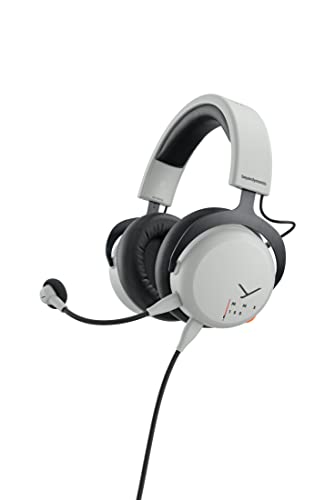
beyerdynamic MMX 150 Closed Over-Ear Gaming Headset — The augmented middle path
The MMX 150 contains the most interesting idea in this list, and it hides in two words of the title: Augmented Mode. A closed headset’s great weakness is total severance from the room, so beyerdynamic built a door in the wall — a mode that admits ambient sound deliberately, letting the wearer hear a doorbell, a conversation or their own voice without removing the headset. It converts isolation from a fixed condition into a choice, which is what isolation should always have been.
The META Voice microphone continues the studio-bred theme that runs through beyerdynamic’s gaming line: a capsule treated as a serious instrument rather than an accessory, in a headset whose title also promises excellent sound for all gaming devices. The grey finish distinguishes it in a sea of black gaming products, and the closed over-ear architecture delivers the bass presence and privacy the category exists for.
Consider who this serves best: the player in a shared home who loves the closed sound but hates shouting WHAT at a partner through sealed cups, the parent who needs one ear on the household, the streamer who wants natural own-voice monitoring. Augmented Mode will not be used every minute, but the minutes when it is needed are exactly the minutes that define whether a sealed headset fits a life.
Augmented Mode also changes the streamer’s equation in a way worth spelling out. A sealed headset normally forces a choice between hearing the game properly and hearing yourself properly; software sidetone patches the gap with delay and artifice. A hardware mode that admits the real room — your real voice, at real speed — keeps delivery natural across a long broadcast, and natural delivery is the thing audiences actually reward. Creators who talk for hours should weigh that more heavily than any single audio specification in this list.
The grey finish, meanwhile, is a small act of honesty about where headsets live. They live on desks, in photographs of desks, in the background of video calls. A gaming product finished like equipment rather than like a toy integrates into a working room instead of colonising it, and the MMX 150’s restraint in that department will age better than a hundred lighting effects. It is a headset designed by adults, for rooms that contain adults, and the category could use more of the species.
- Design: closed over-ear gaming headset
- Special mode: Augmented Mode, per the listing title
- Microphone: META Voice microphone
- Colour: grey
- Compatibility claim in title: all gaming devices
Strengths
- Augmented Mode restores room awareness on demand
- Studio-bred microphone pedigree
- Closed isolation with an escape hatch
Trade-offs
- Augmented listening is a compromise beside true open-back
- Grey finish will not match every setup
- Closed cups still run warmer than open rivals
Best for: parents and shared-home players wanting sealed sound with a deliberate way to hear the room and their own voice
Not suited for: players wanting the widest possible soundstage as the first priority

EPOS Gaming H6Pro – Closed Acoustic Over-Ear Headset With Mic – — The lift-to-mute veteran, sealed
This list contains both H6Pro twins, and the closed one earns its place on a single gesture: lift-to-mute. Raise the boom and the microphone silences; lower it and you are live. On a sealed headset — where the wearer cannot hear the room and the room should sometimes not hear the wearer — that physical certainty about mute state is worth more than any software indicator. Parents answering a door mid-match and professionals taking a household interruption both live by that gesture.
Closed acoustic design gives this version the family sound with the seal applied: the same lightweight build and durable intent as its open sibling, but with privacy out and quiet in. Platform coverage spans Xbox, PS4, PS5 and PC/Windows, which keeps it among the most console-capable closed headsets here, and the white finish again suits desks that are furniture rather than battlestations.
Players choosing between the twins should decide by room, not by model loyalty. The open H6Pro belongs to the private study; this closed one belongs to the living room, the shared flat and the late session. EPOS clearly intends exactly that division, and honouring it produces two satisfied owners where one compromised product would have produced two mildly annoyed ones.
The closed H6Pro also quietly solves the two-headset household problem in reverse. Its open sibling is the private-room instrument; this one is the same family feeling — the same fit language, the same build confidence — translated for the living room. A player who owns both never has to relearn a headset when the room changes, and a household buying one of each has standardised its spares, its habits and its expectations. That kind of family coherence is a real, if unglamorous, ownership pleasure.
Lift-to-mute deserves one more scenario: the video call that includes the game. Sealed players increasingly take work calls on the same headset they game on, and the raised-boom gesture reads identically in both worlds — visible, deliberate, unmistakable to anyone watching on camera. In an era when a hot microphone can become a career event, a mute you perform with your whole hand rather than a hopeful keypress is not a convenience. It is insurance with a hinge.
- Design: closed acoustic over-ear
- Microphone: lift-to-mute boom, per the listing title
- Build: lightweight, per the title
- Platforms named in title: Xbox, PS4, PS5, PC/Windows
- Colour: white
Strengths
- Lift-to-mute gives unmistakable mute control
- Console breadth matches the open sibling
- Lightweight build offsets closed-cup warmth
Trade-offs
- White finish shows daily wear
- Closed soundstage is narrower than the open twin
- Wired connection only
Best for: shared-home players wanting sealed privacy with a foolproof physical mute across console and PC
Not suited for: private-room players preferring open spaciousness

beyerdynamic MMX 300 Pro Wired Closed-Back Gaming Headset — The sealed flagship
Where the open MMX 330 Pro invites the room into the sound, its closed sibling makes the opposite vow in its title: shuts out the room so you stay locked in. The MMX 300 Pro is beyerdynamic’s flagship argument for sealing — closed-back audio for PC, PlayStation and Switch, delivered with the same broadcast-grade condenser microphone philosophy as its open counterpart. It is the headset for the player whose environment is the enemy and whose voice is a performance.
The condenser microphone deserves the same respect-and-caution treatment as before, with the caution inverted. Inside a sealed headset, a detailed capsule captures a voice beautifully while the cups handle the room; the combination suits streamers and creators whose chat doubles as content. The room still matters to a condenser — it hears what reaches it — but the closed architecture means the wearer at least is not fighting the household to concentrate.
Wired delivery, flagship build and a maker with studio heritage complete a product aimed at permanence. This is not the headset bought to try closed-back; it is the headset bought after deciding closed-back is home. Players who record, compete or simply concentrate best in a sealed world will find the category’s ceiling somewhere near this model’s address.
Concentration is the MMX 300 Pro’s true product, and it is worth pricing honestly. A sealed flagship does not merely sound better than a budget headset; it changes the conditions of play, removing the flinch at household noise, the half-heard interruption, the session broken by a door. Competitive players talk about being locked in as a mental state, and this headset’s title uses exactly those words because the state is the deliverable. The audio quality is how the state is achieved, not the achievement itself.
It is also the pick in this list most likely to anchor a permanent setup — one desk, one machine or console, one headset that lives there for years. Permanence justifies the flagship commitment in a way that portable, multi-room use never quite does, because every session repays a fraction of it. Buyers whose gaming has a home address, rather than a rota of locations, should let that arithmetic speak: the costliest headset here may be the cheapest per hour of any product in the guide.
- Design: wired closed-back gaming headset
- Microphone: condenser mic, broadcast-grade per the listing title
- Platforms named in title: PC, PlayStation and Switch
- Positioning in title: shuts out the room for focused play
Strengths
- Flagship sealed isolation from a studio house
- Broadcast-grade condenser voice capture
- Serious build for long-term ownership
Trade-offs
- Condenser hears a loud room honestly
- Sealed cups are the warmest wear in this list
- Wired only, at a flagship commitment level
Best for: streamers and focused competitors wanting flagship sealed isolation with a broadcast-grade voice
Not suited for: casual players wanting a light, occasional-use headset

HyperX Cloud III Gaming Headset — The comfort institution
The Cloud line is close to a default setting in gaming headsets, and the third generation’s title explains the durability of that status: memory foam, a durable frame and connectivity that refuses to argue — USB-C, USB-A and 3.5mm in one product, spanning PC, PS5, PS4 and Xbox Series X|S. HyperX sells reassurance as much as audio, and for a closed-back headset bought to be worn daily for years, reassurance is a rational thing to buy.
The microphone gets an unusual, concrete claim: ultra-clear, and 10mm. Capsule size is rarely advertised because it is rarely a selling point, but a larger capsule can capture voice with an ease smaller ones strain for, and HyperX clearly believes this one earns the headline. In a closed-back context — where the wearer cannot hear themselves and the microphone is the whole of their presence to teammates — that emphasis is well placed.
Memory foam is the comfort half of the same argument, conforming to the wearer and maintaining the seal that closed-back bass and isolation depend on, including over glasses for many wearers. Add the durable frame and the picture is of a headset engineered against the two ways headsets actually die: discomfort that exiles them to a drawer, and breakage that exiles them to a bin. The Cloud III is built to avoid both exiles.
The Cloud III’s real predecessor is not another headset but the idea of the default. Every category has the product bought by people who do not want to become experts in the category, and the Cloud line has held that position in gaming headsets through three generations by being comfortable, durable and unsurprising in the best sense. The third generation’s contribution is breadth — three connection types, four platform families — which widens the default’s territory to nearly every desk and console a buyer might own.
Durability deserves its final word here, because the durable frame in the title addresses the failure mode nobody photographs: the headset that dies at the hinge in month thirteen. A frame engineered against that death, paired with foam that keeps the seal honest, is a product designed around ownership rather than around launch day. For a daily-worn closed headset, that may be the most grown-up specification in this entire list, and it is why the Cloud III closes so many shortlists it did not even apply for.
- Connection: USB-C, USB-A and 3.5mm wired
- Microphone: ultra-clear 10mm mic, per the listing title
- Comfort: memory foam
- Build: durable frame
- Platforms named in title: PC, PS5, PS4, Xbox Series X|S
Strengths
- Three connection types end compatibility worries
- Memory foam sustains the seal and the comfort
- Frame durability suits daily, years-long use
Trade-offs
- Closed design runs warm like all sealed rivals
- Gaming-native tuning favours impact over neutrality
- Wired across all three connections
Best for: daily players wanting a durable, comfortable sealed headset that connects to everything they own
Not suited for: audiophile-leaning players wanting a restrained, studio-style presentation
Sealed and compared: six closed designs on isolation, microphones and fit
Every row of this table seals, so the comparison turns on the details that differentiate sealed headsets: how the microphone mutes, whether the room can be let back in, and how the fit sustains the seal across hours. Read the microphone column first if you stream, and the fit column first if you wear glasses.
| Pick | Connection | Microphone | Fit and form |
|---|---|---|---|
| EPOS H3 Closed Acoustic Gaming Headset with Noise-Cancelling | Wired plug and play | Noise-cancelling mic | Closed acoustic, around-ear |
| Audio-Technica ATH-GL3BK Closed-Back Gaming Headset, Black | Wired gaming connection (confirm in documentation) | Headset mic (details in documentation) | Closed-back, black |
| beyerdynamic MMX 150 Closed Over-Ear Gaming Headset | Wired gaming connection | META Voice microphone | Closed over-ear, Augmented Mode |
| EPOS Gaming H6Pro – Closed Acoustic Over-Ear Headset With Mic – | Wired multi-platform | Lift-to-mute boom | Closed acoustic, white |
| beyerdynamic MMX 300 Pro Wired Closed-Back Gaming Headset | Wired | Condenser broadcast-grade mic | Closed-back flagship |
| HyperX Cloud III Gaming Headset | USB-C / USB-A / 3.5mm wired | Ultra-clear 10mm mic | Closed, memory foam |
Two philosophies contend in the table. The first treats isolation as absolute — the MMX 300 Pro and the Cloud III seal the world away and trust the wearer to manage contact. The second treats isolation as adjustable, with the MMX 150’s Augmented Mode as its purest expression and lift-to-mute as its gesture-level cousin. Neither philosophy is wrong; they encode different households.
Platform breadth is the quiet third contest. The EPOS H3 and the HyperX cover the most machines with the least fuss, while the beyerdynamic pair ask a little more of the buyer and repay it in microphone and build ambition. Match the ambition to the use and the table resolves itself.
How do you get a proper seal and clear chat from a closed headset?
Fit is a procedure, not a moment. Put the headset on, then run a finger around each cushion’s edge: any gap — behind the jaw, over a glasses arm, under an earring — is a leak that costs you bass and isolation simultaneously. Adjust the headband so the cups sit flat rather than tilted, and give memory foam a full minute to conform before judging the seal, because foam that has not settled is a seal that has not happened.
Test with the sounds that expose failure. A low, steady tone reveals seal loss as thinness; a familiar voice recording reveals microphone placement better than any level meter. Position the boom so the capsule sits off-axis from your breath, speak at your true gaming volume rather than a careful test voice, and listen back for the household behind you — that recording is what your teammates have been hearing, and it is the honest baseline for every adjustment.
Finally, schedule relief. Even the best-sealed headset benefits from a two-minute break each hour, not for the equipment but for the ears inside it: pressure, warmth and constant near-field sound accumulate. Players who build the break into loading screens and lobby time sustain longer sessions at higher quality than players who treat endurance as a virtue — and their headsets last longer too, because gear that is rested is gear that is handled gently.
What changes when a whole team or family standardises on one sealed headset?
Standardisation sounds like an IT department’s hobby, but households discover its pleasures quickly. One model means one fit to learn, one mute gesture everyone understands, one set of spare cushions in a drawer and one answer when a younger player asks how anything works. Siblings stop negotiating over whose headset is better, because the question has been retired; parents stop troubleshooting three different connection rituals, because there is only one ritual and everybody knows it.
The picks in this list include two natural standards. The Cloud III’s connection breadth makes it the easiest household treaty — it fits the PC, the consoles and the phone-era leftovers without adapters — while the EPOS H3 makes the same argument with plug-and-play simplicity and the widest platform list of all. Either way, the benefit compounds quietly: headsets that are identical get swapped, shared and replaced without ceremony, and the household’s audio stops being a topic at all.
There is one honest cost to name: a standard fits the average head best, and households contain non-average heads. Buy one unit first, pass it around the family for a week of real sessions, and only then multiply it. A standard that pinches one member will be quietly sabotaged by that member, and the treaty will collapse back into a drawer of exceptions — which is where most households started, and exactly where this exercise was supposed to rescue them from.
What are the classic closed-back buying mistakes?
The first is expecting active noise cancelling from a passive seal. A closed cup quiets a room substantially and leaks nothing, but a television at full volume in the same room will still be audible through it, faintly. Buyers who need true electronic silence should shop that category deliberately rather than blaming a sealed headset for physics it never claimed to break.
The second is ignoring glasses. A seal is only as good as its weakest point, and spectacle arms are most wearers’ weakest point. Memory foam designs forgive more here, but every glasses wearer should treat the first session as a fitting, adjusting cup angle until the bass stops changing when the head turns.
The third is choosing by driver mythology while ignoring the microphone’s mute. On a sealed headset you will mute in a hurry, in the dark, mid-sentence, and the design of that gesture — a lifted boom, a found-by-touch button — decides whether the moment is graceful or a fumble. Buy the mute you can operate blind.
One more fitting habit is worth the thirty seconds it takes: wear the headset with your hair, glasses and earrings arranged exactly as they will be during play, because a seal tested on a bare head in a shop is a seal that exists only in the shop. Headbands should be adjusted on the head they will serve, booms bent for the face they will serve, and the first real session treated as a fitting appointment rather than a verdict. Players who grant a new sealed headset that one honest hour of adjustment rarely return it; players who judge it in the first ninety seconds return products that would have fitted them perfectly by Friday.
Volume discipline completes the ownership picture, and it matters more with sealed headsets than with any other kind, because isolation tempts excess: the quieter the room sounds, the louder the game creeps, one notch per session, until the level that felt thrilling in week one has become the level your ears are quietly paying for in year two. Set a reference level with a familiar piece of dialogue, mark it mentally, and defend it. The players who still hear footsteps clearly at forty are, overwhelmingly, the players who treated volume as a budget rather than a mood — and a sealed headset, honestly used, needs less of that budget than any open rival to deliver the same clarity.
Storage, finally, is where sealed headsets go to be injured. A closed headset dropped into a bag with a console, or left under a pile of books, suffers exactly at its engineered points — the hinge, the cushion edge, the boom root. A hook by the desk or a stand on it costs little and prevents nearly all of it, while also performing the small social service of signalling that the session is over and the player has rejoined the household. Equipment that has a home gets put away; equipment that gets put away survives to be argued about by the next generation of players in the same house.
Final Recommendation
If a single name must lead, the HyperX Cloud III is the closed-back default for most players: it connects to everything, seals comfortably and treats its microphone as a headline rather than an accessory. The MMX 300 Pro is the flagship for sealed focus and broadcast voice, the MMX 150 the clever answer for shared homes, the H6Pro Closed the mute-gesture champion, the H3 the platform-proof all-rounder, and the Audio-Technica the balanced alternative for quiet tastes.
Choose by household before choosing by brand, and the best closedback headsets with mic stop being a specification contest and become what they should be — a door you can close on the world, with a microphone good enough that the world still hears you clearly through it.
Frequently Asked Questions
Is closed-back better than open-back for gaming?
Better at different things. Closed-back isolates, privatises and pressurises bass, which suits shared homes, late sessions and cinematic play. Open-back sounds wider and stays cooler, which suits private rooms and long voice sessions. The correct question is which room you play in; the answer to that question chooses the category before any model is compared.
Will a closed-back headset block a television in the same room?
It will reduce it to a murmur rather than erase it. A good seal is powerful against mid and high frequencies and modest against bass and loud dialogue peaks. If the television belongs to someone else in the same room, combine the headset with sensible volume expectations — or consider that the room may be telling you the session belongs elsewhere.
What is lift-to-mute, and why does it matter?
Lift-to-mute silences the microphone when the boom is raised, as on the EPOS H6Pro Closed in this list. It matters because the mute state becomes physical and visible rather than a software toggle you must remember. On a sealed headset, where interruptions arrive suddenly and silently, that certainty prevents both accidents — broadcasting the room, and performing to a muted microphone.
Do closed-back headsets make your ears hot?
Warmer than open designs, yes, because the sealed chamber traps heat as well as sound. Makers fight it with breathable cushion materials, memory foam that distributes pressure and headbands that reduce clamp hotspots. Session breaks help more than any material. Players in hot climates should weigh this honestly and may prefer the lightest sealed designs in this list.
Can I hear my own voice with a closed-back headset?
Not naturally, which is why features like the MMX 150’s Augmented Mode exist: they feed a measure of the room, including your voice, back into the mix. Without such a mode, expect to speak slightly louder than intended until habit recalibrates you. Streamers often add software sidetone for the same reason.
Are closed-back headsets suitable for music?
Very much so, with a character of their own: intimate, bass-present and private, which flatters electronic, rock and film scores particularly. Listeners who prize a wide, airy stage lean open; listeners who want the music sealed in with them — on a train of thought if not an actual train — are the closed category’s natural citizens.
Can a closed-back headset work for office calls as well as games?
Yes, and several picks here are quietly excellent at it. A sealed cup keeps a home office’s noise out of your ears, a good boom keeps it out of your voice, and designs like the H6Pro Closed carry their mute discipline straight into meetings. The cautions are presentational — a large gaming headset reads differently on camera than an office model — and thermal, across a full day of calls. For a hybrid desk that games in the evening, one closed headset serving both lives is a perfectly rational economy.
How do I clean and maintain the cushions on a sealed headset?
Wipe cushions with a barely damp cloth after heavy sessions and let them dry fully before the next use, because the seal depends on cushion material that stays supple rather than cracked. Keep the headset off radiators and out of direct sun, both of which age foam and covering faster than play does. When bass and isolation fade together after a year or two, suspect the cushions before the drivers — on a sealed design, the cushion is half the acoustic system, and refreshing it restores more than any setting can.
Should I buy a second closed headset for a partner, or share one?
Share for a week, then decide with evidence. If the headset migrates happily between heads — a quick headband adjustment, cushions that forgive different faces — one unit can serve a household whose sessions rarely overlap. The moment two players want the same evening, though, sharing becomes a scheduling tax on every session, and a second headset pays for itself in peace long before it pays for itself in audio. Households that game together nightly should treat two headsets as the setup, not the upgrade.
Why does my closed headset sound different after a year?
Usually because the cushions changed, not the drivers. Foam compresses, coverings stiffen, and the seal that produced the original bass and isolation slowly becomes a suggestion rather than a seal. The sound drifts thin and the room creeps back, and owners blame the electronics because electronics are what they paid for. Refresh the cushions first — on a sealed design that single act of maintenance restores the acoustic system to something very close to its first-month behaviour, at a fraction of a replacement headset’s commitment.
Is a closed-back headset a sensible gift for a teenager?
It is one of the most sensible gifts in gaming, provided the household conversation happens alongside it. The teenager gains privacy and impact; the household gains silence and a living room back. Agree the contact signal and the session-volume expectations when the box is opened, while goodwill is at its peak, and the headset becomes a treaty rather than a wall. Models with obvious physical mutes, like the lift-to-mute EPOS in this list, make that treaty easiest to keep, because everyone in the room can see the microphone’s state at a glance.
Choose the size of the gesture to suit the age of the player, and even the liveliest household will find that a sealed headset, honestly introduced, lowers the total volume of family life far more than it ever raises it, which is, when you think about it, precisely what the whole category was invented to do, back when the first sealed cup closed over the first pair of ears in a noisy, crowded, thoroughly inconsiderate room full of televisions, kettles and conversation at full, unapologetic evening volume, nightly, without pause or mercy.
Related Guides
- Best Headsets With Great Mic Quality — Broadcast, Streaming and Meeting Voices Compared
- Best Noise-Canceling Mic Headsets
- Best Headsets With Mic for Podcasting


