What's inside
- Key Takeaways
- Quick Picks
- How did we assemble a credenza list that respects the word’s meaning?
- What exactly is a credenza, and how does it differ from a desk with drawers?
- Credenza, U-suite or L: the six arrangements compared
- How do you plan a room around a credenza desk or a suite?
- What mistakes do credenza and suite buyers regret?
- How does a credenza change the way an office receives visitors?
- What should live on the credenza surface, and what should never?
- How do you assemble and place a suite without regretting the afternoon?
- How does the credenza idea serve a home office that is also a living space?
- What maintenance do large office suites actually need?
- How do you choose a finish that the room will still love in ten years?
- What is the honest case for starting smaller than a suite?
- How should two people share a credenza office?
- Why does the credenza keep outliving every office fashion?
- What should you verify in the first week after a suite is assembled?
- Final Recommendation
- Frequently Asked Questions
- Related Guides
As an Amazon Associate I earn from qualifying purchases. This post may contain affiliate links at no extra cost to you.
widgetverdict.com is reader-supported. When you buy through links on our site, we may earn an affiliate commission.
The best credenza desks solve a problem the ordinary desk creates: where does the office’s second life go — the files, the printer, the reference books, the equipment that must be near the work but not on it? A credenza, in the original furniture sense, is the low storage cabinet that stands beside or behind the desk, and a credenza desk builds that partnership into one considered arrangement: a working surface joined to serious cabinet storage, so the top stays clear and the room reads as furnished rather than equipped. The pick headings below link to each arrangement’s Amazon listing. Hold one distinction firmly as you read, because this category blurs it constantly: a true credenza desk, like the Bush Studio C that opens our list, is a desk paired with credenza storage, while several larger entries here are executive U-shaped or L-shaped suites that include a credenza as one component among a desk shell, a bridge and a hutch. Both are legitimate; they are not the same purchase, and this guide keeps the two species labelled throughout.
One more framing before the picks: these are all substantial pieces of furniture with substantial assembly, and none of them is a casual purchase to be reversed on a whim. Read the pick analyses with a tape measure nearby, keep the manufacturer’s documentation open for every model whose headline leaves dimensions unstated, and treat the decision with the seriousness you would give a sofa or a bed — because in size, cost of effort and years of daily contact, that is the company this furniture keeps.
The six arrangements span that spectrum deliberately. At one end, a single 72 by 24 inch credenza desk in platinum gray for a professional office. At the other, U-shaped executive suites from Boss and Bestar that wrap the worker in surface on three sides, with hutches above and file pedestals below. Between them sit two large L-shaped executive desks from Tribesigns and SEDETA. Your room, your storage load and your working style — not the biggest number in a title — should decide where on that spectrum you land.
Key Takeaways
- A credenza desk pairs a work surface with low cabinet storage; a U-shaped executive suite adds a bridge and often a hutch, and costs the room far more floor space.
- The Bush Studio C is the purest credenza desk here: a single 72W by 24D unit in platinum gray, sized for a professional office or a serious home one.
- Bestar’s U-shaped suite names its anatomy outright — desk shell, credenza and desk bridge — plus a hutch with frosted glass doors at 72W.
- Boss offers two U-shaped variants, at 66 inches with a hutch in mocha and at 71 inches with a four-door hutch in driftwood.
- The Tribesigns and SEDETA entries are L-shaped executive desks, not U-suites: 78 and 78.7 inches of wraparound surface with file storage below.
- Measure the room for the suite’s full footprint, including chair travel and hutch height, before falling for any three-sided layout.
Quick Picks
| Arrangement | Badge | What it does best |
|---|---|---|
| Bush Business Furniture Studio C 72W x 24D Credenza Desk | The true credenza desk | A single 72 by 24 inch credenza desk in platinum gray for home or professional office use. |
| Boss Office Products Holland Executive U-Shape Desk | Compact U-suite | A 66 inch U-shaped executive desk in mocha with a file storage pedestal and a hutch. |
| Bestar U-Shaped Executive Desk with Hutch | Named three-piece suite | A 72W U-shaped desk in bark gray whose title lists the shell, credenza and bridge, under a frosted-glass-door hutch. |
| Boss Office Products 71 Inch Executive U-Shape Desk | Four-door hutch suite | A 71 inch U-shaped desk in driftwood whose pedestal stores files beneath a hutch with four doors. |
| Tribesigns 78″ L-Shaped Executive Desk | L-shaped with file cabinet | A 78 inch L-shaped executive desk in light walnut and black, with drawers and a file cabinet. |
| SEDETA 78.7″ L Shaped Executive Desk with Charging Station | L-shaped, charging built in | A 78.7 inch L desk with file drawers, an adjustable storage cabinet, a CPU stand and a charging station. |
How did we assemble a credenza list that respects the word’s meaning?
We began with the genuine article — desks whose titles name a credenza as the product or as a defined component — and then admitted the executive suites and L-shaped desks that shoppers inevitably compare against them, labelling each for what it is. That labelling is the service this guide exists to provide, because a buyer who orders a U-shaped suite expecting a single credenza desk will receive a room-filling arrangement, and a buyer who orders the lone credenza desk expecting a wraparound suite will feel short-changed by its honest single surface. Beyond classification, we weighed storage substance — file pedestals, hutches, cabinets — against footprint, and favoured listings whose titles describe their components concretely. Buyers whose rooms lean toward the corner layout should also read Best L Shaped Computer Desks for Home Office alongside this guide, since the two L-shaped picks here compete directly with that category.
What exactly is a credenza, and how does it differ from a desk with drawers?
A credenza began as a sideboard — the cabinet in a dining room where serving dishes lived — and migrated to the office as the low, long storage unit that stands behind or beside the executive’s desk. Its defining traits are proportion and purpose: low enough to work as a secondary surface, long enough to hold a printer, a row of binders or a serving tray’s worth of equipment, and enclosed, with doors or drawers that hide the office’s machinery from the room. A desk with drawers stores things under the work surface, within the kneehole’s competition; a credenza stores them outside the kneehole entirely, which is why executives who receive visitors have always paired the two — the desk faces the guest, clean, while the credenza behind the chair holds everything the meeting might need.
A note on vocabulary will save shoppers real confusion in this category. Manufacturers use credenza loosely — sometimes for the low cabinet alone, sometimes for a desk with cabinet storage, sometimes, as in the suites here, for one named component of a larger arrangement. The safe habit is to ignore the label and read the components: what surfaces exist, where the storage sits, and what the total footprint measures. Bestar’s title, which lists its shell, credenza and bridge outright, is the model of how the honest listings behave; where a title leans on the word credenza without components, the manufacturer’s documentation must supply the anatomy before money follows.
That division of labour explains the two species in this guide. The Bush Studio C compresses the partnership into one unit against a wall: surface in front, credenza character throughout, ideal where floor space allows one substantial piece. The U-shaped suites from Boss and Bestar build the partnership at architectural scale: a front desk, a credenza behind, a bridge joining them into a U, and the worker seated in the U’s embrace with every surface in swivelling reach. The L-shaped desks split the difference, wrapping two sides instead of three. None is the correct answer in the abstract; each is the correct answer to a different room and a different volume of office life.
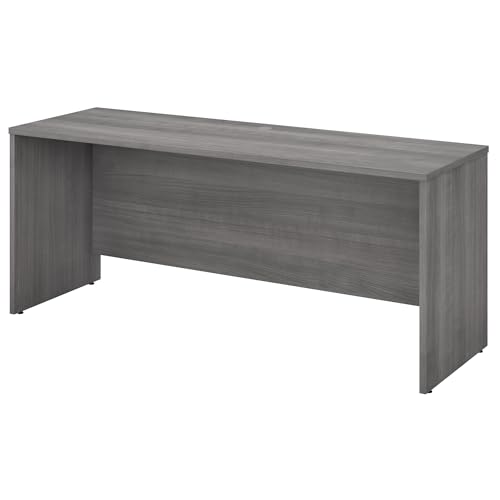
Bush Business Furniture Studio C 72W x 24D Credenza Desk — The true credenza desk
Start with the product that gives this category its name and its standard. Bush Business Furniture’s Studio C credenza desk is a single unit, 72 inches wide and 24 inches deep, in platinum gray, described in its title as a computer table for a home or professional office. That plain description is the point. This is not a suite, not a wraparound command centre, but the classic credenza desk: a generous work surface with the storage character of a credenza, designed to stand against a wall and give an office its calm, ordered backbone. Bush’s business furniture heritage shows in the proportions — 72 inches is the classic executive width, and 24 inches of depth keeps the unit’s footprint disciplined against the wall.
In practice, a unit like this serves two masters equally well. As a primary desk, it offers a wide, uncluttered top with room for dual monitors and a working spread of documents, in a finish — platinum gray — that suits professional rooms where wood tones would feel heavy. As a companion credenza behind a separate front desk, it becomes the storage and equipment surface the credenza was invented to be: printer, binders, the second screen’s stand, all held at a height that keeps them reachable from the chair with a half-turn. The Studio C line’s broader ecosystem of matching pieces, which Bush sells across its business ranges, means the unit can also anchor a room that grows piece by piece.
The headline listing is spare with further detail — drawer and cabinet configuration, cable provision and load figures live in the manufacturer’s documentation, and buyers should confirm the storage layout there, since credenza desks vary between open, drawer and door configurations beneath the same generous top. What the title guarantees is the essential proposition, honestly stated: the real credenza desk, at full executive width, from a maker whose business is office furniture. Every other pick in this guide should be measured against the question it answers — do you actually need more than this?
- Dimensions: 72 inches wide by 24 inches deep, per the listing title
- Finish: platinum gray
- Form: single credenza desk unit, not a multi-piece suite
- Maker: Bush Business Furniture, Studio C line
- Intended settings named in the title: home or professional office
- Storage configuration: not detailed in the headline listing — confirm the drawer and door layout in the manufacturer’s documentation
Strengths
- The genuine credenza desk format, without suite-scale floor demands.
- Full 72 inch executive width in a wall-friendly 24 inch depth.
- Neutral platinum gray suits professional and modern rooms.
Trade-offs
- Single surface; no wraparound bridge or return.
- Storage layout must be verified in documentation before ordering.
- No hutch, so vertical storage requires a separate piece.
Best for: a professional office or serious home office wanting one substantial credenza desk against the wall, as desk or as companion storage.
Not suited for: workers who want to be surrounded by surface on three sides in a U-shaped suite.
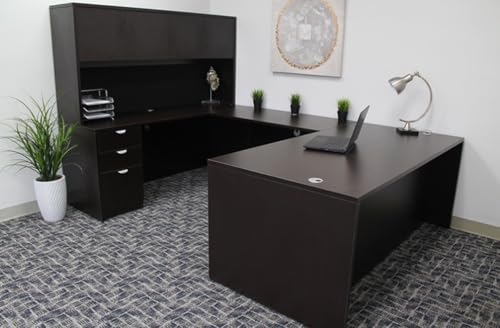
Boss Office Products Holland Executive U-Shape Desk — Compact U-suite
The Boss Holland suite is where this guide crosses from credenza desk into executive suite, and the crossing should be conscious. At 66 inches, the Holland is the smaller of the two Boss U-shaped arrangements here, finished in mocha, and its title names the components that make a U a U: the desk arrangement itself, a file storage pedestal, and a hutch. The worker sits inside the U with the front desk ahead, the credenza surface behind, and the bridge to one side — every document, device and drawer within a chair’s swivel, which is the entire ergonomic argument for the format.
The hutch changes the room’s vertical economy. Storage climbs the wall above the credenza side, holding binders, boxes and reference material at standing reach, while the file pedestal below handles the archive. For a home office that must contain an entire small business — paperwork, supplies, equipment, library — a U-suite with a hutch is less furniture than infrastructure, and the Holland delivers that infrastructure at the most compact footprint in this guide’s suite class. Mocha is a warm, traditional tone that suits rooms with leather, wood and brass rather than chrome and glass.
The commitments are real. A U-suite defines its room permanently; it does not get rearranged on a whim, and its assembly is a project measured in hours and best done in the room it will occupy, since the completed U fits through few doorways. Boss does not publish the suite’s full footprint dimensions in the headline, so the manufacturer’s documentation must be measured against your floor plan with the chair’s territory included. Buyers with the room and the paperwork volume will find the Holland the most complete workstation here; buyers with either constraint should retreat gladly to the Bush or the L-shaped pair.
- Overall size: 66 inches, mocha finish, Holland line
- Configuration: U-shaped executive desk
- Storage named in the title: a pedestal for files, with a hutch above
- Maker: Boss Office Products
- Full footprint dimensions: the headline omits them, so measure from the manufacturer’s documentation against your room
- Credenza component: the U’s rear run serves the credenza role within the suite
Strengths
- Complete U-workstation with hutch storage at the group’s most compact suite size.
- File pedestal and hutch together absorb a small business’s entire paper load.
- Warm mocha finish suits traditional executive rooms.
Trade-offs
- Permanent, room-defining installation with substantial assembly.
- Footprint must be verified from documentation before committing.
- Traditional styling will not blend with modern minimalist offices.
Best for: a dedicated home office or small business room that can give a U-suite its floor and needs total storage in return.
Not suited for: multi-purpose rooms, renters expecting to move soon, or anyone wanting a single credenza unit.

Bestar U-Shaped Executive Desk with Hutch — Named three-piece suite
Bestar earns trust in this category by doing something none of its rivals bother to do: its title lists the suite’s anatomy. The I3 Plus arrangement at 72W comprises a desk shell, a credenza and a desk bridge — the three components whose union forms the U — topped by a hutch with frosted glass doors, all in bark gray. A buyer reading that title knows exactly what species of furniture is being discussed, which is rarer than it should be in a category where the word credenza is often used as decoration. If you want to understand what a U-shaped executive desk actually is, the Bestar listing is the textbook.
The frosted glass doors on the hutch deserve their sentence. Hutch storage is invaluable and visually dangerous: open shelves display the office’s clutter to every visitor, while solid doors can make a suite feel like a wall of timber. Frosted glass splits the difference, concealing the contents’ details while keeping the hutch’s face light, a genuinely thoughtful touch in a home office that doubles as a meeting room. Bark gray, meanwhile, is the contemporary neutral — cooler than mocha, warmer than the Bush’s platinum — and suits the transitional interiors most home offices actually have.
At 72 inches wide the suite asks for a real room, and the documentation should be consulted for the full depth of the U and the hutch’s height against your ceiling and any wall fittings. Bestar positions the suite for home or professional office use, and its component construction has one practical virtue: the pieces can be carried into the room separately and assembled in place, sparing you the doorway problem of a pre-built U. For the buyer who has decided on the suite format and wants its components stated plainly by the maker, this is the most literate offering in the group.
- Overall width: 72W, bark gray finish, I3 Plus line
- Components named in the title: desk shell, credenza and desk bridge
- Hutch: included, with frosted glass doors
- Configuration: U-shaped executive desk
- Intended settings named in the title: home or professional office use
- Full footprint and hutch height: shoppers should confirm both figures in the manufacturer’s documentation
Strengths
- Components named outright, so the suite’s anatomy is unambiguous.
- Frosted glass hutch doors hide clutter without a timber wall effect.
- Component construction eases delivery into the room.
Trade-offs
- Suite scale demands a dedicated room and hours of assembly.
- Key dimensions require documentation confirmation.
- The U format fixes the room’s layout for years.
Best for: buyers committed to a U-suite who want its credenza, shell and bridge components stated plainly, in a contemporary finish.
Not suited for: small or multi-purpose rooms, or shoppers seeking a single credenza desk unit.

Boss Office Products 71 Inch Executive U-Shape Desk — Four-door hutch suite
Boss’s second suite in this guide scales the Holland’s formula up and finishes it in driftwood. At 71 inches, the U-shaped arrangement pairs its pedestal for file storage with a four-door hutch — the door count is the detail to note, because four doors mean the hutch’s storage is fully enclosed, sectioned and presentable, the configuration a client-facing office wants. Where the Bestar’s frosted glass softens the hutch’s presence, the Boss’s solid doors erase the contents entirely, and the suite reads as furniture of substance rather than as storage that happens to hold a desk.
Driftwood is the lightest finish among the suites here, a pale weathered tone that keeps a room-sized U from darkening the wall it occupies — no small consideration when the furniture will cover most of one end of a room. The five extra inches over the Holland translate into working surface on every run of the U, and in a format where the worker’s whole world is the U’s interior, those inches are felt daily in elbow room, document spread and the ability to keep a printer on the credenza run without evicting the reference books.
The suite’s demands mirror its smaller sibling’s, enlarged: verify the full footprint and hutch dimensions in the manufacturer’s documentation, assemble in the room, and commit the layout with open eyes. Boss sells to offices that furnish for the long term, and this suite is furnished thinking — a complete, enclosed, traditional workstation for a practice, a consultancy or a home business whose paperwork and visitors both require the room to look like it means it. If the Holland is the compact suite, this is the confident one.
- Overall size: 71 inches, driftwood finish
- Configuration: U-shaped executive desk
- Storage named in the title: a pedestal for files beneath a four-door hutch
- Maker: Boss Office Products
- Full footprint dimensions: the manufacturer’s documentation carries the measurements the headline leaves out
- Credenza component: the U’s rear run performs the credenza role inside the suite
Strengths
- Four-door hutch hides the office’s entire backstage from visitors.
- Pale driftwood finish keeps a large suite visually light.
- Extra width over the Holland is felt on every run of the U.
Trade-offs
- The largest storage commitment here short of the L-shaped pair’s span.
- Assembly and placement are a two-person, in-room project.
- Solid hutch doors conceal contents from the owner too — organisation is on you.
Best for: client-facing home businesses wanting a complete U-suite whose storage disappears behind doors in a light finish.
Not suited for: rooms under suite scale, or buyers who prefer open or glass-fronted hutch storage.

Tribesigns 78″ L-Shaped Executive Desk — L-shaped with file cabinet
With the Tribesigns, the guide steps down from the U to the L, and the distinction is practical rather than hierarchical. An L-shaped desk wraps two sides — a main run and a return — giving the worker a primary surface and a secondary one at a right angle, without the third run that closes a U around its occupant. At 78 inches the Tribesigns is the longest single span here, finished in light walnut with black, and its title promises drawers and a file cabinet, so the storage lives in the desk’s body rather than in a hutch above it. Modern business furniture for the home office is the stated brief, and the two-tone finish delivers exactly that contemporary register.
The L format suits corner rooms and open plans where a U would barricade the worker from the space. The return can carry the printer and the active project while the main run holds screens and keyboard, or the arrangement can reverse, and unlike a suite the L leaves the room’s circulation open — visitors approach, family passes, the office remains part of the home. For many home workers that openness is worth more than the U’s third surface, and the file cabinet ensures the L does not sacrifice the archive to achieve it.
Tribesigns’ headline leaves the drawers’ count and the return’s exact dimensions to the manufacturer’s documentation, so verify the configuration there, particularly which side the return occupies and whether the layout can be mirrored, since L-shaped desks divide into fixed and reversible designs with very different room demands. Judged on its stated terms — 78 inches, executive scale, drawers plus file cabinet, modern finish — it is the natural choice for the buyer who wants the wraparound feeling at two sides rather than three, with the paperwork housed below the top instead of above it.
- Overall span: 78 inches, light walnut and black finish
- Configuration: L-shaped executive desk — two runs, not a U-suite
- Storage named in the title: drawers and a file cabinet
- Positioning: modern business furniture for the home office
- Return side and drawer count: neither is given in the headline, so confirm both in the manufacturer’s documentation
- Hutch: none included in this design
Strengths
- The longest span here, with file storage built into the desk body.
- L format keeps the room open where a U would enclose it.
- Contemporary two-tone finish suits modern home offices.
Trade-offs
- No hutch, so vertical storage must come from elsewhere.
- Return orientation needs verification before ordering.
- Seventy-eight inches still demands a committed corner.
Best for: corner and open-plan home offices wanting executive scale and filing in an L that leaves the room breathing.
Not suited for: workers who want the full three-sided embrace and overhead storage of a U-suite with hutch.

SEDETA 78.7″ L Shaped Executive Desk with Charging Station — L-shaped, charging built in
SEDETA’s L is the widest span in the guide at 78.7 inches and the most feature-forward of the six. The title assembles a modern inventory: file drawers, an adjustable storage cabinet, a CPU stand and a charging station, across a black and brown L-shaped executive desk. Each feature answers a known L-desk friction. The CPU stand lifts the computer tower off the floor and into the furniture’s plan, ending the era of the tower as a footrest and dust collector. The adjustable cabinet lets the storage conform to what is stored — printer paper one year, archive boxes the next — rather than forcing the office into fixed compartments. The charging station gives the desk’s devices a powered home at the surface, where they are used.
File drawers rather than a separate file cabinet keep the archive inside the desk’s footprint, and at this width there is footprint to spare: the main run can host a full multi-monitor workstation while the return carries the working project, the printer or a second person’s occasional seat. SEDETA pitches the desk at business use in a home setting, and the black and brown palette is the contemporary office standard, dark enough to look deliberate, warm enough to live with.
The checks are the L-desk usuals, amplified by size: confirm the return’s orientation and the full footprint in the manufacturer’s documentation, plan the delivery route for panels of this span, and decide the charging station’s device load against the documentation’s specification, since the headline does not detail it. For the buyer who wants the largest L here with the most built-in answers to modern device life, the SEDETA is the complete package — an executive desk that treats charging, computing and filing as one system rather than three afterthoughts. Buyers weighing it against pure storage-led designs may also consult Best Office Desks for Large People if the desk must accommodate a larger frame at its kneehole.
- Overall span: 78.7 inches, black and brown finish
- Configuration: L-shaped executive desk — two runs, not a U-suite
- Storage named in the title: file drawers and an adjustable storage cabinet
- Extras named in the title: charging station and a CPU stand
- Return orientation and charging specification: the documentation, not the headline, carries these details
- Hutch: none included in this design
Strengths
- The widest L here, with filing, adjustable cabinet storage and charging in one system.
- CPU stand gives the tower a designed place off the floor.
- Adjustable cabinet adapts as the office’s storage needs change.
Trade-offs
- Largest delivery and assembly project among the L-shaped pair.
- Charging specification needs documentation confirmation.
- No hutch for overhead storage.
Best for: device-heavy home businesses wanting the biggest L-shaped workstation with filing, charging and tower storage built in.
Not suited for: compact corners, or offices whose storage problem is vertical and calls for a hutch.
Credenza, U-suite or L: the six arrangements compared
| Model | Format | Span | Storage headline | Finish |
|---|---|---|---|---|
| Bush Studio C | Credenza desk, single unit | 72W x 24D | Credenza storage in one piece | Platinum gray |
| Boss Holland | U-shaped suite | 66″ | File pedestal plus hutch | Mocha |
| Bestar I3 Plus | U-shaped suite | 72W | Shell, credenza, bridge; frosted-glass hutch | Bark gray |
| Boss 71″ | U-shaped suite | 71″ | File pedestal plus four-door hutch | Driftwood |
| Tribesigns | L-shaped executive | 78″ | Drawers plus file cabinet | Light walnut and black |
| SEDETA | L-shaped executive | 78.7″ | File drawers plus adjustable cabinet | Black and brown |
Read the format column first, because it predicts your room’s next decade better than any other figure here. The single credenza desk preserves the room; the U-suites possess it; the L-shaped pair compromise with it. Storage philosophy divides the list just as clearly — hutches store upward, cabinets and pedestals store downward, and the Bush asks its one unit to do a bit of everything. Cable discipline across any of these arrangements is covered in Best Home Office Desks with Cable Management, which the suite buyers in particular should read before installation day.
How do you plan a room around a credenza desk or a suite?
Draw the room to scale, on paper or in an app, and place the furniture’s full footprint — for a U-suite, the complete U with the chair’s rolling territory inside it; for the Bush, the unit plus the chair and the space to open its storage; for an L, both runs and the corner’s dead zone, which should be assigned to the printer or the tower before it assigns itself to dust. Check the hutch heights against windows, radiators and wall cabinets, and check the delivery route with the same drawing: suite components travel as panels, but they are long panels, and stair turns have ended more executive ambitions than budgets have.
Then plan the sightlines. A credenza desk against the wall behind the worker is the classic video-call arrangement, presenting order to the camera. A U-suite’s occupant sits inside the furniture, so the camera sees the room beyond — plan what that beyond contains. Finally, plan power before placement, because suites and credenzas consume walls: the sockets behind a 72 inch unit are sockets the room loses, and the SEDETA’s charging station and the suites’ scale make a deliberate power plan the difference between a clean installation and a fringe of extension leads.
What mistakes do credenza and suite buyers regret?
Ordering by the headline width and forgetting the depth of the U is the classic: a suite’s footprint is a two-dimensional commitment, and rooms fail it in the dimension nobody measured. Second, buying a suite for a multi-purpose room, then watching the furniture’s permanence fight the room’s other lives for years. Third, ignoring the hutch’s height until it meets a window sill or a wall cabinet. Fourth, assuming a credenza desk and an executive suite are interchangeable names for the same thing — the confusion this guide opened with, and the most expensive one here, since the two species differ in footprint, assembly and the entire way a room gets used. Each regret is a measurement or a definition skipped; both take minutes to avoid.
How does a credenza change the way an office receives visitors?
The executive office has always been a theatre of two surfaces: the desk the visitor sees, and the storage the visitor is not meant to study. A credenza arrangement perfects that theatre. The front surface stays clear enough to signal competence; the credenza behind the chair holds the files, the samples and the second laptop, reachable with a turn but invisible from the guest’s seat. In a home office that receives clients, that choreography is worth real money in confidence — a room that looks uncluttered reads as a business that is uncluttered, fairly or not.
The suites extend the theatre vertically. A hutch with solid doors, like the larger Boss’s, hides the entire backstage; frosted glass, like the Bestar’s, hints at an organised interior without displaying it; and even the lone Bush credenza desk, used as the room’s storage wall behind a smaller front desk, performs the same trick at single-unit scale. Buyers furnishing a room where they will meet clients, patients or parents should weigh this presentational function alongside the storage arithmetic, because in such rooms the credenza is not merely holding the office — it is representing it.
What should live on the credenza surface, and what should never?
The credenza’s top is a working surface with a specific job: it holds the office’s shared equipment and its staging area. Printers belong there, raised off the floor and off the desk, with their paper stock in the cabinet below. The current project’s materials belong there in a tray or a shallow stack, visible and reachable, but bounded. A lamp, a phone charger and the reference books in active rotation complete the honest list. What should never live there is the overflow of the desk itself — the unsorted paper, the unopened post, the boxes awaiting decisions — because a credenza used as a dumping shelf loses its function within a month and becomes the room’s most expensive guilt.
The discipline is the same one filing desks demand: assign the surface its categories, and let nothing else land. Suites make the discipline easier by giving the overflow a hutch to hide in, which is both their virtue and their temptation; a four-door hutch can conceal a remarkable amount of unresolved office. The owners who get decades from these arrangements are the ones who treat the credenza’s surface as a stage that is struck nightly, not a shelf that is filled once and forgotten.
How do you assemble and place a suite without regretting the afternoon?
Assemble in the room, in the suite’s final position, in the order the manufacturer directs — which is invariably from the largest, least movable component outward. Clear the room’s other furniture first, protect the floor, and recruit the second person the instructions assume; suite panels are long, heavy and unforgiving of solo improvisation at the moment two components must meet level. Level each piece before joining it to the next, because a suite assembled out of level announces the error at every door and drawer for its entire life, and correcting it afterwards means partial disassembly.
Placement deserves the same patience as assembly. Live with the suite’s position taped on the floor for a day before building, if you can, walking the room’s routes and sitting in the chair’s territory in imagination. Check the hutch against the wall’s reality — sockets, vents, picture hooks, the radiator’s heat — and check the credenza run against the chair’s swivel, because the worker must reach the rear surface without standing, or the suite’s central promise fails silently every day. An afternoon spent this way is the best-value precaution in the whole purchase.
How does the credenza idea serve a home office that is also a living space?
In a home where the office shares a room with domestic life, the credenza’s enclosed storage performs a nightly miracle: the work disappears. Doors close on the files, the hutch conceals the supplies, and the room returns to being a sitting room or a dining room with a handsome cabinet in it. That transformation is why the credenza format, born in dining rooms, keeps returning to them — a Bush credenza desk in platinum gray or a driftwood suite reads as furniture to a dinner guest in a way that a tech-laden workstation never will. Households choosing between an open desk system and a credenza arrangement are often really choosing whether the office may clock off visually, and for many families that is the deciding question in this entire guide.
The L-shaped pair serve the same household differently: they claim a corner completely and honestly, making the office a defined district rather than a disguised one. Some homes prefer the district — work has its territory, and the rest of the room is unbothered — while others need the disguise. Neither answer is more sophisticated; they are different treaties between work and home, and the furniture in this guide can sign either one.
What maintenance do large office suites actually need?
Less than their size suggests, provided it is the right maintenance. Dust is the constant: hutch tops and credenza surfaces collect it visibly, and a weekly pass keeps the room’s presentational promise intact. Doors and drawers want their fixings checked seasonally, since a suite’s many panels settle into a house that itself settles, and a door caught early is a screw turned rather than a hinge replaced. Cable runs behind the credenza should be revisited whenever equipment changes, because suites hide cables so well that forgotten leads accumulate into nests nobody can trace. Finally, keep the manufacturer’s documentation and any spare fixings in one of the suite’s own drawers — the furniture storing its own instructions is a small elegance that pays off at every house move.
How do you choose a finish that the room will still love in ten years?
Suites and credenza desks are decade furniture, and finish is the decision that ages loudest. The safest finishes are the ones already speaking the room’s language: mocha and driftwood continue a traditional room’s conversation, bark gray and platinum gray suit the cooler palette of contemporary offices, and the two-tone L-shaped desks make a deliberate modern statement that should be chosen as a statement, not as a default. Beware matching wood tones exactly across different makers — a near-match reads as an error, while a confident contrast reads as a choice. Samples and the room’s actual light settle arguments that photographs cannot, since a finish that glows in a listing can sit flat under a north-facing window. Choose for the room at its worst light, on a grey morning, and the finish will please you in every other condition.
What is the honest case for starting smaller than a suite?
Rooms reveal their needs slowly, and furniture bought for an imagined office often overshoots the real one. Starting with the Bush credenza desk — or with one of the L-shaped pair — lets the office prove its volume before the room commits to a U. If the archive outgrows the first piece, suites can follow at a house move or a business expansion, when the requirement is measured rather than guessed. The reverse journey, from an overwhelming suite back to a calm single unit, is the one furnished with regret and a listing on a resale site. Experienced office planners buy storage in the order the paperwork demands it, and the paperwork, given a year, will tell you exactly what it demands.
How should two people share a credenza office?
By territory, agreed in advance. In a suite, one partner takes the front desk as their primary seat while the credenza run becomes the shared equipment station — printer, scanner, the household files — and the hutch divides by shelf. In an L-shaped arrangement, each person can claim a run, with the corner as negotiated ground. The arrangements fail when territory is left vague, because office clutter expands to fill any unowned surface within the week. The furniture in this guide provides more than enough bounded spaces — pedestals, cabinets, hutches, drawers — for two people’s work to coexist; what it cannot provide is the agreement, which takes one conversation and saves a hundred small ones.
Why does the credenza keep outliving every office fashion?
Because the problem it solves is not a fashion problem. Every era of office work generates a second life of objects — paper files in one decade, printers and towers in another, chargers and docks in this one — and every era’s workers need that life stored near the work, enclosed, and off the working surface. Desks change shape with technology; the credenza simply changes contents. The six arrangements in this guide are the current state of that long negotiation between work and its belongings, from the Bush’s single disciplined unit to suites that amount to a room within the room. Buy the one whose storage matches the second life your work actually leads, and you will not need to renegotiate for years.
What should you verify in the first week after a suite is assembled?
Work a real week in it before the packaging leaves the house. Sit in the U or at the L and run your actual routine: reach the credenza run without standing, open every hutch door against the room’s reality, load the file pedestal with your real archive and feel the drawers travel under honest weight. Check that the chair’s swivel clears the bridge, that the printer’s paper path does not collide with a hutch door, and that the sockets you planned still serve the equipment you placed. Suites reveal their small misalignments in use, not in inspection, and every one of them is easier to correct in week one — a door re-hung, a panel re-levelled — than in year two, when the room has arranged itself around the flaw.
Final Recommendation
Decide what species of furniture your room is actually asking for. If it asks for one substantial, calm unit — a desk with a credenza’s storage character, against the wall — the Bush Studio C is the honest answer and the standard of this category. If it asks for a complete workstation that wraps and stores in every direction, choose between the Boss Holland’s compact traditional U, the Bestar’s plainly-named components and frosted glass, and the larger Boss’s enclosed four-door hutch in pale driftwood. If it asks for executive scale that leaves the room open, the Tribesigns brings the file cabinet and the SEDETA brings the widest span with charging and an adjustable cabinet. Name the species correctly, measure the room for it honestly, tape the footprint on the floor before you commit, and give the assembly the afternoon and the second pair of hands it deserves. Do those things, and the furniture will organise your working life for a decade — storing the office’s second life out of sight, keeping the working surface clear, and presenting to every visitor, client or camera a room that appears to have its affairs entirely in order.
Frequently Asked Questions
What is the difference between a credenza desk and a regular executive desk?
A credenza desk is built around the pairing of a work surface with credenza-style cabinet storage — low, enclosed, designed to hold the office’s equipment and archive so the top stays clear. A regular executive desk is primarily a large work surface, often with modest drawers, and expects storage to live elsewhere. In this guide the Studio C from Bush is the credenza desk in the pure sense; the Boss and Bestar suites include a credenza as the rear component of a U, and the Tribesigns and SEDETA are L-shaped executive desks whose storage sits in the desk body.
Does a U-shaped desk include a credenza?
In these suites, yes — the rear run of the U performs the credenza’s role, and Bestar’s title says so explicitly by listing a desk shell, a credenza and a desk bridge as the suite’s components. The worker sits between the front desk and the credenza, with the bridge joining them at one side. That is why U-suites store so much within reach, and also why they occupy so much more floor than a lone credenza desk.
How much room does a U-shaped suite really need?
More than its headline width suggests, because the U’s depth — front desk to credenza — plus the chair’s territory inside the U defines the true footprint. Take the full dimensions from the manufacturer’s documentation for the Holland, Bestar or Boss 71 inch suites, draw them on your floor plan, and add the space to walk behind the chair if the room requires it. If the drawing makes the room feel claimed, it is — that is the suite’s nature, and an L or the Bush will serve better.
Can a credenza desk work as the only desk in a home office?
Entirely. The Bush Studio C’s 72 inch width is a full executive span, with room for dual monitors and a working spread, and its credenza storage handles the archive a solo office generates. Suites and L-shaped desks add surface and storage for heavier operations — a business’s full paperwork, multiple work zones, a second occasional worker — but a single professional’s office is complete with a true credenza desk and a good chair.
What should I check about a hutch before buying a suite?
Three things: its height against your ceiling, windows and any wall-mounted items; its door style against your room’s needs — open, frosted glass like the Bestar’s, or solid doors like the larger Boss’s four-door hutch; and its intended load, since hutches hold books and boxes whose weight belongs in the manufacturer’s documentation. The hutch is the suite’s most visible element and its least movable, so it deserves the same scrutiny as the desk itself.
Can I buy a credenza alone later to pair with a desk I already own?
Yes, and it is the classic way these arrangements grow. A standalone credenza in a compatible finish can stand behind or beside an existing desk and deliver most of the format’s benefit without replacing furniture you like. Matching finishes across brands is imperfect, so choose a credenza whose tone complements rather than imitates the desk, and keep the heights compatible — the credenza’s surface should sit at or slightly below the desk’s top for the pairing to feel designed.
Are U-shaped suites practical for one person working alone?
They are designed for exactly that: one worker, seated inside the U, with three surfaces in swivelling reach. The question is not the person but the paperwork — a solo worker with a business’s full archive, equipment and reference library uses a suite completely, while a solo worker whose office is a laptop and a notebook will rattle around inside one. Match the suite to the volume of the work, not the headcount.
What is a desk bridge, in a U-shaped suite?
The bridge is the connecting run that joins the front desk to the credenza at one side, closing the U. Bestar names it explicitly among its suite’s components. It typically carries the keyboard or the current project, and it is the piece that converts two separate units into a single workstation — and the piece whose absence would leave the worker crossing the room between desk and credenza all day.
Related Guides
- Best L Shaped Computer Desks for Home Office
- Best Office Desks for Large People
- Best Home Office Desks with Cable Management


