What's inside
- Key Takeaways
- Quick Picks
- How Did We Separate D Specialists From Universal Machines?
- Why Do D Cells Deserve Their Own Charging Conversation?
- The Six Chargers in Detail
- Comparing the Chargers: Dedicated D Bays Versus Universal Flexibility
- How Do You Run a Rechargeable D System Without the Headaches?
- What Mistakes Do D Battery Charger Buyers Keep Making?
- Final Recommendation
- Which Devices in a Home Actually Eat D Cells?
- How Do You Store Rechargeable D Cells Between Seasons?
- What Should You Do When a D Cell Set Starts Fading Early?
- How Does a Charger Behave at a Campsite or in a Cabin?
- Why Do Some Chargers Offer So Many Bays for Sizes You Rarely Use?
- What Is the Sensible Order to Buy Things In?
- Frequently Asked Questions
- A Note on Handing the System to the Next Person
- How Do You Know the Conversion to Rechargeable D Cells Has Paid Off?
- Related Guides
As an Amazon Associate I earn from qualifying purchases. This post may contain affiliate links at no extra cost to you.
widgetverdict.com is reader-supported. When you buy through links on our site, we may earn an affiliate commission.
Where to buy: the chargers reviewed here are listed on Amazon, and the product names in the Quick Picks table and in the detailed reviews link to their listings. D cells are the giants of the household battery drawer — the size that runs big torches, lanterns, radios and a long tail of pumps, toys and emergency gear — and they are large enough that charging them well is a different problem from charging a handful of AA cells. Start with the table to see which of these six units treat D as their main job and which treat it as one size among many, then read the detail sections before deciding.
Shoppers looking for the best d battery chargers meet a category with a split personality, and naming the split honestly is the fastest way to shop it well. On one side stand the universal chargers: wide-bay units that accept AA, AAA, C, D and often 9V cells in the same body, serving a household whose whole rechargeable collection passes through one machine. On the other side stand the D-focused chargers, built around the big cells — in this guide the BEVIGOR four-bay unit and the POWEROWL bundle, the latter arriving with four rechargeable D batteries of its own in the box. Neither side is superior in the abstract; the right side depends on whether your D cells are the whole collection or merely its largest citizens.
Chemistry is the second dividing line, and this guide follows the listing titles exactly on it. Most of these chargers speak Ni-MH, several add Ni-Cd, and one — the Energizer — is a NiMH-only proposition for its five sizes. Mixing chemistries on a charger that does not claim them is how cells get cooked, so the spec boxes below repeat each title’s chemistry wording faithfully, and the buying sections explain how discharge functions, LCD screens and independent bays change daily life with big cells that take real time to fill.
Key Takeaways
- Universal chargers (EBL, Energizer, Tenergy, BONAI) feed AA, AAA, C, D and 9V cells in one body; D-focused picks (BEVIGOR, POWEROWL) are built around the big cells.
- The POWEROWL listing is a bundle: its four-bay charger arrives with four rechargeable D batteries included, a starter kit rather than a bare charger.
- Chemistry claims differ by title — most cover Ni-MH and Ni-Cd, while the Energizer title specifies NiMH across its sizes.
- Discharge functions on the EBL and BONAI help condition older Ni-Cd and Ni-MH cells before a full charge.
- LCD-equipped models (EBL, Tenergy, BONAI) show per-cell progress, which matters when a D cell’s charge runs long.
- The BEVIGOR states plainly that batteries are not included, with four independent USB-C-fed slots and faulty-battery detection.
Quick Picks
| Pick | Badge | Why it earns its place |
|---|---|---|
| EBL Universal Smart Battery Charger with Discharge Function | Best universal with conditioning | A multi-bay rapid charger for C, D, AA, AAA and 9V Ni-MH and Ni-CD cells, with an LCD display and a discharge function. |
| Energizer Recharge Universal Charger for NiMH Rechargeable AA | Best household name | Energizer’s universal charger for NiMH AA, AAA, C, D and 9V rechargeables, from the battery aisle’s most familiar brand. |
| BEVIGOR C D Battery Charger, 4-Bay USB-C for NiMH/NiCd Batteries | Best D-focused bare charger | Four independent slots aimed at C and D NiMH/NiCd cells, fed by USB-C, with faulty-battery detection and no batteries included. |
| POWEROWL Rechargeable D Batteries with 4 Bay Battery Charger | Best starter bundle | Four rechargeable D batteries plus a four-bay USB quick charger that also handles AA, AAA and C Ni-MH and Ni-CD cells. |
| Tenergy TN486U 5-Bay Universal Battery Charger with LCD, Micro | Best five-bay universal | A five-bay universal charger with LCD and Micro USB/Type-C input for AA, AAA, C, D and 9V rechargeables. |
| BONAI Smart Battery Charger for AA AAA C D 9V Ni-MH | Best smart all-rounder | A smart charger for AA, AAA, C, D and 9V Ni-MH cells with discharge function, LCD display and fast charging in black. |
How Did We Separate D Specialists From Universal Machines?
The sort began with a tape measure, metaphorically: which chargers are shaped around D cells, and which merely tolerate them? A universal charger’s D bays are often its slowest or its shared slots, because the body was designed for a drawer of mixed sizes. A D-focused charger’s bays are the main event — sized, spaced and powered for the big cells — which matters when a lantern’s four D cells must all come back together before the next outing. The BEVIGOR and POWEROWL represent that focus here, each in a different commercial shape: bare charger versus bundle.
The second sort was by stated chemistry, taken strictly from titles. Ni-MH is the modern default for household rechargeables; Ni-Cd lingers in older collections and some hard-use gear, and a household still running Ni-Cd D cells in an old torch needs a charger whose title claims Ni-Cd explicitly — as the EBL, BEVIGOR, POWEROWL and Tenergy-side listings variously do — rather than hoping a NiMH-only unit will cope. The Energizer’s NiMH-only clarity is equally useful information in the other direction.
The third sort weighed the information a charger gives back. D cells charge slowly enough that a screen or per-bay indication stops being a luxury: an LCD that shows each cell’s progress, as on the EBL, Tenergy and BONAI, prevents the nightly guessing game of whether the big cells are done. Readers whose battery world is mostly automotive should note this guide stays with household cells; the twelve-volt side of the drawer lives in Best 10 Amp Auto Battery Chargers.
Why Do D Cells Deserve Their Own Charging Conversation?
Scale changes behaviour. A D cell holds several times the energy of an AA, so a charger moves more power per bay and a full charge from empty is a long session rather than an afternoon’s errand. That duration is why independent bays matter more here than in pocket chargers: an independent bay finishes each cell on its own schedule and lets you remove a ready cell without disturbing its neighbours, while paired-bay designs force cells to march together and can underfeed a mismatched couple. With D cells powering safety-adjacent gear — the big torch in a storm, the lantern in a blackout, the radio in an emergency kit — the difference between mostly charged and fully charged is measured in hours of light.
Scale also changes the economics that push households toward rechargeables at all. Disposable D cells are among the most expensive household batteries to keep replacing, and the devices that eat them — camping lanterns, boomboxes, motorised pumps — tend to eat them in sets of four or six. A rechargeable D system with a decent charger converts that recurring purchase into a one-time kit, which is precisely the proposition the POWEROWL bundle packages and the proposition the bare chargers serve for households that already own the cells.
Finally, scale changes storage. D rechargeables are heavy enough that a household owns a counted set rather than a rattling drawerful, and a counted set can be managed properly: rotated through the charger, kept together, and retired together when their capacity fades. The chargers below are reviewed with that managed-set reality in mind.
The Six Chargers in Detail

EBL Universal Smart Battery Charger with Discharge Function — Best universal with conditioning
EBL’s universal unit leads this guide because it treats the mixed household drawer as a system to be managed rather than a queue to be endured. Its title describes a multi-bay rapid charger for C, D, AA, AAA and 9V cells in Ni-MH and Ni-CD chemistries, with an LCD display and the feature that earns its badge: a discharge function. Discharge matters for older cells — particularly Ni-Cd, and Ni-MH cells that have spent their lives being topped up from half — because a controlled discharge before charging can restore a cell’s willingness to accept a full charge, the closest thing battery care has to a reset button.
The LCD is the second half of the appeal. On a charger whose largest cells take hours, a display that reports per-cell progress converts waiting into information: you can see the lantern’s set marching together, spot the one cell that lags its siblings session after session — the early obituary of a dying cell — and plan around real readiness instead of hope. EBL has built its name in the rechargeable niche rather than the disposable aisle, and this unit reads like it: a tool for people who maintain a battery collection deliberately.
Rapid is the title’s own word for its charging, and as with all such wording the honest test is your first full D session timed against your expectations. What the specification does promise structurally is breadth with intelligence: five sizes, two chemistries, conditioning and a screen in one body. Households whose D cells are part of a larger rechargeable ecosystem — and whose older Ni-Cd cells still earn their keep in garden tools and torches — will find this the most complete single purchase in the guide.
- Sizes named in the title: C, D, AA, AAA and 9V
- Chemistries named in the title: Ni-MH and Ni-CD
- Display described in the title: LCD
- Extra function in the title: discharge function
- Charging wording in the title: multi-bay rapid charger
Strengths
- Discharge function conditions tired cells before charging, extending useful life.
- LCD progress reporting suits the long sessions D cells demand.
- Five sizes and two chemistries cover a whole household drawer in one unit.
Trade-offs
- Universal breadth means D cells share the body with every smaller size.
- Conditioning cycles add hours when a cell needs the full treatment.
- Feature-rich units reward owners who read the manual once, properly.
Best for: a household maintaining a mixed rechargeable collection including older Ni-Cd cells.
Not suited for: a D-only owner whose drawer holds no smaller cells to justify universal bays.

Energizer Recharge Universal Charger for NiMH Rechargeable AA — Best household name
There is a particular comfort in buying the charger from the company whose name is already on half the batteries in the house, and Energizer’s Recharge Universal is the establishment candidate of this guide. Its title is plain: a universal charger for NiMH rechargeable AA, AAA, C, D and 9V batteries. No screen is promised, no discharge cycle, no rapid claim — just the five household sizes and one clearly stated chemistry from the brand that effectively taught households what a rechargeable battery was.
That NiMH-only clarity deserves respect rather than a shrug. A home that has standardised on NiMH cells — as most modern rechargeable collections have — does not need Ni-Cd circuitry, and a charger that states its chemistry without hedging is a charger whose instructions will be equally plain. Energizer’s rechargeable ecosystem also means the cells and the charger were designed in the same house, which removes the low-level compatibility anxiety that attends mixing a bargain charger with a premium cell collection.
Where this unit asks for compromise is feedback. The title promises no LCD, so progress information will be whatever the unit’s basic indication provides — check the product page for its exact signalling — and owners of big D sets who like data will feel the lack during long sessions. In exchange you get the simplest ownership story in the guide: a familiar brand, a universal bay layout, and no features to configure. For the household that wants rechargeable D cells to feel as unremarkable as disposable ones did, that simplicity is the entire point.
- Sizes named in the title: AA, AAA, C, D and 9V
- Chemistry named in the title: NiMH
- Brand: Energizer Recharge line
- Display: the title does not describe an LCD, so check the product page for its indication method
- Discharge function: not mentioned in the title
Strengths
- First-party pairing with Energizer’s own rechargeable cells removes guesswork.
- Five-size universal layout covers the whole household battery drawer.
- Plain, configuration-free operation suits set-and-forget households.
Trade-offs
- NiMH-only chemistry excludes households still running Ni-Cd cells.
- No LCD is promised, so long D sessions give limited progress feedback.
- No discharge conditioning for reviving tired cells.
Best for: a NiMH-standardised household that trusts the battery aisle’s most familiar name.
Not suited for: a Ni-Cd holdout whose older cells need a charger that claims that chemistry.

BEVIGOR C D Battery Charger, 4-Bay USB-C for NiMH/NiCd Batteries — Best D-focused bare charger
BEVIGOR’s unit is the specialist in the room: a four-bay charger whose title leads with C and D cells, feeds through USB-C, handles NiMH and NiCd chemistries, offers four independent slots with faulty-battery detection, and states without embarrassment that batteries are not included. That last phrase is a mark of the specialist’s honesty — this is a tool for people who already own big cells and want them charged properly, not a starter kit pretending to be one.
Independent slots are the heart of the design. Four D cells from a lantern rarely age at identical rates, and independent bays let each cell finish on its own schedule, be removed when ready, and be replaced by the next cell without restarting anyone else’s session. Faulty-battery detection extends that per-cell intelligence: a cell that has failed internally gets identified rather than cooked for hours, which protects both the charger and its neighbouring cells from a bad actor in the set.
USB-C feeding modernises the whole arrangement. A big-cell charger that drinks from USB-C can live off the same adapters and power banks as the rest of a household’s electronics, and can travel to a cabin or a campsite power setup without a proprietary brick. The title’s second half mentions AA and AAA charging under the BEVIGOR name as well, so read the product page for the exact bay geometry; the headline remains C and D. For the D-cell loyalist with cells already in hand, this is the most focused instrument in the guide.
- Lead sizes in the title: C and D
- Chemistries named in the title: NiMH and NiCd
- Bays described in the title: four independent slots
- Input named in the title: USB-C
- Batteries in the box: not included, stated in the title
Strengths
- Bays built around the big cells rather than adapted from an AA-first design.
- Independent slots let mismatched cells finish on their own schedules.
- Faulty-battery detection flags dead cells instead of cooking them.
Trade-offs
- No cells included, so newcomers must budget for batteries separately.
- USB-C input speed depends on the adapter you feed it with.
- Households wanting one machine for every size may prefer the universals.
Best for: an owner with D and C cells already in service who wants dedicated, intelligent bays.
Not suited for: a first-time rechargeable buyer who needs batteries in the same box.
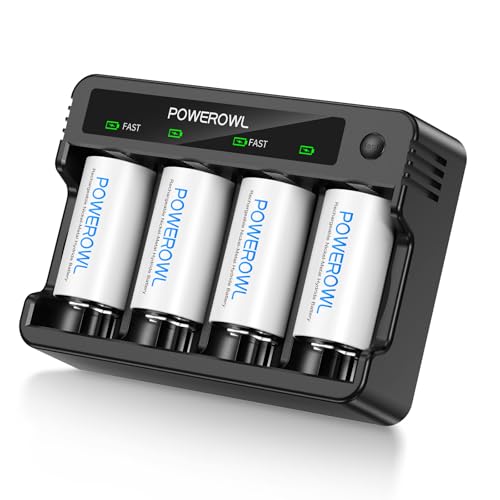
POWEROWL Rechargeable D Batteries with 4 Bay Battery Charger — Best starter bundle
POWEROWL sells the beginning of a system rather than a component of one. The listing pairs four rechargeable D batteries with a four-bay charger fed by USB quick charging, and the charger also accepts AA, AAA and C cells across Ni-MH and Ni-CD chemistries. For a household converting a D-hungry device — the camping lantern, the big torch, the portable radio — from disposables, this single box is the entire conversion: cells, charger, and a bay layout that will still serve the smaller sizes already rattling around the drawer.
The bundle logic deserves spelling out, because it changes the value calculation. A bare charger plus a separately bought set of reputable D cells is two decisions and two deliveries; the bundle is one, with cells and charger chosen by the same maker to work together. Four D cells is also the right starter count for most devices, which typically run on two or four, so the kit maps onto a real lantern or torch set rather than an abstract assortment. The charger’s USB quick-charging wording promises a modern input arrangement, worth verifying against your adapters in the first week as with any speed claim.
The honest cautions are about expansion and mixing. A home that later wants eight or twelve D cells in rotation will be buying bare cells to match the bundle’s, and should confirm the same cells are available separately. And because the charger covers smaller sizes too, it will inevitably be asked to manage the whole drawer’s traffic, where the universal specialists with screens and discharge cycles hold advantages. As a doorway into rechargeable D ownership, though, nothing else in this guide is as complete out of the box.
- Included per the title: four rechargeable D batteries and a four-bay charger
- Other sizes named in the title: AA, AAA and C
- Chemistries named in the title: Ni-MH and Ni-CD
- Input wording in the title: USB quick charging
- Cell count: four D cells, per the title’s 4 Count wording
Strengths
- Complete starter system: cells and charger arrive as one matched purchase.
- Four D cells match the appetite of most lanterns and large torches.
- Charger still serves AA, AAA and C cells after the D conversion is done.
Trade-offs
- Expanding the D collection later means sourcing matching bare cells.
- No LCD or discharge function is promised in the title.
- Bundle pricing bundles the decision; cell-only shoppers pay for a charger too.
Best for: a household converting its first D-powered lantern or torch to rechargeables.
Not suited for: an established collector who needs a charger only and no further cells.

Tenergy TN486U 5-Bay Universal Battery Charger with LCD, Micro — Best five-bay universal
Tenergy’s TN486U competes on capacity of a different kind: five bays. Its title describes a five-bay universal charger with an LCD screen and dual input options — Micro USB and Type-C — for AA, AAA, C, D and 9V rechargeable batteries. Five bays sound like a small increment over four until a household’s charging night is mapped honestly: the lantern’s four D cells occupy a four-bay charger entirely, while the Tenergy still has a seat left for the remote’s AAA or the 9V from the smoke-alarm rotation.
The dual input is a quietly practical feature in a transitional decade. Micro USB cables still live in every household’s cable strata, while Type-C is the present and future; a charger that drinks from either never waits for the right lead to surface. The LCD brings the per-cell visibility this guide keeps praising, particularly valuable when five cells of different sizes and ages are sharing one body and one owner’s attention.
Tenergy’s background is in battery technology rather than general electronics, and the TN486U’s specification reads accordingly — a working tool described in working terms. The title does not name chemistries, so Ni-Cd households should confirm chemistry support on the product page before ordering, and the same page will clarify how the five bays divide among the larger sizes, since bay geometry for D cells is the detail on which universal chargers differ most. For the household whose charging nights are genuinely crowded, five bays and a screen is a persuasive combination.
- Bays described in the title: five
- Sizes named in the title: AA, AAA, C, D and 9V
- Display described in the title: LCD
- Inputs named in the title: Micro USB and Type-C
- Chemistries: the title does not state them, so verify Ni-MH and Ni-Cd support on the product page
Strengths
- Five bays keep a full D set and a small cell charging together.
- LCD visibility across a crowded, mixed-size charging session.
- Dual Micro USB and Type-C inputs accept whatever cable the house offers.
Trade-offs
- Chemistry support needs confirming on the product page before purchase.
- Bay geometry for the largest cells should be checked against your set size.
- No discharge conditioning is mentioned in the title.
Best for: a busy household whose charging nights juggle a D set plus smaller cells.
Not suited for: a Ni-Cd owner who needs the chemistry claim in writing before buying.

BONAI Smart Battery Charger for AA AAA C D 9V Ni-MH — Best smart all-rounder
BONAI’s entry closes the guide by combining the two features this article has praised separately: the discharge function of the EBL and the LCD reporting of the screen-equipped universals, wrapped around the full five-size spread of AA, AAA, C, D and 9V. Its title specifies Ni-MH chemistry, adds fast-charging wording, and names a black finish. For a home that has standardised on Ni-MH — the majority position — that combination makes the BONAI the most complete universal here that does not ask you to pay for Ni-Cd circuitry you will never use.
The discharge function on a Ni-MH-only charger serves the modern version of conditioning: cells that live in low-drain devices and get topped up from partial states for years can drift into lazy habits, and a controlled discharge-and-charge cycle is the standard remedy. Paired with an LCD that lets you watch each cell’s behaviour through that cycle, the BONAI becomes a maintenance instrument as much as a charger — the unit you reach for when a set of D cells seems to fade earlier than it used to and you want evidence before replacements.
Fast charging, the title’s remaining claim, should be read with the usual care around big cells: speed is welcome for AA cells before a trip and less relevant for D cells that will sit overnight regardless, and the product page will carry the per-size figures that the title omits. What the title does establish is a coherent philosophy — smart, screened, conditioning, universal within Ni-MH — executed in a single black unit. Households that recognise their drawer in that description have found their pick.
- Sizes named in the title: AA, AAA, C, D and 9V
- Chemistry named in the title: Ni-MH
- Display described in the title: LCD display
- Extra function in the title: discharge function
- Finish named in the title: black
Strengths
- Discharge conditioning and LCD reporting together in one universal body.
- Full five-size coverage for a Ni-MH-standardised household.
- Smart per-cell management suits long D-cell sessions.
Trade-offs
- Ni-MH-only chemistry leaves Ni-Cd collections to other picks.
- Fast-charging figures per size live on the product page, not the title.
- Maintenance features are wasted on a charge-and-forget household.
Best for: a Ni-MH household that maintains its cells actively and wants the data to do it.
Not suited for: a mixed-chemistry drawer whose Ni-Cd cells need explicit support.
Comparing the Chargers: Dedicated D Bays Versus Universal Flexibility
| Charger | Orientation | Sizes | Notable trait from title |
|---|---|---|---|
| EBL Universal Smart Charger | Universal | C, D, AA, AAA, 9V | Discharge function plus LCD |
| Energizer Recharge Universal | Universal | AA, AAA, C, D, 9V | NiMH-only, first-party simplicity |
| BEVIGOR C D Charger | D-focused | Leads with C and D | Independent slots, faulty-cell detection |
| POWEROWL Bundle | D-focused bundle | D plus AA, AAA, C | Four D cells included |
| Tenergy TN486U | Universal | AA, AAA, C, D, 9V | Five bays, dual USB inputs |
| BONAI Smart Charger | Universal | AA, AAA, C, D, 9V | Discharge plus LCD, Ni-MH |
The comparison table makes the guide’s opening split visible at a glance, and the deciding question is the proportion of your charging life that D cells occupy. If D is a citizen among many, the universals compete on intelligence — EBL and BONAI with their discharge cycles, Tenergy with its fifth bay — while the Energizer competes on trust and simplicity. If D is the main population, the specialists compete on focus: BEVIGOR for owners who already hold cells, POWEROWL for owners starting from zero. Vehicle owners whose batteries are the other kind entirely should detour to Best Car Battery Chargers and Jump Starters rather than forcing this category to stretch.
How Do You Run a Rechargeable D System Without the Headaches?
Buy or designate complete sets and keep them together. A lantern’s four D cells should be bought together, charged together and stored together, ideally marked with a small dot of paint or a strip of tape in a shared colour, because a set that ages together performs together, while a set assembled from strays always contains one cell that gives up mid-evening and drags the device’s runtime down to its level. The charger lives where the devices live — the camping box, the utility cupboard — not in a distant room where good intentions go to be forgotten.
Charge before the need, not after the failure. The household rhythm that works is a standing one: devices come home from a trip or a storm, their cells go on the charger that night, and the set returns to its device or its storage box within a day. Cells stored fully charged in a cool place hold themselves ready for months, while cells stored empty deteriorate and cells stored inside a damp lantern corrode their contacts and sometimes the lantern’s. For emergency kits, put a calendar note twice a year to cycle the set through the charger, which both verifies the cells and refreshes them.
Retire cells as sets and without sentimentality. When one cell of a matched set begins finishing its charge suspiciously fast or lagging on the LCD session after session, the set is telling you its age; replace the set, move the survivors to low-stakes single-cell duty if any exists, and recycle the rest through a battery route. A home that follows those three habits — sets, rhythm, retirement — will find that rechargeable D ownership feels less like a hobby and more like plumbing: invisible, reliable, and only noticed when a neighbour’s disposables run out during the blackout your lantern is calmly outshining. Keep the same discipline for the car side of life with Best Car Battery Smart Trickle Chargers as the companion read.
What Mistakes Do D Battery Charger Buyers Keep Making?
The first mistake is chemistry blindness: feeding Ni-Cd cells to a charger that never claimed them, or assuming a universal label covers every chemistry ever sold. The titles in this guide state their chemistries precisely because the distinction is operational, not pedantic. The second mistake is buying a bare charger and a bundle’s expectations — or the reverse. The BEVIGOR says batteries are not included in its title; the POWEROWL’s cells are its headline. Reading which box you are actually buying prevents the particular irritation of a charger arriving to an empty drawer.
Third, buyers mix cell ages inside a device and then blame the charger for short runtimes that were really a weakest-cell problem. Fourth, D sets get stored inside devices in damp garages, where contacts corrode and cells self-discharge into the zone from which they recover poorly. Fifth, the discharge function gets used as a ritual rather than a remedy, burning hours of conditioning on healthy new cells that needed nothing but a charge. Each of these mistakes is a small one; together they account for nearly every story that begins with the words rechargeables never worked for us.
Final Recommendation
Let your drawer’s composition decide. The mixed, actively maintained collection belongs on the EBL or the BONAI, with the Tenergy taking the households whose charging nights overflow four bays and the Energizer serving those who prefer the familiar name and no homework. The D-devoted drawer belongs to the specialists: BEVIGOR’s independent, fault-detecting bays for cells you already own, POWEROWL’s bundle for the clean start that converts a lantern in one delivery. Whichever you choose, run it as a system — matched sets, a charging rhythm, honest retirements — and the big cells will repay the organisation every time the lights go out or the campsite goes dark.
Which Devices in a Home Actually Eat D Cells?
Walk a house with fresh eyes and the D-powered population is larger than memory suggests. The big torch by the back door and its twin in the car. The camping lantern and the battery radio that comes out for storms and ball games. The boombox in the garage. Motorised water pumps, inflatable-bed pumps and a generation of large toys — ride-ons, train sets, animated holiday figures that eat four D cells per season. Automatic pet feeders in some models, portable fans in others, and the occasional exercise or therapy device in a spare room. Each of these devices shares two traits: it is used in bursts, and its bursts are exactly the moments when dead batteries are least forgivable.
That burst pattern is why the rechargeable conversion pays unevenly across the list, and why honest households should convert selectively. The lantern and the storm radio are the strongest candidates, because their disposables are bought in anxious haste and their rechargeables can be maintained on the twice-a-year cycle this guide recommends. The holiday figures are the weakest, since a device used for three weeks a year asks its cells to survive eleven months of storage, which Ni-MH cells do imperfectly and which argues for either low-self-discharge cells or a frank acceptance of disposables for that one job. The torch fleet sits in between and usually converts happily, because torches get used just often enough to keep a rotation honest.
Counting your own D population before choosing a charger also settles the bay question with data instead of vibes. A household with one four-cell lantern needs a charger that takes four D cells gracefully; a household with the lantern, two torches and the radio needs either a rotation plan or the patience to charge in waves, and should weight the universal chargers’ total bay counts accordingly. The charger is the servant of the device census, never the other way round.
How Do You Store Rechargeable D Cells Between Seasons?
Storage is where rechargeable systems quietly succeed or fail, because D devices are seasonal — camping gear, storm gear, holiday gear — and their cells spend most of their lives waiting. The rules are few and unglamorous. Store cells charged, not empty: a cell put away full will lose some charge over months but remains in the healthy zone, while a cell put away flat can sink below the point where ordinary chargers will revive it. Store them out of their devices, in a cool, dry box, with their set-mates, so contacts stay clean and a leaking or corroding device cannot take the set down with it.
Then give the calendar a job. Twice a year — the same weekends you test smoke alarms is the traditional pairing — bring every stored set to the charger, top it up, and note any cell that behaves strangely on the display or finishes implausibly fast. That ritual converts storage from neglect into maintenance, and it guarantees that the storm lantern’s set is discovered tired in a calm April rather than during the November night it was bought for. Households with a POWEROWL-style bundle should store the charger with the cells, because a set separated from its charger by two cupboards is a set that will be charged late, reluctantly, or on the wrong machine at a relative’s house.
Temperature deserves one sentence of its own: garages that bake in summer and freeze in winter are the worst common storage place, and the utility cupboard or a drawer inside the house’s lived-in zone will treat cells measurably kinder. None of this requires equipment beyond a box and a calendar note, which is precisely why it works — storage systems that require effort get abandoned, and abandoned storage is how good cells die young.
What Should You Do When a D Cell Set Starts Fading Early?
Diagnose before you shop. Put the whole set through a full charge and watch the session the way the LCD-equipped chargers let you: a cell that finishes far earlier than its siblings is announcing low capacity, while a cell that never quite finishes may be running hot internally and should be retired on the spot. If the whole set fades uniformly, try one discharge-and-charge cycle on a charger that offers it — the EBL or the BONAI — because uniform laziness across a set that has lived on partial top-ups is exactly the condition conditioning exists to treat. One cycle, honestly assessed, separates the recoverable sets from the finished ones.
If a single cell is the culprit, resist the temptation to replace just that cell with a fresh one and call the set healed. A new cell among aged partners creates a set whose members now age from different starting points, and the device will still fade at the weakest member — which will simply become a different cell next season. The disciplined move is to demote the surviving old cells to any single-cell or low-stakes duty the house offers, and to start a fresh matched set in the demanding device. It feels extravagant for exactly one purchase cycle, and then the runtime numbers justify it for years.
Keep a small written history if your household runs several sets: a strip of tape on the storage box with the season and year the set entered service. Memory flatters old cells; tape does not. When a set’s tape says it has served five camping seasons, its fading is not a mystery to be solved but a career to be honoured, and its replacement can be ordered calmly in daylight rather than improvised in a blackout.
How Does a Charger Behave at a Campsite or in a Cabin?
Off-grid and semi-grid settings change the charger’s power supply before they change anything else, which is why the USB-fed designs in this guide travel better than their ancestors did. A BEVIGOR drinking from USB-C, a POWEROWL on its USB input or a Tenergy accepting either of its two USB flavours can all be fed by the same vehicle outlets, power stations and large power banks that already run a modern campsite’s lights and phones. The practical discipline is sequencing: cells charge during the day, when solar or vehicle power is abundant, and devices run at night, when it is not — a rhythm that also keeps the charger out of the sleeping tent’s damp and inside a vehicle or dry box.
Cabins with ordinary mains power ask less, but reward the same habit of a fixed charging spot: one shelf, near the door the gear passes through, where the lantern’s set returns after each outing rather than dispersing into drawers. The households that keep a second home often end up keeping a second, simpler charger there — the Energizer’s plain reliability suits a cabin drawer — because cells and chargers separated by a journey are cells that arrive uncharged. Judge that duplication the way you judge the second kettle and the second broom: not extravagance, but the price of a place that works on arrival.
Why Do Some Chargers Offer So Many Bays for Sizes You Rarely Use?
Because the universal chargers are designed against the whole history of household batteries rather than against your particular drawer. The 9V bay exists for smoke alarms and guitar tuners, the C bays for the generation of torches and toys between AA and D in size, and the small bays for the remotes and clocks that still dominate household cell traffic by count. A D-focused buyer is entitled to ignore most of that map — but should check one thing on it carefully, which is whether the D positions are full citizens of the design or occasional guests sharing a bay with another size. Product pages show bay diagrams, and thirty seconds with that diagram tells you whether your four-cell lantern set can charge in one session or must queue in pairs, which is the kind of fact that decides satisfaction a year later and cannot be inferred from a photograph of the closed lid.
What Is the Sensible Order to Buy Things In?
Sequence matters more than selection for newcomers. Start with the device census described earlier, because the census decides whether you are a bundle customer or a bare-charger customer. If the census shows D devices but no rechargeable D cells anywhere in the house, the POWEROWL bundle is the honest first purchase, and its arrival should be followed by one full charge-and-test cycle in the lantern before the disposables are banished from the shopping list. If the census shows cells already owned — inherited from a relative, bought in a previous enthusiasm — then the bare specialists and universals compete for your money, and the deciding evidence is the condition of those cells, which a first session on an LCD-equipped charger will report more truthfully than any guess.
Existing-cell owners should also perform a small chemistry audit before ordering, reading the fine print on their cells rather than trusting the drawer consensus. Ni-Cd survivors hiding among Ni-MH sets are common in older collections, and discovering them after buying a NiMH-only charger is the sort of small, avoidable misery this guide’s spec boxes exist to prevent. Five minutes with the cells in hand, matching their printed chemistry against the titles gathered here, is the cheapest step in the entire purchase and the one most often skipped.
Frequently Asked Questions
Can one charger really handle both D cells and AA cells well?
Yes, with a caveat about attention rather than ability. Universal chargers like the EBL, Tenergy and BONAI are built for exactly that mixed duty, but D cells occupy bays for long sessions, so a busy household should count bay numbers against its biggest simultaneous load — a full D set plus the week’s small cells is where the Tenergy’s fifth bay earns its keep.
What does a discharge function actually do for my cells?
It drains a cell in a controlled way before charging it, which can restore capacity in cells — especially older chemistries and long-serviced Ni-MH — that have grown lazy from years of partial top-ups. Treat it as an occasional remedy for tired cells, not a nightly ritual for healthy ones.
Are the batteries included with any of these chargers?
Only the POWEROWL listing is a bundle, arriving with four rechargeable D batteries alongside its charger. The BEVIGOR states the opposite plainly — batteries not included — and the universal chargers should be assumed bare unless their product pages say otherwise.
Can I charge Ni-Cd D cells on a NiMH charger?
Only if the charger claims Ni-Cd support, as the EBL, BEVIGOR and POWEROWL titles do. The Energizer and BONAI titles specify Ni-MH, so Ni-Cd cells belong on a charger whose stated chemistry includes them; the titles in this guide were quoted carefully for exactly this reason.
How long do D cells take to charge?
Longer than any smaller household size, because each cell holds far more energy; expect an overnight mindset rather than a before-dinner one, and prefer chargers with LCD or per-bay indication so the long session reports itself. Exact hours depend on the cell and the charger’s per-bay output, which the product pages specify.
Why does one weak cell ruin a whole lantern’s runtime?
Devices run their cells in series, so the set can only deliver what its weakest member holds; when that cell empties, the device fades even if its partners remain strong. Matched sets, charged together and retired together, are the household-level cure, which is why this guide returns to set discipline so often.
A Note on Handing the System to the Next Person
Battery systems outlive the enthusiasm of the person who set them up, and the households where they survive a change of hands — a teenager leaving for a flat of their own, a parent inheriting the camping kit, a new partner confronting the utility cupboard — are the ones where the system explains itself. A label on the storage box naming the sets and their year, the charger stored with its cable rather than near it, and one written line about the twice-a-year ritual taped inside the cupboard door: these are the whole of the documentation a D system needs, and they take four minutes to create. The alternative, familiar to every heir of a drawer of anonymous rechargeable cells, is a slow archaeological dig followed by the purchase of a bundle exactly like the POWEROWL’s — the system’s way of restarting itself with a new keeper. Write the four minutes’ worth of notes, and your set may skip that reincarnation entirely.
How Do You Know the Conversion to Rechargeable D Cells Has Paid Off?
Give the question a year and answer it with the shopping list rather than with sentiment. A home that has stopped buying disposable D cells entirely — no emergency packs at the petrol station, no anxious multipack before a camping trip — has its answer in the drawer where the disposables used to live, now occupied by the storage box and its labelled sets. The subtler evidence is behavioural: the lantern gets used more because its fuel is no longer rationed, the big torch lives by the door instead of being saved for serious occasions, and children are allowed to run the battery radio for pleasure rather than by permit. Those small liberations, repeated across seasons, are the real dividend of the system, and they arrive regardless of which of the six chargers above sits at its centre — which is why this guide has spent its length on fit, chemistry and habits rather than on crowning a single winner for every drawer.
One last practical habit ties the whole system together: keep a small reserve of charged cells outside the devices they serve. A lantern holding the household’s only four D cells is a lantern that must be raided when the torch dies, and raiding is how sets get split and rhythms collapse. A reserve set in the storage box — even a modest one — absorbs those emergencies, lets a device be reloaded in a minute during a storm instead of after a charging session, and gives the rotation a spare wheel. Build the reserve gradually, a set at a time as the budget allows, mark it like the others, and the system gains the slack that separates a workable arrangement from a fragile one.
And when the reserve set is finally in the box, do the least technological thing in this entire guide: tell the household where everything lives. A charging system known to one person is a single point of failure wearing a hi-vis jacket of good intentions; a system whose location, rhythm and one golden rule — sets stay together — are known to everyone in the house will survive holidays, illnesses and the original organiser’s distraction, and will still be there, charged and labelled, on the night the power fails and the whole street goes dark except for one calm lantern.
Measure the system’s success a final way, by the arguments that no longer happen: nobody negotiates for the last disposable D cell before a trip, nobody discovers the lantern’s weakness at the campsite, and nobody’s torch dies during the one inspection of the year that mattered. Silence, in a battery drawer, is the sound of a system working — and it is available to any household willing to keep its sets together and its charger fed.
Related Guides
- Best 10 Amp Auto Battery Chargers
- Best Car Battery Chargers and Jump Starters
- Best Car Battery Smart Trickle Chargers


