What's inside
- Key Takeaways
- Quick Picks
- How Were These Five Chosen for a Travel Shortlist?
- What Is the Difference Between Folding Flat and Folding Inward?
- Why Do Hinges Decide Whether a Folding Headset Ages Well?
- How Much Does Closed Acoustic Design Matter Away From Home?
- How Should You Pack a Folding Headset So the Hinges Survive?
- Which of These Actually Folds, and How Far?
- What Do Folding Headset Buyers Most Often Get Wrong?
- How Do You Keep a Travel Headset Working Trip After Trip?
- When Is a Fixed-Frame Headset Actually the Better Traveller?
- How Should Students and Commuters Choose Between These Five?
- What Should You Look for in a Case for a Folding Headset?
- How Does Folding Change the Way You Use a Headset at Home?
- What Happens to Resale and Hand-Me-Down Value?
- How Do LAN Parties and Tournament Trips Change the Calculation?
- What Should Happen to the Microphone While the Headset Travels?
- How Do You Decide Between Folding and a Second Cheap Headset?
- Which Travellers Should Skip Folding Entirely?
- Final Recommendation
- Frequently Asked Questions
- Related Guides
As an Amazon Associate I earn from qualifying purchases. This post may contain affiliate links at no extra cost to you.
widgetverdict.com is reader-supported. When you buy through links on our site, we may earn an affiliate commission.
Where to buy: Amazon lists every headset in this comparison, and the honest place to begin is a warning: folding is a claim that must be read model by model, because four of these five titles state a folding or foldable design outright, while the fifth says nothing about hinges at all and is included for travellers who end up choosing comfort over collapse.
The best folding gaming headsets solve a problem that ordinary gaming headsets ignore: gaming no longer happens in one room. Players carry headsets to friends’ houses, to campus, to tournaments, into office bags for the workday and back out for the evening, and a rigid headset the size of a dinner plate travels badly. It snags, it crushes, its headband becomes the most fragile thing in the bag. A folding design answers by reducing the headset’s footprint, either by collapsing the earcups inward, rotating them flat, or both, so the device can ride in a case or a bag corner without dominating it. This guide covers five headsets whose titles speak to travel in different ways, and it is strict about language: where a title says foldable, the guide says foldable; where a title says nothing, the guide says nothing, and flags the silence plainly.
The five take genuinely different routes. SENZER’s SG500 leads with the full travel brief, foldable, portable, memory foam padding, surround sound, and a noise cancelling microphone across PC, PlayStation, Xbox, and Switch. The EPOS GAME ZERO brings a premium closed acoustic design with a foldable frame and a flip-to-mute boom from the Sennheiser lineage. The targeal headset is the wireless traveller, rotatable and foldable with Bluetooth 5.3, a 2.4G connection, twenty hours of stated battery, and RGB lighting. Skullcandy’s Riff is the on-ear lightweight, foldable by title and built around a durable headband and a 3.5mm plug. NUBWO’s HG04L closes the list as the control case: a light, soft, wired headset whose title makes no folding claim whatsoever, included so readers can see exactly what they give up and gain when folding is not on the table. If desk comfort matters more than portability, compare these against best comfortable gaming headsets before deciding which problem you are actually solving.
Key Takeaways
- Four titles state a folding or foldable design directly: the SENZER SG500, the EPOS GAME ZERO, the targeal wireless headset, and the Skullcandy Riff.
- The NUBWO HG04L title is silent on folding, so this guide treats it as a fixed-frame headset and says so wherever it appears.
- Only the targeal is wireless, pairing 2.4G and Bluetooth 5.3 with a stated twenty-hour battery for travel days.
- The GAME ZERO adds closed acoustic isolation and a flip-to-mute boom, the most communication-focused design here.
- The Skullcandy Riff is the sole on-ear design, trading earcup seal for the smallest wearing footprint of the five.
- Memory foam appears in three titles: the SENZER, the targeal, and the NUBWO.
Quick Picks
| Pick | Badge | Why it earns its place |
|---|---|---|
| SENZER SG500 Foldable Gaming Headset | The complete travel brief | Foldable and portable by title, with memory foam padding, surround sound, and a noise cancelling microphone for four platforms. |
| EPOS GAME ZERO Foldable Gaming Headset | The premium folding pick | Closed acoustic design, foldable frame, flip-to-mute boom, and the Sennheiser gaming lineage behind the EPOS name. |
| targeal Foldable Gaming Headset | The wireless folding pick | Rotatable and foldable with 2.4G wireless, Bluetooth 5.3, twenty stated battery hours, and memory ear pads. |
| Skullcandy Riff Foldable Wired Headphones | The on-ear travel pick | Foldable, lightweight, and comfortable by title, with a durable headband, a built-in microphone, and a simple AUX plug. |
| NUBWO HG04L Wired Gaming Headset | The fixed-frame alternative | No folding claim in its title; instead, 250 stated grams, soft memory earmuffs, and broad console coverage for desk-first players. |
How Were These Five Chosen for a Travel Shortlist?
The first filter was the title itself. A headset entered this guide’s folding conversation only if its listing used the words foldable or folding, or described rotation that flattens the earcups, and four of the five pass that test in their own words. The fifth, the NUBWO, was admitted deliberately as the exception that proves the rule, because many shoppers comparing folding headsets end up buying a light fixed-frame model once they price the difference, and an honest guide should show that fork in the road rather than hide it. Its presence also disciplines the other four: every folding claim in this article can be traced to a title, and the one pick without such a claim is labelled at every appearance.
The second filter was travel realism. A folding headset earns its hinges only if the rest of the design supports the journey: padding that survives being compressed, a microphone arrangement that tolerates a bag, platform coverage broad enough to be useful at the destination, and, for the wireless entry, a battery figure stated plainly. The targeal’s twenty hours, the GAME ZERO’s closed acoustic shell for noisy transit, and the Riff’s durable headband all speak to that realism. Where titles stayed silent, on case inclusion, hinge materials, and folded dimensions, this guide reports the silence instead of inventing measurements, because a traveller planning around a specific bag needs facts, not filler. Players whose trips are really about positional audio at a LAN should also read best gaming headsets for first person shooters, where two of the travel virtues here matter less than microphone and driver choices.
What Is the Difference Between Folding Flat and Folding Inward?
Folding describes two different geometries, and confusing them leads to bags packed around the wrong expectation. Folding inward collapses the earcups into the headband’s arc, shrinking the headset’s width and producing a compact bundle that suits a case or a coat pocket’s larger ambitions. Rotating flat turns the earcups ninety degrees so the headset lies like a paperback against a laptop or a book, shrinking thickness rather than width. The targeal’s title names both motions, rotatable and foldable, which is the most complete travel geometry claimed here. The SENZER, GAME ZERO, and Riff titles claim foldable without specifying the axis, so their listings’ photographs are the authority on which shape each one becomes.
Neither geometry is universally better. Inward folders protect their drivers inside the bundle and present fewer snag points, while flat rotators slide into laptop sleeves and messenger bags that have no room for a bundle at all. The right question is not which motion is superior but which negative space your bag actually offers. Measure the pocket you intend to use, look at the folded photographs in the listing, and let the geometry of your own luggage arbitrate. Travellers who skip that small ritual are the ones writing reviews about hinges, when the hinge was never the problem.
Why Do Hinges Decide Whether a Folding Headset Ages Well?
Every folding headset introduces moving joints into a product category that otherwise has none, and joints are where travel headsets live or die. A hinge flexes thousands of times across a headset’s life, it carries the clamp load while folded and unfolded, and it sits exactly where bags apply pressure. None of the five titles here specifies hinge materials, which is common in this class and precisely why the surrounding design clues matter: the Riff’s title calls its headband durable, the GAME ZERO comes from a premium line where the frame is part of the price, and the SENZER pairs its folding claim with portable in the same breath, suggesting the design brief anticipated the road.
Ownership habits matter as much as materials. Fold a headset the way its geometry intends, with both hands and without forcing the last few degrees, and hinges last for years. Twist one cup against its stop because the bag is already zipped, and the same hinge becomes a countdown. Store the folded headset in the same pocket each trip so nothing else in the bag levers against it, and avoid leaving it folded under tension in heat, where plastics creep. The folding mechanism is a convenience with a maintenance price, and the price is small but never zero, which is the honest frame for everything that follows in this guide.
How Much Does Closed Acoustic Design Matter Away From Home?
The GAME ZERO’s title carries a phrase the others do not: closed acoustic. A closed earcup seals the driver in an enclosed chamber, which keeps your game’s sound in and, more importantly for travellers, keeps the environment’s sound out. On a train, in a shared flat, in a tournament hall warming up around you, that passive isolation is the difference between hearing the game and hearing the room with game underneath. It also protects your neighbours, since a closed design leaks little of your session into a quiet carriage or a late-night household.
The SENZER and targeal approach the same problem from the microphone side, with noise cancelling booms that clean up your voice for teammates when the room around you is loud. Those are complementary rather than competing virtues: closed cups defend your ears, a cancelling microphone defends your squad’s ears. A traveller who games in genuinely noisy places should weight both, while a traveller whose journeys end in a quiet spare room can treat isolation as a bonus. The Riff’s on-ear shape sits at the other end of this spectrum by design, resting on the ear rather than sealing around it, which lets the world in and keeps the wearing footprint small; for a commuter who must hear announcements, that openness is a feature with a constituency.

SENZER SG500 Foldable Gaming Headset — The complete travel brief
The SG500’s title reads like a packing list written by someone who has actually travelled with a headset: surround sound, a noise cancelling microphone, memory foam padding, and the words portable and foldable placed where no reader can miss them. Its platform list covers PC, PS4, PS5, Xbox One, and Switch, which means the same folded bundle serves the home desk, the friend’s console, and the handheld in a train seat. For a traveller whose destinations vary, that breadth is worth as much as the hinge, because a folding headset that only serves one machine folds for one journey and sits out the rest.
Memory foam padding matters doubly in a travel design. At home it moulds for comfort; in a bag it absorbs the small impacts and compressions that a folded headset inevitably absorbs, cushioning the drivers it wraps. The noise cancelling microphone addresses the destination rather than the journey: spare rooms, dorms, and kitchen tables are rarely quiet, and a boom that suppresses the room keeps your callouts clean for the squad back home. What the title does not state is the folding axis or a weight, so buyers planning around a specific case should study the listing photographs for the folded shape. Judged on what it claims, the SG500 is the most completely travel-briefed wired pick here, the one whose title anticipated every question a packing player asks.
- Folding: foldable and portable, stated directly in the listing title
- Padding: memory foam
- Microphone: noise cancelling
- Audio: surround sound, as titled
- Connection: wired
- Platforms named: PC, PS4, PS5, Xbox One, Switch
Strengths
- The fullest travel brief in one title: folding, portable, foam padding, and a cancelling microphone.
- Five named platforms make the folded bundle useful at almost any destination.
- Memory foam serves comfort in play and protection in the bag.
Trade-offs
- The folding axis and weight are not stated, so case planning needs the listing photographs.
- Wired travel means managing a cable in transit and at the destination.
- Surround here is a processing claim; purists should audition it against plain stereo.
Best for: a multi-platform player who packs a headset weekly and wants the travel features named in one listing. Not suited for: a gramme-led ultralight traveller, since this title publishes no weight to plan around.
The SG500 listing on Amazon shows the folded shape in its photographs, which is the first thing a case owner should check.

EPOS GAME ZERO Foldable Gaming Headset — The premium folding pick
The GAME ZERO carries two heritages in its name, EPOS and Sennheiser, and its title behaves like a premium product’s should: closed acoustic design, a noise cancelling microphone, foldable construction, flip-to-mute operation, a lightweight claim, and a platform list that runs from PC and Mac through Xbox One, PS4, and Switch to smartphones. This is the folding headset for the player whose travel ends in serious sessions: tournament trips, work travel with evening ranked play, a second home where the gaming is as important as at the first.
Closed acoustic construction is this model’s centre of gravity. It isolates passively, it presents games with the sealed, focused character closed designs are known for, and it folds without surrendering that seal when reopened, which is the engineering trick cheaper folders sometimes fumble. Flip-to-mute adds the social reflex competitive players drill into habit, muting by rotating the boom rather than hunting for a control mid-round. The title’s lightweight claim is unquantified, a small frustration for planners, and the smartphone compatibility hints at a wired connection that suits travel’s simplicity: no battery to arrive dead at the destination. Buyers should confirm the exact connector arrangement in the full listing, since the title lists devices rather than plugs. What is stated adds up to the most communication-serious folding design here, priced and positioned accordingly.
- Folding: the title claims a foldable frame outright
- Acoustic design: closed, with the isolation that implies
- Microphone: noise cancelling, flip-to-mute
- Build claim: lightweight, unquantified in the title
- Platforms named: PC, Mac, Xbox One, PS4, Nintendo Switch, smartphones
- Connection: wired, per the device list in the title
Strengths
- Closed acoustic isolation serves noisy transit and focused destination play alike.
- Flip-to-mute and a cancelling boom make it the strongest communication design here.
- The broadest device list of the five, extending to Mac and smartphones.
Trade-offs
- Lightweight is claimed without a figure, so gramme comparisons need outside documentation.
- PS5 and Xbox Series machines are not named in the title’s platform list.
- Premium positioning means its price tier sits above the other wired picks.
Best for: a travelling competitor who wants closed isolation and a serious boom in a folding frame. Not suited for: a PS5-first player who needs that console named in the listing before spending at this tier.
Read the GAME ZERO listing on Amazon for its connector details, since its device list is broader than its plug description.

targeal Foldable Gaming Headset — The wireless folding pick
The targeal is the only wireless headset in this guide, and its title makes the travel case for cutting the cord: rotatable and foldable geometry, a 2.4G wireless connection alongside Bluetooth 5.3, twenty hours of stated battery, RGB lighting, memory ear pads, a stretchable noise cancelling microphone arrangement, and platforms spanning PC, PS4, PS5, Mac, and mobile. Rotation plus folding is the complete geometry discussed earlier in this guide, flat for the laptop sleeve and collapsed for the case, and wireless removes the cable that otherwise tangles around everything else in the bag.
Twenty hours is the figure to plan around honestly. It covers a travel day and several destination evenings, but it is not the multi-week endurance of home wireless headsets, so the charging cable earns its place in the bag and a top-up before departure becomes part of the packing ritual. The dual wireless modes divide labour sensibly: 2.4G for the low-latency gaming connection at the destination, Bluetooth for the phone and tablet during the journey itself. RGB lighting is the one feature travel argues against, since lights spend battery, but it can be treated as a home-mode flourish. Memory ear pads keep the wearing experience consistent with the wired folders here. For the player whose bag is already a nest of cables, this is the pick that removes one species from the nest entirely.
- Folding: rotatable and foldable, both motions stated in the listing title
- Connection: 2.4G wireless plus Bluetooth 5.3
- Battery: twenty hours, as stated
- Padding: memory ear pads
- Microphone: noise cancelling, stretchable design as titled
- Platforms named: PC, PS4, PS5, Mac, mobile
Strengths
- The only wireless folder here, with both rotation and folding for different bag shapes.
- Two wireless modes split gaming latency and travel convenience cleanly.
- Memory pads keep long destination sessions as comfortable as home ones.
Trade-offs
- Twenty stated hours demands a charging habit the wired picks never impose.
- Xbox platforms are not named in the title’s list.
- RGB lighting spends the same battery your journey depends on.
Best for: a wireless-first traveller moving between PC, PlayStation, and mobile with one folded headset. Not suited for: an Xbox-centred player, because the title’s platform list passes that family by.
The targeal listing on Amazon details its two wireless modes, which is where a travelling buyer should spend their reading time.

Skullcandy Riff Foldable Wired Headphones — The on-ear travel pick
The Riff approaches travel from the opposite end of the size spectrum: instead of shrinking an over-ear gaming headset, it starts with an on-ear design that was never large to begin with. Its title promises a foldable, lightweight, comfortable build with a durable headband, a built-in microphone, and a 3.5mm AUX connection, and Skullcandy describes it plainly as travel ready. On-ear headphones rest on the ear rather than around it, which keeps the whole device slim, lets some environmental sound through for situational awareness, and folds into the kind of space a jacket-adjacent bag pocket actually offers.
That openness defines both its charm and its limits. Commuters hear announcements, cyclists of the stationary kind hear the doorbell, and players in shared rooms stay socially present. The cost is passive isolation and the deep seal that over-ear designs use for immersion, so the Riff serves travel and casual play better than it serves a midnight horror game in a quiet house. The built-in microphone handles calls and casual chat rather than competitive callouts, an honest positioning the title supports by calling these headphones rather than a gaming headset. The durable headband claim matters because on-ear designs live hard lives in bags, flexed daily. For the traveller whose gaming is handheld, casual, and woven through a moving day, the Riff’s small folded footprint is the most realistic in this guide.
- Folding: foldable by the title’s own wording
- Form: on-ear, the only such design among the five
- Build claims: lightweight, comfortable, durable headband
- Microphone: built-in
- Connection: 3.5mm AUX wired
- Travel positioning: described as travel ready in the title
Strengths
- The smallest folded footprint here, suited to pockets rather than dedicated cases.
- On-ear openness keeps travellers aware of announcements and surroundings.
- A durable headband claim speaks directly to daily bag life.
Trade-offs
- On-ear fit cannot match over-ear passive isolation for immersion.
- A built-in microphone serves calls and casual chat, not competitive callouts.
- No gaming-specific features are claimed, because this is a travel headphone first.
Best for: a commuter and handheld player who wants a foldable headphone that disappears into a daily bag. Not suited for: an immersion-led home player seeking a sealed over-ear soundstage.
Check the Riff listing on Amazon for its folded dimensions, since its entire argument is measured in centimetres saved.
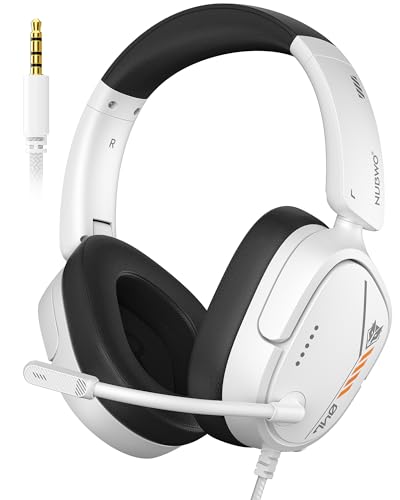
NUBWO HG04L Wired Gaming Headset — The fixed-frame alternative
Honesty requires a full stop here: the HG04L’s title does not claim that it folds, rotates flat, or collapses in any way, and this guide will not pretend otherwise. It earns its place as the alternative a real shopper weighs, the light fixed-frame headset that asks whether your headset truly travels enough to justify hinges. What its title does claim is substantial: 40mm speakers, a clear unidirectional microphone, a stated weight of 250 grams, soft memory earmuffs, a 3.5mm jack, and coverage of PC, PS5 and PS4, and Xbox Series machines alongside the Xbox One, for gaming and work alike.
For a player whose headset moves between two rooms rather than two cities, that specification may be the smarter purchase. There are no hinges to fatigue, no folded shape to plan a bag around, and the low stated weight makes it easy to carry by hand or in a loose tote even without collapsing. The soft memory earmuffs and front-focused microphone serve desk sessions and calls with the same competence described in this guide’s comfort discussions. The compromise is purely geometric: in a packed suitcase it will occupy its full size, and its frame will take the knocks a folder tucks away from. Buy it with open eyes as a fixed-frame headset of genuine lightness, and it will never disappoint; buy it expecting a fold its title never promised, and the disappointment belongs to the assumption, not the product.
- Folding: nothing of the kind appears in the listing title, so plan for a fixed frame and verify any hinge question with the manufacturer’s documentation
- Weight: 250 grams, stated in the title
- Earmuffs: soft memory foam
- Speakers: 40mm
- Microphone: clear unidirectional
- Platforms named: PC, PS5, PS4, Xbox Series X and S, Xbox One
Strengths
- A stated 250 grams makes it easy to carry even without a folding mechanism.
- No hinges means no hinge fatigue across years of ownership.
- Soft memory earmuffs and broad platform coverage serve desk and console alike.
Trade-offs
- It does not fold, so packed luggage must accommodate its full frame.
- The frame travels exposed to knocks that folding designs tuck their drivers away from.
- Switch support is not named in its platform list.
Best for: a desk-first player whose headset travels between rooms and wants lightness without moving parts. Not suited for: a suitcase packer who needs the frame to collapse, because this title promises no such thing.
The HG04L listing on Amazon is admirably plain about what it is, and that plainness is the reason it anchors this guide’s honesty.
How Should You Pack a Folding Headset So the Hinges Survive?
Fold the headset fully before it goes near the bag, never halfway with the intention of letting the luggage finish the job, because a half-folded hinge under pressure is a hinge being bent by forces it was not designed to meet. Give it a consistent home, the same pocket or case on every trip, ideally one where nothing hard shares the space; chargers and power banks are the usual hinge-breakers, rattling against folded frames for entire journeys. Route the cable separately rather than wrapping it around the folded headset, since a wrapped cable tightens under movement and saws at the joints it circles. The targeal’s wireless design skips that particular ritual, which is part of its travel charm.
At the destination, unfold with the same two-handed care and let the headset sit open for a moment before wearing it, a small courtesy that lets pads recover their shape after hours compressed. If a hinge develops play or a creak, note it early rather than forcing past it; a joint that complains quietly in month three and is treated gently may serve for years, while one that is ignored tends to announce its retirement mid-trip. None of this is precious behaviour. It is the luggage equivalent of the fitting discipline desk players apply at home, translated for a life in motion.
Which of These Actually Folds, and How Far?
| Headset | Folding claim in title | Connection | Travel note |
|---|---|---|---|
| SENZER SG500 | Foldable, portable | Wired | Memory foam, five platforms |
| EPOS GAME ZERO | Foldable | Wired | Closed acoustic, flip-to-mute |
| targeal | Rotatable and foldable | 2.4G plus Bluetooth 5.3 | Twenty-hour stated battery |
| Skullcandy Riff | Foldable | Wired 3.5mm | On-ear, smallest footprint |
| NUBWO HG04L | None stated | Wired 3.5mm | Fixed frame, 250 stated grams |
The table is this guide’s conscience in miniature. Four headsets fold because their titles say so, in words a buyer can verify in seconds. One does not, and its row says that too. How far each folder collapses, the exact folded dimensions and the axis of each motion beyond the targeal’s stated rotation, lives in the listings’ photographs rather than in their titles, and a traveller with a specific case should measure against those images before ordering. That small discipline, checking the folded shape against your own bag, prevents more travel disappointment than any other step in this category.
What Do Folding Headset Buyers Most Often Get Wrong?
The first mistake is assuming the category folds by definition, buying a light fixed-frame headset, like the NUBWO here, under a folding search term and blaming the product for a claim it never made. Read the title, not the search results page. The second mistake is folding by force: every design here has a intended range of motion, and the last few degrees of resistance are a stop, not a challenge. Third, travellers overvalue the hinge and undervalue the destination, arriving with a beautifully packed headset whose platform list does not include the machine waiting in the spare room; the SENZER’s five platforms and the GAME ZERO’s device breadth exist to prevent exactly that evening.
Fourth, wireless travellers forget that folding solves geometry, not energy, and the targeal’s twenty stated hours still require a cable in the bag and a charge before departure. Fifth, buyers assume a folded headset is a protected headset. Folding tucks drivers inward on some designs, but pads still compress, booms still flex, and a soft pocket remains kinder than the bottom of a packed suitcase. The travellers who love their folding headsets longest are the ones who treat folding as one feature in a system, bag, cable, battery, and destination all considered together.
How Do You Keep a Travel Headset Working Trip After Trip?
Travel wears equipment differently from home use: grit gets into joints, cables flex at the same tired points, and pads absorb the dust of bags and train seats. Wipe the earpads after trips rather than before them, so whatever the journey deposited does not sit against the foam for weeks. Work each hinge through its full motion occasionally at home, slowly, and feel for grit or stiffness; a joint that moves cleanly on the desk will not surprise you in an airport. Keep the headset out of checked luggage where pressure and temperature swing hardest, carrying it in the cabin bag where its folded size earns its keep most literally.
Cable care decides the wired four’s lifespan. The plug end flexes most, so avoid the sharp folded kink that bags encourage, coiling loosely instead. For the targeal, battery manners are the equivalent discipline: travel batteries age fastest when stored empty or stored hot, so arrive home, charge it, and let it rest at a healthy level rather than dead in the bag until the next trip. A folding headset maintained this way is not a fragile luxury; it is a tool with a routine, and the routine is lighter than the one most players already keep for their phones.
When Is a Fixed-Frame Headset Actually the Better Traveller?
More often than the category admits. If your travel is a weekly drive to the same friend’s house, the headset rides on the passenger seat, not in a compressed suitcase, and the NUBWO’s low weight and lack of moving parts serve that journey better than any hinge. If your destination has its own desk where the headset will live open for a month, folding solves a problem that occurs twice a year. And if your bag is a large duffel with room to spare, geometry stops mattering and the conversation returns to sound, microphone, and fit, grounds on which the fixed-frame pick competes honestly.
The reverse cases are equally clear. Frequent flyers, students crossing campus daily, and players whose gaming happens wherever the week puts them extract real value from every collapse and rotation the four folders here offer. The skill this guide hopes to teach is not loyalty to folding but accuracy about your own itinerary. Count your actual trips, picture your actual bag, and the right side of this small divide chooses itself. Shoppers who game at several homes may also want best headsets for pc and ps5, where the multi-machine question is examined from the desk side rather than the luggage side.
How Should Students and Commuters Choose Between These Five?
Students live the folding life at its most intense: lectures by day, a library’s quiet, a dorm’s noise, a friend’s console at the weekend, and a bag that carries everything every day. For that pattern, the SENZER’s platform breadth and foam, or the targeal’s wireless freedom between laptop and phone, fit the rhythm best, while the Riff suits the student whose gaming is handheld and whose bag is already full of books that resent competition. The GAME ZERO serves the student competitor whose evenings are ranked and whose dorm corridor is loud, its closed cups defending concentration in both directions.
Commuters should think in terms of the journey’s soundscape. A train regular benefits from closed isolation or an over-ear seal; a walker or cyclist who must stay aware of traffic is safer in the Riff’s open on-ear shape, used at sensible volumes. Both groups should weigh the daily fold count honestly, because a hinge cycled four times a day accumulates a year of a home player’s use in a season, and gentle two-handed folding stops being a nicety and becomes the product’s lifespan. The right pick here is the one whose stated design matches the commute you actually make, not the journey you imagine taking twice a year.
What Should You Look for in a Case for a Folding Headset?
A case is the folding headset’s second half, and choosing one deserves the same title-reading discipline as the headset itself. The case must match the folded geometry, bundle or flat slab, with a little room to spare rather than a compression fit, because a case that must be forced shut is applying hinge pressure for the entire journey. A hard or semi-rigid shell defends against the bag’s worst habit, which is having something heavy land on it in transit. A soft pouch defends only against scratches and cable tangles, which may be enough for a headset that travels inside a padded laptop bag and nowhere rougher.
Inside the case, look for a cable pocket that keeps the lead separate from the folded frame, and for a surface that will not shed fibres into the earpads. None of the five titles here promises a case in the box, so treat inclusion as a question for the full listing rather than an assumption, and budget the case as part of the purchase if the answer is no. Players often resist that arithmetic and then pay it later in hinge repairs or a replacement headset, which is the most expensive case on the market. The Riff, with its small on-ear footprint, is the one pick here that can honestly travel in a sturdy pouch inside a daily bag; the over-ear folders deserve the shell.
How Does Folding Change the Way You Use a Headset at Home?
An unexpected dividend appears after a few weeks of ownership: a folding headset changes your storage habits at home too. A folded bundle sits on a shelf corner, hangs tidier on a hook, and clears a desk in seconds when the workspace must become a dining table or an office again. Households where gaming shares space with everything else feel this daily. The targeal folded flat can slide into the same drawer as the laptop it serves. The GAME ZERO folded in its bundle leaves a clean desk for the working day, which matters in the small flats where many players actually live.
There is a subtler effect on care. A headset with a defined folded state has a defined resting state, and objects with resting states get put away properly more often than objects that sprawl. Sprawling headsets get sat on, knocked off desks, and buried under laundry; folded ones get shelved. Over a two-year ownership, that difference in daily handling may matter as much to survival as any material in the frame. It is a modest, unglamorous argument for folding that no title prints, and experienced travellers recognise it immediately.
What Happens to Resale and Hand-Me-Down Value?
Folding headsets hold a particular place in the second-hand and hand-me-down economy, because their buyers are travellers and students, the two groups most likely to shop used. A folder with smooth hinges, honest pads, and its cable intact is an easy gift to a younger sibling heading to university or a friend taking up a commute. The GAME ZERO’s premium lineage and the SENZER’s platform breadth both travel well in that informal market, while the Riff’s simplicity makes it the headset most likely to be handed over without instructions and understood instantly.
The same logic counsels honesty when passing one on: demonstrate the fold, mention any hinge play, and include whatever case you used, because the case is part of why the headset survived to be gifted. A fixed-frame headset like the NUBWO hands down differently, with nothing to demonstrate and nothing to warn about, which is its own form of generosity. Either way, a headset that was folded gently, stored consistently, and wiped after trips arrives at its second owner as equipment rather than as a problem, and that outcome was decided by habits, not by the price tier.
How Do LAN Parties and Tournament Trips Change the Calculation?
Competitive travel is folding’s sternest test, because the headset must survive the journey and then perform at full standard the same evening, with no settling-in period and no backup in the bag. That pattern favours the GAME ZERO most directly: closed isolation for a loud hall, a flip-to-mute boom whose manners are already drilled, and a wired connection that cannot arrive undercharged or unpaired at a venue machine. The SENZER serves the same trips for the player whose tournament is a friend’s living-room bracket across several consoles, where platform breadth beats hall isolation.
Tournament travellers should rehearse the destination setup once at home: fold, pack, travel across town, unfold, connect to an unfamiliar machine, and play a full match. That rehearsal exposes the small frictions, a missing adapter habit, a cable routed for the home desk, a wireless dongle left in the home PC, while they are still cheap to fix. The targeal’s owners should rehearse its pairing sequence on a second machine for the same reason, since 2.4G dongles and Bluetooth pairings behave differently under venue pressure. A folding headset’s promise is that the road adds no new problems; rehearsal is how you collect on that promise.
What Should Happen to the Microphone While the Headset Travels?
Microphones are the most exposed component on any travelling headset, because booms protrude exactly where bags apply leverage. Flip-to-mute designs like the GAME ZERO’s at least park the boom against the earcup, reducing its lever arm during transit. A noise cancelling boom like the SENZER’s should travel in the folded bundle’s protected interior where the geometry allows, never sticking out of the bundle into the bag’s traffic. The targeal’s stretchable arrangement and the Riff’s built-in microphone sidestep protrusion differently, one by flexibility and the other by having no boom at all, which is an underrated travel virtue of integrated designs.
At the destination, give the microphone a ten-second check before the session matters: join a voice channel, ask a teammate for a level report, and flex the boom gently through the positions you will use. Travel shakes connections and bends booms by degrees too small to see, and the check converts a mid-match discovery into a pre-match adjustment. Players who build that habit stop telling stories about the tournament where nobody heard their callouts, because the story’s first chapter, a silent microphone check skipped, never gets written.
How Do You Decide Between Folding and a Second Cheap Headset?
Some players solve travel by owning two headsets, a good one at home and a disposable one that lives in the bag. The arithmetic deserves respect: a second inexpensive headset removes all anxiety about loss and damage, and it is always packed. Its costs are quieter ones. Your ears live in two different sound signatures, your voice sounds different to your squad from each location, and the travel unit’s comfort ceiling is usually low enough to tax long destination sessions. A single folding headset keeps one fit, one sound, and one microphone personality everywhere, at the price of carrying your good equipment through the world’s bag compartments.
The honest tiebreaker is destination session length. If travel gaming means an hour of handheld play in a hotel, the two-headset strategy and the Riff’s casual footprint both serve well. If travel gaming means full ranked evenings at a second home, a campus, or a tournament, one good folder that you maintain properly is the grown-up answer, and the four folding designs here were chosen for exactly that seriousness. Choose the strategy that matches your longest destination session, not your shortest, because that is the evening the equipment will be judged by.
Which Travellers Should Skip Folding Entirely?
Three profiles should, and naming them protects everyone else’s decision. The first is the player whose headset moves only when the furniture does, twice a year at most; hinges bought for that life are jewellery. The second is the heavy-handed owner who knows, from a personal history of snapped stands and cracked controllers, that moving joints in their care live dangerously; a fixed frame forgives what a hinge cannot. The third is the buyer whose budget forces a choice between folding and a better microphone or better isolation at home, where ninety percent of their hours actually happen. For all three, the NUBWO’s presence in this guide is the permission slip: lightness, foam, and platform breadth without a single moving joint.
Everyone else, the weekly packers, the campus crossers, the tournament travellers, the commuters with handhelds, gets measurable value from collapse and rotation, provided the habit side of the bargain is kept. Folding is a contract: the manufacturer supplies the geometry, the owner supplies the gentleness, and the years of service arrive only when both parties honour it.
Final Recommendation
Start with the sentence your own travel writes. If you pack a headset weekly for mixed destinations, the SENZER SG500’s complete brief, foldable, foam-padded, five-platform, cancelling microphone, is the most rounded answer here. If your trips end in serious, noisy, competitive sessions, the GAME ZERO’s closed acoustic fold is the connoisseur’s choice. If cables are your bag’s worst problem, the targeal folds, rotates, and cuts the cord in one design. If your travel is a daily commute with handheld gaming woven through it, the Riff’s tiny folded shape wins. And if your headset barely travels at all, the NUBWO’s honest fixed frame and stated 250 grams may serve you best of all. Fold only as much as your life actually moves, pack the fold with the same care you would give anything you expect to greet you working at the far end of the journey, and the right one of these five will still be collapsing smoothly long after the trips that justified it have blurred together in memory.
Frequently Asked Questions
Do all five headsets in this guide fold?
No, and the guide is built around that honesty. The SENZER SG500, EPOS GAME ZERO, targeal, and Skullcandy Riff all state foldable designs in their titles. The NUBWO HG04L title makes no folding claim, so it is presented throughout as a fixed-frame alternative.
What is the difference between foldable and rotatable?
Foldable usually means the earcups collapse inward toward the headband, shrinking width. Rotatable means the cups turn flat, shrinking thickness for laptop sleeves and slim bags. The targeal claims both motions; the other folders’ titles do not specify an axis, so their listing photographs decide.
Is a folding headset more fragile than a fixed one?
It has more moving parts, so it asks for gentler handling, particularly two-handed folding and a consistent bag pocket. Treated that way, hinges serve for years. A fixed frame like the NUBWO’s removes the question entirely, which is its own kind of durability.
Which folding pick works on the most platforms?
By title, the SENZER SG500 names five gaming platforms, PC, PS4, PS5, Xbox One, and Switch, while the GAME ZERO names the broadest device list overall, adding Mac and smartphones. The targeal covers PC, PlayStation, Mac, and mobile wirelessly but does not name Xbox.
Can I take a folding gaming headset on a plane?
Yes, and cabin carriage is where folding earns its keep, since the headset stays with you, avoids checked-luggage pressure, and serves the flight itself if your entertainment device accepts its connection. The wired picks need no battery considerations at all; the targeal simply needs charge. Pack it in the bag you keep at your feet rather than the one wrestled into an overhead bin, and the hinges avoid the journey’s roughest handling altogether.
Does folding change how a headset sounds?
The fold itself should not, provided the earcups return to their designed position and seal. What changes sound on the road is environment: closed designs like the GAME ZERO defend the seal against noise, while the on-ear Riff deliberately lets the world in.
Will folding a headset every day wear it out?
Daily folding is the use case these designs are built for, and gentle two-handed folding, a consistent storage pocket, and a cable kept separate will carry a hinge through years of daily cycles. What wears hinges early is force at the stops, grit left in the joints, and bags that let hard objects lever against the folded frame. Treat the mechanism as equipment rather than as a party trick and the cycle count stops being the limiting factor; pads and cables will usually ask for attention first.
Is the wireless folding pick safe to pack in a cabin bag?
Yes. The targeal’s battery is an ordinary headset battery of the kind airlines expect in cabin luggage, and cabin carriage is where its folding earns the most, since the headset can serve the journey itself over Bluetooth to a phone or tablet. Charge it before departure, pack its cable separately from the folded frame, and it will arrive ready for the destination’s 2.4G connection.
How do I know the folded size before buying?
Titles rarely publish folded dimensions, and none here does, so the listing photographs are your measuring tool. Compare the folded shape against your case or bag pocket, and favour the design whose geometry, inward bundle or flat rotation, matches the space you actually have.
Related Guides
- best comfortable gaming headsets
- best gaming headsets for first person shooters
- best headsets for pc and ps5


