What's inside
- Key Takeaways
- Quick Picks
- How We Chose These Picks
- When Do Wheels Beat Straps for Carrying a Laptop?
- What Should You Check Before Trusting a Wheeled Bag With a Computer?
- Which Rolling Laptop Backpacks Are Worth Your Money?
- How Should You Judge Wheel and Handle Quality From a Listing?
- How Do You Pack a Rolling Backpack So the Laptop Survives the Ride?
- Which Size of Rolling Laptop Backpack Fits Your Travel Pattern?
- What Does a Day With a Rolling Laptop Backpack Actually Feel Like?
- How Do the Six Rollers Compare Side by Side?
- What Mistakes Do Rolling Backpack Buyers Keep Making?
- Should You Buy a Roller or Spend the Same Effort on Packing Lighter?
- Final Recommendation
- Frequently Asked Questions
- Related Guides
As an Amazon Associate I earn from qualifying purchases. This post may contain affiliate links at no extra cost to you.
widgetverdict.com is reader-supported. When you buy through links on our site, we may earn an affiliate commission.
Where to buy: each of the six wheeled bags below links to its checked Amazon listing, and between the big MATEIN, the compact Rockland, the two women-focused designs, the USB-equipped GOTECH and the compression oddity from Fanwoli, most reasons for wanting wheels on a laptop bag are covered somewhere in the set.
Start with an honest admission about this category: the best rolling laptop backpacks are a genuinely thin slice of the backpack market, and pretending otherwise would produce a padded list. Most laptop backpacks are built to be carried, full stop, and the wheeled versions that do exist cluster into a few recognisable shapes — the upright business roller, the under-seat personal-item roller, and a handful of travel hybrids. All six picks here have real wheels and a real telescoping or pull handle. None of them is a normal backpack with a luggage strap dressed up as something else, because a strap that slides over a suitcase handle is a different product solving a different problem.
Why accept wheels at all, given the compromises they bring? Because shoulders and backs have limits that show up on particular journeys: the long airport concourse with a heavy laptop, charger brick, change of clothes and paperwork aboard; the trade-show floor where you stop and start forty times an hour; the campus crossed twice a day by someone whose commute includes a train platform and a long paved walk. In those settings, rolling converts a load you endure into a load you tow, and the difference by the end of the day is not subtle. Against that, wheels and handle hardware add weight before you pack a single item, the wheels themselves are noisy on rough pavement and hopeless on gravel, and a wheeled bag dragged up three flights of stairs is a worse object than the plain backpack it replaced. This guide keeps both sides of that ledger visible in every pick.
Key Takeaways
- Genuine wheeled laptop backpacks are scarce; every pick here rolls on its own wheels rather than relying on a trolley sleeve.
- The MATEIN 17 inch is the straightforward business choice, with the largest conventional laptop fit in the group.
- Under-seat rollers such as the Ytonet trade total capacity for cabin convenience and a smaller laptop ceiling.
- The Fanwoli is a vacuum-compression travel bag that happens to roll; its laptop space supports the trip rather than leading it.
- Wheel noise, added empty weight and awkward stairs are the standing costs of the format, whichever model you choose.
- Measure your laptop’s body, not its screen marketing size, before trusting any stated inch fit.
Quick Picks
| Pick | Badge | Why it earns its place |
|---|---|---|
| MATEIN Rolling Backpack 17 Inch | The business default | A water-resistant wheeled carry-on sized for larger laptops, aimed squarely at overnight work trips. |
| Rolling Backpack for Women | The styled all-rounder | Dual-opening access and an under-seat friendly shape wrapped in a design that does not look like luggage. |
| Rockland Double Handle Rolling Backpack | The simple classic | An uncomplicated 17 inch roller with two handle options and very little to learn or maintain. |
| Ytonet Rolling Laptop Backpack | The under-seat specialist | Built around 14 inch machines and cabin personal-item dimensions, with dual-opening convenience. |
| GOTECH Rolling Backpack with Wheels | The connected commuter | Adds USB charging ports to a waterproof-leaning 15.6 inch wheeled design for men and women. |
| Fanwoli Rolling Vacuum Travel Backpack | The compression traveller | One-button vacuum packing and 55L expandable volume for clothing-heavy trips that include a laptop. |
How We Chose These Picks
The first filter was mechanical honesty: a candidate needed wheels of its own and a handle system meant for towing, verified from its listing rather than inferred from the word rolling in a title. The second filter was the laptop story — a defined sleeve or compartment with a stated size, because a wheeled duffel that merely swallows a computer among clothes belongs in a travel roundup, not this one. Beyond those gates we weighted the things wheeled-bag buyers actually live with: how the bag behaves in backpack mode once the wheels get dirty, whether the handle feels like a primary feature or an afterthought, how the interior divides tech from clothing, and whether the stated water behaviour matches the materials described.
We also deliberately kept one outlier in the set. The Fanwoli bends this category toward travel compression, and it stays because readers cross-shopping rolling laptop bags will meet it in search results and deserve a clear account of what it is: a clothing system on wheels with laptop accommodation, not a laptop bag with travel flair. Everything else here leads with the computer. Where a listing’s language runs ahead of what the construction can plausibly do — waterproof claims on stitched fabric, for instance — the pick sections say so in plain terms and describe the realistic version instead.
When Do Wheels Beat Straps for Carrying a Laptop?
The honest answer depends on surfaces and distance more than on the weight of the laptop itself. Smooth floors are the wheeled bag’s home turf: airport terminals, hotel corridors, exhibition halls, hospital and university concourses, railway platforms. On those surfaces a modest load rolls almost effortlessly, and a heavy load rolls with far less complaint than it would generate hanging from one shoulder. The equation flips the moment the route includes cobbles, cracked sidewalks, grass, gravel car parks or repeated staircases. Small hard wheels chatter, skip and occasionally stop dead at a pavement lip, and at that point you are carrying the bag anyway — with the wheel hardware adding its own kilos to the lift.
Think about your worst weekly journey rather than your best one. If the route is door-to-door on decent surfaces, wheels repay their weight daily. If it involves a rural station, a building site visit, or a walk across town in all weather, a conventional backpack and a lighter packing list will serve you better, and several guides elsewhere in this batch cover exactly those bags. There is also a middle pattern worth naming: many owners roll the bag for ninety percent of a journey and carry it for the awkward ten percent — up the aircraft steps, across the car park — which is why backpack straps that deploy quickly, and a handle that stows flat, matter more than almost any pocket arrangement.
What Should You Check Before Trusting a Wheeled Bag With a Computer?
Begin with where the laptop actually sits. In better designs the sleeve hangs in the main compartment with padding beneath it, so the machine is not resting directly on the wheelbase hardware that takes every kerb impact. Ask how the base is built: the bottom of a rolling bag meets the ground constantly, gets dragged through puddles, and absorbs the shocks the wheels transmit. A rigid or well-padded base panel is protection; a thin fabric floor is a hope. Corner behaviour matters too, since a laptop’s corners are its fragile points, and a sleeve that leaves corners floating in loose fabric is doing half a job.
Then consider the transformation between modes. Wheels that have just crossed a wet street will press against your back or your coat if the design lacks a cover or a thoughtful strap arrangement, and handles that rattle at full extension on day one rarely improve. Finally, weigh the empty bag. Wheeled hardware is not free: if a roller starts noticeably heavier than the backpack you own now, some of the effort wheels save on the flat returns on every staircase, every overhead-bin lift and every moment you carry it on your back through a crowd where towing is impossible.
Which Rolling Laptop Backpacks Are Worth Your Money?
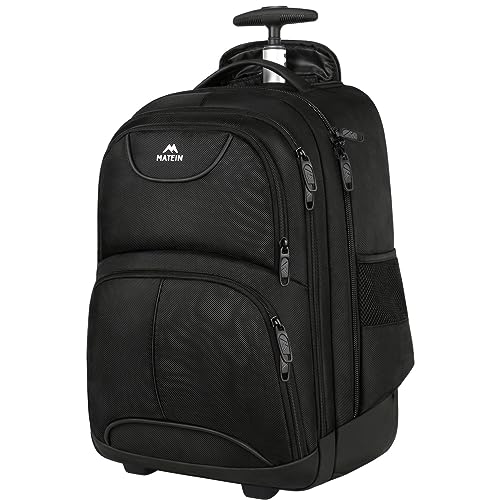
MATEIN Rolling Backpack 17 Inch — The business default
MATEIN builds more laptop backpacks than almost anyone in this price-conscious corner of Amazon, and its rolling model applies the same formula on wheels: a large, square, organisation-first bag that treats the laptop as the reason for the trip. The stated fit covers 17 inch machines, which immediately sets it apart from the smaller rollers in this set, and the interior volume is arranged like an overnight carry-on rather than a daypack — clothes and wash kit in the main space, computer in its own padded zone, smaller items corralled in organiser pockets. The listing describes the shell as water resistant, which is the believable claim for stitched fabric of this kind: it shrugs off drizzle and platform spray, and nobody should ask it to survive a downpour unprotected.
The rolling hardware is the point of the purchase, and it behaves as business rollers generally do: fine on terminal floors and hotel carpet, vocal on rough tarmac. What lifts this bag above generic rollers is that the backpack mode is a real mode rather than an apology — when the route turns to stairs or a crowded platform, carrying it is practical for meaningful distances, not just across a doorway. For the consultant or trainer who flies with a big laptop, a change of clothes and a sheaf of materials, this is the least complicated answer in the group: one bag, both gaits, no styling statement attempted or needed. If that working pattern sounds familiar, follow the MATEIN listing from the table above and compare its stated dimensions against your airline’s carry-on box before ordering.
One more consideration separates this MATEIN from cheaper big rollers: how it behaves at the destination. Business travellers do not merely transport a laptop, they work out of the bag in meeting rooms, training suites and site offices, and the organiser layout here reflects that reality — the machine, its charger and the day’s documents each have an obvious home, so the bag opens in a room full of people without spilling a wardrobe across the table. The clothing stays in its zone, the work stays in its zone, and the separation survives the journey because the compartments enforce it rather than suggesting it. Owners who run workshops or audits out of their luggage will recognise the value immediately; it is the difference between a bag that carries your job and a bag that merely carries your things.
- Laptop fit: up to 17 inch machines
- Format: wheeled backpack with carry-on intent
- Shell behaviour: water resistant fabric
- Organisation: main compartment plus organiser pockets
- Travel role: overnight business trips
Strengths
- Accepts larger laptops that most wheeled backpacks exclude entirely.
- Interior layout suits clothes-plus-tech packing for short work trips.
- Backpack mode remains usable over real distances, not just doorways.
Trade-offs
- Wheel and handle hardware add noticeable empty weight.
- Hard wheels transmit noise and vibration on broken pavement.
- Boxy square silhouette reads as luggage in every setting.
Best for: professionals travelling overnight with a 17 inch laptop on mostly smooth routes.
Not suited for: commuters whose journey includes gravel, cobbles or long stair climbs.

Rolling Backpack for Women — The styled all-rounder
Many wheeled laptop bags are styled like equipment; this one is styled like something its owner actually chose. The listing emphasises a dual-opening design, which in daily use means the main compartment can be reached in two ways — opened wide like a small suitcase for packing, or accessed more narrowly when the bag is upright beside a desk or under an aircraft seat. That second opening is the detail frequent flyers come to value, because fishing a laptop or a document wallet out of a fully packed roller in a cramped cabin is otherwise a small public performance. The bag is positioned as an overnight underseat carry, so its overall footprint stays modest and its laptop accommodation suits mainstream machines rather than the largest gaming hardware.
As a roller it plays the same game as the rest of this category: smooth floors flatter it, rough streets expose the small-wheel compromise, and the backpack straps exist for the stretches in between. Where it earns its slot is in combining that mechanical brief with proportions and finishes aimed at women who found the standard business roller either oversized or visually joyless. It will not swallow a long weekend’s packing for someone who travels heavy, and it is not the choice for a 17 inch workstation. Within its intended envelope — one night, a laptop, a composed appearance from platform to meeting room — it is coherent in a way many rivals are not. The product page linked in the quick picks table carries the colour options, so start there if appearance is half your brief.
Consider also who this bag quietly excludes and includes. It excludes the maximalist packer and the big-laptop owner, and it includes the traveller whose trips are choreographed — one night, two meetings, a dinner, home — and who values arriving looking composed over arriving equipped for contingencies that never occur. The dual opening supports that choreography at both ends: packed flat and orderly at home, dipped into selectively in transit. There is a discipline embedded in a bag this size, and buyers who enjoy travelling as a practised routine rather than an improvisation will feel at home in it, while habitual over-packers should treat its dimensions as a warning rather than a challenge.
- Format: wheeled laptop backpack, overnight underseat intent
- Access: dual-opening main compartment
- Laptop role: padded accommodation for mainstream sizes
- Style direction: women’s travel styling
- Travel role: one-night cabin trips
Strengths
- Second opening makes cabin access far less awkward.
- Under-seat proportions suit personal-item travel strategies.
- Design language avoids the anonymous black-luggage look.
Trade-offs
- Modest volume fills quickly on clothing-heavy packing lists.
- Large 17 inch laptops sit outside its comfortable fit.
- Small wheels remain chatty on uneven outdoor surfaces.
Best for: women flying light overnight with a standard-size laptop and cabin-only ambitions.
Not suited for: travellers packing several days of clothing or hauling oversized machines.
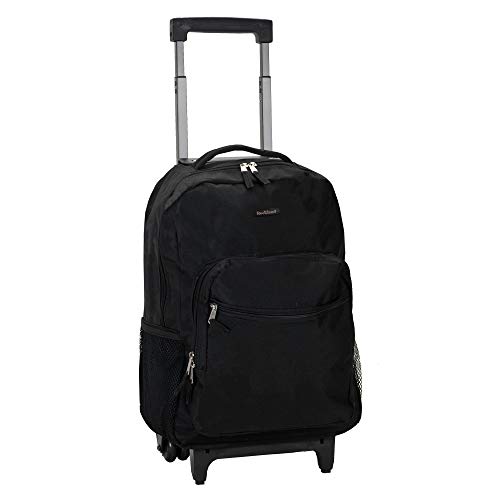
Rockland Double Handle Rolling Backpack — The simple classic
Rockland has sold variations of this bag for years, and its longevity tells you something about the appeal of radical simplicity. The double handle in the name refers to its carrying flexibility — pull it behind you on its wheels for the long flat stretches, grab it by its handles for the short awkward ones — and the interior follows the same unpretentious logic, with a main compartment sized around a 17 inch laptop class machine and the sort of pocket provision a student or field worker uses without thinking about it. There is no charging port theatre, no vacuum pump, no app-adjacent feature list. It is a bag with wheels, and it has stayed in the catalogue by being exactly that at an undemanding position in the market.
That simplicity cuts both ways, and this guide will not pretend otherwise. Organisation is basic, the aesthetic is utilitarian, and anyone wanting a suspended, richly padded laptop vault should look at the MATEIN or accept a non-rolling alternative. What the Rockland offers instead is low commitment: for the student whose campus is flat and whose budget is not, for the technician moving between nearby buildings, for the traveller who wants a spare wheeled bag for occasional trips, it does the rolling job without demanding that you reorganise your life around it. Simplicity also means fewer systems to fail — no pump, no port, no elaborate harness — and for some buyers that absence is the feature. Readers who want the plainest route into this category can head straight to the Rockland listing via the comparison table further down.
The Rockland also makes an instructive spare. Households and small firms often keep one wheeled bag in reserve — for the colleague whose shoulder is injured, the intern sent across town with a heavy machine, the conference trip that appears twice a year. A simple, long-running design suits that reserve role perfectly, because nobody needs a manual, a charging ritual or a familiarisation flight to use it; you pack it, you pull it, it works. Its plainness in a cupboard is a virtue, and its ability to accept a full-size laptop means the reserve bag never becomes the reason someone lugs a workstation through an airport in a tote. Not every pick in a guide needs to be somebody’s daily driver, and this one earns its place as the set’s dependable understudy.
- Laptop fit: 17 inch class machines
- Handles: dual handle arrangement plus towing
- Format: wheeled backpack, classic layout
- Organisation: straightforward main space and pockets
- Travel role: campus, field work and occasional trips
Strengths
- Long-running design with very little to go wrong.
- Handles stairs and lifts more gracefully than handle-only rivals.
- Fits larger laptops despite its undemanding market position.
Trade-offs
- Pocket organisation is basic beside modern business rollers.
- Laptop padding is serviceable rather than vault-like.
- Styling is plainly utilitarian in every colour offered.
Best for: students and occasional travellers wanting uncomplicated wheels under a big laptop.
Not suited for: buyers expecting rich organisation or premium padding systems.

Ytonet Rolling Laptop Backpack — The under-seat specialist
Ytonet’s roller makes its trade openly: it is built for 14 inch laptops, and in exchange for that lower ceiling it keeps the whole bag small enough to live under an aircraft seat. Frequent flyers who travel on personal-item allowances will understand the appeal instantly. A bag that stays with you in the cabin, opens two ways for quick access, and rolls through the terminal removes several small frictions from every trip — no overhead-bin contest, no waiting at a carousel, no hoisting a heavy pack into a locker above a stranger’s head. The dual-opening design returns here, letting the main compartment behave like a tiny suitcase when packing and like a top-access day bag when the journey is under way.
The styling follows the same women’s travel direction as the second pick in this guide, but the Ytonet is the more single-minded of the two: smaller machine, smaller footprint, tighter brief. A 14 inch ceiling excludes a large share of the laptops people actually own, so measure before you fall for the concept — the machine’s width and depth against the sleeve, not the diagonal printed on your laptop’s box. Within its limits it is arguably the most airport-literate bag here, and its large-for-a-small-bag interior is arranged for the overnight essentials rather than a week’s wardrobe. If your travel life is measured in one-night hops on smaller aircraft, the Ytonet’s listing, reachable from the quick picks, deserves the closest look of any in this set.
The Ytonet’s discipline extends to how it should be packed, and the bag rewards owners who learn its rhythm. Heavy items belong near the wheels, the laptop sits in its protected zone, and the dual opening means the things you need in the cabin — headphones, documents, a layer for cold cabins — live near the access point rather than at the bottom of a packed well. Treated that way, the bag delivers an unusually calm airport experience: nothing to hoist, nothing to gate-check, nothing to retrieve from a bin while a queue breathes behind you. Treated as a miniature suitcase to be stuffed without thought, it bulges and disappoints. Small bags are systems, and this one is honest about asking its owner to meet it halfway.
- Laptop fit: up to 14 inch machines
- Format: compact wheeled travel backpack
- Access: dual-opening main compartment
- Cabin role: under-seat personal item intent
- Style direction: women’s travel styling
Strengths
- Cabin footprint avoids the overhead-bin struggle entirely.
- Two access routes suit both packing and in-flight use.
- Compact size keeps the wheeled format manageable on stairs.
Trade-offs
- Fourteen inch ceiling rules out many mainstream laptops.
- Overnight capacity is the ceiling, not the starting point.
- Wheels are sized for terminals, not for rough streets.
Best for: personal-item flyers carrying a 14 inch laptop on short overnight hops.
Not suited for: anyone whose laptop exceeds the stated fit or who packs beyond one night.

GOTECH Rolling Backpack with Wheels — The connected commuter
GOTECH’s entry is the tech-commuter version of the idea: a 15.6 inch wheeled backpack with USB ports built in, pitched at men and women whose travel bag doubles as a charging station. The port arrangement follows the usual pattern in this class — your own power bank rides inside, the external port passes the cable through — and while that is a convenience rather than a revolution, on a long terminal wait it is a real one, sparing you the choice between an open bag and a dying phone. The listing describes the bag as waterproof; read that the way this guide reads all such claims on stitched, zippered fabric, as strong water resistance that handles commutes and showers, with seams and zip tracks remaining the honest weak points in a true soaking.
At 15.6 inches the laptop fit lands on the most common size in offices and universities, which gives this bag a broader natural audience than either the 14 inch Ytonet or the more specialised Fanwoli below. The rest of the design keeps faith with the category’s bargain: roll it where the ground allows, carry it where it does not, and accept the hardware weight as the price of the option. Commuters whose route mixes a station concourse, a smooth office district and one awkward staircase are precisely the people this middle path suits. Those tempted by the charging setup can examine the port layout on the GOTECH product page linked from the quick picks table before deciding.
There is a wider point about the GOTECH’s charging ports that applies across this category: a pass-through port is only as good as the cable discipline inside the bag. Owners who coil a short cable from their power bank to the port and leave it connected get the seamless experience the photos promise; owners who treat the port as decoration and rummage anyway get nothing but a hole with a bezel. Set the arrangement up once, at home, and the feature pays rent on every long platform wait afterwards. It is also worth keeping the internal cable run away from the laptop sleeve’s wall, so a rigid connector never presses into the machine’s lid when the bag is full and the wheels hit a kerb.
- Laptop fit: 15.6 inch machines
- Charging: built-in USB ports for your own power bank
- Shell behaviour: waterproof-leaning, realistically water resistant
- Format: wheeled backpack for mixed commuting
- Audience: men and women, work and travel
Strengths
- Mainstream laptop size covers most office machines.
- Pass-through charging keeps a phone alive on long waits.
- Weather-shedding shell suits year-round commuting routes.
Trade-offs
- Power bank is yours to supply; the port alone stores nothing.
- Zips and seams limit performance in prolonged heavy rain.
- Rolling hardware raises empty weight over a plain commuter pack.
Best for: tech-carrying commuters mixing smooth concourses with short carried stretches.
Not suited for: riders needing a dry bag in sustained downpours or ultralight kit lists.

Fanwoli Rolling Vacuum Travel Backpack — The compression traveller
Every guide in this batch contains one pick that tests the category boundary, and the Fanwoli is this article’s test. Strip the name down and it describes a rolling vacuum-compression travel backpack: 55 litres of expandable space, sixteen pockets by the maker’s count, a built-in electric pump and a one-button compression routine that squeezes the air out of packed clothing so a carry-on volume swallows a wardrobe it has no business holding. That is a travel system, and a clever one for clothing-heavy trips. The laptop accommodation is part of the package, but it is not the organising idea of the bag, and buyers whose computer is fragile, expensive or the entire point of the journey should register that distinction before anything else.
Judged as what it is, the Fanwoli solves a real problem: the traveller who wants carry-on dimensions with checked-bag appetite, rolling through the airport and compressing as they go. Judged as a laptop backpack, it asks you to accept that your machine rides inside a clothing compressor, with the packing discipline that implies — laptop in its sleeve, positioned deliberately, never as an afterthought beneath the vacuum load. Some readers will find that an acceptable bargain for the space gained; others will conclude, correctly for them, that the MATEIN’s conventional layout protects their priorities better. Both reactions are reasonable, which is exactly why this pick carries the fullest explanation in the guide. Anyone intrigued should study the Fanwoli listing closely, particularly how the laptop space is arranged relative to the compression chamber.
Compression deserves one clear-eyed paragraph of its own. Squeezing air from clothing saves space, but the compressed bundle becomes dense and unyielding, and everything sharing the bag must be packed around that dense core with intent. Shoes and wash kits tolerate the neighbourhood; a laptop tolerates it only when its sleeve is respected as a boundary and the machine is loaded last, against the bag’s structured side. Owners who fly with delicate extras — a camera, say, or anything with a screen of its own — should give those items the same deliberate placement. The Fanwoli’s pump makes compression effortless, and effortless systems invite careless packing; the buyers who get the best from this bag will be the ones who stay deliberate precisely because the machine makes the rest easy.
- Capacity: 55L expandable travel volume
- Compression: built-in electric pump, one-button operation
- Format: 2-in-1 rolling travel backpack
- Pockets: sixteen by the maker’s count
- Laptop role: accommodation within a travel-first design
Strengths
- Vacuum compression dramatically expands clothing capacity.
- Rolling format suits airport-centred itineraries.
- Pocket count gives small items defined homes.
Trade-offs
- Laptop protection is secondary to the compression mission.
- Pump and hardware add weight and another system to maintain.
- Packing discipline matters more than in a conventional layout.
Best for: clothing-heavy travellers who carry a laptop rather than travel for one.
Not suited for: buyers whose expensive workstation needs a dedicated padded vault.
How Should You Judge Wheel and Handle Quality From a Listing?
You cannot roll a bag before you buy it, so the listing has to be read like an engineer reads a drawing. Start with wheel count and placement. Two-wheel designs tow at an angle behind you and generally use larger, more durable wheels; four-wheel spinner arrangements stand upright and glide beside you in queues, but their smaller casters are more exposed to damage and their hardware adds complexity inside a bag that also has to work on your back. For a laptop backpack that will live most of its life towing on two wheels, wheel diameter is the number that matters most in practice: bigger wheels roll over pavement joints, lift thresholds and cable covers with less drama, and they spin more slowly for a given walking speed, which is kinder to their bearings.
Look next at how the wheels attach. Housings that appear integrated into a reinforced base, with visible structure around the axle, survive kerb strikes better than wheels that seem pinned to fabric corners. The base itself deserves attention in product photos: a rigid tray or skid rails along the bottom protect both the wheels and the bag’s contents, and they give the bag a fighting chance of standing upright when parked — a small thing in a listing, a daily pleasure in a hotel room. Corner guards, those dull-looking plastic or rubber bumpers, exist because rolling bags are dragged around corners and down kerbs thousands of times; their presence signals a maker who has watched how these bags actually die.
The handle deserves the same forensic treatment. A telescoping handle should lock at more than one height if the household or the travel team includes people of different statures, and the grip should be shaped for a hand that will hold it for twenty minutes, not twenty seconds. Read the photos for the handle’s stowed position: a channel that eats deep into the main compartment steals packing space every single trip, while a flatter arrangement preserves the box-like interior that makes packing a roller pleasant. Wobble is the hardest quality to judge remotely, but reviews that mention rattling or flexing at full extension are telling you the tubes are undersized; a handle that wobbles empty will wobble worse loaded, and the laptop inside feels every oscillation.
Finally, judge the backpack conversion as a system. Straps should stow or at least tame themselves so they do not trail in puddles while towing, and the back panel should not press a dirty wheel housing into your coat. Some designs add a flap or cover for the wheels in carry mode; if your journeys mix wet streets with office arrivals, that unglamorous flap may matter more than any pocket. A bag that converts gracefully gets carried willingly on the awkward stretches, and that willingness is what keeps the wheels from becoming a burden you resent.
How Do You Pack a Rolling Backpack So the Laptop Survives the Ride?
Packing a roller is not packing a backpack with extra steps; the physics differ, and the laptop’s safety depends on respecting them. The golden rule is that heavy items ride low and close to the wheelbase, because a top-heavy roller tips, twists on its handle and slams its upper corners into doorframes. Your laptop, charger and any dense items belong in the lower two-thirds of the bag, with clothing — the lightest, most forgiving cargo — filling the top and the outer face. If the sleeve sits high in the design, compensate by keeping the heaviest extras beneath it rather than beside it.
Build a cushion strategy around the machine. The sleeve’s own padding handles the flat faces; corners need help from you. Rolled knitwear at the sleeve’s corners, a wash kit placed as a buffer on the side that faces the bag’s exterior, and a charger brick moved to a pocket away from the screen side all cost nothing and absorb the knocks that towing transmits. Never place hard, angular objects — adapters, external drives in metal cases, a full water bottle — directly against the laptop compartment’s wall, because every kerb drop presses them into the machine with the bag’s full rolling momentum behind them.
Think about the two journeys the bag will make. In tow mode the dangers are vibration and base impacts, answered by the low, buffered packing above. In carry mode the dangers revert to the usual backpack ones, with gravity pulling contents toward the base — which is the wheel end — so a load packed for towing is also a load packed for carrying, provided the straps take the weight before the bag’s contents settle. At the airport, keep the items you will need at security in the most accessible pocket rather than buried: a roller opened fully on a terminal floor, contents migrating, is a small chaos that good packing prevents entirely. And when you reach the aircraft, lift the bag into the bin by its handles with the wheels facing outward where possible; dragging it sideways across the bin’s edge is how handles and wheel housings get their first real damage.
Maintenance closes the loop between packing and survival. Once a month on a travelling bag, spin each wheel by hand: it should rotate freely and quietly. Grit can be picked from the tread, hair unwound from the axle, and a wheel that grinds or wobbles is information to act on before a trip, not during one. Wipe the wheel housings before using backpack mode after wet weather, extend the handle fully and collapse it twice to keep the mechanism honest, and store the bag unloaded with the handle down. None of this is glamorous, and all of it is the difference between a roller that serves for years and one that becomes a heavy, dragging annoyance inside a single season.
Which Size of Rolling Laptop Backpack Fits Your Travel Pattern?
Size in this category is really three separate decisions wearing one label. The first is laptop fit, already covered: the sleeve must swallow your machine’s actual footprint with a little grace. The second is trip length. An under-seat roller like the Ytonet is a one-night instrument; asking it to cover three days produces the overpacked, bulging bag that fits nowhere and protects nothing. A full carry-on roller like the MATEIN or the Rockland covers two or three nights for a disciplined packer, especially one who re-wears trousers and packs clothing that layers. Beyond that, the honest answer is a suitcase plus a normal laptop backpack, because a wheeled backpack stretched past its volume stops being good at either of its jobs.
The third decision is the one buyers forget: body size — yours. A wide roller towed by a smaller person clips heels and fights at every turn; a tall traveller stooping to a short handle trades shoulder pain for back pain and gains nothing. Handle extension length and bag width are ergonomic facts, not specifications to skim. Similarly, backpack mode must fit the carrier: a heavily built roller with short straps is a punishment device on stairs. If the listing gives strap and handle dimensions, use them; if it does not, treat the omission as a reason to favour the makers who publish theirs.
Airline reality intrudes on all three decisions. Personal-item sizers are unforgiving boxes, and a bag that fits the box empty may fail it packed hard, because soft rollers bulge. Carry-on limits vary not only by airline but by fare class and route, and the same bag can be legal on Monday’s flight and gate-checked on Friday’s. The robust strategy is to size for the most restrictive carrier you regularly use, then let the bag’s extra room serve you on trains and in cars where no sizer waits. Readers who mostly drive to regional meetings can ignore all of this and buy volume freely; readers who fly budget cabins cannot, and for them the compact end of this guide — the Ytonet and the styled dual-opening roller — exists precisely because restriction is their normal condition.
What Does a Day With a Rolling Laptop Backpack Actually Feel Like?
Picture the strongest case first. You leave a hotel with the bag packed to a weight that would have your shoulder complaining by the lobby. Instead it follows you across marble, onto the pavement for one carried block where roadworks have torn the surface up, then back onto its wheels for the smooth run to the station. On the concourse it rolls beside the crowd rather than swinging from your back through it. At the gate it stands — if the base is well designed — rather than slumping. In the meeting it sits under the table, laptop drawn from the accessible pocket, charger reachable, and at no point has your shirt been creased by a strap or your shoulder loaded unevenly for hours. That is the day the format promises, and on smooth-ground itineraries it genuinely delivers it.
Now the honest counter-image. Rain has made the pavement a film of grit and water. The wheels pick up the wet and carry it; when you lift the bag onto your back for the crowded bus, the housings are filthy against your jacket. The old town near your destination is cobbled, and the bag chatters behind you at a volume that turns heads, transmitting every stone through the handle into your wrist. The venue has three floors and no lift. By the stairs you understand, in your forearms, exactly what the hardware weighs. Neither picture is the whole truth; your own geography decides which one you will live more often, and a buyer who maps their real routes before ordering will land on the right side of this category. A buyer who maps only the airport will not.
There is a social dimension worth one paragraph. Rolling bags trail behind their owners in pedestrian space, and in dense crowds — a packed platform, a festival street, a school corridor at changeover — a towed bag is a trip hazard that its owner cannot see. Etiquette and safety both argue for carrying the bag through true crowds and rolling it in open space, which loops back to the conversion question: the roller you want is the one whose straps you can deploy in seconds without a bench, a struggle or a audience. Practise the changeover at home once, slowly, and you will know within a minute whether your bag’s designers ever tried it themselves.
How Do the Six Rollers Compare Side by Side?
| Pick | Laptop fit | Defining idea | Watch out for |
|---|---|---|---|
| MATEIN Rolling Backpack | 17 inch | Business overnight roller | Empty weight from hardware |
| Rolling Backpack for Women | Mainstream sizes | Dual-opening underseat style | Limited multi-day volume |
| Rockland Double Handle | 17 inch class | Simple, long-running design | Basic organisation |
| Ytonet Rolling Backpack | 14 inch | Personal-item cabin specialist | Strict size ceiling |
| GOTECH Rolling Backpack | 15.6 inch | USB pass-through commuting | Rain limits at seams |
| Fanwoli Vacuum Backpack | Travel accommodation | Compression clothing system | Laptop is not the focus |
What Mistakes Do Rolling Backpack Buyers Keep Making?
The first mistake is shopping by screen size alone. A 15.6 inch gaming laptop with thick bezels and a rear cooling shelf can be physically larger than a slim 17 inch ultrabook, and wheeled bags offer less forgiving space than soft backpacks because the frame and handle channels eat into the interior. Measure the machine. The second mistake is imagining the wheels will be used everywhere: buyers picture the airport and forget the gravel drive, the old town’s cobbles, the three floors of stairs at their own building. If the carried stretches dominate your route, the hardware becomes pure penalty. Third, people overload rollers precisely because rolling feels effortless, then discover the weight again at the first staircase or overhead lift — pack to the carry weight you can manage, not the tow weight.
Fourth, owners neglect the wheels themselves. Grit works into small wheel assemblies, hair wraps around axles, and a bag that rolled sweetly in month one drags by month six unless the wheels get an occasional clean and check. Fifth, travellers assume carry-on compliance from the word carry-on in a title; airline sizers differ, expandable bags grow, and the only reliable test is the published dimension box of the carrier you actually fly. Finally, some buyers treat the telescoping handle as an afterthought during selection and then use it for hours every trip — extend it fully in your mind’s eye at your height, because a handle that forces a stoop will punish your back as surely as a heavy shoulder strap would.
One last practical test before ordering any bag in this set: stand your packed current backpack on the floor and look at its silhouette. If it is tall and narrow, a roller of similar proportions will feel familiar; if it is wide and flat, the boxier rollers here will change how you move through crowds and doorways more than the wheels themselves will. Matching the new bag’s shape to the routes and spaces you already know is the quiet detail that separates a purchase that settles in from one that stays faintly awkward for its entire working life.
Should You Buy a Roller or Spend the Same Effort on Packing Lighter?
Every wheeled bag competes with an invisible rival: the ordinary backpack you already own, packed with more discipline. Before spending on hardware, weigh your current load honestly. A surprising share of rolling-bag purchases are really charger, cable and just-in-case purchases in disguise — duplicate adapters, a mouse and keyboard for a two-hour meeting, three changes of clothes for one night. Strip those, and some travellers discover their existing pack was never the problem. The exercise costs an evening and either saves a purchase or confirms, with evidence, that the load is genuinely irreducible and wheels are the correct answer.
If the load survives the audit, the roller’s case strengthens quickly, because the remaining weight is usually the non-negotiables: the laptop itself, its power supply, work materials that must exist on paper, medication, a change of clothes that a delayed flight makes essential rather than excessive. Those are exactly the loads that punish shoulders cumulatively across a working year, and exactly the loads a roller carries without comment on any decent floor. Buyers in that position should not feel they are indulging themselves; they are matching the tool to a measured weight, which is what good equipment decisions look like in every other part of working life.
Final Recommendation
For most readers the MATEIN is the answer this category exists to give: a big-laptop business roller that packs like a small suitcase and carries like a backpack when the ground turns hostile. Choose the Ytonet instead if your travel life runs on personal-item allowances and a 14 inch machine, and look hard at the Fanwoli only when clothing volume, not computer protection, is the problem you are really solving. Buy the roller that matches your smoothest ninety percent of ground — and let the awkward ten percent, the stairs and the gravel, decide how much you pack rather than whether you should have bought wheels at all.
Frequently Asked Questions
Can a rolling backpack go in an overhead bin?
Most in this guide are designed with cabin dimensions in mind, but airlines set their own sizers and enforcement varies by route and aircraft. Compare the bag’s stated external measurements, wheels included, against your carrier’s published carry-on box, and treat expandable models at their expanded size when judging a tight limit.
Are the wheels removable or replaceable?
On bags of this type the wheels are generally fixed assemblies rather than user-swappable parts. That makes pre-purchase judgement important: favour designs whose wheels look proportionate to the bag’s intended load, and keep them free of grit and hair so the original rolling quality lasts.
Will a wheeled bag damage my laptop on rough ground?
The risk is vibration and jolts transmitted through a rigid base rather than a single dramatic impact. A padded sleeve, sensible packing with softer items around the computer, and carrying the bag over the roughest stretches together reduce that risk to a level most owners accept without thinking about it again.
How much heavier is a rolling backpack than a normal one?
Wheels, a handle mechanism and a stiffer base add meaningful weight — enough that you should compare empty weights before ordering and be honest about how often you will carry rather than tow. On smooth routes the trade still favours wheels; on stair-heavy routes it quickly does not.
Do rolling backpacks work for school and campus use?
They work well on flat, paved campuses with long distances between buildings, and poorly where routes involve grass, gravel or crowded stairwells between classes. The Rockland’s simple design has served this role for years, which is why it remains in the set despite its basic organisation.
Can I take a rolling laptop backpack through security without removing the computer?
That depends on the checkpoint’s rules and on whether the bag’s laptop compartment opens in a way screeners accept, which most wheeled overnight bags are not specifically designed to do. Plan on removing the laptop unless the design clearly offers a lay-flat scanning arrangement, and pack so that removal takes seconds: sleeve accessible, nothing stacked on top of the machine, cables corralled elsewhere. A bag that makes the security ritual quick earns its keep twice on every single journey, once at the belt and once when you repack on the far side without holding up the line behind you.
Related Guides
Readers weighing wheels against straps may also find our wider travel coverage useful, starting with best laptop backpacks for travel, and those whose trips are shorter should compare best commuter laptop backpacks before deciding that rolling hardware is necessary at all. If your routes are airport-heavy, Best TSA Approved Laptop Backpacks covers the checkpoint-friendly end of the same problem.


