What's inside
- Key Takeaways
- Quick Picks
- How did we choose for large homes specifically?
- Which system fits which kind of large home?
- How do the six large-home options compare?
- Mesh or one powerful router — how should a large home decide?
- How should a large household count its devices honestly?
- How does a wired backbone change life in a large home?
- What should a large home plan for the next five years?
- How should you stage the installation in a big house?
- What are the most common large-home networking mistakes?
- What about the annex, the garden office, and the converted garage?
- Final Recommendation
- Frequently Asked Questions
- Related Guides
As an Amazon Associate I earn from qualifying purchases. This post may contain affiliate links at no extra cost to you.
widgetverdict.com is reader-supported. When you buy through links on our site, we may earn an affiliate commission.
Where to buy: every system and router below is sold through its checked Amazon listing; count your household’s simultaneously active devices on a real evening before choosing, because that census — not the one on any box — is the specification that matters most in a large home.
The search for the best routers for large homes and multiple devices is really two searches wearing one coat. The first is a geography problem: a big floor plan, several floors, rooms that sit far from wherever the internet enters the building. The second is a population problem: a household whose evenings involve dozens of devices awake at once — televisions, consoles, laptops, phones, cameras, speakers, plugs, appliances that report to apps nobody remembers installing. A product can solve one problem brilliantly and the other barely at all, and the six picks below were chosen to cover the combinations honestly, from whole-home mesh systems to single routers with the wired backbone to anchor a large property’s network. Most buying regret in this category comes from solving the wrong one first and discovering it slowly.
Population claims need the same scepticism this cluster applies to coverage claims. When a listing says a system handles seventy devices, or a router serves a hundred and twenty, that is a manufacturer figure describing connected capacity under the maker’s assumptions — not a promise about seventy simultaneous video streams, and not a measurement made in your home. Idle devices cost a network almost nothing; a doorbell and a smart plug are citizens who mostly sleep. What strains a system is simultaneous activity in the same area on the same band, and that strain is eased less by headline capacity than by distribution: several radios, each serving its neighbourhood, with wired links where the traffic is heaviest. Read every device figure in this guide as the maker’s framing, and plan by your own evening census instead.
The framing decision comes first, then, and this guide will keep returning to it: mesh or mighty single router? Mesh distributes — multiple nodes, one network name, radios placed where life happens. A single powerful router centralises — one fast box, often with multi-gig ports, ideal when the home’s shape lets it sit near the middle and when heavy devices can be wired into it. Large homes with open plans and a central hall often thrive on the second; large homes shaped like an L, a tower, or a terrace with extensions usually need the first. The picks are ordered to walk you through that decision with real hardware at each branch, and none of them asks you to pretend the other branch does not exist.
Key Takeaways
- Device-count figures are manufacturer claims about connected capacity, not measurements of simultaneous heavy use in a real house with real walls.
- Distribution beats raw power at scale: several well-placed radios serve a big household better than one heroic box stranded in a corner by the modem socket.
- Mesh is the default answer for awkward large shapes; a central single router with multi-gig ports suits open plans and wired households.
- Wired backbones and Ethernet backhaul quietly decide how large-home networks feel at peak hours, long after the headline specifications are forgotten.
- Two picks are WiFi 7 flagships, three are WiFi 6 mesh systems, and one is a WiFi 7 single router — each labelled with its true class and generation.
- The Orbi 370 system makes the largest stated coverage claim here; the Deco X50-PoE is the pick for ceiling and wall mounting in cabled homes.
Quick Picks
| Pick | Badge | Why it earns its place |
|---|---|---|
| NETGEAR Orbi 370 WiFi 7 Mesh System (4-Pack) | The maximum-coverage mesh | WiFi 7 mesh with a stated 8,000 sq. ft. and seventy-device manufacturer framing for the biggest homes. |
| TP-Link Deco X55 Mesh WiFi 6 System (3-Pack) | The proven three-node workhorse | AX3000 mesh with three gigabit ports per unit and Ethernet backhaul for wired offloading. |
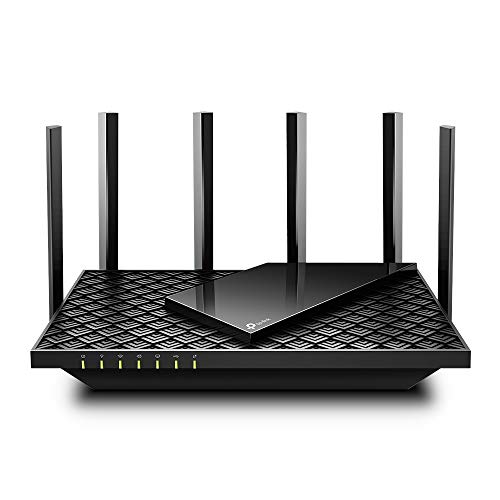
| TP-Link Archer BE700 WiFi 7 Router | The single-router powerhouse | BE15000 tri-band with 10G and 2.5G ports for open-plan homes that can centralise. |
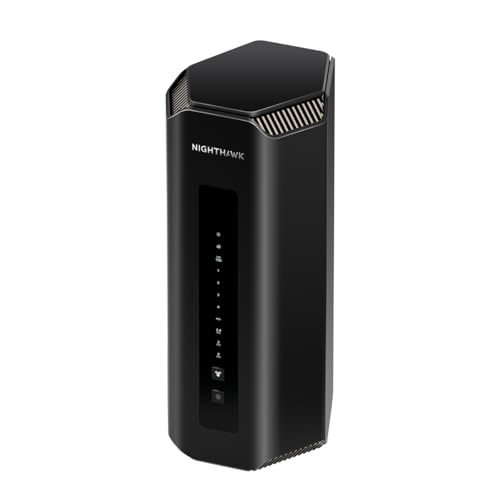
| NETGEAR Nighthawk RS500 WiFi 7 Router | The high-census single box | Tri-band WiFi 7 with a stated 120-device capacity for gadget-dense homes with central placement. |
| TP-Link Deco X50-PoE Mesh WiFi 6 System (3-Pack) | The mountable mesh | PoE-powered nodes that mount on ceilings and walls where furniture placement fails. |
| Amazon eero 7 Mesh WiFi 7 Router | The expandable starter unit | A single WiFi 7 mesh router for large homes that want to grow node by node. |
How did we choose for large homes specifically?
We required every pick to answer at least one of the two problems — geography or population — with hardware rather than adjectives. Mesh systems needed multiple nodes or a credible expansion path; single routers needed the port provision and radio class to anchor a big household from the centre. Stated coverage and device figures were recorded from the verified listing titles and treated throughout as manufacturer claims. We also weighted the unglamorous infrastructure: Ethernet backhaul support, PoE for homes with structured cabling, multi-gig ports for the wired backbone, and ecosystems that let a system grow instead of being replaced. A large home is a decade-long networking commitment, and the picks were judged as infrastructure, not as gadgets.
One deliberate omission should be confessed: no bargain extender kits and no previous-generation clearance systems were admitted, however large their printed coverage claims, because large homes are where weak architecture goes to be exposed slowly and expensively. Every pick below can plausibly serve a decade; that, more than any single specification, is the entry ticket this guide actually charged.
Which system fits which kind of large home?

NETGEAR Orbi 370 WiFi 7 Mesh System (4-Pack) — The maximum-coverage mesh
The Orbi 370 system makes the largest claim in this guide, and it should be read with the guide’s standard discount applied: a WiFi 7 mesh system whose listing title states coverage up to 8,000 square feet, speeds up to 5 Gbps, capacity framed at seventy devices, dual-band design, security features, and a 2.5-gigabit port, in a pack the title describes as including the router with satellite extenders. Even discounted for manufacturer optimism, the intent is unmistakable — this is the kit aimed at the genuinely large property, the five-bedroom house with a study wing, the home where the network must reach a converted garage’s office and a teenager’s attic room in the same evening.
WiFi 7 in a mesh context buys the large home something specific: more efficient handling of many simultaneous conversations, which is the population problem stated in radio terms. The dual-band design is the honest caveat to set against it. Without a third band dedicated to node-to-node traffic, the satellites share spectrum between backhaul and clients, and in a house large enough to need this pack, hop distances will test that arrangement. Placement becomes the owner’s craft — nodes at honest halfway points, the busiest satellite wired if the home allows — and the 2.5-gigabit port on the router hints at the intended pattern: a fast wired spine where possible, wireless distribution where necessary.
The seventy-device figure, again a manufacturer’s framing, is at least scaled to the homes this system courts: a big house accumulates cameras, televisions per room, and appliances per counter faster than any other kind of home, and a system specced with that census in mind will not be embarrassed by the household’s growth. Buyers whose properties genuinely approach the stated scale should treat the Orbi 370 as the ceiling option in this guide and work downward only if their floor plan is kinder than its square footage suggests. Confirm the exact pack composition on the listing before ordering, since the title’s own description of units and satellites is the part of the specification your installation plan will depend on.
One further consideration is operational rather than technical. A system of this size becomes the home’s utility infrastructure, maintained by whoever in the household drew the network short straw. NETGEAR’s app-led management suits that reality: node health, device lists, and updates presented as household administration rather than as a hobby. In a large home, the best system is frequently the one the reluctant administrator will actually keep updated, and that human factor deserves a line in any honest recommendation.
Scale also changes the failure conversation. In a small flat, a router fault is an inconvenience; in a large home running alarms, cameras, heating controls, and two jobs, it is a household event. A system whose nodes can be individually replaced, whose app reports a satellite’s health before the family notices its absence, earns its tier on resilience as much as on reach — and buyers at this scale should weigh that operational maturity as heavily as any radio specification.
- Class: WiFi 7 mesh system, dual-band
- Stated coverage: up to 8,000 sq. ft. (manufacturer claim)
- Stated device capacity: 70 devices (manufacturer claim)
- Speed framing: up to 5 Gbps, per the listing title
- Wired highlight: 2.5 gig port named in the title; pack composition to confirm on the listing
Strengths
- The largest stated coverage in this guide, aimed at genuinely big properties.
- WiFi 7 efficiency suits homes with many simultaneous conversations.
- App-led administration suits the reluctant household network manager.
Trade-offs
- Dual-band backhaul shares spectrum across what may be long hops.
- The 8,000 sq. ft. figure is a manufacturer ceiling, not a survey.
- Smaller large homes will pay for coverage they cannot use.
Best for: a very large multi-storey property whose rooms and device census both stretch ordinary mesh kits. Not suited for: a moderately sized home, where a three-node WiFi 6 system covers the same life at a lower tier.

TP-Link Deco X55 Mesh WiFi 6 System (3-Pack) — The proven three-node workhorse
The Deco X55 appears in this cluster’s mesh guide as the balanced default, and it earns a second, distinct reading here: as the large-home workhorse for households whose size is measured in device population as much as in rooms. Its credentials from the listing title are by now familiar — AX3000 WiFi 6 mesh across three units, stated coverage up to 6,500 square feet as a manufacturer figure, three gigabit ports per unit, and Ethernet backhaul support. In a large home, that port count is the detail that keeps giving: every satellite can wire the cluster of devices around it, draining televisions, consoles, and desktop PCs off the wireless network and reserving the air for things that genuinely move.
Consider the arithmetic of a big family’s evening through that lens. The wireless census that matters is not the fifty devices connected; it is the dozen active ones, and if half of those are wired into their nearest node, the remaining wireless load is suddenly modest enough for a dual-band system to carry with composure. The X55’s design invites exactly that discipline, and its Ethernet backhaul support extends it to the nodes themselves wherever a cable run exists. Large homes built or renovated in the last two decades often have more cabling than their owners remember — a fact worth an hour’s investigation before any mesh purchase, because it can demote the backhaul question from the system’s central anxiety to a solved detail.
Where the X55 asks for honesty in this company is generation and ceiling. It is WiFi 6 in a guide whose flagships are WiFi 7, and its dual-band backhaul will be outclassed at the extremes of distance and load by tri-band designs. For the large home whose shape is kind — three nodes forming a comfortable triangle, wired offloading at each — those extremes may never arrive, and the X55’s maturity becomes the argument: a platform with years of firmware refinement, bought at the settled end of its generation’s pricing. Judge it against your floor plan’s kindness, and check the three-pack listing to confirm the per-unit port layout your wired clusters are counting on.
There is a final, practical virtue in choosing the workhorse: replacement and expansion economics. A system this widely sold is a system whose additional nodes, should a renovation or a new garden office demand one, remain easy to source and simple to adopt into the existing network. Large homes change more than small ones over a decade, and the network that grows by accretion beats the network replaced in revolutions.
Its second appearance in this cluster, after the mesh guide, reflects the same double fitness noted for the RS500 below: the X55 answers the coverage question for ordinary large homes and the population question for busy ones, because its ports let it subtract heavy devices from the air entirely. Guides can rank specifications; households live with architectures, and this one’s architecture is unusually easy to live with.
- Class: AX3000 WiFi 6 mesh, dual-band, three units
- Stated coverage: up to 6,500 sq. ft. across the pack (manufacturer claim)
- Wired ports: 3 gigabit ports per unit, per the listing title
- Backhaul: wireless, with Ethernet backhaul supported per the title
- Role: replaces router and extenders across a large floor plan
Strengths
- Per-unit ports enable wired offloading that transforms busy evenings.
- Three nodes suit the triangle layout most large homes need.
- Mature WiFi 6 platform with settled pricing and firmware.
Trade-offs
- Dual-band wireless backhaul is the ceiling in extreme layouts.
- WiFi 6 generation in a guide led by WiFi 7 flagships.
- Very large or masonry-heavy homes may still outgrow three nodes.
Best for: a large family home with wired clusters at each node position and a kind, triangular layout. Not suited for: an extreme-scale or concrete-heavy property where backhaul demands a dedicated band or PoE mounting.

TP-Link Archer BE700 WiFi 7 Router — The single-router powerhouse
The Archer BE700 is the guide’s argument that some large homes should not mesh at all. Its listing title describes a tri-band WiFi 7 router in the BE15000 class — eight streams, 15 Gbps of aggregate framing — with a wired provision that reads like a small data centre’s: one 10-gigabit port, one 2.5-gigabit port, two gigabit ports, USB 3.0, six internal antennas, VPN client and server support, EasyMesh compatibility, MLO, and a private IoT network feature. For the open-plan large home, the modern build with a central hall and rooms radiating from it, a single instrument of this capacity placed at the centre can serve the whole population without a single satellite.
The ports tell the deeper story. A 10G port in a home router is not about any single device’s speed; it is about the backbone — a fast switch feeding wired rooms, a NAS serving the whole household, a future access point at the far end — none of it throttled by the gigabit ceiling that quietly caps lesser routers’ ambitions. Large homes generate exactly these loads: backups crossing the house, media libraries streaming to several rooms, a home office whose work files live on network storage. The BE700 is built to be the junction those flows pass through, and its tri-band radios, with MLO letting capable clients use multiple bands at once, handle the wireless population with the same seriousness.
The private IoT feature named in the title deserves a sentence in a multiple-devices guide, because it addresses the population problem’s security dimension. Dozens of cheap connected gadgets share the modern large home’s network with the family’s banking and work; a dedicated IoT network segment keeps that census at arm’s length without exiling it. Combined with the EasyMesh compatibility — the escape hatch that lets this router recruit mesh nodes later if an extension or a stubborn wing defeats it — the BE700 is the centralised answer with a distributed insurance policy attached. If your large home has a centre and your heavy devices can be wired, examine its listing closely; it is the most capable single box in this guide.
Placement remains the contract’s fine print. Internal antennas and a flagship’s bulk mean this router wants a proper central stage — a hall console, an office shelf — not a cupboard, and a large home that cannot offer it one should take that as evidence for the mesh branch of this guide instead. Power placed badly is just expense with good specifications.
Its VPN server and client support, named in the title, rounds out the large-home brief in a way smaller households rarely need: the home office whose traffic must join a company network, and the returning traveller who should reach the home’s storage as if from the study. At this scale the router is genuinely the house’s gateway in every sense, and the BE700 is specified like it knows that.
- Class: WiFi 7, tri-band, BE15000 (8-stream, 15 Gbps aggregate framing, per the title)
- Wired ports: 1x 10G plus 1x 2.5G plus 2x 1G, and USB 3.0, per the listing title
- Antennas: 6 internal antennas, per the title
- Features named in the title: VPN clients and server, EasyMesh, MLO, private IoT network
- Role: single central router for open-plan large homes
Strengths
- Multi-gig port provision anchors a serious wired backbone.
- Tri-band WiFi 7 with MLO serves dense wireless populations.
- EasyMesh compatibility insures against the room it cannot reach.
Trade-offs
- One broadcast point still obeys geometry in awkward-shaped homes.
- Its capacity is wasted where the floor plan forces corner placement.
- Flagship tier pricing buys headroom some households never touch.
Best for: an open-plan large home with a central position, wired heavy devices, and a NAS or switch backbone. Not suited for: an L-shaped or multi-wing home whose far rooms sit beyond any single router’s honest reach.

NETGEAR Nighthawk RS500 WiFi 7 Router — The high-census single box
The RS500 returns from this cluster’s long-range guide with its population credentials to the fore. Its listing title states tri-band WiFi 7 in the BE12000 class at up to 12 Gbps, coverage up to 3,000 square feet, capacity framed at 120 devices, and a port layout of one 2.5-gigabit plus three gigabit ports. The coverage figure suits a large home rather than a vast one, and that is precisely the niche: the big, gadget-dense household whose floor plan is compact enough for one strong centre — the modern family pile where five people and their ecosystems live busy, overlapping digital lives under one roof.
Read the 120-device claim the way this guide has taught: as a manufacturer figure, and as a signal of design intent rather than a tested census. The intent matters because device handling is a real engineering discipline — connection tables, band steering, airtime fairness — and a router specced and marketed for triple-digit populations has been built with those disciplines in mind. In the RS500’s home, the strain is rarely distance; it is the school-night hour when homework, streams, calls, cameras, and a game update coincide, and the tri-band layout’s gift is keeping those conversations in separate lanes so the far laptop and the near console stop competing for the same air.
The 2.5G port supports the same backbone logic as the BE700’s, at a step down in scale: a switch for the wired rooms, a NAS, or a future wired access point, all without the gigabit cap. Households choosing between the two single-router picks are really choosing scale — the BE700 for the sprawling open plan with a data-centre streak, the RS500 for the dense household in a merely large shell. Both judgements are respectable; the floor plan and the census, honestly surveyed, decide between them. Verify the RS500’s port layout on its listing before committing the backbone plan to it.
A word on longevity closes its case. A high-census home adds devices monotonically — nothing in the modern household ever disconnects — so headroom bought today is not indulgence but scheduling: the router that absorbs three years of gadget accretion without a replacement conversation has paid for its tier. The RS500’s stated figures, discounted properly, describe exactly that kind of headroom.
Its appearance in two guides of this cluster is deliberate rather than lazy. The long-range reading judged it as a single voice speaking to distant rooms; this reading judges it as a switchboard for a crowded house. A router that survives both audits — reach and population — is rarer than either guide’s length suggests, and households whose homes are both large and busy should notice when the same name keeps answering different questions.
- Stated device capacity: 120 devices (manufacturer claim)
- Class: WiFi 7, tri-band, BE12000 (up to 12 Gbps aggregate, per the title)
- Stated coverage: up to 3,000 sq. ft. (manufacturer claim)
- Wired ports: 1x 2.5G plus 3x gigabit, per the listing title
- Role: single central router for dense, busy households
Strengths
- Tri-band lanes keep a dense household’s conversations separated.
- The highest stated device figure among this guide’s single routers.
- 2.5G port keeps the wired backbone option open.
Trade-offs
- Single-point coverage caps out in sprawling or winged layouts.
- Device and coverage figures are manufacturer framings, not tests.
- WiFi 7 client benefits arrive only as the household’s devices renew.
Best for: a large but centrally manageable home with a triple-digit gadget census and busy overlapping evenings. Not suited for: a sprawling multi-wing property where no single position can serve every room.

TP-Link Deco X50-PoE Mesh WiFi 6 System (3-Pack) — The mountable mesh
The Deco X50-PoE solves the large-home problem that furniture-based mesh cannot: the rooms where no shelf, sideboard, or acceptable surface exists at the right halfway point. Its listing title describes an AX3000 WiFi 6 mesh three-pack whose nodes are ceiling- and wall-mountable and powered — the PoE proposition — with dual 2.5G ports. Power over Ethernet changes the placement map completely. A node no longer needs a mains socket and a table; it needs a network cable, and it can live on a ceiling in the hall, a wall in the stairwell, the very positions a network designer would choose and a furniture arranger never could.
This is the professional pattern brought home, and large properties are where it belongs. Homes with structured cabling — increasingly common in new builds and serious renovations — can adopt this system the way offices adopt access points: nodes placed by signal logic, powered through the same cable that carries their backhaul, which also means the backhaul is wired by design rather than by exception. A wired-backhaul mesh with ceiling nodes is, in coverage terms, the end of the argument; the remaining questions are aesthetic and financial. Dual 2.5G ports per the title give each node a fast wired life beyond its radio duties as well.
The honest prerequisites deserve emphasis, because this pick punishes wishful buying. PoE requires either network switches that supply it or injectors that add it, and ceiling mounting requires the cable runs to exist or to be installable — a retrofit in a finished house is a project, not an afternoon. Households without cabling and without an installer in their future should read the X55’s section instead and place nodes on furniture like everyone else. But for the large home mid-renovation, or the new build whose walls are still open, the X50-PoE is the most grown-up answer in this guide, and its listing should be read alongside your cabling plan.
There is an aesthetic dividend that large-home owners will appreciate only after living with the alternative: a network that is invisible. No pucks on sideboards, no cables draped to sockets, nothing for toddlers or cleaners to unplug. Infrastructure that disappears into the building is the natural end-state of home networking at this scale, and this system is the bridge to it.
Renovation timing deserves one practical underline. If walls or ceilings will be open within the year for any reason — a kitchen refit, a rewiring, an extension — the cabling conversation belongs in that project’s plan, priced alongside the plastering rather than as an afterthought. The marginal cost of network runs in an open wall is trivial; the same runs in a finished house are a negotiation. Buyers mid-renovation who choose this system are not buying a router so much as seizing a once-a-decade opening.
- Class: AX3000 WiFi 6 mesh, three-pack
- Mounting: ceiling and wall mountable, per the listing title
- Power: PoE powered nodes, per the title
- Wired ports: dual 2.5G ports, per the title
- Role: replaces router, access point, or extender across a cabled home
Strengths
- Ceiling placement puts radios where signal logic dictates.
- PoE wiring makes backhaul wired by design, not by luck.
- Nodes disappear into the building — nothing to unplug or hide.
Trade-offs
- Requires cabling and PoE supply hardware to make sense.
- Retrofitting a finished house turns setup into a project.
- WiFi 6 generation in a guide with WiFi 7 flagships.
Best for: a large home under renovation or with structured cabling already in its walls. Not suited for: a finished home with no cable runs and no appetite for installing them.

Amazon eero 7 Mesh WiFi 7 Router — The expandable starter unit
The eero 7 closes the list with the opposite philosophy to the Orbi’s everything-at-once pack: a single dual-band WiFi 7 mesh router, sold as a one-pack, whose listing title supports internet plans up to 2.5 Gbps and states coverage up to 2,000 square feet. On its face that coverage suits an ordinary home, and its presence in a large-homes guide needs justifying — which is easy, because the product is not the unit but the system it starts. Eero’s mesh platform is built to grow node by node, and a large home whose needs are still revealing themselves can begin with this router at the centre and add satellites as the floor plan’s complaints identify themselves.
That staged approach has real wisdom in it for the right household. Large homes are rarely understood all at once; the far study’s weakness appears when someone starts working in it, the annex’s when a relative moves in. Buying the maximum pack on day one spends against guesses, while the eero path spends against evidence, one node at a time, each placed where a measured problem lives. The WiFi 7 platform means the foundation is current-generation, and the stated support for plans up to 2.5 Gbps keeps the front door as fast as the internal distribution. Amazon’s automation-first management, familiar from this cluster’s mesh guide, suits the household that wants growth without administration.
The cautions are the mirror of the virtues. A single unit alone will not cover a large home — the stated 2,000 square feet is a manufacturer figure for one node, and buyers must budget the expansion nodes as part of the real plan rather than as a surprise. Dual-band design applies at each node, so a grown eero system shares the backhaul economics discussed throughout this guide. Judge the eero 7, then, as a foundation purchase: the right first step for a large home that prefers to build its network the way it furnished its rooms, deliberately and in stages. Its listing confirms the one-pack configuration, which is the fact your staging plan depends on.
For households that already know their full requirement — every room counted, every node position surveyed — the staged path offers nothing over buying the complete system at once, and the Orbi or Deco packs above will serve them more directly. The eero 7 is for the honest uncertain, and large homes make uncertain buyers of almost everyone at first.
There is one more household the staged path fits precisely: the one mid-way through populating a large home, where rooms are being claimed season by season — the nursery becoming a study, the spare room becoming a workshop. A network bought in step with that claiming never strands capital in rooms nobody uses yet, and each addition arrives exactly when a real device census justifies it. In a decade-long occupation, that pacing is not indecision; it is procurement matched to life.
- Class: WiFi 7 mesh router, dual-band, sold as a 1-pack
- Stated coverage: up to 2,000 sq. ft. for the single unit (manufacturer claim)
- Internet plan fit: supports plans up to 2.5 Gbps, per the listing title
- Expansion: additional eero nodes join the same mesh system
- Management style: app-led and automation-first
Strengths
- Lets a large home grow its network against evidence, node by node.
- WiFi 7 foundation with fast plan support from day one.
- Automation-first ownership suits non-technical administrators.
Trade-offs
- One unit alone does not cover a large home; expansion is a real cost.
- Dual-band nodes share backhaul spectrum as the system grows.
- Households with a fully surveyed plan gain nothing from staging.
Best for: a large home whose weak rooms are still revealing themselves and whose owners prefer staged spending. Not suited for: buyers who need complete multi-room coverage installed and finished this weekend.
How do the six large-home options compare?
| Pick | Form | Class | Stated coverage | Defining trait |
|---|---|---|---|---|
| Orbi 370 system | Mesh pack | WiFi 7 dual-band | Up to 8,000 sq. ft. | Largest stated reach, app-led |
| Deco X55 | Mesh, 3 units | WiFi 6 AX3000 | Up to 6,500 sq. ft. | 3 gigabit ports per unit |
| Archer BE700 | Single router | WiFi 7 BE15000 tri-band | Not stated as an area | 10G plus 2.5G backbone ports |
| Nighthawk RS500 | Single router | WiFi 7 BE12000 tri-band | Up to 3,000 sq. ft. | 120-device stated capacity |
| Deco X50-PoE | Mesh, 3 units | WiFi 6 AX3000 | Not stated as an area | PoE ceiling and wall mounting |
| eero 7 | Mesh unit, 1-pack | WiFi 7 dual-band | Up to 2,000 sq. ft. per unit | Grow node by node |
Coverage figures are manufacturer claims from open conditions throughout. The form column is the real decision: distributed nodes, one central powerhouse, or a foundation you expand.
Mesh or one powerful router — how should a large home decide?
Walk the floor plan with two questions. First: can a router sit within a room or two of everywhere that matters, in the open, at the home’s centre of gravity? Open-plan builds, homes arranged around a central hall, and large flats often answer yes, and for them the single-router branch — BE700 for the sprawling and wired, RS500 for the dense and central — delivers the simplest, fastest network with the fewest moving parts. Second: does the home have wings, annexes, three working floors, or masonry that has defeated routers before? Then distribution wins, and the argument moves to which mesh flavour: furniture nodes with the X55, maximum-pack WiFi 7 with the Orbi 370, ceiling-mounted PoE with the X50-PoE, or staged growth with eero.
The extender deserves its hearing in this decision, because large-home owners inherit them and shops push them. A single extender repeats one router’s signal under duress, usually at halved efficiency, often under a second network name, and it does not coordinate with anything. As a patch for one overlooked room it can be tolerable; as the architecture of a large home’s network it is a false economy that this guide does not recommend. The honest ladder runs single router, then mesh, with wired access points as the professional’s shortcut where cabling exists — and extenders as the rung you step over.
Hybrid households should notice that the ladder’s rungs combine gracefully in practice. A BE700 anchoring the centre with one mesh satellite recruited for a stubborn wing, an X55 system whose third node is wired into a garden office, an eero foundation that eventually reaches five units — these are not compromises but the normal end-state of large-home networking, arrived at by evidence. Start with the architecture your survey supports, and let the house itself argue for each addition.
Budget follows the same logic. A large home’s network is infrastructure with a decade’s horizon, and the false economies compound: the under-specced system replaced in year two costs more than the right system bought once. Survey honestly, buy for the house’s actual shape and census, and let the specification follow the survey rather than the sale.
How should a large household count its devices honestly?
Take the census on a school-and-work evening at the busiest hour, and count in three tiers. Tier one is the heavy citizens: televisions streaming, consoles, work laptops on calls, the NAS mid-backup — the devices whose simultaneous activity the network actually feels. Tier two is the personal fleet: phones, tablets, watches, e-readers, awake but intermittent. Tier three is the sleeping population: plugs, bulbs, cameras between events, appliances — numerous, nearly free, and the source of the scary totals in conversation. A system strains when tier one clusters in one area on one band, which is why the remedy is distribution and wired offloading rather than a bigger headline number.
Then project the census forward honestly. Large homes add tier-three devices relentlessly and tier-one devices steadily — the second television, the garden office, the relative who moves into the annex. Headroom in connection handling, of the kind the RS500’s and Orbi’s stated figures gesture at, is insurance against that growth. But buy the insurance in the form of architecture — nodes, ports, backhaul — rather than in the form of a number printed on a box, because architecture is what the growth will actually consume.
Keep the census somewhere durable once you have taken it — a note in the router’s admin page, a line in the household file — because every future network decision, from a node addition to a plan upgrade, becomes easier when the population it serves is a written fact rather than a feeling. Households that know their number stop buying by anxiety, which is the most expensive way to buy anything.
How does a wired backbone change life in a large home?
Ask the owners of large homes whose networks feel effortless what their secret is, and the answer is rarely a router model. It is a backbone: a switch in a cupboard where the cables gather, wired runs to the rooms that work hardest, access points or mesh nodes fed by wire instead of by hope. Wireless is a wonderful last few metres and a mediocre last fifty, and the backbone philosophy simply assigns each medium the distance it is good at. The picks in this guide were chosen with that philosophy in view — the BE700’s multi-gig ports, the X55’s per-node Ethernet, the X50-PoE’s very existence — because at large-home scale, the wired layer is not an enthusiast extra. It is the difference between a network that degrades gracefully under load and one that falls over theatrically at Christmas.
Building the backbone incrementally is more realistic than the full renovation fantasy. Start with the single most valuable run: from the router to the room whose complaints are loudest, whether that is the office, the media room, or the satellite node position that serves both. One honest cable routinely outperforms a router upgrade costing several times more, and it never becomes obsolete when standards change. Then wire the stationary heavyweights in place — the television that never moves, the console, the desktop — each one a permanent subtraction from the wireless census. Large-home networking improves by these accumulations far more reliably than by any single purchase, including the excellent ones listed above.
There is a diagnostic dividend as well. A wired reference point in the far room tells you, in one test, whether a problem lives in the wireless layer or in the connection itself — knowledge that prevents the classic large-home ritual of replacing routers annually while a failing line or a dying switch goes unexamined. Infrastructure thinking beats gadget thinking at this scale, every time, and the backbone is where that thinking becomes physical.
What should a large home plan for the next five years?
Three certainties should shape the plan. The device census will grow, mostly at the cheap and chatty end, so connection-handling headroom and a segregated corner for gadgets — the BE700’s private IoT concept, a mesh guest network, a separate SSID where the platform offers one — move from nice to necessary. The household’s shape will change: children acquire rooms and devices, elders move in, work migrates home permanently, and the network that can grow by adding a node or an access point will outlast the network that must be replaced to grow. And the internet service itself will get faster, which quietly argues for multi-gig ports at the centre even when today’s plan cannot fill them, because the router that outlives two plan upgrades is the cheapest router a large home ever buys.
Against those certainties, the fashionable anxieties can be safely discounted. The newest standard’s absence will not be felt by a well-architected WiFi 6 home for years, and the stated coverage race between brands will matter less with every node placed by evidence instead of by hope. Buy architecture, place it honestly, wire what can be wired, and the next five years become a story of small additions rather than repeated revolutions — which is what infrastructure is supposed to feel like from inside a busy house.
How should you stage the installation in a big house?
Large-home installations fail socially before they fail technically: the network goes down on Saturday morning, the household’s patience expires by lunch, and the new system is judged guilty by dinner. Stage it like the infrastructure project it is. Keep the old network alive until the new one is placed, updated, and tested in the three rooms that matter most — the office, the main television, the worst historical dead zone. Reuse the old network name and password for the new system, and the household’s hundred devices rejoin silently while you work, converting a weekend of re-pairing gadgets into an afternoon of placing hardware. Migrate in daylight, test at the busy hour, and keep the old router in its box, unreturned, until a full week of evenings has passed without a complaint you cannot answer.
Placement during that week should stay provisional and honest. Nodes and routers earn their permanent positions by surviving the household’s real rhythms — the call schedule, the streaming hour, the weekend gaming — not by looking tidy in a photograph taken at noon. Blu-tack before screws, shelves before ceiling mounts, and measurements before conclusions. The X50-PoE’s mounting hardware, in particular, should be the last thing installed, after its node positions have been proven from temporary perches. A large home teaches its network’s true shape slowly, and the installer who listens for a week builds once; the one who commits on day one builds twice.
What are the most common large-home networking mistakes?
The first is buying by stated square footage, as if the maker’s test building shared your home’s bones. The second is placing the one powerful router where the line enters rather than where the home lives, then blaming the model. The third is leaving every heavy device wireless while Ethernet ports sit empty at every node. The fourth is mixing generations of extenders and routers into a patchwork of network names and wondering why roaming fails. The fifth is ignoring the cabling already in the walls — the unused runs that could have carried backhaul or fed a PoE node — and buying wireless heroics to solve a problem the house had already wired away. Large homes reward the owner who surveys before spending; they tax everyone else repeatedly.
What about the annex, the garden office, and the converted garage?
Large properties breed outbuildings, and outbuildings defeat domestic wireless with a consistency that borders on comedy: exterior-grade walls, foil-lined insulation, metal doors, and distance, all in one small building. No system in this guide — not the Orbi’s stated thousands of square feet, not the BE700’s flagship radios — should be bought on the promise of reaching a separate structure through its exterior wall. The reliable answers are the wired ones this guide keeps returning to: a buried or ducted Ethernet run, a point-to-point wireless bridge designed for the job, or, at minimum, a node placed at a window with a clear line to a house node at its nearest window, tested before it is believed.
The encouraging news is that once a cable reaches the outbuilding, any architecture in this guide extends gracefully: an access point on the BE700’s backbone, a mesh node wired into the X55’s backhaul plan, a PoE unit on the X50-PoE pattern screwed to the garden office’s ceiling. Treat the link between buildings as civil engineering and the network inside each building as the easy part, and the property’s map stops being a source of annual frustration.
Final Recommendation
Before the verdict, one last discipline: buy for the house as surveyed, not as feared or as hoped. Large-home networking punishes both exaggerations — the system specced for a mansion the family does not own, and the modest kit asked to serve a property it cannot honestly cover. Your evening census and your floor plan, written down, are better specification documents than anything printed on a box.
Let the floor plan cast the deciding vote. Sprawling and open with a wired streak: the Archer BE700 at the centre, with the RS500 as its dense-household sibling. Sprawling and awkward: mesh, in the flavour your building dictates — the Orbi 370 for maximum stated reach, the Deco X55 for wired offloading at every node, the X50-PoE where ceilings and cabling allow the professional pattern, and the eero 7 where the plan is to grow by evidence. A large home’s network succeeds when its radios stand where its life happens, and every pick above is simply a different honest way of putting them there.
Frequently Asked Questions
How many devices can these systems really handle at once?
Connected counts in the dozens are routine for all six picks; the meaningful limit is simultaneous heavy activity in one area. Wire the stationary heavy devices and even a busy large home stays comfortably within any of these platforms. If your census is heading toward the stated figures on the boxes, treat that as a prompt to distribute and wire, not as a ceiling you are about to hit.
Is WiFi 7 worth it for a large home today?
Its efficiency under many simultaneous conversations suits the population problem, and a large home keeps infrastructure longest, so the horizon argument is strongest here. WiFi 6 mesh remains entirely respectable where budgets or cabling plans point that way. The households that regret WiFi 7 are the ones that bought it instead of placement and cabling, not the ones that bought it alongside them.
Can I mix a powerful router with mesh nodes later?
Yes where ecosystems allow — the BE700’s EasyMesh compatibility and the eero platform’s growth model are built for it. Plan the pairing within one maker’s system to keep management and roaming coherent. Mixing brands under one network name is where roaming and updates go to become folklore, so keep the family together even when a rival’s single node looks tempting.
What is PoE and why would a home want it?
Power over Ethernet delivers electricity through the network cable, letting nodes like the Deco X50-PoE mount on ceilings without a nearby socket — and their data arrives by the same wire, making backhaul wired by design. For most homes it becomes relevant exactly once: during a renovation, when adding the cable runs costs a fraction of what it will cost in any later year.
Should a large home use extenders instead of mesh?
Rarely as an architecture. Extenders patch single rooms passably but coordinate poorly and usually halve efficiency. Mesh systems manage nodes, roaming, and backhaul as one network, which is what a large home actually needs. The one respectable extender use is temporary — bridging a room for a season while a renovation or a cabling plan catches up.
Related Guides
Best Child Safe Internet Routers