What's inside
As an Amazon Associate I earn from qualifying purchases. This post may contain affiliate links at no extra cost to you.
A stage monitor does not have to be expensive to be useful, because the job of a monitor is simple: let the performer hear the vocal, the instrument and the cue, clearly enough to stay in time and in tune, and a budget powered wedge that does that job reliably is worth more than an expensive monitor that is left at home because it is too heavy to carry. The best stage monitors under 200 are powered wedges with a clear vocal range, a feedback control, and enough volume for a rehearsal room, a church, a bar or a small gig, and this guide covers six models that musicians, worship teams and presenters use every week, from the Behringer Eurolive F1320D that is the standard budget wedge to the Alto TX408 that adds Bluetooth to a compact cabinet.
The budget for a stage monitor is the first thing to understand, because a monitor under 200 is a monitor that has to make compromises, and the compromises are in the cabinet, the amplifier and the driver, not in the basic job, which is to reproduce the vocal clearly. A budget wedge will have a plastic cabinet rather than a plywood one, a Class-D amplifier rather than a discrete one, and a driver that is good rather than great, and those compromises are acceptable, because a plastic cabinet is lighter, a Class-D amplifier is efficient, and a good driver is enough for a vocal. A buyer who expects a budget wedge to sound like a premium coaxial monitor will be disappointed, and a buyer who expects it to let the band hear the vocal will be happy.
The second thing that matters is the feedback control, because a stage monitor is a speaker that points at a microphone, and a speaker that points at a microphone will feed back, with a squeal that stops the show, unless the monitor has a feedback filter, a notch filter, or an EQ that can cut the frequency that is feeding back. The monitors in this guide all have some form of feedback control, from the adjustable feedback filter on the Behringer F1320D to the three-band EQ on the Alto TX408, and the buying guide explains how to use it, how to ring out a monitor, and how to place it so it does not feed back in the first place.
The six monitors in this guide cover the whole budget range, from the compact Behringer Eurolive B205D that suits a solo performer to the Behringer Eurolive F1320D that suits a full band, and each one is judged on the same things: vocal clarity, volume, feedback control, and portability, because a budget monitor that is too heavy to carry will not be used. A compact monitor is the right choice for a solo performer and a rehearsal, a twelve-inch monitor is the right choice for a band, and the buying guide at the end explains how to choose between them, how to ring out a monitor, and how to get a clear sound out of a wedge that costs less than a night's pay.
Quick picks: best stage monitors under 200
| # | Product | Where to buy |
|---|---|---|
| 1 | Behringer Eurolive F1320D | Check on Amazon |
| 2 | Alto TX408 | Check on Amazon |
| 3 | Behringer Eurolive B205D | Check on Amazon |
| 4 | Samson RSXM10A | Check on Amazon |
| 5 | Behringer Eurolive F1220D | Check on Amazon |
| 6 | Alto TX410 | Check on Amazon |
Quick Comparison
| Product | Key Specs | Best For |
|---|---|---|
| Behringer Eurolive F1320D | 12-inch woofer, 300 W, feedback filter, 3-band EQ | Best overall budget stage monitor |
| Alto TX408 | 8-inch woofer, 350 W, Bluetooth, 2-channel mixer | Best compact budget stage monitor |
| Behringer Eurolive B205D | 5.25-inch woofer, 150 W, 3-channel mixer, mic stand mount | Best personal budget stage monitor |
| Samson RSXM10A | 10-inch woofer, 400 W, coaxial, monitor angle | Best coaxial budget stage monitor |
| Behringer Eurolive F1220D | 12-inch woofer, 250 W, feedback filter, wedge | Best budget 12-inch stage monitor |
| Alto TX410 | 10-inch woofer, 350 W, Bluetooth, 2-channel mixer | Best budget 10-inch stage monitor |

Behringer Eurolive F1320D
The Behringer Eurolive F1320D is the best overall budget stage monitor in this guide, and it is the wedge that bands, churches and schools buy first, because Behringer built the F1320D as a twelve-inch powered floor monitor with a 300-watt Class-D amplifier, a one-inch compression driver, and a feedback filter, in a wedge cabinet that sits on the floor and points up at the performer. The F1320D is the monitor for a band that needs to hear the vocal, and it is the reason it is the standard budget wedge.
The sound is the reason the F1320D is the standard, with a twelve-inch woofer that gives the monitor a full low end, a one-inch compression driver that keeps the vocal clear, and a 300-watt amplifier that is loud enough for a rehearsal room, a church or a small gig. The F1320D has an adjustable feedback filter, which is the feature that sets it apart, because it lets the user cut the frequency that is feeding back, without cutting the whole vocal, and it has a three-band EQ, which lets the user shape the sound for the room. The F1320D is the monitor that a band buys when the goal is to hear the vocal clearly, and it is the monitor that Behringer built for the stage.
The practical details are strong for a budget wedge. The F1320D has a 300-watt Class-D amplifier, a twelve-inch woofer, and a wedge cabinet that is well built for the price, with a handle that makes it easy to carry, although it is heavy at about fifteen kilograms. The F1320D has an integrated limiter that protects the driver from clipping, and a sound processor that shapes the response for a monitor, which is a useful feature for a budget wedge. The F1320D is the monitor that a band buys when the budget is tight and the monitor has to work, and it is the monitor that proves a budget wedge can still be a good wedge.
The trade-offs are that the F1320D is heavy and large, so it is less portable than a compact monitor, and it is a budget wedge, so the cabinet is plastic rather than plywood, although it is well built for the price. The F1320D is also a twelve-inch monitor, so it needs a larger stage, and it is best used as a floor monitor rather than a main speaker, although it can do both in a small venue. But as a budget stage monitor, the F1320D is the best in this guide, and it fits a band that needs a loud, clear monitor, a church that needs a wedge for the worship team, and anyone who wants the standard budget stage monitor.
Check price on Amazon: Behringer Eurolive F1320D

Alto TX408
The Alto TX408 is the best compact budget stage monitor in this guide, and it is the wedge to choose when the stage is small and the monitor has to be portable, because Alto built the TX408 as an eight-inch powered speaker with a 350-watt bi-amplified Class-D system, a one-inch titanium compression driver, and Bluetooth, in a compact cabinet that weighs less than ten kilograms and fits in a car boot. The TX408 is the monitor for a small gig, a DJ, a home studio and a rehearsal, and it is the reason it is the most portable wedge in this guide.
The sound is good for a compact monitor, with an eight-inch woofer that gives the monitor a tight low end, a one-inch compression driver that keeps the vocal clear, and a 350-watt amplifier that is loud enough for a small gig, a rehearsal or a presentation. The TX408 has a built-in two-channel mixer, which lets the user connect a microphone and a line source at the same time, and Bluetooth with True Wireless Stereo, which lets two TX408 speakers be paired for stereo, which is a useful feature for a DJ or a small venue. The TX408 is the monitor that a performer buys when the goal is a compact, portable wedge that can also be a main speaker, and it is the monitor that Alto built for the small stage.
The practical details are excellent for a compact wedge. The TX408 has a wedge-monitor position, so it can sit on the floor as a monitor, and a pole socket, so it can sit on a stand as a main speaker, and it has a handle that makes it easy to carry. The TX408 is light and compact, with a cabinet that is well built for the price, and it has a Bluetooth connection that lets a phone stream music for a break, which is a useful feature for a rehearsal. The TX408 is the monitor that a performer buys when the stage is small and the monitor has to do two jobs, and it is the monitor that proves a compact wedge can still be loud.
The trade-offs are that the TX408 is an eight-inch speaker, so it does not have the low-end impact of a twelve-inch speaker, and it is best used as a monitor for a small gig rather than a main speaker for a large room, although it can do both in a small venue. The TX408 is also a budget speaker, so the cabinet is plastic rather than plywood, although it is well built for the price. But as a compact budget stage monitor, the TX408 is the best in this guide, and it fits a small gig, a DJ, a home studio and a rehearsal, and anyone who wants the most portable wedge available.
Check price on Amazon: Alto TX408
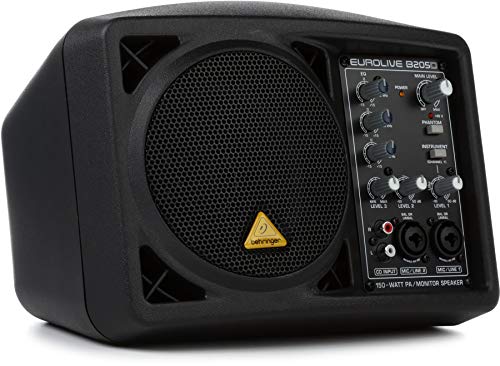
Behringer Eurolive B205D
The Behringer Eurolive B205D is the best personal budget stage monitor in this guide, and it is the wedge to choose when the performer needs a monitor for one person, because Behringer built the B205D as a compact powered speaker with a five-and-a-quarter-inch woofer, a 150-watt amplifier, and a three-channel mixer, in a cabinet that is small enough to sit on a microphone stand, on a table, or on the floor. The B205D is the monitor for a solo performer, a speaker, a keyboard player and a presenter, and it is the reason it is the best personal monitor in this guide.
The sound is good for a personal monitor, with a five-and-a-quarter-inch woofer that gives the monitor a clear vocal range, a 150-watt amplifier that is loud enough for a rehearsal, a church or a small gig, and a three-channel mixer that lets the user connect a microphone, a line source and a second microphone at the same time. The B205D has a mic stand mount, which is the feature that sets it apart, because it lets the monitor sit on a microphone stand at ear height, which is the position where a personal monitor is most useful, and it has a wedge shape that lets it sit on the floor as well. The B205D is the monitor that a solo performer buys when the goal is to hear themselves clearly, and it is the monitor that Behringer built for the individual.
The practical details are built for a single performer. The B205D has a 150-watt Class-D amplifier, a five-and-a-quarter-inch woofer, and a compact cabinet that is light enough to carry with one hand, with a handle that makes it easy to move. The B205D has a three-channel mixer with a volume control for each channel, which is useful when the performer needs to balance a microphone and an instrument, and it has a line output that sends the signal to a PA, which is useful for a gig. The B205D is the monitor that a performer buys when the budget is tight and the monitor has to be personal, and it is the monitor that proves a small wedge can still be useful.
The trade-offs are that the B205D is a small monitor, so it does not have the low end or the volume of a twelve-inch wedge, and it is best used as a personal monitor rather than a band monitor, although it can be used for a small band in a rehearsal. The B205D is also a budget speaker, so the cabinet is plastic, although it is well built for the price. But as a personal budget stage monitor, the B205D is the best in this guide, and it fits a solo performer, a speaker, a keyboard player and a presenter, and anyone who needs a monitor for one person.
Check price on Amazon: Behringer Eurolive B205D

Samson RSXM10A
The Samson RSXM10A is the best coaxial budget stage monitor in this guide, and it is the wedge to choose when the monitor has to sound coherent at close range, because Samson built the RSXM10A as a ten-inch coaxial monitor with a 400-watt amplifier, a coaxial driver that puts the high-frequency driver in the centre of the woofer, and a monitor angle that points the sound up at the performer. The RSXM10A is the monitor for a performer who stands close to the wedge, and it is the reason it is the best coaxial option in this guide.
The sound is the most coherent in this guide, with a coaxial design that mixes the low end and the high end at the source, rather than at a distance, which means the sound is consistent at close range, where a conventional two-way monitor can sound separated. The ten-inch woofer gives the RSXM10A a full low end, and the 400-watt amplifier is loud enough for a rehearsal, a church or a small gig, with a clear vocal range that keeps the performer in tune. The RSXM10A is the monitor that a performer buys when the goal is a coherent sound at close range, and it is the monitor that Samson built for the stage.
The practical details are strong for a budget wedge. The RSXM10A has a 400-watt Class-D amplifier, a ten-inch coaxial driver, and a wedge cabinet that is well built for the price, with a handle that makes it easy to carry. The RSXM10A has a three-band EQ, which lets the user shape the sound for the room, and a monitor angle that points the sound up at the performer, which is the position where a wedge is most useful. The RSXM10A is the monitor that a performer buys when the budget is tight and the sound has to be coherent, and it is the monitor that proves a coaxial wedge can be affordable.
The trade-offs are that the RSXM10A is a ten-inch monitor, so it does not have the low-end impact of a twelve-inch wedge, and it is a budget speaker, so the cabinet is plastic rather than plywood, although it is well built for the price. The RSXM10A is also a little heavier than the Alto TX408, although it is lighter than the Behringer F1320D. But as a coaxial budget stage monitor, the RSXM10A is the best in this guide, and it fits a performer who stands close to the wedge, a singer who needs a coherent sound, and anyone who wants a coaxial monitor on a budget.
Check price on Amazon: Samson RSXM10A

Behringer Eurolive F1220D
The Behringer Eurolive F1220D is the best budget twelve-inch stage monitor in this guide, and it is the wedge to choose when the band needs a twelve-inch monitor and the budget is tight, because Behringer built the F1220D as a twelve-inch powered floor monitor with a 250-watt Class-D amplifier, a one-inch compression driver, and a feedback filter, in a wedge cabinet that is a little smaller and lighter than the F1320D. The F1220D is the monitor for a band that needs a twelve-inch wedge on a budget, and it is the reason it is the best twelve-inch option in this guide.
The sound is good for a budget twelve-inch wedge, with a twelve-inch woofer that gives the monitor a full low end, a one-inch compression driver that keeps the vocal clear, and a 250-watt amplifier that is loud enough for a rehearsal, a church or a small gig. The F1220D has an adjustable feedback filter, which lets the user cut the frequency that is feeding back, and a three-band EQ, which lets the user shape the sound for the room. The F1220D is the monitor that a band buys when the goal is a twelve-inch wedge on a budget, and it is the monitor that Behringer built for the stage.
The practical details are solid for a budget wedge. The F1220D has a 250-watt Class-D amplifier, a twelve-inch woofer, and a wedge cabinet that is well built for the price, with a handle that makes it easy to carry, although it is heavy. The F1220D has an integrated limiter that protects the driver from clipping, and a sound processor that shapes the response for a monitor. The F1220D is the monitor that a band buys when the budget is the limiting factor and the monitor has to be twelve inches, and it is the monitor that proves a budget wedge can still be a twelve-inch wedge.
The trade-offs are that the F1220D is heavy and large, so it is less portable than a compact monitor, and it is a budget wedge, so the cabinet is plastic rather than plywood, although it is well built for the price. The F1220D has a little less power than the F1320D, so it is a little quieter, although it is still loud enough for a rehearsal and a small gig. But as a budget twelve-inch stage monitor, the F1220D is the best in this guide, and it fits a band that needs a twelve-inch wedge, a church that needs a monitor for the worship team, and anyone who wants the cheapest twelve-inch wedge available.
Check price on Amazon: Behringer Eurolive F1220D

Alto TX410
The Alto TX410 is the best budget ten-inch stage monitor in this guide, and it is the wedge to choose when the stage needs a ten-inch monitor, because Alto built the TX410 as a ten-inch powered speaker with a 350-watt bi-amplified Class-D system, a one-inch compression driver, and Bluetooth, in a cabinet that is larger than the TX408 but still portable. The TX410 is the monitor for a small gig, a DJ, a band and a rehearsal, and it is the reason it is the best ten-inch option in this guide.
The sound is good for a ten-inch monitor, with a ten-inch woofer that gives the monitor a fuller low end than the eight-inch TX408, a one-inch compression driver that keeps the vocal clear, and a 350-watt amplifier that is loud enough for a small gig, a rehearsal or a presentation. The TX410 has a built-in two-channel mixer, which lets the user connect a microphone and a line source at the same time, and Bluetooth with True Wireless Stereo, which lets two TX410 speakers be paired for stereo, which is a useful feature for a DJ or a small venue. The TX410 is the monitor that a performer buys when the goal is a ten-inch wedge that can also be a main speaker, and it is the monitor that Alto built for the small stage.
The practical details are excellent for a ten-inch wedge. The TX410 has a wedge-monitor position, so it can sit on the floor as a monitor, and a pole socket, so it can sit on a stand as a main speaker, and it has a handle that makes it easy to carry. The TX410 is light and compact for a ten-inch speaker, with a cabinet that is well built for the price, and it has a Bluetooth connection that lets a phone stream music for a break. The TX410 is the monitor that a performer buys when the stage needs a ten-inch wedge, and it is the monitor that proves a ten-inch speaker can be both a monitor and a main.
The trade-offs are that the TX410 is a ten-inch speaker, so it does not have the low-end impact of a twelve-inch speaker, and it is best used as a monitor for a small gig rather than a main speaker for a large room, although it can do both in a small venue. The TX410 is also a budget speaker, so the cabinet is plastic rather than plywood, although it is well built for the price. But as a budget ten-inch stage monitor, the TX410 is the best in this guide, and it fits a small gig, a DJ, a band and a rehearsal, and anyone who wants a ten-inch wedge that can do two jobs.
Check price on Amazon: Alto TX410
Buying Guide
Ring out the monitor before the gig, not during it
A stage monitor that feeds back during a gig is a monitor that was not rung out before the gig, and ringing out is the process of turning the monitor up slowly, with the microphone on, until it just starts to feed back, then cutting the frequency that is feeding back with the EQ or the feedback filter, and repeating until the monitor is loud enough without feeding back. The monitors in this guide all have a feedback filter or a three-band EQ, and the filter should be used before the gig, in the room where the gig will happen, because a room changes the feedback, and a monitor that is rung out in a rehearsal room will feed back in a different room. Ring out the monitor, save the setting, and check it again when the room changes.
Place the wedge where the performer can hear it, not where it looks good
A stage monitor should sit on the floor in front of the performer, angled up toward the ears, because that is the position where the sound reaches the performer directly, and a monitor that sits to the side, behind the performer, or too far away will not be heard, no matter how loud it is. A monitor that is placed too close to a microphone will feed back, and a monitor that is placed too far from the performer will be too quiet, so the wedge should be about a metre in front of the performer, angled up, with the microphone behind the monitor, not in front of it. A monitor that is placed correctly will be heard clearly at a moderate volume, and a monitor that is placed badly will feed back at any volume.
Match the size to the stage, not to the ambition
A twelve-inch wedge is the right choice for a band on a stage, because it has the low end and the volume to fill the stage, while an eight-inch wedge is the right choice for a small gig, a rehearsal or a presentation, because it is portable and it is enough for the space. A performer who buys a twelve-inch wedge for a bedroom rehearsal will have a monitor that is too loud and too heavy, and a performer who buys an eight-inch wedge for a large stage will have a monitor that is too quiet, so the size should match the stage, not the ambition. A compact monitor is the right choice for a solo performer, a ten-inch monitor is the right choice for a small band, and a twelve-inch monitor is the right choice for a full band.
Use the EQ to cut, not to boost
A stage monitor that is too bass-heavy will feed back, and a stage monitor that is too bright will be harsh, and the remedy is to cut the frequencies that are causing the problem, not to boost the frequencies that are missing, because boosting a frequency will make the feedback worse, while cutting a frequency will make it better. The three-band EQ on the monitors in this guide should be used to cut the low end when the monitor is boomy, to cut the high end when the monitor is harsh, and to leave the midrange alone, because the midrange is where the vocal lives, and a vocal that is cut will not be heard. A monitor that is EQed by cutting will sound clear, and a monitor that is EQed by boosting will feed back.
Keep the monitor clean, and protect the driver
A stage monitor is a speaker that is used on a floor, where it collects dust, drinks and feet, and a monitor that is not protected will fail, because dust in the driver will make it sound muffled, and a drink spilled on the cabinet will damage the amplifier. Keep the monitor in a cover when it is not in use, keep drinks away from the stage, and check the driver regularly for damage, because a driver that is torn will sound bad and will fail completely if it is used. A monitor that is protected will last for years, and a monitor that is neglected will fail in months, which is a waste of a good wedge.
Carry a spare, and know how to use it
A stage monitor that fails during a gig cannot be fixed in the middle of a set, and a band that has no spare will have to finish the gig without a monitor, which is the worst way to play, so a spare monitor should be carried to every gig, even if it is a small one, and the band should know how to set it up quickly. A spare monitor does not have to be expensive, and the Behringer B205D is the ideal spare, because it is small, light and cheap, and it can be set up in a minute. A band that carries a spare is a band that will finish the gig, and a band that does not is a band that is gambling with the show.
Frequently Asked Questions
What size stage monitor do I need?
A twelve-inch wedge is the right choice for a band on a stage, because it has the low end and the volume to fill the stage, while an eight-inch wedge is the right choice for a small gig, a rehearsal or a presentation, because it is portable and it is enough for the space. A compact monitor is the right choice for a solo performer, a ten-inch monitor is the right choice for a small band, and a twelve-inch monitor is the right choice for a full band. Match the size to the stage, not to the ambition, because a monitor that is too large for the stage will be too loud and too heavy, and a monitor that is too small will be too quiet.
How do I stop a stage monitor from feeding back?
A stage monitor feeds back when the microphone hears the monitor, and the remedy is to place the monitor correctly, with the microphone behind the monitor, not in front of it, to ring out the monitor before the gig, by turning it up slowly and cutting the frequency that feeds back, and to use the EQ to cut, not to boost, because boosting a frequency will make the feedback worse. A monitor with a feedback filter, such as the Behringer F1320D, makes this easier, because the filter cuts the feedback frequency automatically, but the placement and the ring-out are still the most important steps.
Can I use a stage monitor as a main speaker?
Yes, in a small venue, because a powered wedge can sit on a pole as a main speaker, and the monitors in this guide all have a pole socket or a wedge shape that lets them do both jobs, although a monitor is optimised for close range, while a main speaker is optimised for distance, so a monitor used as a main will not project as far. A small gig, a rehearsal or a presentation is the right use for a monitor as a main, and a large venue is the wrong use, because the monitor will not fill the room, and the audience at the back will not hear it.
Do I need a powered or a passive stage monitor?
A powered stage monitor is the right choice for most buyers, because it has the amplifier built in, so it needs no separate amp, and it can be set up quickly, with a single cable from the mixer, while a passive monitor needs a separate amplifier, which adds cost, weight and complexity. A passive monitor is only worth it when the venue already has an amplifier, or when the monitor has to be very light, because the amplifier is elsewhere. The monitors in this guide are all powered, which is the standard for a budget wedge, and it is the reason they are easy to use.
How loud should a stage monitor be?
A stage monitor should be loud enough for the performer to hear the vocal clearly, and quiet enough that it does not feed back, and no louder, because a monitor that is too loud will bleed into the microphones, will make the front-of-house mix worse, and will damage the hearing. Set the monitor so the vocal is clear, and use the EQ to cut the frequencies that feed back, rather than turning the monitor up to overcome the feedback. A monitor that is set correctly will be heard clearly at a moderate volume, and a monitor that is turned up too high will feed back at any volume.
Conclusion
The best stage monitor under 200 is the wedge that lets the performer hear the vocal clearly, without feeding back, and in this guide the Behringer Eurolive F1320D is the best overall choice, because its twelve-inch woofer, feedback filter and 300-watt amplifier are built for a band. The Alto TX408 is the best compact monitor, the Behringer Eurolive B205D is the best personal monitor, the Samson RSXM10A is the best coaxial monitor, the Behringer Eurolive F1220D is the best budget twelve-inch monitor, and the Alto TX410 is the best budget ten-inch monitor. Ring out the monitor before the gig, place it where the performer can hear it, match the size to the stage, and carry a spare, because a monitor that works is a monitor that lets the show go on.


