What's inside
- Key Takeaways
- Quick Picks
- How We Chose These Picks
- Why Are Your Neighbours’ Networks Your Real Opponent?
- How Much Router Does a Flat Actually Need?
- Where Should a Router Live in a Rented Flat?
- How Do You Move Into a Flat Whose Internet Is Already There?
- Which Routers Suit Apartment Life, Pick by Pick?
- How Do You Test a New Router Against Your Building’s Noise?
- How Should a Flat Handle Its Growing Herd of Smart Gadgets?
- What Security Habits Matter Most When Your Network Has Forty Neighbours?
- How Do You Wire the Entertainment Corner Without Wiring the Flat?
- When Does a Flat Outgrow These Routers Altogether?
- How Do Two People Work From Home in One Flat Without Network Warfare?
- What Should Renters Do on Moving Day, Network-Wise?
- Why Does a Narrower Channel Sometimes Win in a Dense Building?
- Apartment Routers Compared: Footprint, Bands and Wired Ports
- What Mistakes Do Apartment Router Shoppers Keep Making?
- Final Recommendation
- Frequently Asked Questions
- Related Guides
As an Amazon Associate I earn from qualifying purchases. This post may contain affiliate links at no extra cost to you.
widgetverdict.com is reader-supported. When you buy through links on our site, we may earn an affiliate commission.
Where to buy: apartment routers are commodity purchases at every electronics retailer, and each model below links to its checked Amazon listing; renters should confirm their lease’s drilling and cabling rules before planning any placement that involves more than a shelf and a power strip.
The best wireless routers for an apartment solve a problem that is almost the opposite of the one house-buyers face. Distance is rarely the enemy in a flat: few rooms sit more than a wall or two from wherever the router lands. The enemy is company. Your network shares the air with dozens of neighbours’ networks, stacked above, below and beside you, all broadcasting through the same handful of channels, while your own device count stays modest and your floor area stays small. Apartment router shopping is therefore an exercise in interference management and proportion — enough radio to hold your rooms, enough cleverness to ignore the neighbours, and not one watt or feature more than the flat can use.
That proportion point deserves emphasis because router marketing is aimed at houses. Coverage claims of several thousand square feet are meaningless in a 700-square-foot flat, and a flagship designed to shout across a suburban home mostly shouts at your neighbours, inviting them to shout back. The six picks below are scaled to apartment reality: four honest standalone routers from TP-Link’s Archer range spanning WiFi 6, WiFi 7 and the older AC standard, plus two travel routers that earn their places for the specific apartment situations they fit — the short let, the furnished rental, the stay of uncertain length — labelled plainly as the temporary tools they are.
One more apartment truth shapes the whole guide: you probably cannot run cables, move the internet entry point, or drill anything. Placement advice here assumes shelves, bookcases and the top of the television unit, not ceiling mounts and cable runs. Within those constraints, a well-chosen modest router, placed with ten minutes of thought, will outperform a flagship stuffed into the hallway cupboard behind the coats — a sentence that is true in houses and doubly true in flats, where every router is already close to every room and the only remaining variable is how cleanly it speaks through the communal noise.
Key Takeaways
- In apartments, neighbouring networks are the main interference problem — channel behaviour and band choice matter more than raw coverage power.
- Every coverage figure in these listings dwarfs a typical flat; buy for ports, bands and management features instead of square footage.
- WiFi 7 models here (Archer BE400 and BE230) add MLO and cleaner handling of modern devices, worthwhile for new laptops and phones in dense buildings.
- The Archer AX21 remains the balanced WiFi 6 default for most flats: dual-band, gigabit ports, Easy Mesh if a long flat ever needs a second node.
- Travel routers (GL.iNet Opal, Roam 6) are labelled honestly in this guide — excellent for short lets and furnished rentals, not permanent infrastructure.
- Renters should place by shelf and bookcase, keep the router out of the entry cupboard, and reuse the landlord-issued network name when migrating devices.
Quick Picks
| Pick | Badge | Why it earns its place |
|---|---|---|
| TP-Link Archer AX21 | The apartment default | AX1800 WiFi 6 with gigabit ports and Easy Mesh — the balanced flat router. |
| TP-Link Archer BE400 | The WiFi 7 upgrade | BE6500 WiFi 7 with dual 2.5G ports and USB 3.0 for a gadget-forward flat. |
| TP-Link Archer BE230 | The compact WiFi 7 all-rounder | BE3600 WiFi 7 with two 2.5G ports, three gigabit ports and MLO in a smaller tier. |
| TP-Link Archer A8 | The AC-era value holdout | AC1900 MU-MIMO with gigabit ports and guest WiFi for undemanding flats. |
| GL.iNet GL-SFT1200 Opal | The short-let specialist | A 145g OpenWrt travel router with WireGuard and OpenVPN for furnished rentals and temporary stays. |
| Roam 6 AX1500 Travel Router | The tethering traveller | WiFi 6 travel router with phone tethering and public-WiFi sharing modes for life between addresses. |
How We Chose These Picks
The filter was apartment fitness, applied strictly. Candidates needed a footprint and a radio budget proportioned to small homes, honest gigabit-or-better wired ports for the television-and-console corner, and — because flats cannot be re-cabled — management features that work from an app on a shelf-top box. Whole-home mesh kits were excluded as a category: a typical flat does not need three nodes, and the guide’s one long-thin exception is handled by the AX21’s Easy Mesh compatibility, which lets a single extra node join later if a railway-style flat defeats one router. Flagship house routers were excluded for the opposite reason — their coverage claims describe a building the reader does not live in.
The two travel routers survived a harder argument, and their inclusion comes with the pool’s own instruction attached: they are labelled as travel routers throughout, recommended for short lets, furnished rentals, house-sits and the months between addresses, not as permanent infrastructure for a settled home. Within that honest role they are superb — OpenWrt flexibility and built-in VPN clients that no full-size router at their size attempts. Readers whose living situation is more settled and more experimental may find the gateway conversation in Best Routers for Home Labs closer to their ambitions, while the apartment-specific enemy — the neighbour’s network — is this guide’s home ground.
Why Are Your Neighbours’ Networks Your Real Opponent?
Open a WiFi scanner in any apartment building and the graph looks like a festival: dozens of networks, yours among them, all sharing the same few 2.4GHz channels and crowding the 5GHz band to varying degrees. Every one of those networks is a conversation your router must talk over. The effects are specific: throughput that wilts in the evening when the building comes home, latency that jitters as neighbouring downloads surge, and a 2.4GHz band so contested that smart gadgets occasionally lose their grip. None of this is fixed by a more powerful router — power is symmetric, and the neighbours’ routers are playing the same game.
What actually helps is allocation. The 5GHz band offers many more channels than 2.4GHz, so a router and devices that live on 5GHz escape the worst of the crush; WiFi 7’s refinements, including the MLO named in the BE230’s listing, help modern devices hold steadier links in contested air. Channel selection matters too: most routers choose automatically and choose adequately, but in a dense building it is worth checking, once, whether a manual channel is emptier than the automatic pick — a five-minute experiment with a lasting dividend. And the gadget herd should be deliberately parked on 2.4GHz, where its members’ low demands suit the band, leaving 5GHz for the devices whose evenings depend on it. Apartment networking is urban driving: the skill is lane discipline, not engine size.
How Much Router Does a Flat Actually Need?
Less than the marketing suggests, and the arithmetic is liberating. A one or two-bedroom flat asks a router to cover perhaps 40 to 110 square metres through two or three interior walls, serving an active peak of maybe six to ten devices: a television streaming, a laptop on a call, a console, phones, and the murmuring herd. Every standalone pick in this guide exceeds that brief on paper by an order of magnitude — even the Archer A8’s AC1900 class was designed for small houses. The shopper’s real questions are therefore qualitative. Do the wired ports match the entertainment corner? Does the router handle the building’s interference gracefully? Will its firmware be maintained? Is there a guest network for visitors, so the master password stays masterful?
Where a flat does justify stepping up, the reasons are specific rather than atmospheric. A multi-gig internet plan — increasingly common in new-build blocks with fibre to the building — wants a 2.5G WAN path, which the BE400 and BE230 carry and the older models do not. A household of new WiFi 7 laptops and phones gains real steadiness from the BE-class models in crowded air. A NAS or a USB drive shared from the router points to the BE400’s or BE230’s USB 3.0 port, both named in their listings. Absent one of those named reasons, the AX21’s WiFi 6 balance is not a compromise; it is the correct answer wearing modest clothes. Readers who want to feel the contrast at full size can browse Best ASUS Routers, whose flagships are engineered for the houses this guide keeps declining to furnish — an instructive detour, provided you return with your flat’s measurements still in hand.
Where Should a Router Live in a Rented Flat?
The lease forbids the ideal, so pursue the achievable: the router belongs near the flat’s centre, at roughly chest height, in open air, on furniture you already own. A bookcase in the living room, the top of a sideboard, a shelf in the hall that is genuinely central rather than merely convenient — these are the winning positions. The losing positions are depressingly standard: the floor behind the television, the entry cupboard where the fibre or cable point happens to be, the tangle inside a media console where the router bakes in its own warmth and broadcasts through wood, glass and a games console. Moving a router from the cupboard to a shelf two metres away is the highest-value change most renters will ever make to their network, and it costs one longer Ethernet cable from the entry point.
Long, thin flats — the railway layout, the converted period terrace — are the honest exception to the one-router rule, because the far bedroom sits through four walls from the entry hall no matter where a single box perches. The answer within a renter’s powers is a second node at the flat’s mid-point, which is why the AX21’s Easy Mesh compatibility matters: it lets one router become a small two-node system without replacing the original purchase. Place the node where it still hears the main router strongly — mid-flat, not inside the struggling bedroom — and the far room inherits a clean signal instead of a repeated whisper. Households in even smaller or more temporary arrangements should read the travel-router sections below with the same placement logic in miniature.
How Do You Move Into a Flat Whose Internet Is Already There?
Furnished rentals and house-shares often arrive with a landlord’s router already broadcasting, and the newcomer’s task is diplomacy as much as engineering. If the supplied router is modern and the flat is small, the honest advice is to try it for a week before buying anything; apartment problems are interference problems, and a decent supplied box in a good position may already be adequate. Where it is not — an elderly unit, a locked-down box, WiFi that dies behind the bedroom door — your own router can usually take over the wireless duties while the landlord’s unit keeps the line, an arrangement that respects the lease and the deposit.
Two habits make any migration painless. Reuse the network name and password you already live with, so phones, laptops and the awkward smart speaker rejoin without a pairing ceremony. And set up a guest network from day one: flats host friends, family and the occasional sofa-surfer, and a guest SSID keeps the master password unshared while giving visitors full internet. The Archer A8’s listing names guest WiFi explicitly and the TP-Link app on the newer models makes the arrangement a few taps; whichever pick you choose, the guest network is the feature your future self will thank you for most often. Readers furnishing a first long-term home rather than a rental may also weigh the edge-security thinking in Best Internet Firewall Routers, though for most flats the router’s own firewall is the proportionate answer.
Which Routers Suit Apartment Life, Pick by Pick?

TP-Link Archer AX21 — The apartment default
The Archer AX21 is the router this guide would hand to a friend moving into a typical flat, and its listing explains why in one line: an AX1800 WiFi 6 dual-band router with gigabit ports, Easy Mesh compatibility and a “Certified for Humans” simplicity badge. WiFi 6’s efficiency in crowded air — its ability to serve several devices in the same moment rather than in strict turns — is precisely the talent a dense building rewards, and the AX1800 class, modest beside house flagships, is generously sized for rooms that sit a wall or two apart. The gigabit ports cover the entertainment corner: television, console, streaming box, one spare.
Easy Mesh is the specification with the longest reach. If the flat turns out to be long and thin, a compatible node can join the AX21 later and stretch the network down the hallway without replacing the original purchase — the only mesh idea a flat genuinely needs, bought only when evidence demands it. For the standard flat, meanwhile, the AX21 asks nothing exotic: shelf placement, an app-guided setup, and evenings that simply work. It is not the fastest router here, nor the newest standard, and in apartment conditions those superlatives are mostly decoration. It is the balanced answer, and balance is what flats reward.
- Standard: dual-band WiFi 6, AX1800 class
- Ports: gigabit ports per the listing
- Expansion: Easy Mesh compatible, per the listing title
- Extras in title: works with Alexa; Certified for Humans device
- Role: standalone router for one flat, expandable if the layout is long
Strengths
- WiFi 6’s crowded-air efficiency suits apartment buildings directly.
- Easy Mesh leaves a one-node escape hatch for railway flats.
- Gigabit wired ports match every television and console a flat corner holds.
Trade-offs
- No multi-gig port, so fibre plans above gigabit are capped at the router.
- No USB port is named in its listing for drive sharing.
- Newest WiFi 7 devices connect at WiFi 6 behaviour.
Best for: a typical one or two-bedroom flat on a mainstream plan wanting a router that simply fits. Not suited for: a new-build flat on a multi-gig fibre plan — the BE230 and BE400 below exist for that socket.
Most flats can stop their research at the Archer AX21’s listing and spend the saved effort on placement.

TP-Link Archer BE400 — The WiFi 7 upgrade
The Archer BE400 is the flat’s forward-looking option: a dual-band WiFi 7 router in the BE6500 class whose listing claims coverage up to 2,400 sq. ft. and a 90-device capacity — figures that, translated into apartment terms, mean headroom a flat will never exhaust — alongside dual 2.5Gbps ports, USB 3.0, a quad-core processor, HomeShield and a Private IoT network feature. The specification that changes daily life in a new-build block is the 2.5G pair: one can receive a multi-gig fibre plan at full speed while the other feeds a NAS or a desktop at the same pace, a wired arrangement the older Archers cannot offer.
The Private IoT idea named in the listing deserves its paragraph, because apartment herds are growing: a separate network lane for plugs, bulbs and cameras keeps the gadget rabble apart from the laptops that hold your work and banking, and in a building where your network is already surrounded by strangers’ networks, internal tidiness is the half of security you control completely. USB 3.0 lets the router share a drive across the flat — a modest home media library without a NAS purchase. Buy the BE400 when at least two of its named talents match your flat’s actual life; bought for one, the BE230 below usually answers more cheaply.
- Standard: dual-band WiFi 7, BE6500 class
- Ports: dual 2.5Gbps ports and USB 3.0, per the listing title
- Claimed coverage: up to 2,400 sq. ft. — manufacturer figure, far beyond any flat
- Claimed device capacity: 90 devices, manufacturer framing
- Features named in title: quad-core CPU, HomeShield, Private IoT network
Strengths
- Dual 2.5G ports serve a multi-gig plan and a fast wired device simultaneously.
- A separate IoT network corrals the smart-gadget herd away from work machines.
- USB 3.0 drive sharing covers a small flat’s media-library needs without a NAS.
Trade-offs
- Dual-band WiFi 7 means no 6GHz lane, despite the new standard.
- Its capacity framing is house-sized; small flats pay for headroom they cannot use.
- Feature-rich management rewards an owner willing to configure it deliberately.
Best for: a fibre-connected new-build flat with new devices, a NAS or a drive to share. Not suited for: a basic rental flat on a modest plan, where the AX21 delivers the same evenings for less.
New-build flats on fast fibre should compare the BE400’s listing against their plan speed before anything else.

TP-Link Archer BE230 — The compact WiFi 7 all-rounder
The Archer BE230 distils the WiFi 7 offer into a smaller tier: a dual-band BE3600 router, 4-stream, whose listing packs two 2.5G ports and three gigabit ports, USB 3.0, a 2.0 GHz quad-core processor, four antennas, and a feature line — VPN, EasyMesh, HomeShield, MLO, Private IoT — that reads like the BE400’s in miniature. For apartment purposes the port layout is the headline: five wired sockets is the richest entertainment-corner provision in this guide, and the 2.5G pair keeps the multi-gig plan and one fast machine fed at once, in a router whose wireless class is sized nearer a flat’s reality.
MLO, named in the listing, is the WiFi 7 feature with genuine apartment value: multi-link operation lets a compatible phone or laptop hold links across bands and shift between them without the old disconnect-and-rejoin hiccup, which in a building full of competing networks translates to steadier calls while walking from kitchen to desk. EasyMesh repeats the AX21’s escape hatch for long flats. The BE230 is therefore the guide’s recommendation for the renter who wants the new standard’s behaviour and a serious back panel, without paying for the BE400’s extra wireless class that a flat’s walls will never let anyone use.
- Standard: dual-band WiFi 7, BE3600 class, 4-stream
- Ports: two 2.5G and three 1G ports, plus USB 3.0, per the listing title
- Processor: 2.0 GHz quad-core, per the listing
- Features named in title: VPN, EasyMesh, HomeShield, MLO, Private IoT
- Antennas: four, per the listing
Strengths
- Five wired ports with a 2.5G pair is the best entertainment-corner layout here.
- MLO steadies compatible devices in interference-heavy buildings.
- EasyMesh keeps the long-flat expansion option open.
Trade-offs
- Its BE3600 class trails the BE400 for very device-dense households.
- No 6GHz band, as with every dual-band model in this guide.
- USB sharing is a convenience, not a NAS replacement for heavy libraries.
Best for: a modern flat wanting WiFi 7 behaviour, MLO and a full wired corner at a measured tier. Not suited for: a household whose plan and devices are all last-generation — the AX21 serves that flat identically in practice.
Flats with several wired boxes should count their cables, then read the BE230’s listing with the total in mind.

TP-Link Archer A8 — The AC-era value holdout
The Archer A8 represents the previous WiFi era with its head held up: an AC1900 dual-band router whose listing names high-speed MU-MIMO, gigabit ports and guest WiFi support. AC-era radios in a small flat are not the hardship marketing implies — the distances are short, the device census modest, and a television, two laptops and a herd of gadgets fit comfortably inside AC1900’s envelope on a mainstream plan. What the A8 offers the apartment shopper is the lowest-cost route to a router that is still a proper router: real gigabit ports, a guest network for visitors, and MU-MIMO’s ability to talk to several devices in the same breath, which was the headline efficiency of its generation.
The honest boundaries are generational. There is no WiFi 6 or 7 efficiency for crowded air, no multi-gig port for a fast fibre plan, and the model’s firmware future is shorter than the newer picks’ simply because its era is older. None of that matters to the flat it suits: a first rental, a spare-room setup, a household whose devices are equally AC-era and whose plan is modest. Bought with that self-knowledge, the A8 is not a compromise but a correct proportion — the same virtue this guide praised in the satellite context, wearing an apartment’s clothes. Households planning to stay put and upgrade devices soon should step up to the AX21 and buy the longer future instead.
- Standard: dual-band AC1900 WiFi
- Ports: gigabit ports per the listing
- Radio feature named in title: high-speed MU-MIMO
- Extras in title: supports guest WiFi
- Role: value standalone router for undemanding flats
Strengths
- Proper gigabit ports and guest WiFi at the guide’s gentlest tier.
- MU-MIMO still serves a small flat’s simultaneous devices adequately.
- Its era matches households whose devices are equally last-generation.
Trade-offs
- No WiFi 6 or 7 crowded-air refinements for dense buildings.
- A multi-gig plan upgrade would retire it immediately.
- Its remaining firmware horizon is the shortest in this guide.
Best for: a first flat or spare setup with modest devices and a modest plan. Not suited for: a new-build flat on fast fibre with WiFi 7 devices arriving — begin at the BE230 instead.
Budget-conscious renters should verify the A8’s listing still suits their plan speed before choosing it over the AX21.
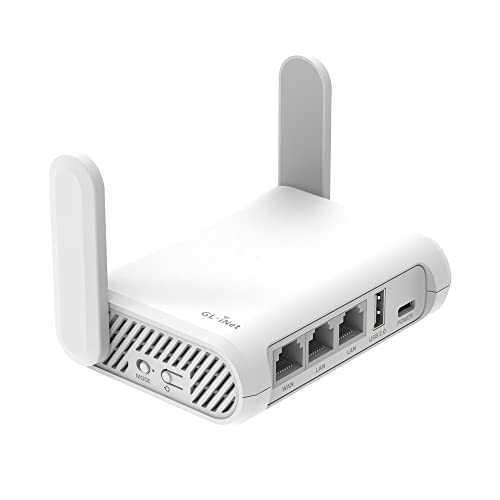
GL.iNet GL-SFT1200 Opal — The short-let specialist
The Opal is a travel router, and this guide recommends it strictly inside that identity. It weighs 145g per its listing, speaks AC1200 dual-band WiFi, carries three gigabit ports, and runs OpenWrt with OpenVPN and WireGuard clients covering more than thirty VPN services. In a furnished short let, a house-sit, a corporate rental or the flat you will leave in four months, those specifications solve the actual problems: the landlord’s WiFi is unknown and possibly elderly, your devices are many, and your work traffic deserves a VPN tunnel rather than faith in a stranger’s network settings. The Opal plugs into whatever internet the property offers and broadcasts your own small, known, encrypted-by-default network for the duration of the stay.
OpenWrt is the enthusiast’s detail: an open, configurable firmware that lets the little box act as router, repeater or VPN gateway with a depth no hotel-room gadget usually attempts. The three gigabit ports are equally un-travel-like in their usefulness — a laptop, a streaming stick’s Ethernet adapter and a spare, wired, in a property where wiring anything permanently is forbidden. The limits are the honest ones stated up front: AC1200 radios and a pocket router’s antennas are a temporary household’s tools, not a settled home’s infrastructure. When the stay becomes a home, graduate to the AX21 or BE230 and let the Opal return to the suitcase it was born for, where it remains the best travel companion in this guide.
- Type: travel router — recommended for temporary stays, per this guide’s labelling
- Standard: AC1200 dual-band WiFi
- Ports: three gigabit ports per the listing
- Firmware: OpenWrt with OpenVPN and WireGuard; 30+ VPN services per the listing
- Weight: 145g per the listing title
Strengths
- Built-in WireGuard and OpenVPN clients secure work traffic on a landlord’s unknown network.
- Three gigabit ports wire a temporary desk without touching the property.
- OpenWrt flexibility lets one pocket box serve as router, repeater or gateway.
Trade-offs
- AC1200 radios are a temporary household’s ceiling, not a settled home’s.
- Its coverage is one flat’s core rooms, not a whole large property.
- OpenWrt’s depth rewards a user comfortable configuring it.
Best for: a furnished short let, house-sit or corporate rental where the stay is measured in months. Not suited for: a permanent family flat needing a long-lived network — that home belongs to the standalone Archers above.
Short-let tenants should read the Opal’s listing for its VPN client list before packing it.

Roam 6 AX1500 Travel Router — The tethering traveller
The Roam 6 is the second travel router here, and its listing describes a slightly different traveller: an AX1500 WiFi 6 dual-band unit, USB-C powered, built for easy public WiFi sharing, hotel and RV use, phone WiFi tethering and multi-mode operation, with OpenVPN and WireGuard support. Phone tethering is its signature — when a temporary flat’s broadband is delayed, absent or unusable, the Roam 6 can take a phone’s connection and redistribute it as a proper little home network, so the laptop, tablet and streaming stick all join one SSID instead of queueing behind a phone hotspot’s device limits. For life between addresses, that trick is worth the suitcase space alone.
WiFi 6 in a travel body lifts it above the Opal for device handling — a workation flat with two laptops, phones, a tablet and a console is a real census, and AX-class radios manage it with less fuss — while the Opal counters with OpenWrt’s configurability and its wired trio. Both are honest tools with the same label: temporary. A settled household should not mistake either for infrastructure, and a mobile household should not underestimate how much calmer a month in a strange flat feels when the network is yours, named by you, and already known to every device you own. The Roam 6’s USB-C powering adds a final traveller’s grace: it runs from the same chargers and power banks as everything else in the bag.
- Type: portable travel router — recommended for temporary stays, per this guide’s labelling
- Standard: AX1500 dual-band WiFi 6
- Power: USB-C, per the listing title
- Modes named in title: public WiFi sharing, phone WiFi tether, multi-mode operation
- VPN: OpenVPN and WireGuard named in the listing
Strengths
- Phone tethering turns a mobile connection into a proper multi-device home network.
- WiFi 6 radios handle a workation household’s census gracefully.
- USB-C powering shares chargers with the rest of a traveller’s kit.
Trade-offs
- A travel router’s antennas and radios are sized for rooms, not whole properties.
- Tethered internet inherits the phone plan’s limits and the handset’s battery.
- Permanent homes should graduate to a standalone router, as with the Opal.
Best for: a stay between addresses, a delayed-broadband flat, or a long hotel or RV spell. Not suited for: a settled multi-room home needing permanent, whole-flat infrastructure.
Households between addresses should check the Roam 6’s listing for its tethering modes before relying on a phone hotspot alone.
How Do You Test a New Router Against Your Building’s Noise?
Give the router a scripted first week rather than a first impression. On day one, after shelf placement and setup, walk every room with the two activities your evenings actually contain — a video call and a stream — and note where each thins. Repeat the walk at the building’s peak, usually between seven and ten in the evening, because that is when forty neighbouring networks wake up and the flat’s true conditions reveal themselves. A router that holds both walks has passed the only examination that matters; a router that fails only the evening walk has an interference problem, not a power problem, and the remedies are allocation remedies: 5GHz for the important devices, a channel check, a shelf move away from the party wall.
Keep the evidence specific. Note the room, the hour and the activity that suffered, because those three facts separate the diseases this guide keeps distinguishing. Always the same room means placement. Always the same hour means congestion. Always the same device means the device — an elderly streaming stick with a feeble radio will struggle in a palace, and replacing it is cheaper than replacing the network around it. Renters especially benefit from the discipline, since their remedies must stay reversible: every fix on the apartment list — repositioning, band discipline, a node at the mid-point — can be undone on moving day in minutes.
How Should a Flat Handle Its Growing Herd of Smart Gadgets?
The modern flat accumulates connected things faster than it accumulates furniture: bulbs, plugs, a vacuum, a speaker in each room, a doorbell, perhaps a camera watching the hallway. Individually they sip bandwidth; collectively they create two apartment-specific problems. The first is pairing pain — many gadgets join only on 2.4GHz and some sulk on merged-band networks during setup, which is why a separate IoT lane, named outright in the BE400’s and BE230’s listings, is such a practical luxury: pair the herd onto its own network name once, and the main network’s settings can evolve without re-pairing a dozen bulbs. The second problem is crowding the band the gadgets share with the neighbours’ gadgets, which argues for keeping the herd’s chatter local and undemanding — schedules for the vacuum, restraint with always-uploading cameras.
There is also a tenancy angle. A renter’s smart herd should be chosen for reversibility: gadgets that stick, screw and drill are a deposit negotiation waiting to happen, while the router-level organisation this guide describes costs nothing and leaves no holes. When the herd outgrows a flat’s patience — when the plugs and bulbs begin to feel like a second job — the answer is rarely a bigger router; it is a hub or a platform that disciplines the herd, with the router’s separate IoT network as the fence that keeps the whole menagerie out of the laptop’s pasture.
What Security Habits Matter Most When Your Network Has Forty Neighbours?
Proximity changes the security arithmetic. Your network’s signal is fully available in the flats around you, which makes the wireless password a genuine lock rather than a formality: make it long, unique and unshared beyond the household, with the guest network absorbing all visitor traffic. Use the strongest encryption mode your device fleet supports — modern routers offer current standards, and the setting is worth checking during setup rather than assuming — and accept that one elderly gadget may need the compatibility lane rather than dictating the whole network’s posture. The router’s administrator password deserves the same seriousness: it is the key to the flat’s entire traffic, and it should never be the password from the sticker, nor a twin of any other account.
Firmware is the quiet half of apartment security. A maintained router receives fixes for flaws that, in a dense building, are not theoretical — the pool of people within radio range of your network is larger than in any detached house. Enable automatic updates where the model offers them, or calendar a monthly check. Finally, audit the client list occasionally: in a flat, an unknown device on your network is not a curiosity but a neighbour, accidental or otherwise, and the list is where such tenancy is noticed. None of these habits costs money, and together they are worth more than any security feature printed on a box.
How Do You Wire the Entertainment Corner Without Wiring the Flat?
Even in a wireless age, the flat’s best network runs on three short cables. The television, the console and the streaming box usually live within a metre of each other and often within a few metres of where the router can sit; wiring those three into the router’s gigabit ports removes the flat’s heaviest traffic from the contested air entirely, which improves life for every wireless device that remains. This is the apartment’s one free lunch: no drilling, no runs along skirting to other rooms, just the corner where the screens already gather. It is also why port counts earned real weight in this guide’s picks — the BE230’s five wired sockets are not a spec-sheet flourish but a description of a well-run corner.
When the router cannot sit near the screens, renters reach for two imperfect bridges, and both deserve honest labels. Powerline adapters send networking over the flat’s electrical wiring; in modern wiring they can be serviceable, in older or cross-circuit wiring they can be mysteriously poor, and they should be bought from somewhere with a painless returns policy and tested in the first evening. The wireless alternative — placing a mesh node or a router in bridge mode at the television and wiring the screens into it — spends airtime to save cable, the reverse of the corner strategy, but in a long flat it can still beat a weak direct signal. Judge either bridge by the evening test, not by the box’s promises.
When Does a Flat Outgrow These Routers Altogether?
Rarely by size — more often by ambition. A flat becomes a workshop: a home server appears, then a NAS, then a partner’s workstation, then a tangle of experiments that wants network segments and rules. At that point the household has stopped shopping for apartment routers and started shopping for a small lab, and the honest move is to graduate the network’s brain while the Archer may stay on as a wireless servant. Equally, a flat can outgrow a router by census alone if both occupants work from home on calls all day while a third stream runs — simultaneity, not square footage, is the ceiling. The signs are consistent: evenings degrade despite good placement, band discipline and an honest channel, and the client list reads like a small office’s. When those signs persist for a month, the constraint is real, and the BE400’s headroom — or the lab direction linked in this guide — is the proportionate next step rather than another identical replacement.
How Do Two People Work From Home in One Flat Without Network Warfare?
The work-from-home flat has a specific peak: two video calls, overlapping for hours, in two rooms, while the building’s other residents run the same schedule and the herd murmurs beneath. Serving it well is less about bandwidth — calls are modest consumers — than about stability and fairness. Wire whichever desk can be wired; a call carried on a cable is immune to the building’s mood. Give the second caller the 5GHz band and the better side of the flat, and let the router sit between the two rooms rather than beside one desk, since a router placed for one worker’s convenience taxes the other’s calls through two extra walls.
Scheduling is the second discipline. The household’s heavy, postponable traffic — cloud backups, game downloads, the operating-system update that arrives like weather — belongs outside call hours, set once in each device’s settings. Where both partners’ employers allow it, staggering the longest calls by even fifteen minutes softens the peak more than any hardware change. And if the flat’s plan is the constraint — some building-wide arrangements share capacity in ways no router can govern — the honest test is a wired speed check at the worst hour; a router cannot distribute what the building has not delivered, and knowing which side of the wall the problem lives on saves both money and resentment.
What Should Renters Do on Moving Day, Network-Wise?
Moving day rewards a small ritual. Photograph the old setup before unplugging anything, label the two or three cables that matter, and keep the router, its power supply and one Ethernet cable in the same box as the kettle and the phone chargers — the box that gets opened first. In the new flat, resist installing the router wherever the line enters until you have walked the rooms and chosen the central shelf; the entry cupboard is the default that this entire guide argues against, and moving day is when defaults get locked in for years. Set up with the same network name and password as the old flat, and the household’s devices will arrive already at home, which on moving day feels like a minor miracle.
Then give the new building the scripted first week: the room walk, the evening walk, the channel check. A new building is a new interference neighbourhood, and the settings that were perfect in the old postcode may be merely adequate here. Finally, update the firmware once the dust settles and record the new arrangement — where the router sits, which band the herd lives on, where the guest password is kept — somewhere the household keeps its tenancy papers. Networks in rented homes are rebuilt every few years by definition; the households that rebuild them calmly are the ones that wrote the last version down.
Why Does a Narrower Channel Sometimes Win in a Dense Building?
One counterintuitive setting deserves a renter’s attention. Routers advertise wide channels as speed, and in an empty field they are; in a tower block, a wide channel is a wide target, overlapping more neighbours and collecting more of their noise. Many apartment households find that a moderate channel width on 5GHz delivers steadier real evenings than the widest setting, because the link trades theoretical peak for consistency — and consistency is what calls, streams and games actually consume. The experiment costs ten minutes: change one setting, run the evening walk, compare notes. If your building is sparse, the wide setting may win and no harm is done; the point is that in dense air, the defaults are written for a detached house, and your flat is allowed to overrule them with evidence.
Apartment Routers Compared: Footprint, Bands and Wired Ports
| Model | Standard and class | Wired ports from the title | Apartment-specific note |
|---|---|---|---|
| TP-Link Archer AX21 | WiFi 6, AX1800 dual-band | Gigabit ports | Easy Mesh escape hatch for long flats |
| TP-Link Archer BE400 | WiFi 7, BE6500 dual-band | Dual 2.5G ports, USB 3.0 | Private IoT network for the gadget herd |
| TP-Link Archer BE230 | WiFi 7, BE3600 dual-band | 2× 2.5G, 3× 1G, USB 3.0 | MLO steadies devices in crowded buildings |
| TP-Link Archer A8 | AC1900 dual-band | Gigabit ports | Guest WiFi at the value tier |
| GL.iNet GL-SFT1200 Opal | AC1200 dual-band, travel | 3× gigabit ports | OpenWrt plus WireGuard for short lets |
| Roam 6 AX1500 Travel Router | WiFi 6, AX1500 dual-band, travel | USB-C powered | Phone tethering for stays between addresses |
The table’s lesson is that apartment quality hides in the rightmost column. Every model here covers a flat; they differ in how they handle the building’s noise, the entertainment corner’s cables and the tenant’s temporary circumstances. Choose the row whose note describes your actual flat, and the standard and class will have chosen themselves correctly in the process.
What Mistakes Do Apartment Router Shoppers Keep Making?
Buying for the house they wish they had is the classic: a flagship with a suburban coverage claim, installed in a studio, delivering precisely the same evenings as the AX21 while interfering more enthusiastically with the neighbours. The second mistake is cupboard placement — the new router sealed where the line enters, behind coats and a door, its signal taxed before it travels a metre. Third is password generosity: the master WiFi password shared with every visitor and one neighbour in an emergency, until the network’s population is a mystery. The guest network exists to end that era.
Fourth comes blaming the router for the building: an evening slowdown caused by forty neighbouring networks will not be cured by a more powerful voice in the same argument, only by band discipline and channel sense. And fifth, for renters specifically, comes permanence thinking — drilling, cabling and ceiling-mounting a network in a property that will be handed back. Apartment networking rewards the reversible: shelves, bookcases, one longer cable, and hardware sized to the flat rather than to ambition.
Final Recommendation
For the settled flat, start at the Archer AX21 and climb only for a named reason: a multi-gig plan or a USB drive to share points to the BE400, MLO and a fuller wired corner at a gentler tier points to the BE230, and a genuinely undemanding household can honourably choose the A8. For the unsettled months — the short let, the house-sit, the gap between addresses — take the travel routers at their word: the Opal for OpenWrt control and wired ports, the Roam 6 for tethering and WiFi 6 manners. Whatever arrives, put it on a shelf in the flat’s middle, give the guests their own network, and let the neighbours’ forty networks argue among themselves. A flat does not need a mighty router; it needs a well-mannered one, and manners, in networking as in buildings, are mostly a matter of knowing your space and respecting everyone else’s.
Frequently Asked Questions
Do I need mesh in a two-bedroom apartment?
Almost never as a starting point. One router placed centrally covers two bedrooms through interior walls comfortably. The exception is the long, thin flat, where a single Easy Mesh node added to an AX21 or BE230 at the mid-point solves the far bedroom without buying a full kit.
Will a WiFi 7 router help if my laptop is WiFi 6?
Your laptop will connect at WiFi 6 behaviour, but the router still helps the household: newer management, MLO for any WiFi 7 phones, and a longer firmware future. If every device you own is WiFi 6 or older and the plan is modest, the AX21 remains a fully rational purchase.
How do I stop neighbours’ networks slowing mine down?
Live on 5GHz for important devices, park gadgets on 2.4GHz, check whether a manual channel beats the automatic choice, and place the router away from the wall you share with the loudest neighbour if you can. Power is not the answer; allocation is.
Can I use a travel router as my only router in a small flat?
For a temporary stay, yes — that is their designed role in this guide. For a permanent home, treat them as a bridge to a standalone router: their radios, antennas and coverage are sized for rooms and journeys, and a settled household will outgrow the arrangement.
Should I keep the landlord’s router or replace it?
Try the landlord’s unit for a week in a good position first; many supplied routers are adequate in small flats. Replace or supplement it when it is elderly, locked down, or cannot hold the bedroom — and keep the arrangement reversible, as leases prefer.
Is a guest network worth it in a small flat?
Yes, disproportionately. Flats host often, and a guest SSID keeps your master password unshared while visitors get full internet. It is the cheapest security upgrade in this entire guide, costing one settings toggle.
Where exactly should the router go in a one-bedroom flat?
On the bookcase or sideboard in the living area nearest the flat’s centre, at chest height, in the open — not in the hallway cupboard where the line enters, and not behind the television. If the bedroom is where evenings are spent, bias the position toward the bedroom door rather than the kitchen; the goal is to minimise the walls between the router and the rooms where life happens, and in a one-bedroom flat that usually means one wall at most.
Can a router be too powerful for a small flat?
In effect, yes. Oversized radios do not harm your own devices, but they add cost, heat and interference pressure on the neighbours whose networks share your air — and in a dense building, everyone shouting produces a worse equilibrium than everyone speaking at room volume. The models in this guide are deliberately sized to flats; that restraint is a feature of the selection, not an accident of it.
What if my flat’s internet comes through the building, not my own line?
Then your router’s WAN side plugs into the building’s socket or sits behind the building’s gateway, and everything else in this guide still applies: your own network name, your own guest lane, your own placement discipline. Ask the building manager whether a bridge arrangement is permitted before stacking routers, and test the worst-hour speed wired, so you know whether the constraint is the building’s feed or your own air.
How often should an apartment router be replaced?
When one of three things happens: the maker stops issuing firmware for it, the household’s plan or devices outgrow its ports and standards, or its evenings degrade despite good placement and honest band discipline. Age alone is a poor trigger — a well-kept WiFi 6 router in a small flat can serve gracefully for years — but an unmaintained router is a genuine liability in a dense building, and the firmware horizon is the date to watch. When replacement day comes, this guide’s ladder applies unchanged: name the constraint the old router failed, and buy the pick that answers it.
Related Guides
Readers turning a spare room into a segmented experiment space should continue to Best Routers for Home Labs. Those who want a dedicated edge-security mindset beyond a flat router’s firewall will find it in Best Internet Firewall Routers. And if the flat is a stepping stone to a house, the brand-wide survey in Best ASUS Routers previews the next rung of the ladder.
Related guides
- Best 3.0 Qualcomm Quick Chargers: QC 3.0 Adapters That Still Earn Their Outlet
- Best Time Machine Compatible Hard Drives: Mac-Ready and Reformatted Picks
- Best 3D Mechanical Engineering Laptops: Certified Workstations for CAD and Simulation
- Best Tattoo Printers: Thermal Stencil Machines for Clean, Lasting Transfers


