What's inside
- Key Takeaways
- Quick Picks
- How did we choose these picks?
- Why does 85 inches change the rules of television buying?
- What should you measure before an 85-inch screen enters the house?
- How do the platforms behave at cinema scale?
- What does an 85-inch screen demand from your sound setup?
- How does ordinary television survive being stretched to 85 inches?
- Which of these six belongs in your largest room?
- How do the six compare side by side?
- How should you install and set up an 85-inch television?
- What mistakes do buyers make at 85 inches?
- Final Recommendation
- Frequently Asked Questions
- Related Guides
As an Amazon Associate I earn from qualifying purchases. This post may contain affiliate links at no extra cost to you.
widgetverdict.com is reader-supported. When you buy through links on our site, we may earn an affiliate commission.
Where to buy: all six of these very large televisions carry verified Amazon listings, and each pick’s name links to its listing in the quick picks table, in its detailed review and in the comparison grid at the end.
An 85-inch television is not an appliance purchase; it is an architectural decision, and the best 85 inch TVs reward buyers who treat it that way. At this diagonal the screen rivals a projector’s image while keeping a television’s daylight confidence, it seats a roomful of viewers inside one picture, and it exposes every weakness a panel has — backlight discipline, brightness, processing — at a scale where nothing hides. The six verified picks here span the class’s full argument: Insignia’s LED route to the size, Toshiba’s QLED colour play, Samsung’s Mini LED pair with different generations of processing, Hisense’s 144Hz U6 Pro, and TCL’s QM6K carrying Mini LED brightness and pace to the largest canvas in this guide series.
Every pick is an 85-inch class 4K set. Beyond that shared fact, the guide is organised around the three questions that decide satisfaction at this size: can the panel hold a bright room, can the household’s favourite content — games, film, sport — use what the panel offers, and can the room itself, its wall, its seating and its delivery route, actually receive a screen of this magnitude. Answer those honestly and the six below sort themselves with unusual clarity.
Key Takeaways
- All six picks are 85-inch class 4K televisions; the contest is backlight authority, brightness and platform, never resolution.
- Mini LED backlighting appears on four picks — both Samsungs, the Hisense U6 Pro and the TCL QM6K — because this size needs it most.
- Hisense’s U6 Pro and TCL’s QM6K both publish native 144Hz rates, the gaming and sport credentials of the guide.
- Samsung’s QN70F brings Neo QLED with Quantum Matrix Technology and its NQ4 AI Gen2 processor, the refinement-led flagship argument.
- Toshiba’s M450 is the colour-led alternative on Fire TV, while Insignia’s F50 is the straightforward route onto an 85-inch wall.
- Delivery route, wall strength and seating distance are part of the specification at this size; measure all three before ordering.
Quick Picks
| Pick | Badge | Why it earns its place |
|---|---|---|
| Insignia 85 F50 4K Fire TV | The scale-first value pick | LED 4K on Fire TV at the full 85 inches, for rooms that want cinema scale without flagship complexity. |
| Samsung 85 M70H Mini LED TV | The composed flagship pick | Samsung’s 2026 Mini LED set with Vision AI Companion and a dedicated Mini LED processor. |
| Hisense 85 U6 Pro Mini LED TV | The gaming colossus pick | Mini-LED ULED with Hi-QLED colour and a native 144Hz rate on Fire TV. |
| Toshiba 85 M450 QLED Fire TV | The colour-led pick | A QLED panel inside the Fire TV ecosystem, tuned for bright, saturated everyday viewing. |
| TCL 85 QM6K Mini LED TV | The bright-room pace pick | Mini LED brightness at 144Hz on Google TV, with IMAX Enhanced among its credentials. |
| Samsung 85 QN70F Neo QLED TV | The refinement pick | Neo QLED Mini LED with Quantum Matrix Technology and Samsung’s NQ4 AI Gen2 processing. |
How did we choose these picks?
At 85 inches, verification protects a major household project, so the gate was strict: each listing had to state its 85-inch class, 4K resolution, panel or backlight architecture and platform in its own title. The reviews that follow discuss only what those titles support, and where a listing is silent — on a refresh figure, say — the guide prints the silence. A buyer committing a wall, a mount rated for serious weight and possibly a doorway negotiation deserves facts read off listings, not remembered from smaller siblings.
Architecture spread guided the selection. Four Mini LED sets anchor the guide because at this diagonal, fine backlight zones and high brightness are the technologies that keep a huge picture composed in real rooms; the QLED Toshiba and LED Insignia represent the colour-led and scale-led value arguments respectively, so readers can see exactly what the Mini LED premium claims to buy. Two of the Mini LED sets publish 144Hz rates, two lean on processing pedigree, and that split — numbers versus refinement — structures the detailed comparisons.
A note on generations, since the guide spans 2025 and 2026 models deliberately. Newer is not automatically better at this size — the 2025 QN70F’s refinement case is made in full below — but a model year sets the starting line for platform support, and a screen bought as a decade’s anchor should have its starting line examined rather than assumed. Where the reviews prefer a 2025 set, they say why; where a 2026 set’s freshness is part of its value, they say that too, and readers can weight the difference by how long they genuinely keep televisions.
The final filter was the room itself. An 85-inch screen demands a wall that can hold it, seating that can appreciate it and a delivery route that can admit it, and the guide treats those as buying criteria equal to any specification. Picks were therefore assessed not as laboratory objects but as installations: how they behave in bright open spaces, how their platforms serve a roomful of viewers, and how gracefully they anchor a household’s largest shared surface for years.
Why does 85 inches change the rules of television buying?
Scale rewrites priorities in a specific order. First, brightness: a picture this large usually lives in the home’s biggest, brightest room, often with glass that smaller screens never face, and a panel that cannot push light confidently will spend its life looking apologetic at midday. Second, backlight discipline: with this much canvas, a bright window scene beside a dark interior exposes crude dimming instantly, which is why Mini LED’s fine zones dominate this guide’s upper reaches. Third, processing: broadcast and streamed sources of ordinary quality get stretched across an enormous field, and the upscaler’s competence becomes the picture quality most evenings.
Ownership psychology changes too, in a way buyers rarely anticipate. A screen this large stops being compared with other televisions and starts being compared with experiences — the cinema, the stadium, the away trip not taken. Judged on that field, even the guide’s value pick performs heroically, because the sensation of scale is the experience being bought. This is why the reviews below spend less time asking whether the size is worth it, a question the room answers, and more time asking which version of the size a particular household will still be praising in its fifth year.
What falls away at this size is equally instructive. Fine interface flourishes matter less because the screen is usually driven by voice from across a room; small specification vanities vanish because the picture is judged as a whole, from a distance, by a roomful of people. What remains is presence — the quality that makes a final feel like attendance and a film feel like an occasion — and every pick here delivers presence. The guide’s job is to match the flavour of that presence to the room and the household, not to pretend five of the six lack it.
There is also a substitution worth naming: at 85 inches a television competes with projectors, and it wins the comparison in any room used before midnight. No blackout discipline, no throw distance, no ceiling mount for a projector and screen — just a panel that performs at noon and at night with the same composure. Households converting a room into a cinema without converting their lives around darkness are this size class’s natural citizens.
What should you measure before an 85-inch screen enters the house?
Measure three routes, not one. The delivery route — street to door, door to room, including stair turns and the narrowest doorway — decides whether the set can physically arrive, and at this size that question is neither rhetorical nor rare. The viewing route — each seat’s distance and angle to the wall — decides whether the household will sit inside the picture’s comfortable field or underneath it. And the structural route — the wall’s material, the mount’s rating, the stud or masonry situation — decides whether the installation is a pleasure or a saga. All three measurements cost an afternoon; skipping any of them can cost the purchase.
Seating at 4K can be closer than the diagonal suggests, because the panel’s detail remains composed at distances where older, larger HD screens would have dissolved — but the tape rehearsal from real chairs remains the only trustworthy test, ideally conducted at the room’s brightest and darkest hours. Furniture follows: few conventional TV benches are honestly wide enough for an 85-inch set’s stance, so most installations at this size are wall installations, and the wall deserves the same deliberation as the television. Budget the mount, the possible soundbar and the cable plan as one project with the panel, and the arrival becomes a completion rather than a beginning of further shopping.
How do the platforms behave at cinema scale?
Fire TV fields three of the six — Insignia, Hisense and Toshiba — and its voice-first, suggestion-led style suits a screen typically driven from a sofa’s depth by whoever holds the remote or speaks to Alexa. In a media room shared by many, that familiarity compounds: guests and family alike arrive pre-trained by smaller Fire TV sets elsewhere in their lives. Google TV’s single entry, the TCL, organises the same abundance around content and profiles, a temperament multi-viewer households often prefer on the screen everyone shares.
Samsung’s two sets run the company’s own Vision AI-flavoured environment, the most self-contained software story in the guide, rewarding households whose digital lives already orbit Samsung. There is a multi-room consideration hiding here as well: households rarely own one television, and platform consistency across the house — the same interface on the bedroom set as on the giant — quietly multiplies the big screen’s usability, because every habit learned anywhere applies everywhere. Buyers replacing a whole house’s screens over time should weigh that compounding, and buyers with a beloved platform on smaller sets should let it cast a real vote at this size too. The honest summary is that at 85 inches the platform is the room’s operating system, encountered at architectural scale, and it should be chosen with the same seriousness as the panel — the reviews below therefore give each set’s software its full weight alongside its light.
What does an 85-inch screen demand from your sound setup?
Presence is a contract between eye and ear, and an 85-inch picture signs it in large letters. A crowd roar, an orchestral swell or a film’s quietest whispered line all arrive at a scale the slim cabinet’s speakers were never built to reproduce, and the mismatch registers subconsciously as a feeling that the expensive new screen is somehow less convincing than it should be. Every set in this guide speaks dialogue clearly for everyday viewing; the gap opens exactly where the size earns its money, in spectacle.
The remedy is planned, not panicked. Treat a soundbar — or, in dedicated media rooms, a fuller audio system — as the second half of the 85-inch purchase, with its position, power and cabling drawn into the installation plan before the mount is drilled. Households that stage the decision, living with the set through a fortnight of real programmes first, occasionally discover their room is small and soft enough that built-in sound suffices; open-plan spaces with hard surfaces essentially never reach that conclusion. Either way, the panel decision stands on picture and platform grounds, and the audio decision follows the room’s acoustics rather than the brochure’s promises.
How does ordinary television survive being stretched to 85 inches?
Through processing, or not at all. Broadcast channels and older streams arrive with a fraction of the panel’s native detail, and the upscaler must invent the difference gracefully across an enormous field of view. This is the unglamorous arena where Samsung’s processor generations, Hisense’s and TCL’s current flagship machinery earn their keep night after night, long after the HDR showcase scenes have been admired. A household fed mainly on broadcast sport and series lives inside its upscaler; a household fed on premium 4K streams lives closer to the panel’s native talents.
Distance performs quiet charity here. The same seating range that makes an 85-inch screen immersive also softens the artefacts of ordinary sources, and most households upgrading from a smaller set find even humble broadcasts look grander simply because the new panel renders them with more precision and the room sits at a scale the picture was composed for. Judge broadcast quality from the real seats during the tape rehearsal’s spirit — honestly, at real distances — and the fear of ordinary television on an extraordinary screen usually dissolves.
Which of these six belongs in your largest room?

Insignia 85 F50 4K Fire TV — The scale-first value pick
The F50’s proposition at 85 inches is almost philosophical: the size is the feature. Its listing is the plainest in the guide — an 85-inch LED 4K UHD smart Fire TV with an Alexa voice remote, model NS-85F501NA26 — and it asks the buyer a genuinely interesting question. How much of the very-large-screen experience is the screen itself? For a great many households the honest answer is: most of it. The first evening’s sport at this scale, the first film with the whole family inside the picture’s field, delivers a transformation that panel tiers refine but do not create.
Fire TV keeps the giant operable by ordinary humans, with voice search doing the cross-room work and live television folded into the same menus as streaming. The picture is capable LED work — bright, clean, entirely convincing for the sport, series and family films that fill a big room’s week — with the class’s known character in the darkest scenes, where a backlit panel’s glow is more visible simply because there is more panel. Buyers whose cinema happens with some light in the room, which is most family cinema, will rarely prosecute that point.
The budget geometry is the F50’s second argument. At this size the installation itself — mount, sound, possibly seating — is a real project with real costs, and the set that leaves the project funded whole often produces the better room. A Mini LED flagship on an inadequate mount with cabinet speakers is a compromise wearing a crown; the F50 properly installed with real sound is a cinema. This guide respects buyers who can tell the difference.
It also serves the projector-curious household perfectly: cinema scale with television manners, daylight competence, and an interface the family already knows. If the room’s ambition is gathering people in front of something magnificent and uncomplicated, the F50 is the guide’s most direct route to that evening.
Finally, its simplicity scales socially. A screen this size becomes the house’s gathering point, driven by visitors, teenagers and grandparents in rotation, and a platform with no learning curve is a form of hospitality. The F50 hosts well, and at 85 inches hosting is half the job.
There is a first-flat, first-cinema generosity to the F50’s approach that suits community spaces too — a clubhouse, a shared games room, a family holiday home where the screen must serve crowds who will never read its manual. Fire TV’s ubiquity means the manual is effectively pre-read by the audience, and a set that hosts crowds without a host’s supervision has passed the hardest test in this size class.
- Panel: 85-inch class LED
- Resolution: 4K UHD
- Platform: Smart Fire TV
- Remote: Alexa Voice Remote
- Model in listing: NS-85F501NA26
Strengths
- The full 85-inch transformation with the simplest ownership story in the guide.
- Fire TV and Alexa keep a giant screen driveable by every guest and grandparent.
- Lets the installation budget fund mounting and sound properly.
Trade-offs
- Dark scenes show LED-class blacks across a very large canvas.
- No Mini LED zones for the finest bright-room contrast control.
- The listing publishes no high refresh rate for gaming households.
Best for: the big family room or media conversion that wants cinema scale, daylight competence and zero interface drama.
Not suited for: a dedicated dark cinema, or a gaming wall comparing published refresh figures.

Samsung 85 M70H Mini LED TV — The composed flagship pick
Samsung’s M70H scales its processing-led philosophy to the largest wall in the guide. The listing describes an 85-inch Mini LED 4K smart TV for 2026 with Samsung Vision AI Companion and a Mini LED Processor, and at this diagonal the emphasis on processing reads as wisdom: with this much picture to govern, the intelligence allocating light across fine backlight zones is quite literally the picture’s author, scene by scene. Mini LED supplies the hardware vocabulary; Samsung’s processor writes the sentences.
Vision AI Companion frames the set as an aware centre of the household’s screen life, and Samsung households will find the ecosystem continuity natural at the room’s most prominent position. The M70H’s natural habitat is the large, bright, multi-purpose living space — the room with glass, gatherings and every kind of content — where composure across all of it matters more than supremacy in any single scene. Bright afternoons, lamplit films, broadcast mornings: the pitch is that none of them find this set unprepared.
Within the guide, its contrasts are instructive. Against the QN70F it is the newer generation’s statement, 2026 against 2025, Companion-era processing against the NQ4 AI Gen2 line. Against the 144Hz pair it trades published pace for processing pedigree, a trade console-led households should weigh consciously rather than by default. Its listing does not chase gaming headlines, and this guide will not invent them on its behalf.
The buyer it flatters is the household furnishing its principal room for the long term, which wants the big wall handled by the most current Samsung thinking available and is content to let film nights, sport and family viewing all be excellent rather than any one of them be extreme. At 85 inches, that composure is a luxury that announces itself quietly, every day, for years.
There is a reassurance in the flagship manner too: fit, finish and the sense that the object was designed as furniture for an important room. An 85-inch screen is never invisible, and the M70H wears its size like it was tailored for it.
Owners of earlier big Samsungs will recognise the M70H’s intended role instantly: the set that makes the room feel finished. Its 2026 processing generation exists to keep a wall of picture looking inevitable rather than installed, and households upgrading within the brand will find the transition culturally seamless — same software manners, larger and more authoritative canvas.
- Panel: 85-inch class Mini LED
- Resolution: 4K
- Platform: Samsung Smart TV with Vision AI Companion
- Processing named in listing: Mini LED Processor
- Year: 2026 model
- Series in listing: M70H
Strengths
- Mini LED backlighting with dedicated processing keeps a huge picture composed at all hours.
- Samsung’s current 2026 platform suits a principal room’s long-term anchor.
- Balanced excellence across broadcast, sport, streaming and film.
Trade-offs
- No headline refresh figure is published for gaming-led comparisons.
- Samsung’s ecosystem rewards Samsung households most completely.
- Its composure-first pitch underwhelms buyers shopping for a single extreme spec.
Best for: the principal bright living space that wants its enormous screen governed with flagship calm for years.
Not suited for: a console-first media room, or a household loyal to Fire TV or Google TV software.

Hisense 85 U6 Pro Mini LED TV — The gaming colossus pick
Some specifications read differently at 85 inches, and a native 144Hz rate is the prime example. Hisense’s U6 Pro listing specifies an 85-inch Mini-LED ULED 4K UHD HDR gaming AI smart Fire TV for 2026 with Hi-QLED colour — the 75-inch formula at full architectural scale. Fast content on a screen this size is not a smaller experience enlarged; it is a different category of event, where a racing line or a pitch-length counterattack occupies the room. A panel that keeps that motion fluid at this scale, with Mini LED zones holding HDR’s extremes in the same frame, is a genuinely formidable object.
The gaming case writes itself: current consoles and gaming PCs find a canvas worthy of them, and the household’s film nights inherit the same backlight authority and Hi-QLED colour. Fire TV underneath keeps the colossus sociable, with Alexa voice control and the streaming catalogue a family expects, so the set’s split personality — instrument by night, household screen by day — resolves without friction. Hisense’s Pro badging and 2026 freshness signal that the company intends this set to be judged against flagships, and on its listing’s evidence the intention is credible.
Discernment, as ever, applies to intensity. A set engineered for brightness and pace will spend its life underused in a small, dark, drama-only room, and households of that description should let the Samsungs’ refinement or the Toshiba’s colour make their case instead. Fire TV’s editorial home screen also asks the household to enjoy Amazon’s suggestions at very large scale. Neither point is a flaw; both are the ordinary matching of machine to room that this guide exists to perform.
Picture the natural installation: a media room or open living space, a console and a PC both within cable reach, sport filling bright weekends, blockbusters filling the wall after dark. In that room the U6 Pro is not a compromise between a television and a gaming display; it is the argument that at 85 inches the distinction stops meaning anything.
Its specification density also future-proofs the purchase in the ways that can be known today: refresh headroom for consoles not yet owned, backlight architecture for HDR content not yet streamed, and a current platform for services not yet launched. A screen bought as a room’s anchor should over-provision exactly those things, and this one does.
Tournament households — the ones whose calendar bends around finals, launches and league weekends — are the U6 Pro’s spiritual owners. A screen specified for pace and brightness turns those appointments into venue events, and the house becomes the place friends angle invitations to. That social gravity is a return on specification that no benchmark prints, yet owners cite it constantly.
- Panel: 85-inch class Mini-LED ULED
- Colour in listing: Hi-QLED
- Resolution: 4K UHD HDR
- Refresh rate in listing: native 144Hz
- Platform: Smart Fire TV, gaming AI
- Model: 85U6SF Pro, 2026
Strengths
- Native 144Hz motion at 85 inches turns games and sport into room-scale events.
- Mini LED backlighting holds HDR highlights and shadows together on a huge canvas.
- Fire TV keeps the gaming instrument friendly for the whole household.
Trade-offs
- Its intensity is wasted on a small, dark, drama-only viewing routine.
- Fire TV’s suggestion rows will not charm interface minimalists.
- Refinement-led buyers may prefer Samsung’s processing manner.
Best for: the media room where consoles, a gaming PC and bright weekend sport all claim the biggest wall.
Not suited for: an intimate dark cinema corner, or a household committed to another platform’s calm.
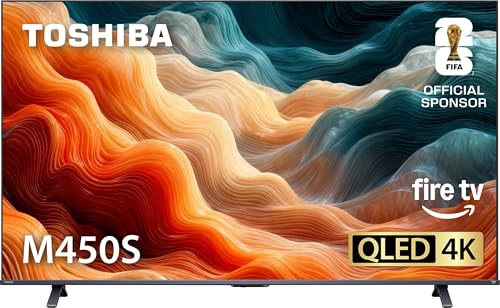
Toshiba 85 M450 QLED Fire TV — The colour-led pick
Toshiba’s M450 takes the opposite bet from the Mini LED crowd: at 85 inches, spend the engineering on colour. Its listing specifies an 85-inch M450 Series QLED 4K UHD smart Fire TV with a voice remote with Alexa and live TV streaming without cable. On a canvas this large, colour is not a detail of the picture — it is most of what the eye takes in from across a room, and a QLED layer that keeps saturation authoritative in bright conditions addresses the exact failure mode of huge screens in real homes: the washed-out afternoon.
The M450’s heartland is the luminous family space where the television runs all day — morning news, afternoon sport, evening series — and where colour fidelity under daylight is the picture quality that actually gets used. Fire TV supplies the household machinery, Alexa the voice route, and the whole set asks nothing exotic of its owners. Against the guide’s Mini LED models it concedes the finest backlight control in extreme scenes; against the plain LED F50 it claims a richness that, at this size, is visible from the kitchen doorway.
There is a value intelligence to the positioning. Households whose viewing is bright, social and varied may extract more daily pleasure from colour authority than from backlight zones their content rarely stresses, and the M450 concentrates its proposition exactly there. It is the pick for the buyer who has watched a QLED demonstration in a bright showroom and recognised their own living room in the conditions.
It also suits the sports-bar end of home life — the house where matches gather crowds. Colour that survives a bright room and a wide seating spread is precisely what group sport demands, and a screen this size with colour this confident turns the room into the neighbourhood’s natural venue. Hosts know which specification that is, even if they never name it.
Choose the M450 when the room is bright, the content is colourful and the platform is Fire TV. Within those coordinates it is not the budget alternative to anything; it is the correct tool, confidently specified.
Daytime soap and news households, often overlooked in flagship conversations, should note how completely the M450 serves them. Colour confidence and Fire TV’s live integration at a scale that makes the morning programme a room-filling companion rather than a corner appliance — that is a legitimate vision of what a very large television is for, and the M450 pursues it without apology.
- Panel: 85-inch class QLED
- Resolution: 4K UHD
- Platform: Smart Fire TV
- Remote: Voice Remote with Alexa
- Noted in listing: stream live TV without cable
- Series in listing: M450
Strengths
- QLED colour keeps an enormous picture saturated and confident in daylight.
- Fire TV and Alexa make it native to Amazon households from the first evening.
- Colour-led value suits bright, social, all-day viewing better than backlight spec sheets suggest.
Trade-offs
- Finest contrast control in extreme scenes belongs to the Mini LED models.
- No high refresh figure is published for gaming-led buyers.
- Dark-room film purists will want backlight zones or a different room in the guide series.
Best for: the bright, social family space where sport and series run all day and colour carries the picture.
Not suited for: a controlled dark cinema, or a console setup built on published refresh rates.

TCL 85 QM6K Mini LED TV — The bright-room pace pick
The QM6K at 85 inches is TCL’s formula expressed at maximum scale: a QLED Mini LED 4K HDR Google TV at 144Hz, with high brightness and IMAX Enhanced among its listed credentials. Every element of that sentence answers a known 85-inch problem. Mini LED zones discipline a backlight with an enormous area to govern; high brightness defeats the big bright rooms these screens inhabit; the 144Hz native rate keeps the fastest content coherent across a canvas where motion blur has the most room to show; and IMAX Enhanced signals film presentation ambitions to match the gaming pace.
Google TV organises the household side, with profiles that keep a multi-viewer family’s recommendations separate on the shared giant — a small mercy that grows with the number of people the screen serves. The QM6K’s direct rival inside this guide is the Hisense U6 Pro, and the contest between them is the guide’s most enjoyable: near-identical athletic credentials, Fire TV against Google TV, Hisense’s ULED framing against TCL’s QM-series lineage. Platform taste and room habits, not specification gaps, should decide it.
Against the Samsungs, the QM6K argues numbers against pedigree, and argues them well: its refresh figure is printed, its brightness is a headline, its backlight is current. Households that trust published specifications over processing reputations will find their champion here. Its concessions are the familiar ones — Google TV rewards a little configuration, and a dark, intimate room will leave its brightness arsenal largely holstered.
The natural QM6K room is the house’s biggest and brightest: open-plan, glass-rich, sport on Saturday afternoons with the curtains open, games and films after dark on a screen that fills the wall the room was clearly built around. In that room, lesser panels spend their lives apologising for the conditions; the QM6K was specified for them.
Longevity completes the case. A current Mini LED architecture, the highest published refresh tier in the guide and a current platform give this set a long runway as the room’s anchor, which is the correct ambition for a purchase that reorganises a house around itself.
Multi-generational sport deserves a sentence in the QM6K’s case. A panel that stays vivid and legible from the wide chairs lets grandparents at the edges and children on the floor share the same match as the sofa’s centre, and at 85 inches that democratic picture is a family feature, not merely a technical one.
- Panel: 85-inch class QLED Mini LED
- Resolution: 4K HDR
- Refresh rate in listing: 144Hz
- Platform: Smart Google TV
- Brightness in listing: high brightness
- Certification named in listing: IMAX Enhanced
- Model in listing: 85QM6K
Strengths
- Mini LED brightness keeps an 85-inch picture authoritative in the brightest rooms.
- A 144Hz native rate serves sport and games at full architectural scale.
- Google TV profiles suit the many-viewer households these screens attract.
Trade-offs
- Its brightness headroom is surplus in a permanently darkened cinema room.
- Google TV asks more configuration than Fire TV or Samsung’s environments.
- Processing-pedigree shoppers may still audition Samsung’s pair first.
Best for: the biggest, brightest room in the house, where afternoon sport and evening games share one wall.
Not suited for: a small dark cinema, or a household that wants its platform chosen by an existing Alexa routine.

Samsung 85 QN70F Neo QLED TV — The refinement pick
The QN70F carries Samsung’s Neo QLED banner at 85 inches, and its listing assembles the flagship vocabulary accordingly: a Neo QLED 4K Mini LED smart TV from 2025 with an NQ4 AI Gen2 processor and Quantum Matrix Technology. Quantum Matrix is Samsung’s name for its precise control of the Mini LED backlight, and at this diagonal precision is the whole game — thousands of small lights, governed tightly, deciding whether a bright sky and a dark street can share one frame without either surrendering. The QN70F’s promise is that they can, with Samsung’s processing taste as the referee.
Neo QLED colour completes the picture story: quantum-dot saturation with the headroom to stay accurate at the brightness levels a big bright room demands. The set’s demeanour is refinement rather than exuberance — the flagship for buyers who notice haloing, gradient banding and colour drift, and who would rather own the screen that commits none of those sins than the screen with the longest specification chant. Samsung’s smart platform, in its Vision AI era, supplies the software side with the company’s characteristic polish.
Its position in the guide requires honest framing. It is a 2025 model beside its own sibling’s 2026 generation, and its listing does not publish a refresh headline to rival the 144Hz pair, so runway-counters and gaming-led buyers have their alternatives clearly marked elsewhere in the six. What the QN70F offers instead is the most considered picture philosophy in the guide at the largest size — the connoisseur’s big screen, bought for the absence of flaws across thousands of hours.
Consider the household that hosts film society evenings, that re-watches a serious library, that notices when a night scene’s shadows crush into mush on a lesser panel. That household’s satisfaction is decided by exactly the virtues Quantum Matrix processing exists to protect, and at 85 inches those virtues are displayed at a scale where they cannot be missed — or faked.
If the M70H is Samsung’s current composure, the QN70F is its considered depth. Between them, Samsung households choose a generation and a temperament; against the rest of the guide, the QN70F stands as the refinement argument, made at the size where refinement is hardest to achieve and easiest to appreciate.
The QN70F also rewards the patient researcher — the buyer who reads panel architecture the way others read wine lists. Quantum Matrix control is a connoisseur’s specification, invisible in a headline and obvious across a dark film’s most difficult passages, and owners who chose it deliberately tend to keep describing scenes to visitors years later. Every guide needs one pick for that reader; at this size, this is it.
- Panel: 85-inch class Neo QLED Mini LED
- Resolution: 4K
- Backlight control in listing: Quantum Matrix Technology
- Processing named in listing: NQ4 AI Gen2 Processor
- Platform: Samsung Smart TV
- Model: QN70F, 2025
Strengths
- Quantum Matrix backlight control gives huge HDR scenes unusual finesse.
- Neo QLED colour stays accurate at the brightness big rooms demand.
- Flagship refinement suits film libraries and discerning viewers at scale.
Trade-offs
- A 2025 model beside 2026 rivals, including its own sibling.
- No published refresh headline for gaming-led comparisons.
- Its virtues are wasted on casual viewing in undemanding rooms.
Best for: the discerning film household furnishing its largest room for years of serious viewing.
Not suited for: a refresh-rate-led gaming wall, or a buyer who insists on the newest model year.
How do the six compare side by side?
| Model | Panel / backlight | Refresh in listing | Platform | Defining trait |
|---|---|---|---|---|
| Insignia 85 F50 | LED | Not published | Fire TV | Scale and simplicity |
| Samsung 85 M70H | Mini LED | Not published | Samsung Vision AI Companion | 2026 processing composure |
| Hisense 85 U6 Pro | Mini-LED ULED, Hi-QLED | Native 144Hz | Fire TV | Gaming colossus |
| Toshiba 85 M450 | QLED | Not published | Fire TV | Colour-led daylight value |
| TCL 85 QM6K | QLED Mini LED | 144Hz | Google TV | Brightness with pace |
| Samsung 85 QN70F | Neo QLED Mini LED | Not published | Samsung Smart TV | Quantum Matrix refinement |
The table exposes the guide’s two honest axes. The first is light: four Mini LED sets against a QLED and an LED, ranked by how completely they govern a very large backlight. The second is pace: two published 144Hz athletes against four sets whose listings decline to publish a figure, a silence this guide reports rather than fills. Cross those axes with platform — Fire TV three times, Samsung’s environment twice, Google TV once — and each household’s answer occupies exactly one cell. That is what a mature size class looks like: not a ladder, but a map.
How should you install and set up an 85-inch television?
Installation at this size is a planned operation, not an afternoon impulse. Confirm the mount’s rating and the wall’s construction with the seriousness the panel’s weight deserves, use two people for every movement of the set, and photograph the rear connections before the screen goes flat to the wall — future device changes will thank the photograph every time. Rehearse the height from the room’s real seats with tape first; an 85-inch screen mounted too high is a chiropractor’s annuity and the commonest installation regret in the class.
Picture setup should follow the room’s two lives. Build a bright preset that spends the panel’s headroom on daytime sport and family viewing, and an evening preset with motion smoothing restrained for film; on the 144Hz pair, configure the console’s input for high-refresh play and verify in the console’s own display settings that the signal the listing promises is the signal arriving. Sound deserves equal planning: at this scale a soundbar or better is less an upgrade than the completion of the purchase, and its shelf, power and cable path belong in the installation plan from the first sketch.
Energy and heat deserve a practical sentence in rooms that will run a panel this large for long hours. A big Mini LED screen is a significant electrical citizen of the house, and its corner of the room should have ventilation and a power arrangement that does not share a strained socket strip with the console, the sound system and the room’s heater. None of this is exotic; it is the ordinary electrical tidiness that a permanent installation deserves, arranged once while the wall is open rather than revisited behind a mounted giant.
Finally, induct the household. A screen this central accumulates friction when only one person can drive it, so walk every regular viewer through voice search, the console’s input and the live television route. Ten minutes of shared fluency at installation is the cheapest harmony a media room will ever buy.
What mistakes do buyers make at 85 inches?
Start with the mistake that precedes all others: choosing the set before auditing the room. Buyers fall for a panel in a showroom or a listing, then discover their wall is plasterboard where the mount needs masonry, their brightest viewing hour defeats the panel they chose, or their sofa sits at a distance the diagonal overwhelms. Every one of those discoveries is free to make in advance and expensive afterwards, and this guide’s structure — room first, technology second, model third — is designed to force the free version.
The gravest mistake is logistical optimism: assuming the box will fit through the door because the wall is big enough, or that a standard mount will serve because it served the last set. Measure the route, rate the mount, and plan the two-person lift before the purchase, not during the delivery. The second mistake is height — screens hung for standing viewers in rooms where everyone sits — and the third is judging the picture in a showroom’s light rather than the room’s own brightest hour.
Fourth comes the unsupported spectacle: an enormous picture paired with neglected sound and a wobbling stand, which leaves the room feeling strangely less cinematic than the smaller, better-supported setup it replaced. Budget the wall as a whole. A subtler oversight is failing to brief the household’s other decision-makers before the screen arrives. An 85-inch panel changes a room’s balance, its light and sometimes its furniture layout, and partners or parents who meet those changes as a surprise litigate them for weeks. Walk the tape outline together, agree the height and the sound plan together, and the installation lands as a shared project rather than one person’s fait accompli.
Fifth, buyers forget the room’s social reorganisation — an 85-inch screen will host gatherings, settle arguments about what counts as the good seat, and dominate the room’s photographs for a decade — and they choose a platform only one household member enjoys operating. At this scale, the interface is a family decision or it is a family grievance.
Final Recommendation
Before the verdict, a reassurance grounded in how these purchases actually age. Households almost never regret the diagonal; the tape comes off the wall, the seats settle, and within a month the room’s proportions feel native. What they occasionally regret is a mismatch they could have named in advance — a panel dimmer than the room, a platform one partner dislikes, a sound plan postponed into permanent inadequacy. Every one of those mismatches is visible in the reviews above, written in plain terms, which means a buyer who has read this far is choosing with the regrets already priced in. That is the best position any purchaser of a very large television can occupy.
Choose by the room’s brightest hour and its fastest evening. If both are demanding, the Hisense U6 Pro and TCL QM6K are the athletes of the guide, split by Fire TV against Google TV, with Samsung’s M70H offering flagship composure and the QN70F Quantum Matrix refinement for households that prize picture discipline over published pace. Toshiba’s M450 owns the bright, colour-led middle, and Insignia’s F50 remains the honest doorway onto an 85-inch wall. Buy the set your room’s light, your household’s hands and your delivery route all approve, and the largest screen in this series becomes what it should be: not a monument to a purchase, but the natural centre of the house’s shared life. Give it a season of gatherings, finals and film nights, and the wall it occupies will feel less like the room’s biggest decision and more like its oldest friend — the one everybody gathers around without thinking twice.
Frequently Asked Questions
How many people do I need on installation day?
Two, minimum, and a third pair of hands is welcome for the moments when the set is being aligned on its mount. The panel’s dimensions make it a sail as much as a screen: awkward to grip, easy to twist, and unforgiving of a solo improvisation. Schedule the help before the delivery, not after the box is open.
Is an 85-inch TV better than a projector for a media room?
For rooms used in daylight or mixed light, usually yes: the panel needs no blackout discipline, no throw distance and no separate screen, and it performs identically at noon and midnight. Dedicated dark cinemas remain projector territory, but most family media rooms are not dedicated or dark, and for them the television is the more honest tool.
How far should seating be from an 85-inch screen?
Most households settle between three and four and a half metres for film, and 4K detail allows the closer end of that range comfortably. The tape rehearsal from the room’s real seats, at its real lighting hours, finds the right number more reliably than any chart.
Which picks suit gaming at this size?
The two listings publishing native 144Hz rates: the Hisense U6 Pro on Fire TV and the TCL QM6K on Google TV. Both pair that pace with Mini LED backlights, which is why they anchor the gaming conversation in this guide.
Will a screen this size make ordinary programmes look worse?
It makes them look larger, which is not the same thing. Well-processed sets upscale broadcast and older streams gracefully, and at proper seating distances most households find ordinary programmes gain presence rather than flaws. The sets with the strongest processing stories in this guide — the Samsungs and the current Hisense and TCL flagships — are the safest hands for a broadcast-heavy diet.
Can an 85-inch television go on a stand?
Only on furniture genuinely wide and strong enough for its stance and weight, which excludes most conventional TV benches. Wall mounting is the norm at this size, with a properly rated mount into a suitable wall, installed by two people.
What if my doorway is too narrow for the box?
Then the purchase must change before the delivery does: a smaller size from this guide series, a different entry route agreed with the retailer, or professional movers with stair and window experience. What must not happen is improvisation on the day, because a panel this size forgives neither a forced angle nor a dropped corner. Measure early, and the problem — if it exists — is a planning detail rather than a disaster.
Do I need special sound equipment for a screen this large?
Need is strong, but most households conclude that a soundbar is the completion of the purchase rather than an accessory, because built-in speakers cannot match an 85-inch picture’s physical presence. Live with the set briefly if you are unsure; film night will deliver the verdict.
What happens to the television this one replaces?
Plan its onward journey before the new box arrives. A capable 55 or 65-inch set usually has a bedroom, a relative or a games room waiting, and arranging the cascade in advance turns the upgrade into a household-wide improvement. The unplanned alternative — a large screen leaning in a hallway for a season — is the most common and most avoidable epilogue to a big purchase.
How long will an 85-inch set remain a room’s anchor?
Resolution will not date it, so the horizon is set by platform currency and backlight headroom. The 2026 models and the Mini LED sets carry the longest runways here, and matching the panel to the room’s light matters more to longevity than any single specification.


