What's inside
- Key Takeaways
- Quick Picks
- How We Chose These Picks
- Comparison
- How Long Is Long Enough? Matching Runtime to the Evening
- Why Does Brightness Fall on Battery Power?
- How Do You Set Up a Garden Cinema on Battery Power?
- What Should You Download Before Leaving Home?
- How Do You Care for a Battery Projector Between Seasons?
- Can a Battery Projector Replace a Television?
- How Do You Keep Outdoor Sound Neighbourly?
- What Weather Should Cancel a Battery Screening?
- How Should You Choose Between the Two Capsule Models?
- What Accessories Actually Earn Their Place in the Bag?
- How Do You Run a Mid-Evening Top-Up Without Killing the Mood?
- What Size Audience Can a Battery Projector Serve?
- How Does Altitude, Heat and Cold Change a Battery Evening?
- Common Mistakes
- Final Recommendation
- Frequently Asked Questions
- Related Guides
As an Amazon Associate I earn from qualifying purchases. This post may contain affiliate links at no extra cost to you.
widgetverdict.com is reader-supported. When you buy through links on our site, we may earn an affiliate commission.
The best battery projectors sell a single liberating idea: the film goes where the evening goes, and no socket gets a vote. A garden wall at dusk, a campsite clearing, a bedroom ceiling, a village hall with one inconvenient plug — a built-in battery turns each into a cinema on the strength of a charge. The six machines below all carry that idea, and this guide judges them by the only currency that matters once the cable disappears: the runtime their own titles are willing to state.
That discipline matters because battery claims are where projector marketing gets creative. This guide prints exactly four stated figures, each taken from a listing title: 2.5 hours for the NEBULA Capsule 3, 2.5 hours for the Capsule 3 Laser, 2.5 hours of playtime for the NEBULA Mars 3 Air, 5 hours for the NEBULA Mars 3, and 3.5 hours for the Wanbo ToGo Pro. One pick, the XGIMI Vibe One, states that a battery is built in without printing a runtime, and its review says so plainly rather than borrowing a neighbour’s number.
A second honesty runs alongside the first: brightness falls when a projector runs on battery. Makers throttle output to stretch the charge, so the picture a machine shows on its battery is dimmer than the same machine plugged into the wall. That is not a scandal; it is physics with a budget. It does mean battery evenings should be planned around dusk, modest image sizes and content that forgives a gentler picture — a family film under stars, not a noon presentation.
Tap any pick’s name to reach its Amazon listing, check price on Amazon there, and read the full specification — battery details included, in the seller’s own wording. Four of the six picks wear the NEBULA name, one is XGIMI’s, one is Wanbo’s, and the ranking below follows stated runtime, stated brightness and stated streaming credentials — never a figure this guide had to guess on a maker’s behalf.
Notice, too, how the class divides by temperament. The capsules are companions, carried without thought; the Mars machines are equipment, packed with intent; the Wanbo is a field tool; the XGIMI is a bedroom resident that occasionally travels. Runtime figures start the conversation, but temperament finishes it, and the reviews below keep both in view.
Key Takeaways
- Only stated runtimes count here: Capsule 3 at 2.5 hours, Capsule 3 Laser at 2.5 hours, Mars 3 Air at 2.5 hours, Mars 3 at 5 hours, Wanbo ToGo Pro at 3.5 hours.
- The XGIMI Vibe One states a built-in battery without printing a runtime, so this guide credits the battery and leaves the hours unclaimed.
- Brightness drops on battery power across this class; plan battery evenings around dusk and sensible image sizes.
- The Mars 3 is the endurance pick: a stated 5 hours beside a stated 1000 ANSI lumens and a 200-inch maximum picture.
- Capsule portability has a shape: the two Capsule 3 models promise a 120-inch display from a mini body with Google TV and licensed Netflix language.
- The Wanbo ToGo Pro pairs its stated 3.5 hours with Google TV 14, native 1080P wording and a fully sealed optical engine for outdoor life.
Quick Picks
| Pick | Badge | Why it earns its place |
|---|---|---|
| Nebula Capsule 3 | The pocket cinema with a stated 2.5 hours | A Netflix-certified portable projector stating 2.5 hours of battery, Google TV, 1080p, Wi-Fi and a 120-inch display with Dolby Digital sound. |
| Nebula Capsule 3 Laser | The laser-lit capsule for outdoor evenings | An outdoor portable mini projector with Google TV, Netflix certification, Dolby Digital sound, a 120-inch display and a stated 2.5-hour built-in battery. |
| NEBULA Mars 3 Air | The balanced traveller at 400 ANSI lumens | A portable outdoor projector with a built-in battery stating 2.5 hours of playtime, 1080p, a stated 400 ANSI lumens, Google TV and licensed Netflix. |
| Nebula Mars 3 Outdoor | The endurance flagship: a stated 5 hours | An outdoor portable projector stating 5 hours of battery, 1000 ANSI lumens, AI-powered image features, a 200-inch picture and Android TV. |
| XGIMI Vibe One | The battery XGIMI with JBL sound — runtime unstated | A battery-powered 1080P smart portable with Google TV and licensed Netflix, JBL sound, auto focus and keystone, in a Cloud Ash finish. |
| Wanbo ToGo Pro | The sealed-engine camper at a stated 3.5 hours | A portable outdoor projector stating an ultra-long 3.5 hours of battery, Google TV 14, native 1080P, 32GB storage, a fully sealed optical engine and real-time focus. |
How We Chose These Picks
Eligibility required the battery to be part of the product’s own title story — a stated hour figure, a built-in battery claim or playtime language — because a projector that merely tolerates a power bank is a different product from one designed around its own cell. Every pick below announces its cord-free intent in its own words, which let us rank the class on evidence rather than on accessory compatibility.
Runtime was scored strictly as printed. A title stating 5 hours outranks one stating 2.5, and a title stating nothing was neither punished with an invented figure nor rewarded with an assumed one. That rule sounds severe until a buyer imagines planning a garden double feature around a guessed number; the disappointment of a screen going dark before the credits is the exact failure this guide exists to prevent.
Brightness was read as a battery-relevant figure, not a showroom one. The Mars 3 Air’s stated 400 ANSI lumens and the Mars 3’s stated 1000 ANSI lumens describe different evenings: the smaller number suits a tent, a bedroom and a small wall at close range, while the larger supports a garden gathering. Neither figure promises its wall-powered character, and the reviews keep that battery dimming in view throughout.
Streaming credentials were weighed because a battery projector far from the house has no rack to lean on. Google TV, Android TV and licensed or certified Netflix language in these titles means the machine carries its library with it. A cord-free projector that still needs a laptop tethered by HDMI has solved only half the problem it was bought to solve.
Finally, outdoor intent was credited where titles claimed it: outdoor naming on the Mars models and the Capsule 3 Laser, a sealed optical engine on the Wanbo. Dust, dew and transport are the battery class’s working conditions, and a maker who designs for them in print deserves the credit when a buyer’s evenings genuinely happen outside.
We also weighed how each machine behaves at the end of its charge, insofar as titles let us: a projector bought for evenings must make its limits predictable, because a planned intermission is a pleasure and a surprise shutdown is a grievance. Stated figures, honestly printed, are what make limits predictable enough to plan a party around.
Sound was scored as part of the battery itself, because every external speaker smuggles a second battery and a second cable into a supposedly cord-free evening. Titles naming Dolby Digital or a recognised audio brand therefore earned genuine marks, not decorative ones.

Nebula Capsule 3 — The pocket cinema with a stated 2.5 hours
The Capsule 3 is the battery idea at its most portable: a mini projector whose title promises Netflix certification, Google TV, 1080p resolution, Wi-Fi and a picture up to 120 inches, all carried by a stated 2.5 hours of battery. That runtime is the honest centre of the product. It covers one full film with room for trailers and a pause for drinks, and it declines to pretend a double feature is happening without a recharge or a cable.
Netflix certification in the title matters more on a battery machine than on any other kind, because the whole point is leaving the laptop indoors. A certified app delivers the proper streaming experience from the projector itself, remote in hand, wherever the machine happens to be standing. Google TV organises the rest of the evening’s services into the same interface, so the Capsule behaves like a tiny television that happens to project.
The 120-inch maximum should be read as a ceiling rather than a plan. On battery power, with output throttled to protect the charge, the Capsule’s happiest evenings happen at sizes well below that figure: a bedroom wall, a garden fence panel, a sheet strung between trees at a size the dusk can support. Buyers who respect that arithmetic get a magical little machine; buyers who demand the full 120 after dark on battery will meet the physics this guide warned about.
Dolby Digital sound is named in the title, and for a machine this small, integrated sound is not a garnish but the entire audio plan on most outings. There is no soundbar in a tent. The Capsule’s proposition is completeness at miniature scale: picture, platform and sound in one hand-carried object, ready in the time it takes to find a flat surface and a pale wall.
Choose it for spontaneity. The Capsule 3 is the projector that gets used on a Tuesday because using it costs nothing in setup, cables or planning, and a stated 2.5 hours matches the length of the evenings spontaneity actually produces. Households wanting scheduled epics under the stars should keep reading toward the Mars models; households wanting cinema at the speed of an idea start here.
Apartment balconies deserve a mention in the Capsule’s life, because a small outdoor space and a pale wall opposite are all it asks. Neighbours forgive a quiet film at modest volume, and the machine packs away into a drawer when the evening ends, leaving the balcony to its plants again.
The Laser variant also suits households that lend their projector, because laser consistency forgives borrowers who never adjust anything. The picture they get is the picture the owner calibrated, however the machine was handled, and lending technology that returns unaltered is a small social pleasure.
A thermos, a blanket and the Capsule’s small glow compose the complete packing list for its favourite kind of evening. Machines that ask this little of an outing tend to be invited on many of them, and invitation frequency is the battery class’s truest measure of success.
- Battery: 2.5 hours, stated in listing title
- Resolution: 1080p, per title
- Streaming: Google TV, Netflix-certified
- Maximum image: 120 inches stated
- Sound: Dolby Digital stated
- Connectivity: Wi-Fi stated
Strengths
- Netflix certification frees it from any laptop
- Stated runtime matches a full film honestly
- Picture, platform and sound in one mini body
Trade-offs
- 2.5 hours excludes battery-only double features
- Battery brightness suits modest image sizes
- Maximum size is a ceiling, not a plan
Best for: spontaneous film nights in bedrooms, gardens and rented rooms.
Not suited for: planned double features far from a socket.
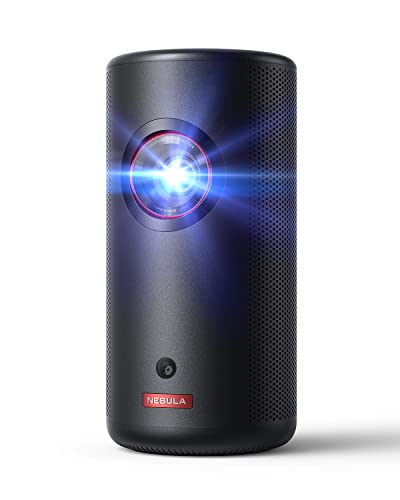
Nebula Capsule 3 Laser — The laser-lit capsule for outdoor evenings
The Capsule 3 Laser takes its sibling’s pocket-cinema formula and aims it outside. Its title calls it an outdoor portable mini smart TV projector, keeps the Google TV platform and Netflix certification, keeps Dolby Digital sound and the 120-inch display claim, and states the same 2.5 hours of built-in battery. The word laser in its name signals a different light engine from the standard Capsule 3, with the consistency that laser light brings to a machine used in short, frequent bursts.
Outdoor naming changes what a buyer should expect from the design. A projector marketed for gardens and patios anticipates being carried, set on uneven tables, aimed at fences and walls, and packed away after dark by torchlight. The Capsule format already suits that handling; the Laser variant’s identity simply admits where its evenings will happen and dresses accordingly, with the same certified streaming so no laptop joins the expedition.
The stated 2.5 hours deserves the same planning respect as its sibling’s: one film, comfortably, with the social margins around it. Laser light does not repeal battery arithmetic, and brightness on battery remains a budgeted resource. Garden hosts should size the picture for the dusk they have, start the film as light fades rather than in full evening sun, and let the machine’s steadiness do the rest.
Against the standard Capsule 3, the choice is about venue and light engine rather than runtime or platform, since the titles match on those figures. Indoor spontaneity belongs to the original; a household whose projector will live its life between patio and lawn should take the variant that calls itself outdoor in its own title and carries laser light for the seasons of short sessions ahead.
It is also the natural gift-shaped pick of this guide: a complete, certified, self-contained cinema in a mini body asks nothing of its recipient but a wall and an evening. Recipients who would never assemble a projector system will use this within the hour, which is a rarer and more valuable property than another half hour of anyone’s battery.
Hotels and holiday lets are the Air’s natural habitat, where the television is small, the accounts are signed out, and the wall is large. A licensed platform and a stated playtime turn a strange room into the family’s cinema within minutes of arrival, which is worth more on holiday than any specification.
For the Mars 3, sports deserve equal billing with films: a five-hour stated battery swallows a long final, its ceremony and its celebrations without a cable crossing the garden. Few purchases change a household’s summer calendar the way an event-proof outdoor screen does.
Winter stargazing evenings pair naturally with the Laser capsule: a documentary about the sky, watched beneath the sky, on a battery that outlasts the cold audience’s attention. Portability judged by such evenings is doing cultural work no specification captures.
- Battery: 2.5 hours built in, stated in title
- Light source: laser, per product name
- Streaming: Google TV, Netflix-certified
- Maximum image: 120 inches stated
- Sound: Dolby Digital stated
- Framing: outdoor portable mini projector
Strengths
- Outdoor framing with laser light consistency
- Certified Netflix inside Google TV
- Same pocket format, aimed at gardens
Trade-offs
- Runtime matches its sibling at 2.5 hours
- Battery brightness still budgets the picture size
- Premium variant of a formula some will find sufficient in standard form
Best for: garden and patio film nights in a hand-carried format.
Not suited for: all-night outdoor marathons on a single charge.

NEBULA Mars 3 Air — The balanced traveller at 400 ANSI lumens
The Mars 3 Air steps up from capsule scale to a fuller portable, and its title is admirably specific: built-in battery, 1080p, a stated 400 ANSI lumens, 2.5 hours of playtime, Google TV with Netflix officially licensed, Dolby Digital sound and a picture up to 150 inches. Every number a travelling buyer needs is printed, which lets the machine be judged as what it is — a mid-sized cord-free projector for rooms and gardens that can be darkened.
The stated 400 ANSI lumens defines its evenings honestly. That output, further budgeted on battery, belongs to dusk and darkness: a bedroom, a tent’s side, a rental’s living room after sunset, a garden once the light has properly gone. Buyers planning twilight kick-offs should either start small or start plugged in. Within darkness, 400 ANSI lumens at sensible sizes gives a relaxed, watchable picture that suits the films portable projectors are actually bought for.
Playtime language in the title — 2.5 hours — matches the Capsule models, so the Air’s advantage is not endurance but presence: a larger picture claim at 150 inches, a fuller portable body, and the same licensed streaming completeness. It is the machine for a household that found the capsule idea slightly too small and wants the same honesty in a bigger frame, for regular garden nights rather than spontaneous ones.
Dolby Digital sound and Google TV keep the one-box promise intact, which matters at the venues the Air targets. A holiday rental has no soundbar; a campsite has no rack. The Air arrives with picture, platform and sound in a single carry, and that completeness, repeated across addresses, is the real specification its buyers are purchasing.
Against its bigger sibling below, the Air trades endurance and brightness for a lighter commitment. The Mars 3 states double the playtime and well over double the lumens; the Air answers with the smaller ask. Households whose outdoor evenings are single films with friends will rarely feel the difference, and should let the simpler machine win their money.
Ceiling projection is the Vibe One’s party trick and its most persuasive bedroom argument. Lying back to a film overhead removes neck strain, furniture rearrangement and the screen entirely, and a battery machine makes it safe, with no cable trailing toward the bed. Confirm the runtime, then try it once.
The ToGo Pro’s storage also serves multi-household tours: films downloaded once can screen at a parent’s garden, a friend’s campsite and home again without a single stream between them. Touring projectors earn their luggage space exactly that way.
The Air also moonlights as a presentation traveller for small venues — a club night, a classroom visit, a parish hall talk — where its licensed platform and stated figures remove the venue’s ancient projector from the equation entirely.
- Battery: 2.5 hours playtime, stated in title
- Brightness: 400 ANSI lumens, stated in title
- Resolution: 1080p, per title
- Streaming: Google TV, Netflix officially licensed
- Maximum image: 150 inches stated
- Sound: Dolby Digital stated
Strengths
- Every key figure printed in its title
- Licensed Netflix inside Google TV
- A fuller portable than the capsule format
Trade-offs
- Stated 400 ANSI lumens needs real darkness
- Playtime matches the smaller Capsules
- Bigger sibling states far more brightness and hours
Best for: regular garden and travel film nights at sensible sizes.
Not suited for: bright twilight screenings or very large outdoor images.

Nebula Mars 3 Outdoor — The endurance flagship: a stated 5 hours
The Mars 3 is the machine this guide’s runtime discipline was built to celebrate, because its title states the number cord-free buyers dream about: 5 hours of battery. Five stated hours changes the planning category entirely — a double feature becomes possible, a long sports event fits, a film plus a children’s matinee earlier in the evening stops requiring a recharge negotiation. Endurance is not a specification here; it is a different social life for the projector.
Brightness supports the ambition with a stated 1000 ANSI lumens, the largest figure among the battery picks whose titles print one. Even after battery throttling takes its share, that starting point gives the Mars 3 the best chance in this guide of holding a big outdoor picture together, and its title claims a 200-inch maximum for the venues — fields, big gardens, hall walls — where such sizes are attempted. Sensible hosts will still size for the dusk, but the headroom is real.
AI-powered image features are named in the title, speaking to the setup forgiveness outdoor life demands: surfaces are imperfect, angles are improvised, light changes as the evening deepens. A machine that helps correct its own picture while standing on a garden table earns its keep nightly. Android TV supplies the platform, with the backyard, office and business uses the title names, and camping listed among its intended lives.
That venue list deserves respect: backyard, office, business, camping. The Mars 3 is designed as equipment for occasions, the projector a family or a small organisation owns for events rather than for the daily television replacement. Its size and intent follow that role. Buyers wanting a bedroom companion should look at the Capsules; buyers wanting an occasion machine with the stamina to finish what it starts have found the guide’s endurance champion.
The cautions are the class’s own, stated once more for the flagship: battery brightness is budgeted brightness, stated runtime assumes the maker’s conditions, and a 200-inch picture in daylight remains a fantasy no battery survives. Plan the Mars 3’s evenings at dusk, at sizes the light supports, and its five stated hours will feel less like a figure and more like freedom.
A support vehicle mindset helps Mars 3 owners: screen, seating, machine and a charged battery arriving together turn any flat ground into an event space. Organisations that master that kit become the people every summer gathering quietly depends on.
- Battery: 5 hours, stated in listing title
- Brightness: 1000 ANSI lumens, stated in title
- Maximum image: 200 inches stated
- Image: AI-powered features stated
- Streaming: Android TV
- Named uses: backyard, office, business, camping
Strengths
- Stated 5 hours enables double features
- Stated 1000 ANSI lumens leads this battery class
- Built and framed for outdoor occasions
Trade-offs
- Occasion-sized machine, not a pocket companion
- Battery output still throttles below wall power
- Platform is Android TV rather than Google TV
Best for: garden cinemas, camping trips and event evenings that run long.
Not suited for: bedroom users, whose evenings end long before its stamina does.

XGIMI Vibe One — The battery XGIMI with JBL sound — runtime unstated
The Vibe One requires this guide’s most careful sentence: its title states a built-in battery and calls the machine battery powered, but it prints no runtime, so no hours are claimed for it anywhere in this review. Buyers should find the figure on the listing before planning an evening around it. What the title does promise is substantial: 1080P resolution, Google TV with licensed Netflix, JBL sound, auto focus and auto keystone, in a finish named Cloud Ash, aimed at bedrooms and backyards.
JBL sound is the differentiator its title shouts loudest. Battery projectors live or die by their integrated audio, since external speakers defeat the portability, and a named audio brand signals that XGIMI spent money where travelling viewers actually notice it. Dialogue on a bedroom wall and music under a film’s credits both benefit, and a household choosing between portables on sound should weigh this title heavily.
Auto focus and auto keystone suit the Vibe One’s stated venues — bedroom and backyard — where the machine will be set down at a fresh angle nightly and expected to square itself. That automation is the difference between a projector that gets used and one that gets admired; every removed setup step multiplies the evenings a portable actually serves, because spontaneity dies in menus.
Licensed Netflix inside Google TV completes the self-containment story, matching the certification standard this guide prizes in the NEBULA picks. The Vibe One therefore competes on completeness and sound rather than on a stated endurance figure, and honest shoppers should compare it exactly that way: if its listing’s runtime, once checked, covers your evenings, its audio and automation may well make it the class’s most likeable machine.
Bedroom use deserves the final word, because a battery projector in a bedroom can aim at a wall or a ceiling and retire without a cable across the floor. For renters, students and anyone whose screen must vanish by morning, that cable-free tidiness is the product. The Vibe One was framed for precisely that life; just confirm its hours before the first ceiling cinema.
Students in shared houses report the Vibe One pattern often: the machine lives in whoever’s room hosts tonight, because battery and automation make it a guest that needs no installation. Shared ownership suits no television ever made.
- Battery: built in, stated — runtime NOT stated in title
- Resolution: 1080P, per title
- Streaming: Google TV with licensed Netflix
- Sound: JBL sound stated
- Setup: auto focus and auto keystone stated
- Finish: Cloud Ash, per title
Strengths
- JBL sound leads the class’s audio story
- Auto focus and keystone remove nightly setup
- Licensed Netflix inside Google TV
Trade-offs
- No runtime printed in its title
- Brightness figure absent from its title
- Endurance comparisons must wait for the listing
Best for: bedrooms and backyards wanting sound and automation first.
Not suited for: trips planned around a runtime figure this title never states outright.

Wanbo ToGo Pro — The sealed-engine camper at a stated 3.5 hours
Wanbo’s ToGo Pro makes its battery claim in words a buyer can plan around: ultra-long 3.5 hours, stated in the title. That figure sits deliberately between the 2.5-hour crowd and the Mars 3’s five, and it covers the most common outdoor evening exactly — a full film, its trailers, its pauses and its encore episode — without demanding the flagship’s commitment. Runtime honesty at the middle of the class is a genuinely useful market position.
The fully sealed optical engine is the title’s other headline, and outdoor users should understand why it matters. Dust, pollen and campsite grit are the slow enemies of portable projectors, fogging pictures from inside where no cloth can reach. A sealed engine refuses that entire failure mode at the design stage, which makes the ToGo Pro the pick whose picture should look the same after its twentieth field as after its first.
Google TV 14 and native 1080P wording give the streaming and resolution stories unusual precision for this class: a named platform generation, and the word native attached to the resolution claim. A stated 32GB of storage supports the traveller’s habit of downloading films before leaving coverage, which is how camping projection actually works — the stream is fetched at home, the screening happens beyond the signal’s reach.
Real-time focus completes the outdoor brief, correcting the picture as the machine is nudged, bumped or repositioned on imperfect ground. Camping and garden setups are living things, adjusted throughout the evening, and a projector that refocuses itself keeps the audience watching the film instead of the setup. Wanbo’s title reads like a list of outdoor complaints answered one by one.
Choose the ToGo Pro when the evenings are genuinely outdoors and genuinely long: campsite features, garden films that start at dusk and end near midnight, travelling shows for family scattered across postcodes. Its stated 3.5 hours, sealed engine and downloaded library compose the most field-minded package in this guide, even where the Mars 3 out states it on raw endurance.
Sealed engines also forgive beach-adjacent holidays, where salt air and fine sand test every vent a projector owns. A machine designed to keep the outside outside earns its place in the holiday bag year after year.
- Battery: 3.5 hours, stated in listing title
- Resolution: native 1080P, per title
- Streaming: Google TV 14
- Storage: 32GB stated
- Engine: fully sealed optical engine stated
- Focus: real-time focus stated
Strengths
- Stated 3.5 hours covers a full outdoor evening
- Sealed engine refuses dust and grit
- Storage supports downloaded films beyond signal reach
Trade-offs
- Brightness figure absent from its title
- Out-endured by the Mars 3’s stated five hours
- Outdoor specialisation exceeds bedroom needs
Best for: campers and garden hosts whose films run past the 2.5-hour crowd.
Not suited for: indoor-only users, who would pay for sealing they never test.
Comparison
| Pick | Headline facts from its listing title | Room it suits first |
|---|---|---|
| Nebula Capsule 3 | 2.5H battery stated, 1080p, Google TV, Netflix-certified, 120-inch max | A bedroom wall or garden fence at dusk |
| Nebula Capsule 3 Laser | 2.5H battery stated, laser, Google TV, Netflix-certified, outdoor | A patio or lawn after dusk |
| NEBULA Mars 3 Air | 2.5H playtime stated, 400 ANSI lumens, 1080p, Google TV | A darkened garden, tent or rental room |
| Nebula Mars 3 Outdoor | 5H battery stated, 1000 ANSI lumens, 200-inch max, Android TV | A big garden, campsite or hall wall |
| XGIMI Vibe One | Built-in battery (runtime unstated), 1080P, Google TV, JBL sound | A bedroom wall or ceiling, a backyard at dusk |
| Wanbo ToGo Pro | 3.5 hrs battery stated, native 1080P, Google TV 14, sealed engine | A campsite clearing or garden at dusk |
How Long Is Long Enough? Matching Runtime to the Evening
Start from the programme, not the product. A single family film with trailers and a drinks pause consumes roughly two and a half hours of evening; a double feature or a long final with extra time consumes four and beyond. The stated figures in this guide map cleanly onto those programmes: 2.5 hours for the single film, 3.5 for the film with ceremony around it, 5 for the double bill.
Then subtract realism. Battery figures are stated under a maker’s chosen conditions, and brightness settings, volume and streaming over Wi-Fi all spend the charge at their own rates. Planning to finish with charge to spare — choosing the machine whose stated figure exceeds the programme — converts a specification into an evening that never ends early, which is the only conversion that matters.
Why Does Brightness Fall on Battery Power?
A battery holds a finite store of energy, and a projector’s lamp or light engine is its hungriest component. Makers therefore budget output on battery, trading peak brightness for minutes, because a slightly dimmer film that finishes beats a brilliant one that stops at the climax. Every machine in this guide lives under that bargain, whatever its title’s brightness figure describes under mains power.
The buyer’s response is choreography rather than complaint: begin at dusk, keep the image modest, choose the picture mode intended for battery use where one exists, and save the largest sizes for plugged-in nights. Evenings planned that way look intentional and relaxed; evenings that demand mains performance from a battery look like an argument with physics, and physics remains undefeated.
How Do You Set Up a Garden Cinema on Battery Power?
Choose the wall or screen first and the projector position second, because throw distance decides image size before brightness gets a say. A pale fence panel, a garage door or a hung sheet all serve; what matters is flatness and a surface the household can darken around. Set the machine on something stable at the measured distance, square it before the audience gathers, and focus as the light falls.
Sound and seating complete the illusion. Place listeners between the projector and the screen where possible, keep the machine’s speaker aimed at the audience rather than the sky, and run any extension lead for other equipment — never assume the battery covers the whole party. Start the film when the sky, not the clock, says so, and the battery’s budgeted brightness will look like plenty.
What Should You Download Before Leaving Home?
Streaming assumes a network, and the best battery venues — campsites, beaches, rural gardens — are exactly where networks go to die. Download the evening’s films over home Wi-Fi before departure, a habit the Wanbo’s stated 32GB of storage exists to support. Licensed apps on the Google TV and Android TV machines here generally permit downloads within their own rules, so fetch early and fetch at full quality.
Carry the unfashionable backups too: a charged power bank for the remote’s sake and the phone’s, an HDMI cable for the laptop that becomes the library when plans change, and a cloth for evening dew. Battery projection rewards the prepared with an ease that looks effortless, and punishes improvisation precisely when the audience is seated and the sky is finally dark.
How Do You Care for a Battery Projector Between Seasons?
Batteries dislike two storage conditions: completely empty and forgotten, and baking in a hot car or loft. Store the machine partly charged in a cool, dry place, and give it a charge cycle every few months if it will sit idle across winter. A battery treated that way keeps the runtime its title promised; a neglected one quietly rewrites the specification downward.
The rest of the care is outdoor common sense. Dry the machine before packing it after a dewy evening, keep its lens capped in transit, and let a sealed engine like the Wanbo’s do its dust work without opening anything. Portable projectors die of journeys and storage far more often than of use, so the bag and the cupboard matter as much as the specification.
Can a Battery Projector Replace a Television?
For some households it already has: renters who cannot mount a television, students in furnished rooms, families whose viewing happens wherever the evening gathers. The stated runtimes here cover an evening’s viewing, the platforms carry the same services, and the picture sizes exceed most televisions. The replacement works when viewing is an event the household schedules, rather than a background that runs all day.
It falters as an always-on appliance. Daily hours accumulate against a battery’s cycle life, daytime brightness disappoints, and re-aiming nightly wears patience thin. The honest division: battery projectors own the evenings out — garden, bedroom ceiling, campsite, spare room — while a television or a mains projector keeps the daytime shift. Households that respect that division love these machines without reservation.
How Do You Keep Outdoor Sound Neighbourly?
Open-air sound travels further and thinner than indoor sound, so the audience should sit close and the speaker should aim at ears rather than at the sky. Lower volume at a shorter distance beats higher volume across a garden for clarity, and it keeps the peace with the houses beyond the fence, whose goodwill every garden cinema depends on across a summer.
Choose the evening’s content with the hour in mind: dialogue films sit kindly at modest levels, while action climaxes at midnight test friendships. A battery projector’s integrated speaker is naturally modest, which in a neighbourhood is less a limitation than a built-in courtesy the hosts rarely have to enforce themselves.
What Weather Should Cancel a Battery Screening?
Rain cancels, full stop: electronics, batteries and water keep no truces, and a sheet-screen in a shower helps nobody. Heavy dew is the subtler call — if the grass is soaked by nine, the machine will be too by eleven, so wipe it down before packing and dry it indoors before storage. Wind above a gentle breeze turns hung sheets into sails and the picture into comedy.
Cold deserves a footnote because batteries surrender capacity as temperatures fall. A stated runtime earned in mild conditions will shrink on a frosty night, so winter garden screenings should plan a shorter programme or a mid-evening top-up. The machines forgive a great deal of weather optimism, but they keep their own ledger.
How Should You Choose Between the Two Capsule Models?
The titles make the decision unusually clean: runtime, platform and display claims match, so the choice reduces to light engine and intended venue. The standard Capsule 3 is the indoor spontaneity machine; the Laser variant declares outdoor intent in its name and carries laser light for a life of short, frequent, bright-eyed sessions in gardens and on patios.
Households whose projector will migrate constantly between bedroom and garden can justify either, and should let the venue they use more often cast the deciding vote. There is no wrong capsule here — only a capsule whose name matches its evenings, and one whose name describes evenings it will rarely see.
What Accessories Actually Earn Their Place in the Bag?
A small stable tripod or stand leads the list, because garden tables wobble and ground slopes. A lightweight screen or a pale sheet with clips follows, then the charging cable, a cloth for dew, and a power bank for the phones that inevitably become torches and remote controls by the evening’s end.
Everything else must argue for its weight. Battery projection is an exercise in enough: enough picture, enough sound, enough charge. Kit that serves the evening earns its place; kit that serves hypothetical evenings stays home, and the machine’s whole philosophy stays intact.
How Do You Run a Mid-Evening Top-Up Without Killing the Mood?
If the programme outgrows the battery, plan the recharge like an intermission rather than suffering it like a failure. A cable to a nearby socket or a vehicle, run during a scheduled break for drinks and blankets, restores the machine while the audience stretches. Hosts who announce the interval as part of the evening discover guests enjoy the ceremony.
The deeper lesson is selection: a household that routinely needs a top-up bought one runtime class too low. The stated figures exist so that the second purchase can be the right one — an evening that ends on credits, not on a cable, is the battery class working exactly as its titles promised.
What Size Audience Can a Battery Projector Serve?
Audience size is a brightness and sound question wearing a seating costume. A stated 1000 ANSI lumens and a big voice can hold a garden party; a capsule’s gentler output holds a family on a rug. The honest unit is not headcount but distance: the furthest viewer should sit where the picture still has punch and the dialogue still has words.
Arrange seating in a shallow arc close to the screen, and even modest machines feel generous. Push chairs back to impress and the same machine feels inadequate. Battery evenings reward intimacy by design, which most hosts discover was the atmosphere they wanted all along.
How Does Altitude, Heat and Cold Change a Battery Evening?
Batteries are chemistry, and chemistry has weather. Heat accelerates self-discharge in storage, cold shrinks available capacity during the screening itself, and a machine left in a hot car all afternoon arrives at the garden with less than its title promised. None of this is a defect; it is the class’s physics, and hosts who store and transport the machine kindly are repaid in minutes.
The practical rules are few: charge indoors, transport shaded, screen at the day’s cooler end, and keep the programme shorter when the night is frosty. A battery projector treated like a picnic hamper — kept cool, kept dry, opened at the right moment — delivers its stated evening far more reliably than one treated like a toolbox.
Common Mistakes
Planning an evening around a runtime nobody stated leads the error list, and it is the easiest mistake in this category to make, because product pages discuss batteries warmly in prose while titles commit to figures. If the figure is not printed, find it on the listing and write it into the plan; if the plan needs five hours, buy the machine whose title says five.
Demanding the maximum image size on battery power comes next. Every title’s largest figure describes a ceiling under favourable conditions, and battery brightness budgets shrink that ceiling after dark. A smaller, brighter, finished film beats a vast, faint, interrupted one on every evening ever held, so size for the charge you have.
Starting the film too early wastes the battery’s best hours fighting daylight. Twilight is the battery projector’s natural premiere time, when the sky’s dimming and the picture’s budgeted output cross in the viewer’s favour. Hosts who serve drinks first and press play at dusk discover their modest machine suddenly looks like a cinema.
Forgetting the sound plan outdoors recurs at every first garden screening. Open air swallows small speakers, neighbours hear what the audience cannot, and dialogue vanishes into the hedge. Aim the machine’s speaker at the seating, keep the audience close, and consider where the sound goes before the opening scene explains the problem.
Storing the machine flat-charged in a hot place all winter quietly steals next summer’s runtime. Batteries age by treatment more than by birthdays, and a season of neglect can cost the margin that used to finish a film. Charge it partly, store it cool, and the title’s promise survives to be kept again.
Charging from the first convenient cable found in a drawer can also betray an evening, since slow charging before departure masquerades as a full battery at dusk. Use the maker’s own charging arrangement, confirm the indicator’s full state, and treat the hour before leaving as part of the screening itself.
A final recurring error is lending the machine without its charger and calling it ready. Borrowers return battery projectors empty as reliably as they return them late, so the household rule should be simple: it leaves full, it leaves with its cable, and its next evening is planned only after it has eaten.
Final Recommendation
Let the stated hours choose. Evenings built around one film belong to the 2.5-hour machines: the Capsule 3 for indoor spontaneity, its Laser sibling for gardens, and the Mars 3 Air when a fuller portable body and a stated 400 ANSI lumens suit regular outdoor nights. Evenings with ceremony — the film, the pause, the encore — belong to the Wanbo ToGo Pro and its stated 3.5 hours behind a sealed engine.
Double features, long events and big gardens belong to the Mars 3 alone, the only title here stating 5 hours, backed by a stated 1000 ANSI lumens. The Vibe One asks to be judged after a listing check: confirm its unstated runtime, and its JBL sound, licensed Netflix and automatic setup may carry bedrooms and backyards better than any rival. Whichever name wins, plan for dusk, download before departure, and let the battery’s honesty set the size of the night.
The battery class ultimately sells evenings, not equipment, and its titles are unusually honest about the exchange rate. Believe the stated hours, respect the dimming bargain, and choose the machine whose number matches the night you actually host — the projector will keep the promise its title made, which is all any buyer can fairly ask.
Pack the machine, charge it fully, download the film, and wait for the sky. Battery projection at its best feels less like operating equipment and more like keeping an appointment with the dark, and every machine in this guide, honestly matched to its evening, keeps that appointment beautifully.
And if the shortlist still holds two names at midnight, choose the one whose stated runtime exceeds your longest regular evening, because a battery projector should always finish with something in reserve — for the encore, for the photos after, for the one more episode nobody admits they planned.
There is a particular quiet that falls over a garden when the credits roll and the only light left is the sky the audience had forgotten. Battery projectors exist to manufacture that quiet, and the six above, matched honestly to their evenings, manufacture it reliably — which is the highest praise this category can honestly earn.
A battery projector turns a white sheet and two trees into the best seat in the village for one night only. Charge the machine the afternoon before, because a battery topped up in a panic rarely forgives the planner. Dusk has a schedule of its own, and the wise host reads the sky rather than the clock. Children remember the garden cinema long after they forget the film that played in it. A spare blanket for the audience is worth more than another hundred lumens nobody stated.
Frequently Asked Questions
Which battery projector lasts longest on a charge?
By stated title figures, the NEBULA Mars 3 leads the entire class with 5 hours, followed by the Wanbo ToGo Pro at 3.5 hours, then the Capsule 3, Capsule 3 Laser and Mars 3 Air at 2.5 hours each. The XGIMI Vibe One’s title states no runtime at all.
Why is my battery projector dimmer than at home?
Makers budget light output on battery to stretch the charge, so the same machine projects more gently unplugged than on mains power. Smaller images and later start times are the practical answers, and every pick in this guide lives under that trade.
Can I watch a whole film on the Capsule 3’s battery?
Its title states 2.5 hours, which covers a typical film with trailers, an interval and a short pause for drinks. Longer films and double features should either start plugged in or choose a machine stating more hours in its title.
Does the XGIMI Vibe One have a good battery?
Its title confirms a built-in battery and a battery-powered design but prints no runtime figure anywhere, so this guide makes no hours claim for it at all. Check the listing’s stated figure carefully, then weigh its JBL sound and licensed Netflix against that number.
What size picture works outdoors on battery?
Well below each title’s maximum. The stated ceilings run from 120 to 200 inches, but battery brightness supports modest sizes best after dusk; a relaxed picture at a sensible size will always beat a vast faint one.
Can I charge these projectors from a power bank?
Titles here do not state power-bank charging for most picks, so treat the listing as the authority for your exact model and its charging requirements. The safe planning rule is to arrive with the internal battery fully charged, the evening sized to its stated runtime, and a mains option identified nearby for programmes that grow beyond the plan.
Related Guides
Cord-free evenings connect to the rest of the house in the neighbouring guides. The bedroom mini projectors with honest resolution labels collection covers the smallest screens of all, the boardroom projectors for lit-room presentations round-up solves daylight legibility instead of darkness, and the all-around mega tank printers for home and office guide handles the paperwork waiting back at the desk on Monday morning.



[…] basement is one stop on a longer tour of the house. Buyers weighing light sources should read the battery projectors for evenings away from the mains next, then the bedroom mini projectors with honest resolution labels for the smallest room in the […]