What's inside
- Key Takeaways
- Quick Picks
- How We Chose These Picks
- Comparison
- What Does Bluetooth Actually Do on a Projector?
- Google TV or a Streaming Stick: Which Should Run the Show?
- How Bright Does a Google TV Projector Need to Be?
- How Do You Set Up Bluetooth Sound Properly?
- What Should a First-Time Buyer Expect in the First Week?
- How Do These Projectors Handle Gaming?
- Common Mistakes
- Final Recommendation
- Frequently Asked Questions
- Related Guides
As an Amazon Associate I earn from qualifying purchases. This post may contain affiliate links at no extra cost to you.
widgetverdict.com is reader-supported. When you buy through links on our site, we may earn an affiliate commission.
The best android projectors with bluetooth begin with a naming truth that will save every buyer in this class a confused evening: Android TV, as a living platform, has largely become Google TV. Google TV is the current Android-based television platform, the interface and app ecosystem that modern projectors mean when their titles promise an Android experience with proper licences. So this guide’s six picks all run Google TV, stated in every title, and all six pair it with Bluetooth, also stated in every title, because a smart projector that cannot reach a speaker, a pair of headphones or a game controller without a cable has only finished half its job.
Bluetooth deserves its headline place in the keyword. A projector’s own speakers sit wherever the projector sits, usually behind the audience or off to one side, and Bluetooth is the trapdoor out of that geometry: pair a soundbar under the screen, pair headphones for a midnight film in a shared flat, pair a controller for the console-free gaming these platforms increasingly offer. Every title below confirms the radio is present, and the reviews explore what each machine does with it.
The six divide by personality more than by specification. HAPPRUN appears twice, once with a licensed Google TV pitch built around native 1080p and once with a stated 2500 ANSI brightness figure aimed at home theatre and camping. Soundcore’s Nebula P1i is the musician of the group, a portable projector whose speaker flips and whose audio claims lead its title. Pignynt and VOPLLS chase brightness headlines and big Dolby wattage in the dialect this guide has learned to read carefully, and the closing pick is a Netflix-carrying Google TV machine stating a sober 600 ANSI.
Brightness language, once again, must be read by unit. Two titles here print ANSI figures, 2500 and 600, with a third, the Nebula, stating 380 ANSI lumens in plain words. Two others print bare numbers, 3000 Bright and 2000 Bright, which this guide reports as headline claims rather than measurements. The pattern should be familiar by now: compare the ANSI machines with each other freely, and let the bare numbers wait for a listing or a living room to give them meaning.
Resolution follows the same honesty rules. Native 1080p is claimed outright by the first and last picks. Others speak of 4K decoding or 4K support, which describes what the machine can accept and process, a real convenience for modern streams, and the reviews keep that distinction visible wherever it appears.
Key Takeaways
- Google TV is the current Android-based TV platform, and all six picks state it in their titles alongside Bluetooth.
- HAPPRUN’s first pick leads with an official licensed Google TV claim, native 1080p and 4K decoding.
- The Nebula P1i is the speaker-forward pick: a flippable speaker, 20W Dolby Audio and a stated 380 ANSI lumens.
- HAPPRUN’s second entry states 2500 ANSI, the strongest standardised brightness figure in this guide.
- Pignynt and VOPLLS print bare brightness numbers, 3000 and 2000, which are headline claims, not ANSI figures.
- The closing pick pairs Google TV with Netflix in its title and a stated 600 ANSI, the sober end of the band.
Quick Picks
| Pick | Badge | Why it earns its place |
|---|---|---|
| HAPPRUN Native 1080P Google TV Bluetooth Projector | The licensed all-rounder | Official licensed Google TV, native 1080p, 4K decoding, Dolby and AirPlay, WiFi and Bluetooth, PS5 compatible. |
| Soundcore Nebula P1i Portable Projector with Speaker | The flippable-speaker musician | Google TV portable with a flippable speaker, 20W Dolby Audio, autofocus, an all-glass lens and 380 ANSI stated. |
| HAPPRUN 2500 ANSI Google TV Projector | The brightness-led HAPPRUN | A stated 2500 ANSI, Google TV built in, 4K decoding, WiFi 6 and Bluetooth 5.2, Dolby sound. |
| Pignynt Projector with Built-in Google TV | The voice-controlled portable | Google TV with 10,000+ apps claimed, 4K AI auto focus, voice control, WiFi 6 and Bluetooth 5.0. |
| VOPLLS Outdoor 4K Projector with Google TV | The 50W outdoor voice | Official Google TV billing, a 50W Dolby speaker claim, WiFi and Bluetooth for outdoor home theatre. |
| Google TV Smart Projector with Netflix (15W Dolby) | The sober 600 ANSI streamer | Google TV with Netflix, native 1080p, a stated 600 ANSI, 15W Dolby and AI auto focus and keystone. |
How We Chose These Picks
The platform had to be stated, not implied. Every pick’s title names Google TV, the current form of the Android television platform, because a projector bought for its apps must promise those apps in writing. Machines describing themselves with vague smart language and no platform were left aside; a buyer cannot verify a vibe, and the app store a household lives in for five years should be a printed fact.
Bluetooth had to be stated too, since it is half the keyword. All six titles confirm it, several with version numbers, 5.2 on the brighter HAPPRUN, 5.0 on the Pignynt, and the reviews treat the radio as working equipment: the route to soundbars, headphones and controllers that turns a projector from a display into a system.
Brightness claims were sorted by dialect before they were weighed. ANSI figures, 2500, 600 and the Nebula’s 380, form the comparable set. Bare numbers, Pignynt’s 3000 Bright and VOPLLS’s 2000 Bright, are reported as their titles print them and flagged as claims awaiting a standard. No conversion between dialects appears anywhere in this guide, because inventing one would betray the reader the guide is written for.
Resolution wording received the same discipline. Native 1080p, where a title claims it, is credited as the display fact. Four-K decoding and 4K support are credited as signal handling, valuable for modern sources and irrelevant to native sharpness. A buyer who keeps those two sentences separate will never be disappointed by a projector in this class.
Character closed the judging. This class is bought for living rooms, bedrooms, gardens and campsites, often by households choosing their first projector, so each pick had to offer a distinct reason to exist: a licence, a speaker, a brightness figure, a voice remote, a wattage claim or a sober specification. Six identical boxes with different logos would have failed the guide even if every one of them were excellent.

HAPPRUN Native 1080P Google TV Bluetooth Projector — The licensed all-rounder
Official Licensed Google TV is the first phrase in this title, and leading with a licence is a statement of intent. HAPPRUN is telling the buyer that the platform inside this machine is the real platform, with its real app store of ten thousand plus apps, its proper service licences and its updates, rather than a phone interface stretched over a projector. For a machine bought to be a household’s television, that legitimacy is what lets nightly viewing run without workarounds or apologies.
Native 1080p is the second foundation, and it is claimed in the plainest words the class offers. A native Full HD display fed by Google TV’s streams gives the household a sharp, honest picture at the sizes these projectors serve, and the title’s 4K decoding claim then takes its correct place as a convenience: modern 4K streams are accepted and handled gracefully, shown at the machine’s native resolution without fuss or format errors.
Dolby and AirPlay share a line in the title, and together they describe the machine’s social range. Dolby covers the sound processing for films played through its own system or out via Bluetooth to a bar, while AirPlay opens the door to the Apple households that Google TV projectors sometimes forget. A projector that welcomes both ecosystems into the same living room has understood that households are mixed and guests are various.
WiFi and Bluetooth are both present, Bluetooth carrying the keyword’s promise: headphones for the late film, a speaker placed under the picture, a controller for a cloud game. PS5 compatible closes the title’s argument, positioning the machine as a room’s all-purpose screen, streaming box by weeknight, console display by weekend, outdoor ready by its own billing when the garden calls.
Guest-proofing is where the licensed platform quietly earns its licence fee every week. A visitor handed the remote faces the same Google TV home screen they may have at home, finds the service they want in the place they expect, and never has to learn a bespoke menu invented for one projector. Households that host often, grandparents, students, in-laws on holiday, feel that familiarity as hospitality, and it is a quality no specification table captures.
Outdoor ready needs a careful reading. It is the maker’s claim of portability and robustness for garden duty, not a weatherproofing certificate, and the wise owner treats the machine as a visitor to the outdoors like every projector in its class. Within that reading, the package is coherent: a licensed platform that travels, a native picture, and the radios to reach whatever sound the evening needs.
What the title withholds is a brightness figure in any unit, and this guide will not supply one. Buyers for bright rooms should weigh the 2500 ANSI sibling below, or extract this model’s figure from its listing and compare it in ANSI terms if the listing offers them. Buyers for ordinary rooms, bedrooms and dusk gardens can judge this machine on its platform and picture, which are its stated strengths.
Open the listing for that brightness figure and the current price on Amazon together, and the all-rounder’s file is complete: licence verified in the title, resolution native, radios all present.
- Platform: Official Licensed Google TV stated; 10K+ apps claimed
- Resolution: Native 1080P stated; 4K decoding stated
- Audio: Dolby stated; AirPlay named
- Connections: Wi-Fi and Bluetooth stated
- Brightness figure: Not stated in the listing title — verify with the manufacturer documentation
Strengths
- Licensed Google TV with the full app ecosystem
- Native 1080p picture rather than a support claim
- AirPlay and PS5 compatibility widen its household
Trade-offs
- No brightness figure printed in its title
- Outdoor ready is a portability claim, not weatherproofing
- Speaker wattage absent from its title
Best for: a household wanting one licensed, native-1080p machine for streaming, console nights and garden duty.
Not suited for: a bright, unshaded room where a verified ANSI figure must lead the decision.

Soundcore Nebula P1i Portable Projector with Speaker — The flippable-speaker musician
Most projectors treat sound as an apology. The Nebula P1i treats it as the headline: a portable projector with a flippable speaker, 20W of Dolby Audio, and a design that lets the speaker be aimed where the audience actually sits. Soundcore is Anker’s audio house, and this machine reads like an audio company’s answer to the projector question, which is precisely why it earns its place in a guide where Bluetooth and sound share the keyword.
The flippable speaker is a small mechanical idea with a large acoustic consequence. Projectors usually fire sound at a wall, a ceiling or the back of the room; a speaker that flips toward the listeners puts the dialogue in the audience’s lap. At portable-projector distances, where the machine sits among the viewers rather than across a cinema, aim is worth more than watts, and this design spends its ingenuity on aim.
Google TV supplies the platform, with WiFi and Bluetooth completing the wireless set, so the P1i streams for itself and pairs outward when an even bigger speaker or a pair of headphones is wanted. Autofocus and auto keystone handle the portable ritual, set it down, let it square itself, press play, and the all-glass lens named in the title speaks to optical quality as a stated priority rather than an assumption.
Now the honest number: 380 ANSI lumens, printed in the title in the standard unit. That figure defines the machine’s parish. It is a dusk and darkness projector, for bedrooms, tents, dens and gardens after sunset, where its picture will look rich and its speaker will shine. A buyer planning midday living room duty should take the figure at face value and shop the brighter ANSI machines in this guide instead; a buyer planning evenings will find the honesty refreshing and the machine sufficient.
Four-K support appears in its correct grammatical place, as support, alongside the native 1080p the title also states. The pairing is the class’s standard honesty when it is done well: the display is Full HD, the inputs are modern, and nobody has been promised pixels that are not there. Portable machines live and die by whether their owners feel deceived in week two, and this title is written to survive week two.
Think of the student flat as this machine’s natural habitat and its design makes complete sense. One object replaces a television, a speaker and a streaming box in a room where all three would fight for the same shelf, and at term’s end the whole entertainment system travels home in a single bag. The flippable speaker even solves the flat’s acoustics, aimed at the bed or the sofa rather than at the landlord’s wall, which is the kind of thinking that earns a product a following.
Portability completes the portrait. A machine with its own serious speaker, its own platform and self-managing focus is a complete evening in one carry, the projector equivalent of a picnic hamper. For students, renters and travellers, that completeness is the product, and the P1i’s specification reads like it was assembled by people who have actually carried a film night across a city.
Check the listing for battery or power arrangements and the current price on Amazon in one visit, and judge this Nebula by the evenings it was built for rather than by the afternoons it honestly declines.
- Audio: flippable speaker, 20W Dolby Audio stated
- Brightness: 380 ANSI lumens stated
- Platform: Google TV stated; Wi-Fi and Bluetooth
- Picture: 1080p stated; 4K support stated
- Optics: all-glass lens; autofocus and auto keystone stated
Strengths
- Speaker aims at the audience instead of the wall
- Complete portable evening: platform, focus and sound
- Brightness stated honestly in the ANSI unit
Trade-offs
- 380 ANSI confines it to dusk and dark rooms
- Portable scale caps its maximum useful image size
- Serious film sound still benefits from a paired bar
Best for: bedrooms, tents, dens and travel, where evenings are dark and sound matters as much as picture.
Not suited for: a bright living room expected to perform at midday.

HAPPRUN 2500 ANSI Google TV Projector — The brightness-led HAPPRUN
The second HAPPRUN in this guide leads with its number: 2500 ANSI, the strongest standardised brightness figure among these six, printed in the unit that allows comparison. Where its sibling sold a licence, this one sells light, Google TV built in, 4K decoding, WiFi 6, Bluetooth 5.2 and Dolby sound arranged behind the figure like a supporting cast that knows its place.
Twenty-five hundred ANSI buys a specific freedom: the freedom to stop managing the room so carefully. Curtains can stay half open, the kitchen light can stay on, a camping evening can start before the light has fully gone. No figure in this class defeats direct sun, and no honest review would claim that it does, but within the honest territory of bright rooms and early evenings, the strongest ANSI claim in the guide is the one that asks the fewest favours from its surroundings.
WiFi 6 and Bluetooth 5.2 are the current-generation radios, and in a crowded household network they are working specifications rather than decoration. The projector competes for bandwidth with every phone and console in the building during a streamed film, and a modern WiFi standard holds its place in that queue. Bluetooth 5.2 likewise steadies the connection to the soundbar or headphones that this keyword exists to pair.
Dolby sound and built-in speakers are both claimed, without a wattage, so the listing must finish the audio story. The platform, though, is fully stated: Google TV built in, with the app ecosystem the first HAPPRUN’s title quantified, and outdoor billing in the title’s tail, for camping and gaming alongside the home theatre headline. This is the machine HAPPRUN aims at the buyer who reads specifications in order and stops at the first number.
Shift workers and early risers give this machine an unexpected constituency. A household whose film time falls at odd, bright hours, breakfast cinema after a night shift, a child’s afternoon screening while a parent sleeps, needs brightness that respects the clock rather than the sunset. A stated 2500 ANSI is the specification that lets a projector serve a household living out of phase with the evening, and that service is worth more to them than any resolution argument.
Four-K decoding takes its usual correct place as signal handling. The title does not claim a native resolution in words, so buyers for whom native sharpness is the deciding question should take the display figure from the listing and weigh it against the first HAPPRUN’s explicit native 1080p. Brightness and resolution trade against each other throughout this class, and this pair of siblings illustrates the trade inside a single brand.
Outdoor projector with apps, the title’s closing phrase, is the use case to hold onto. A machine that carries its platform to the campsite, throws a bright picture at dusk and reaches a Bluetooth speaker across a picnic blanket is a complete holiday appliance, and the 2500 ANSI figure is what lets it start the film while the sky still holds some light.
Extract the native resolution and speaker details from the listing, note the delivered price on Amazon beside them, and this HAPPRUN becomes the easiest specification in the guide to argue for in a bright room.
- Brightness: 2500 ANSI stated
- Platform: Google TV built-in stated
- Connections: WiFi 6 and Bluetooth 5.2 stated
- Audio: Dolby Sound and built-in speakers stated
- Signal: 4K decoding stated; outdoor and camping billing
Strengths
- Strongest standardised brightness figure in the guide
- Current-generation WiFi 6 and Bluetooth 5.2 radios
- Platform and brightness in one machine, no compromises split
Trade-offs
- Native resolution not claimed in words in its title
- Speaker wattage absent from its title
- Brightness still loses to direct sun on the screen
Best for: bright rooms, early-evening gardens and campsites where the picture must start before darkness.
Not suited for: a pixel-counting cinema corner where native resolution outranks light.

Pignynt Projector with Built-in Google TV — The voice-controlled portable
Pignynt is not a name with a century behind it, and its title compensates with enthusiasm: built-in Google TV with ten thousand plus apps claimed, 4K AI auto focus, voice control, WiFi 6, Bluetooth 5.0, and a brightness line that reads 3000 Bright. This guide’s duty is to sort that enthusiasm into the verifiable and the decorative, and the sorting leaves a real machine standing: a portable Google TV projector with voice control and modern radios, wearing a brightness claim that no standard governs.
Voice control is the feature to take seriously. A projector on a bedroom ceiling or a camping table is a machine operated in the dark, often from under a blanket, and a remote that accepts spoken requests, find the match, play the series, removes the menu-fumbling that makes small projectors feel like chores. For households with children or with grandparents, voice is not a novelty; it is the difference between the projector being used and the projector being admired.
The app claim, ten thousand plus, matches the figure the licensed HAPPRUN prints, and it describes the Google TV ecosystem’s scale rather than a Pignynt exclusive. Credit it as platform breadth: the services a household wants are overwhelmingly likely to be present, properly licensed, on a Google TV machine, and that breadth is the practical meaning of choosing this platform at all.
Now the brightness line, handled with the guide’s standing rule. Three thousand, followed by the word Bright, is a headline in search of a unit. It cannot be placed beside the 2500 ANSI of the HAPPRUN above, and a buyer who ranks it higher on the strength of the larger digits has been defeated by typography. The listing may contain a standardised figure; if it does, compare that. If it does not, the machine must be auditioned in the buyer’s own room during its first week, which is the honest price of an unstandardised claim.
Accessibility is the Pignynt’s unadvertised virtue. Voice control, large-tile Google TV menus and a platform that reads its interface aloud through the wider ecosystem’s tools make a ceiling projector usable by people whom a fiddly remote would exclude. A grandparent who can ask the ceiling for the news has been given independence by a feature marketed as convenience, and households shopping for an older relative should weigh that heavily.
AI auto focus and the portable billing suit the machine’s likely life between bedroom, ceiling and campsite, all three named in its title alongside PS5 and Switch compatibility. Console names in a projector title promise casual gaming welcome; the title makes no latency claim, so ranked players should look elsewhere in the projector world, while social gaming households can take the welcome at face value.
Bluetooth 5.0, a generation behind the 5.2 radios elsewhere here, remains entirely sufficient for speakers and headphones, the pairings this class actually performs. Version numbers matter at the margins of range and multi-device juggling; for a soundbar across a bedroom, 5.0 is a working radio and the review declines to manufacture a grievance from it.
Read the listing for any ANSI figure and the native resolution, keep the current price on Amazon in view while you do, and buy the Pignynt, if you buy it, for its voice and its platform rather than for its headline.
- Platform: Built-in Google TV stated; 10,000+ apps claimed
- Control: voice control stated
- Brightness wording: “3000 Bright” headline claim, no standard unit stated
- Focus: 4K AI auto focus stated
- Connections: WiFi 6 and Bluetooth 5.0 stated; PS5 and Switch named
Strengths
- Voice control suits dark-room and ceiling operation
- Google TV breadth with the full app ecosystem
- Portable billing across bedroom, ceiling and camping
Trade-offs
- Brightness claim carries no verifiable unit
- Unestablished brand behind the specification
- No latency figure for the consoles it names
Best for: a bedroom or ceiling setup where voice control will run the evening from under the blanket.
A guaranteed brightness figure for a bright room is not on offer, because the title states no ANSI number to plan around.

VOPLLS Outdoor 4K Projector with Google TV — The 50W outdoor voice
Fifty watts of Dolby speaker is the loudest claim in this guide, and VOPLLS prints it in the middle of a title that also carries official Google TV billing and an outdoor home theatre purpose. A 2000 Bright headline opens the title in the unstandardised dialect, and this review will give that number the same treatment as its cousins: reported, labelled, and never ranked against the ANSI figures. What remains after the labelling is a machine built around sound and platform for outdoor evenings, and that is a coherent thing to be.
Outdoor sound is a genuine engineering problem, as this guide’s first article in the family explained: no walls to return dialogue, an audience scattered across a lawn, and a neighbourhood listening whether it wants to or not. A serious speaker claim addresses the first two problems from inside the cabinet, throwing a fuller voice across the seating than the class’s typical drivers manage. The third problem, the neighbours, remains the owner’s diplomacy, assisted by Bluetooth pairing to a speaker placed among the chairs at lower volume.
Official Google TV, the title’s bracketed boast, carries the licensing argument this guide has made throughout: the real platform, the real app store, the updates that keep services alive. For an outdoor machine that may sit in a cupboard between summers, a platform that maintains itself is worth more than one that freezes at the software of its purchase year, because the garden film night of three summers from now will be run by whatever the platform has become.
WiFi and Bluetooth are both stated without version numbers, and the roles named in the title, movie, gaming, phone, bedroom, ceiling, describe the modern projector’s expected versatility. A machine sold for everywhere must focus itself and forgive placement, and while this title does not print an autofocus claim in the text supplied, the listing should be checked for the setup aids before the machine is judged on portability.
Street parties and school fêtes are the VOPLLS’s proving grounds, the occasions where a projector is carried out by volunteers, aimed at a borrowed screen and asked to be heard across a playground. A big speaker claim and a self-maintaining platform are the two features those afternoons actually consume, and a machine bought by a community group for such duty will be judged, correctly, on whether the film was heard at the back of the crowd.
The 4K in the name follows the class pattern of headline class rather than native claim, and the honest buyer reads the listing for the display’s native figure. Outdoor evenings are forgiving of resolution and demanding of brightness and sound, which happens to be the order this title’s verifiable claims are arranged in, once its brightness headline is set aside as unproven.
Judge the VOPLLS, then, as a sound-led outdoor Google TV machine from an unestablished brand, bought with a first-week audition in mind. If its speaker fills your garden and its picture holds your dusk, the wager has paid; if either fails, the returns window is the second half of the purchase method, and it should be used without sentimentality.
Let the listing supply the native resolution, any standardised brightness figure and the delivered price on Amazon, and decide with those three numbers in front of you rather than with the headline’s arithmetic.
- Platform: Official Google TV stated in title
- Audio: 50W Dolby Speaker stated
- Brightness wording: “2000 Bright” headline claim, no standard unit stated
- Roles: outdoor home theatre; movie, gaming, phone, bedroom, ceiling
- Connections: WiFi and Bluetooth stated
Strengths
- Largest speaker claim in this guide at 50W
- Licensed-platform billing for long software life
- Outdoor purpose stated rather than implied
Trade-offs
- Brightness headline uses no standard unit
- Setup aids are not detailed in its title
- Unestablished brand, so audition it in week one
Best for: a garden host whose evenings fail on sound long before they fail on picture.
Ranking by guaranteed specification fails at the first hurdle here, because no brightness figure in this title is stated as an ANSI measure.
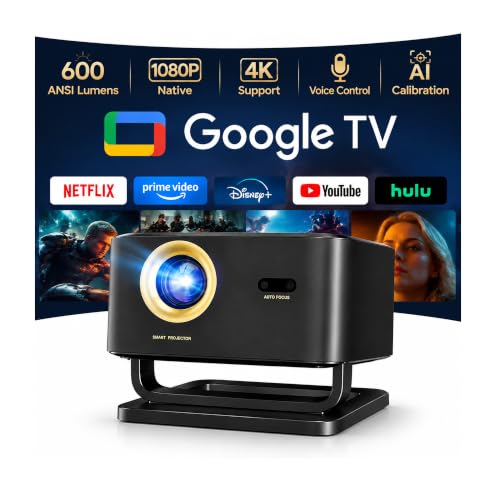
Google TV Smart Projector with Netflix (15W Dolby) — The sober 600 ANSI streamer
The last title in this guide is the most soberly written, and sobriety in this class is a form of respect for the buyer. Google TV with Netflix named in the opening line, native 1080P stated outright, 600 ANSI printed in the standard unit, 15W of Dolby audio quantified, AI auto focus and keystone for setup, and a 150-inch display ceiling claimed at the end. Almost every sentence can be checked, and the machine that emerges is a modest, complete streamer for dark rooms and evenings.
Six hundred ANSI defines the parish precisely. This is not a bright-room machine and does not audition for the job; it is a bedroom, den and dusk-garden projector whose figure will deliver a rich picture once the light is governed. Buyers who have followed this guide’s unit lessons will recognise the honesty instantly: a real number, in the real unit, at a level that tells you exactly which rooms to use it in.
Netflix in the title, beside Google TV, answers the first question every streaming household asks. The service that anchors most subscriptions is present and named, on the platform that keeps it updated, and voice control joins it for the dark-room operation this machine will mostly perform. A projector on a bedroom shelf lives or dies by whether it can be run half asleep, and this title’s combination of platform, voice and AI setup is aimed squarely at that half-asleep user.
Native 1080p at these light levels is the right resolution bargain. The picture’s limiting factor in a dark bedroom is not pixel count but the pleasure of a big, calm image, and Full HD at a hundred inches from a bed’s distance delivers that pleasure completely. The 4K support in the title handles modern streams gracefully, in the supporting role the phrase properly describes.
Fifteen watts of Dolby audio is a middleweight claim, printed with a number, which already places it ahead of the guide’s unquantified audio promises. For a bedroom or a small den it describes a complete sound without accessories; for a living room film night, Bluetooth stands ready to hand the job to a soundbar, and the title confirms the radio is present with WiFi and Bluetooth both stated.
There is a discipline this machine teaches its owner that brighter machines never have to: choosing the film for the room. Animation, comedies, series episodes and sport all flourish at 600 ANSI in a darkened space, while the shadowy thriller waits for the blackout blinds to be properly drawn. Owners of modest projectors become better programmers of their own evenings, and many report, heretically, that they prefer the ritual to the brute force of a brighter box.
The 150-inch display claim should be read as a maximum the optics can draw, not a recommendation. At 600 ANSI, the wise owner sizes the picture to the room’s darkness, smaller in a merely dim room, grander in a properly dark one, and the machine will repay the restraint with contrast that a stretched image would spend. Sizing discipline is the cheapest picture upgrade in all of projection, and this modest machine rewards it most visibly.
Confirm the remaining details and the current price on Amazon from the listing, and if your parish is the darkened bedroom and the dusk garden, this sober specification may be the most honest purchase in the entire guide.
- Platform: Google TV with Netflix stated
- Resolution: Native 1080P stated; 4K support stated
- Brightness: 600 ANSI stated
- Audio: 15W Dolby stated
- Setup: AI auto focus and keystone; 150-inch display claimed
Strengths
- Every headline claim is quantified or named
- Netflix and Google TV answer the streaming question fully
- Native 1080p matched honestly to its light level
Trade-offs
- 600 ANSI excludes bright-room duty entirely
- Large claimed screen sizes will dim its picture
- 15W audio serves small rooms, not living room crowds
Best for: a bedroom or den where the lights go down and a licensed streamer must simply work, nightly.
Not suited for: a living room expected to perform with curtains open.
Comparison
| Pick | Headline facts from its listing title | Room it suits first |
|---|---|---|
| HAPPRUN Native 1080P Google TV | Licensed Google TV, native 1080p, 4K decoding, AirPlay | An all-purpose household screen |
| Soundcore Nebula P1i | Flippable speaker, 20W Dolby, 380 ANSI, all-glass lens | A dark bedroom, tent or travel evening |
| HAPPRUN 2500 ANSI Google TV | 2500 ANSI, WiFi 6, Bluetooth 5.2, Dolby sound | A bright room or early-evening campsite |
| Pignynt Google TV Projector | Voice control, 10,000+ apps, “3000 Bright” claim | A ceiling bedroom run by voice |
| VOPLLS Outdoor Google TV | 50W Dolby speaker, “2000 Bright” claim, official Google TV | A garden evening led by sound |
| Google TV Smart Projector with Netflix | Native 1080p, 600 ANSI, 15W Dolby, Netflix named | A dark den or bedroom streamer |
What Does Bluetooth Actually Do on a Projector?
It moves the sound to where the people are, and that is most of the answer. A projector’s speakers fire from wherever the machine happens to sit, which is rarely where film sound belongs. Bluetooth pairing lets a soundbar live under the screen, a portable speaker live among the garden chairs, or headphones carry a midnight film in a flat where somebody is sleeping in the next room. Every pick in this guide states the radio, because in this class it is not an accessory; it is the audio plan.
The second job is control and play. Controllers pair for cloud and casual gaming on the Google TV platform, and phones pair for the quick audio duties, a podcast from the projector’s speaker position, music while the room is set up. Version numbers refine the experience at the edges, range, stability, multiple devices, but the headline capability is identical across all six titles here: the projector can reach beyond its own cabinet without a cable.
Google TV or a Streaming Stick: Which Should Run the Show?
A built-in platform, as all six picks here offer, wins on simplicity: one remote, one home screen, no HDMI port surrendered, no dongle hanging off a ceiling-mounted machine. It also travels better, which matters for the portable half of this class, since the whole cinema packs into one object. The platform’s licence, emphasised in the HAPPRUN and VOPLLS titles, is what guarantees the apps are the real services with real quality.
A stick keeps one argument in reserve: it can be replaced when it ages, while a built-in platform ages with the projector. In practice, Google TV’s update life on current machines is measured in years that match a projector’s own, and the convenience gap is paid every single evening. Households that already love a particular stick can still plug it into any of these machines; the built-in platform simply removes the obligation.
How Bright Does a Google TV Projector Need to Be?
By room, as always, but this class has a centre of gravity: bedrooms, dens and dusk gardens, where the stated ANSI figures here, 380, 600 and 2500, divide the territory cleanly. The Nebula’s 380 is a darkness figure for intimate screens. The 600 ANSI pick serves governed light and modest sizes. The 2500 ANSI HAPPRUN is the one that argues with a bright room and wins often enough to change the household’s habits.
The bare-number claims, 3000 and 2000 Bright, cannot be assigned rooms until a listing or a living room translates them. Treat them as invitations to audition rather than as specifications, and let the returns window be part of the purchase. A buyer who follows that rule can shop the whole class safely, because the honest figures sort themselves and the headlines must prove themselves in person.
How Do You Set Up Bluetooth Sound Properly?
Pair before the audience arrives, and pair from the projector’s menu rather than hoping the speaker remembers. Bluetooth connections in this class are generally remembered well, but the first pairing of an evening should happen while the room is still being arranged, with the speaker placed where it will live for the film: under the screen for living rooms, among the chairs for gardens, on the bedside table for the headphone alternative’s charging base. Sound placed with intention sounds twice its wattage.
Check lip sync with a dialogue scene, not with music. A few projectors and speakers introduce a small delay that music hides and speech exposes mercilessly, and many platforms and machines offer an audio delay adjustment for exactly this repair. Two minutes spent aligning a newsreader’s lips during setup saves an entire film of subliminal wrongness, and the adjustment, once made for a given speaker, tends to stay made.
Keep a cable in the drawer anyway. Bluetooth is a radio, and radios share their air with every other device in a modern home; on the one evening a connection refuses to behave, a simple audio cable between projector and speaker rescues the film in thirty seconds. Owners who treat the cable as the spare tyre, unglamorous, rarely used, always present, never lose an evening to a pairing menu.
What Should a First-Time Buyer Expect in the First Week?
A small education, pleasantly delivered. The first evening teaches placement: how far the machine sits from the wall for the picture the household wants, and how much the room’s light argues back. The second teaches the platform: signing into services, arranging the home screen, discovering that voice search is faster than the grid. By the third evening the ritual has usually compressed into minutes, which is the moment a projector stops being a purchase and becomes a habit.
Expect also to learn the machine’s honest size. Every projector in this class can draw a larger picture than it should, and the temptation to fill the whole wall on night one produces the dim, soft image that disappoints new owners into blaming the machine. Shrink the picture until it looks rich, live at that size for a week, and the household will have found the size the projector was actually bought for, which is almost always the size it will keep for years.
Finally, expect the sound to migrate. The built-in speaker serves the first evening; by the fourth, a Bluetooth bar or portable speaker has usually taken the post under the screen, and the projector’s own audio retires to daytime clips and travel. That migration is not a failure of the machine. It is the keyword’s promise being kept, the Bluetooth radio finally carrying sound to a speaker worth listening through.
How Do These Projectors Handle Gaming?
Casually, and on the whole cheerfully. The titles here name consoles, PS5 on the HAPPRUN and Pignynt, Switch on the Pignynt, as welcome sources, and the Google TV platform adds cloud and casual gaming of its own. Party games, racers, platformers and co-operative adventures play beautifully on a wall-sized screen in a social room, which is the gaming most households actually do together.
The honest boundary is latency. None of these six titles prints a millisecond figure, so a player whose evenings are ranked matches should treat these machines as the room’s second screen rather than as competitive equipment, or hunt the listing for a game mode figure before committing. Bluetooth controllers pair for the platform’s own games, while consoles are best connected by cable, keeping the competitive path wired and the casual path wireless.
Families should note the social geometry. A projector turns gaming from a person at a monitor into a room at an event: spectators see what the player sees, turns pass with ceremony, and younger players can be supervised by the simple fact that everything is on the wall. For many households that geometry is worth more than any specification in this guide, and it is available from every pick here the day the box opens.
Common Mistakes
Assuming every Android-branded projector runs the real platform is the founding error of this class. Old Android builds, phone interfaces and unlicensed app stores still circulate, and they decay as services update around them. The defence is printed in this guide’s titles: a named, current platform, Google TV, with licensing language where the maker offers it. If a listing cannot name its platform, it has answered the question.
Ranking bare brightness numbers against ANSI figures is the second error, and this guide has prosecuted it in every article of the family because the market keeps committing it. A larger unstandardised digit is not more light; it is merely a larger digit. Compare within the unit, or audition in the room, and never let typography spend your money.
Forgetting the sound geometry comes third. Buyers audition a projector’s picture carefully and its speakers not at all, then discover the dialogue lives behind the sofa. Plan the Bluetooth pairing, a bar under the screen, a speaker among the chairs, headphones for the night shift, as part of the purchase, and every pick in this guide becomes a better machine than its cabinet allows.
Headline resolution is a claim to verify on the listing, never a specification to buy on faith. Four-K support and 4K decoding are conveniences for modern streams, not display resolutions, and the machines here that claim native 1080p in words are making the strongest sharpness promise in the class. Read the verb, support, decode, native, before admiring the number it follows.
Final Recommendation
For most households, the first HAPPRUN is the guide’s centre: licensed Google TV, native 1080p, AirPlay and console welcome, a complete all-rounder whose only homework is a brightness figure on its listing. Its sibling is the answer when brightness is the question, a stated 2500 ANSI with the same platform and faster radios, aimed at bright rooms and campsites that start before dark.
The Nebula P1i is the character pick, bought for evenings, travel and the pleasure of a speaker that aims at its audience. The Netflix-named 600 ANSI machine is the sober bedroom choice, every claim quantified. Pignynt and VOPLLS remain the headline purchases, voice control and a 50W speaker respectively, each worth its price if its unstandardised brightness claim survives a first week in your own room, and neither should be bought on the strength of its digits alone.
Choose the platform in writing, the brightness in ANSI, and the sound by Bluetooth, and the projector that arrives will be the one the title promised, which is the whole art of shopping in this class.
Picture the household a year after the right choice, whichever of the six it was. The projector has a place, a perch or a shelf it returns to; the speaker it pairs with has a place too; the children know the voice command and the grandparents know the remote. Nobody in that house thinks of themselves as owning projection equipment. They think of film nights, match afternoons and a bedroom ceiling that occasionally becomes the sky over a story, and the machine has dissolved into those occasions so completely that its model number would stump the whole family. That dissolution is the destination every pick in this guide is travelling toward, at its own brightness, in its own dialect, and the buyer’s only real task is to choose the travelling companion whose claims were honest enough to survive the journey.
So read the titles the way this guide has taught you to read them, verb by verb and unit by unit, and then trust the room to finish the review. The right Google TV projector, paired by Bluetooth to a speaker that sits where sound belongs, will make its household’s screens feel larger, kinder and easier for years, and it will do so starting from the very first evening it is switched on, in the room it was chosen for, at the brightness it honestly promised, with the whole household already fluent in its one simple remote, and with the garden, the bedroom and the living room all quietly competing to host the next screening it throws, whether that screening is a cup final at teatime, a cartoon before breakfast or a classic film long after the house has gone to bed and the headphones have come out of their drawer for the night shift at the end of another long and perfectly ordinary day.
Frequently Asked Questions
Is Google TV the same as Android TV?
Google TV is the current platform built on Android for televisions and projectors, the successor experience to the older Android TV interface. When modern titles say Google TV, that is the Android-based system they mean, with the Play Store ecosystem, licensed services and voice search included. Every pick in this guide states Google TV in its title.
Can I connect any Bluetooth speaker or headphones?
In general, yes: Bluetooth audio pairing is the standard job of the radio these titles confirm. Pair a soundbar for films, a portable speaker for the garden, or headphones for late viewing. Exact profiles live on each listing, and a quick check there is worthwhile if you plan an unusual pairing, such as two devices at once.
Does 4K decoding mean the picture is 4K?
No. Decoding means the projector can accept and process a 4K stream, which it then displays at its native resolution. The picks here that state native 1080p display a Full HD picture, sharp and complete at their intended sizes. Read decoding as compatibility, and native as the picture itself.
Which pick works best for camping?
The 2500 ANSI HAPPRUN argues hardest for the campsite, with the strongest standardised brightness for early evenings and an outdoor billing in its title. The Nebula P1i argues for the tent itself, portable, self-contained and speaker-led, provided the night is properly dark. Both need power arrangements the listings should confirm before the trip.
Why do two picks print brightness without a unit?
Because nothing forces them to, and a large bare number photographs well in a listing. This guide reports those figures exactly as printed, labels them as headline claims, and advises buyers to find a standardised figure on the listing or to audition the machine at home. The machines may be perfectly good; their numbers simply cannot be compared until they are translated by evidence.
Related Guides
The projector family closes its circle here, and the neighbouring guides open the next rooms: beginner 35mm film cameras for readers ready to make images the slow way, automatic compact film cameras for pocket cameras that load and focus themselves, and canon eos film cameras for the SLR tradition that taught a generation to see.



[…] projection is a family of problems, and the neighbouring guides cover its other members: android projectors with bluetooth for the smart end of projection that small churches and home groups often start with, beginner 35mm […]