What's inside
- Key Takeaways
- Quick Picks
- How We Chose These Picks
- Why Does Depth Matter More Than Width at This Size?
- One Piece, Three Pieces or Splice — What Will Your Forearms Notice?
- How Many Monitors Does a Desk This Size Really Serve?
- What Does a Six-Foot Electric Desk Ask of the Room?
- How Do You Cable a Desk That Rises With Everything on It?
- How Do You Arrange a Six-Foot Surface So It Stays Usable?
- What Changes About Standing When the Desk Gets This Big?
- The Six Large Standing Desks, Reviewed One by One
- How Do the Six Large Desks Compare on Paper?
- What Mistakes Do Large Desk Buyers Keep Making?
- Final Recommendation
- Frequently Asked Questions
- Related Guides
As an Amazon Associate I earn from qualifying purchases. This post may contain affiliate links at no extra cost to you.
widgetverdict.com is reader-supported. When you buy through links on our site, we may earn an affiliate commission.
Where to buy: Amazon carries every desk in this guide; the Quick Picks table and the detailed reviews both link each name straight to its listing. These are the largest desks in their class, shipped in large boxes — check the delivery notes in each review before assuming the staircase will cooperate.
The best large standing desks are defined by a single measurement taken seriously: tops from 71 to 79 inches wide. That width is not vanity sizing. It is the width at which a standing desk stops being a workstation for one screen and becomes a surface for a way of working — two or three monitors without negotiation, a laptop open beside them, paperwork that spreads instead of stacking, a desk that can hold the work and the tools of the work at the same time. Every pick in this guide is electric, dual-motor where the title says so, and built around a top in that 71-to-79-inch class.
Width, though, is the headline rather than the differentiator, and this guide will keep returning to the measurement that actually separates these desks: depth. The tops here run from 30 inches deep to the VIVO’s exceptional 36 inches, and those six inches change the desk’s character more than a foot of width does. Depth is viewing distance for large monitors, room for a keyboard in front of a deep screen stand, space for the open book behind the keyboard. A buyer choosing between a 71 x 30 and a 71 x 36 is choosing between two different desks that happen to share a width, and the reviews below treat depth as the first specification after size itself.
The six divide by philosophy as much as by dimension. The Vari is the established flagship: a one-piece laminate top at 72 x 30, dual motors, four memory presets, and an assembly system designed to be fast. The FlexiSpot E6 pairs the same footprint with a solid bamboo top and a stated 220 lb capacity. The VIVO is the depth outlier at 71 x 36 with the guide’s highest stated capacity, 264 lbs. The SIAGO is the value build at 71 x 30 with a one-inch-thick top and a double frame. The Desktronic HomePro is the European-made 72 x 30 with a touchscreen controller and built-in USB charging. And the SANODESK is the largest of all at 79 x 32, in white, for the room that wants the maximum surface the class offers.
Key Takeaways
- All six tops measure between 71 and 79 inches wide; the SANODESK’s 79 x 32 is the largest surface here.
- Depth is the real differentiator: 30 inches on most, 32 on the SANODESK, and an exceptional 36 on the VIVO.
- Stated capacities, where titles give them: FlexiSpot E6 and SIAGO at 220 lbs, the VIVO highest at 264 lbs.
- The Vari’s top is one-piece laminate; the VIVO’s deep top comes in three pieces and the SANODESK’s is a splice board — seams are part of the large-desk bargain.
- Memory presets run from three (most) to four (Vari); the Desktronic adds a touchscreen controller and USB/USB-C charging.
- Measure the room, the doorway and the lift or stairs before ordering — these desks ship big and live bigger.
Quick Picks
| Pick | Badge | Why it earns its place |
|---|---|---|
| Vari Classic Electric Standing Desk, 72×30 | Best established flagship | A one-piece laminate 72 x 30 top, dual motors, four memory presets and slide-and-lock assembly. |
| FlexiSpot E6 Bamboo 3-Stage Dual Motor 72 x 30 Electric Standing Desk | Best natural top | A solid bamboo desktop at 72 x 30, three-stage dual motors and a stated 220 lb capacity. |
| VIVO Electric Dual Motor Standing Desk, 71″ x 36″ | Best depth and capacity | An extra-deep 71 x 36 top, a stated 264 lb capacity and three memory presets. |
| SIAGO Black 71×30 In Standing Desk | Best value build | A one-inch-thick 71 x 30 top on a double frame, a stated 220 lb capacity and three memory settings. |
| Desktronic HomePro Standing Desk 72×30 | Best European build | Made in Europe, dual motor, touchscreen control and USB/USB-C charging at 72 x 30. |
| SANODESK 79 x 32 Large Electric Standing Desk | Largest surface | A 79 x 32 white top — the biggest in the guide — with memory presets. |
How We Chose These Picks
Size was the entry ticket, applied without exceptions: no top under 71 inches wide was considered, because a guide to large standing desks that pads itself with 60-inch desks has failed before it starts. Within the class, we spread the six across the decisions a buyer actually faces — depth from 30 to 36 inches, tops one-piece and seamed, finishes from reclaimed-look laminate to bamboo to white — rather than selecting six near-identical 72 x 30 desks and pretending the choice between them matters more than it does.
Stated specifications were quoted from the listings’ titles and only from there. Three picks state capacities — the FlexiSpot E6 and SIAGO at 220 lbs, the VIVO at 264 lbs — and those figures appear in this guide exactly as stated. The Vari, Desktronic and SANODESK titles state no capacity, so their reviews discuss structure and use rather than numbers. That discipline matters most in this class, where a big top invites big loads and invented reassurance would be a disservice: a buyer loading a desk toward a quarter-ton should be working from the maker’s stated figure or choosing a desk that states one.
Top construction was weighed as a first-order feature, because at these widths it decides the daily feel of the desk. A one-piece top — the Vari’s laminate, the FlexiSpot’s bamboo — gives a seamless surface across the full span. A three-piece top, like the VIVO’s, and a splice board, like the SANODESK’s, make a very large desk shippable and affordable at the cost of seams the forearms will find. Neither answer is wrong; they are answers to different budgets and different sensitivities, and the reviews say plainly which desk makes which bargain.
Finally, we judged the desks as roommates. A 72-inch electric desk is a permanent, powered, six-foot piece of a room’s architecture: it needs a wall, a socket, a cable plan and a floor that can take it. Assembly systems — the Vari’s slide-and-lock, the FlexiSpot’s two-box shipment — were credited because at this scale, the build is a genuine part of the product, and a desk that assembles badly at 72 inches punishes its owner at a scale a small desk never reaches.
Why Does Depth Matter More Than Width at This Size?
Because width is spent on things, and depth is spent on you. The extra width of a large desk holds objects — the third monitor, the printer’s corner, the paperwork field — and once those objects are placed, width’s work is done. Depth works continuously: it sets the distance between your eyes and the screens, which on a 30-inch desk with a large monitor can feel closer than the screen’s size wants; it decides whether the keyboard sits in front of the monitor stand or competes with it; it determines whether an open book, a graphics tablet or a mixing desk fits between you and the screens or exiles itself to a side table.
The VIVO’s 36 inches is the extreme expression, and it changes what the desk is for. Thirty-six inches of depth swallows a deep monitor stand, a keyboard, and a working layer of paper or equipment in front of it, with the screens at a genuinely comfortable distance — it is the depth of a studio desk or a workbench, and buyers in audio, design, electronics and crafting will recognise their own requirement in it. The cost is the room: a 36-inch-deep desk projects into the floor plan like furniture, not like an accessory, and the chair’s space behind it must be planned rather than assumed.
The mainstream 30-inch desks — Vari, FlexiSpot, SIAGO, Desktronic — are the balanced answer for screen-based work: deep enough for large monitors at a sane distance with a keyboard in front, shallow enough to keep the room’s proportions. The SANODESK’s 32 inches split the difference for buyers whose monitors are large and whose rooms are merely generous. Choose depth by your screens’ size and your work’s physical layer, and let width follow; the common shopping order — widest first — buys the wrong desk more often than any other mistake in this class.
One Piece, Three Pieces or Splice — What Will Your Forearms Notice?
A desk top over 70 inches is a shipping problem before it is a surface. It must fit in a box, in a van, through a door and up the stairs, and the makers’ answers divide this guide neatly. The Vari ships a one-piece laminate top at 72 x 30, and the FlexiSpot E6 a solid bamboo desktop — in two boxes, per its title, with the top kept whole. The VIVO’s 71 x 36 top comes in three pieces. The SANODESK’s 79-inch top is a splice board, joined at assembly. Each answer trades the same currencies: freight, cost and seams.
A seam is not a defect, but it is a fact your forearms will learn. Where two pieces meet there is a line — level if the assembly was careful, a whisper of a lip if it was not — and it sits wherever the join falls, which on a three-piece top is typically in the working zone. Writers who slide paper across the desk, artists, and anyone who rests bare forearms on the surface at standing height will register the joins daily. Buyers whose work is screens and a keyboard, with forearms mostly on the desk’s front edge, will register them hardly at all. The seam question is therefore a question about your own work’s physical habits, and it deserves an honest answer before the width seduces you.
Assembly care is the variable that decides which experience a seamed top delivers. The joins must be pulled level while the fixings are tightened, on a flat floor, with the frame square — a rushed build locks a lip into the surface permanently. The one-piece tops forgive all of this, which is part of what their price buys. Neither construction should be bought carelessly; they should be bought knowingly, with the work pattern and the assembly patience both honestly assessed.
How Many Monitors Does a Desk This Size Really Serve?
Two, luxuriously; three, genuinely; and the difference between those adverbs is where buying decisions live. Two large monitors on a 72-inch top sit with space between and around them — room for the laptop open beside, the notebook in front, the speakers at the ends. That spaciousness is the large desk’s real product: not the count of screens it can hold, but the absence of negotiation among everything it holds. Most buyers of this class are buying the end of the daily shuffle, and two screens with air around them deliver it completely.
Three monitors fit across 71 to 79 inches with the centre screen ahead and the wings angled, and the desks here — dual motors, stated capacities up to 264 lbs on the VIVO — are built for that load’s weight and width. What three screens consume is the margin: the paperwork moves to the depth, the laptop closes or leaves, and the desk becomes a cockpit. Traders, developers and video editors who live in that cockpit will find these tops correctly sized; buyers tempted by a third screen they use twice a week should keep the two-screen luxury and spend the difference elsewhere.
One wide ultrawide monitor is the third pattern, and large desks flatter it: the screen centres, the width spreads the work’s physical layer on both sides, and the depth keeps the big panel at its comfortable distance. Whichever pattern you run, place the screens before judging the desk’s size — the tape measure lies about how a loaded 72 inches feels, in both directions, and the first morning’s arrangement is the review that matters.
What Does a Six-Foot Electric Desk Ask of the Room?
A wall, first: six feet of it, reasonably flat, with a socket the desk’s power lead can reach without crossing a walkway. A floor that can take a heavy desk’s four feet without complaint, and enough depth in front for the chair’s full travel plus the standing user’s space — a large desk in a room sized for a small one makes the whole room feel like the desk’s accessory, which some owners love and others discover too late. Measure the room’s remaining life, not just the desk’s fit.
Delivery is the second ask, and it is not trivial. These desks arrive in large, heavy boxes — the FlexiSpot’s title notes it ships in two — and the route from the street to the room must be walked with the biggest box in mind: door widths, the stair turn, the lift if there is one. A 79-inch top, even spliced for shipping, is a commitment of a package. The assembly then wants a clear floor area larger than the desk itself, two people for the top, and the patience to level a six-foot frame before loading it.
The third ask is permanence. A desk this size is not rearranged on a whim; it is placed, cabled and settled, and it will organise the room around itself for years. That is precisely its appeal for the established home office — and precisely its risk for the renter, the rearranger, the household in flux. Buyers in the second group should hear the guide’s smaller formats calling. Buyers in the first group are this class’s natural owners, and for them the remaining questions are the pleasant ones: depth, finish, and which end the coffee lives at.
How Do You Cable a Desk That Rises With Everything on It?
A large standing desk carries the heaviest cable problem in the category, because everything on it — three monitors, a tower or a dock, speakers, a lamp, chargers — must travel through the desk’s full height range without straining, snagging or pulling free. The architecture that works is a single managed spine: a tray or basket under the desk’s rear edge holding a power strip, into which everything on the surface plugs with short leads, and one cable from the strip to the wall with slack enough for full height. One moving cable, generously looped, instead of nine taut ones — that is the whole secret, and it is easier to build on assembly day than to retrofit in month three.
The tower decision shapes the rest. Park the tower on the moving top and its leads stay short, because the machine rises with everything it serves; the price is that its kilos join every lift, spending capacity — 220 to 264 lbs on the desks that state a figure — that could otherwise belong to the screens. A tower on the floor keeps the lift light but needs display and USB cables with travel slack, routed so the rising desk never tensions them. At this desk size, a laptop-and-dock setup sidesteps the dilemma elegantly, which is one reason docks have become the large desk’s standard companion.
Leave the system serviceable. Cables in a tray you can reach from a kneeling position at the desk’s front, labelled at the strip, with the wall plug accessible without unloading the desk. A large desk’s cable system will be touched for years — every new device, every replacement — and the owners who planned for that touch spend minutes where the others spend a Saturday. The desk rises; the system should make the rising invisible.
How Do You Arrange a Six-Foot Surface So It Stays Usable?
Zoning is the discipline that separates a large desk from a large mess. Divide the surface in your mind before anything lands on it: a centre zone for the screens and the keyboard, where you sit and stand; a working flank for the current project’s physical layer; and a far flank for the standing population — printer, speakers, the charging devices, the lamp. The zones are not decoration. A large desk without them fills by drift, the centre’s working room quietly colonised from both ends until the six-foot desk has the usable surface of a four-foot one and twice the cleaning.
The far flank deserves its anchor rule: whatever lives there must justify itself monthly, because distance from the chair is where objects go to be forgotten at scale. The printer earns its corner by weekly use; the scanner that scans twice a year belongs in a cupboard, and its exile returns a square foot of the desk’s best real estate. Large-desk owners who audit the flanks seasonally keep the format’s promise; the desk stays a workspace rather than becoming the room’s most expensive shelf — a shelf, moreover, that rises and falls with everything on it, taxing the motors for objects nobody touches.
Underneath needs the same government. A six-foot desk tempts its owner to store beneath it — the tower, the boxes, the spare chair — until the legroom that standing requires is negotiated away. Keep the centre’s underside empty for your feet and the chair’s travel, park the tower at one end where the frame’s design allows, and let the cable tray own the rear. The desk’s size is an argument for discipline, not against it: the bigger the surface, the more entropy it can host, and the more its owner must be its editor.
What Changes About Standing When the Desk Gets This Big?
The first change is social. A large standing desk at full height is a presence in the room — a six-foot surface at chest level reorganises sightlines, conversations and the cat’s opinion of the furniture. In a dedicated office that presence is authority; in a shared living space it is a daily negotiation, and households should picture the desk raised, not just installed, before choosing the largest sizes. The SANODESK at standing height in a small living room is a room divider that hums; in a studio office it is a workstation. Same desk, different verdicts.
The second change is movement. A big desk invites a bigger standing territory — you will walk its length, work at one end, take a call at the other — and that roaming is one of the format’s genuine pleasures, the desk as a bench you patrol rather than a post you are stationed at. It also means the floor space along the desk’s front must stay clear for the full six feet, which is a room-planning commitment the tape measure should confirm. Owners who clear that runway find themselves using the whole surface across a day; owners who block half of it own a three-foot desk with storage attached.
The third change is permanence of arrangement. Small desks get rearranged by whim; a six-foot electric desk’s setup — screens placed, cable spine built, zones settled — tends to stay fixed for years, because changing it is a project. That fixity rewards the buyer who sets the desk up slowly and correctly the first time, and it punishes the placeholder arrangement that was meant to be temporary. Give the first setup a full day across the first week: the desk will repay the patience every day it stands there, which will be most of them.
The Six Large Standing Desks, Reviewed One by One

Vari Classic Electric Standing Desk, 72×30 — Best established flagship
Vari is the name that built much of this category’s reputation with offices, and the Classic is its statement at home scale: a 72 x 30 one-piece laminate top in a reclaimed wood finish with slate, dual motors, and four memory presets — one more preset than most rivals offer, a small specification that matters in a shared or multi-posture household. The one-piece top is the headline for anyone who has read the seam discussion above: across the full 72 inches, the surface is continuous, with no join for a forearm or a sheet of paper to find.
The slide-and-lock assembly in the title is the other Vari signature. Large desks are furniture projects; Vari’s system is designed to cut the build’s time and its error rate, with the frame’s parts locking together in a sequence that resists the classic flat-pack failure of discovering a reversed component at step nine. For a buyer whose hesitation about this class is the build rather than the desk, that system is a genuine argument, and it reflects a maker that sells to facilities teams as well as to households.
Four presets, dual motors, a seamless top and the category’s most established name: the Vari is the desk for the buyer who wants the large format decided rather than deliberated. Its title states no capacity figure, so heavy-load buyers should note the rivals below that do state theirs — but for the mainstream multi-monitor office load, the Vari’s specification is complete, coherent and proven at a scale few makers can claim.
The reclaimed wood finish deserves a word of its own, because at 72 inches the top is the room’s largest horizontal surface and its appearance does disproportionate work. The reclaimed look — weathered, varied, warm — hides the daily evidence of work better than any flat colour: rings fade into the grain’s story, scratches read as character, and the desk ages like furniture rather than like equipment. In a spare room that hosts guests one weekend and deadlines the next, that forgiving surface is a practical feature disguised as an aesthetic one, and it is part of why this desk anchors so many rooms without dominating them.
- Top: 72 x 30 inches, one-piece laminate
- Motors: dual
- Presets: four memory presets
- Assembly: slide-and-lock system
- Finish: reclaimed wood with slate
- Capacity: not stated in the listing title
Strengths
- One-piece top — no seams across the full span.
- Four memory presets suit shared or multi-posture use.
- Slide-and-lock assembly lowers the build’s difficulty.
Trade-offs
- No capacity figure in the title for heavy-load planning.
- Laminate, not solid wood — a finish, however handsome.
- Thirty inches of depth is the class standard, not its maximum.
Best for: an established home office wanting the proven flagship with a seamless top. Not suited for: a buyer who needs a stated capacity figure before loading heavily.

FlexiSpot E6 Bamboo 3-Stage Dual Motor 72 x 30 Electric Standing Desk — Best natural top
The E6’s distinction is growing on trees: a solid bamboo desktop at 72 x 30, where its rivals offer laminates and boards. Bamboo is a serious desktop material — hard, dense, warm to the forearm, and visually alive in a way printed finishes imitate — and at this size it turns the desk into the room’s piece of furniture rather than its equipment. The white frame beneath keeps the large structure light in appearance. For buyers whose office is also a living space, that material difference is felt every day and seen by every visitor.
The engineering under the bamboo is fully specified in the title: a three-stage dual-motor frame — three-stage legs give the wide height range that serves both short seated users and tall standing ones — with memory presets and a stated capacity of 220 lbs. That figure covers a serious multi-monitor load with the tower on the floor, and it lets a buyer plan the setup arithmetically rather than hopefully. The desk ships in two boxes, which at this size is a kindness to the staircase and the delivery driver alike.
FlexiSpot’s depth in this category shows in the completeness of that specification — nothing important is left for the buyer to guess. The E6 answers the buyer who reads a desk as furniture first and machinery second, and who wants the wide format wearing a natural surface with its strength stated outright. In a guide of capable desks, it is the one your hand will enjoy most.
The three-stage leg system deserves its practical translation. A two-stage frame splits its travel between two telescoping sections; three stages split it across three, which buys range at both ends — low enough for a shorter seated user with feet flat, high enough for a tall standing user with forearms level — without the wobble that stretching a two-stage frame to its extremes invites. Households where the desk’s users differ greatly in height, or where the chair is unusually low or high, feel that range daily. It is the specification that decides whether one desk can honestly serve two bodies, and the E6 states it where rivals leave it to be discovered.
- Top: 72 x 30 inches, solid bamboo
- Motors: dual, three-stage legs
- Capacity: 220 lbs, as stated in the listing title
- Presets: memory presets
- Frame: white
- Shipping: arrives in 2 boxes, per the listing title
Strengths
- Solid bamboo top — a real material at full size.
- Stated 220 lb capacity allows honest load planning.
- Three-stage legs widen the height range at both ends.
Trade-offs
- Bamboo asks for coasters and care a laminate forgives.
- Two boxes still means one very large delivery.
- White frame shows scuffs a black frame would hide.
Best for: a living-space office that wants a natural top and a stated capacity. Not suited for: a careless-with-coffee workflow or a buyer wanting maximum depth.

VIVO Electric Dual Motor Standing Desk, 71″ x 36″ — Best depth and capacity
The VIVO is this guide’s outlier in the two specifications that matter most: a 71 x 36 inch top — six inches deeper than the class standard — and a stated capacity of 264 lbs, the highest figure here. Read those together and the desk’s identity is clear: it is the workbench of the class, built for setups whose physical layer is deep and heavy. A deep monitor array at a comfortable distance, equipment in front of it, tools, boards, instruments — the 36-inch field holds a working stratum that a 30-inch desk exiles to a side table.
The top is a three-piece construction, described in its title as an extra-deep smooth 3-piece top, and the seam discussion from earlier applies in full: at this width and depth, pieces are how such a top ships at all, and careful assembly — joins pulled level on a flat floor — decides whether the seams are lines or lips. The dark gray top on a black frame is the most workshop-toned finish here, suiting studios and technical rooms. Three memory presets handle the height routine.
Dual motors move the stated 264 lbs, and that figure should be spent as the desk intends: on the deep field’s equipment, not on storage. Buyers in audio production, electronics, design and making — the disciplines whose desks accumulate physical apparatus — are this pick’s exact audience, and for them the extra depth is not a luxury dimension but the specification the whole purchase turns on. Screen-only workers will find the 30-inch desks more proportionate to their rooms.
One arrangement shows the depth at its best and is worth describing for the buyer hesitating at 36 inches. Monitors at the back, on their stands, with a shelf or riser above the desk’s rear edge for the small equipment; the middle band for the keyboard, the control surface, the drawing tablet; the front band — the twelve inches nearest the body — kept deliberately empty, as the landing zone for whatever the hands bring to the work: the component being soldered, the sketchbook, the document being marked up. A 30-inch desk cannot hold that empty front band and the rest; the VIVO can, and that kept emptiness, paradoxically, is what its owners praise most.
- Top: 71 x 36 inches, three-piece, dark gray
- Motors: dual
- Capacity: 264 lbs, as stated in the listing title
- Presets: 3 memory presets
- Frame: black
- Model: DESK-KIT-2B7G-36
Strengths
- Thirty-six inches of depth — the class’s deepest working field.
- Highest stated capacity here, at 264 lbs.
- Suits equipment-heavy studio and technical work.
Trade-offs
- Three-piece top has seams the forearms will find.
- Projects furthest into the room of any pick here.
- Dark gray and black is a single, technical look.
Best for: a studio or technical workspace with deep, heavy equipment. Not suited for: a screen-only setup in a room that cannot spare the depth.

SIAGO Black 71×30 In Standing Desk — Best value build
The SIAGO takes the class’s standard footprint — 71 x 30 inches, all in black — and spends its specification on structure: a tabletop a full inch thick, a double frame, electric adjustment with three memory settings, and a stated capacity of 220 lbs that matches the FlexiSpot’s figure. The thick top deserves attention, because thin tops are the large desk’s quiet compromise: at a 71-inch span, a thin board can drum under typing and flex under a monitor arm’s leverage, while an inch of material gives the surface the dead, solid feel owners describe as quality without knowing its source.
The double frame is the same argument made underneath — more structure across a wide span, in service of the steadiness that a standing desk at full height must earn. Wobble is the large format’s endemic complaint, amplified by width and height together, and a maker who doubles the frame is answering it directly. The all-black finish keeps the big desk visually quiet, the choice for rooms where the desk should recede behind the work rather than present itself.
SIAGO does not carry the category fame of a Vari or a FlexiSpot, and its title offers no story beyond the specification — which is, in the end, a respectable specification, plainly stated: size, thickness, frame, capacity, presets. Buyers who shop by the numbers rather than the name will find this desk difficult to argue against, and buyers for whom the desk is a tool rather than a statement are its natural constituency.
- Top: 71 x 30 inches, one inch thick
- Frame: double frame design
- Capacity: 220 lbs, as stated in the listing title
- Presets: 3 memory height settings
- Adjustment: electric
- Finish: black top, black frame
Strengths
- One-inch-thick top gives a solid, drum-free surface.
- Double frame answers wide-desk wobble directly.
- Stated 220 lb capacity matches pricier rivals.
Trade-offs
- Less category track record than the flagship names.
- All black is the only look on offer.
- Standard 30-inch depth — no deep-field option.
Best for: a numbers-led buyer wanting flagship specifications without flagship theatre. Not suited for: a buyer who values a natural material or a seamless brand story.

Desktronic HomePro Standing Desk 72×30 — Best European build
The HomePro’s first distinction is geographic: made in Europe, per its title, in a category manufactured almost everywhere else. For buyers who weight origin — for its standards, its supply chain, or the simple preference — that line in the specification is the desk’s headline, and Desktronic builds the rest of the specification to match the positioning: a 72 x 30 dual-motor desk with three memory presets, a touchscreen controller, and USB and USB-C charging built in.
The touchscreen and the charging are the daily-touch features, and they are more considered than they sound. A touchscreen handset at the desk’s edge replaces the membrane buttons most desks offer, and built-in USB charging at the surface retires the charger brick that otherwise lives on the desk or dangles from its edge — the phone and the earbuds charge where they are used. On a desk whose surface is its owner’s whole working world, those integrations keep the 72 inches for work. The title also claims a wobble-free character for the frame; stability claims are best read as the maker’s priority rather than a physical absolute, but the priority is the right one at this size.
The HomePro suits the buyer who wants the large format finished like an appliance from a design-led maker — considered controller, integrated charging, European manufacture — over the buyer chasing a capacity figure or a natural top, neither of which its title states. In a guide where every desk is large and electric, the HomePro is the one that competes on refinement, and there is a real constituency for exactly that.
- Top: 72 x 30 inches
- Origin: made in Europe, per the listing title
- Motors: dual
- Controller: touchscreen, 3 memory presets
- Charging: USB and USB-C built in
- Capacity: not stated in the listing title
Strengths
- European manufacture distinguishes it in this category.
- Touchscreen controller is the class’s most considered interface.
- Built-in USB/USB-C charging clears the surface of bricks.
Trade-offs
- No capacity figure in the title for heavy-load planning.
- Refinement is the premium — specification shoppers may pass.
- Thirty-inch depth, the class standard rather than its stretch.
Best for: a design-led office that values origin, interface and integrated charging. Not suited for: a buyer planning loads around a stated capacity figure.
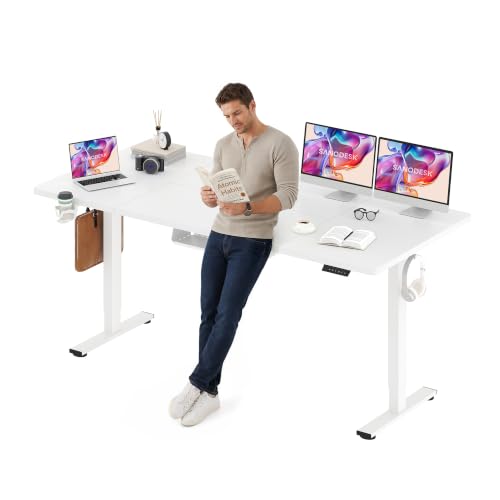
SANODESK 79 x 32 Large Electric Standing Desk — Largest surface
The SANODESK is the maximum: a 79 x 32 inch top, the largest surface in this guide by a clear margin, in a white frame with a white top. Seventy-nine inches is within a hand’s breadth of seven feet of desk — a surface that holds three monitors and still has ends, that lets two people work side by side in a pinch, that turns the home office into something closer to a studio bench. The 32-inch depth adds the second dimension of generosity, giving large monitors their distance while the width does its work.
The top is a splice board, as its title states — at 79 inches, a joined top is how such a desk exists at a sane price and in a deliverable box — and the seam guidance from earlier in this guide applies: assemble the joins level, on a flat floor, and the surface will serve; rush it and the forearms will file their report daily. Memory presets handle the height routine, and the all-white finish makes the largest desk here also the lightest in appearance, a genuine consideration when seven feet of furniture joins a room.
Who needs the maximum? The three-screen worker whose paperwork also spreads; the pair who share one desk across a day; the crafter or designer whose materials occupy territory no 72-inch desk survives. Who does not: anyone whose room, door or staircase argues otherwise, and this guide’s room section should be re-read before this pick is ordered. For the space that can hold it and the work that can fill it, the SANODESK is the class’s ceiling, offered plainly.
The white finish is a strategy, not just a colour, at this size. A 79-inch desk in a dark finish absorbs its wall; in white, the same structure reflects the room’s light and reads as part of the room’s architecture rather than as an object parked in it. For the studio flat or the bright spare room where the desk must coexist with the household’s life, that lightness is the difference between a workstation the room tolerates and one it resents. The cost is housekeeping: white shows the week’s marks honestly, and its owners keep a cloth in a drawer the way dark-desk owners keep coasters.
- Top: 79 x 32 inches, splice board
- Presets: memory presets
- Adjustment: electric
- Frame: white
- Top finish: white
- Capacity: not stated in the listing title
Strengths
- The largest surface here — 79 inches of working width.
- Thirty-two inches of depth suits large monitors well.
- All-white finish lightens a very large desk’s presence.
Trade-offs
- Splice-board top has seams; assembly care decides their feel.
- The delivery and the room must both be measured honestly.
- No capacity figure stated in the title.
Best for: the maximum-workspace buyer — three screens plus a spreading physical layer. Not suited for: a small room, a narrow staircase or a two-screen setup that values margin over maximum.
How Do the Six Large Desks Compare on Paper?
| Pick | Top | Construction | Stated capacity | Presets |
|---|---|---|---|---|
| Vari Classic | 72 x 30 in | One-piece laminate | Not stated in title | 4 |
| FlexiSpot E6 | 72 x 30 in | Solid bamboo | 220 lbs | Memory presets |
| VIVO Deep | 71 x 36 in | Three-piece top | 264 lbs | 3 |
| SIAGO | 71 x 30 in | One-inch-thick top, double frame | 220 lbs | 3 |
| Desktronic HomePro | 72 x 30 in | European build, touchscreen | Not stated in title | 3 |
| SANODESK | 79 x 32 in | Splice board | Not stated in title | Memory presets |
Three desks compete at the class’s centre — Vari, FlexiSpot and Desktronic at 72 x 30, separated by top material, origin and interface. The VIVO leaves the centre for depth and capacity; the SIAGO for structural value; the SANODESK for sheer size. Decide which direction your work pulls — deeper, stronger, larger, or finer — and the table collapses to one or two names.
What Mistakes Do Large Desk Buyers Keep Making?
The first is shopping width-first, as this guide warned at the start: ordering the widest desk the budget allows and discovering that the room wanted depth, or the work wanted margin, or the doorway wanted neither. Width is the last decision, after depth, room and load. The second mistake is ignoring the delivery route — the staircase turn, the door width, the lift — until a very large box is standing in a hallway negotiating with a banister. Walk the route with the box dimensions from the listing before the order, not after.
The third is loading the desk like a shelf. A standing desk is a lift: everything on it travels, and heavy static storage — the archive boxes, the printer’s paper stock, the library — taxes the motors and the habit alike. Stated capacities of 220 and 264 lbs are working limits for equipment, not invitations to store a household on a moving surface. The fourth mistake is cabling at sitting length, the category’s perennial error, magnified here by the number of devices a large desk carries: build the single-spine system described above, on assembly day, with slack for the full rise.
The fifth is assembling a seamed top carelessly and living with the lip forever. The joins of a three-piece or splice top are set once, under tension, and they will feel exactly as careful as the hour that made them. Assemble on the flattest floor available, pull the joins level before the final tightening, and check with a forearm — the instrument that will audit the work daily — before the monitors go on.
The sixth is forgetting that the wall behind a large desk becomes unreachable the day the desk is loaded. Six feet of furniture against a wall seals the sockets, the skirting and the floor strip behind it more completely than any other furniture in the home. Everything that will ever need to happen back there — the router’s placement, the cable route, the socket the desk itself will use — must happen before the desk is pushed home, or be designed to happen from the front, through the cable tray. Owners who plan the wall first never have to unload six feet of workstation to change a plug; owners who do not, learn the lesson exactly once, at length.
Final Recommendation
Let depth and load decide, then width. A mainstream multi-monitor office: the Vari for its seamless top and four presets, the FlexiSpot E6 if a natural surface and a stated capacity matter more, the Desktronic if origin and interface lead your values. A deep or heavy working field: the VIVO, without a close rival. A structural bargain at the standard size: the SIAGO. The maximum surface for the work that genuinely fills it: the SANODESK.
Measure the room, the route and the wall before any of them, and build the cable spine on the day the desk is built. Do those unglamorous things and a desk this size becomes what its owners promised themselves on the day they ordered it — the last desk the room needs, wide enough that the work finally stops negotiating for space, and steady enough that the negotiation is never reopened.
Frequently Asked Questions
Is a 72-inch desk too big for a home office?
It is too big for some home offices and exactly right for others, and the tape measure knows which: you need six feet of wall, depth for the desk plus the chair’s travel, and a room that still functions with the desk as its largest object. Spare rooms and dedicated offices absorb 72 inches easily; a corner of a living room should be measured with the household’s other claims in view. The 79-inch SANODESK raises the same question one size louder.
How much can a large standing desk actually hold?
Where the makers state it in their titles, this guide quotes it: 220 lbs for the FlexiSpot E6 and the SIAGO, 264 lbs for the VIVO. Those are working capacities for the moving surface — monitors, equipment, the desk’s daily load — and they are generous for any screen-based setup. The Vari, Desktronic and SANODESK titles state no figure, so heavy-load buyers should either choose a desk that states one or consult the full listing specifications before loading toward the extreme.
Are seams in a large desktop a real problem?
They are a real sensation and rarely a real problem. A carefully assembled three-piece or splice top presents level joins that paper and forearms register as lines; a carelessly assembled one presents lips that register as faults. The work pattern decides the sensitivity — screen-and-keyboard work barely notices, drawing and paper-spreading work notices daily — and the one-piece Vari and solid bamboo FlexiSpot exist for buyers who would rather not have the question at all.
Do I need dual motors at this size?
At 71 inches and above, dual motors are the class’s working standard rather than its luxury: one motor per leg keeps the wide frame rising evenly under an off-centre load, which is how large desks are always loaded in practice. Every pick here whose title specifies its drive uses dual motors. A wide desk rising unevenly racks its frame and its top’s joins over time, so the specification matters more at this size than at any other.
Can a large standing desk work for two people?
Sequentially, beautifully — the presets exist for it, the Vari offering four, and the width lets each user’s arrangement coexist. Simultaneously, the 79-inch SANODESK is the only pick here that genuinely seats two side by side, and even then it is a shared surface rather than two workstations. Households sharing one desk across a day are this class’s natural owners; the height memory turns the handover into a button press.
Should the computer tower sit on the desk or on the floor?
Both work, and the choice is arithmetic plus cables. On the desk, the tower travels with the surface — cables stay short — but its weight spends the capacity the titles state, 220 to 264 lbs on the desks that state it, and raises the load’s centre at full height. On the floor, the lift stays light and the desk’s capacity belongs to the screens, but display and data cables need slack for the full rise, routed so they never tension. At this size, many owners choose a third way: a laptop and dock on the desk, and no tower question at all.
What floor does a heavy standing desk need?
Any sound floor serves, with two courtesies: on carpet, expect the desk to settle into the pile over the first fortnight and re-level it then; on hard floors, pads under the feet protect the surface and quiet the small movements of a wide frame at full height. What the desk cannot use is a slope it must fight — a noticeably uneven floor shows up at standing height as a lean in the whole structure, and shims at setup are the entire cure.
Related Guides
If the full desk is more commitment than the room allows, our guide to the best crank adjustable standing desks covers the manual desks and frames that adjust without motors at all. For the workstation that pairs movement with the desk rather than replacing it, the best bike desks roundup covers trainer desks and pedal setups. And when a standing station ends up anchoring a corner layout, the best l shaped desks with drawers roundup turns to corner desks with the storage built into the base.


